Trudeau Considers Additional Housing Tax


Posted originally on Jul 11, 2024 By Martin Armstrong 
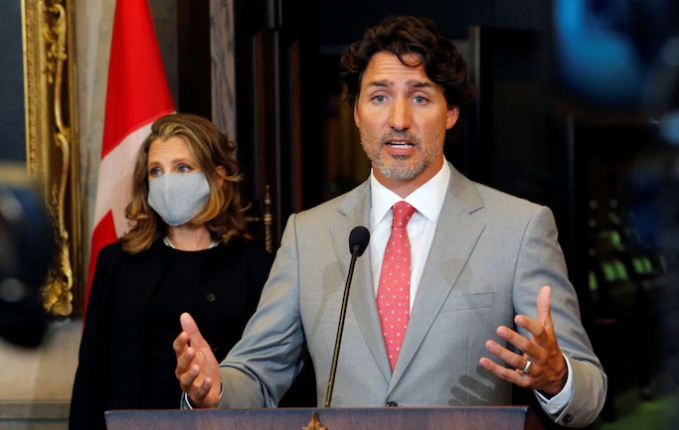
Canadian Prime Minister Justin Trudeau

Inefficient politicians consistently cite additional taxation as the solution to their nation’s economic troubles. The housing crisis in Canada is has spread to every province. Instead of addressing availability, the disproportionate demand brought on by multiplying the nation with migrants, or any of the countless fiscal policies that have contributed to inflation, the Canadian government believes it is the duty of citizens to subsidize their wealth as a temporary solution.

The Trudeau Administration has been trying to paint the housing crisis as a conflict between the social-economic classes. All those greedy citizens who saved for homes are preventing new homeowners from entering the market. Trudeau basically said this when appearing on the podcast Generation Squeeze, an organization that is pushing to add an annual surtax on homes over C$1 million. They believe houses between C$1 million to C$1.5 million, even if a primary residence, should face a 0.2% surtax that would eventually rise to 0.5%. Homes over C$2 million would face a 1% surtax.

What about older Canadians who have been residing in their family homes for decades? They may not necessarily be rich but they purchased when the landscape was different. Trudeau said those who “scrimped and saved” simply fail to understand that the younger generation can no longer do the same due to the economic environment he helped to create.

“GOVERNMENT BUREAUCRATS DON’T BUILD HOMES!” – Conservative Leader Pierre Poilievre

I mentioned in a separate post that 13.5% of young Canadians under 24 cannot find entry-level work. Unemployment is on the rise and young people cannot afford to save what little they have. All Canadians are feeling the constraints of inflation, with household debt rising to over 100% of GDP and the debt service ratio surpassing 15.22%. People are paying for the luxury of even having debt.

This thoughtless plan does not count for the fact that home prices are continuing to rise. C$1 million may sound high, but the average home in British Columbia is around C$965,447, with those in Ontario facing an average price of C$853,915. The average home cost around C$657,145 across all provinces in 2023, but that average was only C$391,820 just 10 years ago. The Canada Mortgage and Housing Corporation (CMHC) believes the average home will reach C$$746,410 by next year.

This is not a tax on the wealthy, though that would not be a solution, rather, this is a tax on hardworking Canadians who are struggling to maintain what they have left. This tax is in addition to the countless other grabs that the government is expecting from homeowners. There are federal initiatives that currently spend billions on new construction, such as the Canada Housing Infrastructure Fund, which spent C$6 billion toward new construction. What’s the point of increasing the supply when you’re increasing the overall population more rapidly? Trudeau did not offer ANY other solution during his interview because he had none to offer.


Canada’s Job Market – Where are the Jobs?


Posted originally on Jul 10, 2024 By Martin Armstrong 

Jobs

Unemployment in Canada ticked up by 0.2% in June to 6.4%, yet the economy lost 1,400 jobs. Around 1.4 million Canadians were looking for work as of June 2024, a 42,000 person increase from May. Overall employment has fallen in eight of the past nine months to 61.1% in June. So where are all the jobs?

Canada’s population surpassed 41 million, marking an all-time high. Canada’s population has surpassed 41 million, but it is not due to new births. Statistics Canada declared that the population rose 0.6% or 242,673 people since last quarter, standing at 41,012.563 as of April 2024. The nation rose by 1.27 from 2022 to 2023 or a 3.2%. . Nearly all population growth (99.3%; 240,955 people) was solely attributed to migrants arriving in Canada.

Trudeau said that immigration was crucial for in-demand labor roles, and his “temporary immigration” laws led to more permanent residents. Jobs once secured by the youth (under 24) rose to 13.5% in June, a ten-year high. Young people are unable to enter the job market as unskilled labor positions have been filled. Statistics Canada has said that the overall workforce is up 588,500 in the past 12 months, but the economy has only added 343,400 positions, and only 165,500 of those positions are full-time.

Unemployed

Inflation has caused businesses to offshore or reduce their workforces. The Bank of Canada kept rates artificially low for over four years and then shocked the markets with swift raises. BoC Governor Tiff Macklem insists the labor market has simply “cooled,” but Canada is in trouble here.

The cost of living is up, and wages must follow. Wage growth accelerated 5.6% in June from 5.2% in May. There is a sector shift happening as well. Services have declined by 14,1000 jobs, with positions in transportation and warehousing and information, culture and recreation, declining. Agriculture and food services have seen recent  upticks instead.

Long-term unemployment, people without work for over 27 weeks, has risen to 6.4%. Analysts were expecting the job market to grow by 22,500 positions last month but Canada lost 1,400 positions.

There are too many people and not enough jobs or houses to accommodate everyone. The cost of living is simply too high. Many businesses are turning to migrants to fill labor shortages simply due to costs or offshoring roles to companies in nations like India. Students and young adults are unable to even participate in the workforce as those roles have been taken by foreigners who also likely receive aid from the government. A good portion of them are sending those paychecks back home and not recirculating their earnings into the Canadian economy. The entire Canadian economy needs a major overhaul, but this “cooling” in employment is quickly snowballing into an unemployment crisis.

Household Debt in Canada Exceeds 100% of GDP


Posted originally on Jul 10, 2024 By Martin Armstrong 

CanadaNationalDebt

World leaders spend recklessly with no regard for the overall economy. Canadian Prime Minister Justin Trudeau has fallen out of favor for one primary reason – the cost of living is too high. Canada is deeply indebted, and now ranks the third-highest nation in household debt in the world.

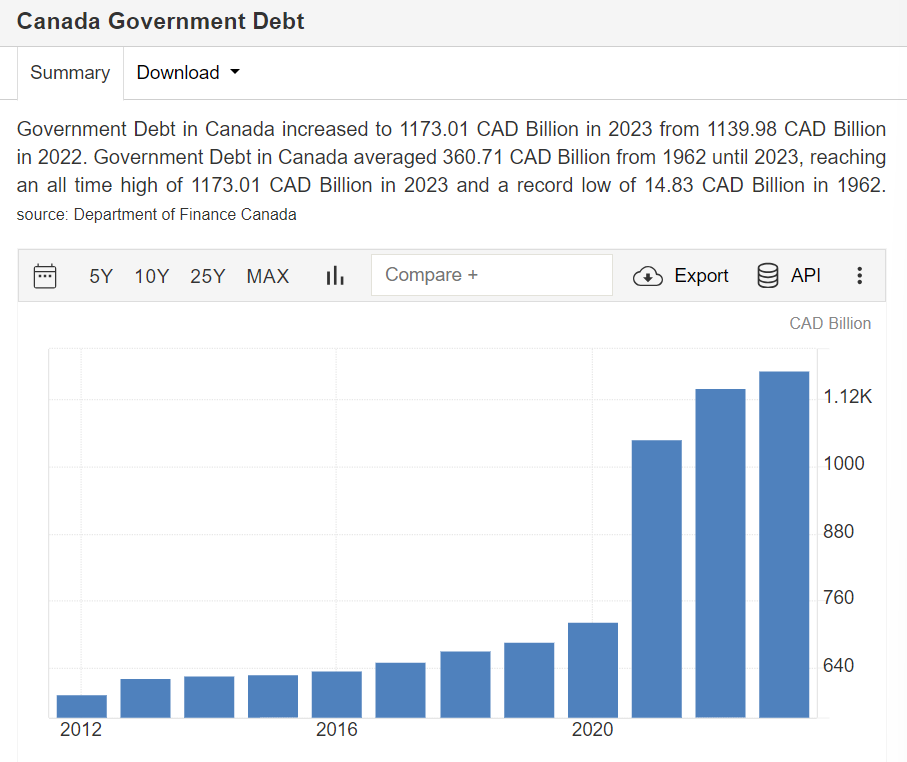
Switzerland and Australia are the only nations exceeding Canada’s debt levels. Government debt has SOARED in recent years, now exceeding C$1,139.98. This figure was only C$721.36 billion in 2020 before Trudeau used the pandemic as an excuse to bulk up social programs.

CanadaHouseholdDebt

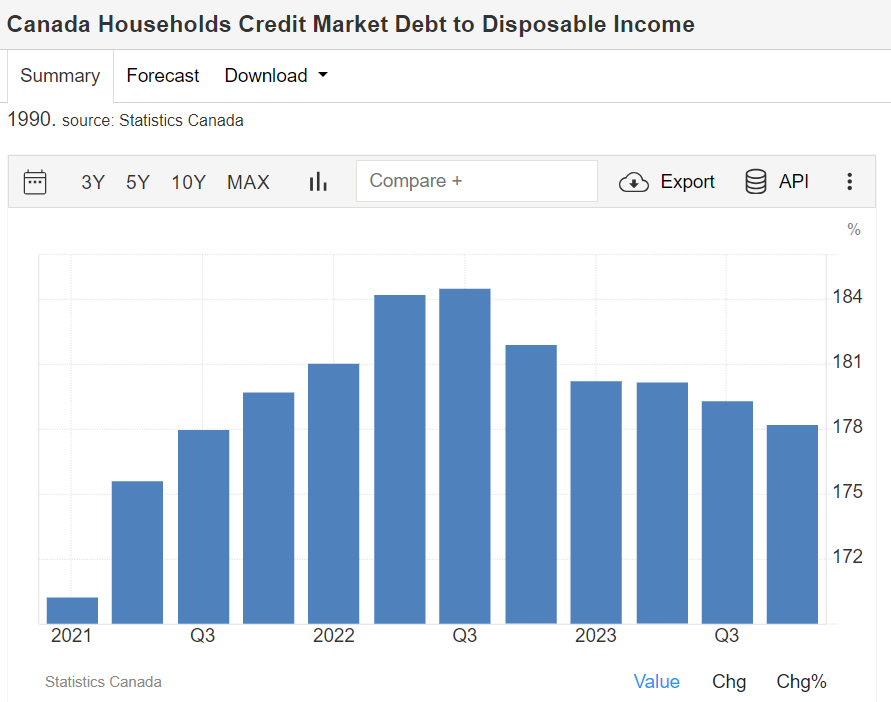
As for household debt, that figure exceeded 100% of GDP by the end of 2023. The debt-to-income ratio reached 178.22% by Q4 2023, but that was the LOWEST on record compared to the past nine quarters. Household debt as a percentage of the overall GDP reached 103.54% in Q4, also slightly down from prior quarters. During the pandemic lockdowns in Q3 of 2022, this figure peaked at 184.52%.

The United States, also in dire conditions, reached 75% of household debt in relation to GDP. This means that Canadian families are deeply in debt and unable to spend or contribute to economic growth.

The housing crisis in Canada is a major contributing factor, with two-third of the total debt going solely to mortgages. No one was prepared for the rise in rates, which went from 0.25% in March 2022 to 5% in July 2023 before slightly dropping to 4.75% last month.

And yet, Trudeau speaks of finding more aid to fund foreign wars and support the millions of migrants that have entered Canada. He speaks of raising taxes and increasing spending through social programs and green initiatives, but nothing meaningful is being done to address Canada’s debt crisis.

Canada Institutionally Rationalizes Oppression


Posted originally on the CTH on June 10, 2024 | Sundance

Ever since the U.S. election of 2016, and to a lesser extent the Brexit referendum months earlier, I have read a dozen or so government publications about the general subject of interference in the election process.  What I find common amid each of those government reviews, is a general leftist theme that democracy must be protected from election outcomes.

I know that last sentence sounds a little goofy, but that’s because leftism is exactly that weird and fraught with hypocrisy.

Keep in mind, right now in Europe Ukrainian President Volodymyr Zelenskyy has banned any political opposition and cancelled elections in his country in order to “preserve democracy.”  Meanwhile, the western politicians clap like seals and beclown themselves in support of the ridiculous assertion.

Do you remember the statement, “words progressives do not support are defined as violence; and violence progressives do support are defined as protests.”

Well, in the electoral version of that same theme, election outcomes leftists do not support are defined as threats to democracy; while manipulated election outcomes the leftists do support are defined as trustworthy.

This is the essential context for a rather alarming publication from the Canadian Government that says many of their elected politicians are working for foreign governments.  The Canadian National Security and Intelligence Committee of Parliamentarians published a report last week saying unnamed lawmakers in Canada’s parliament (and there are many of them) have helped foreign actors meddle in Canadian government.

[READ REPORT – SOURCE HERE]

CANADA – […] Heightened anxiety in Ottawa about foreign interference comes in the middle of historic global elections where factors such as artificial intelligence and emboldened foreign powers are testing the resilience of democratic systems.

Prime Minister Justin Trudeau has been on the defensive since the allegations broke Monday. Conservative Leader Pierre Poilievre is calling on the government to name names.

“The national security committee indicates there are members of this House that have knowingly worked for foreign hostile governments,” Poilievre said Wednesday. “Canadians have a right to know who and what is the information — who are they?”

The findings put pressure on Canada’s national police force to investigate potential criminal charges. The report also refuels debate on the ability of the federal government’s deterrence mechanisms to curb foreign interference in a country whose political and legal system is considered one of the highest-performing in the world.

The committee with top-security clearance said it based its findings on more than 4,000 documents and some 1,000 pieces of evidence. Its report said China remains the largest foreign interference threat to Canada with India the second.

The intelligence included a claim that unnamed parliamentarians are taking direction from unnamed diplomats to “improperly influence” their colleagues or parliamentary business to the benefit of a foreign state.

[…] The Trudeau government called an inquiry into foreign interference in September in the wake of claims that the Chinese government helped mobilize voters against a Conservative candidate in western Canada and helped elect another as a Liberal in the Toronto area.

It tasked Justice Marie-Josée Hogue with investigating foreign interference and election meddling, a topic that has also captured the interest of U.S. Congress.

[…] An initial report released by Hogue last month observed that the government’s messy handling of foreign interference has undermined the public’s faith in Canadian democracy. (read more)

To reassure the public the Canadian government and Prime Minister Justin Trudeau’s administration have stated that sunlight on the named politicians who are working on behalf of foreign governments will not be permitted.

No one in public will be allowed to know which politicians are working as foreign agents.

If you are a Canadian trucker against COVID mandates, you are a threat to democracy.  If you are a Canadian politician working as a foreign agent, it’s all good.

How about that, eh?

Petition to Remove Trudeau from Office


Posted Apr 13, 2024 By Martin Armstrong 

Canada Accuses India of Election Interference


Posted originally on Apr 11, 2024 By Martin Armstrong 

Trudeau 7

The Canadian Security Intelligence Service (CSIS) issued a report accusing India and Pakistan of interfering in Canada’s federal elections in 2019 and 2021. India has called the claims “baseless,” but the CSIS said it will be on the hunt for meddling during the upcoming election.

It is not Government of India’s policy to interfere in democratic processes of other countries. In fact, quite on the reverse, it is Canada which has been interfering in our internal affairs. We have been raising this issue regularly with them. We continue to call on Canada to take effective measures to address our core concerns,” stated India’s External Affairs Ministry spokesperson Randhir Jaiswal.

Canada’s next election is not until October 2025, but polls show that Canadians are eager for a change in leadership. A poll from January conducted by Nanos Research found that 46% of Canadians would like to cast their vote in 2024. The Canada Elections Act of 2007 changed the timeline for general elections, which are to be held the third Monday of October every four years. Yet, an election could be held earlier, according to Election Canada, “as long as it is no later than five years after the previous election.”

People are simply losing confidence in their government leaders. Canadians are not happy with their current conditions and want Trudeau out. As is common, his administration now must blame foreign interference for his loss in popularity.

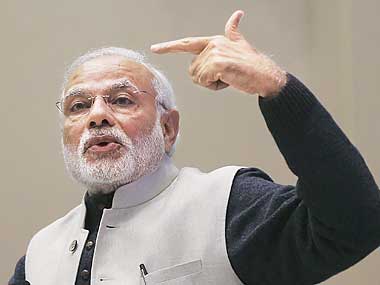
Prime Minister Narendra Modi

The CSIS was granted extended powers by the Liberal government in 2015 under Bill C-51, the Anti-Terrorism Act. The CSIS is now able to actively interfere with potential terrorist activities, such as censoring websites, blocking the freedom of movement, or de-banking individuals as they did to the truckers during the Trucker Convoy.

“We have known for many, many years that many different countries take an interest in engaging in Canadian institutions and sometimes influencing, sometimes interfering, in the work of Canadian institutions,” Trudeau said. “I can assure people that we will continue to do everything necessary to prevent interference from whatever country it comes from.”

Threat-reduction matters could include parking a cop car outside of a potential terrorists home; government intimidation. They believe Sikh Canadians are being forced to vote in alignment with Indian policies, therefore, the CSIS will be watching them closely as the next election approaches.

There is no concrete evidence that an outside source interfered in Canada’s elections but that is not preventing the government from attacking foreign nations and alerting the public that they will be taking preventative measures to ensure the public votes accordingly.

Toronto Police Suggests Permitting Auto Theft to Prevent Home Invasions


Posted Mar 18, 2024 By Martin Armstrong 

Thieves have been knocking down doors in Toronto neighborhoods. The government is not permitting the police to curtail crime and has sided with the criminals over the Canadian public. Toronto Police Service Constable Marco Ricciardi is now urging residents to leave their keys in their cars to make it easier for criminals to steal. “To prevent the possibility of being attacked in your home, leave your [key] fobs at your front door because they’re breaking into your home to steal your car. They don’t want anything else,” Ricciardi said.

Major crime is rising in Toronto and throughout Canada, with Toronto actually being one of the safer cities. Auto theft increased by 37.7% last year, with 6,019 vehicles stolen, according to recent crime statistics. When compared with figures for 2021, auto theft increased by an alarming 50%.

The top ten major offences reported by the Toronto Police Service for 2023 year to date include:

  • Assault—21,398 (up 10.4%)
  • Auto Theft—8,287 (up 37.7%)
  • Breaking and Entering—4,821 (up 18.9%)
  • Robbery—2,086 (up 8.1%)
  • Sexual Violations—2,175 (up 12.1%)
  • Theft Over $5,000—1,194 (up 24.5%)
  • Assault with a weapon—3,059*
  • Assault Causing Bodily Harm—688*
  • Breaking and Entering with Intent—656*
  • Robbery with a Weapon—637*

Toronto neighborhoods experiencing the most significant year-to-date increases in major crimes include:

  • Princess-Rosethorn—up 208.9%
  • Kingsway South—up 138.1%
  • Miliken—up 106.2%
  • Bayview Woods-Steeles—up 100%
  • Banbury-Don Mills—up 85.7%

Twenty-six neighborhoods in Toronto reported a >50% increase in major crimes in the past year. Homicides are now rising with 689 reported in 2019 compared to 874 in 2022. There were only 49 recorded homicides in 1999, so one must ask, what changed? The demographics changed. The economy changed. And legislation, mainly gun laws, have changed. Toronto police have been prohibited from carrying revolvers since the 1990s. It is far more difficult for a law-abiding citizen to obtain a firearm compared to criminals, and people simply cannot defend their homes or families.

The Toronto police department and the Trudeau Administration should be absolutely ashamed. They expect citizens to quietly permit criminals to steal their possessions, threaten their families, and pander to illegal activities since they are forbidden from protecting their selves. Perhaps Trudeau should eliminate his security detail and stand in solidarity with the people who must accept living in a lawless land.

Canada to Incorporate Social Scores in Banking


Posted originally on Mar 14, 2024 By Martin Armstrong 

Debanking

The Canadian banking system is set to be radicalized by open banking framework. Proponents are framing this as a way for banks to easily share information and access user data. The truth of the matter is that this is an opportunity to merge social standings with banking to provide government complete control over our finances.

The organization Open Banking Excellence, a World Bank partner that originated in the UK, claims that it will host all of a bank’s relevant needs in one place. The organization, which has reached 40 countries, aims to “create exceptional platforms and content that promotes knowledge sharing, new thinking and partnerships within the industry – catalysing the adoption of Open Finance and Data for better financial inclusion worldwide.”

CBDC Cover

“It’s about having that fairer, more inclusive, more open society,” said Helen Child, founder of Open Banking Excellence. Open Society, well, that does sound familiar. Why is there a need for inclusivity and fairness in banking when it should come down to numbers? “It drives financial inclusion,” she added, “It’s democratizing data.”

Data. That will be worth more than gold as we move forward with a cashless society. There is no easier way to control the masses than to control their access to money, their ability to buy, trade, and freely move about. The Canadian Press outlined the true motive in plain sight: “One of the biggest areas of growth is in credit assessments. Under open banking, lenders could directly access an individual’s banking data, so they can look beyond credit scores. Consumers can also use it to build their credit scores, for example, by proving reliable rent payments.”

Looking beyond credit scores equates to determining if a person is fit to participate in the global economy based on their personal views. Look at what happened to Nigel Farage. He never committed a crime or did anything to warrant what many have called the “Farage fiasco.” Nigel was suddenly debanked by Coutts and was unable to access any of his checking or savings accounts. His credit cards were deactivated. He was unable to participate in society without a moment’s notice.

Nigel Farage 2019 WEC

Farage did his due diligence and found that there were countless people who experienced the same financial attack carried out by the banks on behalf of the government.

This is a widespread phenomenon. We saw it happening commonly during COVID lockdowns, where users were not permitted to access places if their digital COVID passports failed. In China, when banks were facing a liquidity crisis, the CCP simply denied depositors the right to access their money and blocked them from physically accessing their banks. The government successfully prevented a bank run. We saw a few celebrities debanked from the system for voicing unpopular opinions without any legal proceedings or crimes committed.

Canada is one of many nations hoping to use unofficial social scores to control the masses. All of these actions are setting the stage for how CBDC will operate, a collective network containing everyone’s personal data and accounts. Governments have already begun debanking individuals and these steps will make it increasingly easier to force the masses to bow down and relinquish all control to the almighty government.

Canada Moves to Ban Christianity – Changes to Bill C-367


Posted Originally on Mar 6, 2024 By Martin Armstrong 

Canada News Ban

Canadian Prime Minister Justin Trudeau has passed numerous pieces of legislation prohibiting free speech in Canada, yet nothing has been as restrictive as Bill C-367, an amendment to the Criminal Code that will prohibit Canadians from expressing “an opinion based on a belief in a religious text. If passed, people can be arrested for quoting the Bible on Canadian soil.

Proponents are cloaking this attack on religion under the premise that it will curtail antisemitism. Yet, months ago, Justin Trudeau stood with Zelensky and the Canadian Parliament, celebrating a known Nazi war criminal, and even giving him a standing ovation.

This is precisely what the bill would remove from the Criminal Code of Canada through Private Member’s Bill C-367: Removing Religious Protections For Antisemitic Expression:

3) No person shall be convicted of an offence under subsection (2)
(a) if he establishes that the statements communicated were true;
(b) if, in good faith, the person expressed or attempted to establish by an argument an opinion on a religious subject or an opinion based on a belief in a religious text;
(c) if the statements were relevant to any subject of public interest, the discussion of which was for the public benefit, and if on reasonable grounds he believed them to be true; or
(d) if, in good faith, he intended to point out, for the purpose of removal, matters producing or tending to produce feelings of hatred toward an identifiable group in Canada.

Defences — subsection (2.1)

(3.1) No person shall be convicted of an offence under subsection (2.1)
(a) if they establish that the statements communicated were true;
(b) if, in good faith, they expressed or attempted to establish by an argument an opinion on a religious subject or an opinion based on a belief in a religious text;
(c) if the statements were relevant to any subject of public interest, the discussion of which was for the public benefit, and if on reasonable grounds they believed them to be true; or
(d) if, in good faith, they intended to point out, for the purpose of removal, matters producing or tending to produce feelings of antisemitism toward Jews.

first they came for the communists but i was not Martin.Niemoller.Religion.FreeSpeech
Neiollmer.Martin.FreeSpeechReligion

This is an outright attack on religion. There are countless examples throughout history from every area of the globe where religious prosecution led to heinous massacres. Outright bans on religion start off small, removing a provision or two, until the government deems entire groups of people a danger to society.

I discussed the case of Pastor Artur Pawlowski who was arrested for speaking out against the Canadian government, in particular their COVID era restrictions on medical autonomy. Pawlowski was charged with criminal mischief for preaching from the Bible to the Trucker Convoy. He did not commit a violent offense nor did he say anything “hateful,” but the words from the Bible are now deemed as offensive similar to how the government is labeling words like “mother” or “father” unacceptable.

Religion demands that followers believe in a higher power greater than the almighty government. Statistics Canada reported that only 68% of Canadians identify as religious, with a notable decrease among the Christian community in particular. The same organization believes that non-Christian religious affiliation will double by 2036. An Angus Reid survey from April 2022 showed that religious tolerance in Canada is at an all-time low, with 22% of respondents saying all religion is harmful to society.

This legislation will prohibit Christians, Muslims, and others from freely expressing their opinions. They speak of banning antisemitism, but the law will also target Jews. Anyone expressing an opinion “relevant to any subject of public interest” based on a religious text will be considered a criminal, a danger to the new world order. For example, if someone says they are against MAID, child transgenderism, abortion, or anything that is not deemed acceptable by the Abrahamic religions, they will be accused of promoting hate speech and prosecuted for their religious beliefs.

https://platform.twitter.com/embed/Tweet.html?dnt=true&embedId=twitter-widget-0&features=eyJ0ZndfdGltZWxpbmVfbGlzdCI6eyJidWNrZXQiOltdLCJ2ZXJzaW9uIjpudWxsfSwidGZ3X2ZvbGxvd2VyX2NvdW50X3N1bnNldCI6eyJidWNrZXQiOnRydWUsInZlcnNpb24iOm51bGx9LCJ0ZndfdHdlZXRfZWRpdF9iYWNrZW5kIjp7ImJ1Y2tldCI6Im9uIiwidmVyc2lvbiI6bnVsbH0sInRmd19yZWZzcmNfc2Vzc2lvbiI6eyJidWNrZXQiOiJvbiIsInZlcnNpb24iOm51bGx9LCJ0ZndfZm9zbnJfc29mdF9pbnRlcnZlbnRpb25zX2VuYWJsZWQiOnsiYnVja2V0Ijoib24iLCJ2ZXJzaW9uIjpudWxsfSwidGZ3X21peGVkX21lZGlhXzE1ODk3Ijp7ImJ1Y2tldCI6InRyZWF0bWVudCIsInZlcnNpb24iOm51bGx9LCJ0ZndfZXhwZXJpbWVudHNfY29va2llX2V4cGlyYXRpb24iOnsiYnVja2V0IjoxMjA5NjAwLCJ2ZXJzaW9uIjpudWxsfSwidGZ3X3Nob3dfYmlyZHdhdGNoX3Bpdm90c19lbmFibGVkIjp7ImJ1Y2tldCI6Im9uIiwidmVyc2lvbiI6bnVsbH0sInRmd19kdXBsaWNhdGVfc2NyaWJlc190b19zZXR0aW5ncyI6eyJidWNrZXQiOiJvbiIsInZlcnNpb24iOm51bGx9LCJ0ZndfdXNlX3Byb2ZpbGVfaW1hZ2Vfc2hhcGVfZW5hYmxlZCI6eyJidWNrZXQiOiJvbiIsInZlcnNpb24iOm51bGx9LCJ0ZndfdmlkZW9faGxzX2R5bmFtaWNfbWFuaWZlc3RzXzE1MDgyIjp7ImJ1Y2tldCI6InRydWVfYml0cmF0ZSIsInZlcnNpb24iOm51bGx9LCJ0ZndfbGVnYWN5X3RpbWVsaW5lX3N1bnNldCI6eyJidWNrZXQiOnRydWUsInZlcnNpb24iOm51bGx9LCJ0ZndfdHdlZXRfZWRpdF9mcm9udGVuZCI6eyJidWNrZXQiOiJvbiIsInZlcnNpb24iOm51bGx9fQ%3D%3D&frame=false&hideCard=false&hideThread=false&id=1760773104975122831&lang=en&origin=https%3A%2F%2Fwww.armstrongeconomics.com%2Finternational-news%2Fgreat-reset%2Fcanada-moves-to-ban-christianity-changes-to-bill-c-367%2F&sessionId=6faa0b224fc745f1f12e0ae0f3e35640812d02f4&theme=light&widgetsVersion=2615f7e52b7e0%3A1702314776716&width=500px

Karl Marx deemed religion the “opium of the masses” that was intended to give false hope to the impoverished who should fill their hearts with hatred and entitlement. “The abolition of religion as the illusory happiness of the people is required for their real happiness. The demand to give up the illusion about its condition is the demand to give up a condition which needs illusions,” Marx continued.

What is happening in Canada will spread throughout the Build Back Better nations under the direction of the World Economic Forum. This is happening precisely on target with our model’s forecasts.

It is rather stunning how we come to major religious events every 309.6 years. This appears to be a change in beliefs that does not necessarily suggest complete changes in religions but rather moving away from the belief in a higher power. Often, these are shifts that become more fundamentalist in their beliefs or a turn toward liberalism. There are two primary cycles. First, we can look at the cycle of change in religion, which seems to follow the 309.6-year cycle, which is, of course, the 8.6-year frequency. The second is to look at the derivative of the 8.6-year, which produces a target for a major collapse in religion, which is underway at this time, by 2033.

Categories:GREAT RESET

Inflation Dropped in Canada – So Why is the Cost of Living Unaffordable?


Posted originally on Feb 22, 2024 By Martin Armstrong 

canadian dollar C

Statistics Canada reported that inflation slowed in January to 2.9%, beating expectations of 3.3%. So why are Canadians still struggling to afford basic necessities like rent and food?

Mortgage interest costs remain the top noted driver of inflation after rising 27.4% YoY, while rentals increased 7.9% during the same period. Bank of Canada governor Tiff Macklem explained that the central bank cannot fix the housing crisis through cuts. “Housing affordability is a significant problem in Canada but not one that can be fixed by raising or lowering interest rates,” he noted at the beginning of February. The Bank of Canada has voted to raise interest rates 10 times since March 2022, with little to no impact on inflation.

The central bank cannot manage supply and demand. Rentals.ca noted that rentals have been rising by C$373 per month since COVID restrictions and lockdowns decimated the global economy. Demand far outweighs supply, and Canada Mortgage and Housing Corp. noted that vacancies are at their lowest level since they began reviewing the data in 1988.

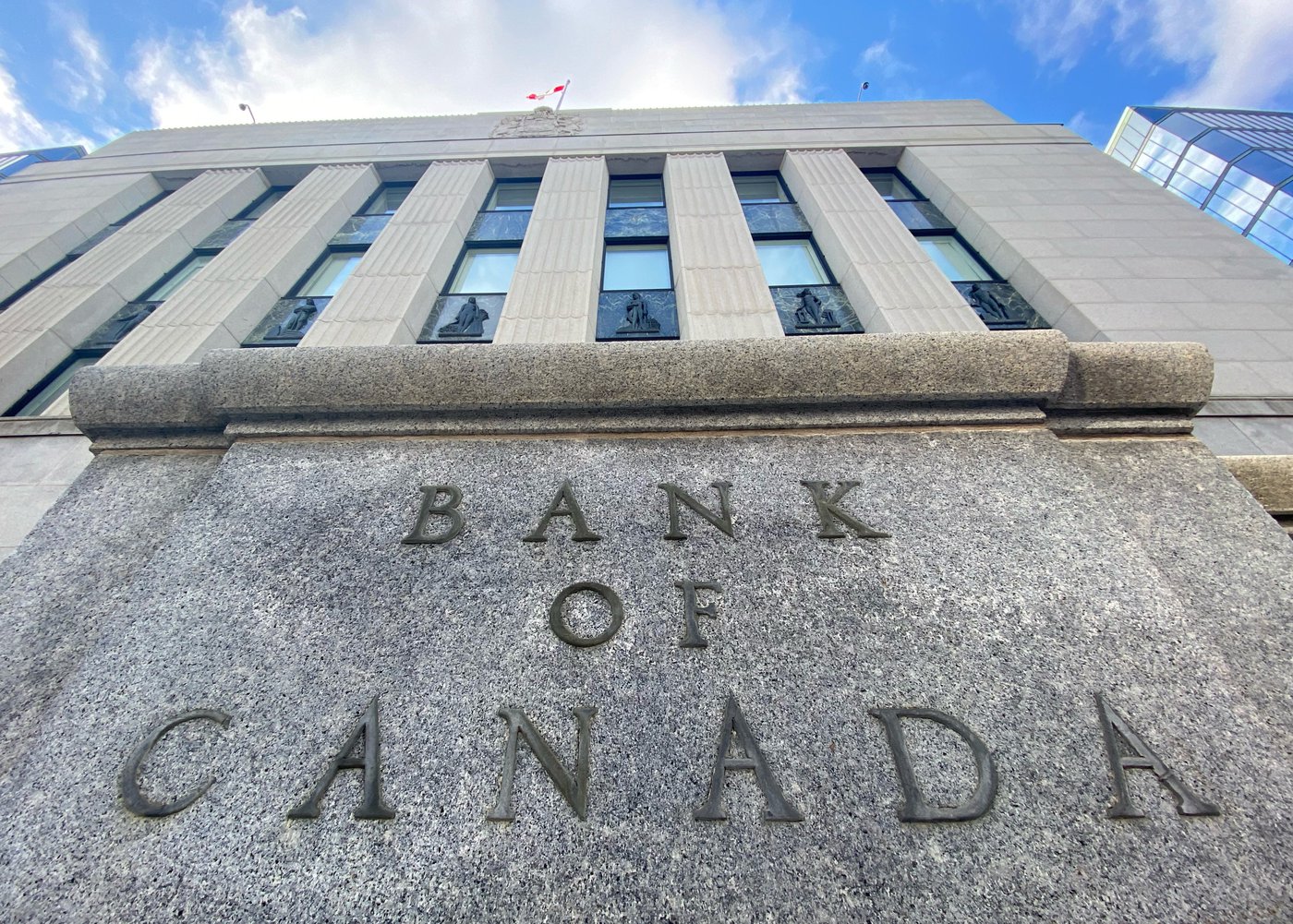
The Bank of Canada building

Trudeau’s government only cares about the rising debt-to-GDP ratio, and analysts cling to their failed theories of Keynesian economics. What percentage of interest costs are in that deficit, and what happens when they can no longer sell the debt? These are questions entirely overlooked.

The Canadian dollar is simply worth less than it was before the COVID lockdowns, and the Canadian dollar’s decline is contributing to the rising cost of imports.

The Bank of Canada has the same issue with its central bank as many other nations – the government will not stop spending. Total government spending for the 2023 fiscal year through the end of March 2024 is estimated to be C$488.7 billion.

Yet, the Trudeau Administration announced this week that they will be spending another C$300+ million on ammunition for Ukraine as Canada, like all other NATO nations, has been prioritizing spending on foreign wars while ignoring its growing deficit.

Canada’s deficit is expected to hit C$38.4 billion in 2024/25 and C$38.3 billion in 2025/26. Who is the largest buyer of Canadian debt? Foreign investors from the United States who purchased around $13.1 billion of Canadian debt securities. Canada saw a high in foreign share acquisitions in December 2023 to the tune of C$29.4 billion, with non-US foreign share investment reaching C$6.3 billion.

Investors are mainly seeking instruments denominated in USD that are issued by Canadian banks. Now, Canada must make investment opportunities more lucrative for the US buyer compared to domestic investments. Hence, the BoC is moving in line with the Federal Reserve, but both are utterly helpless as they cannot control fiscal policies.