The Fed Does Not Back Down


Armstrong Economics Blog/Interest Rates Re-Posted Mar 22, 2023 by Martin Armstrong

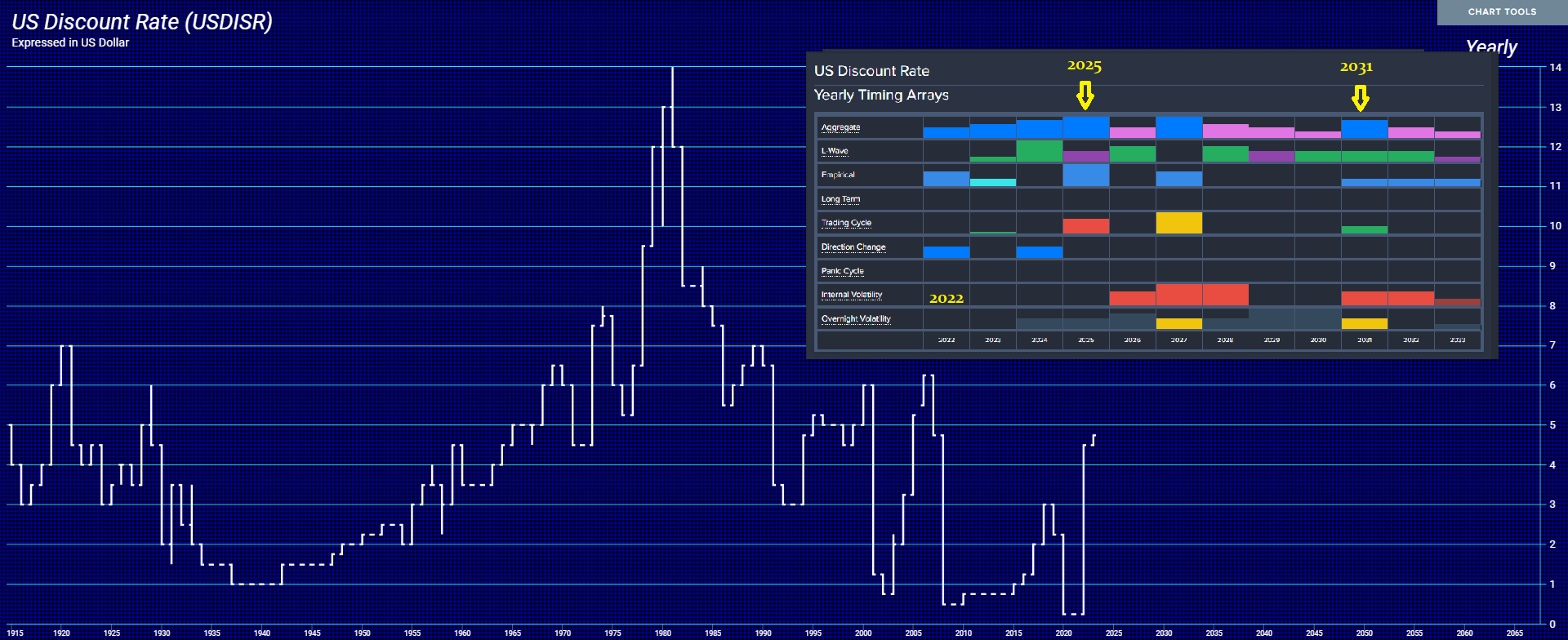
COMMENT: Marty, it’s refreshing to have Socrates that is totally unbiased. It projected continued rising rates into next year and the Fed just proved its point. It is not backing down.

Thank you. Socrates is very enlightening.

GS

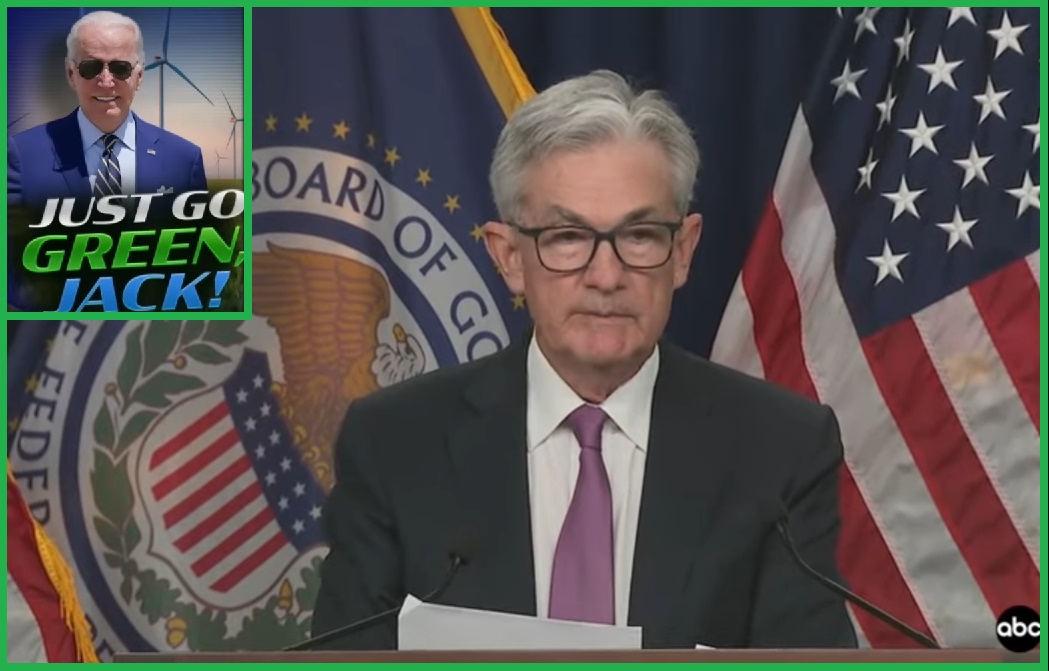
ANSWER: I know there were a lot of talks that surely the Fed had to lower rates and start QE all over again. Most of those sorts of comments have no real experience in markets. They just mouth a lot of hot air. Perhaps instead of putting masks on cows, we should do that on the shills. The Federal Reserve had no choice but to raise interest rates although it was just by a quarter point. Not to do so and the Fed would lose all credibility and the market would then not take them seriously.

You MUST understand that this crisis has unfolded because too many banks were wrapped up in WOKE culture and hired people who were UNQUALIFIED to run risk management. Some were more excited about cross-dressing as a woman and winning the Rainbow award in banking than actually protecting the bank from the risk of rising interest rates.

In a statement released at the conclusion of the meeting, Fed officials acknowledged that recent financial market turmoil is weighing on inflation and the economy, though they expressed confidence in the overall system. “The US banking system is sound and resilient.” They had no choice but to make this statement.

“Recent developments are likely to result in tighter credit conditions for households and businesses and to weigh on economic activity, hiring and inflation. The extent of these effects is uncertain.”

The Fed is saying that their rise in rates will in fact reduce inflation and economic activity. The banks have this yield curve risk and that is different from the 2007-2009 crisis where the debt was based on fraud. Here, the debt is US Treasuries so they are not going bankrupt from that aspect, but it is a liquidity crisis.

If these people who scream loudly but know nothing really about finance keep up the nonsense, they will only add to the uncertainly. This inflation is accelerating thanks to the war.

The Banking & Debt Crisis Continues


Armstrong Economics Blog/Banking Crisis Re-Posted Mar 22, 2023 by Martin Armstrong

The banking crisis continues and it is impacting funds that have been buying bonds. Allianz, a subsidiary of Pimco, is writing off countless millions with Credit Suisse bonds. The banking crisis has been the result of artificially low-interest rates for far too long and banks were used to free money and buy long-term bonds all because they were making their money on the spread. Now that rates are rising, their risk management was effectively nonexistent, and thus the losses and widespread.

The Allianz subsidiary Pimco is one of the largest asset managers in the world. They have to now write off a loss in Credit Suisse bonds and it’s ain’t over yet as we head into April 10th.

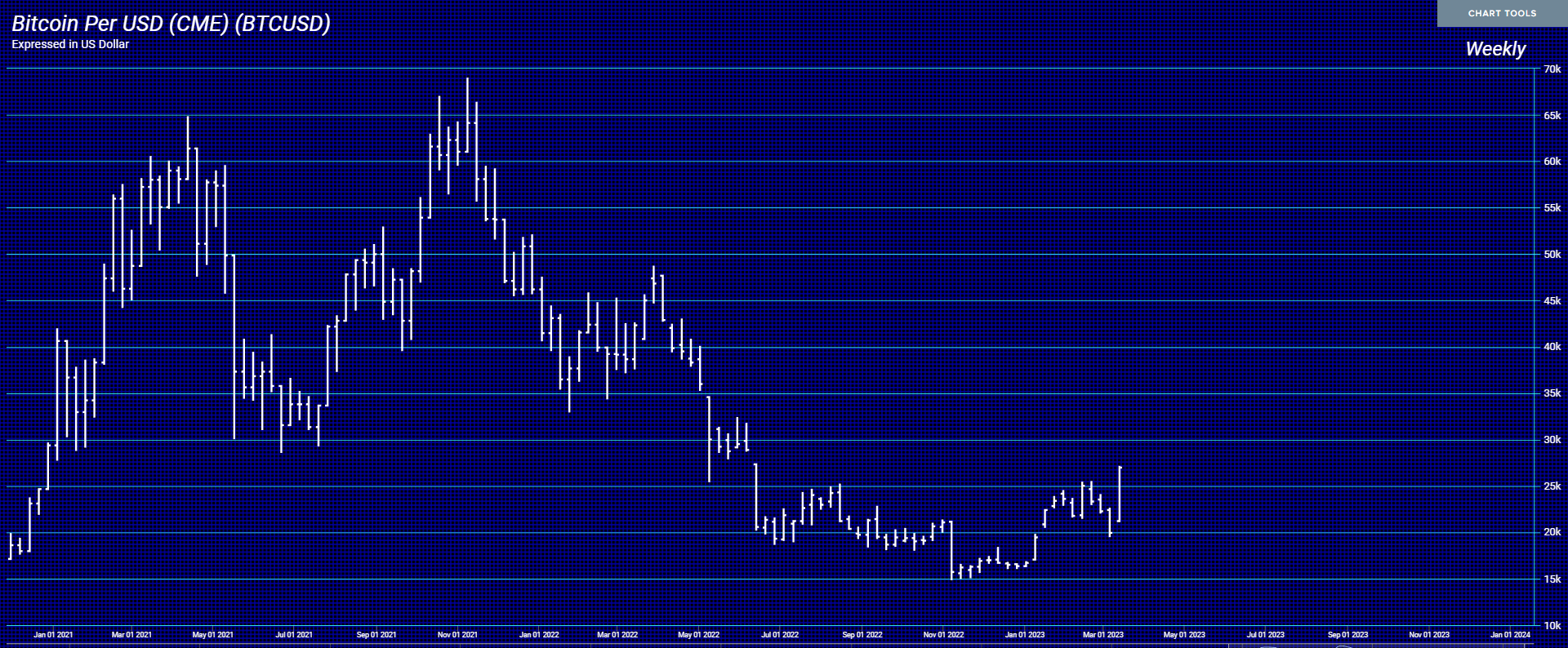
BITCOIN – The Reality Check


Armstrong Economics Blog/Cryptocurrency Re-Posted Mar 21, 2023 by Martin Armstrong

COMMENT: Mr. Armstrong, I just wanted to thank you for the education. When you explained that Bitcoin was not some hedge against central banks or an exception to everything out there but was just another trading vehicle, you saved my life for sure my wife would have killed me during the crash. The November turning point proved correct. Now we head into some very interesting times with Directional Changes ahead. The bounce now is the same pattern you see in gold. It is just a trading vehicle and not a store of wealth. Thank you for that reality check.

Sam

REPLY: Yes, spousal abuse can be a major deterrent. Merrill Lynch paid me to teach a client how to trade who had created the biggest one-day loss perhaps in trading history and wrote a check and kept trading. I got him to pay more attention, but when he was winning, he was too busy to watch. He seemed to love to lose money for that got him all geared up. It was his wife that made him stop trading.

Look, Bitcoin is NOT some store of wealth. You will lose your shirt, pants, and spouse if you buy into that. It is a trading vehicle – nothing more. Just follow Socrates. That gives at least an unbiased viewpoint. What goes up, comes down and what goes down eventually goes up. That is just the law of the market.

This Just In – Western Nation Central Banks Organize to Provide Daily Liquidity of Dollars in The Event of Contagion Bank Collapse


Posted originally on the CTH on March 19, 2023 | Sundance 

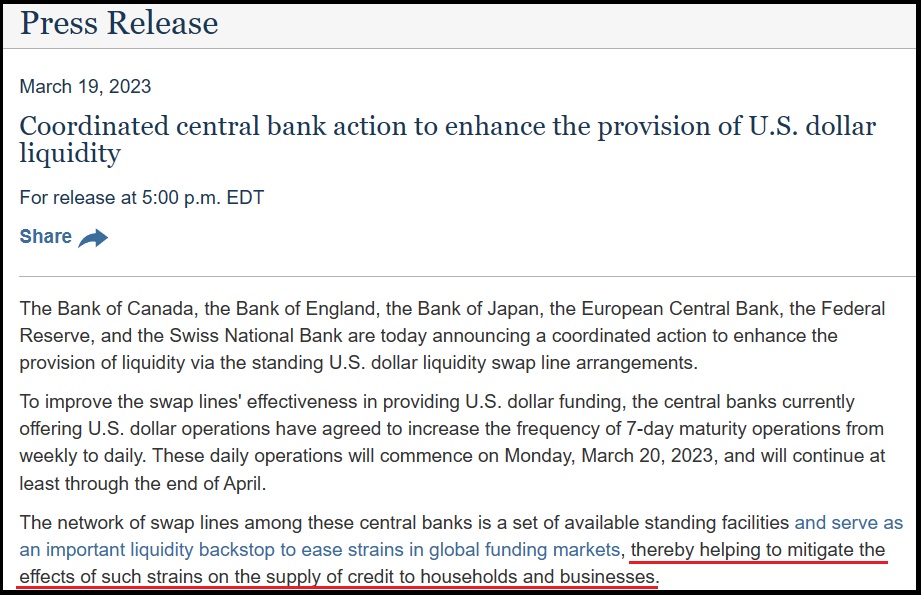
This is rather remarkable and tells us something about the current status of the “western” financial system.  The last sentence in today’s announcement from the FED is particularly laughable.   Check this out [Source]:

That last sentence is nonsense.   When was the last time the ‘central banks’ worried about the supply of credit to households and businesses?  Total and complete nonsense. What they are worried about is the need to have readily available dollars, faster, to backstop banks that are supposed to be holding deposits.

Nothing quite inspires ‘global banking confidence’ like the need to swap dollars rapidly, from country to country on a daily basis, because the amount of currency in bank, within any western nation, at any given time, might disappear.

Yesterday’s monologue from Neil Oliver, and the recent personal banking story that structures his comments, is standing as eerily prescient right now.  SEE BELOW:

.

“This just in.  Everything is fine… the liquidity of the Western banking system has never been stronger”… “Look over there folks, Trump indictment, nothing to see here folks… move along now”…

Interview: Neocons, Global Warfare, Digital Currencies, Bitcoin


Armstrong Economics Blog/Armstrong in the Media Re-Posted Mar 18, 2023 by Martin Armstrong

Watch the video above or click here to listen to my latest interview: “Neocons, Global Warfare, Digital Currencies, Bitcoin.”

Cash Not Accepted


Armstrong Economics Blog/The Hunt for Taxes Re-Posted Mar 16, 2023 by Martin Armstrong

There once was a time when cash was the undisputed king. Merchants preferred cash payments over credit, and there were often incentives for paying with paper. I recall receiving lower gas prices when paying with cash, for example. It is increasingly common to see “no cash accepted” signs at establishments as the world moves toward a cashless society. At the Federal level, there are no laws protecting consumers who wish to pay in cash. The Federal Reserve stated on its website:

There is no federal statute mandating that a private business, a person, or an organization must accept currency or coins as payment for goods or services. Private businesses are free to develop their own policies on whether to accept cash unless there is a state law that says otherwise.

"Section 31 U.S.C. 5103, entitled "Legal tender," states: "United States coins and currency [including Federal Reserve notes and circulating notes of Federal Reserve Banks and national banks] are legal tender for all debts, public charges, taxes, and dues." This statute means that all U.S. money as identified above is a valid and legal offer of payment for debts when tendered to a creditor."

Yet, the Federal Reserve also recognizes that as of 2021, 4.5% of US households were “unbanked.” This means that 5.9 million households are unable to pay by card. This is the lowest unbanked rate since the Fed began keeping track in 2009. The most common reason for not having an account, reported by 21.7% of unbanked households, is that they do not meet minimum balance requirements. The second most reported reason (13.2%) is that people simply do not trust banks, while the third most cited reason (8.4%) was the desire for privacy.

If merchants refuse to accept cash, these people cannot participate in consumerism. Their legal tender is simply not accepted. Unbanked households are more likely to contain persons with lower levels of education, lower incomes, disabilities, single mothers, and minorities. As the Fed reported:

“Differences in unbanked rates between Black and White households and between Hispanic and White households in 2021 were present at every income level. For example, among households with income between $30,000 and $50,000, 8.0 percent of Black households and 8.4 percent of Hispanic households were unbanked, compared with 1.7 percent of White households.”

If cash is legal tender, then it should be accepted everywhere. Numerous merchants not only refuse cash but they charge an additional fee for using credit. Tennessee, Arizona, Delaware, District of Columbia, Idaho, Maine, Massachusetts, Michigan, Mississippi, New York, North Dakota, Oklahoma and Pennsylvania, New Jersey, Rhode, Colorado, and Connecticut have laws at the state level protecting cash payments. Some cities such as Washington D.C., Berkley, Chicago, New York City, Philadelphia, and San Francisco also have laws in place. However, I can assure you that many retailers in these areas still do not accept cash.

Washington wants to move us toward a cashless society to tax everyone, even those with the least to give, on every transaction we make.

Toxic Currencies – Good for the Yuan


Armstrong Economics Blog/China Re-Posted Mar 14, 2023 by Martin Armstrong

The Chinese yuan has out-traded the US dollar by volume for one of the first times in recent Russian history. The dollar was king in 1991 when the Soviet Union collapsed, but that is no longer the case after Moscow branded the dollar a “toxic currency” along with the euro. Toxic currencies accounted for 87% of exports from Russia at the beginning of 2022, but this figure fell to 48% by the start of the new year. The Bank of Russia has reported that the proportion of USD/ruble pair in exchange fell to only 36% in February. The central bank is calling this a “broad structural transformation of the Russian economy.”

As “unfriendly countries” and their “toxic currencies” band together, those on the outskirts are winning. China has become the new go-to country for new trade partnerships as it bypasses Western-imposed sanctions. Toxic currencies represented 46% of imports in December 2022 but were at 65% in January 2022 before the war. In contrast, the yuan’s share rose from 4% to 23% during that time.

Those who were previously shunned from the big table are now pulling up a chair to discuss economic prospects with China. This will make it much easier to phase out toxic currencies because more people are willing to accept the yuan. The confidence in the yuan is growing. Everything occurring may seem odd, but it is precisely on target. As I mentioned in my report “China on the Rise,” China will dethrone the United States to become the world’s leading economic powerhouse by 2032. It’s just time.