Posted originally on the CTH on February 28, 2023 | Sundance
It’s not just the United Kingdom, but as we await the latest figures from monthly U.S. data, the statistics from the U.K. are hitting the newswires. According to Reuters, food inflation in the U.K. is currently 17.1% The primary driver of the skyrocketing food costs is the energy cost associated with the fast turnover categories.
With prices increasing 17.1% yet net sales only increasing 8.1%, there is a substantial impact in unit food sales. British customers are buying much less to offset the fact they are paying much more. This trend is not just in the U.K. we have seen the same trend in U.S. data as families are being squeezed at the grocery store.
The prices on name branded products like Kraft and Heinz are leading the escalating food prices. Just last week I noticed 6oz Kraft Philadelphia cream cheese was $6.99, and a 24 oz. bottle of Heinz ketchup at over $8. Dairy products are leading the way with the most rapid increases in price. It appears that we are entering the fourth wave of food inflation currently.
LONDON, Feb 28 (Reuters) – British grocery inflation hit 17.1% in the four weeks to Feb. 19, another record high, dealing the latest blow to consumers struggling with a cost-of-living crisis, industry data showed on Tuesday.
Market researcher Kantar said prices are rising fastest in markets such as milk, eggs and margarine. It said UK households now face an additional 811 pounds ($978) on their annual shopping bills if they don’t change their behaviour to cut costs.
“This February marks a full year since monthly grocery inflation climbed above 4%. This is having a big impact on people’s lives,” Fraser McKevitt, head of retail and consumer insight at Kantar, said.
He said its research found that rising grocery prices are the second most important financial issue for the public behind energy costs. Also a quarter of people say they’re struggling financially, versus one in five this time last year.
[…] Kantar said that sales of own label products were up by 13.2% in February, well ahead of growth in branded products, which are generally more expensive, of 4.6%.
Kantar said UK grocery sales increased 8.1% over the 12 weeks to Feb. 19, masking a drop in volumes when accounting for inflation. (read more)
The last estimate for U.S. data (January ’23) is in the chart below. We should get the February data the first week in March.
The financial markets had become integrated globally prior to World War I. It was the globalization and openness of world financial markets that became the problem and are important to understand for we will face the same problem today. The capital was free to flow from one country to another before World War I. All the major countries of the world were on the Gold Standard at that point in time so exchange rates were not as volatile.
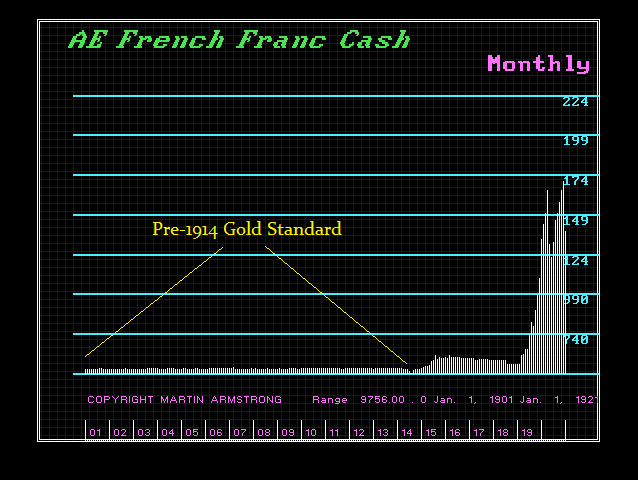
We can easily see that the currency market was very stable pre-1914 looking at the French Franc. Keep in mind that this was also a period of fiscal responsibility – pre-Socialism and Marx. Therefore, governments practiced balance budgets to retain confidence in their currencies. That enabled the gold standard to function. Furthermore, any differences in exchange rates were arbitraged. That is how the United States went into crisis in 1896 because the Democrats were inflating the system by overvaluing silver at 16:1 compared to 15:1 in Europe. That resulted in gold fleeing the United States and silver pouring in from international arbitrage.
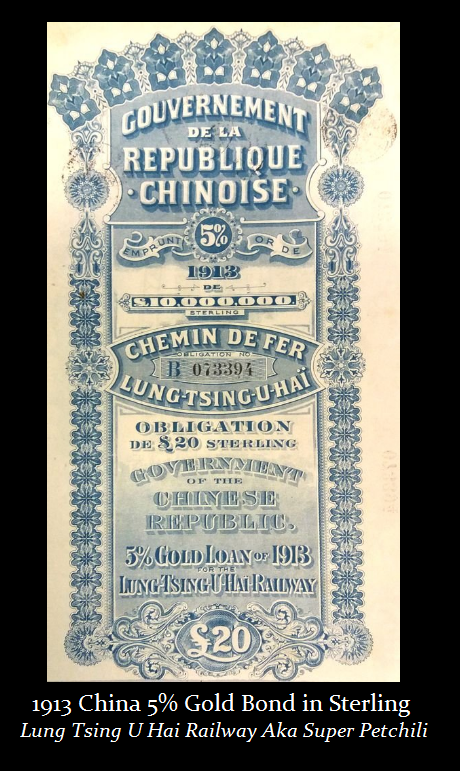
There was also a viable arbitrage that took place trading the spreads between international bonds listed on the various world stock exchanges. Many countries would issue bonds in British pounds just as they do in dollars today to sell more to the investors in the financial capital of the world, which was London at that point in time.
A country such as China or Russia would issue a bond that was listed on the stock exchanges in London, New York, Paris, Berlin, Amsterdam as well as St. Petersburg in Russia. Here is a Chinese bond issued in British pounds in 1913 paying 5%. The differences in exchange rates, which would still fluctuate marginally, would be arbitraged by buying and selling bonds in different markets.
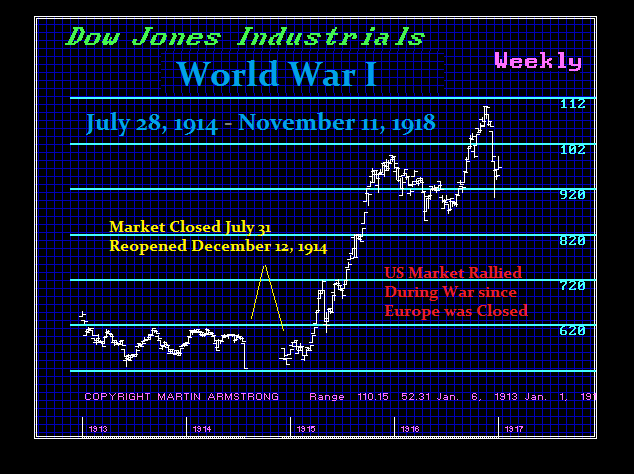
Consequently, during World War I, there was a global marketplace. In effect, this integration of markets presented a problem when the war hit. Capital could flee from one country to the next and thus the method to deal with the capital flows was to close the stock markets. The United States also closed the market in sympathy with Europe.
We will be taking a closer look at the various global markets. What you can count on is clearly CAPITAL CONTROLS. It would be best for those in Asia and Europe to have some capital tucked away in the United States. Once bullets start shooting, it will most likely be too late to move money.
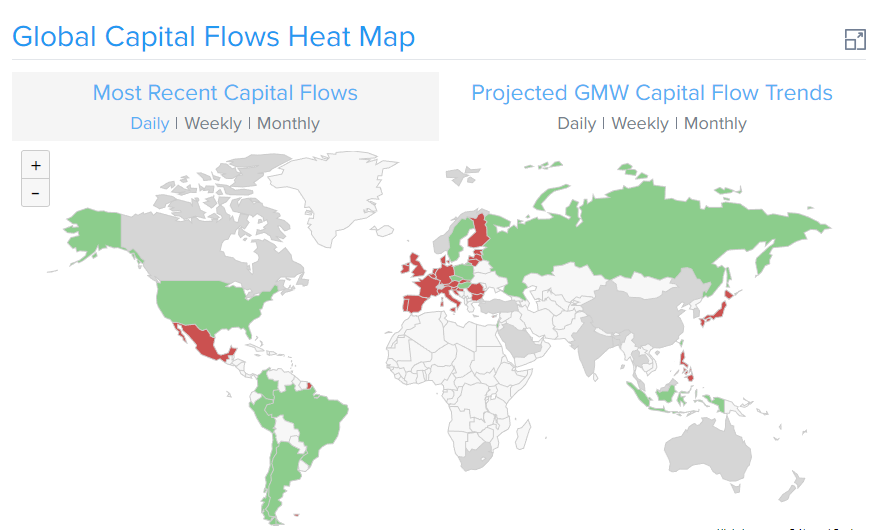
Keep an eye on our Capital Flow tracking. This may become very critical in the months ahead.
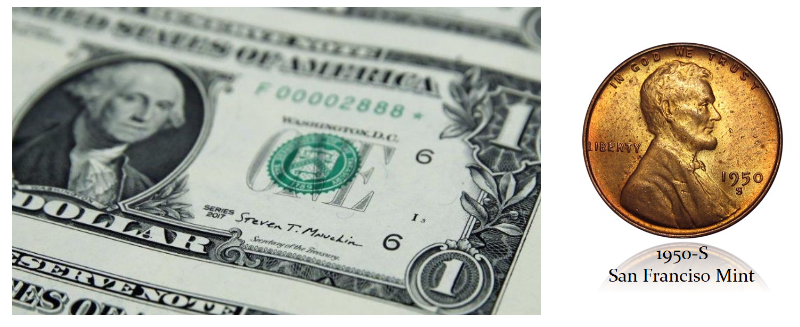
History repeats because human nature never changes. During the Roman Republic, the name of the moneyer would appear on the coinage just as today the Secretary of the Treasury’s signature appears on our paper currency – i.e. Steven T. Munchin. To this day, our coins are denoted by which mint produced them – Philadelphia, Denver, or San Francisco.
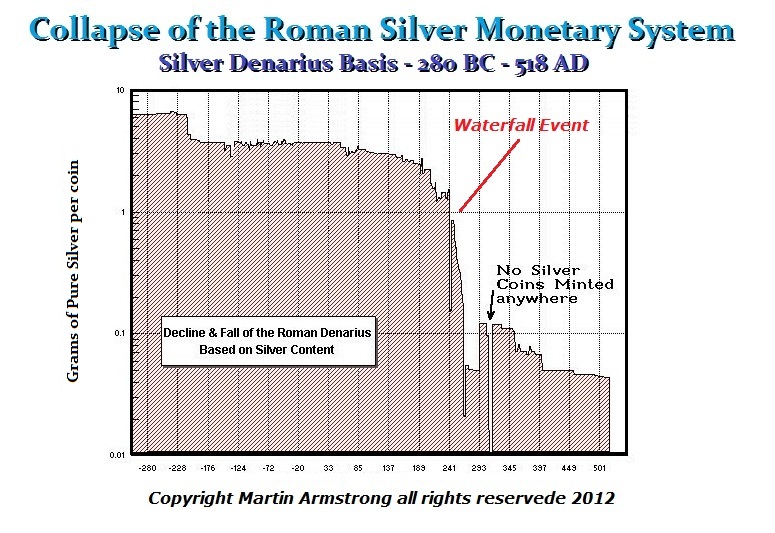
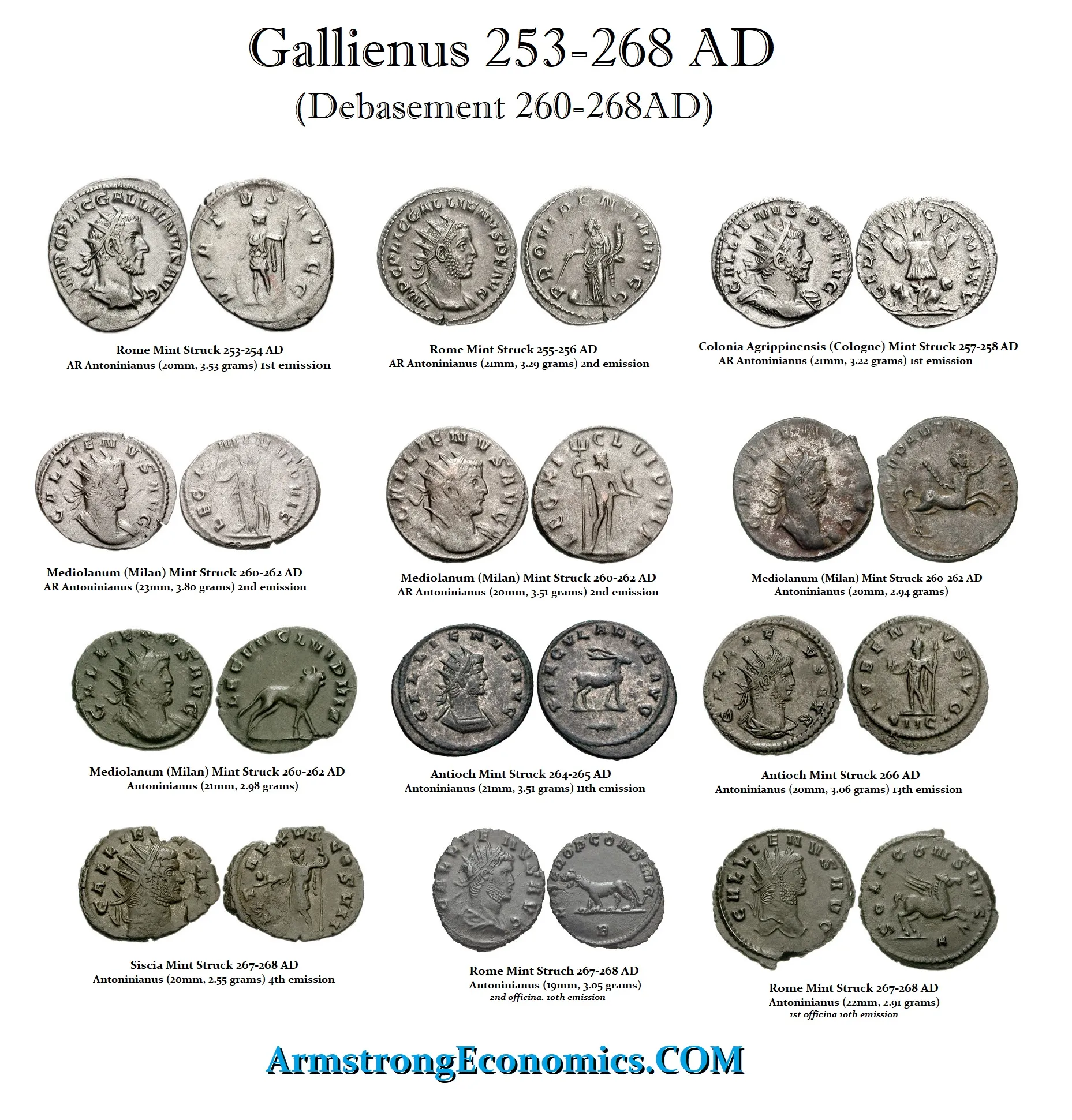
The collapse of the monetary system following the capture of Emperor Valerian I in 260AD by the Persians, set off a collapse in public confidence whereby the people suddenly saw Rome as vulnerable. What is fascinating is that the “hyperinflation” of Rome which took place in just 8.6 years, was aided by the corruption within the Deep State of the Roman Empire. This raises the question: We will see the same thing take place during our final 8.6 years into 2032 which begins by May 2024. The debasement of the coinage was NOT on the decree of the Emperor. This was the greed of those in the Deep State.
Following the assassination of Emperor Gallienus, that is when Claudius II came to power and the debasement reached it lowest point during his reign. The Goths invaded Rome and brought the plague with them from the East. Emperor Claudius II died of the plague. Claudius’s brother, Quintillus tried to succeed him, but Aurelian and his troops marched against him. His troops deserted him and he committed suicide.
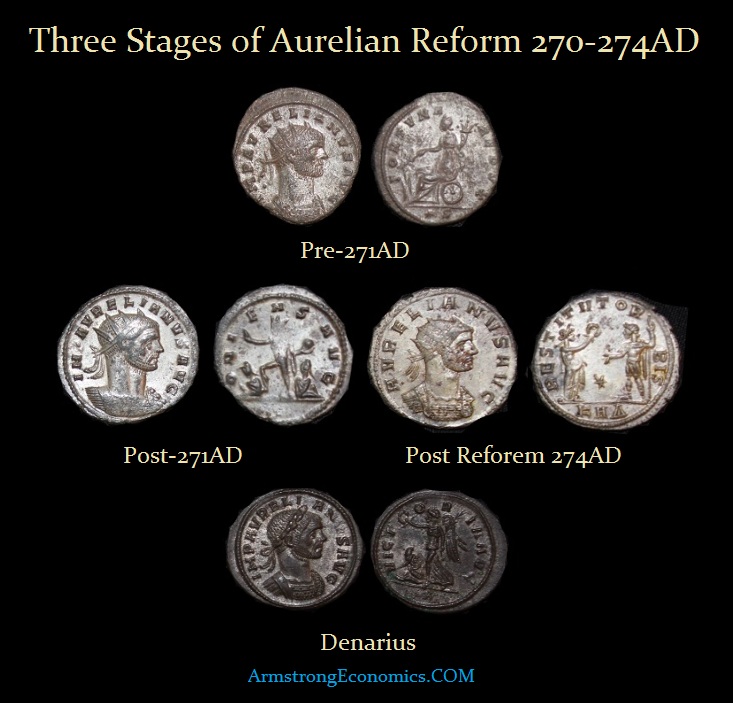
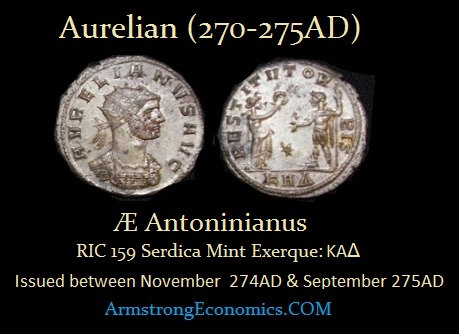
Therefore, Aurelian became emperor in 270 AD and he returned to Rome in 271 AD, where he had to pacify a terrified city. He immediately halted the rioting and restored order to the capital. The controller of the mint in Rome began a rebellion over the monetary reforms laid out by Aurelian. He ordered that all the debased currency be purchased back and replaced with a new currency of higher content in silver. The rebellion was led by Felicissimus. It appears that those who had been running the mint were embezzling the intended silver and issuing the debased coinage at least in part on their own authority.
Obviously, any reform to the monetary system that called for an increase in silver content would have been unprofitable for those running the mint for personal gain. In the rebellion, as many as 7,000 soldiers died when Aurelian was forced to trap and execute them and their allies, some of the senatorial ranks, in a terrible battle on the Caelian Hills. Thereafter, Aurelian then introduced mintmarks to identify if any mint was cheating the silver content.
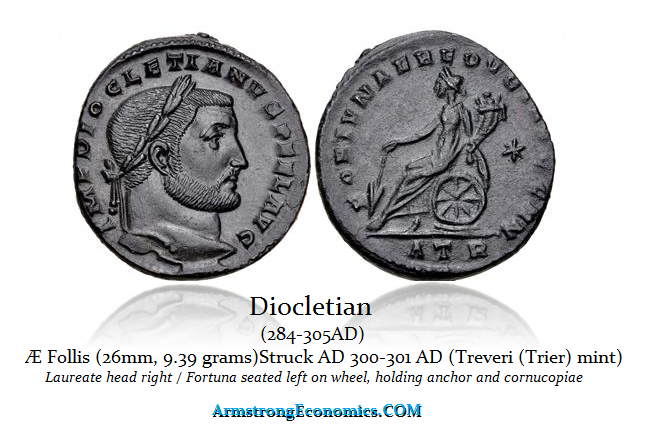
When Diocletian (284-305AD) reorganized the coinage when he came to power as well as the political structure of the Roman Empire. With respect to politics, he divided the empire in two creating two emperors with their eventual successors given the rank of Caesar. This became the Tetrarchy.
The monetary reform introduced the new bronze coinage silver plated known as the follis terminating the radiate antoninianus which had begun as a double denarius during the reign of Caracalla (198-217AD). Diocletian required each mint to engrave their coins with an identifiable mint mark, and also letters or marks to indicate the individual workshops (officina) within the mints. Thereby, any collusion to debase the coinage would be identifiable to a specific group within each mint.
Each mint mark from Diocletian onwards consists of a group of letters identifying the mint (normally in the exergue) and usually (but not always) letter(s) and/or mark(s), sometimes in the exergue, sometimes in the field, These identified the individual workshop within the mint. In the West, workshops were numbered either in Latin numerals I, II, III or in the initial letters of Latin ordinals such as P(rimus), S(ecundus), T(ertius). The problem with Latin surfaced when trying to distinguish between S(ecunda) and S(exta) or between Q(uarta) and Q(uinta). They had to develop in the West a mixed system of Greek and Latin to give P(rima), B, T(ertia), Q(uarta), E, and S(exta) valid meanings. Western mints sometimes used the Greek system at varying times.
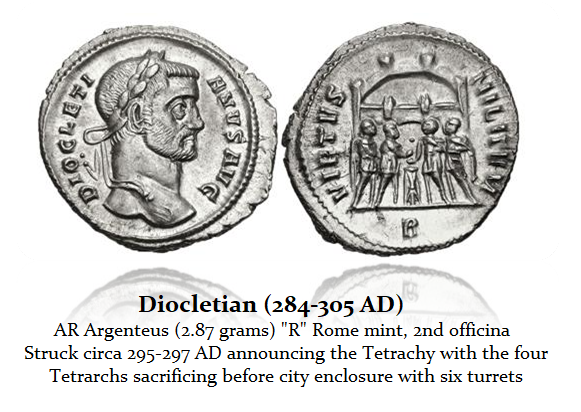
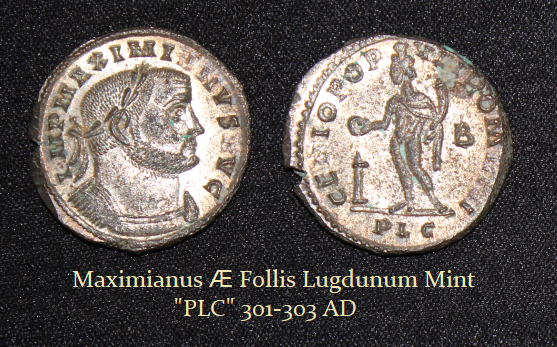
Here we can see a silver Argentius (2.87 grams) with the “R” Roman mint mark. Lugdunum used “PL” for their mint mark as illustrated by this follis of Maximianus – Diocletiuan’s co-emperor.
Posted originally on the CTH on February 21, 2023 | Sundance
Follow the bouncing ball of consequence….
(Via Daily Mail) Vegetable rationing could last for ‘weeks’, it was warned today, after Morrisons joined Asda to became the second major supermarket to limit sales of certain items.
Perishables like tomatoes, potatoes, cucumber and broccoli have been restricted to just two or three per customer in a host of stores up and down the country.
The crisis has developed in recent weeks due to soaring energy costs which have forced British farmers to switch off greenhouses as they desperately try to make ends meet – leaving a dearth of home-grown produce. (read more)
While it is prudent to remind everyone how fortunate we are to have Florida, California and Mexico for North American vegetable supplies, ie. no dramatic supply shortages, the energy price pressure being applied by Biden policy will lead to even higher consumer prices for all row crops.
18 months ago (Oct 2021), CTH first strongly recommended restarting victory gardens at home. The same recommendation only strengthens.
COMMENT: Martin, After several years of reading your blog, I have concluded that Socrates’ prognostications appear to be spot on. I also share your assertion that a study of history supplies an insight into future events due to the constancy of “human nature.” Where we appear to part ways is in the definition of “money.”
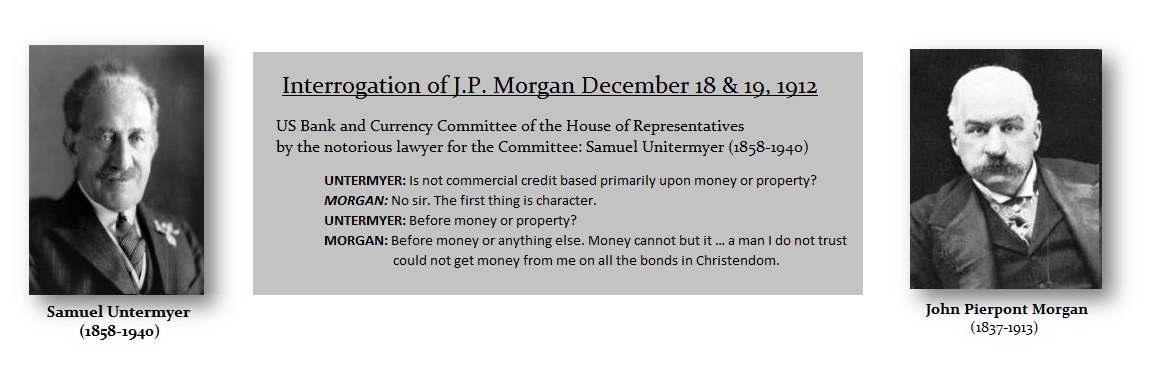
In the early 20th century J. P. Morgan said: “Gold is money; everything else [used as currency] is credit.” Hence, paper money, (and digital entries in an electronic ledger) when issued by a monopolist i.e. government, inevitably descends to its intrinsic value: zero.
AN
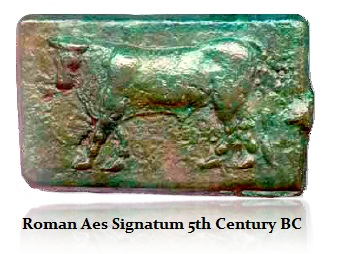
ANSWER: Human society has recorded our monetary history and you should not confuse irresponsible government with what is really money. I have a great deal of Respect for J.P. Morgan. If you asked the question of what is money in a Babylonian, it would be a silver shekel. Even the Bible spoke of weighing the silver and how Judas sold out Christ for a handful of silver coins. To a Greek from Anatolya (Turkey), he would have said it is a stater. To an Athenian, he would say a drachma. A Roman would have replied a denarius. But when Rome was first forming, money had been cattle which became thereafter bronze. Indeed, if you had asked before all of them, a Minoan, would have it was bronze. Money has been many things including sea shells, and cattle.
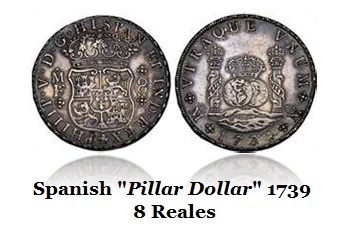
A Spanish during the 15th century would have said it was a one-ounce silver reale. The German would have said no – it’s the silver thaler. The British would disagree and said it was the pound sterling (.925 silver). The Americans, not wanting to be subservient to England, adopted the dollar, which was a version of the German thaler. In Asia, it was the cash, then the yen.
Saint Patrick in the 5th Century AD upon his arrival in Ireland, found that MONEY was expressed in human slave girls. He wrote in his Confession,“I think that I have given away to them no less than the price of fifteen humans.” This passage shows something very important. First, MONEY is not defined as the Medium of Exchange exclusively. It also serves the purpose of a Unit of Account. In fact, this becomes the true function of MONEY even more so than what it is. MONEY is a language of value.
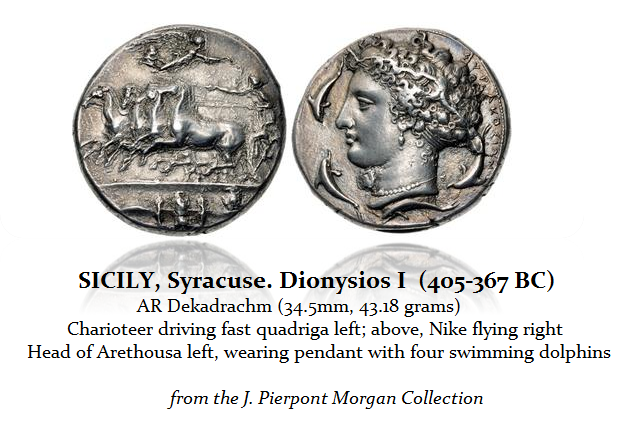
Many of the major bankers, kings, and heads of companies were ancient coin collectors including President Teddy Roosevelt. JP Morgan understood banking and credit – but not money. This was a Syracuse Dekadrachm of Dionysios I (405-367BC) was one of the coins from his collection that was eventually sold by the coin firm Stacks of New York in September 1983. You can download that catalog. People like Josiah K. Lilly Jr. and Paul A. Straub donated their collections to the Smithsonian.
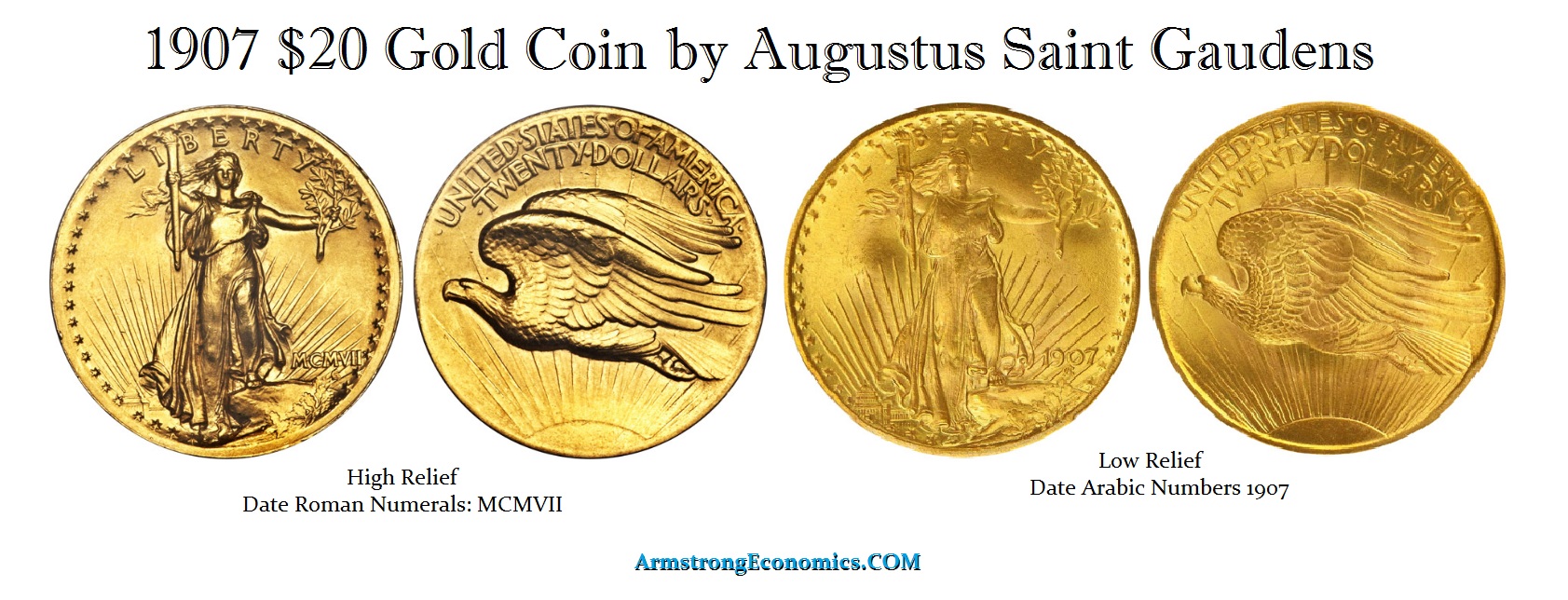
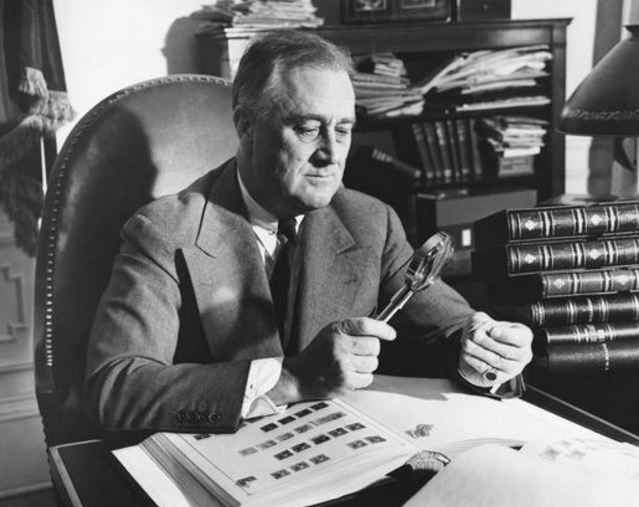
Teddy Roosevelt (1858-1919) loved the high relief of ancient Greek coins. When Teddy Roosevelt became president on September 14, 1901 – March 4, 1909, he commissioned the artist Augustus Saint-Gaudens (1848 –1907) to redesign the $20 gold coin and made it high relief as the ancient coins had been struck. The machines could not handle the high relief for the dies would break and they lacked the power of an individual stamping out coins. Thus, the new $20 gold coins had to be reduced in their relief. Nevertheless, we have ancient coins to thank for the limitation on the confiscation of gold in 1934. It was that very reason that his cousin FDR exempted ancient gold coins from confiscation when FDR was himself a stamp collector instead.
I would say the problem here is the definition of money and what predates coinage was the development of a weight standard to enable trade. That invention of weighing technology appears to emerge around 3100 to 3000 BC. This was the most significant turning point in monetary history for it marked the beginning of economic history itself.
It was private merchants during the Bronze Age that created the weight systems. Trade took place through informal networks, but it was clearly Mesopotamian merchants who established a standardized system of weights that later spread across the Western region and into Europe. This innovation enabled international trade across the continent. By the second millennium BC, merchants could potentially trade anywhere in Western Eurasia simply by knowing the conversion factors of a multitude of local weight units. What was emerging was the formation of weight systems that was the foundation for the booming commercial interaction of the Bronze Age world.
From the very beginning, MONEY has been a commodity – nothing more. It simply began a barter. I will give you these carrots for potatoes. When the Lydian King Kroisos (561-546BC) created the first bimetal monetary system, a gold stater was about 10.71 grams and the silver-gold ratio was 13.33:1 because gold was common in the Turkey. The inflation caused by war led to a gold weight reduction to 8.71 grams. Fiscal mismanagement existed from the very beginning. This would have been no different than FDR revaluing gold in 1934 from $20.67 to $35 per ounce.
There were competing standards from the very beginning. The Lydian/ Milesian standard began with an electrum stater at 14.2 grams. The stater as minted under the Euboic Standard was 17.2 grams of electrum. There was the Phokaic Standard placing the electrum stater at 16.1 grams. Obviously, foreign exchange dealers became necessary for international trade among the city states.
I can find no evidence of a single standard that dominates the nations at this time. By 530BC, the invention of coins spreads to Greece and now the first city state begins to strike a silver stater at 12.6 grams – the Isle of Aigina. In Greece, silver was common and gold was rare.
In Athens they established the Attic Standard based on a silver didrachm (2 drachms) of 8.6 grams, but as inflation emerged, the standard coin became the tetradrachms (4 drachms) at 17.2 grams. So you can see there may have been gold and silver used as MONEY, but by no means was there a unified standard agreement as to weight. In Corinth, they set their stater at 8.5 grams and divided it into three drachms. Standardization comes only with conquest as was the case with Napoleon. Athens dominated many city states and in 449BC issued its famous enigmatic “Coinage Decree” promulgated by Perikles that restricted other city states from striking coins making their coins a single currency. Perhaps it was just a power play. On the other hand, it was most likely just the profit earned over the raw metal cost known as seigniorage. In other words, the coins once minted purchased more in goods than the raw metal.
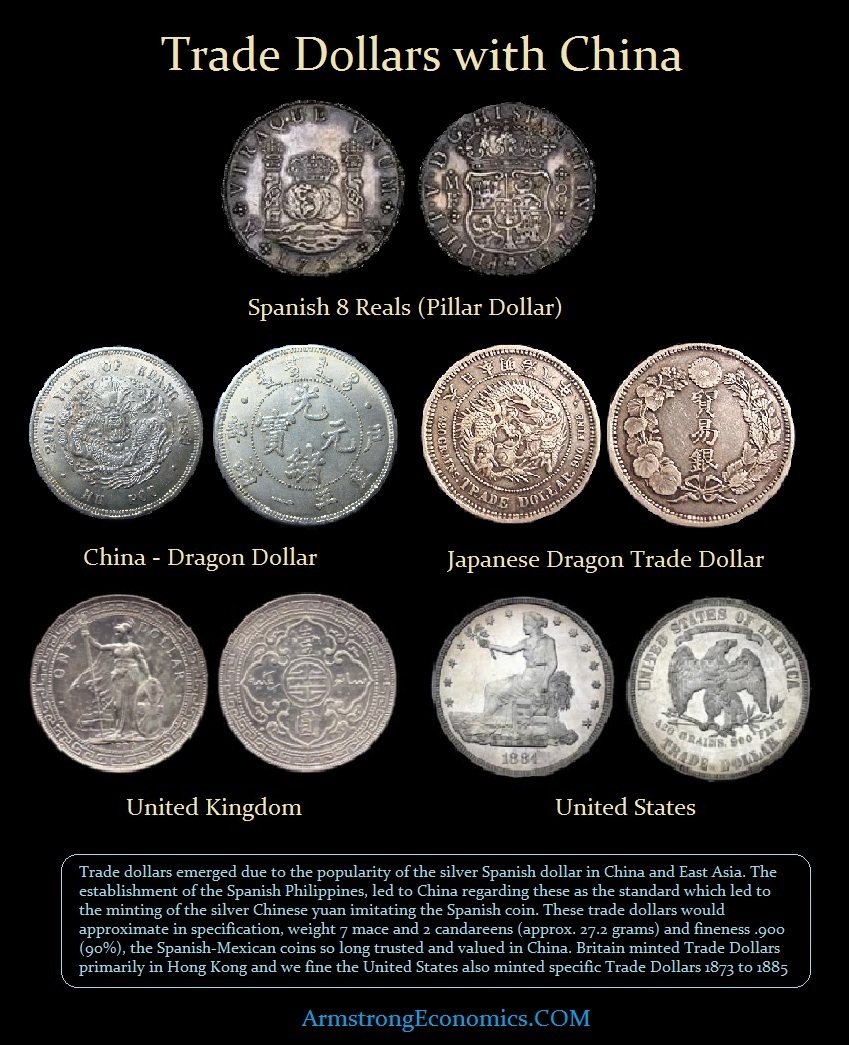
China did not use gold. They had a silver standard. The West had to create silver trade dollars set to their weight standard, which was heavier than the standard United States silver dollar. There have been different monetary systems throughout world history. They have not all been based on precious metals. What it always boils down to is the capacity of the people to produce. There are plenty of places with natural resources and the countries are barely even 3rd world. China, German, and Japan rose from the ashes without gold. Their people produced and they rose to the top of the list of economies despite others having gold.
The bottom line has always been that the wealth of a nation is nothing more than they total productivity of its people.
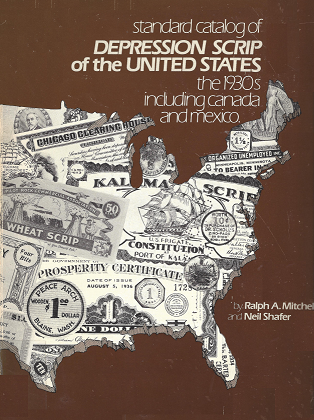
QUESTION: At the WEC, you said as the nation breaks apart, the most likely course of action will be the creation of local currencies. You also said you would post a catalog of Depression Scrip. I have not seen that. Can you post that, please?
Thank you for a great WEC. Always learning something new.
GJ
ANSWER: Sorry. I may have forgotten to publish that because I searched Amazon and could not find it. It was published back in 1984. Because Depression Scrip is not a huge field of collectors largely because most have never heard of the existence of private currency during the Great Depression, this book is quite rare. You may find some used copies that go for $125 or more.
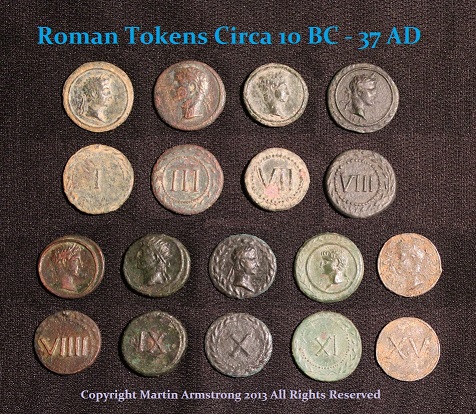
I have studied the subject from the standpoint of economics. During the reign of Tiberius (14-37AD), he was very frugal and as such there was a shortage of money which led to a Financial Panic in 33AD. During such periods, private money surfaces as a necessity. This is why history repeats because human nature never changes. It will always respond the same way.
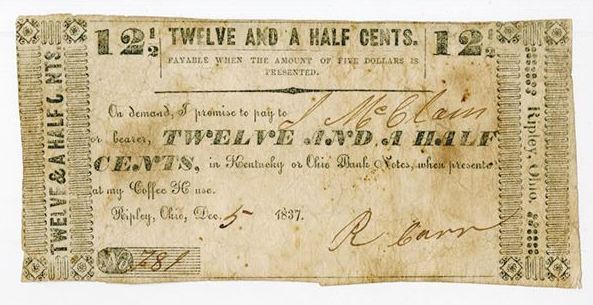
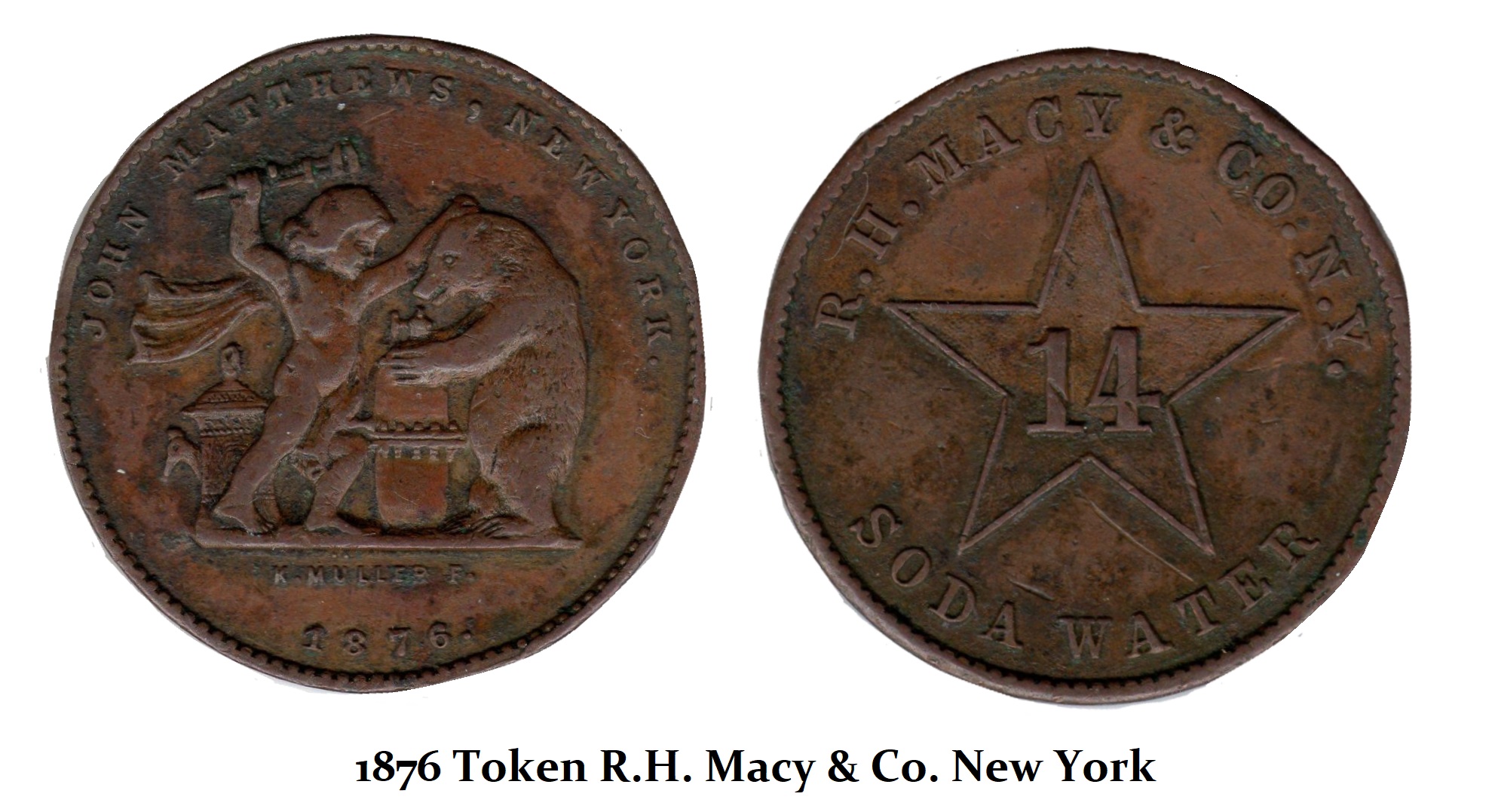
Here is private money from the Panic of 1837. The denomination reads 12 1/2 cents. This was issued by a Coffee House. Here is a half-penny issued by the New York store of Macy’s in 1876 following the Panic of 1873.
Throughout history, we see the very same reaction each and every time. I have collected a large number of private currencies covering the various financial waves of panic since Roman times. It has been a critical part of being able to forecast what takes place during these events. The common denominator is always humanity since we never change for thousands of years. We only progress in terms of technology – not our human emotions.
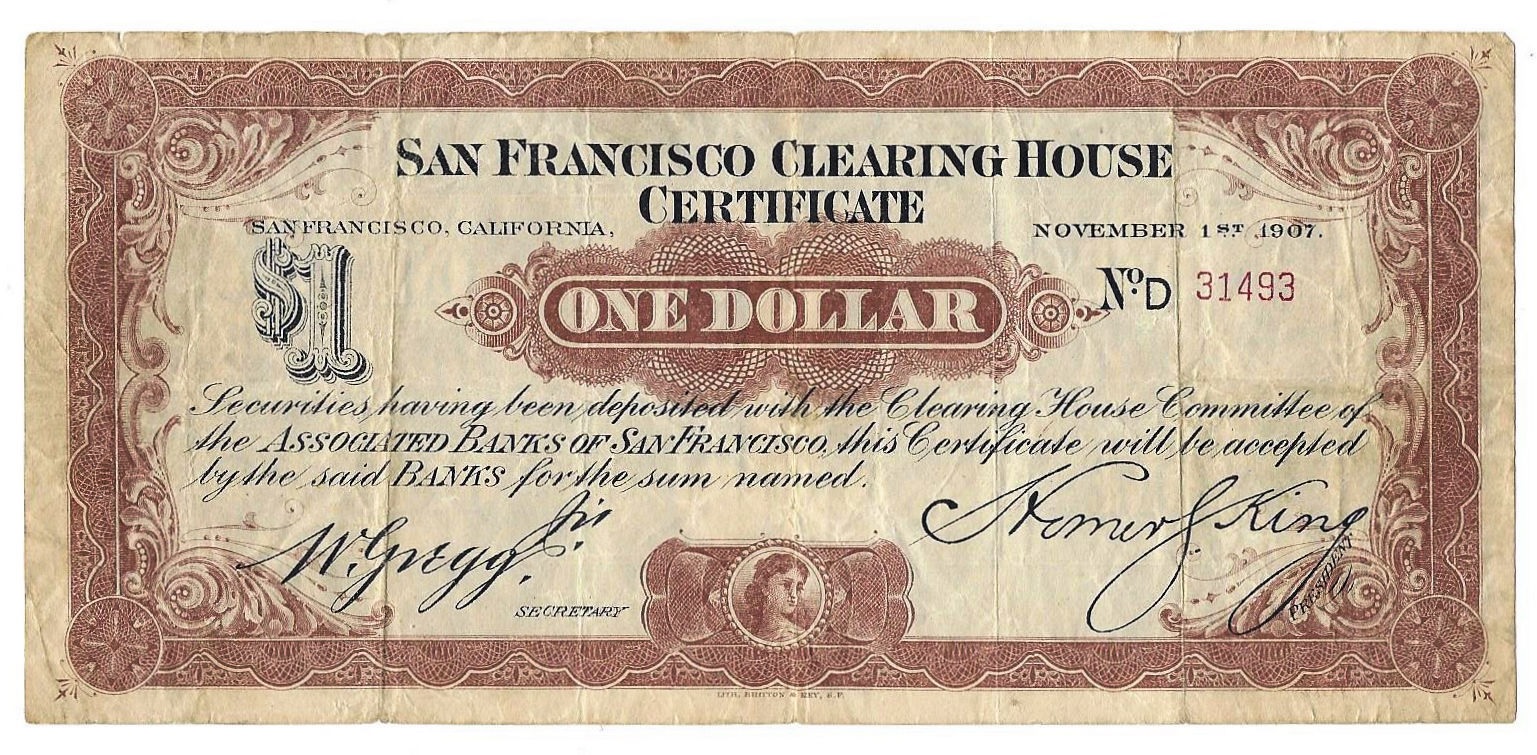
Here is private scrip issued by the San Francisco Clearing House where transactions were settled in the bond and stock markets. The backing was the private shares in companies. This was the Panic of 1907.
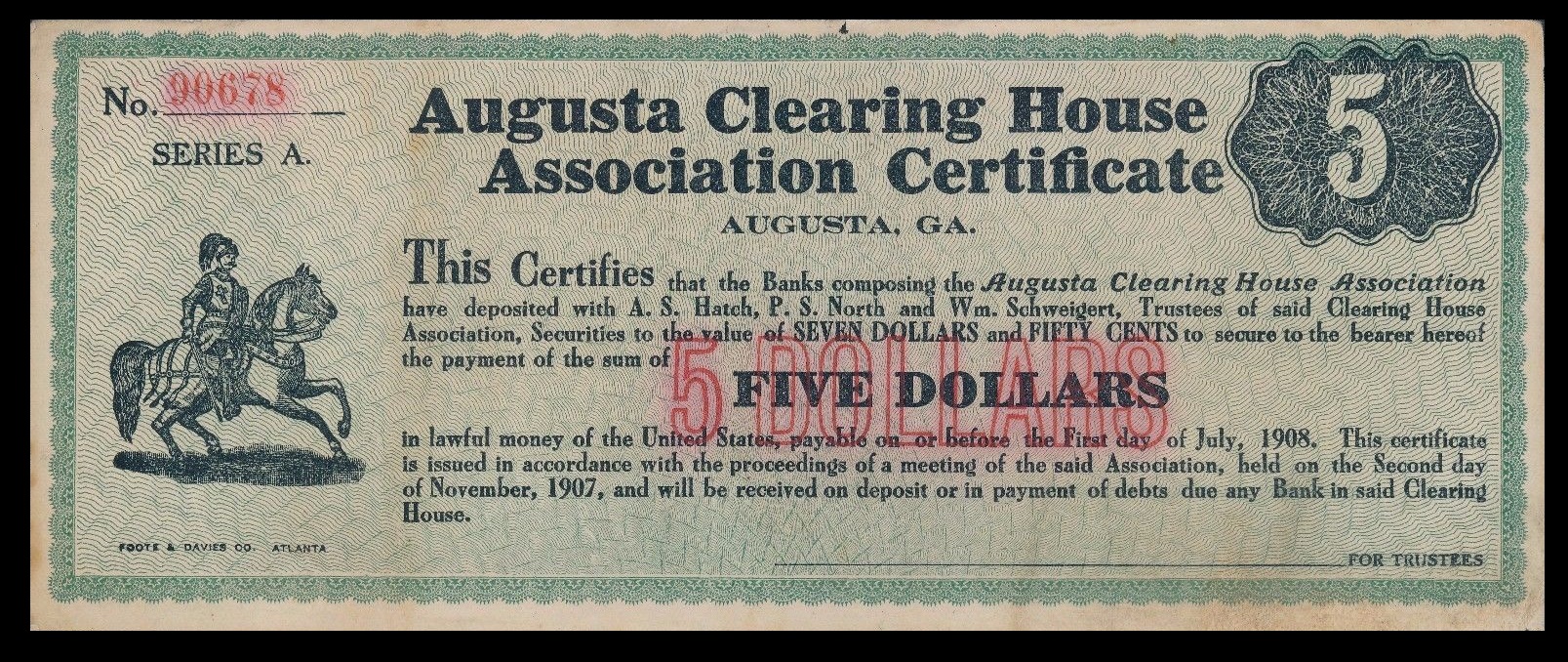
Here is another issued in 1908 in Augusta, Georgia. It was the Panic of 1907 that really we began to see widespread stock exchanges issuing money that began because if there was a shortage of cash, you could not conduct any business whatsoever since it was impossible to pay.
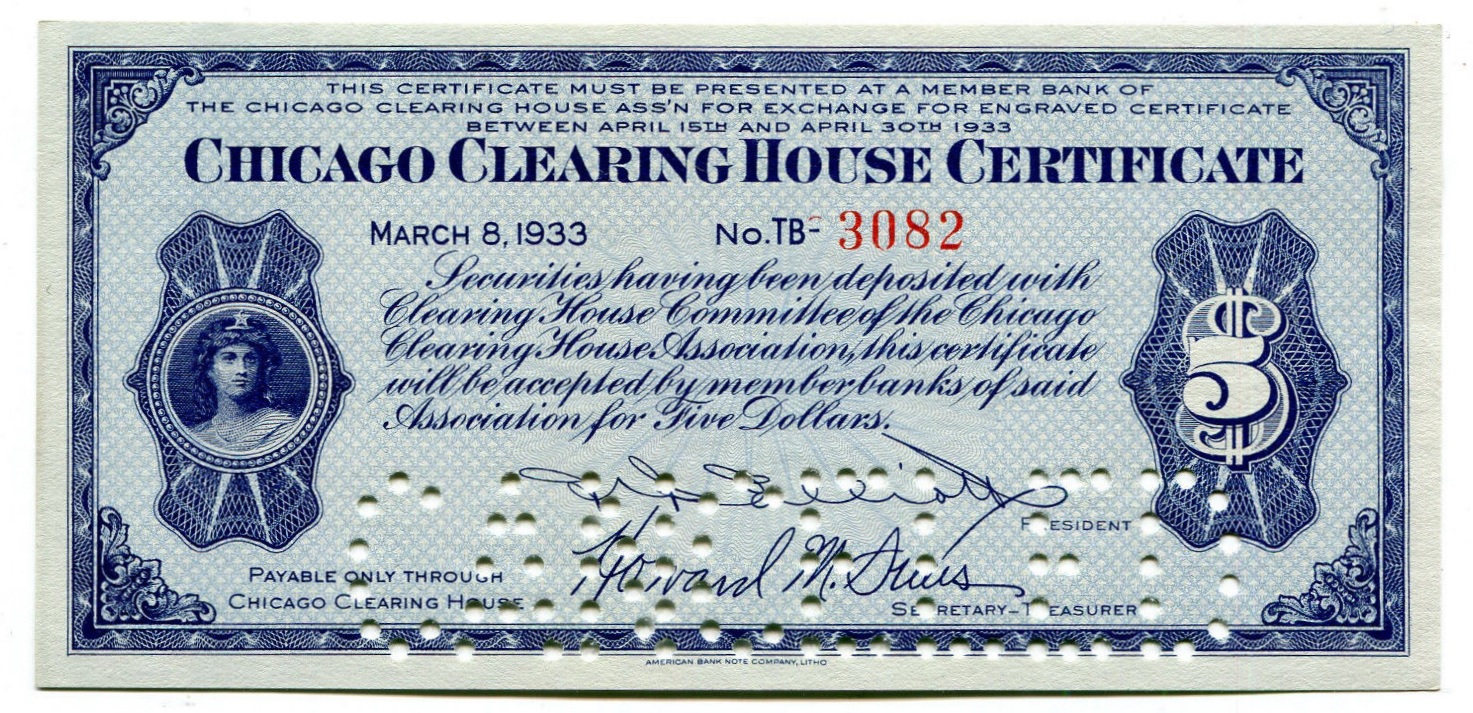
Here is the Chicago Clearing House which issued private money during the Great Depression in 1933. We find various stock exchanges issuing private currency in times when there was a shortage of money because people were hoarding their cash in times of uncertainty.
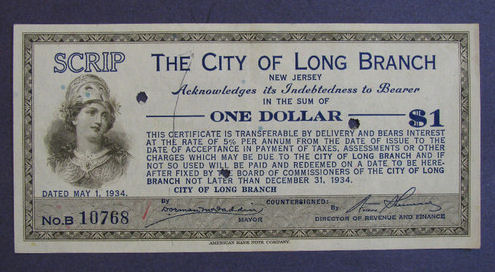
This was the very first Depression Scrip I ever saw and immediately purchased it. This opened the door in economics for me to understand how things function during a great crash. What took place during the Great Depression was that there was such a shortage of cash, over 200 cities began to issue their own currencies just to enable transactions to take place. Businesses could not hire people because there was no available cash to pay them
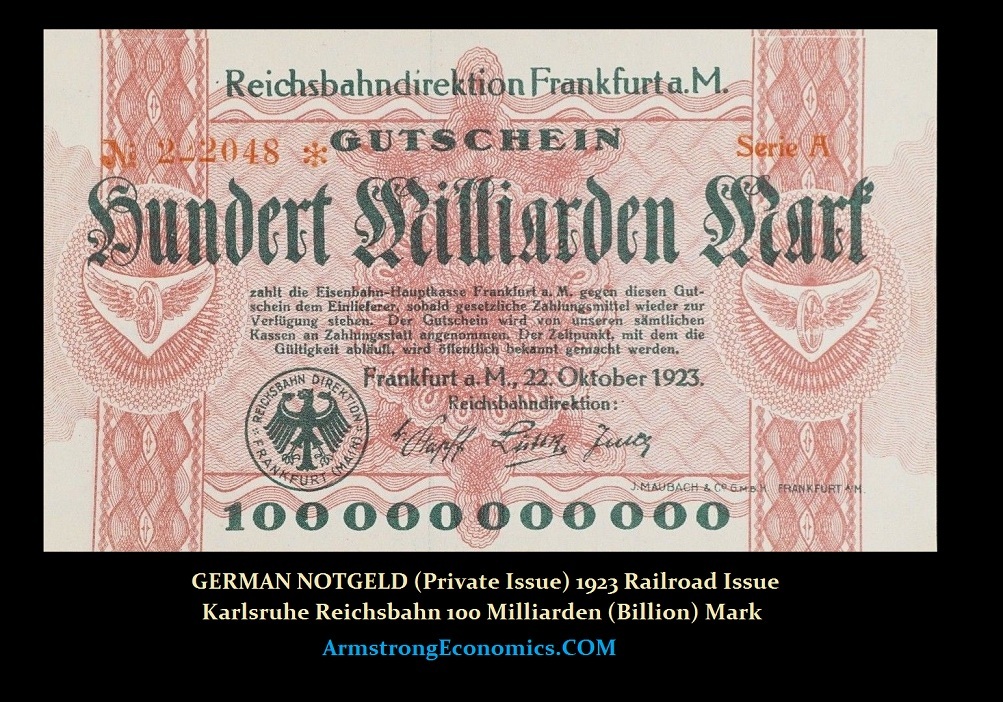
There are catalogs available in German concerning the NotGeld, private issues of currency, during the Hyperinflation of the 1920s. Once again, it does not matter what nation or culture. The same human response will unfold every time.
As the United States breaks up, as is the case in Europe, we will see currencies appears on a regional basis. This is how it will always work. I spent more than two decades investigating these trends and collecting scrip from all financial crises going back to ancient times. Without access to these examples, there is just no economic historical account that has ever tied all of this together. I had to explore this all on my own.
QUESTION: Marty, Ever since the debacle in London with the long-term debt, there have been whispers in NYC about how the demand for long-term is drying up. When this becomes critical, is that when the whole thing comes crashing down?
KW
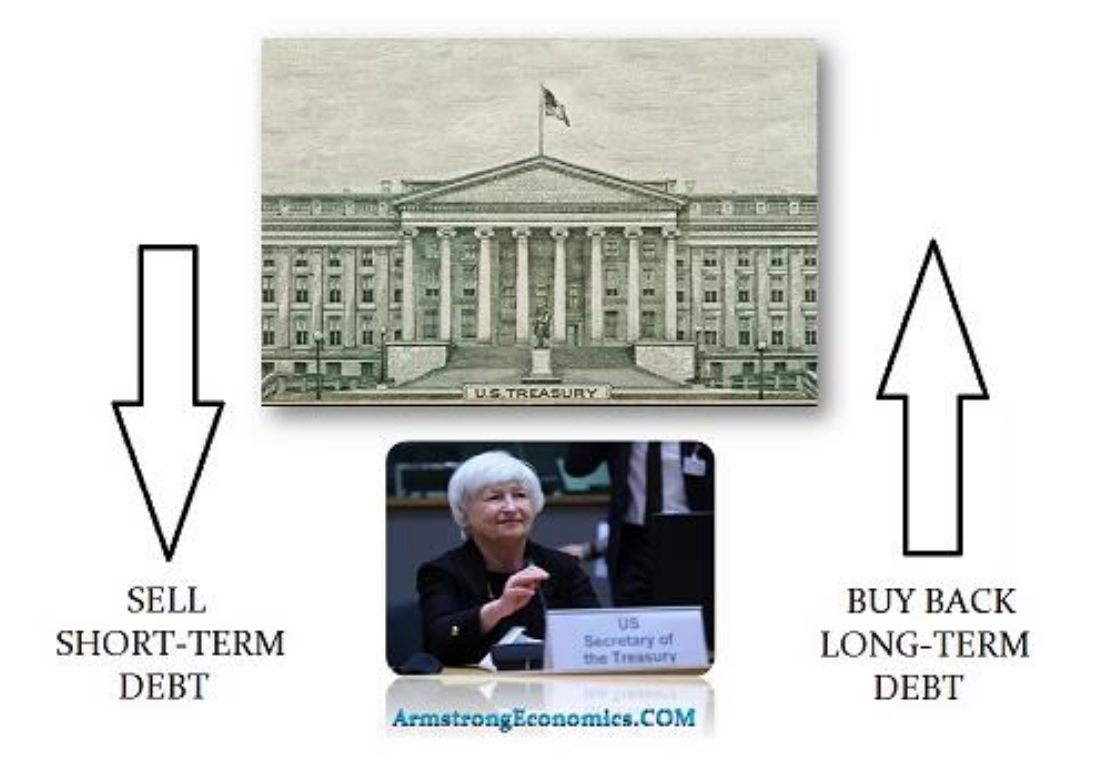
ANSWER: That was the real gist of Yellen’s speech back in October of 2022. Of course, the US press will never elaborate on this problem until it smacks them in the face. Yellen publicly admitted that the Treasury asked the primary dealers of US government debt for their views on the merits and limitations of a buyback program. The Treasury Borrowing Advisory Committee, made up of market participants, highly recommended considering the move because the demand for long-term was declining.
Yellen herself publicly acknowledged the decline in trading volume in 20-year bonds, which they reintroduced in 2020 thanks to COVID. Quoting from her direct comments:
“The 20-year Treasury is an area, an issue where there’s been less liquidity — but we haven”t made any decisions about it.”
Even the Securities Industry and Financial Markets Association came out and publicly also stated last October that there had been episodes of illiquidity. This was the same problem that created the Crisis in the Long-term British gilt market.
Institutions do not want to buy the long-term in the face of (1) rising interest rates to fight inflation, and (2) unlimited handing of money to Ukraine that will NEVER come back for Ukraine is a black hole and reliable sources are deeply concerned that Ukraine will lose and exist no more.
The escalation in debt on the horizon with World War III is beyond the capacity of the Primary Dealers to buy. They are strained now with the debt expansion for socialism, then Ukraine, and add War, this system is cracking NOW! The Primary Dealers cannot buy more debt than their balance sheets allow. The “whispers” running around have been on the street. The press has not articulated this for (1) it’s above their pay grade to comprehend, and (2) they cannot dare report the truth.
Posted originally on the CTH on February 6, 2023 | Sundance
John Boyd Jr., President of the National Black Farmers Association appears on Newsmax TV to discuss the ongoing issue of higher farm input costs. Energy costs, fertilizer costs, fuel costs as well as all packing and distribution costs that are associated with petroleum manufacturing, are continuing to drive farm costs throughout the supply chain.
After a review of the current farm output status, there is a very strong possibility we will see the fourth wave of food inflation hit this spring, in combination with several manufacturing and production facilities. Again, the lack of consumer spending on durable goods has moderated the price in hard goods (supplies up, demand down); however, the highly consumable products like food, fuel and energy continue to experience upward price pressure as a direct result of Biden energy policy. WATCH:
.
If consumers could eat missiles and weapons, the U.S. government would be offsetting the costs. Unfortunately, for actual farming products, there is no government attention, policy or support. Apparently, food is still not considered a national security issue.
Posted originally on the CTH on February 3, 2023 | Sundance
Not only does the buck not stop with Biden, the installed occupant of the White House refuses to admit the buck even started with him. It did!
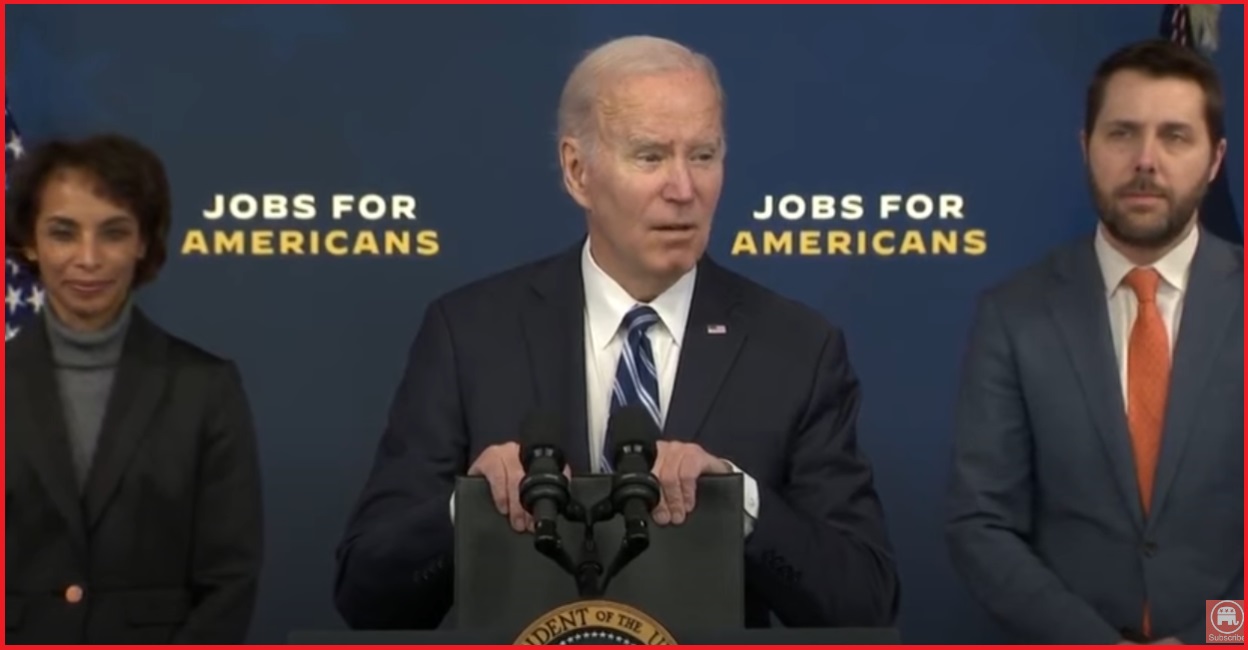
During remarks to the press today, even Brian Deese looked stunned as Joe Biden incredulously claimed he didn’t cause the rampant inflation that is crushing middle class Americans. Oh, he started it alright…. He not only started it, but he also created it.
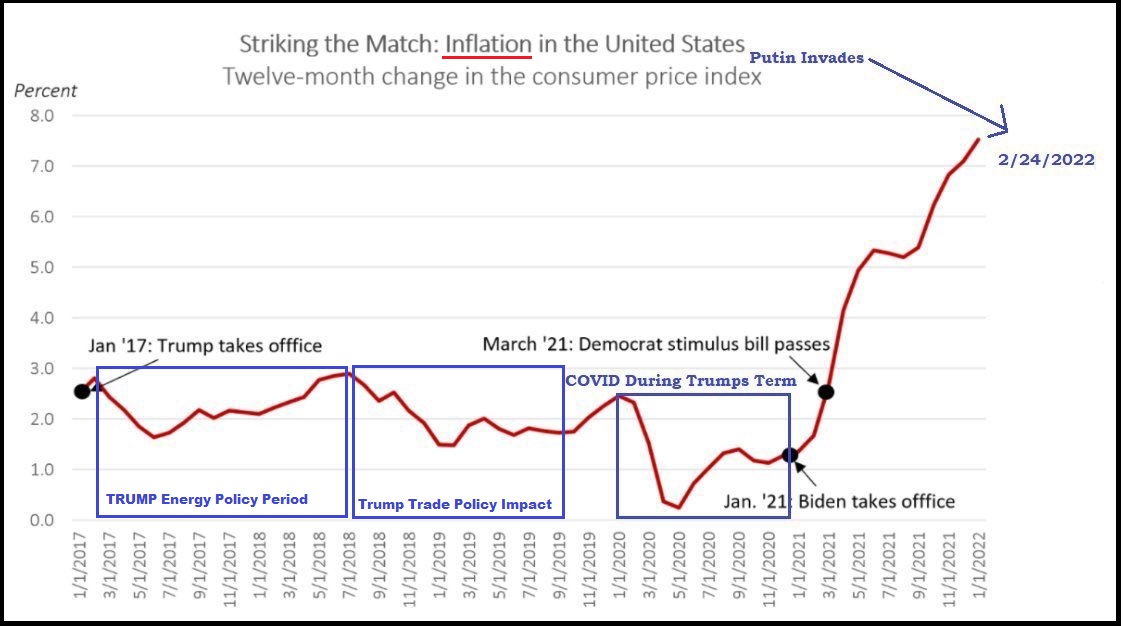
The combination of the January 2021 immediate move to block any domestic energy development, in combination with the April 2021 unneeded explosion of deficit spending triggered both a supply side and demand side inflationary impact; with the former continuing to put massive upward pressure on prices still. WATCH:
The lies from the lying, liar who lies, just flow so easily from his mouth.
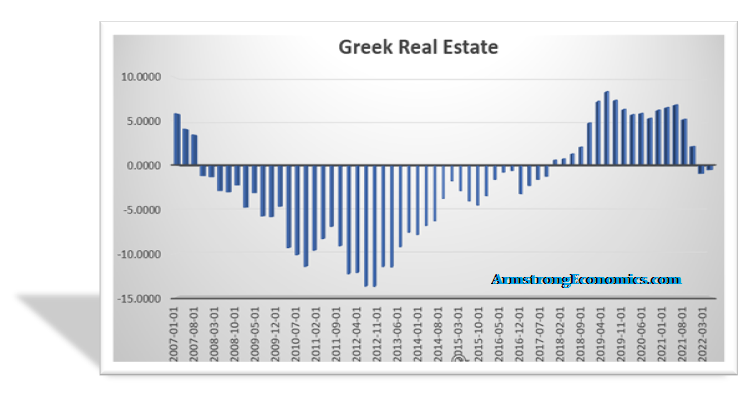
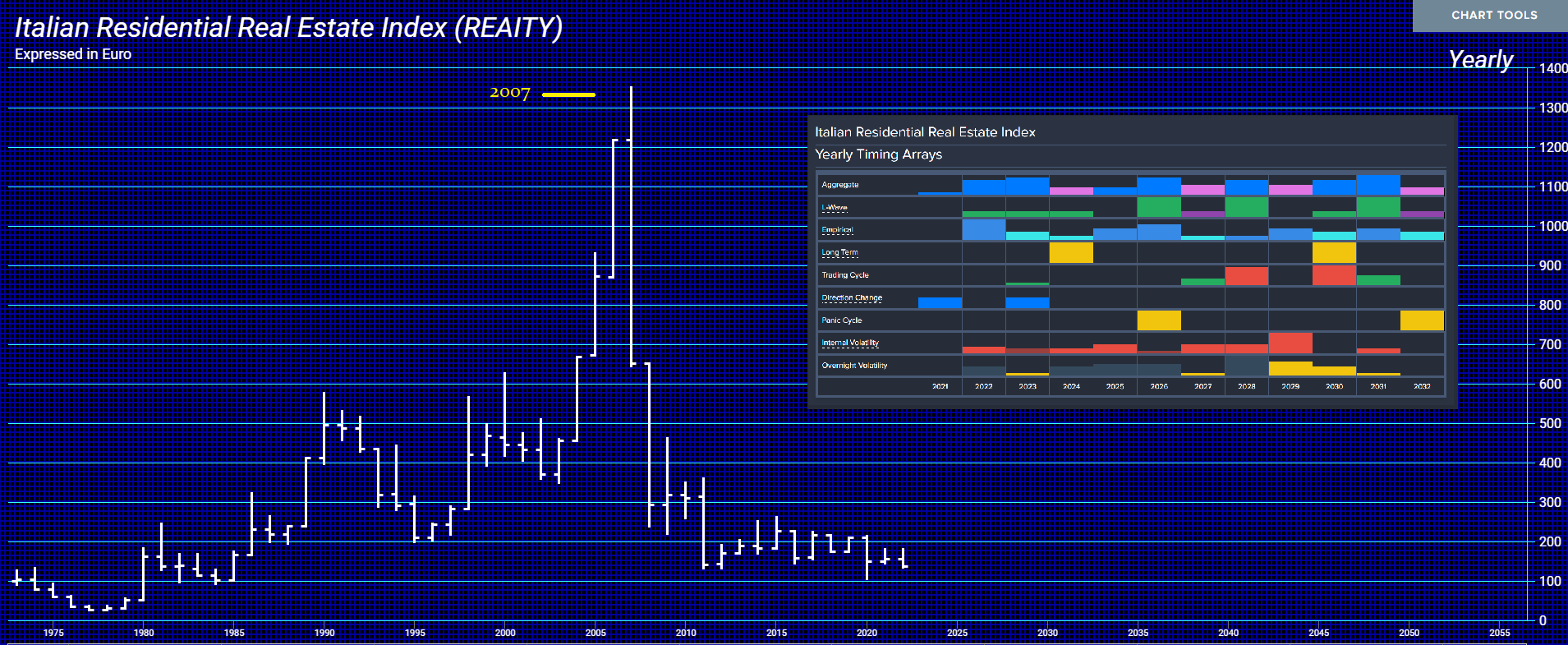
QUESTION: Dear Sir, Hello from Europe and a hopeful new year. In WW2 in Athens, people were exchanging their apartments for a few liters of olive oil, hence real estate went really down. The short question that you can answer even with a yes or no: If this year’s aggressivity in terms of war actions will rise, what happens? Will real estate fall on the first stage and then – due to governmental actions – will rise again? It is a bit confusing while I am trying to understand the mechanism… economy is not simple at all. Thank you. SM
ANSWER: The real truth about real estate and war, declines the closer you get to the action. When we look at our models for European real estate, it clearly shows 2023 as a directional change and it appears to be heading into a Panic Cycle for 2027. Our leaders project like we should all go charge into Russia and defeat it in a matter of weeks or just days. Besides the fact that they never discuss that civilian deaths are twice as high as military, they also never talk about how the net worth of everyone in Europe will decline. Your house will decline in value for (1) people are not interested in buying a new home in times of uncertainty, and (2) interest rates will rise sharply due to inflation which is also part of the war cycle.
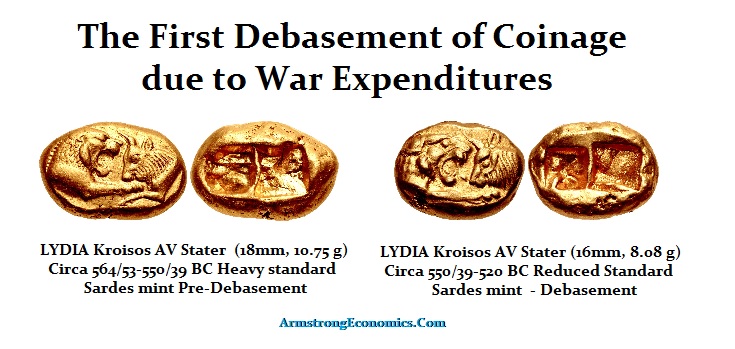
Lydia, in modern Turkey where coins were invented, shows the impact of war. It was Lydia v Person (Cyrus the Great) and we see the very first debasement in recorded history which accompanies war. The coinage was debased showing roughly a 25% devaluation in the purchasing power during the 6th century BC.
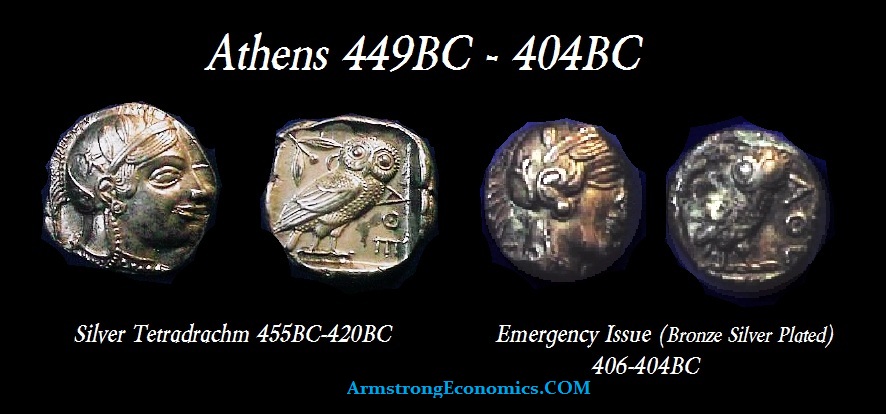
The Peloponnesian War in Greece saw the Athenian Owl reduced from silver to bronze and just silver plated. We find the same trend in Rome. There is NEVER any exception to this rule.
Beware, as the West insists upon expanding this war, you are sacrificing all your life savings in real estate for the political nonsense of our leaders in Europe as a whole. They are true war criminals. They could settle this in a day. Just honor the Minsk Agreement.
I have created this site to help people have fun in the kitchen. I write about enjoying life both in and out of my kitchen. Life is short! Make the most of it and enjoy!
This is a library of News Events not reported by the Main Stream Media documenting & connecting the dots on How the Obama Marxist Liberal agenda is destroying America







 Centinel2012