Office of Management and Budget Director Mick Mulvaney holds a press briefing to discuss the upcoming government funding lapse – aka. ‘The Schumer Shutdown”, that well, doesn’t actually shut anything down…


Office of Management and Budget Director Mick Mulvaney holds a press briefing to discuss the upcoming government funding lapse – aka. ‘The Schumer Shutdown”, that well, doesn’t actually shut anything down…
QUESTION: Martin.. I have been trading /investing for over 20 plus years.
How can one be in the markets and survive if the “biggest Safest Banks” in Canada are failing even today to not only fill a trade or give you a reliable quote but even to even give you an accurate account balance!
ANSWER: This is a growing problem being caused by (1) excessive regulation and (2) the juniorization of staff. Institutions have been firing people with experience to reduce cost replacing them with entry people. This is becoming widespread throughout Europe and sets the stage for a very dangerous situation. Covertly, there is an assumption that those with experience should be removed and juniors put in place and they will not fear the crash as experienced traders and that will help eliminate short positions against the government.
On top of these issues, we then have the problem of aggressive governments trying to defend themselves forcing even institutional trading to be politically correct. If the market goes down, the regulators will begin hauling in traders for interrogation. This is an exceptionally high risk in Europe.

Politically Correct Trading
Individual non-Americans can open accounts in the USA. Americans are turned away overseas. So for the individual, you do have to be concerned especially about dealing in Europe. The more any government interferes with the free markets, the greater the risk that your funds will be frozen and you will not be able to trade. It just may come down to having once again to trade “politically correct” to avoid being targeted.
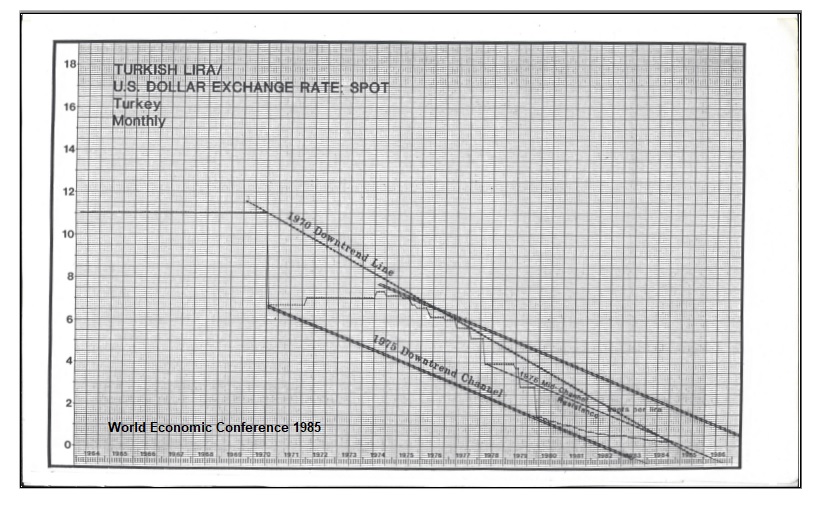
I am currently working on coding my synthetic correlation model I use to use in the Middle East back in the 1980s. The problem then was rather different. We were advising one Islamic Bank where the board made the decision to open in Turkey. However, the currency was in a perpetual decline. This is the chart from the materials handed out for the 1985 World Economic Conference. The problem back then was the lack of any market to hedge the Turkish Lira. We had to create a synthetic model correlation cyclically to tackle the hedging project we were given. That was one of the most interesting projects of my career – hedging something that did not trade.
We are bringing this model back into play because there are rising concerns among our European clients that if they hedge against the decline of the Euro and government bonds in the EU when the collapse unfolds, they will be targeted for undermining the government. The way to avoid this and be “politically correct” traders, is to once again create synthetics correlated with time.
With the hostility in Europe eliminating the ability to short government bonds in a pathetic attempt to prevent the collapse of the EU bond market, it is paramount that we resurrect our synthetic models in order to be “politically correct” in trading what will no doubt turn into a witch-hunt once again.
I wrote in the Greatest Bull Market in History in the 1930 chapter, that the witch-hunts began subtly. One of the first targets was a young trader named John Pope.
One such early victim was a young broker named John W. Pope who was only 32 at the time. He reportedly had been a soft-spoken chap, quite independent, and a student of values. He firmly believed that stocks always sought their values up or down. In 1930, John was accused of forcing Fox Films down, as it was alleged that if he had not been short the stock would not have plummeted as far down. The New York Stock Exchange summoned the young fellow before their board of governors. They interrogated him in a way that Time magazine called a “harrowing trial by statistics.”[1] John W. Pope pulled out his charts and his studies of Fox Films and demonstrated that the stock had been seriously overvalued in comparison to historical measurements. The board found no malicious reports of rumors started by Pope, and his documentation as to why Fox Films had been overvalued won the day. He was completely exonerated, but this would be a dangerous trend that eventually led to the witch hunts of the 1930s.
[1] “Business: Trial by Statistics” Time (New York, NY) Dec. 22, 1930.
The founder of that company, William Fox, was summoned to the US Senate. They failed to show he was short against his own company. Never satisfied that government could ever be wrong, they then prosecuted Fox for tax evasion on a single transaction out of thousands. I explained in the Greatest Bull Market in History:
The bear-hunt continued … Gray [Prosecutor] summoned William Fox, once the proud owner of Fox Films. William Fox, upon his arrival in Washington, became ill. Fox’s doctor claimed he had an attack and stated that he believed Fox had diabetes. But Gray, depraved, perverse and suspicious a person as he was, held true to his character. Gray simply wouldn’t believe him. Gray hired a physician to check Mr. Fox’s condition with orders to report directly to Mr. Gray. When that doctor also reported that William Fox was seriously ill, Gray still refused to believe it and then hired a third doctor ordering him to check the condition of this Mr. Fox. All three doctors agreed that Fox was very ill.
Gray still scoffed at the situation and proceeded with his case against Fox without his being present to raise his defense. Gray charged Fox had “wrecked” his former companies through stock market activity. He revealed countless details of his stock transactions right down to how much his daughter had owned. But all the evidence which Gray had compiled did not show Fox as a bear-raider but as a dead and battered bull. Gray was still not satisfied. Gray uncovered what he called a fraud. Gray accused Fox on one transaction out of several thousands of willful fraud again while Fox was still confined to his bed. Fox had dealt in the name of his company as well as in his personal name from time to time. Gray charged that on one transaction Fox had deducted a loss incurred in the market which he claimed the company had originally paid for.
The Committee naturally flaunted this in the face of the press and then announced that they were turning Mr. Fox over to the IRS. Mr. Gray took much pleasure in announcing publicly that “the recovery of evaded income tax will offset the expense (of the proceedings) 100 times,” as they voted to continue the investigation despite having failed to turn up the illustrious bear who had supposedly destroyed the market and perpetrated the Depression upon the entire world.

QUESTION: You have talked about bitcoin and are rightly skeptical as we all should be, yet creative destruction rolls on. What insights do you have to share about the Dapps and Ethereum? In reading your blog for several years now you have truly opened many peoples minds. Thank you for your insight!
KS
ANSWER: If you want to trade Bitcoin, use the futures. The futures market will bring stability to the price and open the door for hedging what is otherwise at times an illiquid market. Understand one thing. This is all part of the shift from Public to Private. Cryptocurrencies are marketed as some magic money that will be free of the fiat world of government. That is total nonsense for governments will by no means allow that to happen. Nevertheless, this is part of the same anti-government movement that brought Trump to the White House, BREXIT, Catalonia uprising, Ukraine revolution and so on. This is the rise in the stock market and the shift of capital from government bonds to equities. This will all end in a monetary crisis event perhaps as soon as 2021.
Keep in mind that Coinbase had to give up everyone’s name to the IRS and they sent out notices warning people they better claim their profits because the IRS will be looking to audit anyone trying to hide their gains from taxes. The technology of Bitcoin is inferior to other currencies. I believe in the end, we are moving toward electronic money but the governments will control it. This idea that somehow it is safer because it is outside the central banks is really nonsense. So is gold, commodities, real estate, and shares. There is a huge void with respect to counterparty risk in the cryptocurrency world and the fees to use this stuff are outrageous. I do not see this as a viable situation moving forward in time. It also requires a power grid. Take that out and you have nothing. The good old tangible things will always survive. If society collapsed, electronic money in all forms may not survive. Also remember that today only about 4% of all transactions take place in paper money. We already live in an electronic monetary system.
COMMENT: Mr. Armstrong; I live in Germany. I wanted to send my father €200 for Christmas. I had to prove where the money came from. It does seem as if there is a major gap between those trading the euro for big banks and the people. I left Romania for freedom. Everything that I fled from has seemed to follow me to the West. Those who cheer the rise of the euro seem oblivious to the reality on the street. We have no real government in place here since nobody won a majority. The clash between freedom and oppression is playing out in silence. I fear this will just explode all of a sudden as it did behind the Iron Curtain.
PB
REPLY: You are not alone. I have several Russian, Hungarian, and Ukrainian friends who all express the same concerns. The fact that you fled to freedom and then see the very aspects of government that made you flee in the first place have taken hold in the West is all part of the cycle. This is simply how Empires, Nations, and Citystates collapse. They are always the same – a constant search for more power to retain their control. Then it all snaps. That comes typically when a government can no longer feed its own workforce to keep the people in check.

Revolt of the Heraclii 608-610 AD of Carthage
Emperor Phocas (602-610) persecuted the Aristocrats (rich) seeking taxation causing capital to go into hiding and the VELOCITY of money to decline. His reign did more than any other to begin the process of a significant decline of the Byzantine Empire. His tyrannical treatment of wealth led to a rebellion that began in North Africa by the exarch of Carthage, Heraclius in 608AD, who had been a leading and respected general under the previous emperor Maurice Tiberius (582–602).
This tax rebellion that began in Carthage, spread throughout the provinces. The funds were thereby raised to put together a considerable effort under Heraclius and his son. This major effort gathered a massive fleet that sailed toward the capital Constantinople. When they reached Constantinople, the gates were opened and Phocas was handed over. He was promptly executed being abandoned, and his statue he had constructed in the Hippodrome was now publicly burned. The young Heraclius was crowned by the Patriarch and began a new dynasty as Heraclius (610-641AD). His father did NOT assume the role of co-emperor showing his motives were to simply save his nation.

What most people do not know about history is the fall of government typically comes from tax rebellions. Michael IV the Paplagonian (1034-1041AD) raised taxes excessively setting in motion the collapse in VELOCITY of money once again as people hoarded their wealth creating the essential element to the destruction of an economy as you see in Europe today. Once capital begins to hoard and hide from the government tax collectors, the beginning of the end appears. In the case of Byzantium, this was set in motion by a tax hike and aggressive tax collection. The Slav population of the Balkans rebelled against the taxation. Michael IV himself was present to put down the tax rebellion oppressing the people and pillaging what they had.

The heavy taxation had also contributed to the demise of the small landowner. Thus, the higher the tax rates, the less production took place. The Empire had begun a vicious downward economic spiral that was not understood. Isaac I, Comnenus (1057-1059) embarked on a mission to strengthen the Byzantine Empire. His fatal mistake was one of finances. The treasury was depleted. The gold coinage had been debased, and the high taxation did nothing but send the economy into a downward spiral. Unable to tax the people, they began to run out of precious metal. Isaac I now did what so many other rulers had done before him; i.e. Napoleon, Henry VIII, and all Communists. He confiscated Church property with no other option. The Patriarch protested, and Isaac had him arrested and put on trial on trumped up charges of heresy. The Patriarch died before judgment or trial, yet the people were so outraged, Isaac I was forced to abdicate and go to a monastery.

What people do not credit is the Muslim conquest of Byzantium with the fact that they had the support of most Jews and many Christians. Why? The Muslim government eliminated the abusive taxation of the Byzantine Empire that was plagued with tax rebellions all the time. The Jewish revolt against Heraclius was part of the Byzantine–Sasanian War of 602–628. This was the final attempt by Jews to gain autonomy in the Land of Israel prior to modern times.
President Trump and team have released the TOP Eleven Fake News Stories of 2017:

11. “RUSSIA COLLUSION!” Russian collusion is perhaps the greatest hoax perpetrated on the American people. THERE IS NO COLLUSION!
10. The New York Times FALSELY claimed on the front page that the Trump administration had hidden a climate report.
09. CNN FALSELY reported that former FBI Director James Comey would dispute President Trump’s claim that he was told he is not under investigation.
08. Newsweek FALSELY reported that Polish First Lady Agata Kornhauser-Duda did not shake President Trump’s hand.
07. CNN FALSELY reported about Anthony Scaramucci’s meeting with a Russian, but retracted it due to a “significant breakdown in process.”
06. CNN FALSELY edited a video to make it appear President Trump defiantly overfed fish during a visit with the Japanese prime minister. Japanese prime minister actually led the way with the feeding.
05. Washington Post FALSELY reported the President’s massive sold-out rally in Pensacola, Florida was empty. Dishonest reporter showed picture of empty arena HOURS before crowd started pouring in.
04. TIME FALSELY reported that President Trump removed a bust of Martin Luther King, Jr. from the Oval Office.
03. CNN FALSELY reported that candidate Donald Trump and his son Donald J. Trump, Jr. had access to hacked documents from WikiLeaks.
02. ABC News’ Brian Ross CHOKES and sends markets in a downward spiral with false report about Michael Flynn testifying against President Trump.
01. The New York Times’ Paul Krugman claimed on the day of President Trump’s historic, landslide victory that the economy would never recover.

CNN took a production crew to Youngstown Ohio to talk to formerly registered Democrats who switched parties in 2016 in order to support Donald Trump.
A year into President Trump’s administration, CNN asks them if they still support Donald Trump. The answers seemed to confound the questioner, CNN’s Martin Savage. And when the topic of illegal immigration surfaces, Savage had a ‘splodey head, WATCH:
.
Yes, after a year of 24/7/365 MSM onslaught – the media are unable to break the power behind MAGA. The perspective of this representative group is exactly why Democrats are apoplectic and thrashing wildly for anything to stop President Trump. And Democrats are threatening to shut down government to maintain illegal immigration?…


U.S. Secretary of Education Betsy DeVos gave a far-ranging speech Tuesday in Washington at an American Enterprise Institute conference, “Bush-Obama School Reform: Lessons Learned.” Most media reporting outlines Mrs. DeVos presentation to state ‘the era of common core education is now dead“…
The full transcript of Secretary DeVos remarks is below:
 [Transcript] “Thank you, Rick, for that kind introduction. Who would’ve thought that after we were last together on a panel in Grand Rapids a couple of years ago, I’d be here in this capacity today?
It’s an honor to be with all of you at an organization I have long appreciated.
AEI is now in its 80th year and in that near century, the Institute’s scholars have influenced and shaped the way Americans think about so many issues in the public square. AEI has been – and will continue to be – a treasured constant in this town of transition. And it should be noted that’s due in no small part to the leadership of Arthur Brooks, who brings a unique and compelling perspective. I’m grateful to call him a friend.
I’d like to especially thank Rick and Michael for putting this volume together and for hosting today’s important discussions. Both of you have contributed significantly to the policy debates in American education, and, importantly, you’ve put your distinct perspectives and experience to work with the goal of improving education for all. You both left the classroom out of frustration, and there are still far too many teachers who share that experience today.
My work over thirty years has revolved around time spent on the outside, looking in. Outside Washington. Outside the LBJ building. Outside “the system.” Some have questioned the presence of an outsider in the Department of Education, but, as it’s been said before, maybe what students need is someone who doesn’t yet know all the things you “can’t do.”
To a casual observer, a classroom today looks scarcely different than what one looked like when I entered the public policy debate thirty years ago. Worse, most classrooms today look remarkably similar to those of 1938 when AEI was founded. Take a look at this! These two operating rooms look starkly different, as does this general store and this website. But these two classrooms look almost identical.
The vast majority of learning environments have remained the same since the industrial revolution, because they were made in its image. Think of your own experience: sit down; don’t talk; eyes front. Wait for the bell. Walk to the next class. Repeat. Students were trained for the assembly line then, and they still are today.
Our societies and economies have moved beyond the industrial era. But the data tell us education hasn’t.
The most recent Program for International Student Assessment, or PISA, report, with which you are all familiar, has the U.S. ranked 23rd in reading, 25th in science and 40th in math. And, you know this too: it’s not for a lack of funding. The fact is the United States spends more per pupil than most other developed countries, many of which perform better than us in the same surveys.
I know that hard truth touches a nerve for everyone in this room. It does so for educators who try to help their students realize their potential. For employers who seek prepared employees. And, most importantly, for parents who only want the best for their children.
Of course there have been many attempts to change the status quo. We’ve seen valiant efforts to improve education from Republicans and Democrats, liberals, conservatives and everyone in between.
That’s because everyone is aiming for the same result.
Everyone wants students to be prepared and to lead successful lives.
We can’t say that sort of public harmony exists in other policy arenas. Not everyone agrees about the outcome or goal of tax policy or energy policy or immigration policy.
Our unity of purpose here presents an opportunity.
But while we’ve changed some aspects of education, the results we all work for and desire haven’t been achieved.
The bottom line is simple: federal education reform efforts have not worked as hoped.
That’s not a point I make lightly or joyfully. Yes, there have been some minor improvements in a few areas. But we’re far from where we need to be. We need to be honest with ourselves. The purpose of today’s conversation is to look at the past with 20/20 hindsight, examine what we have done and where it has – or hasn’t – led us.
First, let me be clear that I’m not here to impugn anyone’s motives. Every one of us wants better for students. We want better for our own children. We want better for our communities and our country. We won’t solve any problems through finger-pointing.
I also don’t intend to criticize the goals of previous administrations’ education initiatives. In the end, every administration has tried to improve education for students and grow the number who are learning valuable skills.
We should hope – no, we should commit – that we as a country will not rest until every single child has equal access to the quality education they deserve. Secretary Spellings was right to ask “whose child do you want to leave behind?”
But the question remains: why, after all the good intentions, the worthwhile goals, the wealth of expertise mustered, and the billions and billions of dollars spent, are students still unprepared?
With No Child Left Behind, the general consensus among federal policymakers was that greater accountability would lead to better schools. Highlighting America’s education woes had become an American pastime, and, they thought, surely if schools were forced to answer for their failures, students would ultimately be better off.
President Bush, the “compassionate conservative,” and Senator Kennedy, the “liberal lion,” both worked together on the law. It said that schools had to meet ambitious goals… or else. Lawmakers mandated that 100 percent of students attain proficiency by 2014. This approach would keep schools accountable and ultimately graduate more and better-educated students, they believed.
Turns out, it didn’t. Indeed, as has been detailed today, NCLB did little to spark higher scores. Universal proficiency, touted at the law’s passage, was not achieved. As states and districts scrambled to avoid the law’s sanctions and maintain their federal funding, some resorted to focusing specifically on math and reading at the expense of other subjects. Others simply inflated scores or lowered standards.
The trend line remains troubling today. According to the most recent National Assessment of Educational Progress data, two-thirds of American fourth graders still can’t read at the level they should. And since 2013, our 8th grade reading scores have declined.
Where the Bush administration emphasized NCLB’s stick, the Obama administration focused on carrots. They recognized that states would not be able to legitimately meet the NCLB’s strict standards. Secretary Duncan testified that 82 percent of the nation’s schools would likely fail to meet the law’s requirements — thus subjecting them to crippling sanctions.
The Obama administration dangled billions of dollars through the “Race to the Top” competition, and the grant-making process not so subtly encouraged states to adopt the Common Core State Standards. With a price tag of nearly four and a half billion dollars, it was billed as the “largest-ever federal investment in school reform.” Later, the Department would give states a waiver from NCLB’s requirements so long as they adopted the Obama administration’s preferred policies — essentially making law while Congress negotiated the reauthorization of ESEA.
Unsurprisingly, nearly every state accepted Common Core standards and applied for hundreds of millions of dollars in “Race to the Top” funds. But despite this change, the United States’ PISA performance did not improve in reading and science, and it dropped in math from 2012 to 2015.
Then, rightly, came the public backlash to federally imposed tests and the Common Core. I agree – and have always agreed – with President Trump on this: “Common Core is a disaster.” And at the U.S. Department of Education, Common Core is dead.
On a parallel track, the Obama administration’s School Improvement Grants sought to fix targeted schools by injecting them with cash. The total cost of that effort was seven billion dollars.
One year ago this week, the Department’s Institute of Education Sciences released a report on what came of all that spending. It said: “Overall, across all grades, we found that implementing any SIG-funded model had no significant impacts on math or reading test scores, high school graduation, or college enrollment.”
There we have it: billions of dollars directed at low-performing schools had no significant impact on student achievement.
These investments were meant to spark meaningful reforms. Schools were encouraged to significantly alter their teaching staffs, fire the principal or change the structure and model of the school. But most glossed over those recommendations. They simply took the federal money and ran the school the same old way.
So where does that leave us? We saw two presidents from different political parties and philosophies take two different approaches.
Federally mandated assessments. Federal money. Federal standards. All originated in Washington, and none solved the problem. Too many of America’s students are still unprepared.
Perhaps the lesson lies not in what made the approaches different, but in what made them the same: the federal government. Both approaches had the same Washington “experts” telling educators how to behave.
The lesson is in the false premise: that Washington knows what’s best for educators, parents and students.
Rick, you’ve rightly pointed out that the federal government is good at making states, districts, and schools do something, but it’s not good at making them do it well. Getting real results for students hinges on how that “something” is done.
That’s because when it comes to education – and any other issue in public life – those closest to the problem are always better able to solve it. Washington bureaucrats and self-styled education “experts” are about as far removed from students as you can get.
Yet under both Republican and Democratic administrations, Washington overextended itself time and time again.
Educators don’t need engineering from Washington. Parents don’t need prescriptions from Washington. Students don’t need standards from Washington.
Throughout both initiatives, the result was a further damaged classroom dynamic between teacher and student, as the focus shifted from comprehension to test-passing. This sadly has taken root, with the American Federation of Teachers recently finding that 60 percent of its teachers reported having moderate to no influence over the content and skills taught in their own classrooms.
Let that sink in. Most teachers feel they have little – if any — say in their own classrooms.
That statistic should shock even the most ardent sycophant of “the system.” It’s yet another reason why we should shift power over classrooms from Washington back to teachers who know their students well.
Federal mandates distort what education ought to be: a trusting relationship between teacher, parent and student.
Ideally, parent and teacher work together to help a child discover his or her potential and pursue his or her passions. When we seek to empower teachers, we must empower parents as well. Parents are too often powerless in deciding what’s best for their child. The state mandates where to send their child. It mandates what their child learns and how he or she learns it. In the same way, educators are constrained by state mandates. District mandates. Building mandates… all kinds of other mandates! Educators don’t need Washington mandating their teaching on top of everything else.
But during the years covered in your volume, the focus was the opposite: more federal government intrusion into relationships between teachers, parents and children.
The lessons of history should force us to admit that federal action has its limits.
The federal-first approach did not start with No Child Left Behind. The push for higher national standards was present in the Clinton administration’s “Goals 2000” initiative. Before that, we had President George H.W. Bush’s “America 2000,” also calling for higher national standards. These followed the Reagan administration’s “Nation at Risk” report, released in 1983.
That report gave dire warnings about the country’s track if education was not reformed. “If an unfriendly foreign power had attempted to impose on America the mediocre educational performance that exists today,” the report warned, “we might well have viewed it as an act of war.” That came after President Carter’s giant nod to union bosses: the establishment of the Department of Education, with the ironic charge to “prohibit federal control of education.”
The trend is evident. Politicians from both parties just can’t help themselves. They have talked about painting education in new colors and even broader strokes. But each time, reform has not fundamentally changed “the system.” Each attempt has really just been a new coat of paint on the same old wall.
When we try the same thing over and over again, yet expect different results, that’s not reform – that’s insanity.
We will not reach our goal of helping every child achieve his or her fullest potential until we truly change. Let me offer three ways we can move forward in that pursuit.
First, we need to recognize that the federal government’s appropriate role is not to be the nation’s school board. My role is not to be the national superintendent nor the country’s “choice chief” – regardless of what the union’s “Chicken Littles” may say! Federal investments in education, after all, are less than 10 percent of total K-12 expenditures, but the burdens created by federal regulations in education amount to a much, much larger percentage.
The Every Student Succeeds Act charted a path in a new direction. ESSA takes important steps to return power where it belongs by recognizing states – not Washington — should shape education policy around their own people. But state lawmakers should also resist the urge to centrally plan education. “Leave it to the states” may be a compelling campaign-season slogan, but state capitols aren’t exactly close to every family either. That’s why states should empower teachers and parents and provide the same flexibility ESSA allows states.
But let’s recognize that many states are now struggling with what comes next. State ESSA plans aren’t the finish line. Those words on paper mean very little if state and local leaders don’t seize the opportunity to truly transform education. They must move past a mindset of compliance and embrace individual empowerment.
Under ESSA, school leaders, educators and parents have the latitude and freedom to try new approaches to serve individual students.
My message to them is simple: do it!
Embrace the imperative to do something truly bold… to challenge the status quo… to break the mold.
One important way to start this process is to make sure that parents get the information they want and need about the performance of their children’s schools and teachers. ESSA encourages states to be transparent about how money is spent, down to the school-building level.
Some states have developed information that is truly useful for parents and teachers. Others have worked just as hard to obfuscate what is really going on at their schools. To empower parents, policymakers and teachers, we can’t let “the system” hide behind complexity to escape accountability.
We must always push for better.
ESSA is a good step in the right direction. But it’s just that – a step. We still find ourselves boxed in a “system,” one where we are in a constant battle to move the ball between the 40-yard lines of a football field. Nobody scores, and nobody wins. Students are left bored in the bleachers, and many leave, never to return.
So why don’t we consider whether we need a new playbook?
That brings me to point number two. And, to finish the analogy… let’s call a new play: empowering parents.
Parents have the greatest stake in the outcome of their child’s education. Accordingly, they should also have the power to make sure their child is getting the right education.
As Deven Carlson points out, there is little constituency in America for the top-down reforms that have been tried time and again. In order for any reform to truly work, it must attract and maintain the support of the people.
I have seen such support for parental empowerment. The more parents exercise it, the more they like it. This growing support is why states are responding to that demand one by one. It’s also why sycophants entrenched in and defending the status quo are terrified. They recoil from relinquishing power and control to teachers, parents and students.
Well, I’m not one bit afraid of losing power. Because I trust parents and teachers, and I believe in students.
Equal access to a quality education should be a right for every American and every parent should have the right to choose how their child is educated. Government exists to protect those rights, not usurp them.
So let’s face it: the opponents of parents could repeal every voucher law, close every charter school, and defund every choice program across the country.
But school choice still wouldn’t go away. There would still be school choices… for the affluent and the powerful.
Let’s empower the forgotten parents to decide where their children go to school. Let’s show some humility and trust all parents to know their kids’ needs better than we do.
Let’s trust teachers, too. Let’s encourage them to innovate, to create new options for students. Not just with public charter schools or magnet schools or private schools, but within the traditional “system” and with new approaches yet to be explored.
What we’ve been doing isn’t serving all kids well. Let’s unleash teachers to help solve the problem.
You know, I’ve never heard it claimed that giving parents more options is bad for mom and dad. Or for the child. What you hear is that it’s bad for “the system” – for the school building, the school system, the funding stream.
That argument speaks volumes about where Chicken Little’s priorities lie.
Our children deserve better than the 19th century assembly-line approach. They deserve learning environments that are agile, relevant, exciting. Every student deserves a customized, self-paced, and challenging life-long learning journey. Schools should be open to all students – no matter where they’re growing up or how much their parents make.
That means no more discrimination based upon zip code or socio-economic status. All means all.
It’s about educational freedom! Freedom from Washington mandates. Freedom from centralized control. Freedom from a one-size-fits-all mentality. Freedom from “the system.”
Choice in education is not when a student picks a different classroom in this building or that building, uses this voucher or that tax-credit scholarship. Choice in education is bigger than that. Those are just mechanisms.
It’s about freedom to learn. Freedom to learn differently. Freedom to explore. Freedom to fail, to learn from falling and to get back up and try again. It’s freedom to find the best way to learn and grow… to find the exciting and engaging combination that unlocks individual potential.
Which leads to my final point: if America’s students are to be prepared, we must rethink school.
What I propose is not another top-down, federal government policy that promises to be a silver bullet. No. We need a paradigm shift, a fundamental reorientation… a rethink.
“Rethink” means we question everything to ensure nothing limits a student from pursuing his or her passion, and achieving his or her potential. So each student is prepared at every turn for what comes next.
It’s past time to ask some of the questions that often get labeled as “non-negotiable” or just don’t get asked at all:
Why do we group students by age?
Why do schools close for the summer?
Why must the school day start with the rise of the sun?
Why are schools assigned by your address?
Why do students have to go to a school building in the first place?
Why is choice only available to those who can buy their way out? Or buy their way in?
Why can’t a student learn at his or her own pace?
Why isn’t technology more widely embraced in schools?
Why do we limit what a student can learn based upon the faculty and facilities available?
Why?
We must answer these questions. We must acknowledge what is and what is not working for students.
Now, I don’t have all the answers or policy prescriptions. No one person does. But people do know how to help their neighbors. People do know how they can help a dozen students here or 100 there. Because they know the students. They know their home lives. They know their communities. They know their parents. They know each other.
That means learning can, should, and will look different for each unique child. And we should celebrate that, not fear it!
I’m well aware that change — the unknown – can be scary. That talk of fundamentally rethinking our approach to education seems impossible, insurmountable.
But not changing is scarier. Stagnation creates risks of its own. The reality is…
we should be horrified of not changing.
Our children don’t fear their futures. Think of a newborn, born into hope — not fear. They begin life with a clean slate. With a fresh set of eyes to see things we don’t currently see. That’s how students begin their lifelong learning journeys… with unlimited potential… yet with limited time.
Their dreams, their hopes, their aspirations, their futures can’t wait, while another wave of lawmakers puts yet another coat of paint on the broken “system.” One year may not seem like much to an adult, but it’s much too long for the child who still can’t read “Goodnight Moon.”
We, the public, can’t wait either. Education is good for the public.
Everything else – our health, our economy, our continued security as a nation — depends on what we do today for the leaders of tomorrow. It follows, then, that any educator in any learning environment serves the public good. If the purpose of public education is to educate the public, then it should… not… matter what word comes before school.
What matters are the students the school serves. What matters are their futures. We’ve been entrusted with their futures not because we asked to be, but because it’s a duty to destiny – theirs… and ours. It all depends on what we do now.
When our grandchildren tell their children about this moment in history, let them say we were the ones who finally put students first.
Thank you, and I look forward to this conversation.

Meanwhile… the fake news media are cats chasing Trump’s dancing laser pointer…
MAGAnomics – The first round of economic results from 2017 holiday sales are coming in and the results are incredible. Total holiday sales from November and December increased 5.5% over the prior year, that’s a massive jump.
Keep in mind, two-thirds of GDP is attached to consumer spending. The spending jump to $692 billion will increase fourth quarter GDP growth when calculated.

(Via CNBC) Holiday sales jumped 5.5 percent compared with last year, marking the largest jump seen since the end of the Great Recession, the National Retail Federation said Friday.
Total sales for November and December were $691.9 billion, exceeding the industry trade group’s forecast of between $678.75 billion and $682 billion, which would have been an increase of between 3.6 and 4 percent.
“We knew going in that retailers were going to have a good holiday season but the results are even better than anything we could have hoped for,” NRF President and CEO Matthew Shay said.
Economists and advisors had expected robust spending across the board due to strong employment and consumer confidence. However, many questioned exactly where that increased spending would go.
Over the holidays, the strongest performers were building materials and supply stores (8.1 percent growth ), furniture (7.5 percent growth) and electronics (6.7 percent growth). Clothing/accessories and health/personal care clocked in weaker growth, up 2.7 percent and 2.2 percent, respectively. (read more)

Sarah Huckabee Sanders delivers the White House press briefing for Wednesday January 17th. Secretary Sanders is joined by a DOJ official to help show the connection between immigration policy and the evolving threat from terrorism.
Department of Justice, Asst. Attorney General Ed O’Callahan (part of the National Security Division), delivered remarks on the Departments of Justice and Homeland Security Release Data Release on Terrorism-Related Activity –SEE HERE-
.
U.S. Dept of Justice – Today, the Department of Justice (DOJ) and the Department of Homeland Security (DHS) released a report, revealing that three out of every four, or 402, individuals convicted of international terrorism-related charges in U.S. federal courts between September 11, 2001, and December 31, 2016 were foreign-born.
Over the same period, U.S. Immigration and Customs Enforcement removed approximately 1,716 aliens with national security concerns. Further, in 2017 alone DHS had 2,554 encounters with individuals on the terrorist watch list (also known as the FBI’s Terrorist Screening Database) traveling to the United States. (continue reading)

CNN Chief White House Correspondent Jim Acosta has a history of rude journalistic behavior and disrespect that has never before been allowed in the White House.
Today during an oval office meeting between President Trump and President Nursultan Nazarbayev of Kazakhstan the CNN journalist exhibited a level of disrespectful behavior that should lead to his White House press credentials being revoked permanently.

I have created this site to help people have fun in the kitchen. I write about enjoying life both in and out of my kitchen. Life is short! Make the most of it and enjoy!
De Oppresso Liber
A group of Americans united by our commitment to Freedom, Constitutional Governance, and Civic Duty.
Share the truth at whatever cost.
De Oppresso Liber
Uncensored updates on world events, economics, the environment and medicine
De Oppresso Liber
This is a library of News Events not reported by the Main Stream Media documenting & connecting the dots on How the Obama Marxist Liberal agenda is destroying America
Australia's Front Line | Since 2011
See what War is like and how it affects our Warriors
Nwo News, End Time, Deep State, World News, No Fake News
De Oppresso Liber
Politics | Talk | Opinion - Contact Info: stellasplace@wowway.com
Exposition and Encouragement
The Physician Wellness Movement and Illegitimate Authority: The Need for Revolt and Reconstruction
Real Estate Lending


