Biden Harris Inflation Continues Crushing Middle Class – Only Donald Trump Has the Policies to Stop it


Posted originally on the CTH on September 22, 2024 | Sundance 

If there is one economic dynamic we have talked about on these pages more than the rest, its inflation.  {Background}

The root causes of inflation are two-fold, monetary policy and energy policy.  However, when combined they represent a predictable outcome.  Specifically predictable, when it comes to highly consumable goods that require a lot of industrial effort, labor, distribution and warehousing processes.  Thus, food inflation was/is worst.

Within all of the sectors most vulnerable to upward price pressure as a result of policy (monetary and energy), the main industry impacted by immediate and severe inflation is food, farming and agriculture.  Food, a highly consumable product with a thin supply chain, sees the results of inflation first and fastest.  Durable good inflation lags behind high-velocity consumable goods.

It was with this understanding CTH first warned in 2020 of what would happen coming out of the COVID Pandemic economic crisis.  We predicted and watched in 2020 as one-third of all food supplies were destroyed because 50% of the food supply chain (restaurants, cafeterias, schools, food trucks, essentially food away from home) was shuttered.
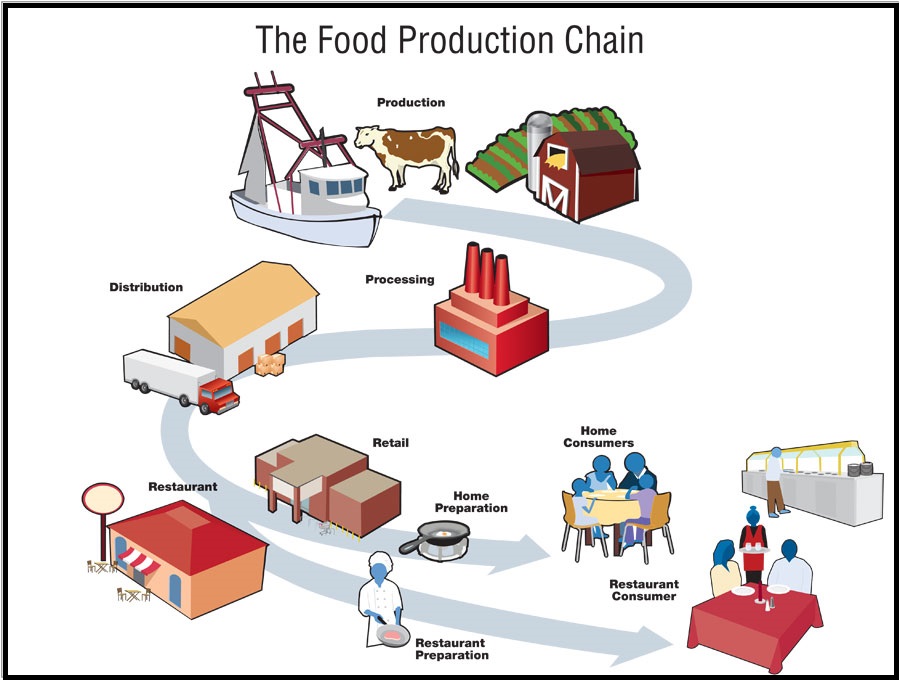
In the middle and latter part of 2020, the retail food supply chain (grocery stores), normally representing 50% of total caloric consumption, struggled to keep pace with massively increased demand on that side of the food supply.  The agricultural supply chain was completely screwed up in the USA when half of the normal food distribution (wholesale food away from home) was blocked from their business model.   The resulting impacts were entirely predictable for those who did not pretend.  We warned, and it happened exactly as we anticipated.

Then, making the predictive nature of food pricing more obvious, we watched as the Build Back Better or Green New Deal was thrust upon the entire western world dynamic.  This BBB/GND energy policy shift intentionally and purposefully exploded the cost of manufacturing and distributing food.  With massive and immediate increases in energy prices, the price of food skyrocketed quickly; because the impacts are fast in this sector.

Over the next several years the prices of food continued going up as the increased energy cost embedded within the agriculture sector.  Nothing about the price of food, or the ancillary processes within the industry, will change unless and until energy costs retreat.   In essence, with higher energy costs, food prices stay high; they are directly connected.

No other facet to food inflation is more substantial than the cost of energy to produce the product.  Farming and agriculture are energy dependent from fertilizer to farming equipment, fuel, processing, packaging, transportation, warehousing, storage, climate controls in distribution etc, everything is dependent on energy pricing.

High energy costs are why food prices (inflation) would always stay high, regardless of what happens in other sectors.  CTH talked about this at length long before the impacts came over the horizon.  We talked about preparing our families to offset this issue, but there is only so much you can do.

We are all currently feeling the intense increase in prices at the market, grocery store and supermarket, and the worst aspect to this dynamic is the reality that as long as energy prices remain high, food prices will never drop.  [NOTE: There is a smaller supply/demand impact; however, with most of the USA agricultural sector exporting food products (multinational corporations ie. Big Ag) the domestic USA supply is subject to globalized pricing.]

Bottom line.  As long as energy prices remain high, food prices will remain high.

The “great reset” per se’, was not a process that began after the pandemic. The pandemic was the beginning, ushering in the “great reset” by being the starting point of the mostly western, global energy shift.

Into this dynamic there is good news, one voice has clear eyes on the problem, and as a consequence, answers. President Donald Trump understands the nature of how the current price pressures that are crushing the middle-class can be reversed and removed. WATCH:

.

Many people have written with appreciation for the CTH forecasts delivered in the fall of 2021.  I am thankful to have been of benefit to those who could take proactive measures to avoid the economic issues we faced in 2022 and beyond.  However, that financial pain has not subsided.   There’s only so much a person/family can do to offset rising energy costs.

I know just about every reader on these pages can relate to how financial fear can eat at you from the inside.  The life game of trying to figure out how to get from one week to the next, keep a roof over your head and keep the kids/grandkids safe and fed is fraught with trepidation.  I get it. Believe me, I get it….  But you just gotta keep going; whatever it takes.

Our heels are over the cliff, it’s already rough for most working families and people on fixed incomes.  We need MAGAnomics more now than any other moments in our lifetime.  This is why I was saying in 2023 we needed to focus at home; keep building that bunker safe and secure.

Then look to help/assist the neighbors, then the community, etc.  But start by being proactive at home and do not isolate.  Fear, worry, trepidation, foreboding etc, is worse when internalized.  Do not swallow it – reach out to a loving God, pray, release it, and then embrace the central purpose in life, fellowship.

Be patient, be respectful, be kind and caring. Don’t look for trouble. But when the time comes to fight, drop the niceties and fight for your family with insane ferocity.

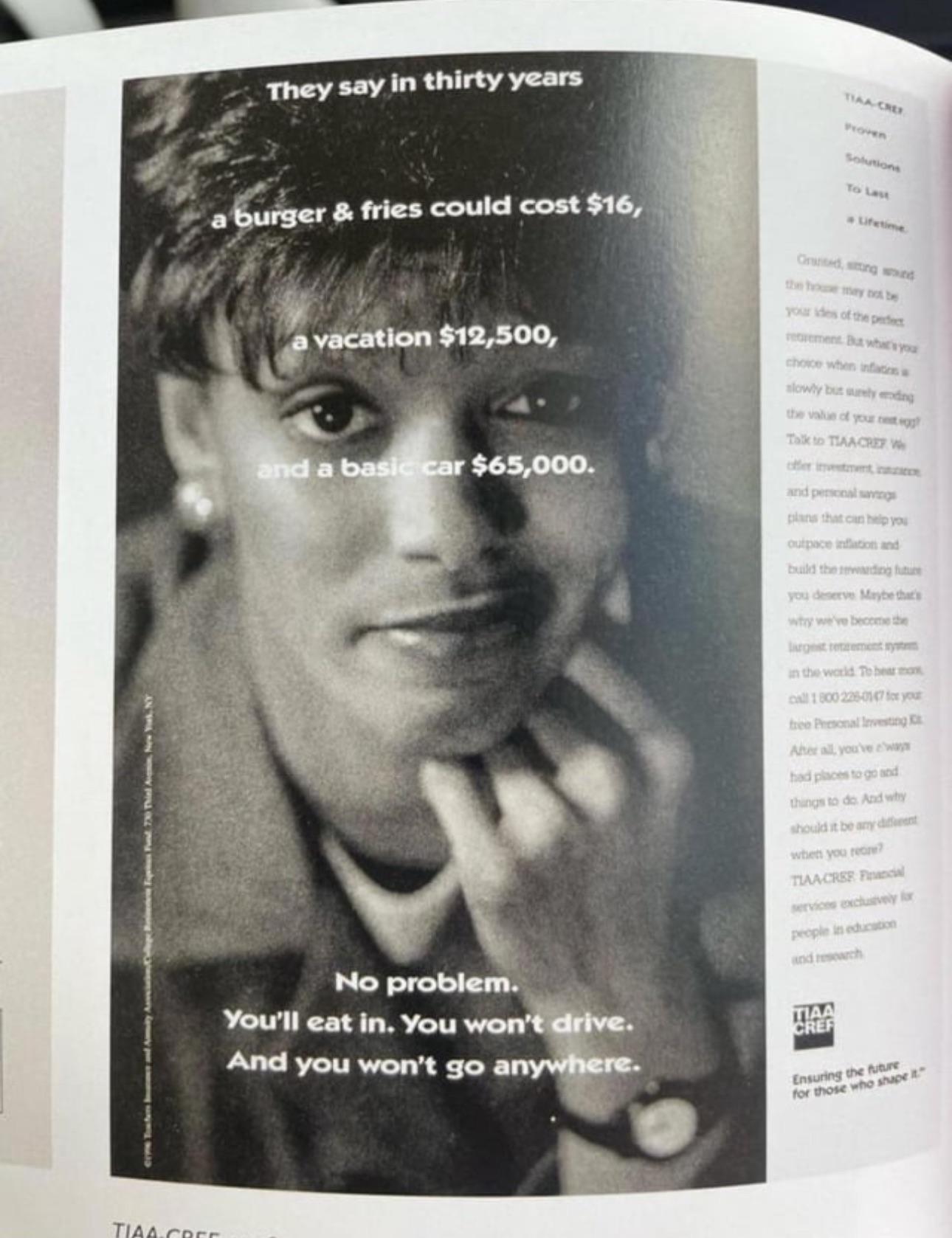
Americans Prepared for Lasting Inflation


Posted originally on Aug 6, 2024 By Martin Armstrong 

InflationPredictedMagazine

Americans are preparing for a prolonged inflationary period, based on new data from the New York Fed. The New York Federal Reserve’s Survey of Consumer Expectations found that Americans are still pessimistic about inflation waning, with no one now believing it is transitory. The median expectation is that inflation will remain at the 3% level in 2025.

The public does not anticipate inflation tapering off in a meaningful way in the years to come. The Federal Reserve is still honing in on that 2% target but the people have lost confidence in its ability to do so. Most Americans see inflation sitting at 2.9% in three years from now, up from the 2.4% estimate in January 2024. Even in five year’s time, the average consumer believes inflation will be above target at 2.6%.

The central bank believes they can meet that 2% target. Policymakers believe inflation will fall to 2.1% by 2025 before finally reaching 2% in 2026. Amid the sell off this week, Chicago Fed President Goolsbee came out and said that the central bank will simply “fix it” if the economy continues to deteriorate.

“The Fed’s job is very straightforward, maximize employment, stabilize prices and maintain financial stability. That’s what we’re going to do,” Goolsbee told CNBC. “We’re forward-looking about it. So if the conditions collectively start coming in like that on the through line, there’s deterioration on any of those parts, we’re going to fix it.”

Unfortunately, there is not much that the central bank can do to offset government’s suicidal fiscal policy. Remember, inflation was only 1.4% when Joe Biden took office – far beneath the Fed’s target. Inflation has risen as a direct result of fiscal policies under Bidenomics.

FederalReserve 1

The Fed was unable to prevent policies that ended America’s energy independence. They were unable to stop the supply chain issues exacerbated by the pandemic. They cannot alter the weak jobs reports that are propped up by multiplying the public sector, which only detracts from overall GDP. The Federal Reserve cannot maintain diplomatic relations with America’s trade partners or prevent the likes of Japan and China from selling off US government debt. The millions of immigrants now subsidized by the taxpayers cannot be curtailed by Jerome Powell or the FOMC. Worst of all, war is the most powerful driver of inflation. The Federal Reserve can do absolutely nothing to prevent America from steering NATO into three potential battles. Our Treasury Secretary says we can afford numerous wars. The $35 trillion in government debt rises every day and those in the central bank simply KNOW that the government has no intention on paying it off – how could they?

Americans are rightfully pessimistic about the future of the economy. All the talking heads insist that the economy is thriving under Bidenomics, but we the people are living in a different reality. This is what happens when people lose trust in the government entirely.

Car Repos Rise 23% YoY


Posted originally on Aug 2, 2024 By Martin Armstrong 

German Cars

The private debt crisis is becoming apparent in America after car repossessions jumped 23% during the first half of 2024. Data shows that 1.6 million Americans will have their car repossessed by the bank before the end of the year, a slight increase from the 1.5 million autos repossessed in 2023 and a drastic upturn from the 1.1 million in 2021.

Obviously, the cost of purchasing a car have drastically risen with inflation, interest hikes, and supply chain shortages. Americans simply cannot afford new autos and car dealerships can do nothing to entice purchases. New car inventory in the US rose 36% this year, close to February 2021 levels before the supply chain crisis put a dent in imports. Yet, the average list price of a new car is $49,096 and far more than the average American can afford. The average new vehicle will sit in a dealer’s lot for 65 days, a 41% annual increase.

Dealerships are hardly asking for a downpayment these days unless someone has horrid credit. Even putting a few grand down will only take off about $20 per monthly payment. The average new car costs about $735 monthly based on data from Experian, and $523 monthly on used models. The average American simply is not educated in finance. Autos are behind mortgages in the largest share of personal household debt and there is a portion of the population who do not understand what they can actually afford.

The average American now borrows around $40,634 for new vehicles and $26,073 for used vehicles. About 9.2% of all consumer debt is through autos alone.

There was that viral story from April of a woman purchasing a Chevy Tahoe for $80,000 – without factoring in the interest on all household vehicles. Her husband purchased 2020 GMC Sierra 1500 AT4 for $78,000 in August 2022 and she simply could not understand why the payments on the truck were more than on the Tahoe. Well, the husband’s 14% rate on the vehicle placed their monthly payment or the truck $1,600. I recalled reading comments suggesting the family simply let the bank repo one of the cars as if that could be a valid option for personal finance.

Cox Automotive believes the trend of repossessing cars will increase into 2025 when they anticipate. 1.7 million cars being repossessed. As of Q1 2024, US household debt stood at $1.77 trillion; $12.44 trillion held in mortgage debt, $1.62 trillion in autos, $1.12 trillion in credit card debt, and $543 billion in other forms. Bank of America, Citigroup, Goldman Sachs, and others recently reported a stunning $4,139,000,000 loss in unrecoverable debt.

The banks will come after their assets if a payment is missed, with some only waiting 30 days after a missed payment to seize property. They may then ask for full payment to return the car which is simply not happening in these situations. While there are some who cannot compute their monthly payment, others are now living paycheck-to-paycheck and are one large bill or missed paycheck away from losing their shirts. Then we have agencies telling the public across Build Back Better nations that they will soon need to purchase an EV to adhere to the climate emergency. Cheaper alternatives from China have been slapped with 100% tariffs, and there are no alternatives. Governments are do nothing to assist this growing problem as the ultimate goal is to eliminate private car ownership under the premise of the Great Reset.

Powell: March Rate Cut Unlikely


Posted originally on Mar 7, 2024 By Martin Armstrong

Powell Jerome

Those who follow this blog already knew that the Federal Reserve would not drop rates in the future due to unsustainable fiscal policies paired with America’s increasing involvement in foreign wars. All of the talking heads were preaching that rates would significantly decline to pandemic levels, as if that were the historical norm. Every fiscal policy in recent years has exacerbated inflation and the Fed cannot keep up with government spending. QE FAILED. The artificially low interest rates of the recent past were completely unsustainable and relied on outdated theories.

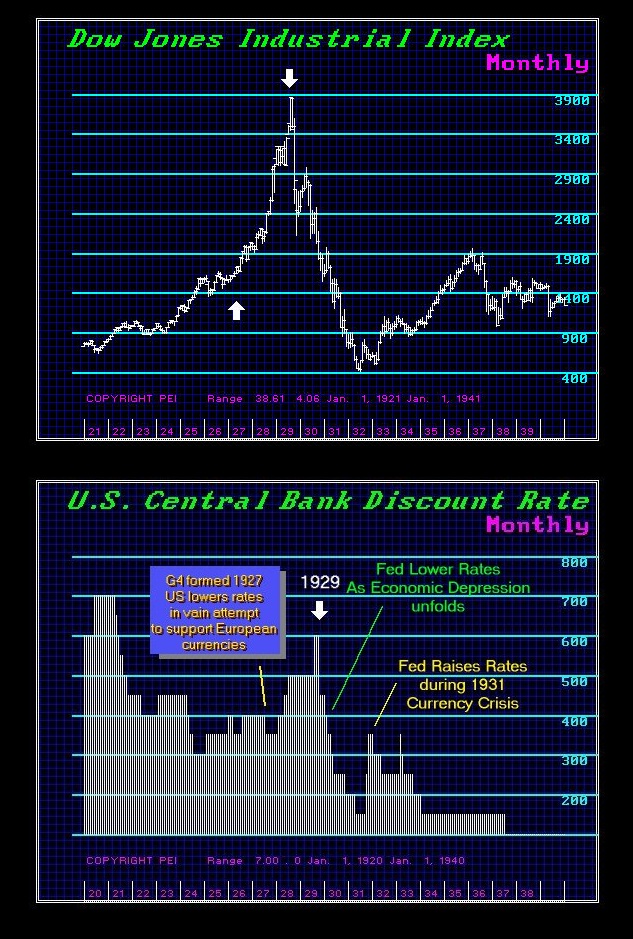
The outdated understanding based on Keynesian Economics remains to increase the supply of money and it MUST be inflationary. The Fed raises rates to reduce consumption and lower rates to stimulate consumption. It’s a very nice theory, but when actually tested, it utterly fails. Lower rates will NEVER cause people to invest UNTIL they believe that there is an opportunity to invest. We are watching the big players withdraw from equities, let alone government debt. We are in a private wave where money is running off the grid at a rapid pace.

DowIntRates 1929

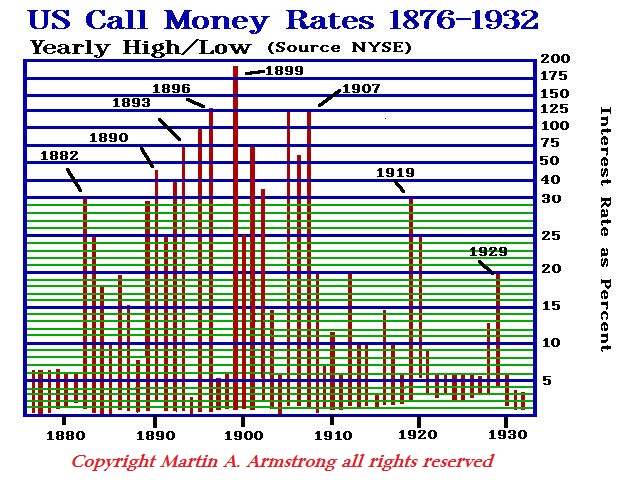
The peak in interest rates took place in 1899 at virtually 200%. Yet, 1929 was the real bubble top and it peaked with 20% interest rates in call money on the NYSE. In theory, the biggest boom should have been met with the highest interest rate. In truth, the “real interest rate” as I have defined it is when the interest rates exceed expectations. If you think the stock market will double, you will pay 25% interest.

As you can see, while interest rates hit nearly 200% in 1899, the share market did NOT crash percentage-wise anything as it did following 1929. Look, there is a lot more to this than meets the eye. Everything must be addressed on a global scale for it all depends also on the direction of capital flows. There is just a lot more to this than simply the money supply and interest rates.

CALLMONY MA

Now, Powell continues to explain to the public that VOLATILITY and economic conditions are beyond the control of the Fed. “We believe that our policy rate is likely at its peak for this tightening cycle,” Powell said. “If the economy evolves broadly as expected, it will likely be appropriate to begin dialing back policy restraint at some point this year. But the economic outlook is uncertain, and ongoing progress toward our 2% inflation objective is not assured.”

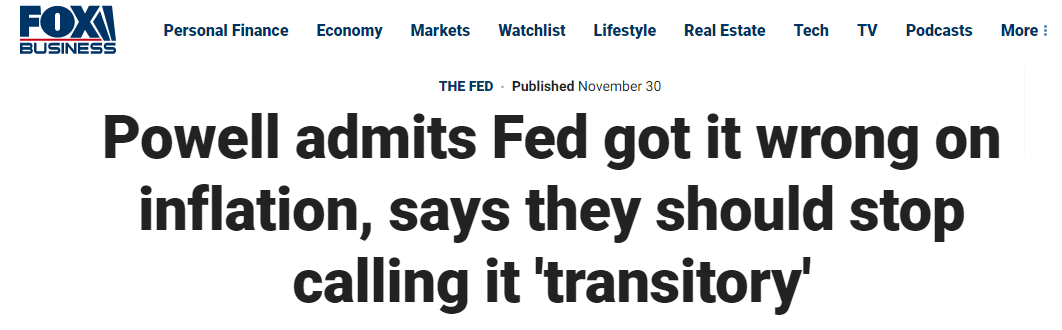
Powell Fed Got Inflation Wrong Nov 2021

All the news of inflation waning, including recent data, is inaccurate propaganda intended to calm recessionary fears. Even by the government’s data, inflation is up 3.1% compared to last year. It was an unprecedented moment when Powell broke with Washington and criticized the government for their unsustainable spending. The Fed NEVER criticizes the government, despite the two being separate.

Hence, I say to stop blaming the Fed. They are not the ones creating all the money but are working to match monetary policy with unsustainable fiscal policies. We are looking at trillions in deficits per year. There is no restraint when creating new massive spending packages. Then people blame the central bank with no concept that it’s only a fraction of “money;” the real issue is CONGRESS.

Listen, interest rates cannot decline in the face of war. The 2020 yearly array showed a turning point for a high in 2022 and a possible correction into 2024. I explain this in more detail on the Socrates private blog but buckle up for the year ahead.

NY Fed Survey: Americans Optimistic on Inflation


Posted originally on Jan 10, 2024 By Martin Armstrong 

Inflation up

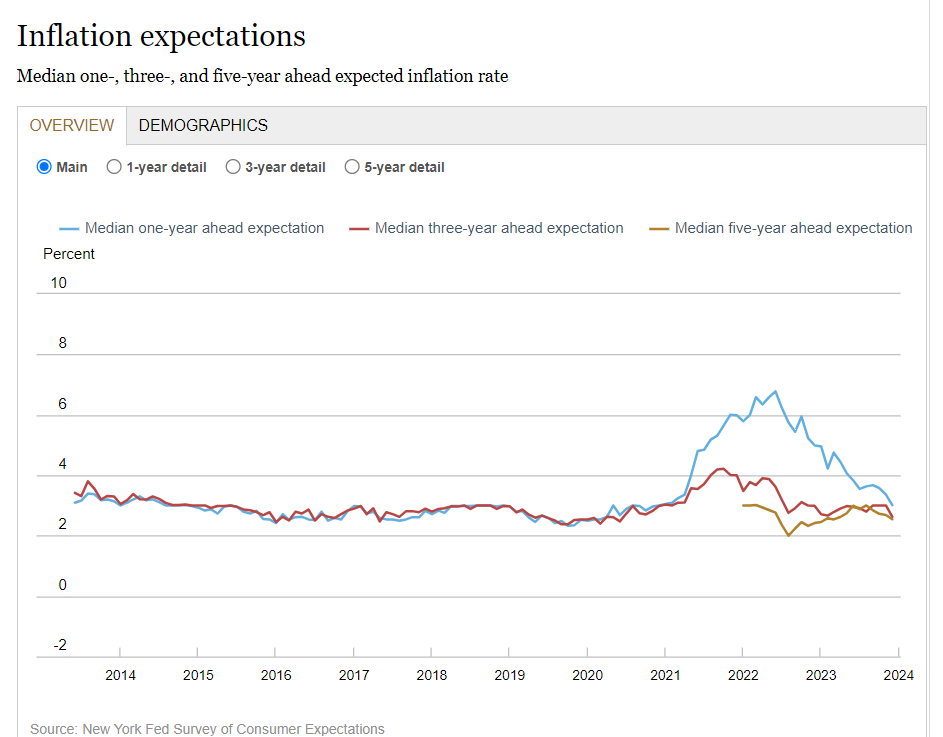
According to a recent survey by the New York Federal Reserve, Americans’ inflation expectations have dropped to the lowest level in three years. “How much worse could it get?” the average person assumes. The median expectation is that the inflation rate will be up 3% one year from now, down from a high of 7.1% recorded in June 2022. The survey found that Americans anticipate wages rising by 3% to meet their inflation expectations. Consumers have not been this optimistic since January 2021.

However, the people still anticipate that inflation will remain above the Fed’s 2% target in the longer term, with projections of around 2.6% three years from now and 2.5% five years from now. The Federal Reserve’s last forecast states inflation will decline to 2.2% in 2025 before reaching its lofty 2% target in 2026.

Inflation.Expectations.NYFED2024

The year began with a massive disruption in the global supply chain and increased cargo costs. There are countless protests occurring among farmers across the world who disagree about the future of crops and food price stability. The leading driver that is not discussed – WAR! America is funding two major conflicts at the moment and sinking deeper into debt. The extreme geopolitical uncertainty and risks associated with war always lead to higher energy prices, increased production costs, and massive government spending, further fueling inflation.

Cost Of Living Outpaces Wage Increases


Posted originally on Dec 7, 2023 By Martin Armstrong 

Powell Fed Got Inflation Wrong Nov 2021

A recent study by Achieve revealed that despite a 37% increase in income, many Americans are facing financial challenges due to rising costs and high interest rates, leading to a surge in personal debt. The average monthly participation in debt resolution programs increased by 119% in the first nine months of 2023 compared to 2020. Wages are rising but they simply cannot keep up with the growing cost of living.

The typical household income of individuals enrolled in debt resolution programs was $59,900 in 2023, a notable increase from $43,598 three years prior. The study’s findings reflect the impact of inflation, a challenging interest rate environment, and the winding down of government stimulus on consumer debt levels. The report underscores the need for measures to address the rising debt burden and its potential impact on income growth.

The study also found that people are facing financial hardship significantly earlier in life. The average age of someone facing debt resolution was 52 in 2020, but that age has since decreased to 44 in 2023. Nearly 40% of people entering debt resolution programs are Millennials, which is also the age demographic of those with the sharpest increase of credit card delinquencies. Nearly everyone is living on credit as balances rose $154 billion YoY, marking the most significant increase since 1999.

No one feels relieves when new inflation reports are released. Governments can release whatever data they like but the fact remains that the price of EVERYTHING has become too much to maintain. Inflation allegedly peaked in June 2022 at 9.1% but I cannot think of anything that has dramatically decreased in price since then.

US Real Estate Prices Rose in September


Posted originally on Nov 30, 2023 By Martin Armstrong 

House US Real Estate

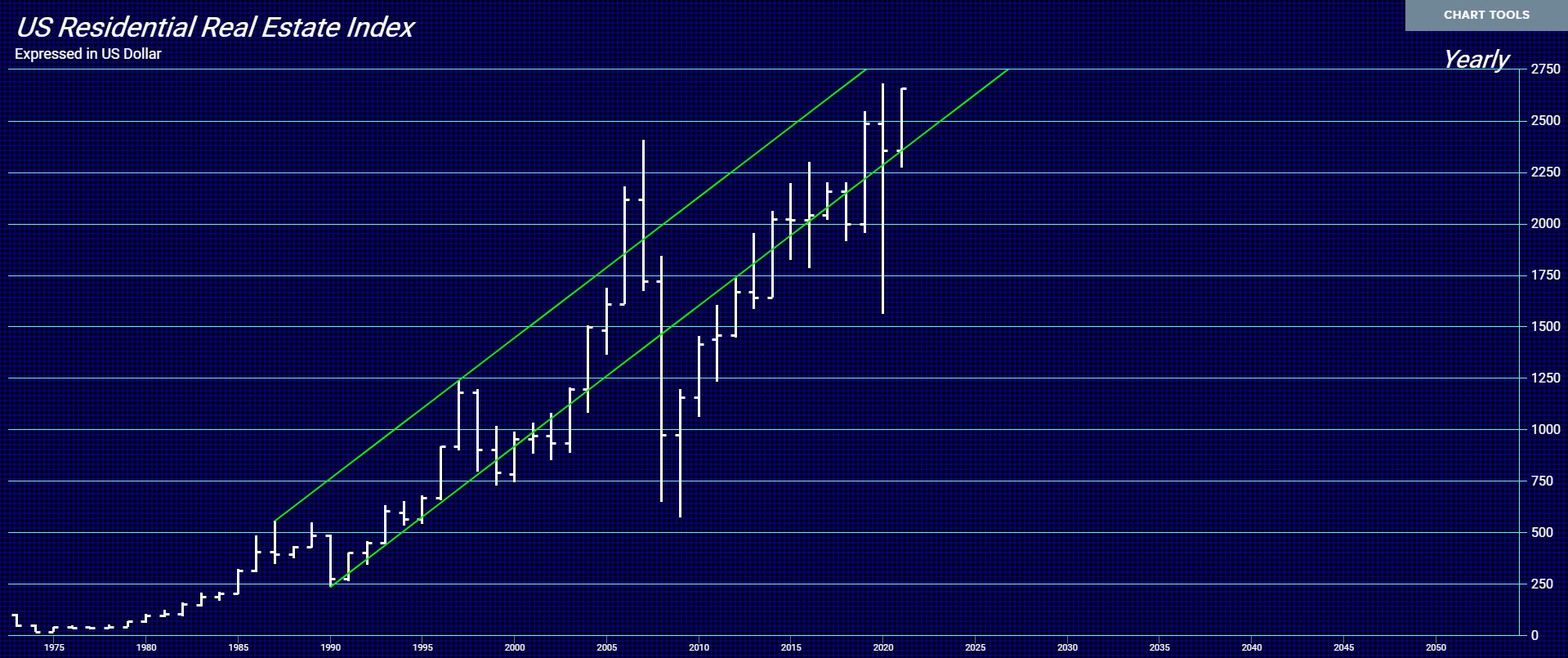
The S&P CoreLogic Case-Shiller Index reported a 3.9% year-over-year increase in home prices in September, despite a surge in mortgage rates. The growth coincided with the 30-year fixed mortgage rate’s climb toward 8%. Notably, rents are easing while home prices continue to rise. The report highlighted that of the 20 metropolitan markets, Detroit saw the largest annual increase at 6.7%, followed by San Diego at 6.5%, and New York at 6.3%. However, three cities, including Las Vegas, Phoenix, and Portland, reported lower prices compared to a year ago. The housing market’s strength has been attributed to a relative shortage of inventory for sale, which has supported prices despite the increase in mortgage rates and insurance premiums.

USResidential Y

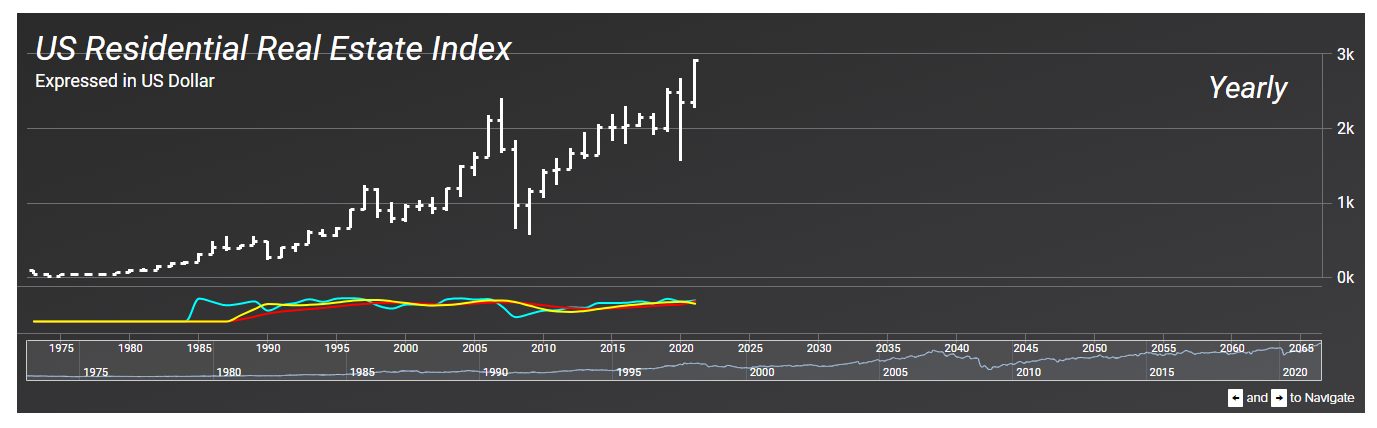
As I foretold in April 2021:”One of the factors that confirmed to me that we would be heading into progressive inflation long-term was the fact that this Residential Index elected a Yearly Bullish Reversal at the end of 2012. That confirmed the long-term trend had changed. However, urban condo and commercial properties were forming a divergence. I assumed that was being caused by the debt and rising taxes in cities. In that regard, I suppose I was only partially correct, for the rest has been the brain-dead response to COVID. For example, locking people down and causing them to lose jobs has resulted in a sharp rise in violence. Not just mass shootings, but all sorts of conflicts from domestic disputes to outright feuds. Cities, such as Philadelphia and New York, have sections in which the police have totally lost control. It is debatable if they will ever be able to restore civility to these regions. While Fauci claims to ignore the Constitutional violations, his agenda in helping Gates and Schwab is more than simply preparing society for the Great Reset. He is furthering the collapse of urban civility and this trend is part of what is driving this index. I would expect to see this escalate and if we make a new high on this index and close above last year’s high, single-family homes outside of urban centers will rise sharply into 2023.”

US Residential Real Estate 8 9 21

The typical analysis of sales down mortgage rates up is no longer the rulebook. As I explained in the Real Estate report provided to World Economic Conference attendees, America experienced a great migration after COVID lockdowns. People fled states with harsh COVID laws and rising crime. There has been a great wealth migration across America as both individuals and businesses are seeking refuge in red states. As taxes continue to rise to accommodate failed policies, the states with somewhat of a resemblance of taxation with representation will become more appealing.

There is a reason that Blackrock has become the largest landlord in the nation by far, in addition to plans for 15-minute cities. Institutions have also lost their confidence in the government – the 30-year fixed mortgage is more appealing than the 30-year Treasury.

For the past few years, I have heard countless realtors and brokers saying that home prices are expected to go down next quarter or the one after that. Inventory has continued to decline while prices and rates have risen. This is not the 2008 crisis as we do not have an over-leveraged market. The market can no longer be viewed from a broad perspective.

State Wealth Migration Re-Posted Nov 15, 2023 By Martin Armstrong 


Migration to USA

In 2019, New York hosted 72 billionaires. That figure has declined to 62 in 2023, with smart money fleeing the state due to high taxes and crime. The state of New York depends on the top 1% of earners to pay 42% of its tax burden. New York is already operating in a deficit and has the added burden of hosting tens of thousands of migrants with tax funds.

The top 1% of Americans have an average net worth of $10,815,000. While billionaires earn on investments and not income, states like New York expect top earners to pay 14.8% in income tax. “If you had someone who was earning $100 million [a year] in New York suddenly move to Florida, that’s something like a $11 million-a-year hit per year recurring to the state,” said Ken Girardin, the research director for the Albany-based think tank, Empire Center for Public Policy. The 62 billionaires that remain in New York have a collective net worth of $562.3. Only the top 5% of Americans have a net worth of over a million dollars.

Inflation is hurting those at every class level and people do not want to downgrade their lifestyles. Policymakers want to scream “Eat the rich!” to appease voters who do not understand that the money held by those at the top is needed for a healthy economy. In 2020 alone, when the pandemic struck, New York lost $19.5 billion in taxes from people fleeing the state. California lost $17.8 in tax revenue that year and counting.

We are seeing a wealth migration in the US. This is why I say that markets like real estate cannot be looked at on the national level, as prices in red states continue to rise as blue states have become uninhabitable. This is only taking into consideration individuals as moneymakers are also taking their businesses to states where they do not need to support the welfare system. Around 160 firms have fled Wall Street since 2019, displacing $1 trillion.

Real Estate

Hence, people are saying Miami is the new Wall Street. Lawmakers do not comprehend the impact that this will have on state budgets.

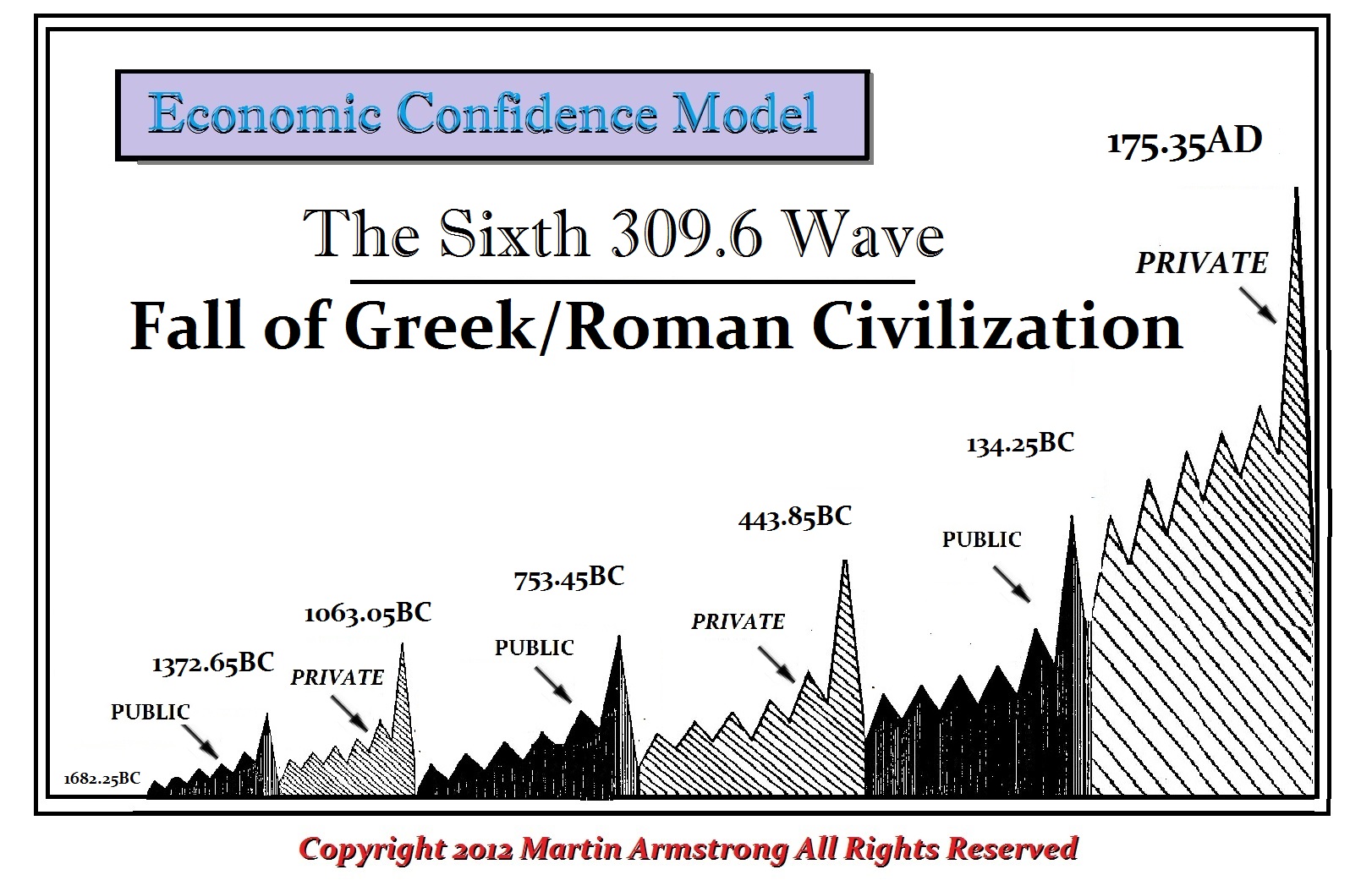
Sixth Wave ECM Greek Roman 309.6

This is precisely what happened prior to the collapse of the Roman Empire. The top 1% half 16% of the empire’s wealth. Wealthy Romans were the first to leave cities when public confidence collapsed. We can see the migration from archaeological finds that saw villas built far from city centers. And even in those days, people felt that the wealthy were selfish for acting in accordance to the invisible hand. As noted in “The Decline and Fall of the Roman Empire” by James William Ermatinger: “Their disinclination to leave may have been caused by forced exactions, confiscations, business concerns, tax pressured, or general economic fears, which made protecting one’s own interests seem more prudent than looking out for the interests of others.”

Rome’s Sovereign Debt Crisis is what ultimately led to its collapse. Yet one of the first signs of major trouble was the mass exodus of wealth from the cities.

The Public’s Top if not ONLY Concern…


Armstrong Economics Blog/Inflation Re-Posted Aug 20, 2023 by Martin Armstrong

INFLATION

The public is not concerned about “Russian aggression,” the Trump inditement, or even the MSM wrench about aliens. No one cares — the average person is struggling to keep up with the rising cost of living. Homelessness is on the rise as people cannot afford shelter. The blank checks to Ukraine are a slap in the face of those begging for help at home. These politicians need to work for us. No one campaigning is going to make a dent in the polls unless they clearly detail how they plan to address INFLATION! And no, the problem is not limited to America. The solution cannot be a universal income, currency, or Great Reset. The economy was strong before they attempted to BUILD BACK BETTER.

Trying to Make Heads or Tails about Recessions


Armstrong Economics Blog/Economics Re-Posted Jul 28, 2023 by Martin Armstrong

QUESTION: Looking at Socrates,  do you think that these people who were constantly calling for a recession because there were two quarters that declined with covid really need revision? Socrates was correct, no recession. But it is showing major turning points in 2024 which seem to align with your old ECM forecast calling for commodity inflation into 2024. How would you define a recession?

EJ

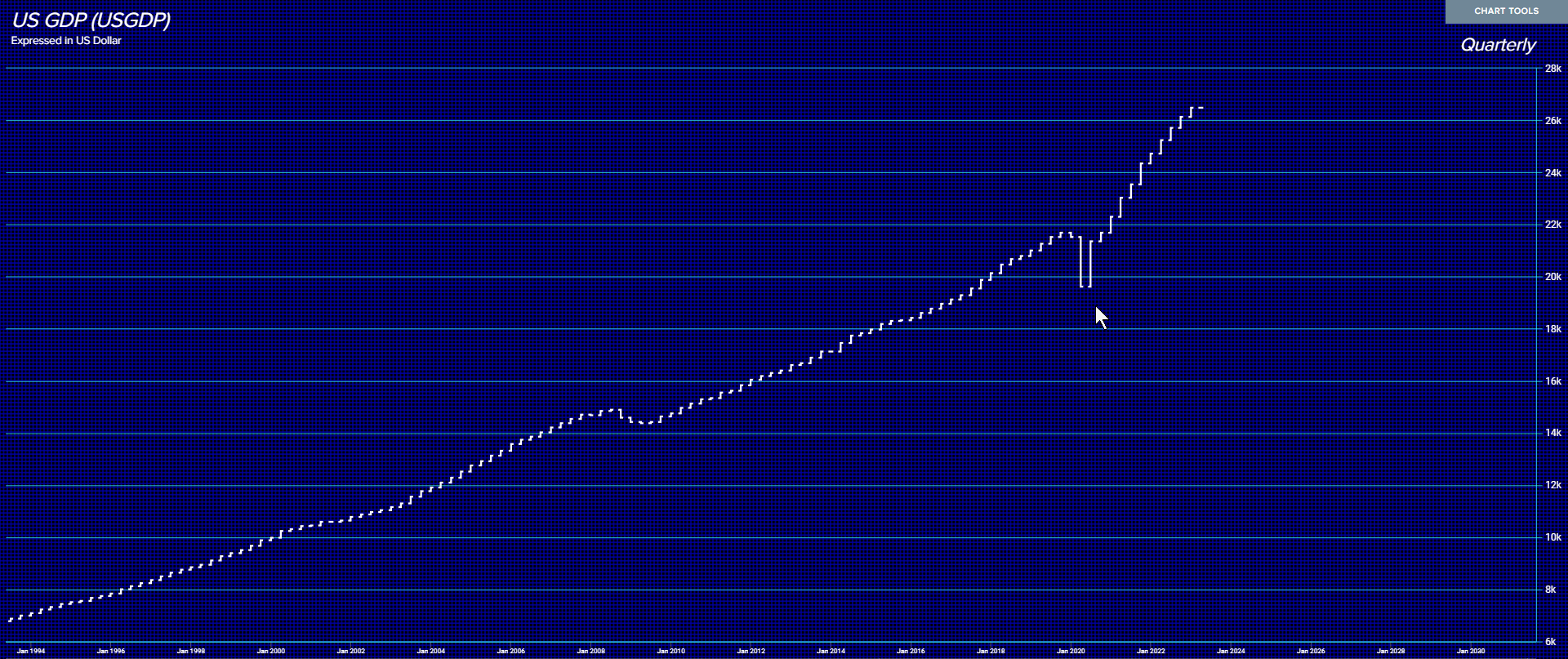
ANSWER: In trading, reactions are 1 to 3 time units. I believe that the same definition should be used for classifying a recession. They define a recession as two consecutive quarterly declines. If you look at the “Great Recession” of 2008-2009, you will see three consecutive quarterly declines and a rebound. If we look at the COVID recession caused by locking everyone down, that was just two consecutive quarterly declines.

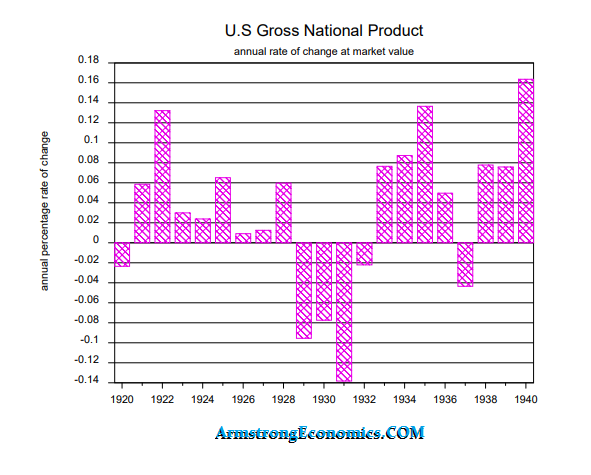
I personally would argue that a true economic recession MUST exceed three consecutive declines. Here is the chart of GNP from 1929 to 1940. There were three years of negative growth. I simply think that this definition of two quarters is wrong. You can have a slight decline of 1 to even 5%, but that does not suggest a recession. In the case of 1929, that was a decline of 9.5% in 1930 – the first year. Now look at the COVID Crash, which was also a decline of 9.53%. But the difference is that the COVID decline was forced and not natural. That is why it rebounded so quickly. Now the so-called “Great Recession” of 2008-2009 only saw a decline in GDP of 3.47%.

The “Great Recession” was not really so great. It wiped out real estate and bankers but did not fundamentally alter the economy. So who is right and who is wrong will always depend upon the definition. Yes, the AI Timing Arrays point to a recession starting Next Year by their definition. This will most likely be caused by the decline in confidence that will lead to UNCERTAINTY, and as such, the consumer will contract. Up to now, the continued expansion of the economy into 2024 has also been fueled by the shift in assets from public to private.

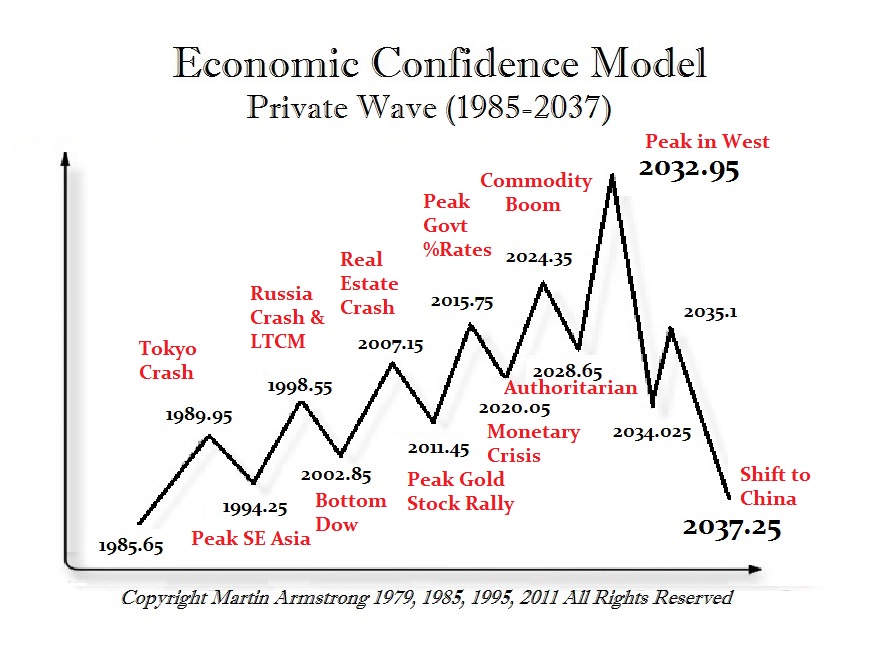
As originally forecast, we should have seen a commodity boom into 2023,

and we should expect a highly authoritarian attempt by 2028.