Elon Musk Describes Current Status of Twitter Offer in His Own Words


Posted Originally on the conservative tree house on May 17, 2022 | Sundance 

The Elon Musk appearance on the All-In podcast has generated a lot of news.  Below is the entire interview.

The first 20 minutes is worth watching if you do not have the time for the entire broadcast.  WATCH:

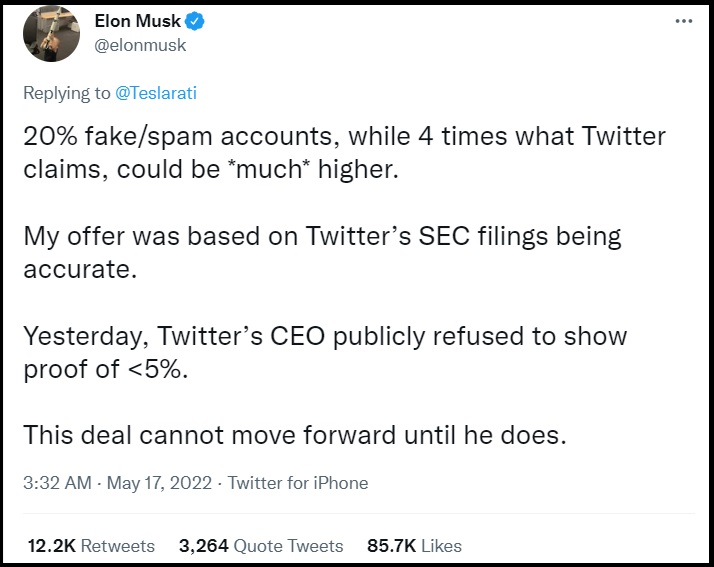
Elon Musk Indicates Twitter Deal Cannot Move Forward Unless Platform Proves Fake Accounts Less Than 5 Percent


Posted originally on the conservative tree house on May 17, 2022 | Sundance 

A quick update to the drama around the potential Elon Musk takeover of the social media platform Twitter. The eventual outcome of this could carry large consequences, it is worth watching how it plays out.

This morning, Elon Musk indicated the $44 billion deal he’d agreed to “cannot move forward” until he sees the proof he’s looking for about its active user numbers or monetized Daily Active Users (mDAU’s). Musk does not believe there are less than 5 percent “fake” or “bot” accounts. [Tweet Link]

As we have mentioned from the outset of the purchase offer, the more Elon Musk demands transparency on the operations, the more Twitter is going to end up painted into a corner on the engineering and data-processing side of the platform.

If Twitter cannot publicly explain how they are making determinations for Daily Active Users, they are going to have major issues with; (a) fraud in their billing of advertisers, and/or (b) shareholder lawsuits for fraudulent operations. {Go Deep}  Musk’s demands could take down Twitter and/or make the purchase price much lower.  Stay tuned….

REMINDER – In the big picture of tech platforms, Twitter, as an operating model, is a massive high-user commenting system.

Twitter is not a platform built around a static website; Twitter is an interactive user engagement platform for comments and discussion that operates in the sphere of social media.  As a consequence, the technology and data processing required to operate the platform does not have an economy of scale.

There is no business model where Twitter is financially viable to operate…. UNLESS the tech architecture under the platform was subsidized.

In my opinion, there is only one technological system and entity that could possibly underwrite the cost of Twitter to operate.  That entity is the United States Government, and here’s why.

Unlike websites and other social media, Twitter is unique in that it only represents a platform for user engagement and discussion.  There is no content other than commentary, discussion and the sharing of information – such as linking to other information, pictures, graphics, videos url links etc.

In essence, Twitter is like the commenting system on the CTH website.  It is the global commenting system for users to share information and debate.  It is, in some ways, like the public square of global discussion.   However, the key point is that user engagement on the platform creates a massive amount of data demand.

Within the systems of technology for public (user engagement) commenting, there is no economy of scale.  Each added user represents an increased cost to the operation of the platform, because each user engagement demands database performance to respond to the simultaneous users on the platform.  The term “simultaneous users” is critical to understand because that drives the cost.

According to the Wall Street Journal, Twitter has approximately 217 million registered daily users, and their goal is to expand to 315 million users by the end of 2023.   Let me explain why things are not what they seem.

When people, users, operate on a tech platform using the engagement features, writing comments, hitting likes, posting images, links etc, the user is sending a data request to the platforms servers.  The servers must then respond allowing all simultaneous users to see the change triggered by the single user.

Example: when you hit the “like” button feature on an engagement system, the response (like increasing by one) must not only be visible to you, but must also be visible to those simultaneously looking at the action you took.   If 100,000 simultaneous users are looking at the same thing, the database must deliver the response to 100,000 people.  As a result, the number of simultaneous users on a user engagement platform drives massive performance costs.  In the example above, a single action by one person requires the server to respond to 100,000 simultaneous users with the updated data.

As a consequence, when a commenting platform increases in users, the cost not only increases because of that one user, the cost increases because the servers need to respond to all the simultaneous users.

This is why most websites, even big media websites, do not have proprietary user engagement, i.e. commenting systems.  Instead, most websites use third party providers like Disqus who run the commenting systems on their own servers.  Their commenting systems are plugged in to the website; that defers the cost from the website operator, and the third party can function as a business by selling ads and controlling the user experience.  [It also sucks because user privacy is non existent]

The key to understanding the Twitter dynamic is to see the difference between, (a) running a website, where it doesn’t really matter how many people come to look at the content (low server costs), and (b) running a user engagement system, where the costs to accommodate the data processing -which increase exponentially with a higher number of simultaneous users- are extremely expensive.   Twitter’s entire platform is based on the latter.

There is no economy of scale in any simultaneous user engagement system.  Every added user costs exponentially more in data-processing demand, because every user needs a response, and every simultaneous user (follower) requires the same simultaneous response.  A Twitter user with 100 followers (simultaneously logged in) that takes an action – costs less than a Twitter user with 100,000 followers (simultaneously logged in), that takes an action.

If you understand the cost increases in the data demand for simultaneous users, you can see the business model for Twitter is non-existent.

Bottom line, more users means it costs Twitter more money to operate, and the cost to the user is “free.”  The business model is backwards from traditional business.  More customers = higher costs, because each customer brings more simultaneous users….. which means exponentially more data performance is needed.

User engagement features on Twitter are significant, because that’s all Twitter does.  Not only can users write comments, graphics, memes, videos, but they can also like comments, retweet comments, subtweet comments, bookmark comments, and participate in DM systems.

That is a massive amount of server/data performance demand, and when you consider simultaneous users, it’s almost unimaginable in scale.  That cost and capacity is also the reason why Twitter does not have an edit function.

With 217 million users, you could expect 50 million simultaneous users on Twitter during peak operating times.  My back of the envelope calculations, which are really just estimations based on known industry costs for data performance and functions per second, would put the data cost to operate Twitter around $1 billion +/- per month. In 2021, Twitter generated $5.1 billion in revenue, according to the Wall Street Journal.

There is no business model, even with paying subscribers, for Twitter to exist as it is currently established.  As the business grows, the costs increase, and the costs to subscribers would grow.  So, what is going on?

The only way Twitter, with 217 million users, could currently exist as a viable platform is if they had access to tech systems of incredible scale and performance, and those systems were essentially free or very cheap.  The only entity that could possibly provide that level of capacity and scale is the United States Government – combined with a bottomless bank account.

If my hunch is correct, Elon Musk is poised to expose the well-kept secret that most social media platforms are operating on U.S. government tech infrastructure and indirect data-processing subsidy.  The Govt/CIA contract with Amazon Web Services (AWS), the cloud operation that most Big Tech social media platforms operate within, might hold a key part of the construction.

The U.S. technology system, the assembled massive system of connected databases and server networks, is the operating infrastructure that offsets the cost of Twitter to run their own servers and database.  The backbone of Twitter is the United States government.

There is simply no way the Fourth Branch of Government, the U.S. intelligence system writ large, is going to permit that discovery.  However, shareholder lawsuits or legal filings associated with the purchase/takeover of the platform, may force that operating information to the surface regardless of how hard the board of directors and background engineers need to fight to hide it.

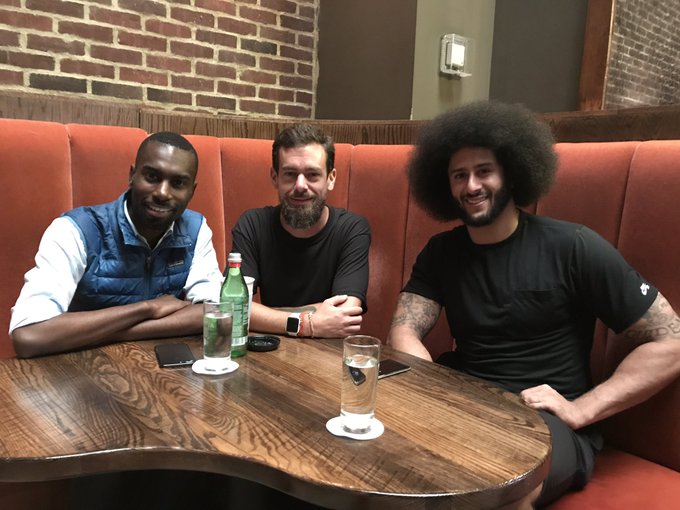
Go Deep ~ “Jack’s Magic Coffee Shop

Almost all other internet websites and social media have two structures: (A) Content, and (B) User Engagement.

Content represents a small part of any internet hosting expense for a platform and represents almost 100% of the platform’s ability to generate money.  User engagement on the other hand, costs massive amounts of money – due to the need for data processing to handle the engagement and simultaneous users – and provides almost no revenue.

Many news and information content providers do not even host a user engagement commenting system any longer.  User engagement is just too expensive and requires monitoring, moderation and massive amounts of data processing speed on the platform servers.

Twitter’s operating model only consists of ‘user engagement.’

The platform itself is a massive global commenting system – the ‘public square’ discussion.

♦CONTENT is the material that can be monetized easily.  Content is the article, graphic, podcast, or video you would see and watch.  Content is profitable based on advertising.   Eyeballs on content means eyeballs on internet advertising.  This is how websites and content providers are able to pay for expenses and operate as a business model for the continuation of content.  Hosting costs for content, even on a massive scale of viewership/readership are low, and the income from advertising increases with more readers and viewers.  This is the traditional business model of content providers.

♦USER ENGAGEMENT is the part that is not as easily monetized, and user engagement drives a higher cost.  User engagement is the comments, likes, dislikes, pictures, images, videos and uploaded user data; and the discussion that takes place based on the users who view the content material and discuss.

More user engagement, particularly more simultaneous users, costs more money for the platform, because the random capability of the audience to interact with the server network creates exponentially more data processing demand.  Data processing, not capacity, drives the cost.

Server capacity is a relatively easy issue to solve for content providers.  In order to see the content, the host needs to ensure they have enough capacity for the audience to arrive and view, read, or watch the content without overwhelming the server network.  Cache’s and static library services take the load off the primary server functions.  Server processing speed and data performance are a part of the construct to ensure everything is smooth.

Server capacity is not the challenge for ‘user engagement.’  Processing trillions of simultaneous user-activated functions is the tech challenge for ‘user engagement.’  It’s not the capacity, it’s the data processing.  As a result, it is far more expensive to operate social media than it is to operate a simple website construct, because user engagement is the entire premise behind social media.

Facebook and Instagram have a more viable business model because users provide the content they host.  Content can be monetized, and in the case of Facebook, Google, Instagram and YouTube they can also monetize the user that provides it.  Twitter does not host content at all.

Facebook makes money by selling advertising like a traditional website.  Facebook and Google have also specialized in the micro-targeting of advertising to very specific tailored advertising audiences.   Advertising agencies pay a premium for the micro-targeting of a specific audience.

Facebook also makes money by selling data on users.  You may remember the reference of Cambridge Analytica purchasing micro-targeting user information from Facebook for use in elections and voter targeting efforts.  More recently, Facebook has cut out the middlemen and started micro-targeting for politics and getting paid directly by political campaigns for their efforts.

In almost all social media, the user is providing the content that the platform can monetize.   In the Facebook example above, the platform can offset the extreme increases in user engagement costs (data processing) by making money from the hosted content, and from selling the data of the user (there are many purchasers).

However, for Twitter the business model problem is: (a) the absence of content to monetize, and (b) the extreme costs of user engagement that dwarf the “simultaneous user” data processing costs for Facebook.

As Facebook grows, they can grow their revenue.   As Twitter grows, it increases their expenses massively and only moderately increases their revenue.

Twitter did not initially make a decision to decline the generous offer by Elon Musk because of stewardship or fiduciary responsibility to shareholders.  The financials of Twitter as a non-viable business model highlight the issue of money being irrelevant.  Twitter does not, and as structured cannot, make money.  Growing Twitter only means growing an expense. Growing Twitter does not grow revenue enough to offset the increase in expense.

There is only one way for Twitter to exist as a viable entity, people are now starting to realize this.

What matters to the people behind Twitter, the people who are subsidizing the ability of Twitter to exist, is control over the global conversation.

Control of the conversation is priceless to the people who provide the backbone for Twitter.

From that perspective, there are trillions at stake.

Buttigieg Blames Private Sector for Formula Shortage


Armstrong Economics Blog/USA Current Events Re-Posted May 17, 2022 by Martin Armstrong

Transportation Secretary Pete Buttigieg, the man who suggested everyone immediately switch to electric vehicles to combat the “Putin gas hike,” has a new message for American parents struggling to feed their babies – deal with it.

Buttigieg appeared on CBS and could not contain his utter ignorance and lack of empathy. “This is a capitalist country. The government does not make baby formula, nor should it. Companies make formula. And one of those companies, a company which, by the way, seems to have 40% market share, messed up and is unable to confirm that a plant, a major plant, is safe and free of contamination,” he stated, absolving government of any guilt. The baby formula shortage began BEFORE Abbott had a formula recall.

Luckily reporter Margaret Brennan was able to explain the situation to the confused politician. Buttigieg said the shutdown has nothing to do with a shortage of ingredients. “No, it is a factor that has led to price. Inflation is one of the factors among many that has been blamed for months of problems with baby formula even before the recall in February,” Brennan reminded him. He maintained that the private sector has the ability to make more formula, and Brennan reminded him that right now America is importing baby formula from Europe as its strategy.

The Biden Administration happily sends $40 billion off to Ukraine without hesitation but refuses to fund the problems we are facing at home. This nationwide formula shortage is an extremely serious issue that US politicians simply disregard. A fraction of the money spent on Ukraine could have fixed the Michigan plant that closed after the recall, and it could have been used to create new manufacturing plants and import more formula in the meantime.

Americans More Concerned with Inflation than Abortion


Armstrong Economics Blog/Politics Re-Posted May 17, 2022 by Martin Armstrong

Sorry, Democrats, but Americans are more outraged that they cannot afford to live than whether others should be able to terminate pregnancies. A poll by Rasmussen Reports found that both Republicans and Democrats are far more concerned with inflation than any other issue. Nearly 94% of Republicans, 84% of Democrats, and 83% of Independents cited rising prices as their top concern.

Abortion outrage is actually low on the list. Among all voters surveyed, 83% are concerned about violent crime that has increased throughout the country amid relaxed laws and defunded police agencies. Sixty-nine percent are worried about illegal immigration and the absence of border security. Across all political beliefs, inflation is the main concern. It is something that all Americans must grapple with on a daily basis. The Democrats have only exacerbated the problems concerning most Americans by avoiding major issues entirely. At this point, even the most die-hard liberal cannot say with a straight face that we are better now than we were under Trump.

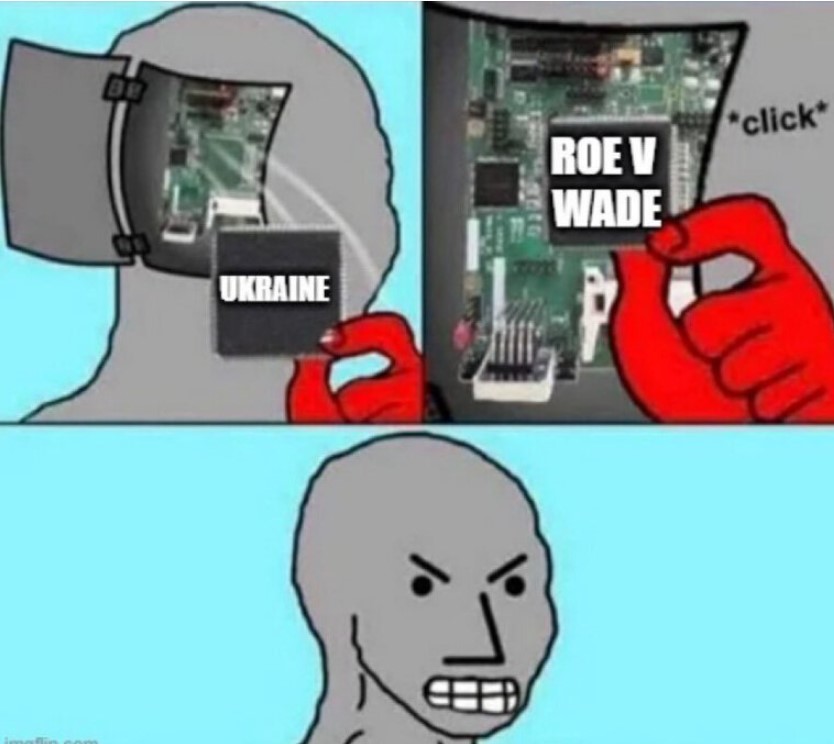
The Democratic Party has become tone-deaf. People fear that they cannot maintain their current standard of living, pay for housing, or feed their families. They feel outraged every time they go to the gas pump or grocery store and only see darker days ahead. Leaking the Supreme Court decision on Roe v. Wade was a FAILED attempt to redirect the public’s attention before the midterm elections.

Pennsylvania Senate Republican Race is a Dead Heat as Candidates Make Closing Arguments


Posted originally on the conservative tree house on May 16, 2022 | Sundance

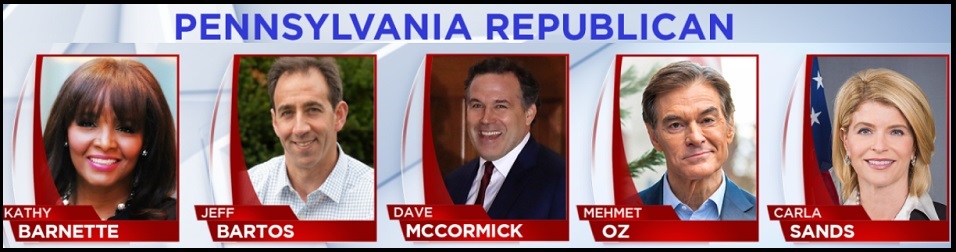
The republican primary race in Pennsylvania is essentially a three-way tie going in to voting day tomorrow.  All three of the top candidates are carrying approximately 25 percent of the vote with around 15 percent still undecided.   It really is anyone’s race.

President Trump has sent robocalls into Pennsylvania to support Mehmet Oz as a last-minute effort to push his endorsement over the line. “I’ve just spent a lot of time with him. I did endorse him, and the reason is he’s tough, he’s smart and he really loves our country and he wants to do a great job for the Commonwealth of Pennsylvania.”

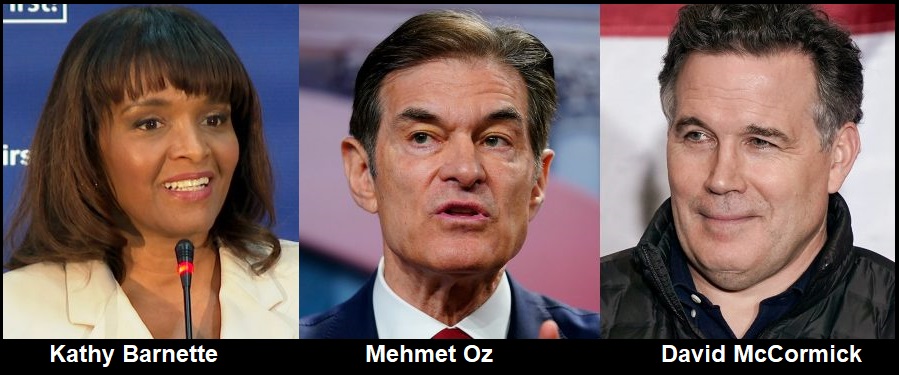
Fox News Sean Hannity also hosted Mehmet Oz on his evening broadcast to deliver his closing arguments, while Fox News Laura Ingraham provided the same opportunity for David McCormick.  In the counterbalancing effort, Steve Bannon hosted Kathy Barnette for an interview Monday providing her the opportunity to speak to the Bannon audience.

The wild aspect to this race is the still high number of undecided voters as the final hours count down.   McCormick representing the party candidate, with both Oz and Barnette splitting the MAGA base.  Pennsylvania undecideds have a tough decision.

Mehmet Oz is not trusted by the base despite President Trump’s endorsement.  Kathy Barnette is the landing place for many base voters who do not want to support the establishment McCormick and cannot bring themselves to vote for Oz.  However, democrats and left-wing media are already showing their intent to weaponize Barnette’s attendance at the J6 rally in Washington DC, if she should win the primary {Video Here}.

As expected, David McCormick’s current position tying all three of them at the top of the polling, appears to have resulted as a splitter strategy from the fractured MAGA base.

Many people just cannot support Mehmet Oz because of his prior positions on issues of importance.  Oz is by far President Trump’s most controversial endorsement of the year.  As an outcome, those who refuse to vote for Oz lean heavily toward Kathy Barnette.

(Via Politico) – […] “You are seeing people move to McCormick because he is a trustworthy conservative,” said James Schultz, a former Trump White House lawyer who is close to McCormick’s campaign. “We have seen for this entire cycle Mehmet Oz’s struggle with the truth. With Barnette, there have been many questions surrounding her truthfulness as well.”

Messaging from McCormick’s campaign on Monday appeared to concede that he is one of multiple candidates crowded at the front of the pack. The campaign wrote in an election eve press release that McCormick would make the case to Republicans that he is “the only front-runner who grew up in Pennsylvania and shares the same conservative values as PA voters.”

A series of other twists in recent days have added to the sense of volatility ahead of Tuesday’s primary election. Lt. Gov. John Fetterman, the leading Democratic Senate candidate, remains hospitalized after suffering a stroke over the weekend. And Trump, on Saturday weighed in with a last-minute endorsement in the governor’s race, picking Doug Mastriano, the candidate who is publicly backing and campaigning with Barnette.  (read more)

This race will be very interesting to watch on Tuesday as the votes come in.  However, with the race so close, and with all three of the leading candidates willing to request a recount, we might not even know the results tomorrow.


Project Veritas Releases Video of Senior Twitter Engineer Describing Culture and Ideology of The Platform


Posted originally on the conservative tree house on May 16, 2022 | Sundance 

A senior engineer working for the Twitter social media platform is captured on undercover video explaining the culture and ideology of the people who work within the organization.

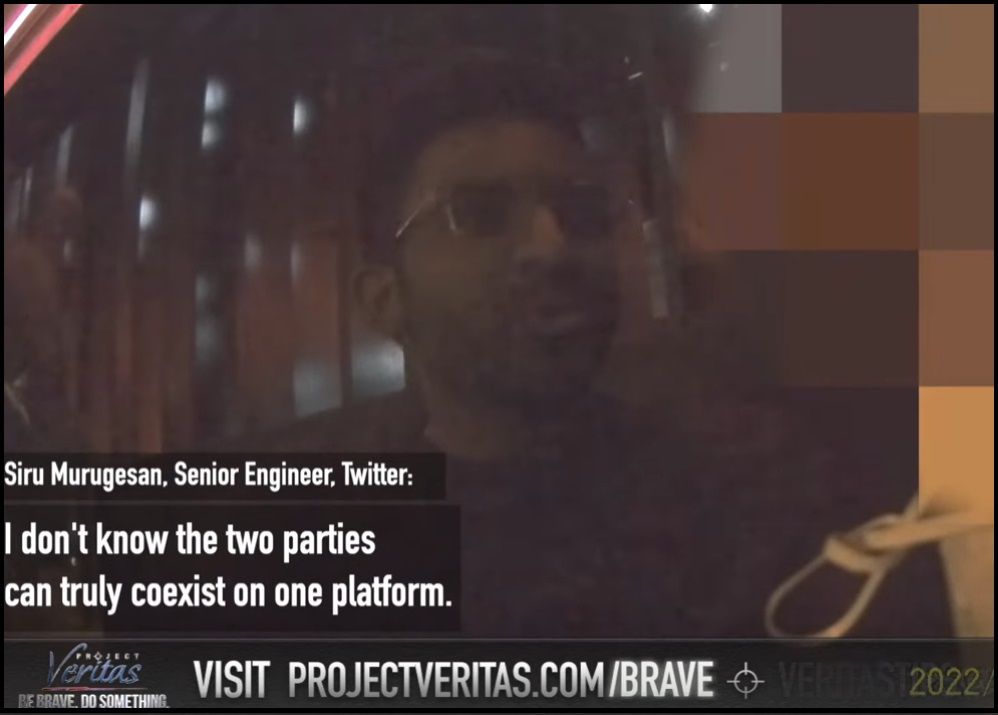
In the video Twitter Sr. Engineer, Siru Murugesan, a self-described communist, explains why most of his colleagues are freaked out about Twitter being purchased by Elon Musk and operating as a capitalistic company.  Many might have to work more than 4 hours a week to earn their salary. WATCH:

[NEW YORK – May 16, 2022] Project Veritas published explosive undercover footage on Monday night featuring one of Twitter’s senior engineers discussing the dynamics behind internal reactions to the acquisition of the tech company by business magnate, Elon Musk.

In the video, Twitter Sr. Engineer, Siru Murugesan, says many of his colleagues have voiced “this would be my last day if it happens,” referring to Musk’s high publicized intended purchase of Twitter. He also says employees at Twitter are “stress-eating” and “worried for our jobs.”

More significant than those soundbites are the reasons he says employees at Twitter feel this way. (read more)

The Twitter Bot Inquiry Intensifies as Musk is Seemingly Stiff Armed


Posted Originally on the conservative tree house on May 16, 2022 | Sundance

The ramifications for Twitter surrounding fake users or algorithmic bots are considerable.  One issue is overcharging advertisers for ad impressions based on mDAU’s, which are “monetized Daily Active Users.”  The second issue is an outcome of the first and relates to the valuation of Twitter.  If Twitter bots are higher than Twitter estimates, then the mDAU rate is overstated.

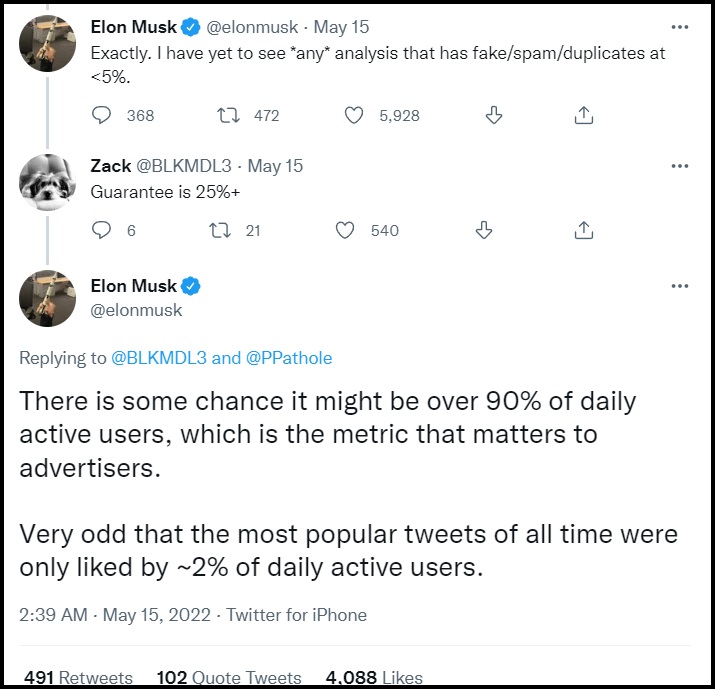
Elon Musk is indicating there may need to be a lowering of the purchase price unless Twitter becomes transparent with how they are calculating the number of bot users at less than 5%.  All outside reviews attempting to estimate the number of fake accounts, or bots, puts the estimations considerably higher than the claims by Twitter.  Elon Musk tweeted:

At “The All In Summit 2022,” Elon Musk gave the impression the purchase price of Twitter may be tenuous.  He said that a deal with a lower price tag is not “out of the question,” Bloomberg reported.  “Currently, what I’m being told is that there’s just no way to know the number of bots… It’s like, as unknowable as the human soul,” Musk said at the Miami conference, per a social media video, Bloomberg added.

Twitter CEO Parag Agrwal has responded to the controversy in a very obtuse twitter thread:

Let’s talk about spam. And let’s do so with the benefit of data, facts, and context…

First, let me state the obvious: spam harms the experience for real people on Twitter, and therefore can harm our business. As such, we are strongly incentivized to detect and remove as much spam as we possibly can, every single day. Anyone who suggests otherwise is just wrong.

Next, spam isn’t just ‘binary’ (human / not human). The most advanced spam campaigns use combinations of coordinated humans + automation. They also compromise real accounts, and then use them to advance their campaign. So – they are sophisticated and hard to catch.

Some final context: fighting spam is incredibly *dynamic*. The adversaries, their goals, and tactics evolve constantly – often in response to our work! You can’t build a set of rules to detect spam today, and hope they will still work tomorrow. They will not.

We suspend over half a million spam accounts every day, usually before any of you even see them on Twitter. We also lock millions of accounts each week that we suspect may be spam – if they can’t pass human verification challenges (captchas, phone verification, etc).

The hard challenge is that many accounts which look fake superficially – are actually real people. And some of the spam accounts which are actually the most dangerous – and cause the most harm to our users – can look totally legitimate on the surface.

Our team updates our systems and rules constantly to remove as much spam as possible, without inadvertently suspending real people or adding unnecessary friction for real people when they use Twitter: none of us want to solve a captcha every time we use Twitter.

Now, we know we aren’t perfect at catching spam. And so this is why, after all the spam removal I talked about above, we know some still slips through. We measure this internally. And every quarter, we have estimated that <5% of reported mDAU for the quarter are spam accounts.

Our estimate is based on multiple human reviews (in replicate) of thousands of accounts, that are sampled at random, consistently over time, from *accounts we count as mDAUs*. We do this every quarter, and we have been doing this for many years.

Each human review is based on Twitter rules that define spam and platform manipulation, and uses both public and private data (eg, IP address, phone number, geolocation, client/browser signatures, what the account does when it’s active…) to make a determination on each account.

The use of private data is particularly important to avoid misclassifying users who are actually real. FirstnameBunchOfNumbers with no profile pic and odd tweets might seem like a bot or spam to you, but behind the scenes we often see multiple indicators that it’s a real person.

Our actual internal estimates for the last four quarters were all well under 5% – based on the methodology outlined above. The error margins on our estimates give us confidence in our public statements each quarter.

Unfortunately, we don’t believe that this specific estimation can be performed externally, given the critical need to use both public and private information (which we can’t share). Externally, it’s not even possible to know which accounts are counted as mDAUs on any given day.

There are LOTS of details that are very important underneath this high-level description. We shared an overview of the estimation process with Elon a week ago and look forward to continuing the conversation with him, and all of you.  (Link to Twitter Article)

Methinks Parag Agrwal doth protest too much….  Especially if you overlay the ideological incentives that Twitter carries into its operational platform.

If you accept that Twitter is manipulating the public conversation intentionally (they are), then Twitter bots would serve an ideological function.  However, the issue of ‘bots’ operating on the Twitter platform is interesting when you consider the cost of platform operation.

On one hand, extensive auto-generated ‘bots’ would be an issue of cost and data-processing, a net negative.  On the other hand, the use of bots would be a manipulative practice for the creation of false impressions to generate advertising revenue.

If the scale of data-processing was subsidized, an outcome of a network of data processing centers -the AWS cloud- linked to government resources, the bots would not be a cost issue for the operation.  Despite the false impressions generated, bots would, however, under this weird situation, be useful for the manipulation of the conversation.

At the root of Elon Musk’s line of inquiry is the need to discover if this suspicion is true.

If the scale of bots has been underestimated (likely by a willfully blind operation) the advertising fees charged by Twitter were potentially fraudulent.  This is another operational reason (mitigating lawsuits from advertisers) for Musk to make the determination prior to the final purchase of the platform.

Taking Twitter private as a company, eliminating bots (which is essentially removing fraudulent users) then carries the potential benefits of both lowering costs and positioning the company to increase genuine ad revenue from authenticated users as real people.

Many people suspect the size of the political left on the Twitter platform is manipulated by programatic bots.  Meaning there seems to be more people on the left side of the spectrum because bots are deployed to give the impression of like-minded users.  I am one of the people who believe this suspicion is accurate, because it would be a typical way the ideological left operates.

The bots would be in addition to the deployment of algorithms that are designed to suppress speech the platform operators do not like.

I have long suspected the Twitter algorithm process is essentially assigning certain users into specifically designed data-processing containers where their voice is suppressed.   Some people call this ‘shadow-banning,’ I simply call it suppression.

Elon Musk represents a threat to the way the platform was/is designed to operate.  If Musk removes the discussion constraints, opens the containers and removes the restrictions, while simultaneously eliminating bots and fake accounts, the entire perspective of the platform could change very quickly.  This is what I think the current board and operators are trying to avoid.

Another rudimentary way to look at it…. Think about the last several months of public opinion polls.   Despite the efforts of a compliant media, repeatedly we see a 75/25 split against Biden and leftist policies.  The 3:4 and/or 4:5 ratio has been a consistent pattern for several months.  That ratio shows up in almost every poll.  However, if you look at Twitter that ratio is not present in the “organic” conversation about the same issues.

As CTH has said for many years, there are more of us than them.  However, Big Tech controls the mechanisms we use to communicate – and as a consequence the scale of our assembly is severely understated.

Twitter user fraud is the digital and social media equivalent to voter election fraud.   The voices raised in opposition to researching both issues are exactly the same.

Suspicious Cat remains, well, suspicious….

Erdogan Will Not Accept Sweden and Finland into NATO Until He Extracts Concessions for Former Positions Against Interests of Turkey


Posted originally on the conservative tree house on May 16, 2022 | Sundance

Turkey as a member of NATO has always been a thorny and multi-layered geopolitical issue.  In the latest chapter of the dynamic, Turkish President Recep Erdogan, a man with visions of his own grandiose importance as the leader of the next Ottoman empire, has said Sweden and Finland do not warrant entry into NATO because they have held positions adverse to the interests of Erdogan and the Muslim Brotherhood.

As the entry point from the middle east into Europe, Erdogan has long leveraged his gatekeeper status to create an oversized influence of power.  When the EU formally declared the era of multiculturalism was failing 2012, and Islamic extremists were carrying out terrorism attacks all over the NATO alliance, Erdogan leveraged his ability to open the floodgates from Syria to gain additional financial benefits.

On one hand, when Turkey shot down a Russian fighter jet in northern Syria, Erdogan hid behind the skirt of NATO seeking protection from Russian retaliation.  On the other hand, when the U.S. refused to give Turkey missile defense systems, Erdogan buried the hatchet with Putin and purchased Russian missile defense systems.   President Erdogan plays all sides in advancing his interests.

In the latest development, what Joe Manchin is to the leftist agenda of Joe Biden, Erdogan is playing that role toward the globalist agenda of NATO.  The big picture behind Erdogan’s priorities is always connected to the agenda of the Brotherhood.

ISTANBUL (Reuters) -Turkish President Tayyip Erdogan said on Monday that Swedish and Finnish delegations should not bother coming to Ankara to convince it to approve their NATO bid.

Sweden’s government has formally decided to apply for NATO membership, Prime Minister Magdalena Andersson said on Monday, a day after Finnish President Sauli Niinisto confirmed that Helsinki will also apply for membership.

Turkey surprised its NATO allies last week by saying it would not view their applications positively, mainly citing their history of hosting members of groups Ankara deems terrorists.

In a news conference on Monday, Erdogan repeated that Turkey would not approve their bids to join NATO, calling Sweden a “hatchery” for terrorist organisations, and adding it had terrorists in its parliament.

[…]  NATO and the United States said they were confident Turkey would not hold up membership of Finland and Sweden.

Diplomats said Erdogan would be under pressure to yield as Finland and Sweden would greatly strengthen NATO in the Baltic Sea.

Erdogan’s spokesman said on Saturday that Turkey has not shut the door to Sweden and Finland joining NATO but wants negotiations and a clampdown on what it sees as terrorist activities.  (read more)

Recep Erdogan can see the global cleaving underway, and he will position himself to use the geopolitical agenda of the western alliance to build out his continued quest to recreate a new Ottoman empire.  That’s his legacy agenda.

President Erdogan is sketchy and cunning…

Biden Redeploys U.S. Combat Troops to Somalia, Reversing Trump Draw Down


Posted originally on the conservative tree house on May 16, 2022 | Sundance

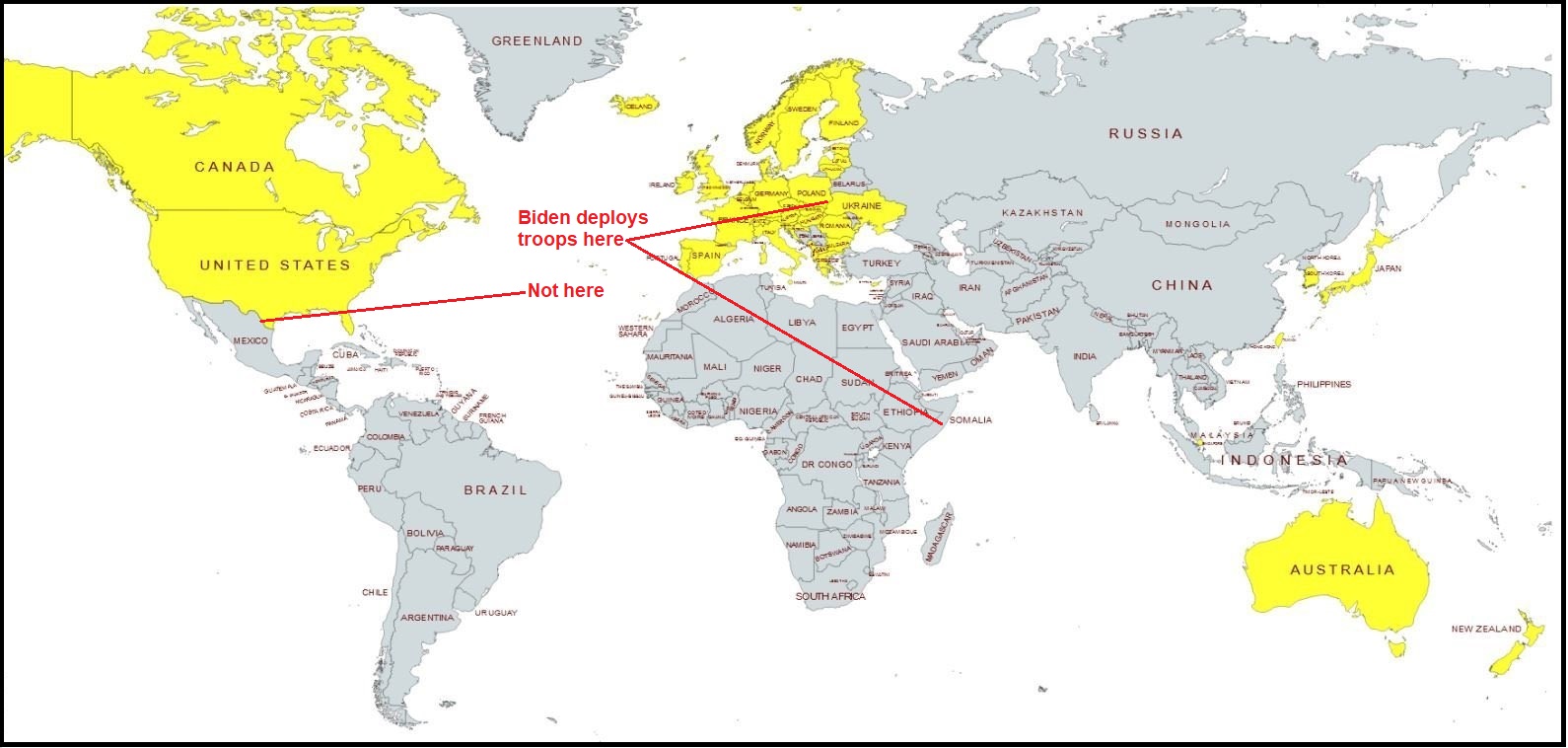
Democrats love war, even when they have to go looking for one.  The New York Times is reporting that Joe Biden has signed a Defense Dept order authorizing 700 combat troops to redeploy to Somalia, reversing the Trump-era troop withdrawal.

WASHINGTON — President Biden has signed an order authorizing the military to once again deploy hundreds of Special Operations forces inside Somalia — largely reversing the decision by President Donald J. Trump to withdraw nearly all 700 ground troops who had been stationed there, according to four officials familiar with the matter.

In addition, Mr. Biden has approved a Pentagon request for standing authority to target about a dozen suspected leaders of Al Shabab, the Somali terrorist group that is affiliated with Al Qaeda, three of the officials said. Since Mr. Biden took office, airstrikes have largely been limited to those meant to defend partner forces facing an immediate threat.

Together, the decisions by Mr. Biden, described by the officials on the condition of anonymity, will revive an open-ended American counterterrorism operation that has amounted to a slow-burn war through three administrations. (read more)

Inflation Crippling Low-Income Americans


Armstrong Economics Blog/Inflation Re-Posted May 16, 2022 by Martin Armstrong

We went from a booming economy to staring down the next recession. Inflation has reached 8.3%, and most Americans are troubled that they will no longer be able to afford their standard of living. According to the latest Gallup poll, 52% reported that they are fearful about maintaining their standard of living. Some may say, “So what? The rich will have to sell off one mansion and fly commercial!” The people who will feel the brunt of this economic downturn are lower-income earners.

Among those earning under $40,000 annually, 73% said they no longer believe they can afford basic living necessities, up from 56% a year prior. About 65% of lower-income Americans worry about having enough money to pay their monthly bills, while 59% say they fear they’ll no longer be able to afford housing. In fact, more lower-income renters should be concerned about the rising cost of housing because landlords will pass their increased costs on to their tenants at a time when rental costs are already at an all-time high.

Medical bills, the leading cause of bankruptcy, are of the utmost concern. Seventy-two percent of lower-income earners said they cannot afford an emergency medical event, and 62% cannot afford basic medical care. These fears are not unfounded and we are looking at a major crisis on the horizon.