News of spreading and morphing political protests in Iran are beginning to surface as social media accounts are now gaining MSM attention.
Openly political protests are not common in Iran ever since the 2009 ‘Green Revolution‘ was harshly put-down by security forces carrying out the instructions of the ruling Mullahs and political class. Iranian security services are omnipresent and looming. However, what appears to have begun as protests over prices, inflation and the lack of economic freedom, seems to have morphed into several regional political protests directly challenging the Mullahs and the reigning political class.
Back in 2009, after President Obama gave his famous Cairo speech, the message was interpreted by the Iranian reform movement, the “Greens”, as a spark toward freedom. However, the Mullahs responded violently, Iranian security forces attacked the protestors, several were killed and hundreds jailed and President Obama stood by, watched the brutality, saying and doing nothing. 2009 was a very dark time for the reform movement.
It is too soon to tell if today’s protests are the beginning of a similar uprising, a resurgence of those previously crushed cries for freedom, but the reform movement appears to be pushing the message: this is indeed their objective. It is a very interesting development.
(Reuters) – Demonstrators chanted anti-government slogans in several cities across Iran on Friday, Iranian news agencies and social media reports said, as price protests turned into the largest wave of demonstrations since nationwide pro-reform unrest in 2009.
Police dispersed anti-government demonstrators in the western city of Kermanshah as protests spread to Tehran and several other cities a day after rallies in the northeast, the semi-official news agency Fars said.
The outbreak of unrest reflects growing discontent over rising prices and alleged corruption, as well as concern about the Islamic Republic’s costly involvement in regional conflicts such as those in Syria and Iraq.
An official said a few protesters had been arrested in Tehran, and footage posted on social media showed a heavy police presence in the capital and some other cities.
About 300 demonstrators gathered in Kermanshah after what Fars said was a “call by the anti-revolution”. They shouted: “Political prisoners should be freed” and “Freedom or death”, and some public property was destroyed. Fars did not name any opposition groups.
The protests in Kermanshah, the main city in a region where an earthquake killed over 600 people in November, took place a day after hundreds rallied in Iran’s second largest city Mashhad to protest at high prices and shout anti-government slogans.
Videos posted on social media showed demonstrators yelling, “The people are begging, the clerics act like God”.
Fars said there were protests in the cities of Sari and Rasht in the north, Qazvin west of Tehran and Qom south of the capital, and also in Hamadan in western Iran. It said many marchers who wanted to raise economic demands left the rallies after demonstrators shouted political slogans. (read more)
I would advise caution not to read too much into the events and accept there are tenuously connected seeds within the larger Middle-East struggles. History is filled with the conflicting polarity between Persians and Arabs.
Iran has been on a growing question to influence the broader middle-east ideology, and Saudi coalition members are pushing back against that influence with open support for the reform agenda within Iran. Proxies on proxies, and sub-sects on sub-sects. A considerable challenge for those who would support increased ‘freedom’.
Viewpoint of National Council of Resistance in Iran – SEE HERE
Another Viewpoint of Resistance Supporters – SEE HERE
Reminder, proceed with caution. There’s a great deal of misinformation.
QUESTION: Mr. Armstrong; You are clearly a Roman scholar. Is it true that the Romans used crucifixion only for political crimes and that the two who were crucified with Jesus were not thieves but rebels? There has been some debate on this subject. I would like to hear your views.
Thank you
WR
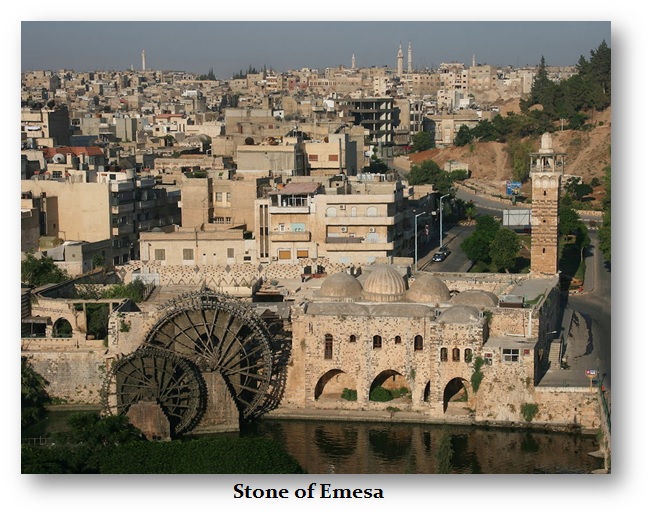
ANSWER: Jesus’ crime was really sedition and not blasphemy. The high priests may have seen this as blasphemy, but Jesus would never have been put to death by the Romans for such a local issue. The Romans practiced freedom or religion. They allowed the provinces that they had conquered to retain their own gods. Even the Roman Emperor Elagabalus (218-222AD) was an heir to the throne being of the Severian House. He had been a priest in Emesa of the sun god, which is the modern city of Homs in Syria today. He worshiped a black meteor that had fallen from the sky and a temple had been built for this stone of god (see above). When Elagabalus became emperor, he carried the Stone of Emesa to Rome and built a temple there. After he was murdered, the Romans respectfully returned the stone to Syria as to not offend any god. As for the Black Stone of Emesa is concerned, it was most likely smashed to pieces when the temple was converted into a Christian church at some point during the 4th Century AD by the Byzantines.
Therefore, the only possible way that Jesus would have been crucified was for a civil crime, not a religious one, and the penalty had to be only for sedition, which is conduct or speech inciting people to rebel against the authority of a state. It is rabble-rousing, incitement to rebel, subversion, troublemaking, but not a religious issue. Therefore, the high Jewish priests took Jesus to the governor and had to make their case that he was inciting a rebellion against Rome by claiming to be King of the Jews. Pilate interrogates Jesus:
“You are a king, then!” said Pilate. Jesus answered, “You say that I am a king. In fact, the reason I was born and came into the world is to testify to the truth. Everyone on the side of truth listens to me.
“What is truth?” retorted Pilate. With this he went out again to the Jews gathered there and said, “I find no basis for a charge against him.”
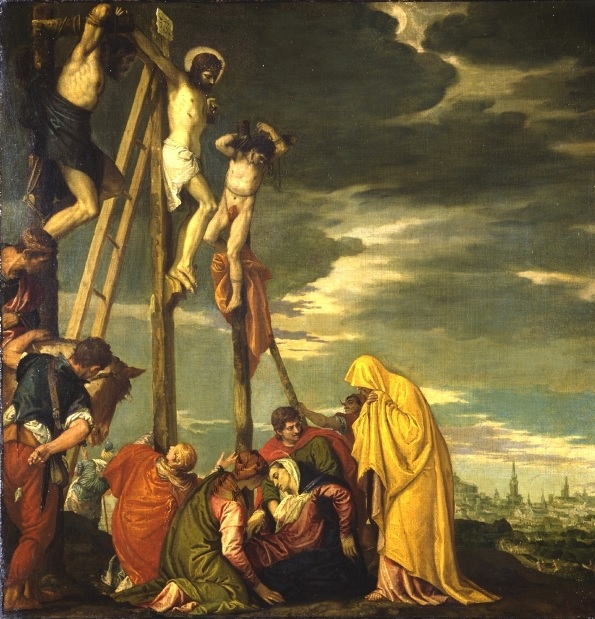
Rome’s punishment only for a political crime was a crucifixion, which was a public display that was painful, and a visible warning to others. There is no possible way that the two men crucified with Jesus were common thieves. The sentence of crucifixion was only something that Rome could order. The two men who were killed along with Jesus are identified in the Gospel of Nicodemus as Dismas and Gestas.
Luke 23:39-41 says, “One of the criminals who hung there hurled insults at him: ‘Aren’t you the Christ? Save yourself and us!’ But the other criminal rebuked him. ‘Don’t you fear God,’ he said, ‘since you are under the same sentence? We are punished justly, for we are getting what our deeds deserve. But this man has done nothing wrong.’”
Matthew refers to Barabbas who is released by Pilate in place of Jesus only as a “notoriousprisoner” and that would never imply a common thief. Mark and Luke further refer to Barabbas as one involved in a στάσις (stasis, a riot), probably one of the numerous insurrections against the Roman power who had committed murder. The translation as “thieves,” however, the word can also mean “insurgents,” and it is more-likely-than-not that the two were co-conspirators of Barabbas rather than thieves. This is the only possibility that would support the sentence of crucifixion, which was a political weapon used to send a message to those still living: Do not engage in sedition or this will be your fate.
Crucifixion was an execution that was severe and reserved for political crimes, not common thieves. The more common method of execution in the Roman Empire was by strangling. Even the leader of the Gauls, Vercingetorix, who was an adversary was put on display in a triumph of Julius Caesar and then strangled – not crucified. This was simply a captive of a conquered nation or group who had not been under Roman rule and thus did not warrant crucifixion.
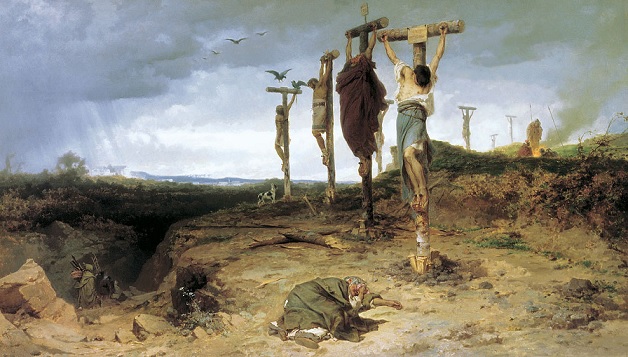
Spartacus (111-71BC) was a Thracian gladiator who escaped and became a slave leader during the Third Servile War, a major slave uprising against the Roman Republic. Crassus crucified 6,000 of Spartacus’ followers on the road between Rome and Capua pictured here in the 1878 painting by Fyodor Bronnikov. Again, the punishment of crucifixion is employed for rebellion. Even Karl Marx listed Spartacus as one of his heroes and described him as “the most splendid fellow in the whole of ancient history” and a “noble character, real representative of the ancient proletariat”.
Therefore, from a historical perspective of Roman law, Jesus would then have been crucified ONLY as a rebel and not for blasphemy. Giving a choice to the crowd between Jesus and Barabbas would not have been plausible unless they both stood for the same type of offense of sedition. This to me is clear evidence of the political nature of Jesus’s execution and was not merely a local religious issue but was a crime of sedition against the Roman Empire.
The War Cycle is in full swing upward since 2014. We have witnessed the invasion of Ukraine, the invasion of Syria, Rocketman in North Korea, and numerous civil uprisings. However, the war also comes with sharply declining economies as political leaders need to point the finger outside their domestic rule to distract their people.
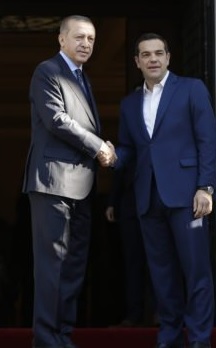
The Turkish President Recep Tayyip Erdoğan is also on a power trip and the sharply collapsing currency only puts more pressure on him to start conflicts. That basic incentive has played out with his visit to Greece in December. This was the first time a Turkish leader visited Greece in 65 years. As the Guardian reports, Erdoğan shocked Greece by calling for a revision of the Lausanne Treaty of 1923. The Turkish president in Turkey has sharply criticized the opposition for this demand and as always there is the justification for protecting people of Turkish origin living in Greece. Hitler used the same excuse to invade neighbors to defend Germans living on foreign lands.
The Treaty of Lausanne marks the conclusion of the four-year Greco-Turkish War, which regulated the demarcation between Greece and Turkey and the rights of the religious minority in the other country. Keep in mind that Turkey was the seat of the Ottoman Empire that conquered Constantinople and renamed it Istanbul. The Church of St Sophia became the Blue Mosque. So the conflicts between Greece and Turkey extend back thousands of years. Turkey was originally Anatolia settled by Greeks. They were conquered by Cyrus the Great of Persia and then by Rome. The Turks invaded from Turkestan and thus the ancient land of Anatolia became Turkey. This was where written language and even money were both born.
Erdoğan, while visiting Athens, accused the Greek government of not allowing the Turkish minority to vote for muftis, as promised in the treaty. Instead, the religious jurists would be appointed by the government. The Turkish President had questioned the Treaty of Lausanne in an interview with the Greek broadcaster Skai TV before leaving for Athens. Airspace and the maritime border could be “improved”, Erdoğan said.
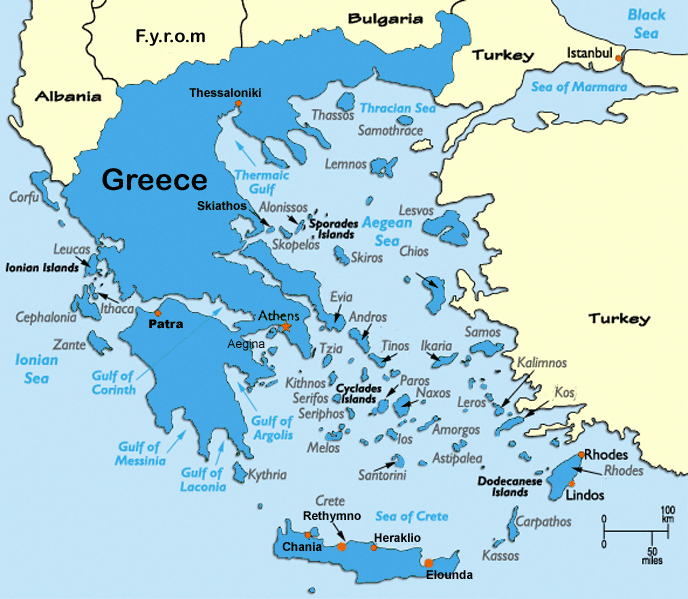
In the Treaty of Lausanne in 1923, Greece had been given almost all the Aegean islands off the Turkish coast. The Greek Islands comprise more than 6,000 islands and islets covering much of the eastern Mediterranean. Only about 230 Greek islands are inhabited and, of these, just 80 or so have more than 100 permanent inhabitants.
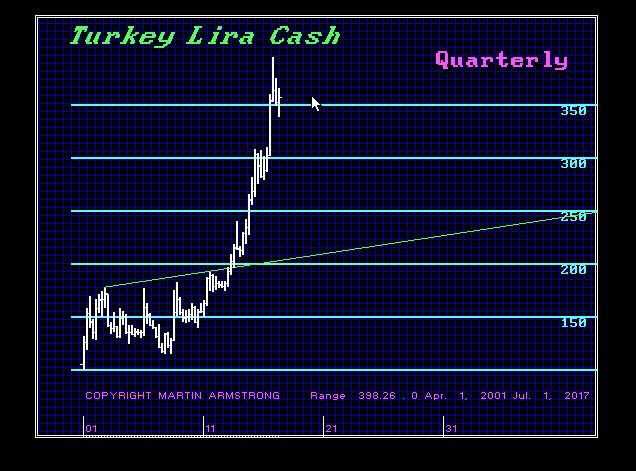
Erdoğan has domestic problems with the currency moving dangerously toward hyperinflation, which only unfolds when confidence in the government collapses. Turkey’s currency is being attacked from all sides. In October 2017, the Turkish lira collapsed when Turkey and the United States suspended bilateral visa processing, which was restored in early November. However, our model is warning that the Turkish lira will collapse into 2021.
Erdoğan is obviously trying to create an external enemy as the domestic economy turns against his policies. For several months, Erdoğan is trying hard to provoke a conflict in the Aegean Sea of Greece. On April 16th, 2017, Greek Minister of Defense Panos Kammenos and Greek Commander-in-Chief Alkiviadis Stefanis flew to Agathonisi Island, just off the Turkish coast. There they carried out an action with several soldiers. Lambs were roasted on a skewer, which was a symbolic action that dates way back to the Greek occupation of Turkey from 1919 to 1922. At that time, the Greek occupiers in the conquered territories of Turkey roasted lamb on skewers to make it clear to the Turks that they would be defeated.
Erdoğan asserts that the protection of the rights of ethnic Turks is his “top priority” and he wants to visit the Turkish minority in the northern Greek region of Thrace. Erdoğan was twice in Athens before back in 2004 and 2010. But it is the first visit of a Turkish head of state in Greece since 1952.
Erdoğan also criticized the implementation of the EU refugee pact with Turkey in Athens. The EU had “not fulfilled any of its economic promises”, while its country has kept all promises, Erdoğan said. He has long accused the EU of failing to fulfill its part of the March 2016 agreement, including the payment of aid.
Erdoğan also criticised the matter of the eight military personnel who had fled to Greece after the coup attempt in a helicopter. Erdoğan stated that Greece promised to extradite those men to Turkey, but that still had not happened.
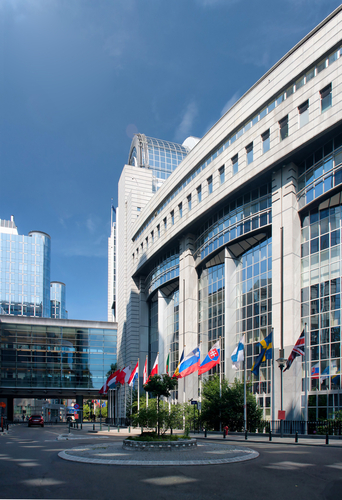
My recent meetings in Brussels reveals some concern what happens when Merkel loses power? Schultz is calling for the complete federalization of Europe – the United States of Europe as he puts it. The power is starting to slip between their fingers and as Italy approaches its confrontation with the EU in the next elections, there too we see the Social Democratic ruling party PD is losing its support in the same manner as the SPD in Germany.
Now with only a few weeks before the expected dissolution of the Italian parliament before the new elections, the PD is already down to only a 23.4% approval rating. The Socialist agenda is losing around the world just as Hillary lost in the States as did Schultz in Germany.
In Italy, the center-right coalition of former Prime Minister Silvio Berlusconi is on the road to a major come-back gathering 36% of the polls, which is the strongest political party in Italy right now. The second party in line is also the anti-Euro Five-Star movement coming in at 28.2%.
If the polls are correct and the election took place today, 64.2% of the people would vote AGAINST the EU. This type of coalition could become the strongest single party in the next parliament and the strongest as a percent of the population throughout Europe. There is a rising feeling in Italy that the EU has been a disaster burdening them with refugees they refuse to compensate or allow to move north within Europe. Italy is now just trying to keep the EU out which or interfering ever again.
In Italy, a new parliament is likely to be elected at the beginning of March. It is expected that President Sergio Mattarella will dissolve Parliament between Christmas and New Year, paving the way for new elections.
I previously wrote that it was the EU which conspired to overthrow Berlusconi because he was anti-Euro back then and wanted to take Italy out before BREXIT. For Berlusconi, this is political payback.
The more political chaos in Europe, the crazier the markets will become in 2018 driving the dollar up until the monetary system cracks wide open.
The attack upon religion in Australia is not what one would call a direct assault. It is also not unique to just Australia. This is simply the way prosecutors expand the envelope of power. They look at a single issue and seek to address that issue alone. They rarely look at the implications beyond their immediate objective.
Take FACTA in the USA. The objective is to catch people avoiding taxes by putting their profits offshore. They begin with that assumption and ignore the fact that NOT everyone doing business offshore is to hide taxes. They then obstruct businesses from expanding globally. In my own case, despite the fact that we do business around the globe, because I am an American, I cannot open an account anywhere outside the USA because nobody wants to deal with the FACTA reporting back to the USA. My only solution is to go public since an American citizen can no longer own and operate a multinational business privately. Here we have a law designed to get tax evaders, but it blocks the legitimate business from operating. The only exception is the multinational corporation.
This is the entire problem with regulation. In the case of Australia, they may have a noble goal and demand that religion should abolish celibacy and report child abuse crimes confessed to priests to be able to punish people. But such noble goals end up altering the entire structure of a faith. Once you make one exception, you open the door for all crimes.
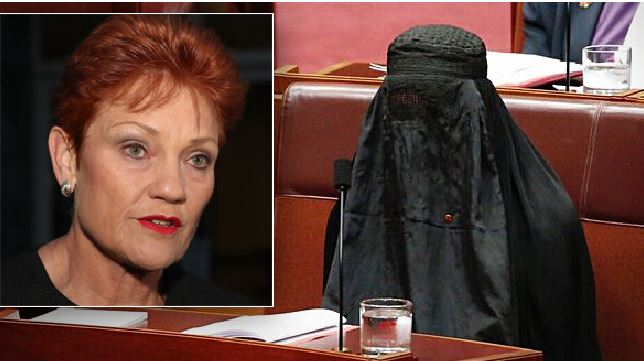
The same thing with the Muslim secs that demand women wear the full burka. Yes, on the one hand, anyone could put on a burka and hide from the public. So how do you deal with this? The Australian Senator Pauline Hanson entered the Senate in a burka to demonstrate the point. You can outlaw a burka and effectively tell them to leave your country or go to jail. Is that what you tell Christians if they do not report specific crimes to the State? Once you take that first step for one specific crime, you have taken it for all crimes. There is NEVER a line in the sand that remains uncrossed.
This is a very complex and touchy issue. How do we address religion that clashes with the State?
OK, believe it or not, the Australian government wants sweeping changes in the Catholic Church and other organizations, including making celibacy voluntary for clergy, but the real kicker is that they want priests to report people who confess sins in church. Politicians no longer have respect for religion or the beliefs of people. To them, there is no God, only their power. This is getting really insane.
In a stunning display of international transparency, U.N. Ambassador Nikki Haley presents actual, physical, incontrovertible and, yes, uncomfortable, evidence of Iranian weapons that have been used by proxy fighters against allied nations. The presentation takes place at joint base Anacostia-Bolling in Washington, DC and consists of formerly classified intelligence gathering presented openly to the international community.
Ambassador Nikki Haley presents an assembly of actual Iranian missiles and weapons that have been fired against mid-east allies within the peace coalition. After a brief speech outlining the material on display, Mrs. Haley takes questions from international media.
.
[Transcript] It’s really important that you be here today, because we have a story to tell, and the story is a very important one. And it’s not just important for the United States, it’s important for the entire international community. As President Trump announced on October 13, the United States is taking a new approach to Iran by focusing on all of the regime’s destabilizing behavior. That means we are focused not just on the nuclear program.
We’re also taking a hard look at Iran’s ballistic missile program, its arms exports, and its support for terrorists, proxy fighters, and dictators.
Our new strategy was prompted by the undeniable fact that the Iranian regime’s behavior is growing worse. The nuclear deal has done nothing to moderate the regime’s conduct in other areas.
Aid from Iran’s Revolutionary Guard to dangerous militias and terror groups is increasing. Its ballistic missiles and advanced weapons are turning up in warzones across the region. It’s hard to find a conflict or a terrorist group in the Middle East that does not have Iran’s fingerprints all over it.
Four days ago, Iranian Foreign Minister Mohammad Zarif wrote an op-ed assuring the world that Iran has been misunderstood. He wrote, “Iran’s military capabilities comply with international law and are entirely defensive.”
Instead of stoking violence, Zarif promised that Iran and its partners, “labor to put out fires [while] the arsonists in our region grow more unhinged.”
But the United Nations just released a new report that tells the opposite story. It tells the story of Iran as the arsonist. The report shows the Tehran regime not putting out fires, but fanning the flames of conflict in the region.
This was the Secretary-General’s fourth report detailing Iranian compliance – or noncompliance – with UN Resolution 2231. That resolution places specific prohibitions on Iranian conduct.
In its strongest language yet, the Secretary-General’s report describes violation after violation of weapons transfers and ballistic missile activity.
The United States welcomes this report, as should every nation concerned about Iranian expansion. We are grateful for the depth of the UN’s inspection and analysis. Most telling, the report makes a convincing case that Iran is illegally providing the Houthi militants in Yemen with dangerous weapons. The report provides devastating evidence of missiles, conventional arms, and explosive boats of Iranian origin used by the rebels in Yemen – all of which violate UN resolutions.
The United States and our partners went to great lengths to support the UN investigations into Iranian violations by declassifying evidence so that the world could better be informed of the extent of Iran’s malign activities.
As you know, we do not often declassify this type of military equipment recovered from these attacks. But today we are taking an extraordinary step of presenting it here in an open setting. We did this for a single, urgent purpose: because the Iranian regime cannot be allowed to engage in its lawless behavior any longer. International peace and security depends on us working together against the Iranian regime’s hostile actions.
The fight against Iranian aggression is the world’s fight. The United States is acting today in the spirit of transparency and international cooperation that is necessary to defeat this threat.
In this warehouse is concrete evidence of illegal Iranian weapons proliferation, gathered from direct military attacks on our partners in the region.
Behind me is an example of one of these attacks. These are the recovered pieces of a missile fired by Houthi militants from Yemen into Saudi Arabia. The missile’s intended target was the civilian airport in Riyadh, through which tens of thousands of passengers travel each day.
I repeat: This missile was used to attack an international civilian airport in a G-20 country.
Just imagine if this missile had been launched at Dulles Airport or JFK, or the airports in Paris, London, or Berlin. That’s what we’re talking about here. That’s what Iran is actively supporting.
What is most revealing about this missile is what’s not here. This is a short-range ballistic missile. It is missing the large stabilizer fins that are typically present on these kinds of missiles.
The Iranian Qiam missile is the only known short range ballistic missile in the world that lacks such stabilizer fins and includes nine valves that you will see running along the length of the missile. Those valves are essentially Iranian missile fingerprints.
On your walk through, you will also see missile debris stamped with the logo of Shahid Bagheri Industries, an Iranian manufacturer.
Those are just two of the many pieces of evidence that tell us of this missile’s Iranian origins.
It was made in Iran, then sent to Houthi militants in Yemen. From there it was fired at a civilian airport, with the potential to kill hundreds of innocent civilians in Saudi Arabia.
You will see more than that. In this warehouse there is also material from an anti-tank guided missile. Such missiles have a range of over two miles and can destroy tanks, and even buildings. You will see material from an unmanned aerial vehicle, also known as a kamikaze drone, that can take out radar sites. You will see material from a SHARK-33 explosive boat. These are boats with a warhead inside them that explodes on impact. They can blow six feet wide holes in the hulls of ships.
All of these weapons include parts made in Iran, some by Iran’s government-run defense industry. All are proof that Iran is defying the international community. And not just one time. This evidence demonstrates a pattern of behavior in which Iran sows conflict and extremism in direct violation of UN Security Council resolutions.
In just a minute, Laura Seal from our Defense Department will walk you through the items gathered here and explain their connection to the Tehran regime. We welcome a thorough examination of this material, not just by the members of the press here today, but by the international community.
Several countries will be sending delegations here to view this material in the next few days. Some have already been here. We are inviting the entire UN Security Council to see it for themselves. And we are inviting all members of Congress to view it.
This evidence is part of what has led the U.S. intelligence community to conclude, unequivocally, that these weapons were supplied by the Iranian regime.
The evidence is undeniable. The weapons might as well have had “Made in Iran” stickers all over it.
The United States stands ready to share what we know to further the cause of peace. We ask our friends and our allies to do the same. Iran is determined to undermine the international consensus against its conduct.
We must speak with one voice in exposing the regime for what it is: a threat to the peace and security of the entire world. We call on all nations to join us in a united front resisting this global threat. (read more)
The Catholic Near East Welfare Association (CNEWA) was established as a charitable organization, in 1924 by Monsignor Richard Barry-Doyle and in 1926 by Pope Pius XI, to help Catholics in the Near East and Asia, including victims of the September 1922 Armenian Genocide. The tragic Turkish/Islamic massacres and atrocities against the 1.5 million Greek and Armenian population was followed by the Great Fire of Smyrna, which then completely destroyed the Greek and Armenian quarters of the Greek city, located on the Aegean coast of Anatolia/Turkey.
Barry-Doyle’s entreaties for generous donations for his humanitarian work with orphans in Asia Minor, Asian Turkey and the Anatolian peninsula included heart-wrenching, detailed accounts of Muslim savagery used against Christians. Given that history, one would assume that today’s CNEWA members would continue to tell its readers the truth of the perilous Christian experience in most of the Middle East, and the one exception where they are safe and thriving, but that is not the case.
CNEWA recently reported in the “Middle East Christians on the Move” about the recent shift of the Christian population throughout the Middle East, basing its figures on information from the Holy See, regional church officials, the CIA World Factbook, World Bank, the UN and the US Census Bureau. The reasons given for the population upheaval were the war in Syria, the terrorism of ISIS, and the general turmoil caused by the totalitarian regimes.
Unpardonably, the papal agency failed to cite the only Middle East country where the population of indigenous Christians has increased since 1948 – Israel. Rather, the association alleges that Israel’s Christian population declined by half since the 1940s, a vague date that would suggest reasons of Israel’s War of Independence, discontent, or insecurity. However, there are more Christians living in Israel today (170,000) than there were before Israel’s statehood (130,000); Christians are flourishing under Israeli sovereignty. The report also gave the year of flight of 50,000 Christians from Iraq as 2014, when the truth is more than a million Christians were driven out with the overthrow of Saddam Hussein in 2003.
CNEWA divides the Middle East into two categories, using “Major Decline” to describe Iraq and Syria, and “In Flux” for Egypt, Israel, Jordan, Lebanon, Jerusalem, and “Palestine.” Despite CNEWA’s partiality, Jordan’s 19-year designation of “West Bank” for Judea and Samaria and Gaza do not constitute a “Palestine,” and the separate listing of Jerusalem from Israel is in keeping with the Vatican’s violations of Jewish human rights and its desire to control Jewish archaeology and holy sites. The terminology also suggests that the six entities are designated “In Flux” due to a troubled regime, insecurities and war, which does not apply to Israel with its robust economy, and its inexplicably large impact and disproportionate contributions to the world. Yet, with such a dishonest designation, the association intimates that the future of Christians is as perilous in Israel as in the Islamic states.
The truth has been distorted to make their assertion. Israel’s indigenous Christian population increased by almost 300 percent in Israel since 1948, enjoy a higher level of education than do Israel’s Jews, are unlikely to leave, and are not “in flux.” Yet, CNEWA’s report puts the Christians at a small minority, 170,000 people, a 2.4 percent of the population.
The report fails to mention that of the 34,000 Christians in 1948, the majority were Arab Christians, who now number 130,000, an increase of 282 percent, but are excluded from the equation. That skews the true numbers. The data’s poor presentation and omissions appear to be intentionally tailored for a dishonest anti-Israel agenda.
The result of this misreporting has its ramifications:
The agency’s ethics come into question for using fallacious and derogatory propaganda about Israel to raise funds.
Despite the evidence that Christians are prospering in Israel, Israel is being unfairly vilified and categorized with Islamic countries (Syria, Egypt, Iraq), where churches are burned to the ground and Christians are slaughtered en masse by jihadis.
CNEWA is concealing the actual statistics about the horrific fate of Christians in Islamic countries, further endangering the remaining religious minorities by not bringing the truth of their plight to the world’s attention.
It is time for Msgr. John E. Kozar, secretary, and Michael JL Le Civita, director of communications, of Catholic Near East Welfare Association (cnewa@cnewa.org), and trustees Cardinal Timothy M. Dolan, Treasurer and Archbishop of New York (communications@archny.org), Mr. Rev. Terrence T. Prendergast, SJ., Archbishop of Ottawa (arch@ottawa.ca), and Most Rev. J. Michael Miller, CSB, Archbishop of Vancouver (http://rcav.org/contact-the-archbishop/), to make the necessary adjustments to the reports and provide the public with the unvarnished truth. An apology and corrections would be honorable. I look forward to their positive replies.
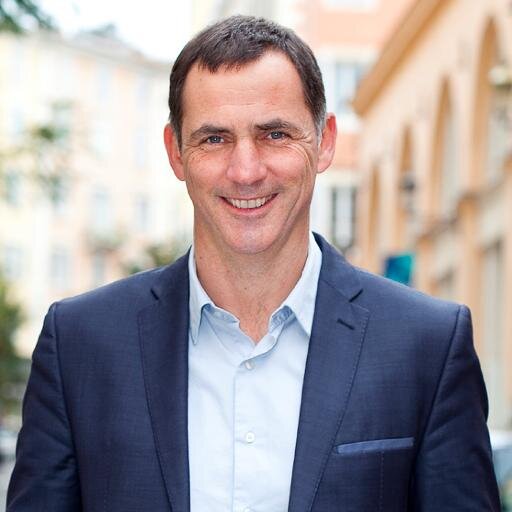
Corsica is known for its illustrious contribution to politics — Napoleon Bonaparte. The winner of the Sunday election, Gilles Simeoni, is quite different. He is the 50-year-old mayor of Bastia and son of a legendary independence fighter. He admitted his victory was an “unusual election outcome.” In fact, his Nationalist Party Pè a Corsica (For Corsica) scored a 45.4% victory in the first round of territorial elections.
In Corsica, we are also witnessing a sharp rise in nationalism against the EU. This wave of nationalism in Paris is being portrayed as a “tsunami,” “earthquake,” or “shock.” This has been a movement that began back in 2014 when the sports bon vivant Simeoni moved into the Town Hall of Bastia. In the parliamentary elections this summer, his “nationalists” won three of the four seats in the Paris National Assembly. Now Corsica is starting to be noticed in Paris.
One of the most notorious political men who also pretended to be a man of God, was Cardinal Armand Jean du Plessis, Duke of Richelieu and Fronsac (1585–1642), who is commonly referred to as Cardinal Richelieu. Richelieu was a French nobleman and statesman who then pretended to be religious. During the 17th century, controlling the Catholic Church and using God for the political cover was the name of the game. Richelieu was consecrated as a bishop in 1607 and then was appointed Foreign Secretary of the French government in 1616. Richelieu rose through the political ranks in both the Catholic Church and the French government. By becoming a cardinal in 1622, he then became King Louis XIII’s chief minister in 1624! He remained in office until his death in 1642.
He is famous for political corruption and using the Rule of Law to create political prosecutions. He was a ruthless and cruel man who consolidated the power in France into a federalized government. He is well known for saying:
“Harshness towards individuals who flout the laws and commands of state is for the public good; no greater crime against the public interest is possible than to show leniency to those who violate it.”
(Source:Champlain’s Dream (2008) by David Hackett Fischer).
Nevertheless, Richelieu has set the standard in political prosecutions as we are witnessing by the latest corruption orchestrated by Muller and his witch hunt to anyone guilty of anything even if it had nothing to do with Russia interfering with the US elections. Richelieu also said this line which should be the real motto of the US Department of Justice:
“If you give me six lines written by the hand of the most honest of men, I will find something in them which will hang him.”
(Source: The Cyclopedia of Practical Quotations (1896) by Jehiel K̀eeler Hoyt, p. 763 : some dispute this quote)
I have created this site to help people have fun in the kitchen. I write about enjoying life both in and out of my kitchen. Life is short! Make the most of it and enjoy!
This is a library of News Events not reported by the Main Stream Media documenting & connecting the dots on How the Obama Marxist Liberal agenda is destroying America


 ANSWER: Jesus’ crime was really sedition and not blasphemy. The high priests may have seen this as blasphemy, but Jesus would never have been put to death by the Romans for such a local issue. The Romans practiced freedom or religion. They allowed the provinces that they had conquered to retain their own gods. Even the Roman Emperor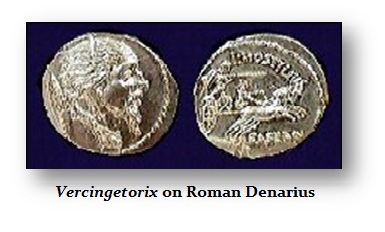
 In Italy, the center-right coalition of former Prime Minister Silvio Berlusconi is on the road to a major come-back gathering 36% of the polls, which is the strongest political party in Italy right now. The second party in line is also the anti-Euro Five-Star movement coming in at 28.2%.



 Centinel2012