Deferred Action for Childhood Arrivals – Equity v Law


Many people have written in on both sides of the issue concerning the Deferred Action for Childhood Arrivals program, or DACA. Some totally disagree with me and cite that the law is the law. But there is a historical problem with the rule of law – there are times when the rule of law is unjust. For example, if someone tried to kill you and you defended yourself and killed them, are you a murderer because you killed someone by the strict interpretation of the law?

King’s Bench

Historically, there were two courts in England – the King’s Bench and Chancery. In modern practice, the biggest mistake the Founding Fathers made in the United States was to merge the two into the same court. That is what has given judges unbridled discretion to tear up the constitution any time they desire relying on the ancient powers of Chancery rather than the rule of law.

There is a clear distinction between someone who was brought here as a small child, grew up here, married, and had children with an American and a child sent across the border on their own. The deportation of the former would be a injustice not merely to the child who grew up here and is unfamiliar with the customs of his parent’s origins no less their own children here who are Americans depriving them of a parent. The deportation of the latter would not be an injustice.

Court of Chancery

The most important distinction between law (King’s Bench) and equity, which was administered by the Court of Chancery,  is the set of remedies each offers. The most common civil remedy a court of law can award is monetary damages. Equity, however, enters injunctions or decrees directing someone either to act or to forbear from acting. By the 14th century, the English Court of  Chancery was affording remedies where the strict procedures of the common law worked injustice or could not provide a remedy to a deserving petitioner. The writ of Habeas Corpus was equity – not law. The judges or Chancellors presiding in Chancery were often theological in background yet were also knowledgeable of Roman law and canon law. Over time, a body of rules emerged but they varied from Chancellor to Chancellor and they tended to become more fixed only during the 17th century. The became the system of precedent much like its common-law cousin.

The Court of Chancery assumed a vital role in many areas from false or unjust imprisonment to establishing a framework that the common law could not accommodate. This role gave rise to the basic distinction between legal and equitable interests. However, when one hands discretion to any judge, the net result is always, and without exception, the progression of corruption. By the 19th century, the Court of Chancery was hopelessly corrupt and as such, so was the United States Federal courts because the Founding Fathers merely this discretion with the rule of law and as such there can be no rule of law that is consistent in the United States.

The distinction of a child who grew up here and married an American and one that was recently pushed across the border is of tremendous importance. To deport the former will deprive children of their parent. This is what Chancery was for at the beginning. Unfortunately, we no longer have a court of real chancery nor do we have a court of law. The federal Judiciary is a corrupt system incapable of honoring either the law or equity.

In 1853, Bleak House was written by Charles Dickens, in which he describes how corrupt Chancery became during the 19th century. He concluded, “Suffer any wrong that can be done you rather than come here!” That was a sad statement of what had become of honor, dignity, and justice. We have reached that same point in American history where there is nothing left.

” On such an afternoon some score of members of the High Court of Chancery bar ought to be–as here they are–mistily engaged in one of the ten thousand stages of an endless cause, tripping one another up on slippery precedents, groping knee-deep in technicalities, running their goat-hair and horsehair warded heads against walls of words and making a pretence of equity with serious faces, as players might. …  This is the Court of Chancery, which has its decaying houses and its blighted lands in every shire, which has its worn-out lunatic in every madhouse and its dead in every churchyard, which has its ruined suitor with his slipshod heels and threadbare dress borrowing and begging through the round of every man’s acquaintance, which gives to monied might the means abundantly of wearying out the right, which so exhausts finances, patience, courage, hope, so overthrows the brain and breaks the heart, that there is not an honourable man among its practitioners who would not give–who does not often give–the warning, “Suffer any wrong that can be done you rather than come here!”

Macron wants a Federal Budget for All of the Eurozone


French Prime Minister Emmanuel Macron is coming out arguing for the total federalization of Europe proposing that there should be a budget for the Eurozone of hundreds of billions of euros. Macron’s position is that this budget should represent several points of the gross domestic product (GDP) of the Eurozone. It should be possible, Macron said, to collect money together in the markets and “allocate it with sufficient force” for all.

He also has made it clear that the GDP of all euro area countries was €10.7 trillion in 2016 according to Eurostat. He makes it clear that the Eurozone is far too restrictive in its budget policy when compared with the policies of China, Russia or the United States. He has made it clear that this is the cause of the high unemployment in Europe among the youth.

France has very high unemployment as is the case in most Eurozone countries. The debt of the Eurozone countries has escalated and as in France there is a growing gap between expenditure and tax collection. Some fear that the creation of such a common euro budget will lead to even more government debt as countries pump out debt to try to stimulate their economies.

Macron is correct that there is a huge problem that is eating away at the Eurozone. The restrictive policies are because of Germany’s fear of inflation that they went through during the 1920s. They wrongly attribute inflation to the increase in money supply and ignore the fact that it was a collapse in confidence given the 1918 revolution led by Communists in Germany.

Macron wants to push forward with his proposals for a further development of the monetary union after the German Bundestag election. Merkel will certainly not entertain any such proposal before the election. Still, Macron is way off the mark. Increasing the spending and debt with rising taxes will still fail to reverse the economic decline. The Eurozone must be restructured or it cannot survive.


When Will People Learn Career Politicians Are Anti-Democracy

It is amazing that people keep voting for career politicians every time and then are dissatisfied every time. Now Reuters is reporting that most French voters are now dissatisfied with Emmanuel Macron’s performance. The latest poll shows a sharp decline for Macron who won a landslide. The poll revealed that Macron’s “dissatisfaction rating” has risen to 57%, from 43% in July.

Macron Moves to Restore French Colonial Power


France has proposed setting up camps inside Libya in order to control the migration flows.  Macron has acted alone once again illustrating that the EU design fails.  Macron is once more pursuing the objectives of a neo-colonial power restoring France to its former glory not unlike Putin. Macron wants to control Libya settling in the area taking control of the country thereby extending its sphere of influence to restore its former colonial glory to the Maghreb and also sub-Saharan Africa.

Macron is acting unilaterally with no regard for the interests of the rest of Europe or the Mediterranean countries. This is the problem with the entire EU project. Merkel unilaterally opened the doors to all of Europe to the refugees to save her personal falling polls. Now we have Macron attempting to restore the colonial power of France over Northern Africa also without consulting anyone.

It is bad enough that there is no democratic process inside Europe where all Europeans could vote in Germany on September 24th regarding Merkel, yet she is the dominant politicians that controls the lives throughout Europe. This is either one country like the United States and you surrender national power to Brussels, or you terminate Brussels and reduce the EU to simple a trade agreement. You cannot have it both ways.

Erdogan Tells Turks in Germany to Vote Against Merkel


While the Democrats want to make a huge issue out of Russia hacking their files and releasing evidence that they were truly corrupt and how Clinton was just a liar blaming Russia rather than themselves, interference in the elections of other countries is par for the course. I have reported how Obama has interfered in Canada, Britain, and France. This is standard operational procedure. Now Turkish President Tayyip Erdogan publicly told all Turks living in Germany to vote against Chancellor Angela Merkel’s Christian Democrats on September 24th.

For Erdogan to publicly try to influence the German elections as Obama did in Britain tell them to get to the  ‘back of queue‘ if they voted for BREXIT, demonstrates the lack of unity between the NATO allies and major trade partners.

Ties between Ankara and Berlin have been strained in the aftermath of last year’s failed coup as Turkish authorities have sacked or suspended 150,000 people and detained more than 50,000 people, including German nationals. Erdogan’s response has been to Merkel’s voiced concern that he has used the coup as a pretext to quash dissent in Turkey. Erdogan has adopted a clear authoritarian role for himself trying to tie it to the roots in political Islam. Erdogan has accused Merkel of being anti-Turkish and anti-Muslim. He pronounced:

“I am calling on all my countrymen in Germany: the Christian Democrats, SDP, the Green Party are all enemies of Turkey. Support those political parties who are not enemies of Turkey,” 

“I call on them not to vote for those parties who have been engaged in such aggressive, disrespectful attitudes against Turkey, and I invite them to teach a lesson to those political parties at the ballot box.” 

The tensions between Germany and Turkey are on a crash course between 2018 and 2020.

Angela Merkel is being Called a Traitor for the Refugee Crisis


The EU has abandoned Italy while simultaneously demanding that the refugees must be taken care of. Nearly 100,000 refugees have arrived in Italy since the start of this year alone. The Italian government cannot cope with the refugee crisis and Brussels said they cannot exempt them from the restraint of busgets. That means that money for Italians must be diverted to the refugees and they keep coming.

Italy is being pushed to the limit and cannot possible cope with this burden alone while Brussels refuses to compensate them. Let any country refuse to accept refugees and Brussels is quick to condemn them, but wont pay for them itself.

German Chancellor Angela Merkel is solely responsible for the refugee crisis. She is starting to be greeted with shouts of “traitor” by discontent German protesters. Nevertheless, Merkel continues to defend her decision to allow hundreds of thousands of refugees into the Germany.

Merkel only received 16,233,642 votes during the 2013 election which was  37.2% of the popular vote of Germany. So the majority of Germans are really not supporting Merkel. Because they get to form collation governments, that someone who received less that any President in the political history of the USA gets to run Euorpe. Even Donald Trump won  46.1% of the American popular vote. So someone who would never get into office under the USA system gets to dominate Europe.

Barcelona Terrorist Attack – Is Europe Lost?


Barcelona, one of the most beautiful cities in Europe, was the target of the Islamic State in their latest terrorist attack to kill people on a wholesale basis. Spain has now mounted an all out sweeping anti-terror operation after an Islamist militant drove a van into crowds in Barcelona, killing 13 people and possibly injuring 100 before fleeing, in what police suspect was one of multiple planned attacks.

Islamic State claimed responsibility for the deadly attack along the city’s most famous avenue on Thursday, which was packed with tourists taking an afternoon stroll. Police said they had arrested two men, a Moroccan and a man from Spain’s north African enclave of Melilla.

Meir Bar-Hen, the Jewish Barcelona Barrister, said the Jews in Spain should not repeat the mistake of the Jews in Algeria or Venezuela: “Go ahead rather than too late.” Bar-Hen urged the Jews Spain to buy and emigrate land in Israel: “I tell my church: We are destined to perish. Europe is lost. “

This refugee crisis in Europe has been the greatest mistake perhaps in modern history. It is one things to set up camps and help people displaced by war. It is totally different to open your doors and let single men in hiding among women and children.

European Refugee Crisis will Engulf Europe by 2032


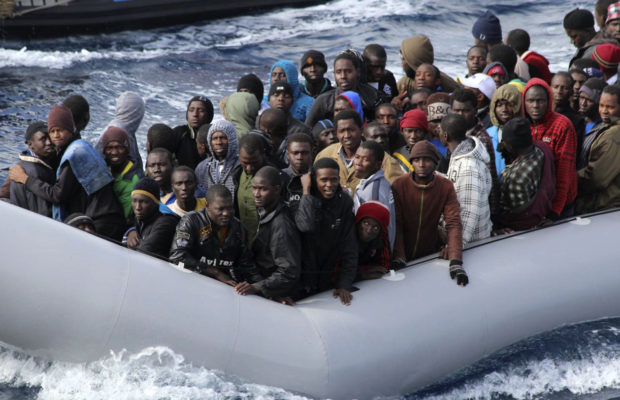
Migrants sit in a boat during a rescue operation by the Italian navy off the coast of Sicily on Nov. 28. Italy is looking to revamp the way it handles the hundreds of thousands of migrants who arrive annually.


The European Refugee Crisis is really completely out of control. The bulk of these people are by no means refugees. You see no women and children here in the boat – only young men. Now Spain is the new target and will overtake Greece as the second-biggest gateway for economic invader entering Europe by sea. The sudden surge in migration to Spain comes following a crackdown on human smuggling along the Libya-Italy sea route, which has been the main entry route to Europe. Africans are migrating to Europe because there is little to do at home.  Egypt will grow to 100 million people while Nigeria to soon reach 400 million. Europe will be swallowed up whole as it was when the Roman Empire was subjugated by the Barbarians who crossed the Rhine River.

When the Barbarians took over Europe, they at first issued coinage in the Roman tradition. But this began to rapidly diminish. Nevertheless, history is repeating. Europe is being swallowed up once again. By the time we see the other side of 2032, Europe will be a shadow of its former glory just as the main language of California will be Spanish not English. Things are definitely changing

Can the Sanction Work on North Korea


QUESTION: Mr. Armstrong, can the sanctions against North Korea succeed now that China is implementing them as well?

ANSWER:  The UN sanctions are curbs on everything from lead and fish exports to questionable North Korean companies. North Korea is in the middle of a serious drought that’s ruining crops. Food is an issue there so this intensifies an already dark humanitarian picture where estimates are that 40% of the population is already malnourished. Only the people can create regime change.

North Korea is in a very severe recession particularly since 2015. The sanctions directly impact the mining and manufacturing industries, which account for just over 30% of GDP. The increase in food shortages will not deter Kim Jong Un from his ambition of developing an arsenal of nuclear-tipped missiles. Only the people can overthrow him for he could care less about the people.

North Korea’s dependency on Chinese fuel is China’s main ace-in-the-hole. If the fuel is cut off, then we are looking at curtaining his air force and their electricity production will decline significantly.

To the extent that the sanction force the people to rise up, then they can work. Otherwise, Kim will not yield as long as he retains power.

The Legal Challenge to Quantitative Easing


General view of the buildings of the Court of Justice of the European Communities

It has taken almost 10 years for the ECB’s controversial government bond purchases to finally reach the European Court of Justice (ECJ) to be reviewed as to their constitutionality. There have always been serious questions whether the PSPP (Public Sector Purchase Program) was compatible with the ban on monetary budgetary funding that has been imposed upon member states. Italy, for example, asked for an exemption from the budgetary constraints to take care of the refugees, The EU Commission said absolutely no!

The German high court has been hearing a case that proposes it rule that financing government budgets would not be covered by the mandate of the European Central Bank (ECB). That has long been a thorn in the side of Draghi that he was acting unconstitutional at the end of the day. The ECJ has been requested to expedite the procedure, because “the case requires a quick settlement” after almost 10 years?

The background of the case is three constitutional arguments are fairly straight forward against the PSPP. The ECJ has not answered these issues which has been preventing the German court from finally decide the constitutional complaints.

The argument claims that the European System of Central Banks, with the program for the purchase of securities of the public sector which it has set up, is contrary to the prohibition of monetary government financing (Article 123 TFEU) and the principle of limited individual authorization (Article 5 1 TEU in conjunction with Art. 119, 127 et seq. TFEU).Therefore, the Deutsche Bundesbank should not participate in this program and the German Bundestag and the Federal Government are obliged to take appropriate measures against the program.

The plaintiffs in Germany wanted the Bundesverfassungsgericht to stop the Bundesbank’s participation in the ECB program. Germany, they argued, would suffer a complete loss if the bonds failed. The risk to the German national budget is disproportionate was their main point.

The ECJ has a political mandate which is strangely different from the Supreme Court of Germany or the United States for that matter.The ECJ has a mandate to promote integration within the EU, which is clearly a political element. If we add this political element, that one can see that the ECJ can view the purchase of government bonds as a permissible means of integration.

The ECB has clearly altered the bond market destroying liquidity. Banks are rushing to sell their bonds to the ECB in anticipation of rising rates which will cause their bond holdings to decline. Hence, the ECB has actually functioned as a place to dump financial toxic-waste.
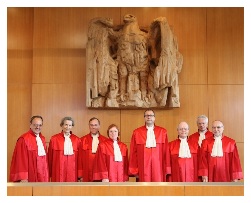
The Germany Federal Constitutional Court has thus suspended further litigation pending the ECJ ruling.


The Federal Constitutional Court announced in a Press Release No. 70/2017 of 15 August 2017

Decision of 18 July 2017
2 BvR 859/15, 2 BvR 980/16, 2 BvR 2006/15, 2 BvR 1651/15
With the decision published today, the Second Senate of the Federal Constitutional Court has suspended the procedure concerning the question whether the Public Sector Purchase Program (PSPP) of the European Central Bank is compatible with the Basic Law for the purchase of public sector securities and asks the Court of Justice of the European Union several questions For a preliminary ruling. According to the Senate, there are important reasons for the fact that the decisions underlying the bond purchase program are in breach of the ban on monetary budgetary financing and go beyond the mandate of the European Central Bank for monetary policy and thus fall within the competence of the Member States. The Senate seeks the implementation of the accelerated procedure in accordance with Article 105 of the Rules of Procedure of the Court of Justice of the European Union, since the nature of the case requires its speedy completion.

Facts:

The PSPP is part of the Expanded Asset Purchase Program (EAPP), a framework program of the European Central Bank (ECB) for the purchase of assets. The PSPP accounts for the largest share of the total volume of the EAPP. On 12 May 2017, the EAPP achieved a total volume of EUR 1 862.1 billion; Of this total, EUR 1,534.8 billion accounted for the PSPP.

The complainants, by their constitutional complaints, claim that the European System of Central Banks, with the program for the purchase of securities of the public sector which it has set up, is contrary to the prohibition of monetary government financing (Article 123 TFEU) and the principle of limited individual authorization (Article 5 1 TEU in conjunction with Art. 119, 127 et seq. TFEU). Therefore, the Deutsche Bundesbank should not participate in this program and the German Bundestag and the Federal Government are obliged to take appropriate measures against the program.

Important considerations of the Senate:

1. Article 38 (1), first sentence, of the Basic Law guarantees to German nationals the right to democratic self-determination, which is enforceable with the constitutional complaint, in the scope protected by Article 79 (3) of the Basic Law. On the basis of the responsibility of integration, the German constitutional authorities have the duty, within the limits of their competences, to work towards compliance with the integration program. It is the task of the Federal Constitutional Court to examine whether measures taken by bodies, bodies and other bodies of the European Union are based on apparent excesses of competence or affect the non-transferable area of ​​the constitutional identity, with the result that German state institutions are not allowed to participate in their condition or implementation ,

2. There are doubts as to whether the PSPP decision is compatible with the ban on monetary budgetary financing.

(A) Article 123 (1) TFEU prohibits the ECB and the central banks of the Member States from purchasing debt securities directly from the institutions of the European Union and the Member States. Purchases on the secondary market may not be used to circumvent the objective pursued by Article 123 TFEU. A program dealing with the purchase of government bonds on the secondary market must therefore be provided with sufficient guarantees to ensure effective compliance with the prohibition of monetary government financing. The Senate is of the opinion that the Court of Justice of the European Union considers the terms which it sets out to limit the scope of the OMT program of 6 September 2012 within its scope as a legally binding criterion The purchase of government bonds.

(B) The PSPP covers bonds issued by States, state enterprises and other government bodies, as well as by European institutions. These bonds are purchased exclusively on the secondary market. However, for an infringement of the PSPP decision against Article 123 TFEU, it is argued that details of purchases are announced in a manner which could give rise to factual certainty on the markets that the Eurosystem will also purchase issued government bonds, The time limits between issuance of a debt instrument on the primary market and its acquisition on the secondary market is not verifiable, that acquired bonds are held to maturity until now, and that bonds with a negative return are obtained from the outset.

3. The PSPP decision could not be covered by the mandate of the ECB.

(A) monetary policy should be distinguished, in particular, from the economic policy which is primarily the responsibility of the Member States, in accordance with the wording, system and objective of the Treaties; The objective of a measure to be determined objectively, the means chosen to achieve this objective, and its link with other arrangements.

(B) From the Senate’s point of view, the PSPP decision could not be seen as a monetary policy measure, but rather as a predominantly economic policy measure, on the basis of an overall view of the relevant delineation criteria. While the PSPP has a stated monetary policy objective and is committed to the pursuit of this objective of monetary policy, But the economic policy implications arising from the volume of the PSPP and the associated predictability of the purchase of government bonds are already directly reflected in the program itself. This would render the PSPP disproportionate in relation to the underlying monetary policy objective. Moreover, the decisions constituting the basis of the program do not provide a comprehensible explanation which would allow the continuous continuity of the program to be reviewed on an ongoing basis during the several years of implementation of the decisions.

4. On the basis of the risk allocation between the ECB and the Bundesbank, the budgetary right of the German Bundestag, protected by Article 20 (1) and (2) in conjunction with Article 79 (3) of the Basic Law, and its overall budgetary responsibility by the PSPP decision Or its implementation in view of possible losses of the Bundesbank, can not be foreseen at present.

(A) An unlimited risk allocation within the Eurosystem and the resulting risks to the national central banks’ profit and loss account would constitute a violation of constitutional identity within the meaning of Article 79 (3) of the Basic Law if it were to recapitalize the national central banks with budgetary resources Which the Senate has committed to the approval of the German Bundestag in its jurisprudence to the EFSF and the ESM. For the success of the constitutional complaints, it is therefore important whether such a risk allocation can be excluded under the primary law.

(B) the decision-making by the Governing Council on the nature and extent of the risk-sharing between members of the European System of Central Banks is hardly determined by primary law. This could allow the ECB Council to amend the rules on risk-sharing within the Eurosystem, which could lead to risks to the national central banks’ profit and loss account and, moreover, to the overall budgetary responsibility of the national parliaments. Against this background, the question arises whether an unlimited risk allocation in the event of default of bonds of central governments and equivalent issuers between the national central banks of the Eurosystem against Article 123 and Article 125 TFEU and Article 4 (2) TEU With Article 79 (3) of the Basic Law).