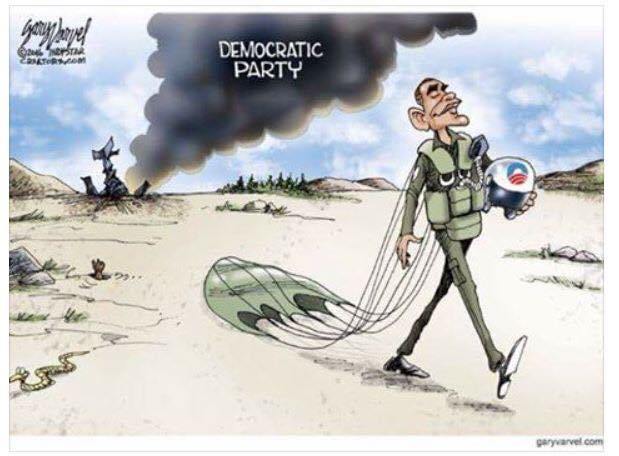
Today in Atlanta 447 members of the Democrat National Committee will meet to vote on the next Chairperson for the DNC. The two top candidates are Representative Keith Ellison and former Labor Secr…
Tag Archives: Rob Peter to Pay Paul
Yes we can? Petition launched for Obama 2017 French presidential campaign
What an ass Obama is this is beyond belief, actual I hope its not true but then knowing Obama it could be.
RUSH: This Is Why Trump Refers To CNN As ‘FAKE NEWS’
Rush almost never gets it wrong and this is no exception.
‘FAKE NEWS’ MEDIA OUTLETS CNN, NYT, BUZZFEED NOT INVITED TO WHITE HOUSE PRESSER
Fake News is the method of choice of the liberal press!
President Trump Begins Dismantling The Regulatory and Administrative State…
Upon leaving CPAC, today President Trump took another step to dismantle the choking network of regulations that strangles economic growth, impedes business and weakens the overall economy. Today bu…
Source: President Trump Begins Dismantling The Regulatory and Administrative State…
Data Fraud At Chinese Province Suggests Local GDP Numbers As Much As 20% “Overcooked”
One month ago, in delightful, if anticipated, confirmation that much if not all of China’s data has been cooked and fabricated as so many skeptics suspected, we reported that according to the People’s Daily, the rust-belt province of Liaoning had admitted to fabricating fiscal numbers from 2011 to 2014. The fabricated economic data was meant to show a state of economic strength with fiscal revenues inflated by at least 20%, and some other economic data were also false, the paper said, without specifying categories.In short, the fabrication opened a hornet’s nest: if one Chinese was doing it, then why not all, and by how much was the real data off?
But why manipulate the numbers to paint a rosier picture? For obvious reasons: the data were made up “because officials wanted to advance their careers.” The fraud misled the central government’s judgment of Liaoning’s economic status, he said, citing a report from the National Audit Office in 2016.
Yet while it was this confirmation of data fraud was gratifying, what was absent was the scale of the fraud, as having the real and fake numbers would provide a useful rule of thumb into just how cooked all of China’s books are, not just those in Liaoning. Conveniently, today we got the answer courtesy of the FT, which reported that the economic output of the province in question shrank by 23% in nominal terms last year, according to official statistics, showing the extent to which officials had previously exaggerated performance in China’s struggling rust-belt.
The sudden drop in provincial gross domestic product is only partly due to a fall in the real economy: in inflation adjusted terms, GDP fell by 2.5 per cent according to the national statistics bureau. The rest was undoing the book cooking: “The main reason for the decline, analysts say, was officials’ attempts to undo the effects of previous over-reporting.”
Further evidence of data fabrication can be seen in Liaoning’s fixed-asset investment figures, which fell 64 per cent in 2016. China International Capital Corporation, a partly state-owned investment bank, said the drop in investment raised doubts about previous years’ figures.
The Lianoing scandal also appears to have convinced even those not overly skeptical, that no Chinese data can be trusted going forward.
“The sharp decline was not only a result of economic downturn but also reflected the correction of its previously inflated data,” wrote CICC last week.
“Liaoning have had stark issues with their data over the past few years. Does that mean other provinces do too? That’s definitely the case — provincial GDP is always higher than national GDP,” said Jonas Short, head of China research at NSBO, an investment bank.
It gets more ironic: the current Premier Li Keqiang was the top official in Liaoning from 2004 to 2007, and once decried GDP data as “man-made” and therefore unreliable. Instead, he preferred three indicators of industrial activity: electricity consumption, railway cargo volume and loans extended by banks. However, such indicators are less relevant to measuring China’s economic output now that the dominance of traditional industries is fading.
While it is still too early to extrapolate, if all of China’s data is “overcooked” by 20%, assuming the country’s debt statistics are reliable, it would mean that instead of 300% as per the IIF’s latest estimate, China’s real debt/GDP is roughly 375%, and fast approaching the world record holder, Japan, which remains untouchable at 400%. The implications for the global economy and capital markets – once a bubble of this magnitude bursts – hardly need elaboration.
Here’s What Happens When Trump Finds Culprit Behind Flynn Intel Leaks
Submitted by Ronn Blitzer via LawNews.com,
Information leaks from within the federal government led to the revelation that now-former National Security Adviser Michael Flynn spoke to the Russian ambassador about U.S. sanctions against his country soon after President Obama announced them. Flynn’s communication has led to speculation that he may have broken the law by talking to a foreign government about a dispute without U.S. authority. He was asked to resign after word got out that he lied to Vice President Mike Pence when he insisted that he didn’t discuss the sanctions with the ambassador.
But to President Donald Trump, the big story is that we know the story. Flynn was caught by U.S. intelligence officials after they wiretapped his communications with the ambassador. They also made transcripts of the conversations, but it wasn’t until that information mysteriously found its way to the Washington Post that anyone knew about it. On Twitter and in public statements, Trump has railed against the leaks, which the Post has only attributed to “current and former U.S. officials,” and heads will roll if he learns who’s behind them. As it turns out, the law is on his side. However, these leaks are notoriously hard to prosecute and are rarely pursued. But, if there are, here’s what could happen to the culprits.
First, there’s the prohibition against disclosure of classified information. This is the obvious one, since any publication of classified material to an unauthorized party is illegal. Under the Espionage Act, 18 U.S.C. § 798, a person guilty of this can end up in prison for 10 years and face a fine. If the leaks involved classified information that was sent to members of the press, the source could end up behind bars if they’re caught. Opponents of Hillary Clinton argued that she violated this with her handling of emails on a private server, but the FBI determined they did not have a strong enough case to prosecute. As LawNewz.com contributor Philip Holloway wrote, the information regarding Flynn’s wiretapped phone calls is Signals Intelligence (SIGINT), which is highly classified, so if one of the “current and former U.S. officials” is identified, they could be in trouble.
The form of the leaks could also determine whether additional charges appropriate. If information was merely spoken to a reporter, that’s one thing, but if actual files or physical materials were transferred, then 18 U.S.C. § 641 could kick in. That law says that anyone who steals or provides for another person’s use “any record, voucher, money, or thing of value of the United States or of any department or agency” is guilty of a crime. If a source of a government leak turned over a physical record, they could face 10 years in prison and a fine for it.
In addition to laws against revealing certain information, if the President discovers a source behind a leak, they could face additional charges if they lie about it. Besides perjury, which applies to anyone who lies under oath, false statements or covering up material facts in a federal investigation, either by the Department of Justice of Congress, can lead to five years in prison.
However, one thing to keep in mind is how rare these type of prosecutions are. Of all prior administrations, President Obama was the most aggressive when it came to prosecuting leakers. According to a report from the Committee to Protect Journalists, six government employees, plus two contracts including Edward Snowden, were the targets of felony criminal prosecutions for leaking information. Prior to Obama, there were only three such prosecutions in history! And the prosecutions themselves are no easy task. For example, Jeffrey Sterling, a former CIA employee, was charged under the Espionage Act and it took the feds five years to get a conviction. Sterling was sentenced to 3 1/2 years behind bars. The case involved a seven year legal fight over whether James Risen, a New York Times reporter, would be forced to identify his confidential sources and testify.
Of course, none of this matters if Trump doesn’t discover any of the sources behind the leaks. Lately, that seems to be the only information not getting out of the White House
Which Country Punishes Productive People The Most?
Submitted by Daniel Mitchell via The Foundation for Economic Education,
Back in 2014, I shared some data from the Tax Foundation that measured the degree to which various developed nations punished high-income earners.
This measure of relative “progressivity” focused on personal income taxes. And that’s important because that levy often is the most onerous for highly productive residents of a nation.
But there are other taxes that also create a gap between what such taxpayers earn and produce and what they ultimately are able to consume and enjoy. What about the effects of payroll taxes? Of consumption taxes and other levies?
Looking at the Evidence
To answer that question, we have a very useful study from the European Policy Information Center on this topic. Authored by Alexander Fritz Englund and Jacob Lundberg, it looks at the total marginal tax rate on each nation’s most productive taxpayers.
They start with some sensible observations about why marginal tax rates matter, basically echoing what I wrote after last year’s Super Bowl.
Here’s what Englund and Lundberg wrote.
The marginal tax rate is the proportion of tax paid on the last euro earned. It is the relevant tax rate when deciding whether to work a few extra hours or accept a promotion, for example. As most income tax systems are progressive, the marginal tax rate on top incomes is usually also the highest marginal tax rate. It is an indicator of how progressive and distortionary the income tax is.”
They then explain why they include payroll taxes in their calculations.
The income tax alone does not provide a complete picture of how the tax system affects incentives to work and earn income. Many countries require employers and/or employees to pay social contributions. It is not uncommon for the associated benefits to be capped while the contribution itself is uncapped, meaning it is a de facto tax for high-income earners. Even those social contributions that are legally paid by the employer will in the end be paid by the employee as the employer should be expected to shift the burden of the tax through lower gross wages.”
Englund and Lundberg are correct. A payroll tax (sometimes called a “social insurance” levy) will be just as destructive as a regular income tax if workers aren’t “earning” some sort of additional benefit. And they’re also right when they point out that payroll taxes “paid” by employers actually are borne by workers.
They then explain why they include a measure of consumption taxation.
One must also take value-added taxes and other consumption taxes into account. Consumption taxes reduce the purchasing power of wage-earners and thus affect the return to working. In principle, it does not matter whether taxation takes place when income is earned or when it is consumed, as the ultimate purpose of work is consumption.”
Once again, the authors are spot on. Taxes undermine incentives to be productive by driving a wedge between pre-tax income and post-tax consumption, so you have to look at levies that grab your income as it is earned as well as levies that grab your income as it is spent.
All Things Considered
And when you begin to add everything together, you get the most accurate measure of government greed.
Taking all these taxes into account, one can compute the effective marginal tax rate. This shows how many cents the government receives for every euro of additional employee compensation paid by the firm. …If the top effective tax rate is 75 percent, as in Sweden, a person who contributes 100 additional euros to the economy will only be allowed to keep 25 euros while 75 euros are appropriated by the government. The tax system thus drives a wedge between the social and private return to work. …High marginal tax rates disconnect the private and social returns to economic activity and thereby the invisible hand ceases to function. For this reason, taxation causes distortions and is costly to society. High marginal tax rates make it less worthwhile to supply labour on the formal labour market and more worthwhile to spend time on household work, black market activities and tax avoidance.”
Here’s their data for various developed nations.
Keep in mind that these are the taxes that impact each nation’s most productive taxpayers. So that includes top income tax rates, both for the central governments and sub-national governments, as well as surtaxes. It includes various social insurance levies, to the extent such taxes apply to all income. And it includes a measure of estimated consumption taxation.

And here’s the ranking of all the nations. Shed a tear for entrepreneurs in Sweden, Belgium, and Portugal.
Slovakia wins the prize for the least-punitive tax regime, though it’s worth noting that Hong Kong easily would have the best system if it was included in the ranking.

U.S. Ranking
For what it’s worth, the United States does fairly well compared to other nations. This is not because our personal income tax is reasonable (see dark blue bars), but rather because Barack Obama and Hillary Clinton were unsuccessful in their efforts to bust the “wage base cap” and apply the Social Security payroll tax on all income. We also thankfully don’t have a value-added tax. These factors explain why our medium-blue and light-blue bars are the smallest.
By the way, this doesn’t mean we have a friendly system for upper-income taxpayers in America. They lose almost half of every dollar they generate for the economy. And whether one is looking at Tax Foundation numbers, Congressional Budget Office calculations, information from the New York Times, or data from the IRS, rich people in the United States are paying a hugely disproportionate share of the tax burden.
Though none of this satisfies the statists. They actually would like us to think that letting well-to-do taxpayers keep any of their money is akin to a handout.
Now would be an appropriate time to remind everyone that imposing high tax rates doesn’t necessarily mean collecting high tax revenues.
In the 1980s, for instance, upper-income taxpayers paid far more revenue to the government when Reagan lowered the top income tax rate from 70 percent to 28 percent.
Also, keep in mind that these calculations don’t measure the tax bias against saving and investment, so the tax burden on some upper-income taxpayers may be higher or lower depending on the degree to which countries penalize capital formation.
P.S. If one includes the perverse incentive effects of various redistribution programs, the very highest marginal tax rates (at least when measuring implicit rates) sometimes apply to a nation’s poor people.
P.P.S. Our statist friends sometimes justify punitive taxes as a way of using coercion to produce more equality, but the net effect of such policies is weaker growth and that means it is more difficult for lower-income and middle-income people to climb the economic ladder. In other words, unfettered markets are the best way to get social mobility.
Starbucks’ ‘Brand Perception’ Takes A Massive Hit After Announcing Plans To Hire 10,000 Refugees
About a month ago, Starbucks CEO Howard Schultz decided to ‘take a stand’ in defiance of Trump’s immigration executive order and penned a message to the world vowing, among other things, to hire 10,000 refugees over the next 5 years and “build bridges, not walls, with Mexico”. Here are some excerpts from the politically charged message drafted by Schultz with “deep concern and a heavy heart”:
I write to you today with deep concern, a heavy heart and a resolute promise. Let me begin with the news that is immediately in front of us: we have all been witness to the confusion, surprise and opposition to the Executive Order that President Trump issued on Friday, effectively banning people from several predominantly Muslim countries from entering the United States, including refugees fleeing wars. I can assure you that our Partner Resources team has been in direct contact with the partners who are impacted by this immigration ban, and we are doing everything possible to support and help them to navigate through this confusing period.
Hiring Refugees: We have a long history of hiring young people looking for opportunities and a pathway to a new life around the world. This is why we are doubling down on this commitment by working with our equity market employees as well as joint venture and licensed market partners in a concerted effort to welcome and seek opportunities for those fleeing war, violence, persecution and discrimination. There are more than 65 million citizens of the world recognized as refugees by the United Nations, and we are developing plans to hire 10,000 of them over five years in the 75 countries around the world where Starbucks does business.
Building Bridges, Not Walls, With Mexico: We have been open for business in Mexico since 2002, and have since opened almost 600 stores in 60 cities across the country, which together employ over 7,000 Mexican partners who proudly wear the green apron. Coffee is what unites our common heritage, and as I told Alberto Torrado, the leader of our partnership with Alsea in Mexico, we stand ready to help and support our Mexican customers, partners and their families as they navigate what impact proposed trade sanctions, immigration restrictions and taxes might have on their business and their trust of Americans.
Unfortunately, Schultz quickly found out the hard way that while most adult-aged Americans can agree that they like coffee, roughly 50% disagree with his leftist political opinions. Which, according to Yahoo Finance, has sent the company’s “brand perception” into a downward spiral since January 29th.
The coffee giant’s consumer perception levels have fallen by two-thirds since late January, according to YouGov BrandIndex.
The perception tracker measures if respondents have “heard anything about the brand in the last two weeks, through advertising, news or word of mouth, was it positive or negative.” In Starbucks’ case, perception is still overall positive, but significantly lower than it was prior to CEO Howard Schultz published a public letter outlining the company’s plans to give refugees jobs.
YouGov says that there’s reason to believe backlash will impact the chain’s bottom line. Two days before Starbucks’ announcement, 30% of consumers said they’d consider buying from Starbucks the next time they were craving coffee, the highest proportion in nearly a year. Now, the percentage is down to 24%, according to YouGov.
Of course, this isn’t the only time Starbucks has alienated customers by publicly pursuing a controversial political agenda. As we noted back in March 2015, the Company was forced to abandon its “Race Together” campaign that was intended “to be a catalyst for a larger conversation on race” relations in the United States but really just served to piss off a bunch of anxious people eager to grab their cup of coffee and be on their way.
Apparently nothing will ever convince some of America’s leftist billionaires that, no matter how rich they become, they will never be able to force their political opinions on Americans who see through their propaganda…just ask all the rich people that just lost a fortune trying to elect Hillary.
KOMMONSENTSJANE – EINSTEIN’S OF HOLLYWEED
If you are a good actor or actress you don not necessarily need to know anything just act like you are playing a part and you will get a Nobel if you are a good actor just like Obama did.
February 23, 2017 10:13 AM
Einstein’s of Hollyweed
WHEN DID WE STOOP TO THE LEVEL OF LISTENING TO THESE IDIOTS? SIMPLY INCREDIBLE!
We are tired of their ragging and lecturing us. They are suppose to entertain us; but even their entertaining is boring.
Keep in mind these idiots are all worth millions of dollars, too. If that is true, what does that make them? Doesn’t make them any better than the next poor person. We don’t care how much money they have
Read at your own risk. Don’t laugh too much.
Ever looked up the education credentials of Hollywood and New York soothsayers?
Most of them rely on knowledge clouds drifting across the Pacific, perhaps from an Asian mystic who wears lots of colorful beads.
The mystic has brought them deep understanding of economics, governance, military affairs and especially science. It inspires bold words on most topics.
LEONARDO DeCAPRIO’s self-declared…
View original post 907 more words