Jonathan Haidt visited Penn State for a lecture on work from his latest book, “The Coddling of the American Mind: How Good Intentions and Bad Ideas are Setting Up a Generation for Failure.” Haidt is the Thomas Cooley Professor of Ethical Leadership at New York University’s Stern School of Business. Listen to the McCourtney Institute for Democracy’s podcast interview with Jonathan on the moral foundations of politics and democracy: https://www.democracyworkspodcast.com… Thank you Penn State’s World in Conversation for recording and producing the lecture.
This is an example of what happens when politicians and far-left activists push a false narrative that ICE facilities are comparable to concentration camps.
An obviously unstable man armed with a rifle attempts to blow up an ICE detention facility in Tacoma Washington following protests hours earlier.
WASHINGTON – An armed man was fatally shot early Saturday during a confrontation with police after he hurled incendiary devices at a Washington state immigration detention center, Tacoma police said.
The shooting occurred about 4 a.m. local time outside the US Immigration and Customs Enforcement’s Northwest Detention Center, where the gunman attempted to set the building and parked cars on fire, according to police spokeswoman Loretta Cool.
Authorities did not immediately identify the gunman, saying in the statement the “medical examiner will release the identity of the victim when it is appropriate.”
The assault on the privately-run immigrant detention facility came amid protests over ICE plans to begin the previously postponed raids across the country on Sunday. The goal is the arrest of thousands of migrant families who already have court orders to be removed, according to US officials.
A peaceful rally against the raids at the Tacoma detention center had ended about six hours before the shooting, Cool said. […]
Police said the man set a vehicle ablaze in the center’s parking lot and attempted to ignite a propane tank with a flare to set the building on fire. Officers called out to the man and shots were fired, according to a police statement. It’s not known whether the man fired on the officers, Cool said.
The gunman died at the scene; four officers involved in the shooting were placed on administrative leave per department policy. The incident is under investigation. (more)
.
This death is directly attributable to the dangerous incitement by politicians and immigration activists. However, watch the media run cover for those who advocated for exactly this type of Antifa resistance violence.
Bill Whittle
Published on Jul 12, 2019
The Jeffrey Epstein sex trafficking case claims a Trump team scalp as Labor chief Alex Acosta resigns. He still defends his actions a decade ago in a secret deal that many view as a slap on the wrist for Epstein. Should Trump have fought for him or fired him? This episode of Bill Whittle Now is one of 48 shows each month produced by the Members at BillWhittle.com. To learn more about what Membership means, visit https://billwhittle.com/ufaqs/what-is…
There have been countless stories of how Jeffrey Epstein and the Clintons would fly around and go off to his secret places. When federal prosecutors announced sex trafficking charges against Jeffrey Epstein this week, they described him as “a man of nearly infinite means.” They argued that his vast wealth — and his two private jets — made him a flight risk. Bill Clinton took four trips with Epstein on his private jets, one to Europe, one to Asia, and two to Africa.
Former President Clinton has not been linked by prosecutors to the current or previous accusations against Mr. Epstein in sex trafficking. Epstein began in finance at Bear Stearns and when he struck out on his own, Mr. Epstein came in contact with Clinton in 2002, when the former president took a trip on Mr. Epstein’s private jet. Clinton had been out of the White House for two years and the contact seemed to be related to the Clinton Foundation. Jeffrey Epstein’s lawyers said in a letter back in 2007 that he forged a close relationship with former President Bill Clinton and helped conceive an arm of the Clinton Foundation.
Of course, the rumors running around are that Epstein will spill the beans on Bill. The problem with that scenario is the presumption that the prosecutors would even be interested in exposing Clinton, which to date nobody has dared to even assume there is fire behind the smoke.
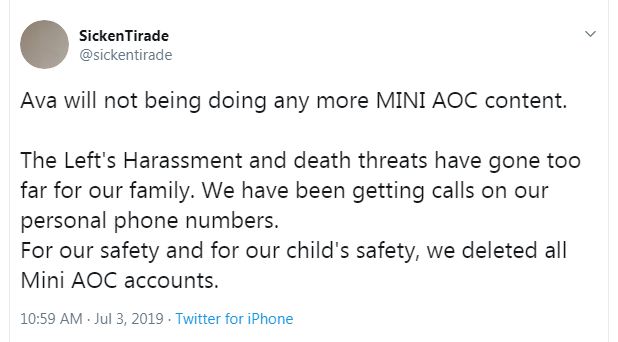
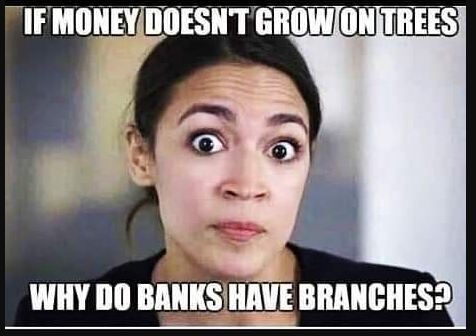
The peaceful left has made death threats against Ava and her family for her imitation of AOC. Her family posted this on Twitter and announced that they have deleted all posts because the right to freedom of speech does not exist if you disagree with the left.
In his former role as U.S. Attorney for the District of Miami Alexander Acosta was one of the senior DOJ officials involved in the Jeffrey Epstein case. Mr. Acosta has explained his role and justified all the actions of his office over a decade ago. However, the media and political opponents to the administration are using Acosta to attack the Trump cabinet.
Today President Trump and Labor Secretary Acosta announce the decision to depart from the administration. President Trump doesn’t want Acosta to resign, but understands he is doing so in order to stop any further distractions to the administration and labor dept.
.
[Transcript] THE PRESIDENT: I think he was a great Labor Secretary, not a good Labor Secretary. He’s done a fantastic job. He’s a friend of everybody in the administration. And I got a call this morning, early, from Alex. And I think he did a very good job yesterday. Under a lot of pressure, he did a fantastic job and he explained it. He made a deal that people were happy with, and then, 12 years later, they’re not happy with it. You’ll have to figure all of that out.
But the fact is, he has been a fantastic Secretary of Labor. And Alex called me this morning and he wanted to see me. And I actually said, “Well, we have the press right out here, so perhaps you just want to say it to the press.”
But I just want to let you know, this was him, not me, because I’m with him. He was a — he’s a tremendous talent. He’s a Hispanic man. He went to Harvard. A great student. And, in so many ways, I just hate what he’s saying now because we’re going to miss him.
But, please, Alex.
SECRETARY ACOSTA: Thank you, Mr. President. Over the last week, I’ve seen a lot of coverage of the Department of Labor, and what I have not seen is the incredible job creation that we’ve seen in this economy — more than 5 million jobs. I haven’t seen that workplace injuries are down, bucking a three-year trend; workplace fatalities are down, bucking a three-year trend; that we had the safest year ever in mining, the lowest number of fatalities ever in mining.
I have seen coverage of this case that is over 12 years old, that had input and vetting at multiple levels of the Department of Justice. And as I look forward, I do not think it is right and fair for this administration’s Labor Department to have Epstein as the focus, rather than the incredible economy that we have today.
And so I called the President this morning. I told him that I thought the right thing was to step aside. You know, Cabinet positions are temporary trusts. It would selfish for me to stay in this position and continue talking about a case that’s 12 years old, rather than about the amazing economy we have right now.
And so I submitted my resignation to the President –effective seven days from today, effective one week from today — earlier this morning.
Q If the Secretary explained himself, as you say he did two days ago, why the need for him to resign?
THE PRESIDENT: There’s no need at all, as far as I’m concerned. I would have — I watched Alex yesterday. I thought Alex did a great job. And, you know, you could always second guess people, and you could say it should have been tougher. They do it with me all the time. I make a great deal with anybody, and then they say — like, the Democrats — “Oh, it could have been better.”
I got $1.2 billion settlement fined from a company, from ZTE. And the next day — and everybody couldn’t believe it. The next day, the Democrats said, “Oh, he should have gotten more.” So you can always be second guessed. That’s what people do.
I just want to tell you: This is a person that I’ve gotten to know. There hasn’t been an ounce of controversy at the Department of Labor until this came up. And he’s doing this not for himself; he’s doing this for the administration.
And, Alex, I think you’ll agree. I said, “You don’t have to do this.” He doesn’t have to do this.
Q Why would you — why would you accept his resignation?
Q But you accepted the resignation. You accepted the — why did you accept the resignation if he hasn’t done anything wrong?
THE PRESIDENT: I do, and we have — we have — as everybody knows, we have Pat Pizzella, who right now is a deputy, and he’ll be Acting for a period of time. I think you know Pat. He’s a good man, highly recommended by Alex. But Pat is going to be Acting, and we’ve already informed him.
Normally, equity valuations reflect the present value of future cash flows that are primarily a function of current cash flows, growth expectations, and then the discount rate. Most fundamentalists will look at the cash flow generation in both the short and long-term. With equity valuations at their record highs, investors, in theory, are showing confidence in short-term cash flows not declining materially. The interpretation normally would be that they are betting on no recession and on stable long-term growth. However, is this analysis just sophistry?
The probability of a recession is much higher than what global equities are currently reflecting. Then there are people pointing to the yield curve and yelling, “See, a crash is coming!” They argue this is a leading indicator, sending the strongest warning signals to investors. Nevertheless, history begs to differ with that analysis for it has often shown a final bullish move in equities despite clear evidence of an oncoming recession. Is this precisely what we are facing? Others point to the Fed, claiming that the first rate cut is often a reliable signal that a recession is coming, which reduces short-term cash flows and raises return expectations as investors become more risk-averse.
There are those who look at all of these factors and then argue that long-term profit growth expectations are way too high. Others argue that corporate debt is too high and we have also reached debt saturation, especially technology companies.
All things considered, we are facing a slightly different future. Doing simple correlations of equities to interest rates reveals that the share markets have NEVER peaked twice with the same level of interest rates because the real issue is the differential between the cost of money and expectation of inflation or future price gains. We are in a similar pattern where interest rates are so low that even a 3% dividend from shares looks fantastic. When we look at the extremes, we also see that the PE ratio hits its extremes, not at speculative booms, but at the bottom. There comes times like in 2009 where capital no longer trusts the banks, governments, and is just looking to get its money back intact. This is when they will buy blue-chip shares without expectation of future profits and cash flow, but the preservation of capital. So while many see the share markets as totally disconnected, perhaps they need to look at the other side of the equation — who do you trust?
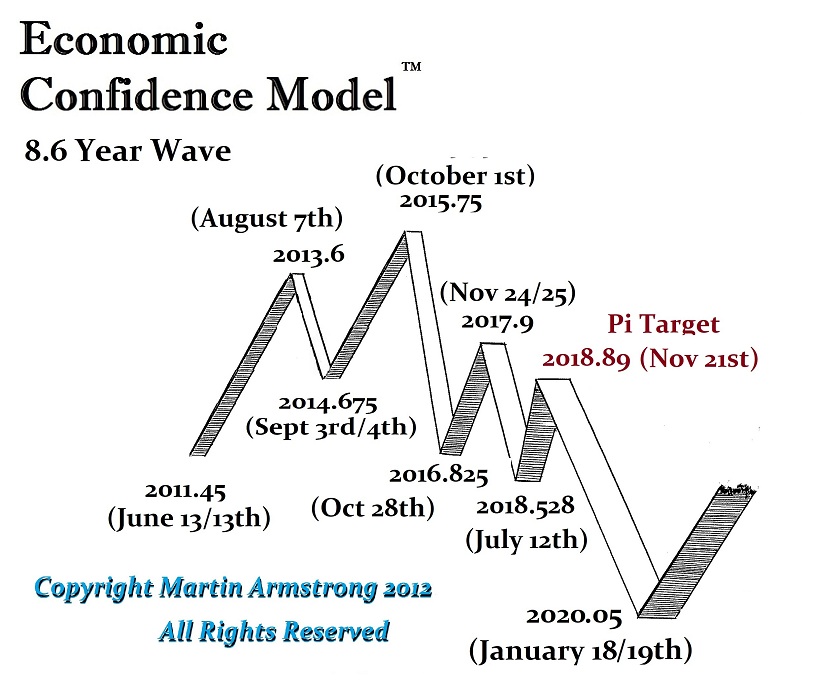
COMMENT: It is fascinating how your work has been so accurate on forecasting the business cycle, yet you are probably the most ignored by the mainstream media. The only possible reason for this is that they are not interested in someone who can forecast the business cycle when the general belief is that governments can manipulate it.
Keep up the great work
HS
REPLY: You are correct. They are not ready to accept that the business cycle can be forecast. That undermines politics as we know it today.
The OECD’s leading indicators on the global economy are still declining with the latest numbers marking the 19th consecutive monthly decline. The global economy is at its weakest point since July 2008, and the probability of a recession is still elevated and not fully reflected in equity valuations. South Korea, one of the world’s economies most tuned to globalization, is showing significant weakness with its leading indicators declining for 25 straight months to levels not seen since early 2012. The South Korean economy has historically been one of the best indicators for the global economy, so we expect more pain to come in the second half of the year.
The only major economy that has turned positive among the OECD’s leading indicators is China. This is not a big surprise, given the recent major improvement in the credit impulse, although it is still negative. But China’s improved industrial sector is driven by a major national push from the government and is likely driving domestic demand more than global demand. Meanwhile, the country’s car sales (which serve as a proxy for the consumer sector) remain weaker than at the bottom of the financial crisis, highlighting elevated uncertainty among Chinese consumers. In fact, May data shows that sales growth weakened again.
The problem is the entire Keynesian-Marxist agenda whereby governments believe their own propaganda. Nobody is willing to publicly look at our model because it highlights the entire problem with the assumption that governments are in control when they are just aggravating the trend.
QUESTION: I was told that none of the big bankers during the Great Depression went to jail either. Doesn’t the government understand that this is the very image of draining the swamp?
DK
ANSWER: The bankers own the reign of government from the courts to the White House. In the years that followed the 2008 financial crisis, the Securities and Exchange Commission brought charges against more than 150 people and institutions and won $2.68 billion in penalties. The SEC loves big fines. Keep in mind if they charge the individual banker, it will never be profitable. Charge the bank and promise no criminal prosecutions and you get the big bucks. So yes, not one of the bankers went to jail from that financial meltdown that they created which left 8.8 million Americans jobless. It also led to a $700 billion government bailout to save the bankers which never stimulated the economy.
Your question was whether it was this way during the Great Depression. Virtually no bankers were jailed in the wake of the Great Depression. However, they were at least charged but beat the criminal charges.
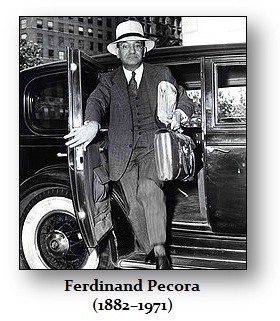
Beginning in 1932, the Senate Committee on Banking and Currency opened a public inquiry into the stock market crash. The Pecora Commission, as the investigation came to be known, led to indictments for several of the era’s finance giants. However, this was all before the SEC and Glass-Steagall, which Goldman Sachs had the Clintons repeal. Since banking laws did not guard against the kind of speculation that fueled the crash, most escaped prosecution for they did not violate any law.
Charles Mitchell was the president of the National City Bank, now Citibank. Mitchell built the bank into the nation’s largest by splitting it into two branches which fed each other. One half became its investment arm, while the other was its banking arm. Hence, this was the reason Glass-Steagall was enacted. The banks sold investments to clients, often financed with money borrowed from the bank. They also knew, as they did in 2007-2009, that the investments were toxic. When the market crashed, clients lost everything after listening to the advice of the bankers and the banks would often collapse. Mitchell resigned and admitted to the Pecora Commission that he knew his bank was pushing bad investments onto its clients, as was the case many alleged with Goldman Sachs in 2007. Mitchell was indicted for tax evasion but was ultimately acquitted. He paid a $1 million civil fine instead.
Then there was the utility magnate Samuel Insull who also appeared before the Pecora Commission. He fled the country in June 1932, which was about eight months before prosecutors brought fraud charges against him. Insull pioneered the concept of a holding company, in which one company holds partial or complete interest in another company. At the height of his success, Insull controlled businesses worth as much as $500 million in assets with just $27 million in equity. When the crash hit, 65 of his businesses failed, ruining 600,000 investors. Insull was eventually returned to the U.S. nearly two years later but he also beat the charges.
The Pecora Commission went after the individuals. The SEC and Justice Department protect those bankers today. The Securities and Exchange Commission is now controlled by the people from Goldman Sachs. The likelihood of the SEC ever prosecuting anyone from the banking industry is ZERO,
I have created this site to help people have fun in the kitchen. I write about enjoying life both in and out of my kitchen. Life is short! Make the most of it and enjoy!
This is a library of News Events not reported by the Main Stream Media documenting & connecting the dots on How the Obama Marxist Liberal agenda is destroying America