The Problem with K-Waves


Posted originally on May 29, 2024 By Martin Armstrong 
K Wave MAA

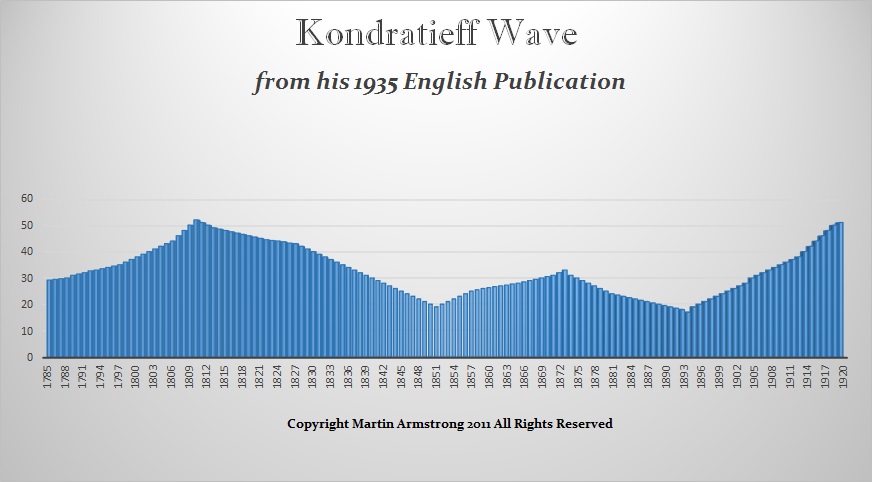
All those investigating cycles within the economy made a simple mistake. Kondratieff followed agriculture/commodity prices when agriculture accounted for 70% of the GDP pre-19th century. That only began to decline from 1850 forward, dropping to 40% by 1900 as the Industrial Revolution emerged with the invention of the steam engine. Moreover, aside from climate impacting the food supply, there were also wars. So the Kondratieff Wave failed to take into account all of the external forces.

If we extend the K-Wave 54 years from the commodity high in 1919, that brings us to 1973, which was close to the end of Bretton Woods in 1971 and the OPEC Oil crisis. Another 54 years from there will bring us to 2027. Therefore, this may be based entirely on commodities, but they were impacted by weather and war. Note that 2027 is the ideal target on our model for war derived from entirely different sources.

KONDRATF

There is a cycle of industrialization as well. Rome began as an agrarian society and moved toward trade, which brought them into conflict with Carthage. Rome itself became more like New York and grain was imported from Egypt. As agriculture became more of an import, Rome blossomed like New York into the arts and culture. The shift toward industrialization also resulted in a decline in birth rates for children. Large families were needed in an agrarian society but not so much in a developed society – hence the family laws of Augustus.

The first known Clean Air Act occurred in 535 AD by Emperor Justinian in Constantinople. He proclaimed the importance of clean air as a birthright. “By the law of nature these things are common to mankind—the air, running water, the sea.” Even Cicero wrote about pollution in the ancient city of Rome. This went hand and hand with developed societies and urbanization.

Consequently, when looking at long-term cycles, a few hundred years is not enough data. If Kondratieff were alive today and based his study on the current system, he would focus on services rather than commodity-based economies. Agriculture has fallen to just 1.2% of the civil workforce, so we cannot follow K-Waves as the innovator intended.
Commodities Trade Differently


Posted originally on May 29, 2024 By Martin Armstrong 

Wheat1220 1375

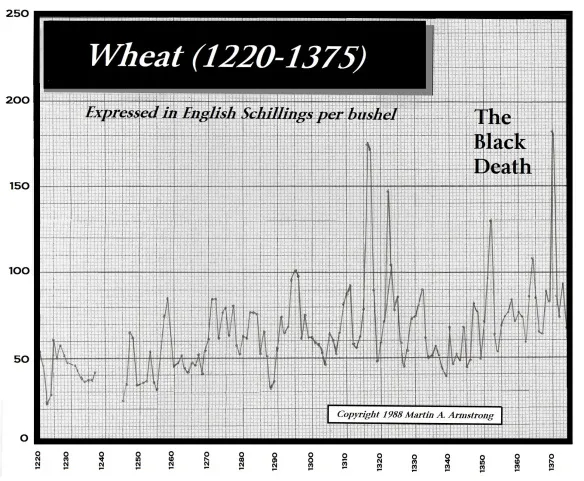
All commodities, including gold, trade substantially differently than stocks or real estate. Pictured here is wheat back to 1200. Note that you see what appears to be a brain wave. Commodities trade differently because they are subject to nature. Manufactured items can be produced on a more regular basis. However, commodities are subject to weather, and even mining is subject to discovering supply.

Look at energy. The US was dependent on imports and was virtually self-sufficient from foreign production until Biden was appointed.

Here is wheat impacted during the Black Death. Two trends were clashing. There was a 50% drop in population, so demand dropped, but also there was a collapse in labor, so production declined. Prices rose because there was still a shortage of supply because land went vacant and that forced landlords to begin paying wages. There are always far more complicated trends involved in commodities.

WheatWholesaleWWI

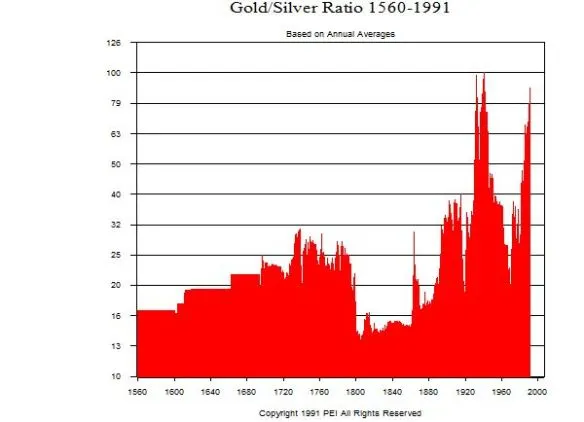
War has also impacted commodities. But when gold was MONEY, it declined in purchasing power WITH inflation. When gold is a free market as present, it moves opposite to inflation because, yes, it too is then a commodity. Making gold money will NEVER prevent the cycles as illustrated above and it will decline in purchasing power with inflation that is in part driven by nature.

GOLD1560to1991

Consequently, even gold makes runs to the upside (bursts) that are largely catch-ups. It does not remain constant even against silver. Gold is the worst investment from an inflationary standpoint if you expect it to track inflation, for it does not and will not. Right now, we are in a cycle where CONFIDENCE has waned, and we will see gold rise with the stock market, but it trades far differently from stocks.

Cyclical analysis is all about defining WHEN such events will take place. Price is entirely a different aspect. The burst is just that – a rally that appears to come from nowhere playing catch-up because EVERYTHING has an international value.

Does an Increase in the Money Supply Lead to Inflation?


Posted originally on May 29, 2024 By Martin Armstrong 

Supply Demand

The old idea that inflation is created by an increase in money supply has distorted the minds of many people. Inflation is caused by numerous factors for it is not a one-dimensional aspect. For example, say a bird flu has rendered half of the egg production to be worthless, which would send egg prices soaring. This would have nothing to do with the quantity of money. So, obviously, a decline in the supply of some service or commodity can also lead to rising prices. Supply and demand.

Then there can be cost-push inflation as we saw during the 1970s due to OPEC. The first OPEC price shock was October 1973 from where we should see the next low in 2016 (43 years later). The sudden rise in oil sent a shockwave through the economy, driving up prices because the entire economy had to readjust to higher energy. This was not the result of an increase in demand nor an increase in the money supply.

When gold was used for money during the 19th century, it fell sharply in value with each new discovery from California, Australia, and Alaska. Inflation rose because of a dramatic increase in the money supply, which is exactly what took place in Europe when Spain brought back ship after ship of gold from the New World. The sudden dramatic rise in the supply of money unleashed inflation, and during both periods, money (gold) failed to provide a store of value.

Steady, slow growth in the supply of money does not lead to inflationary waves. We find that major waves of inflation are often tied to waves of speculation, which differ with each wave moving from real estate, commodities, stocks, or bonds, constantly rotating over decades within a domestic economy and then this movement of capital takes place internationally.

Inflation is not a single one-dimensional aspect. It moves up and down between the rise and fall in the demand for private assets vs. hoarding and uncertainty.

Steve Bannon’s Explosive Rant: Conservative Leaders Lack the Balls to Save the West


Posted originally on Rumble By Bannons War Room on: May 25, 2024 at 06:00 pm EST

Steve Bannon Warns: World War 3 is Closer Than Ever with Terrifying New Battlefield Tech


Posted originally on Rumble By Bannons War Room on: May 25, 2024 at 06:00 pm EST

Bannon Exposes Plot: RINOs Scheming to Steal GOP Nomination from Trump and Push Nikki Haley as VP


Posted originally on Rumble By Bannons War Room on: May 25, 2024 at 06:00 pm EST

Steve Bannon Predicts Violent Revolution in Britain if Technofeudalism Takes Over


Posted originally on Rumble By Bannons War Room on: May 25, 2024 at 06:00 pm EST

President Trump Sends Message of Support for Cryptocurrency


Posted originally on the CTH on May 25, 2024 | Sundance 

This is interesting. Only a very small segment of the U.S. electorate seemingly understands the ramification of a dollar-based central bank digital currency (CBDC) for the USA. There is also evidence the Russian sanctions were created as the starter fuse for the CBDC process.

WASHINGTON DC – […] Crypto-friendly legislation moving through Congress in the last two weeks drew a surprising level of bipartisan support, surfacing household names such as Senate Majority Leader Chuck Schumer and former House Speaker Nancy Pelosi as unexpected allies, while suggesting that crypto skeptics like Sen. Elizabeth Warren may soon be isolated on the issue.

[…] Republicans who were already aligning themselves with the crypto world are leaning into the embrace even further. Former President Donald Trump is increasingly pledging to support the interests of digital asset traders, and he’s starting to accept campaign contributions in crypto. (MORE)

Please Keep this in Mind from MARCH 2022:

“The Order directs the U.S. Government to assess the technological infrastructure and capacity needs for a potential U.S. CBDC in a manner that protects Americans’ interests. The Order also encourages the Federal Reserve to continue its research, development, and assessment efforts for a U.S. CBDC, including development of a plan for broader U.S. Government action in support of their work. This effort prioritizes U.S. participation in multi-country experimentation, and ensures U.S. leadership internationally to promote CBDC development that is consistent with U.S. priorities and democratic values.”  (WHITE HOUSE)

That announcement was less than 2 weeks after Russia moved into Ukraine.

Is the population decrease a bad thing? Unpacking why population increase is an overall good


Posted originally on Rumble By Charlie Kirk show on: May 24, 2024 at 5:30 pm EST

The Role of Grandparent Vanishing from Society


Posted originally on May 24, 2024 By Martin Armstrong 

Family

I discussed how the rising costs of childcare surpass the cost of rent by 25% to 50% across the United States. The cost of raising a child is directly reflected in the birth rate crisis we are seeing across the world. Another new phenomenon is permanently altering the family structure as a result of economics – the absence of the role of grandparents.

Unlike countless animal species, humans were designed to survive well past child-rearing years. Only a few animal species, such as elephants and whales, undergo menopause, and not so coincidentally, these species rely on shared wisdom passed down through the generations for survival. Men begin to decline in testosterone around the same time that women go through menopause, and while they can continue having children throughout their life cycle, men are wired to be less likely to compete for mates later in life. Grandparents served an essential role in the family structure.

Elderly Parent

The nuclear family has always been supported by the extended family. Older generations helped to care for the younger generations, passing down priceless knowledge. Younger generations had the ability to then care for the elderly. Tens of thousands of years of evolutionary biology is no longer the norm due to economics.

Simply put, most grandparents are still working to survive. I will speak from the US perspective, but this phenomenon is happening throughout the world. Over half of families (53.3%) were dual-income earners in the United States as of 2019. A recent survey found the average age of retirement is between 61 to 64, up from 57 in 1990. The current cost of living will require most to work far beyond this age for survival. Social Security will go bust, and hardly anyone outside of government employees will receive a pension. A comfortable retirement is hard to obtain for the average person.

Additionally, children are less likely to support their parents as they age for cultural and financial reasons. We saw nations like China fining young people for not caring for aging parents. Individualism is favored in our societies, and the youth throughout the world is geared toward starting a new life in the cities away from their immediate families. Younger generations notoriously have less saved for retirement compared to earlier generations due to the high cost of living, and many are unable to financially care for sick and elderly parents because they lack the resources. Life expectancy is slightly declining, but we are living far longer than past generations.

Since grandparents are preoccupied working, the parents are placing their children in daycares rather than with grandparents. That once essential role of the grandparent is less prominent in modern societies. The public education system rather than the family is passing down knowledge, or the knowledge they deem appropriate.

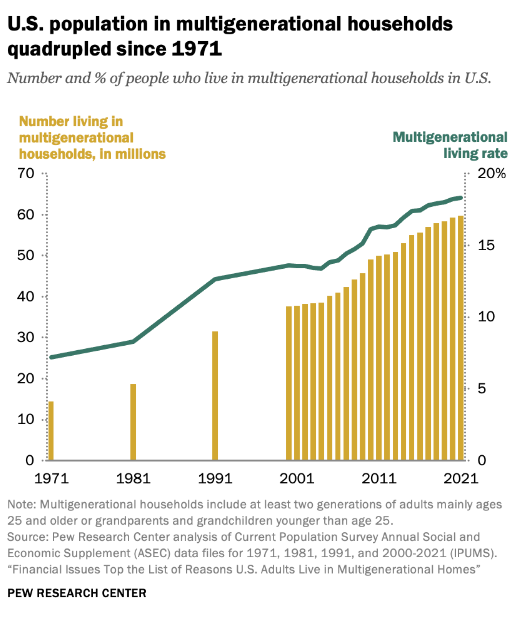
multigenerational.households.USA_

Could the extreme increase in the cost of living revive the multigenerational family structure? Pew Research has found that multigenerational homes, “defined as including two or more adult generations (with adults mainly ages 25 or older) or a “skipped generation,” which consists of grandparents and their grandchildren younger than 25,” are now rising in America. Around 59.7 million Americans lived in multigenerational homes in March 2021, compared to 58.4 million in 2019 before the pandemic. Yet a large cause of this shift is an increase in Asian and Latino immigrants, who account for a higher proportion of multigenerational households.

Around 10,000 Baby Boomers will turn 65 every day from now until the pivotal year of 2030. Estimates believe that there will be a 50% increase in the number of seniors living in nursing homes full-time by 2030. The Washington Post found that 10% of seniors 85 years of age or older now live in retirement homes unless they are working in US Congress.

The role of the grandparent was essential throughout all of evolutionary biology. Women had the opportunity to enter the workforce, and now, it is mostly a mandatory obligation due to living costs. Both parents are working, as are the grandparents, and the children are being partially raised by daycares and the school system. The role of the grandparent is vanishing from our society as a direct result of shifting economic and societal norms.