Asia expert Gordon Chang discusses the U.S.-China trade negotiations with Lou Dobbs and why President Trump should consider raising tariffs on Chinese imports on March 1st.
Massive pressure is being applied by Chinese purchased interests including Wall Street, the multinational corporate lobbying groups; the U.S. Chamber of Commerce and all of the global financial elite, to oppose President Trump’s confrontation with Beijing.
Q How confident are you that it will be finished by March 1? Or are you considering extending that deadline?
THE PRESIDENT: Well, they are very complex talks. They’re going very well. We’re asking for everything that anybody has ever even suggested. These are not just, you know, “let’s sell corn or let’s do this.” It’s going to be selling corn but a lot of it — a lot more than anyone thought possible. And I think the talks are going very well — with China, you’re referring to?
THE PRESIDENT: And the talks are going very well.
Our group just came back and now they’re coming here. I can’t tell you exactly about timing, but the date is not a magical date. A lot of things can happen.
The real question will be: Will we raise the tariffs? Because they automatically kick in to 25 percent as of — on $200 billion worth of goods that they send. So I know that China would like not for that to happen. So I think they’re trying to move fast so that doesn’t happen. But it’s — we’ll see what happens.
I can only say that the talks with China on trade have gone very, very well. In the meantime, our economy is very strong. We’re doing well.
I don’t know if you noticed, but deficits seem to be coming down. And last month it was reported, and everybody was surprised, but I wasn’t surprised. We’re taking in a lot of money coming into our Treasury from tariffs and various things, including the steel dumping. And our steel companies are doing really well. Aluminum companies also. So we’re very happy about that.
I think that it’s — they’ll be coming very shortly. They’re going to have very detailed discussions on subjects that have never really been even discussed by people that sat in this chair and they should have been. Very important subjects. And I think we’re doing very well. Okay?
Earlier this afternoon President Donald Trump met with Austria’s Chancellor Sebastian Kurz [Video and Transcript below] Additionally, the president answered questions from the White House media on current events and issues including the section 232 auto-tariffs, the upcoming visit to the DPRK, AG Bill Barr and Andrew McCabe.
.
[Transcript] – Oval Office 1:52 P.M. EST – PRESIDENT TRUMP: Hello, everyone. Thank you very much. And it’s great to be with the Chancellor of Austria. We have a tremendous relationship, long term, with Austria. And we’re going to be discussing numerous things — immigration — today. But we’re also discussing trade. We have a very big trade presence and a very good relationship on trade. We do a lot of business with each other.
And, Chancellor, it’s very nice to have you. Thank you very much. Thank you. Please.
CHANCELLOR KURZ: Thank you, Mr. President, for receiving us here in the U.S., in the White House. It’s a pleasure for my delegation and for me to be here.
Austria, as you probably know, is — compared to the U.S. — a very small country, but we are a beautiful country.
PRESIDENT TRUMP: That’s true.
CHANCELLOR KURZ: We are a, economically, quite strong country. You would probably say a “great country.” We are in the heart of the European Union, an active member state of the European Union. It’s a small country. We need international cooperation, and therefore I hope that we can discuss now our bilateral relations, but also the relations between the European Union and the United States of America. Of course, trade and how we can gain economic growth for the U.S., but also for Europe. And probably international issues like Middle East, Korea —
PRESIDENT TRUMP: Right.
CHANCELLOR KURZ: — and probably also Russia. Thank you for receiving us.
PRESIDENT TRUMP: Thank you very much. I appreciate it.
Q Mr. President, are you going to impose auto tariffs on the Europeans?
PRESIDENT TRUMP: Well, it’s something we certainly think about. We’re trying to make a deal. They’re very tough to make a deal with — the EU. They’ve been very difficult over a period of time — over many, many years. And so it’s something we think about, and we’re negotiating with them. If we don’t make the deal, we’ll do the tariffs.
Q The new report hasn’t changed your mind about it at all? There’s a new report from the Commerce Department.
PRESIDENT TRUMP: The new report is not that kind of a report. It’s just really a study that’s underway. We’ve studied it very carefully. We’ve seen the results. But the bottom-line result is whether or not we can make a deal with the EU that’s fair. We lose about $151 billion trading with the EU. That’s a lot of money. And this has been going on for many years. They wouldn’t meet with the Obama administration, and they’re meeting with us. So we’ll see what happens. We’ll see what happens.
Q Mr. President, should the Mueller report be released when you’re abroad next week?
PRESIDENT TRUMP: That’ll be totally up to the new Attorney General. He’s a tremendous man, a tremendous person, who really respects this country and respects the Justice Department. So that’ll be totally up to him, the new Attorney — the new Attorney General, yes.
Q Should it be public? Should the report become public, do you think?
PRESIDENT TRUMP: I guess, from what I understand, that will be totally up to the Attorney General. Okay?
Q Mr. President, on your push to decriminalize homosexuality, are you doing that? And why?
PRESIDENT TRUMP: Say it?
Q Your push to decriminalize homosexuality around the world.
PRESIDENT TRUMP: I don’t know which report you’re talking about. We have many reports.
Anybody else?
Q What do you expect the Austrian Chancellor to do in European policy?
PRESIDENT TRUMP: Well, we’re just going to have a great meeting. We have a great relationship and our countries have a great relationship.
And he’s a very young leader, I have to tell you. You are a young guy. That’s pretty good.
CHANCELLOR KURZ: But the problem with the age is getting better from day to day.
PRESIDENT TRUMP: That’s right. Someday you won’t be saying it.
But we have a very good relationship and we have a great trade relationship, and that’s pretty much what we’re going to be talking about today.
Q Are you considering replacing Dan Coats as your Director of National Intelligence?
PRESIDENT TRUMP: I haven’t even thought about it.
Q Mr. President, you spoke to the Prime Minister of Japan today.
PRESIDENT TRUMP: I did.
Q How hard is it going to be to get North Korea to completely, verifiably denuclearize, which I think you —
PRESIDENT TRUMP: Well, I spoke with — this morning, with Prime Minister Abe. I had a long conversation with him. We talked about the trip next week to Vietnam, which will be, I think, very successful. I think the first trip to Singapore was extremely successful.
We’ll be meeting with Chairman Kim for two days, and I think we’ll accomplish a lot. We started off with a very good meeting, and I think we’ll continue that along. I don’t think this will be the last meeting by any chance, but I do think that the relationship is very strong.
When we started, as you know, there were a lot of problems. There was the missiles going all over. There were hostages that were being held. There were remains that we wanted to get back. There were many, many things. Now there’s no nuclear testing, no missiles going up. And we have a good relationship — a very good relationship, I’d say.
So I spoke with Prime Minister Abe of Japan about that, and we compared notes. And I think we are very much on the same wave length. It was a good meeting. A good conversation.
Q They seem very reluctant — the North Koreans — to denuclearize. Do you think you’ll be able to make any —
PRESIDENT TRUMP: No, I don’t think they’re reluctant. I think they want to do something. But I — you know, you’ve been talking about this for 80 years. They’ve been talking about this for many, many years, and no administration has done anything. They’ve gotten taken to the cleaners. And I think we have a really meaningful relationship. We’ll see what happens.
The sanctions are on in full. As you know, I haven’t taken sanctions off. I’d love to be able to, but in order to do that, we have to do something that’s meaningful on the other side.
But Chairman Kim and I have a very good relationship. I wouldn’t be surprised to see something work out. I really believe that, as an economic power, because of its location in between. I mean, if you look on a map and you see Russia, China, and right in the middle of everything is South Korea, but North Korea right smack in the middle. So you have Russia, China, and then South Korea. And this is right in the middle. Tremendous potential for economic wellbeing, long term. And I think he understands that very well. I think he might understand that better than anybody.
So they have a great, great potential as a country, and I think that’s what they’re looking to do. We’ll see. But we’ve made a lot of progress. We’ve made a tremendous amount. That doesn’t mean this is going to be the last meeting, because I don’t believe it will. But we have subjects to discuss which will be very fruitful, I believe.
Q Do you have a comment on Andrew McCabe briefing McConnell and Paul Ryan and Devin Nunes, telling them about the investigation into you?
PRESIDENT TRUMP: Well, I think Andrew McCabe has made a fool out of himself over the last couple of days, and he really looks to me like sort of a poor man’s J. Edgar Hoover. He’s a — I think he’s a disaster. And what he was trying to do was terrible and he was caught. I’m very proud to say we caught him.
So we’ll see what happens. But he is a disgraced man. He was terminated, not by me; he was terminated by others. The IG report was a disaster — a disaster, from his standpoint. Anybody reading the IG report would say, “How could a man like this be involved with the FBI?” And the FBI has some of the greatest people — some of the finest people you’ll ever meet. But this man is a complete disaster.
Thank you all very much.
Q Are you going to Japan, Mr. President? Are you going to Japan in May?
At the current federal minimum wage of $7.25 per hour, working 40 hours per week, 52 weeks per year, yields an annual income of only $15,080. This is below the annual poverty line. It also reflects something that most people are unaware of — in Illinois, there are more than 19,000 retired teachers who get OVER $100,000 per year in their pension. According to the latest data, nearly 1.5 in ten federal employees are eligible to retire RIGHT NOW, and in five years the number will hit three in 10 or about 30%. The Housing and Urban Development Department in the federal government has the highest rate of employees eligible to retire right now of any major agency in government, which stands at a shocking 24%.
Under U.S. law, there are two broad types of retirement plans: defined-benefit (DB) and defined-contribution (DC) plans. The Defined-benefit plan has been mostly abandoned in the private sector because they were rapidly revealing how they failed to work. The DB plan use to come with a gold watch and ensured you some level of benefit for the rest of your life. This was all part of how to prevent another Great Depression. Typically, your employer would invest part of your compensation in the plan based on some formula. In some cases, you, the worker, might have added more money to the pot. The employer was required to send your defined benefit each month or quarter to a fund. Typically, this was in the form of a fixed-dollar amount, sometimes with periodic cost-of-living adjustments. That scheme ran into trouble that set standards for private-sector pension plans and defined their tax benefits under federal law because government wanted a piece of the action due to income taxes.
Most state and local government employees, actually 87% of those working full time, participate in a defined benefit (DB) pension plan. They contribute nothing but are simply guaranteed a pension on top of what they earned. These plans typically provide pensions based on members’ years of service and average salary over a specified period before retirement. On top of that, most members also receive cost-of-living adjustments that help maintain the purchasing power of their benefits during retirement. In the private sector, where defined contribution (DC) or 401(k)-style plans dominate, only 19% of full-time workers belong to DB plans. This is the real PENSION CRISIS. Government workers generally contribute nothing and demand tax increases to fund their pensions.
The DC plans emerged when the DB plans were showing signs of economic stress. The handwriting was on the wall. As taxes rose, the standard of living declined and governments wanted to regulate pensions to prevent too much money going into tax-free vehicles. The 401K is a kind of defined-contribution plan (as are various types of IRAs/Keogh/SEP plans, etc.) which emerged under the DC plan structure. Government regulations govern who puts money into the plan and how much. Typically, it’s you and your employer. Your employer also has to give you some reasonable investment options, but it’s up to you to use them wisely. Good luck. Most people have discovered nothing but losses. The advice for the general public has been biased, subject to conflicts of interest, and fragmented. This is because we have fragmented agencies (i.e. SEC & CFTC). The CFTC is regarded as the unqualified regulator. The lawyers there are the people who generally are turned down by the SEC. But the real crisis is that the regulations under the SEC and CFTC are exactly opposite. If you managed money under one agency’s rules, you went to jail under the other. This resulted in the development of offshore hedge funds where you paid a manager to make all the decisions, whereas domestically, a manger in stocks could not also advise on commodities. This resulted in conflicts of interest and has seriously harmed average people in understanding how to manage their own 401K.
Therefore, regulations have prejudiced the private sector while the public sector is predominantly under DB plans where government workers have no decisions they confront. This stark difference is coming to a head. Before 2032, there will be more people on retirement from government than actual workers. Taxes have NOWHERE to go but up dramatically because nobody is willing to look at reform. The new Modern Economic Theory is their answer — just print.
On the surface it would appear the Mueller probe has reached its final stages. Deputy AG Rod Rosenstein was scheduled to exit the DOJ simultaneous to his partner, Robert Mueller, concluding his special counsel investigation.
[Via The White House] February 19, 2019 – President Donald J. Trump Announces Intent to Nominate Individual to a Key Administration Post.
Today, President Donald J. Trump announced his intent to nominate the following individual to a key position in his Administration:
Jeffrey A. Rosen of Virginia, to be the Deputy Attorney General at the Department of Justice.
Mr. Rosen currently serves as Deputy Secretary of the U.S. Department of Transportation. Previously, Mr. Rosen was a senior partner at Kirkland & Ellis LLP. During his nearly 30 years at that firm, he held positions of Associate, Partner, Co-Head of the Washington, D.C., office, and member of Kirkland’s Global Executive Management Committee.
Mr. Rosen served as General Counsel and Senior Policy Advisor for the White House Office of Management and Budget and as General Counsel at the U.S. Department of Transportation. Additionally, he served as an adjunct professor at Georgetown University Law Center and Chair of the American Bar Association’s Section of Administrative Law and Regulatory Practice.
Mr. Rosen earned his B.A. in economics with Highest Distinction from Northwestern University and his J.D., magna cum laude, from Harvard Law School. (WH Link)
Jeffrey Rosen is the hand-picked deputy of Attorney General William Barr:
Earlier today President Trump signed Space Force Policy Directive #4 and held a brief presser in the Oval Office. [Video and Transcript Below] During questions, President Trump answered a variety of questions on: McCabe, China, N-Korea and Bernie Sanders.
.
[Transcript] 2:11 P.M. EST – THE PRESIDENT: Okay, thank you very much. I had a great conversation this morning with President Moon of South Korea. And we obviously discussed the upcoming trip next week, where we’re going Hanoi, in Vietnam. And I look forward to be with Chairman Kim, and I think a lot of things will come out of it.
We had a tremendous first summit. That was really breaking the ice, but a lot of things came from that, including good relationships. And we’re looking forward to having a very good meeting. And President Moon and I discussed, I think, probably every aspect of the meeting; it was a good conversation. I’ll be speaking tomorrow with Prime Minister Abe of Japan, and we’ll be having a similar conversation. So I think next week is going to be very exciting.
It’s going to be the second summit. I think a lot can come from it — at least, I hope so — the denuclearization, ultimately. I’m in no particular rush. The sanctions are on, the relationships are very strong, and a lot of good things have happened.
We’ve gotten our hostages back. The remains are coming back. Vice President Pence was in Hawaii when the first large number, actually, had come. And now, certain have been identified. Their families members have found out exactly what’s going on, and they’ve had ceremonies that are absolutely beautiful. That was an incredible event.
In fact, when we were campaigning, so many people would say — even though it was many years ago, they would say, “Is it possible to get the remains back from North Korea?” So we’ve done that. And as you know, there’s been no testing of rockets, missiles, or nuclear.
So we’re in no rush. A lot of the media would like to say, “Oh, what’s going on? Speed, speed, speed.” No rush whatsoever. We are going to have our meeting; we’ll see what happens. And I think, ultimately, we’re going to be very, very successful.
When I became President, the relationship with North Korea was a very dangerous one for the world, and I think now it’s far less dangerous. And there’s a lot of sanity, a lot of really sane thinking.
So he looks forward to it; I look forward to it. And the talk with President Moon, and tomorrow with Prime Minister Abe, I think will be very helpful.
Today, I’m thrilled to sign a new order taking the next step to create the United States Space Force. So important, when you look at defense, when you look at all of the other aspects of where the world will be someday. I mean, this is the beginning. This is a very important process.
First, I want to recognize our wonderful Vice President, Mike Pence, who serves as the Chairman of the National Space Council. Thank you, Mike. Great job. I know you feel the same way I do.
I also want to thank Acting Secretary of Defense Patrick Shanahan, who is with us; Secretary of the Air Force Heather Wilson; Vice Chairman of the Joint Chiefs of Staff, General Paul Selva; and the Executive Secretary of the Space Council, Dr. Scott Pace for being here today.
They’ve all worked very hard on the Space Force. They all believe in it very strongly, as I do. It’s the future. It’s where we’re going. I suspect, whether we like it or not, that’s where we’re going. It’s space. That’s the next step, and we have to be prepared.
Our adversaries and — whether we get along with them or not, they’re up in space. And they’re doing it, and we’re doing it. And that’s going to be a very big part of where the defense of our nation — and you could say “offense” — but let’s just be nice about it and let’s say the defense of our nation is going to be.
America must be fully equipped to defend our vital interests. Our adversaries are training forces and developing technology to undermine our security in space, and they’re working very hard at that.
That’s why my administration has recognized space as a warfighting domain and made the creation of the Space Force a national security priority. I think we’ll have great support from Congress, because they do support something when we’re talking about such importance. And a lot of the generals, a lot of the people involved have been speaking to Congress. And we have some very interesting dialogue going on.
We’re investing in new space capabilities to project military power and safeguard our nation’s interests, especially when it comes to safety and defense.
This directive calls on the Secretary of Defense to develop a legislative proposal that will establish the structure and authority of the Space Force as the sixth branch of the United States Armed Forces. That would mean a high-ranking — the highest-ranking person there would go on to the Joint Chiefs of Staff. So it’s a very, very important deal.
The Space Force will organize, equip, and train the next generation of warriors to deter aggression and defend the nation, our allies, and American interests against hostile actions in the form of space and taking place in space.
So we have a lot of things on the books. We have a lot of new defensive weapons and offensive weapons designed specifically for this, and now we’re going to start taking advantage of. This is something they could have done sooner but they decided to wait. And here I am, and we’re going to do it. And I’m very proud that, during my administration, we’re doing so much in space. We need it.
We’ve already taken historic action to create the United States Space Command, as you know, within the Department of Defense to oversee the nation’s military space operations.
Now, in the face of these threats all around the world, American leadership in space is more important than it ever has been. Before, it used to be something that we’d aspire to, we’d talk about, but we wouldn’t do anything. Now we have to do something because that’s where it’s at.
With today’s action, we will ensure that our people are secure, our interests are protected, and our power continues to be unmatched. There will be nobody that can come close to matching us. It won’t be close.
What we have on the books are things that you wouldn’t even believe. You wouldn’t even believe. It’s going to mean the safety of our nation for many, many decades and many, many generations, and that’s what I’m here for. I guess when you get right down to it, more importantly than anything else, that’s why I’m here.
So I just want to thank everybody. The Space Force is a very important part of my administration and it’s a very important part of this nation. And it’s an honor to be with you all. And I’ll sign and we will then maybe take a few questions and ask a few. You may want to say something. In fact, Mike, why don’t you start off? You’ve been — you and I have been working on this very hard. Why don’t you say a few words? Please.
THE VICE PRESIDENT: We have. Thank you, Mr. President. From the first days of this administration, President Trump has made national security a priority. We’ve secured historic investments in our national defense.
But from very early on, the President also said that America needed to be as dominant in space as we are on the Earth. And now, with this fourth Space Policy Directive, America is leading in space once again.
But in this respect, the President is calling on the Department of Defense to fashion what we have literally been working on for months, consulting with members of Congress and military experts. It will be a legislative proposal that will establish the United States Space Force as the sixth branch of our armed forces.
It will build on the President’s leadership of a United States Space Command, a joint combatant command that we’ve already organized at the President’s direction. But this is now the foundation of ensuring that even as we are dominant in space today, now we’ll begin to bring all of our resources together under U.S. Space Command, which will operate under the Department of the Air Force. And in so doing, we’ll ensure that we bring the best resources and the best minds together to protect the American people and advance our interests.
And, Mr. President, all the members of the National Space Council and the agencies that are a part of it are gathered behind you today —
THE PRESIDENT: That’s right.
THE VICE PRESIDENT: — and we thank you for your leadership and your support in this effort.
THE PRESIDENT: Some great talent, I will say that. Would you like to say something? You’ve helped us so much. Please, Paul.
GENERAL SELVA: Sir, you’ve been incredibly supportive in bringing space to the fore as not only a domain of potential warfare, but also recognizing it as a place where a large amount of our economic power comes from. And so our job to protect our national security includes protecting our economy as well. And so, as your Vice Chairman, the Joint Chiefs endorse all this effort to make sure that we get the right emphasis on defending our interests and our assets in space.
THE PRESIDENT: Thank you very much, Paul. Patrick? How about you?
ACTING SECRETARY SHANAHAN: Yes, sir.
THE PRESIDENT: Mr. Secretary.
ACTING SECRETARY SHANAHAN: This is a historic moment. The dawn of a new service. I’d like to thank you for your leadership and, most importantly, the resources so that we can do our job.
Mr. Vice President, thank you for pushing us. We’ve come quite a distance in a very short period of time.
And then to my counterparts here, thank you for all the remarkable teamwork. We will deliver the capability better, sooner, faster so we can sustain our margin of dominance.
Thank you.
THE PRESIDENT: Thank you very much.
Maybe John Bolton — you’ve been very much involved and I know how you feel about it.
AMBASSADOR BOLTON: Well, this is a visionary project, Mr. President — your leadership, the Vice President, and really everybody on the Space Council. This is not something for the next year or two, or even the next six years. This is on into the century. A place where, as President Kennedy once said, “I believe space is a new ocean and the United States must sail upon it.” And you’re taking the steps to make sure that, from the national security perspective, the United States will be dominant on that new ocean.
THE PRESIDENT: And we will be. Okay, thank you.
Anybody have anything to say? Huh? Would anybody like to say? Fine? No? Good. We’re all (inaudible). (Laughter.) Right? We’ve said enough. Let’s sign. Let’s sign. It’s very exciting.
(The directive is signed.)
So how about we give this one to Paul? Mike, do you want to do that? Okay. Come on, Paul. That’s a big deal. (Applause.)
It’s very important. Thank you very much. Thank you very much, everybody. Thank you.
Q Mr. President, there’s another round of trade talks starting this week here in Washington.
THE PRESIDENT: That’s right.
Q How confident are you that it will be finished by March 1? Or are you considering extending that deadline?
THE PRESIDENT: Well, they are very complex talks. They’re going very well. We’re asking for everything that anybody has ever even suggested. These are not just, you know, “let’s sell corn or let’s do this.” It’s going to be selling corn but a lot of it — a lot more than anyone thought possible. And I think the talks are going very well — with China, you’re referring to?
Q Yes.
THE PRESIDENT: And the talks are going very well.
Our group just came back and now they’re coming here. I can’t tell you exactly about timing, but the date is not a magical date. A lot of things can happen.
The real question will be: Will we raise the tariffs? Because they automatically kick in to 25 percent as of — on $200 billion worth of goods that they send. So I know that China would like not for that to happen. So I think they’re trying to move fast so that doesn’t happen. But it’s — we’ll see what happens.
I can only say that the talks with China on trade have gone very, very well. In the meantime, our economy is very strong. We’re doing well.
I don’t know if you noticed, but deficits seem to be coming down. And last month it was reported, and everybody was surprised, but I wasn’t surprised. We’re taking in a lot of money coming into our Treasury from tariffs and various things, including the steel dumping. And our steel companies are doing really well. Aluminum companies also. So we’re very happy about that.
I think that it’s — they’ll be coming very shortly. They’re going to have very detailed discussions on subjects that have never really been even discussed by people that sat in this chair and they should have been. Very important subjects. And I think we’re doing very well. Okay?
Q (Inaudible) terrorists from Pakistan have been — struck, inside India, 40 security persons last week. How do you see this issue? What’s the message to Pakistan?
THE PRESIDENT: I’ve seen it. I’ve watched. I’ve gotten a lot of reports on it. We’ll have a comment at the appropriate time. It would be wonderful if they got along. It seems like that was a horrible situation. But we’re getting reports. We’ll have a statement to put out. Okay? Thank you very much.
Q Mr. President, did you ask Acting Attorney General Matthew Whitaker to change the leadership of the investigation into your former personal attorney, Michael Cohen?
THE PRESIDENT: No. Not at all. I don’t know who gave you that. Just more fake news. A lot of — there’s a lot of fake —
Q (Inaudible) story in the New York Times.
THE PRESIDENT: — there’s a lot of fake news out there. No, I didn’t.
Q What is the current status of your relationship with Mr. Whitaker?
THE PRESIDENT: Very good. I have a lot of respect for Mr. Whitaker. I think he’s done a great job. He’s a very, very straight shooter. I watched him during the hearing — some of it. I thought he was exceptional. He’s a very fine man and he should be given a lot of thanks by our nation.
Okay. Thank you very much.
Q Mr. President, what’s your reaction to the lawsuits yesterday filed by the states against your executive order?
THE PRESIDENT: Well, I think I called it exactly, right? Including the fact that they would put them in through the Ninth Circuit. That’s where they put them in. And I think we’ll do very well.
We have absolute right to do that. I have an absolute right to call a national security. We need strong borders. We have to stop drugs and crime and criminals and human trafficking. And we have to stop all of those things that a strong wall will stop. I could call it a barrier, but I think I don’t have to do that so much anymore. We’ll call it whatever we want.
But the point is that we have to have a stoppage. Billions and billions of dollars of illicit things are pouring through our border. And, you know, we talk about points of entry, and one of the things that we do have is a lot of money now from points of entry, because everything was given. The money was given — so much that you almost don’t know what to do with it — by Congress. But when it came to the wall, they wanted to hold back because it was politics. That’s all it is.
In fact, I hear the Democrats want to take down all walls along the southern border. And if they do that, you’re going to have a very different country. But they’re not going to do that. They wouldn’t. First of all, they won’t do it because they know it’s wrong. They know walls are necessary, maybe more than we do. But they’re playing a political game. And their new game is, “Let’s take down all walls.” I saw where Beto wanted to take down walls. I said — they asked me, “What do you think?” I said, “Well, I think that’s probably the end of his political career.”
We’re doing very well on the wall. We’re building a lot of wall right now. You know that. In the valley, we’re doing tremendous work in a very important area. We have a lot more under negotiation right now. We’re working with the Army Corps of Engineers. They’re fantastic. And a lot of great things are happening.
I think, in the end, we’re going to be very successful with the lawsuit. So it was filed — it was filed in the Ninth Circuit. And I actually think we might do very well, even in the Ninth Circuit, because it’s an open and closed case.
I was put here for security — whether it’s Space Force, which we’re doing today, or whether it’s borders. Because if our nation doesn’t have borders, we don’t have too much of a nation, especially when drugs and all of the things that — you know better than anybody what’s happening at the border. It’s a bad situation. So I think we’re going to do very well with the lawsuit.
Okay?
Q Just one more on Vietnam. You said — you referred earlier to your meetings in Vietnam. What do you want to achieve during that summit?
THE PRESIDENT: Well, I’d just like to see, ultimately, denuclearization of North Korea. I think we will see that ultimately. I have no pressing time schedule. And I think a lot of people would like to see it go very quickly from the other side.
I really believe that North Korea can be a tremendous economic power when this is solved. Their location between Russia, China, and South Korea is unbelievable. I think that North Korea and Chairman Kim have some very positive things in mind, and we’ll soon find out. But I’m in no rush. There’s no testing. As long as there’s not testing, I’m in no rush. If there’s testing, that’s another deal. But there has been no testing.
If you look at the end of the Obama administration, it was a disaster what was going on. You don’t have that right now; it’s a much different feeling. I think people have — there’s always danger, but I think people have a much different feeling.
So I hope that very positive things are going to happen. I think that it will be a very exciting couple of days.
Thank you all very much.
Q Your reaction to Bernie Sanders running for President?
THE PRESIDENT: Oh, Bernie Sanders is running. Yeah, that’s right. Personally, I think he missed his time. But I like Bernie because he’s — he is one person that, you know, on trade, he sort of would agree on trade. I’m being very tough on trade. He was tough on trade. The problem is he doesn’t know what to do about it. We’re doing something very spectacular on trade.
But I wish Bernie well. It will be interesting to see how he does. I think what happened to Bernie maybe was not so nice. I think he was taken advantage of. He ran great four years ago, and he was not treated with respect by Clinton. And that was too bad. I thought what happened to Bernie Sanders four years ago was quite sad as it pertains to our country. So we’ll see how he does.
You’ve got a lot of people running, but only one person is going to win. I hope you know who that person is.
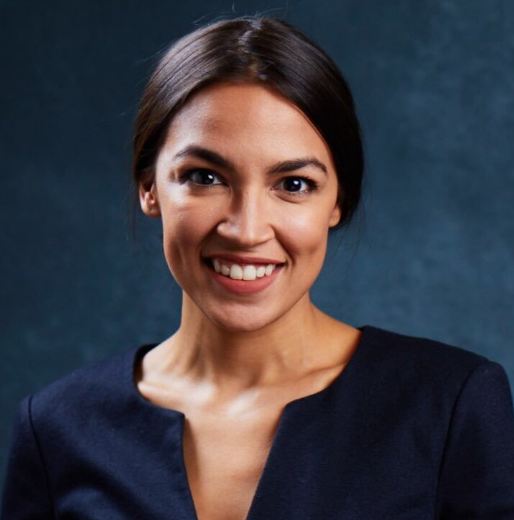
In addition to Elizabeth Warren running in 2020 on a platform of imposing a 3% wealth tax on all assets annually, Bernie Sanders has also thrown in his hat to run for President. We also have people who actually wanted Alexandria Ocasio-Cortez to run for President arguing the 35 year age minimum was not fair. Other Democrats are starting to get really nervous for the big companies they count on for big bucks are starting to run away. Alexandria’s push for higher taxes to fund her Green New-Deal is giving a lot of Democrats deep concern about their funding. How can they justify outlawing air travel? Even Hillary counted on the bankers to line her pockets to take the presidency. They are not going to be there for Alexandra, Warren, or Sanders.
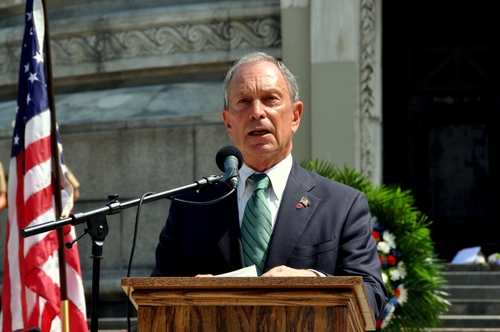
On the other is freshman Rep. Alexandria Ocasio-Cortez, who on Friday declared victory when Amazon announced it was having second thoughts about opening in Queens. Former New York Mayor Michael Bloomberg, demonstrated to the world that he too is either completely braindead, or pandering to the socialists. Bloomberg said that Amazon doesn’t really need any more tax breaks. He seems to be joining Alexandria against Governor Cuomo and New York Mayor de Blasio and Cuomo. Amazon announced it would NOT build in New York City after the attack it has received from Bloomberg and Ocasio-Cortez. You would think that at least Bloomberg would realize if one city offers a significant lower tax rate than New York, it is called COMPETITION!
Ocasio-Cortez and progressives called this a victory. So let’s see. Somehow not creating 25,000 jobs is a victory? The amount of taxes earned from salaries would have been $15 billion compared to a $3 billion tax deal. Sorry, but neither Bloomberg nor Ocasio-Cortez are suited for political office when they cannot see that the benefit of creating jobs outweighs their greed for taxes.
QUESTION: Dear Marty,
First I would like to thank you for all the help you provide especially for us little guys.
I’m from Barcelona, and happily attended the release of “The forecaster” when you were there a few years ago.
I’m under 30 and working my butt off trying to save what I can while paying rent with my partner on a smallish 50m flat (which has become prohibitevely expensive for young local people as rents are at all time highs).
Following your recomendations I’ve put my small savings into movable assets (US and European equities).
With regards to the chart you posted on Spanish Real Estate I was surprised to see the price still so near the bottom of the Housing Crisis. I live in Barcelona and prices are in most cases near or at all time highs for most of the city neighborhoods (of course in € nominal prices wich have dropped quite a bit in $ terms) but as you move away from the city the recovery has been more modest to say the least.
In Barcelona price increses are mostly due to foregneirs moving in and maybe also because people here don’t ussually invest in the stock market but instead put savings into RE (despite the housing bubble people have a big chunk of retirement savings into real estate).
RE is not cheap to say the least but I’m wondering wether I should contract a 30y fixed mortgage and buy a house. My biggest fears are two:
– If long term mortgages dry up I may find out in mkt to mkt loss positions on the house as prices might collapse.
– If the economy declines I have the risk of maybe being fired but still chained to a mortgage.
I fear the later specially since my father has been recently notified that he is going to get fired. The company he works for has decided to fire all employees who are up to 13y!!! close to retirement age (and will probably replace 1/4 of the workforce with cheaper labor).
Given the above do you think it’s still a good time to buy in the big Spanish cities like Barcelona using a fixed mortgage or that you might be better off renting and waiting for the collapse.
Thank you
A.
ANSWER: Barcelona is one of the most beautiful cities in Europe. It is even one of the best places to live. In terms of local earning power, yes, rent in Barcelona is high. In terms of international value, they are cheap, which is why you have so many foreign investors who have poured into your city. Even economically, Barcelona is extremely productive and this was in part behind the reason for the separatist movement. It also had its own history of separatist movements from the Roman Empire (see Maximus 409 AD).
You have noticed the foreign buyers. As the euro drops, the value of property will look cheaper to a foreign investor than domestic. If you stay in the city proper region, this will have an international bid based on currency. In real terms, of course, the property will decline in value. However, this is more of a short-term trend. We all need a place to live. If you can buy with a FIXED rate mortgage, then you will be better off and certainly do not do floating rates. The risk with banks remains that they will stop lending on property as loans turn bad and political turmoil unfolds. Soon it will be an issue of whether Spain will stay in the euro, or whether the euro even exists. The property in the rural area will always be cheaper. So it depends upon what your personal goals might be. Rural property where you have a bit of land and can grow some food is not a bad hedge. But it has been getting cold even in Spain, a country that normally supplies Europe with food during the winter.
We will be heading into a currency crisis. Tangible assets are the way to survive. The biggest problem with real estate is that you cannot take it with you. So keep that in mind. We need a place to live so that is the bottom line. You do not want all your wealth in one asset. You are young enough to survive the major government reset. That will happen. I remain hopeful that if enough people understand the causes behind this crash, then we can make a difference and push back against tyranny.
Make no mistake about it. Government will ALWAYS act in its own self-interest to survive. There has NEVER been a single government that has EVER admitted it is wrong. They must always suppress the people to survive. Remember one thing: even in the USA, there were only three presidents who ever won slightly more than 60% of the popular vote. So, about 10% of the people really decide the fate of nations. We do not have to convince 100% or even 50%. We just need that 10% to make a difference.
The content of the investigative finding is unknown. The Commerce Department has privately delivered the 232 report directly to the White House. However, with the possibility of the report empowering President Trump to implement 20 to 25% import auto tariffs industry executives are proactively going bananas.
An important aspect here is that the USMCA (U.S., Mexico and Canada) agreement exempts the trilateral North American pact from any auto tariff fear. If the vehicle consists of 75% North American (USMCA) content, there’s no tariff.
At the 30,000 ft level, the USMCA deal positioned the U.S. and Mexico to retain their current multinational investments; and through a series of sector-by-sector standards on origination the deal simultaneously closed the fatal NAFTA loophole.
The USMCA agreement makes an economic manufacturing partnership between the U.S, Mexico and Canada; and for assembly products third parties will have to produce parts and origination material within the U.S. and Mexico.
U.S.T.R. Lighthizer put some details forward: ♦The NAFTA Loophole closure is explained in Summary Form HERE; with emphasis on the Auto-Sector. The key is a 75% part origination level for auto-assembly; and a 40-45% level for parts with a minimum $16/hr wage rate. The source-origination rate (75%) is even higher than all previously forecast USMCA negotiation predictions.
Example of downstream consequences/benefits: German auto-maker BMW recently built a $2 billion assembly plant in Mexico (almost complete). Most of their core parts were coming from the EU (steel/aluminum casting components) and/or Asia (electronics). Now the assembly plant will have to source 75% of the auto-parts from the U.S. and Mexico, with 45% of those parts from facilities paying $16/hr.
As a direct result of the USMCA agreement BMW made an announcement in November they were exploring additional parts manufacturing facilities within the U.S. for their engines and transmissions. BMW needs to modify their supply chain and build auto parts in the U.S. and Mexico:
LOS ANGELES (Reuters) – BMW (BMWG.DE) is considering a second U.S. manufacturing plant that could produce engines and transmissions, Chief Executive Harald Krueger said on Tuesday, shortly after a report that U.S. President Donald Trump would impose tariffs on imported cars from next week
Additionally, with the KORUS (Korean-U.S.) bilateral trade deal now cemented there would be no impact to South Korean auto imports (Kia etc) from a 232 decision. However, any EU, China or Japanese automaker who is not currently inside U.S.M.C.A operations could be subject to an application of a countervailing duty.
Specifically because of the scale of the industry, German Chancellor Angela Merkel is the most at risk from a lack of an overall U.S-EU trade deal. This potential 232 auto tariff is a big stick to get the EU to the bargaining table.
WASHINGTON (Reuters) – The U.S. Commerce Department sent a report on Sunday to U.S. President Donald Trump that could unleash steep tariffs on imported cars and auto parts, provoking a sharp backlash from the industry even before it is unveiled, the agency confirmed.
Late on Sunday, a department spokeswoman said it would not disclose any details of the “Section 232” national security report submitted to Trump by Commerce Secretary Wilbur Ross. The disclosure of the submission came less than two hours before the end of a 270-day deadline.
Trump has 90 days to decide whether to act upon the recommendations, which auto industry officials expect to include at least some tariffs on fully assembled vehicles or on technologies and components related to electric, automated, connected and shared vehicles. (read more)
Don’t forget there’s already an existing 25% tariff on imported trucks and SUV’s, that’s why most foreign automakers opened truck and SUV auto-plants in the U.S. over the past two decades. BMW builds their SUV’s in South Carolina. Volkswagen builds SUV’s in Tennessee. Mercedes now builds their SUV’s in Alabama, and Toyota builds in Princeton Indiana as well as Canada. Volvo has also moved all their SUV building to South Carolina.
It is doubtful President Trump will actually pull-the-trigger on tariffs for cars; however, as said, his ability to do it is a massive stick to get both the EU and Japan to commit to a renegotiated bilateral trade agreement.
Today President Trump is delivering a speech in Florida to Miami’s Venezuelan community. The speech is being delivered at Florida International University in Miami and the anticipated start time is approximately 4:25pm EST.
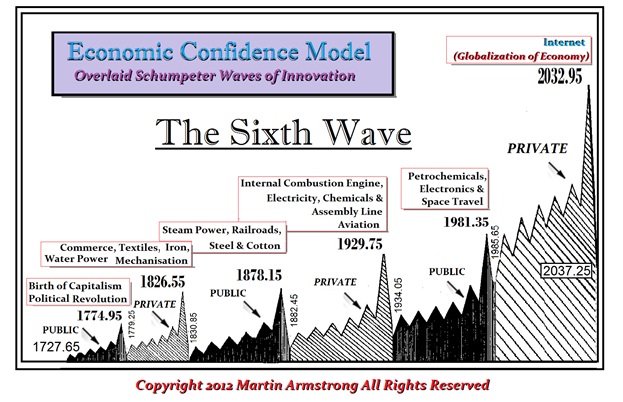
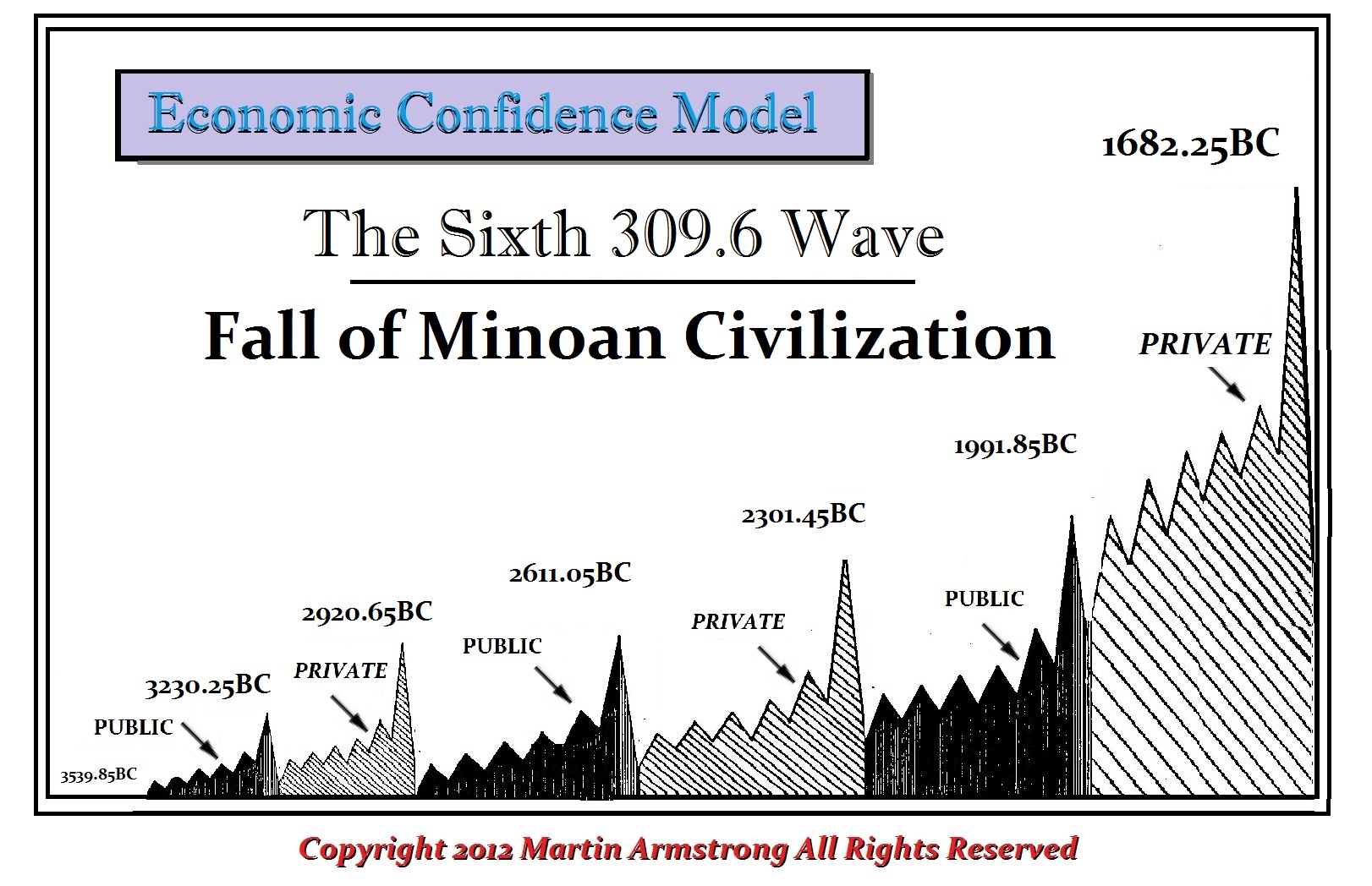
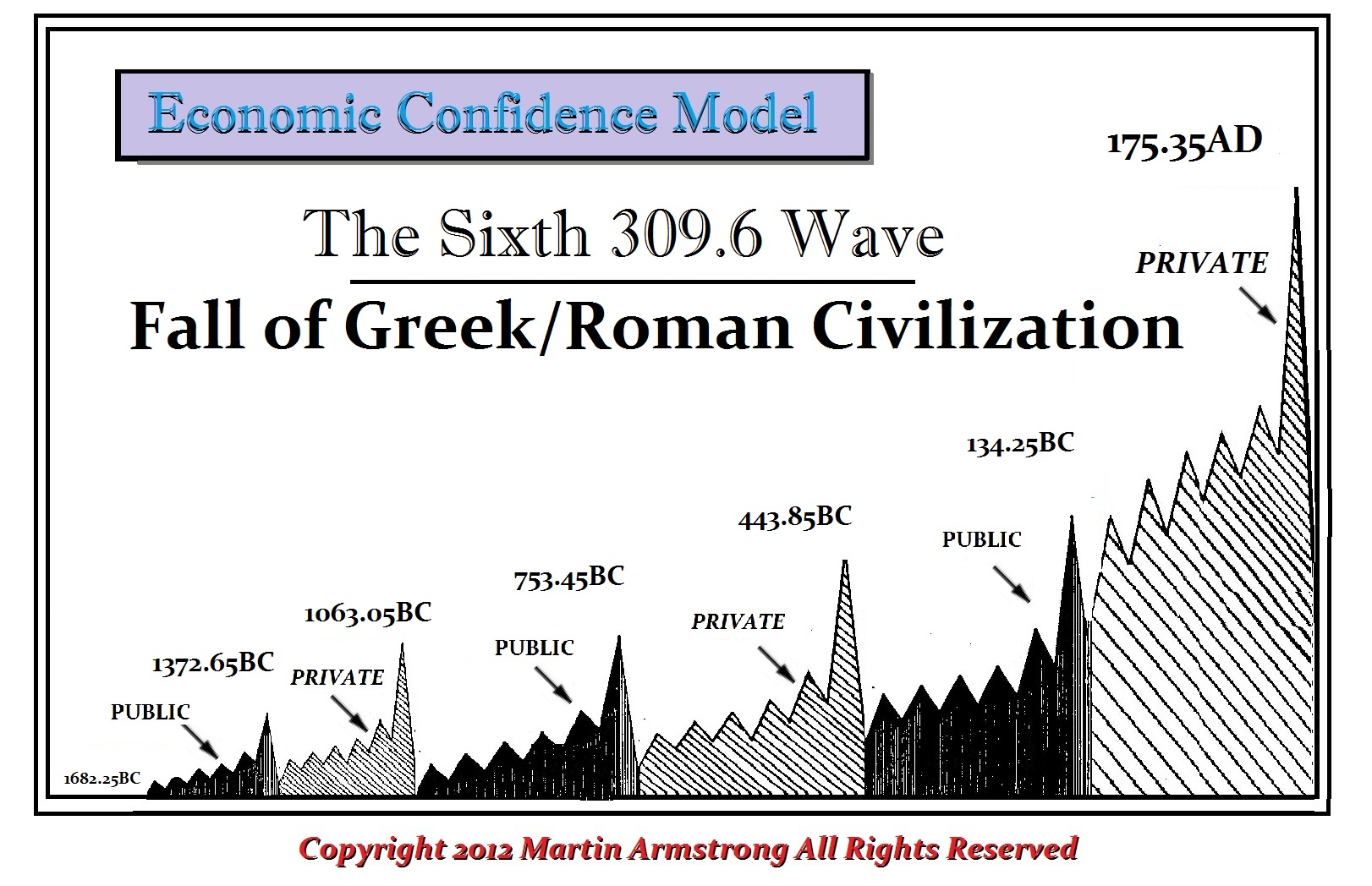
QUESTION: Western Civilization will collapse by 2032.
I didn’t expect such a strong comment from you.
Specifically, what does this mean?
On the level of ancient Rome? Followed by the dark ages or just mediocrity and the rise of the East?
GVH
ANSWER: There is a serious risk that after 2032, this will be very much like the fall of Rome. Nonetheless, it is my personal hope that is we understand that risk, we can avert it and move to a new type of wave formation and learn from the past just once. At the lower threshold of risk lies that reality whereby at the very minimum we are looking at the collapse of centralized governments as took place in 1989 with communism. That will result in greater separatist movements and the breakup of national states as we know it today. The USA could break into four main regions. Britain would find it too splits and Scotland, as well as Wales and Ireland, revert back to their origins. The idea of centralized power in Europe will fail. There are even separatist movements in Germany beginning to rise with Bavaria against the north.
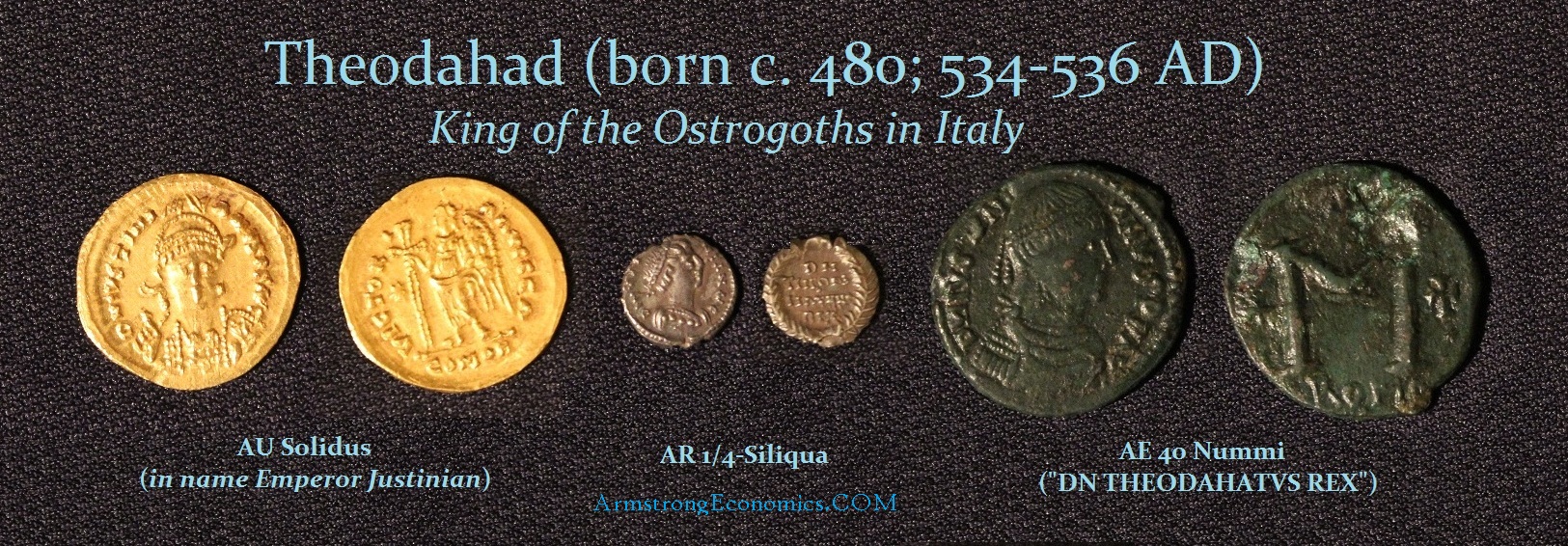
The fall of Rome moved back into a separatist trend. Even when Rome fell, that barbarians were imitating Roman traditions. They began to issue coins in the name of the East Emperor just to try to pretend that they were the rulers of the West.
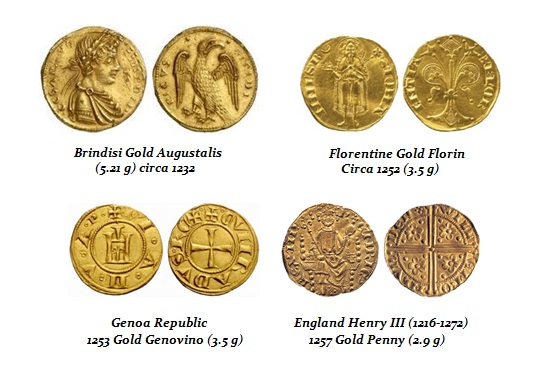
Eventually, gold vanished from the money supply for nearly 600 years. It did not reappear until 1232 with the first coin being issued in Brindisi. This was issued in order to conduct trade with Byzantine and Arabs.
So what the computer is showing is the rise in civil unrest and the risk of war. Just look at what took place at the State of the Union – there is no UNION. This nonsense the Democrats have engaged in has fired the first shot that will be heard around the world. They opposite absolutely everything that Trump says or does and when the political tide switches, the Republicans will do the same to them. It is over. There is no common ground or going back.
This is part of what the computer is forecasting – the collapse of governments as we have known. NEVER before has anyone dared to say that the president was not “their” president. We always accept the winner even when it was someone we voted against. That acceptance no longer exists. Furthermore, we are looking at the collapse of socialism the same as communism. Both were derived from Karl Marx. They are both unsustainable economically. The pension system is collapsing. Just look at Illinois as an example. The state, provincial, and municipal levels of government cannot create money. All they can do is raise taxes to force people to pay state employees that were promises endless money for life.
I have created this site to help people have fun in the kitchen. I write about enjoying life both in and out of my kitchen. Life is short! Make the most of it and enjoy!
This is a library of News Events not reported by the Main Stream Media documenting & connecting the dots on How the Obama Marxist Liberal agenda is destroying America










 Centinel2012