MAGAnomics – Despite Tariffs and Growing Economy, Inflation Nonexistent – Economists and Financial Class Perplexed…


Today is a very good day.  Despite the professional punditry and their doomsayer predictions of Trump tariffs driving up costs for consumers, exactly the opposite is happening.

Despite large growth in the Main Street USA economy; and despite large wage gains by U.S. blue-collar workers; inflation remains low and mysteriously detached from the Fed monetary policy.

WASHINGTON (Reuters) – U.S. inflation was much weaker than initially thought in the first quarter amid a sharp slowdown in domestic demand, which could cast doubts on the Federal Reserve’s view that the benign price pressures were largely because of temporary factors.

The personal consumption expenditures (PCE) price index excluding the volatile food and energy components increased at a 1.0% rate last quarter, the government said. The so-called core PCE price index, which is the Fed’s preferred inflation measure, was previously reported to have risen at a 1.3% pace.

The increase last quarter was the smallest in four years and pushed inflation further below the Fed’s 2% target. (read more)

They just don’t get it.  For over three years CTH has been explaining how President Trump’s maganomic policy will reverse three decades of stagnant Main Street economic growth.  Today the Bureau of Economic Analysis (BEA) once again confirms our earlier predictions, and releases the data showing inflation is essentially nonexistent.

Since the mid-to-late 1980’s the U.S. economy split into two divergent economic engines. One traditional engine powered by Main Street, and a second engine powered by Wall Street.  For thirty-plus years the distance between those engines was growing as federal monetary policy provided low interest rate support for investment, but the end destination for the investment was NOT in the U.S. [Hence, globalism]

For more than 30 years monetary policy has been driven by Wall Street influence.  FED interest rates made borrowing cheap, but the money -the actual investment itself- flowed out of the United States.  The end product from the investment, steered by multinationals, created products overseas.  Within this flow of capital there was no benefit to Main Street.

President Trump’s America-First policy has reversed the dynamic.   As a result of his focus and demand, the end product(s) from capital investment are now here in the U.S.A.

The MOUSE is money or investment. The CHEESE is end products, manufactured stuff.

Rather than beg the Wall Street investment mouse to change direction in the manufacturing maze, president Trump has simply moved the cheese to Main Street.  The mouse’s travel changed accordingly.

(BEA Table 4 – pdf)

The price index for gross domestic purchases increased 0.7 percent in the first quarter, compared with an increase of 1.7 percent in the fourth quarter (table 4). The PCE price index increased 0.4 percent, compared with an increase of 1.5 percent. Excluding food and energy prices, the PCE price index increased 1.0 percent, compared with an increase of 1.8 percent. (link)

As companies reevaluate the best place for investment (highest return), and they see that Trump’s policies (corp taxes, tariffs, material and labor costs) focus on greatest benefit being inside the U.S, then companies return to Main Street.  This is what has been happening since Trump took office; and it continues through today.

The prices of highly consumable goods (food, fuel, energy) is kept low by Trump policies  that increase energy production and return a genuine supply-side dynamic to domestic production prices. [The battle with Big AG]

Meanwhile multinationals, and some foreign governments, fight to keep their footing abroad (original investment) by keeping down the price of durable goods manufactured overseas.  This is done by increase productivity, adjusted supply chains and retention incentives afforded by the benefiting nation.  This is done to offset Trump tariffs which are designed to influence a shift in the manufacturing process.

The end result of both production dynamics, domestic and abroad, is low inflation.

This price dynamic is happening at the location of output, internally to the operations that are determining the output price, based on their determination of what U.S. market prices will absorb.

Key Point – The pricing is NOT a result of decision-making on new investment; and therefore the pricing dynamic is not able to be impacted or influenced by FED monetary policy.

Only when the majority of manufacturing investment fully returns to the U.S. will FED policy have any significant bearing on manufacturing prices.  This is the parity point where Main Street’s economic engine is recoupled to inflation.

There was 30 years of distance in the FED disconnect, and it will take more than a few years for the recoupling of Main Street to FED monetary policy.

This dynamic is the basic thesis behind THE THEORY HERE.

DECEMBER 2016 – […] Additionally, inflation on durable goods will be insignificant – even as international trade agreements are renegotiated.  Why?  Simply because the originating nations of those products are going to go through the same type of economic detachment described above.

Those global manufacturing economies will first respond to any increases in export costs (tariffs etc.), by driving their own productivity higher as an initial offset, in the same manner American workers went through in the past two decades.  The manufacturing enterprise and the financial sector remain focused on the pricing.

♦ Inflation on imported durable goods sold in America, while necessary, will ultimately be minimal during this initial period; and expand more significantly as time progresses and off-shored manufacturing finds less and less ways to be productive.   Over time, durable good prices will increase – but it will come much later.

♦ Inflation on domestic consumable goods ‘may‘ indeed rise at a faster pace. However, it can be expected that U.S. wage rates will respond faster, naturally faster, than any monetary policy because inflation on fast-turn consumable goods become re-coupled to the ability of wage rates to afford them.

The fiscal policy impact lag, caused by the distance between federal monetary action and the domestic Main Street economy, will now work in our favor.  That is, in favor of the middle-class.

Within the aforementioned distance between “X” and “Y”, a result of three decades traveled by two divergent economic engines, is our new economic dimension….

Advertisements

Printing Money to Cover the Cost of Government


QUESTION: Hi Marty,
I have read that Lincoln’s treasury issued “Greenbacks” to help fund the North during the civil war.
1. Was this a direct printing, issuing of paper currency, aka like your “The Solution” ? (Bill Still, creator of the money masters documentary claims such…)
2. Others claim that it was meant all along to be backed by gold, and they point to the Specie Payment Resumption Act of January 14, 1875 as evidence..
So many different conflicting opinions / explanations out there, and was hoping you would tell us all what you believe about the Greenbacks. Thanks once again for all you do!

DC

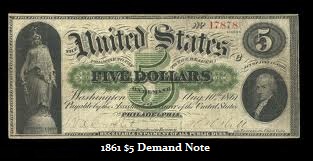
ANSWER: Paper currency was issued to fund the Civil War beginning in 1861. Demand notes were issued between August 1861 and April 1862 to fund the American Civil War in denominations of 5, 10, and 20 USD. Demand notes were the first issue of paper money by the United States that achieved wide circulation. They were used to pay expenses incurred during the Civil War including the salaries of its workers and military personnel.

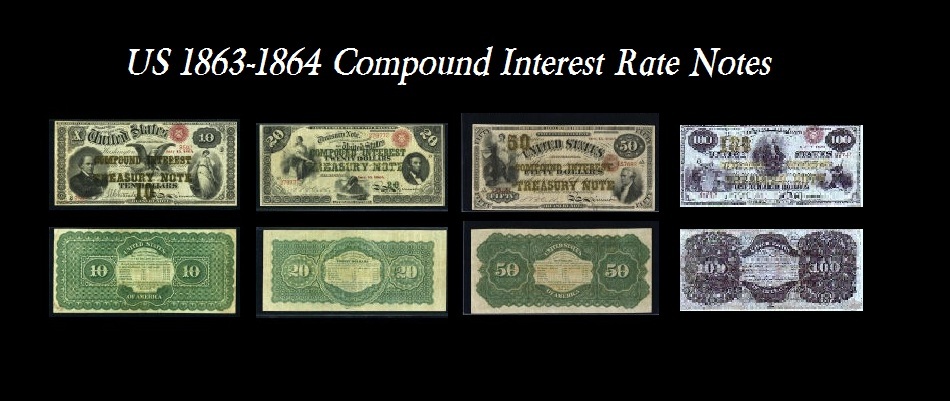
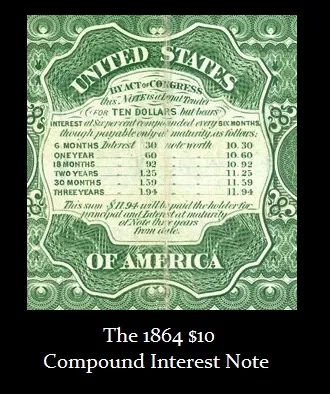
There was a reluctance to accept the demand notes, for there was no intent on redeeming them in gold. Instead, the government issued currency that was really a form of circulating bearer bonds. They were interest-bearing notes that had the table on the reverse, expressing the value of the note in terms of interest.

Demand notes became known as “greenbacks,” which distinguished them from the interest-bearing notes that displayed the interest table on the reverse. The demand note only had green ink.

The demand notes were discontinued, and their successors were the legal tender notes. The legal tenders could not be used to pay import duties, which were the taxes imposed at that time (indirect taxation). Demand notes took precedence and were acceptable. As a result, most demand notes were redeemed.

Therefore, the issue of paper money to pay the expenses worked. There was no such promise to repay these notes in gold when they were issued.

World Trade


COMMENT: Hi Marty

I agree with Trump. Assembling in the U S is not sufficient. We need the supply chain parts (eg manufacturing ) in the US. What do we do when we get in a war with say China – do we submit an order to china for parts to assemble a ship? Does not fly.

Kyle Bass and Bannon have come out speaking about the duty american companies have to our country. They use our legal system, tax system, to date favorable non tariffs and other incentives — where is the pay back to us? The days when our country was simply for sale and being sold out by politicians is gone – or we won’t have much of a country left. We have lost about half of our manufacturing jobs since nafta.

It needs to stop. Too bad if countries whine and cry that we can no longer be taken advantage of
We have been used and abused for a long time…people are sick of it.

thanks for the blog

Alice

REPLY: It is true that parts are shipped and then the final assembly takes place in the USA. But we also have to ask why did manufacturing leave in the first place? I testified before the House Way & Means Committee on this topic back in 1996. They wanted to know why no American companies got contracts in China to do the Yellow River Dam, which went to the Germans. I explained that Americans are taxed on worldwide income whereas Europeans pay taxes on what is earned in their territory. Why should someone pay taxes on income generated outside the USA when they are not using any services in the United States? It turns out that we are economic slaves because whatever we produce anywhere belongs to the government. It is no different from the 19th century – we are still the property of the state.

What we must understand is that American companies began to set up offshore just to be competitive. It was not that labor was $5 an hour v $15. That is the popular image they create to target corporations. The real problem is our tax code looks like the brainwave of a schizophrenic.

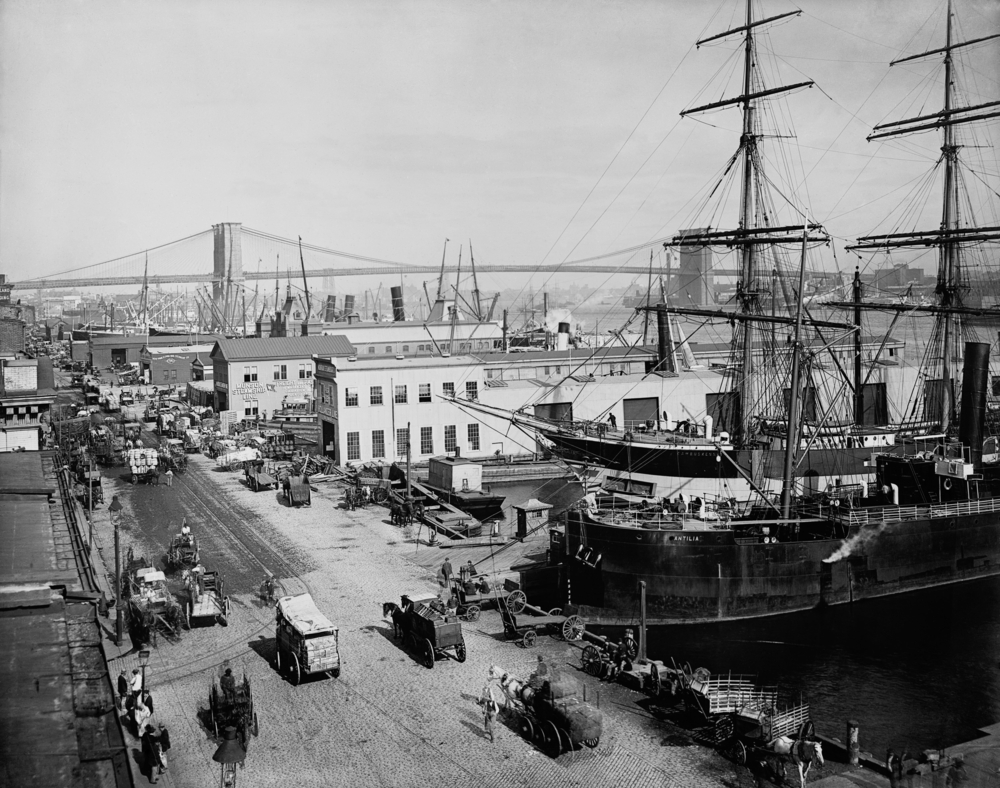
On top of that, we had a period of really hostile unions. Just look at New York City. Here is a photo of horse-drawn express wagons, moored ships, and piers at New York City’s South Street Seaport back in 1901. New York City was the largest port for trade. The unions became so corrupt and militant, they simply drove the port to other cities. There is nothing left in New York City anymore.

Then there was the fact that the militant unions took the position that they were exploited so the quality of their work declined. The Germans and Japanese offered quality and that was fair competition which eventually forced changes in the United States. Instead of workers, not much is done by robots. If we are really concerned about jobs, then address the elimination of income taxes which would make American workers more competitive. Restore the Constitution to indirect only.

Corporate Buy Backs


Many people are confused as to why corporations have been buying back their shares in mass. The latest figures for 2018 are in and they demonstrate that the S&P 500 listed companies spent more on dividends and buybacks in 2018 than they actually made in total reported earnings ($1.26 trillion vs $1.1 trillion). What is really fascinating is that of the 500 listed companies, 444 have bought back their own shares. Buybacks alone have actually come in at 66% of reported earnings over the last five years. Since 2014, buybacks and dividends combined have exceeded the total increase in S&P 500 market capitalization by $1.3 trillion. In other words, buybacks alone represent 87% of the increase in S&P 500 market capitalization during that period.

Buying back shares at this stage has been massive, but companies have been taking advantage of the cheap interest rates. When interest rates collapsed to artificially low levels, it became economically more efficient to buy back the shares at such a low cost, and this, in turn, will increase the dividend yields. This mix of low interest rates has had a reverse impact on equities. There is no question that companies are keenly aware of just how important their buyback programs are to their share prices. As long as interest rates are cheap, then it’s hard to see them stopping unless the cost of borrowing forces them to do so. This is also setting the stage for a shortage in equities when capital begins to realize that there is a huge problem brewing on the public debt side of the balance sheet.

World View v Domestic & Why It Has Been Always Wrong


COMMENT: Mr Armstrong, I want to thank you for I listened to the forecasts of analysts who said Europe and Emerging Markets were the best places to invest because the US was overpriced and would crash. I was introduced to you by a friend. I listened. I cut my losses and switched to the domestic market. Your analysis saved my future.

I cannot thank you enough.

HA

REPLY: I was a hedge fund manager. I used to manage a fund for Deutsche Bank (Track Record). The reason analysis is so bad is because of regulation. We have the SEC & CFTC and the regulations between them are incompatible. You could never have a fund domestically where you would actually hire a fund manager who made that decision for you. Because of the regulation, you had fragmentation. Funds that sold Munis, other tech, others IPOs, high growth, etc., etc. etc. There was no domestic fund that would make those decisions for you because there was no single entity that served as the regulator as is the case outside the United States. Too many chiefs and no Indians, as they say.

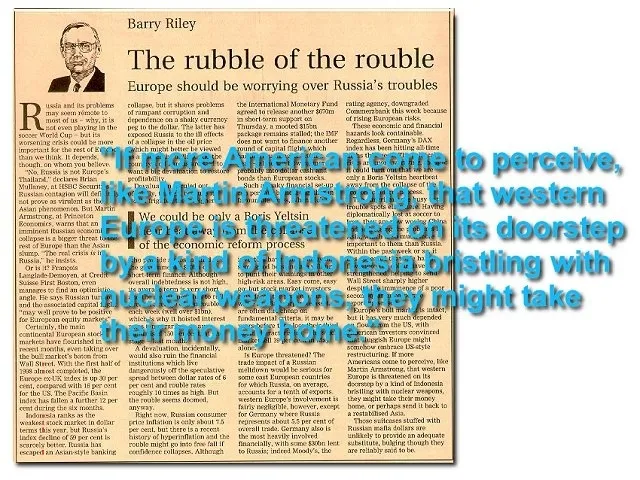
The offshore hedge fund began, not a real hedge, but as a fund where the manager made the decision and could invest in anything. Today, hedge funds have lost their way. The idea that they would offer an alternative strategy that would move opposite to standard funds was really a sales job. Often, hedge funds have not performed because of biased domestic views. That was NEVER the way I managed the fund. I was named “Hedge Fund Manager of the Year” back in 1998 because my strategy was to make that decision on a global scale of what to be in and out of. I was not trying to lose money deliberately as a hedge when the market rallied and I saw its mirror image. I never got that idea of a hedge fund nonsense. My job was to pick the winners on a global scale and avoid the danger areas like Russian back in 1998.

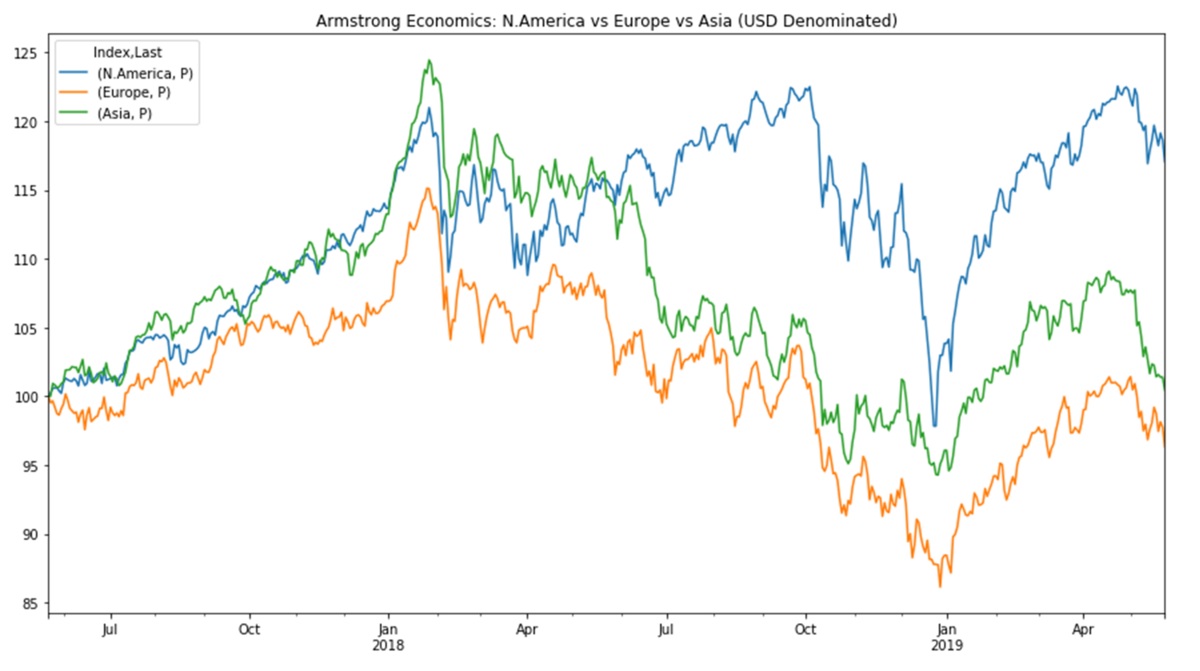
If we look at the world in REAL VALUE terms, that means we MUST look at everything filtered through currency. Here is our index of the world. We take Europe and Asia, combine the indices and then replot them in dollars. This clearly shows that we ABSOLUTELY MUST include currency into the analysis. We can see that the US share market has dramatically outperformed everything else in the world.

I had to always consider geopolitical risks. Knowing when there was a risk of war or political uprising was important. Understanding the trends in weather was critical, as was evident from the Great Depression. Even keeping an eye on earthquakes and correlating that to the global economy was also obvious from hist – e.g. the 1923 Japan Earthquake and the 1906 San Francisco Earthquake that eventually contributed to the creation of the Federal Reserve. The realization that the world economy was dynamic meant we had to respect the various different influences each factor played in the outcome of the whole.

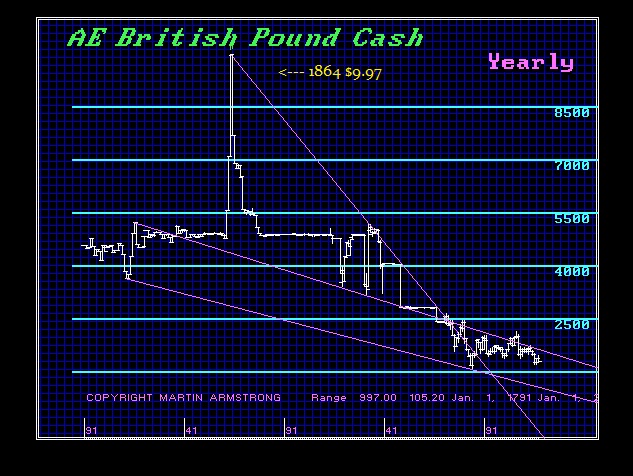
Yet, none of this would be possible without also considering capital flows and currency movements. The currency became the means for capital to vote on a global scale as to who it trusted and who it did not. Here we can see that the British pound reached $9.97 in 1864 against the dollar. It fell to $1.03 in 1985. The trend of the currency cannot be ignored.

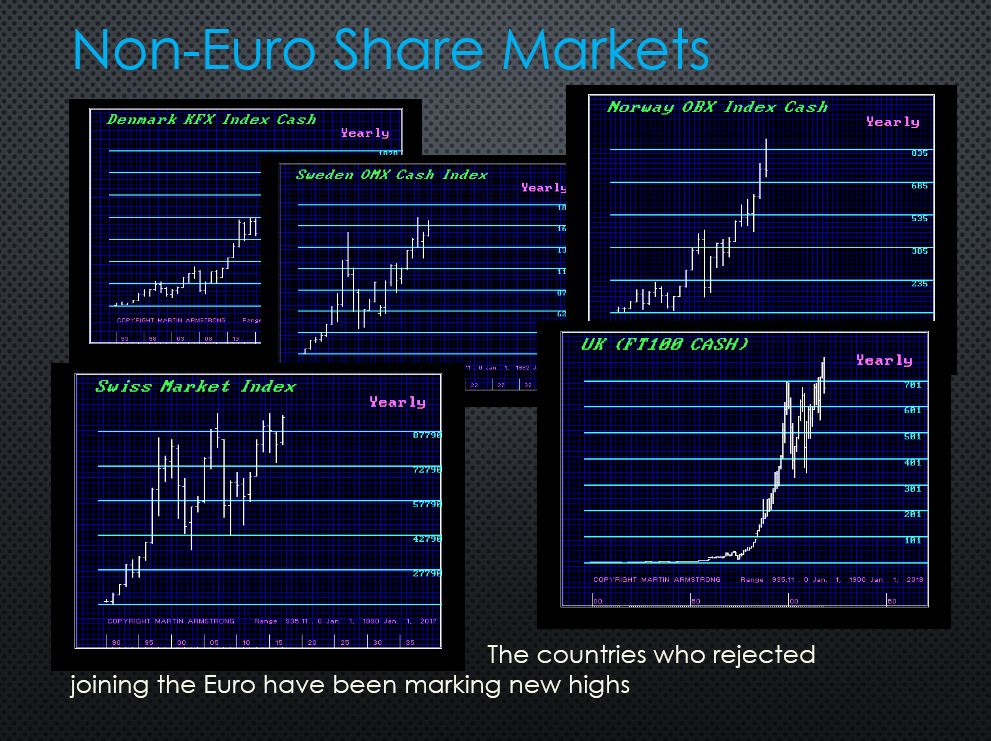
Here are the share markets based in euros. All peaked in 1999 to 2000, except Spain which entered the euro late. How any analyst could recommend Europe two years ago was just nuts. This demonstrates that they do not understand international capital flows or the importance of the currency in making such forecasts.


Now, look at the European share markets that are NOT in the Eurozone. They have all made record highs. The difference has been the currency and regulations pouring out of Brussels with self-interest in maintaining the European Project, even though it has failed.

This is not my opinion v everyone else. This is simply looking at the facts, not propaganda, and letting the fact lead to the conclusion.

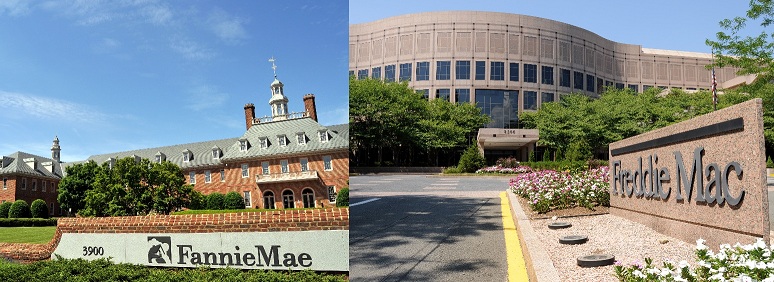
Fannie & Freddie to go Public in 2020?


QUESTION: Hi Martin ! always wondered What would be the outcome of Fannie/ Freddie going private ? they have been trying this for years, but now looks like they are giving it another try and may be successful under the guise of ” protect the taxpayer ” …. what do you think will be the ramifications especially for real estate REITS and MREITS as well as homeownership going forward .

Thank you

JD

ANSWER: Fannie Mae and Freddie Mac are two companies that are in the longest conservatorship perhaps on record. Because the law governing these agencies is separate from banking conservatorship law, judges have largely done nothing about Fannie and Freddie shareholder complaints to date. The government’s 2012 net worth took all of the money that they said was worthless back in 2008-2011 that was on the balance sheets. Keep in mind that FHFA was acting as conservator when this was all agreed.

Fannie Mae and Freddie Mac will be allowed to retain capital, but the Senior preferred securities purchase agreement will be amended and the lawsuits will be settled in order for the companies to go to the public markets and raise new money via selling new equity to investors. They would like to do an IPO by 2020. After the balance of the senior preferred gets written off, the warrants will be exercised and the junior preferred will likely equitize some or all of their shares to help facilitate the recapitalization of Fannie Mae and Freddie Mac. There will be risks that include higher capital requirements, a shorter timeline to recapitalization, more CRT/STACR deals, more regulation and/or lower guarantee fees.

Moreover, we face a period where the interest rate is going to enter a major divergence. Central banks will be forced to create interest rate caps on sovereign debt, assuming people will buy them at these low rates of under 3%. This all hinges upon confidence. When we begin to see economic stress in the sovereign markets, such as in Europe with the ECB unable to stop QE, sovereign rates will become merely artificial and irrelevant. The ECB moved to negative interest rates but that did not lower private interest rates.

Expect divergences as we move forward into the next cycle which will peak in 2024. Expect wild movements ahead on the yield curve as well.