A “Lehman Moment on Steroids”


This is a very real problem!

Financial Capitol of the World & Its Migration


WorldEconomy

QUESTION:

I am a great admirer of your Socrates model, but there’s one thing in your personal pronouncements that seem to contain a contradiction. On the one hand you are predicting a decline of the U.S.A. and other western economies, mainly caused by excessive government interference in the economy. However, on the other hand you are predicting a rise in the prominence of China occurring simultaneously with the decline in the Western economies, yet the Chinese economy is still dominated by State-owned enterprises (SOEs) and that is unlikely to change anytime soon. Can you please explain this apparent contradiction?

Also, you (perhaps justifiably) continually put the boot into Western governments for their excessive involvement in their economies and yet you rarely, if ever, criticise the Chinese government’s heavy involvement in the Chinese economy. Why the double standard? Is Socrates is actually predicting a near-term decline in Chinese government involvement in their economy? And is there an allied Socrates prediction for increased democracy in China in the near-term?

Thanks for your great service,

Andrew.

ANSWER: You are missing the timing and overlap. It is true that the Chinese government is still trying to manage its transition to a free economy. Ultimately, that will happen. However, the difference between the former communist regions such as Europe, Russia, and China, in comparison to Western Europe, such as North America, Australia, New Zealand, and Japan, is significant whereas the former region has people who do not depend on government and the latter still expects government to be there to take care of us until we die. A collapse in government in the former communist regions will not be as devastating to the common people and it would be in the Western developed world. China and Russia learned that Marxism failed. It is simply our turn in the West to experience the same as they did with the collapse of socialism.

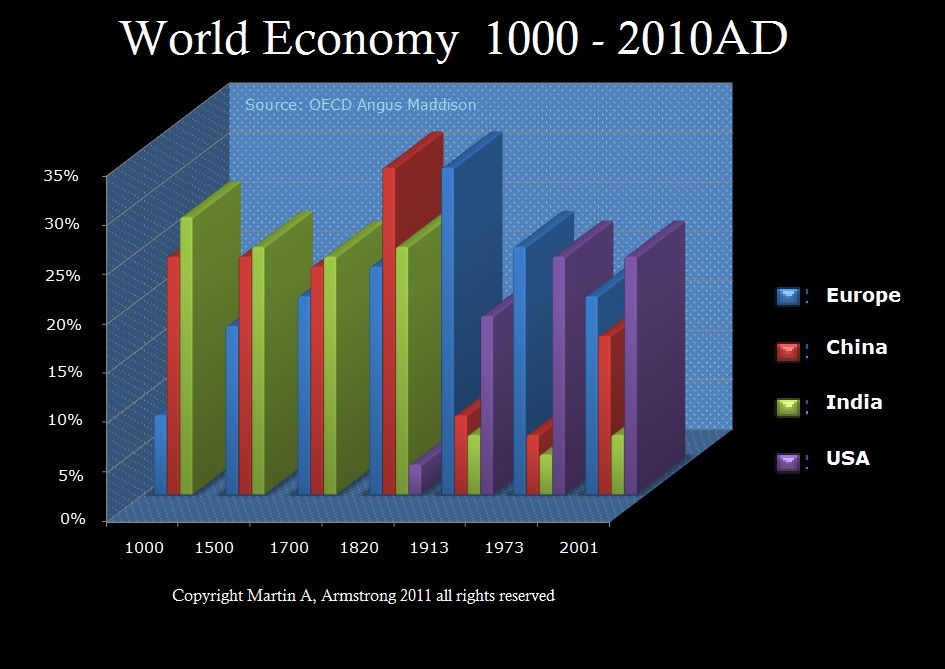
After 2032, the financial capital of the world will simply migrate to China. It always migrates. You are assuming that the government of China will survive in its current form. They too will change and alter. In the West, governments are not interested in reform. They are only interested in holding on to power. This is simply how empires, nations, and city-states have always historically failed.

China is moving through its reform stage that began in 1989.95. We should see the first political shake up by 2021/2022. That is simply how long it will take from the beginning in 1989.95. They are simply at a different point in their own cyclical history.


German Private Health Insurance up 11% Thanks to Pension Crisis


healthcare-1

Private health insurance in Germany now faces a massive contribution increase in 2017 of more than 11%. Add to this the banking crisis and we will start to see the core economy in Europe turn down really hard. This will impact about 9 million people who are privately insured. The industry needs the money, which they could not achieve in the capital markets. The increase is also caused by higher pension costs. 

Anonymous – Message to the Citizens of the World V – YouTube


Pentagon Chief Outlines Preparations for Nuclear War with Russia


Soros and the progressive want WW III for some really bizarre reason thinking they can live through it and eliminate Russia. Russia is not out enemy Islam is and we are doing what they want with the US a waste land there will be no stopping them in south America and what is left of Europe and Asia. However they victory could be short lived as the radiation and fallout will blanket the entire world.

Deutsche Bank – The Meltdown Crisis


db-exposure

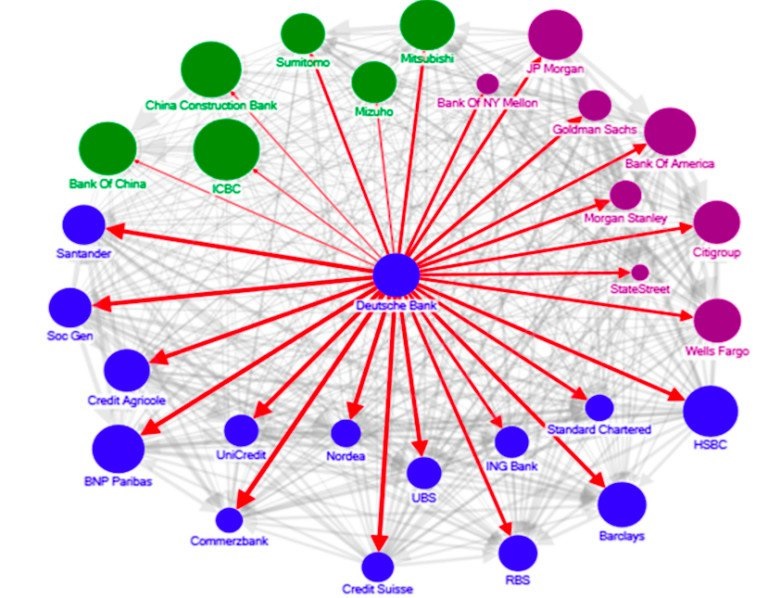
Ten of the large hedge funds are withdrawing from Deutsche Bank. What must be understood here is that Deutsche Bank is the main clearing house for trades in Europe. The problem the hedge funds have is where do they move for clearing? Short-term, they can move to New York or London. With over $60 trillion derivative book at the Deutsche Bank, the government is totally incapable of even understanding how to deal with this crisis. We are looking at a major crisis in confidence.

Merkel is simply out of her mind to adhere to this insane policy of a bail-in. How can hedge funds stay with clearing at Deutsche Bank when she takes this position that would set off a catastrophic global meltdown. It still appears that Merkel will have to blink. Once people realize this is the real crisis, then the German debt market should turn down rather hard.

The pressure is clearly building based upon how my own phone is melting down. This illustration based upon IMF data, illustrates the global contagion. I “BELIEVE” that Merkel will be compelled to blink. We may see an announcement this weekend at the latest where she must address this issue. The implications of a global contagion go far beyond Germany.

Investors in Deutsche Bank are obviously looking to Merkel and whether or not she will step up to the plate here. DB shares have plummeted more than 50 percent this year. The prospect of bailing out Deutsche Bank is particularly a problem when Merkel seeking a fourth term in an election next year. Her view is to hold to what she took as a position. Hence, must the world suffer for her personal political career once again?

The EC attack on Apple has led to a backlash where the US Justice Department in retaliation wants a multibillion-dollar fine from DB. This is also contributing to the problem of DB being in the cross-hairs of US prosecutors who also seek to further their political career not unlike Merkel.

Merkel’s spokesman said the government sees “no grounds” for talk of state funding for DB. This simply cannot stand in the face of a major global contagion. The government would have to step in if Deutsche Bank was really in major trouble and hedge funds reducing exposure are abandoning the bank. You can bet by tomorrow, every bank will be trying to reduce their exposure to DB by the weekend.

John Cryan, Deutsche Bank’s chief executive officer, has come out publicly saying that raising capital “is currently not an issue,” and as far as a bailout from government, he has stated Merkel’s position that such support is “out of the question for us.” This entire crisis is actually set in motion by Merkel who championed to keep taxpayers off the hook in a crisis. She pushed for bail-ins and not bail-outs and this has made it far more difficult for governments to support banks in Europe. The Bank Recovery and Resolution Directive, which is the cornerstone of Europe’s efforts to tackle too-big-to-fail banks, takes the position that the need any such extraordinary public financial support indicates that a firm is “failing or likely to fail,” that will trigger the resolution. Now, support for banks is highly restricted and has devastated Greece, Italy, and Portugal. Consequently, if Merkel now intervenes on Deutsche Bank’s behalf, she is basically saying the law is for everyone else but Germany. That will lead to internal protests within the EU.

Internationally, if Merkel’s governing coalition does not step up to support Deutsche Bank, the political fallout globally will in itself cause a major crisis probably by November.  Clearly, the need for some sort of state intervention would outweigh calculations about the political fallout. Merkel will cause the international chaos if DB fails and it can fail if this bank run continues. DB needs to be restructured but when it is the biggest in Europe, it cannot be merged as a shotgun wedding. Its business must reduce risk for itself and the connection of other banks. The German government could assume a stock investment. The legal restrictions prevents extraordinary support as state aid that would distort competition by favoring one company over another. Under the EU law, the German government could just take an equity stake. That would not be a bailout in the classic terms that Merkel opposed. It must be carried out at current market conditions. They cannot arbitrarily supply money at some agreed upon share price that is away from the market.

Euro HangingOne loophole under EU regulation would allow Merkel bailout DB provided it is only to “remedy a serious disturbance in the economy of a member state and preserve financial stability.” This must be only a temporary measure. This would qualify and she can claim that she is following the EU law and it is not different from country to country. However, EU state-aid rules require junior creditors and shareholders to share losses. Therein lies the problem of a global contagion.

If Merkel actually tried to inject government funds into Deutsche Bank or purchase its capital instruments, it may do so only if there is a capital shortfall identified. Still, there must be no advantage to DB from a competition perspective. The interesting problem that would emerge, highlights the clearing crisis. The European Union would then NEED British banks for clearing. In the face of BREXIT, they are not likely to concede that at any time, so there is another nail in the coffin of the euro.

Saudia Arabia to Sell All US Assets as Congress Overrides Obama Veto


saudi-arabia

Congress voted to override Obama’s veto that families of those killed in the terror attacks on 9/11 would not be allowed to sue Saudi Arabia. This is the first time he has been overruled. This will open the courts in New York to some very interesting court battles, but Saudi Arabia will most likely sell off all US assets to prevent any US court from freezing their assets. If they take everything out of the USA, then they can ignore the courts and not defend at all exposing themselves to discovery rules that will be very intrusive.

The Fish Bowl Economy & Academics


fish-bowl-economy

QUESTION: Hi Marty, I hope you’re doing well. Having been a follower of yours for some time now, and been enlightened from that, I am ever in your debt for what you have shared and (hopefully!) will continue to share. I am an economic history student studying at the University of Edinburgh, and I have to say the professors are consistently bamboozled when I bring anything up that I read on your blog! I am going into my second year now and am in particular very much interested in population flows. I am trying to set up my own ‘database’ to store all of this information and subsequently start creating my own analyses in a similar image of our dear friend Mr. Socrates. To get to my point, I am wondering how you went about initially setting up Socrates, what sort of coding or programs you were using and if there were any big potholes to try and avoid when setting up something like this? I am in absolute awe of Socrates and yourself, but I am enticed by the challenge of doing something I can call my own. Any help at all is very much appreciated I hope to hear from you soon!

Kind regards,

C

ANSWER: Yes, you will find traditional economics fall short of reality. They rest upon supply and demand, yet assume they can stimulate demand with Keynesian economics to raise or lower interest rates. They are clueless with regard to international trends because that would mean that they could not manipulate any economy, for there are always external factors they have no control over. Consequently, all theories are based upon what I call the “Fish Bowl Economy” that assumes everything is self contained and nothing external will enter their perfect world.

From a programming standpoint, there are no off-the-shelf programs to do what is necessary. Languages are really much the same. VB and C are the main languages, but then there are specialties like Prologue, etc. I was always into artificial intelligence from the start. The pitfall to avoid is to NEVER presume anything. Just let the data reveal the truth. As soon as you make an assumption, you will fail. Migration has always contributed to dictating the rise and fall of nations. Let the data show you the way. That is the exciting path to discovery.

World Trade Collapsing On Schedule


world-trade-2

The World Trade Organization (WTO) has warned that there is a “dramatic slowing of trade growth” unfolding. The WTO has revised downward its projections, saying trade is now on track this year to grow at the slowest pace since 2009.

The hunt for taxes is destroying the world economy and on January 1, 2017, all governments will begin sharing info on foreigners. The assumption is that anyone doing anything outside the USA is hiding money from taxes. With this attitude, world trade will continue to collapse into 2020.

Canadian v US Municipality Debt Crisis


canada-halfmast

Canada has a different legal structure compared to the United States. Canada is one of the most decentralized countries in the world where provinces are actually responsible for most major social expenditures as a whole. The Canadian provinces receive large, unconditional transfers from the federal government whereby some provinces receive transfers from the federal government that are more important sources of revenue than their own local taxes. This does set the stage for resentment between provinces, which is rather different from the United States model where the states are separate, individual, sovereign entities.

When we then look at the next tier lower, Canadian municipalities are effectively only agents of provincial governments, and in the United States, they too are stand alone entities. Therefore, in Canada, we have a hierarchical budget and debt constraints that combine to restrict the revenues of municipalities. Consequently, the province impacts the direct expenditures and controls access to capital markets for municipalities. If a local government gets into financial trouble, then the province comes to the rescue in various ways and can even change the municipal territorial boundaries, which is sort of similar to merging banks when in trouble. The province can even take over functions and has the authority to take over control of a municipality’s finances.

Municipalities cannot, therefore, actually go bankrupt in Canada since they are implicitly guaranteed by the province. This also means that in Canadian municipalities, the normal interest rate spreads or disparities are based upon various credit ratings and are not really a big factor at the municipal level, but rather at the provincial level. In Canada, local borrowing requires prior provincial approval and is severely limited. Therefore, the credit rating tends to be that of the province. Such debt constraints are a product of the implicit provincial responsibility for bailing out any municipal default, which is a legacy of the Great Depression, since in Canada, that event caused a tidal wave of local defaults amounting to about 10% of all Canadian municipal debt.

Canada has continued to expand the size of provincial transfers to municipalities as a percent of GDP, which has reached nearly the 50% level. This tends to introduce a different risk whereby if the province gets in trouble, it will directly impact all municipalities within its domain. So during the Great Depression it was one municipality against another, today in a sovereign debt crisis everyone risks going down with the ship.

In Canada, provinces have freedom to choose their own tax bases and rates. In practice, the majority of provincial income taxes are collected by the federal government under tax collection agreements. The underlying terms dictate that the same base is taxed for the federal income tax. Therefore, the Canadian federal government collects corporation income taxes and personal income taxes for several provinces under these arrangements. Therefore, in the United States, there tends to be tax competition among states where some states do not have income taxes at all, but the Canadian federal and provincial governments essentially tax the same basis. The Canadian federal government collects more from its taxes than its direct spending. The excess taxation is transferred through two large, unconditional transfer programs to the provinces.

Therefore, the risks in a sovereign debt crisis are actually higher in Canada than the United States. The Canadian structure means it is one for all and all for one, whereas in the United States there will be a disparity between states as some will survive better than others. A Detroit bankruptcy is not possible in Canada, whereas in the United States everyone stands alone and a collapse of one does not take down the whole. So a collapse in Illinois will not take down North Carolina.