Interest Rates & The Chaos Ahead


Armstrong Economics Blog/Interest Rates Re-Posted May 25, 2022 by Martin Armstrong

QUESTION: Marty, Your forecast for the Panic Cycle here in Australian politics was correct and it beat all the polls as you did in BREXIT. Our new leader is a full-on board with the WEF climate agenda and will have all cars electric by 2030. As you say, in war you take out the power grid first. I guess this makes the power grid even more of a first-strike target.

I want to thank you for Socrates. It is great to have something that provides a non-emotional forecast. The forecasts you publish on so many things around the world are amazing and accurate.

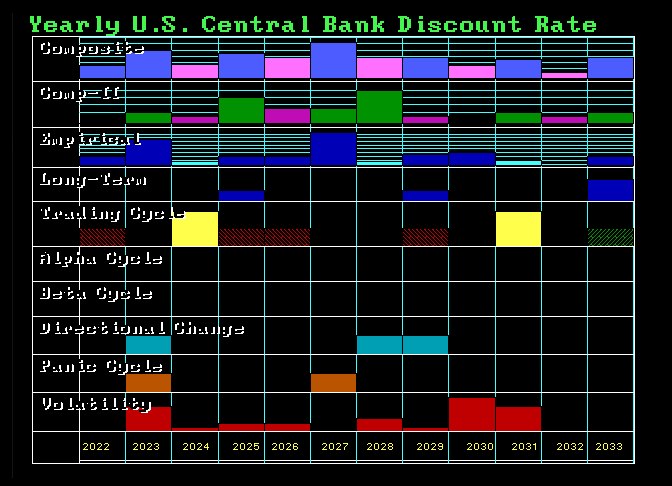
So my question is this. You were correct that rates would rise, or Socrates was, and you said that there would be shortages with a commodity cycle mixed with war rising and civil unrest. So now that the central banks are in a state of panic, what do you expect with the panic cycle in 2023 in the Fed?

ANSWER: You are correct. Too many people attribute everything to just me as if I have a crystal ball. The forecasts are from the model. Nobody could be forecasting so many things for 40 years on a gut feeling and be correct. The odds of humanity are against that.

People tend to forecast what they want to happen. It is just an inherent human flaw. But it is also what drives markets. The majority of people are influenced by the direction of the trend. So a rising market makes people feel bullish and a declining market makes people more pessimistic. That is just a fact of life. So the ONLY hope for an accurate forecast MUST come from a non-emotional source. Staring into 2023 just looks like total chaos.

I do get the occasional email asking me how I cope with my own forecasts. I look at it this way. If I said here comes my fist, I’m going to punch you in the face. Do you just stand there and smile or do you dodge the punch, or defend against it? Isn’t it better to know something is coming to prepare?

It is more like an out-of-body experience for me personally because these forecasts are the computer and I have to stand here and watch as well as live through them. It is a different experience to forecast these events years in advance and live through them myself.

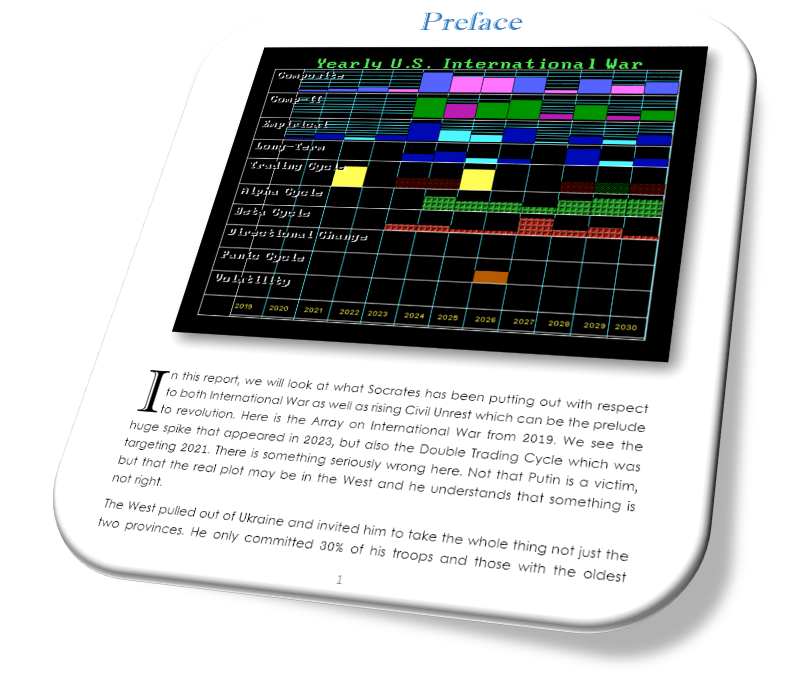
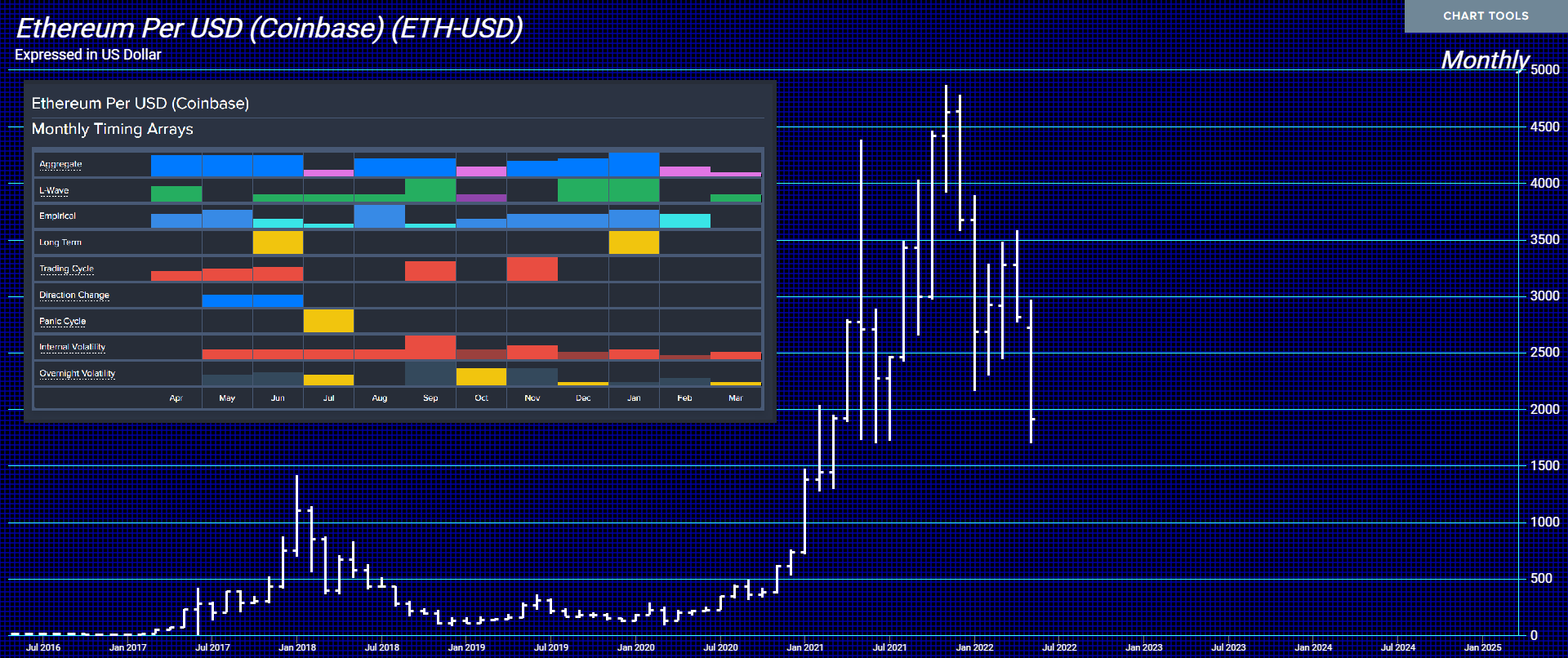
I am concerned that when you look around the globe, so many things have serious targets and panic cycles in 2023. Even in the war cycle, the computer has the highest aggregate bar for 2023. The central banks are unable to prevent inflation because this is a shortage crisis, not a speculative boom where raising interest rates will reduce the buying.

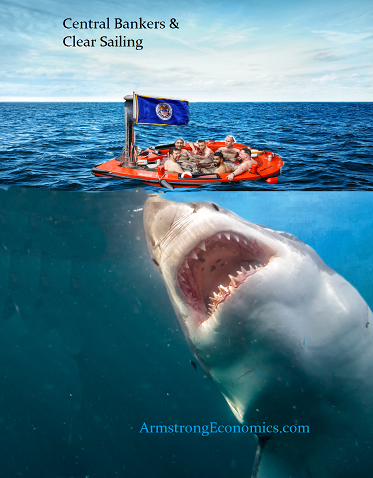
While the Central Bankers think this is clear sailing, they have entered uncharted waters. The risks of the markets discovering they cannot control the economy anymore will raise the crisis to extreme levels as we head into 2023.

Can Cryptocurrencies Survive WWIII?


Armstrong Economics Blog/Cryptocurrency

Posted May 20, 2022 by Martin Armstrong

Spread the love

QUESTION: Hi Marty, You mention that cryptocurrency has been orchestrated to get people accustomed to cryptocurrencies for the end goal of the Great Reset – all digital currency so they can tax, absolutely every transaction. All popular blockchains are transparent and provide no privacy but there are some blockchains that do provide privacy and are uncensorable. Do you think crypto could ultimately live up to its name?

Alan

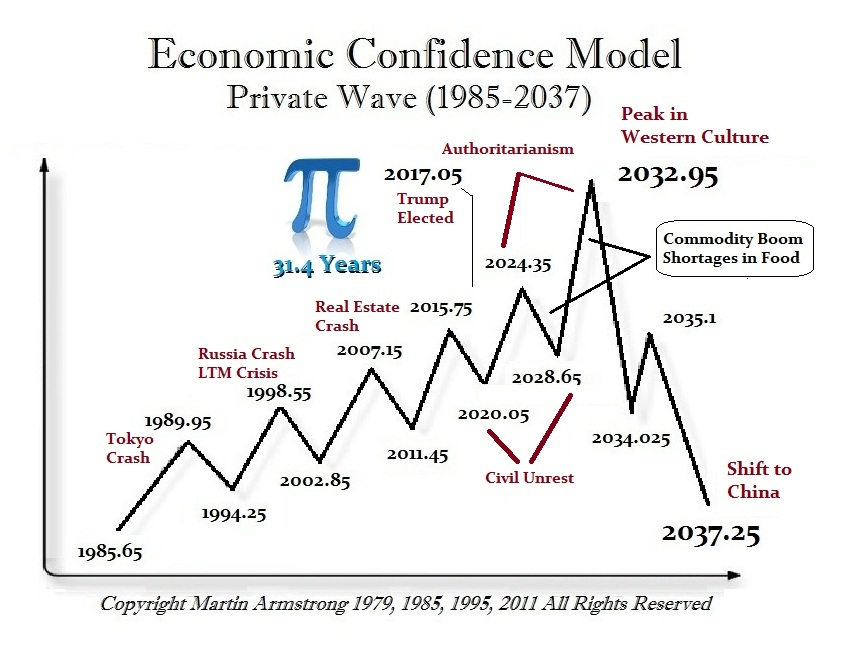
ANSWER: The sales pitch behind cryptocurrency is seriously flawed. (1) they depend entirely upon the government; with the stroke of a pen, they can all be seized; (2) They also depend upon a power grid; (3) they also become dependent upon others accepting them. But note that the last 12 years from 2020 to 2032 were dominated by a rising authoritarian level of government. That means you better not trust that they will simply standby and allow some alternative currency to defeat them. It’s not going to happen. Anyone who disagrees has unprecedented confidence in politicians. I’m amazed when people believe that government really cares about them.

The scenario they put out is that these are outside the fiat system and thus somehow surviving. The only thing outside the fiat system as they want to call it is EVERYTHING tangible from real estate, stocks, collectibles, and precious metals. There is a much greater track record behind those and how they survive than cryptocurrencies. If the world went to Hell in a hand-basket as they say, there is no power grid, then how is a cryptocurrency going to survive?

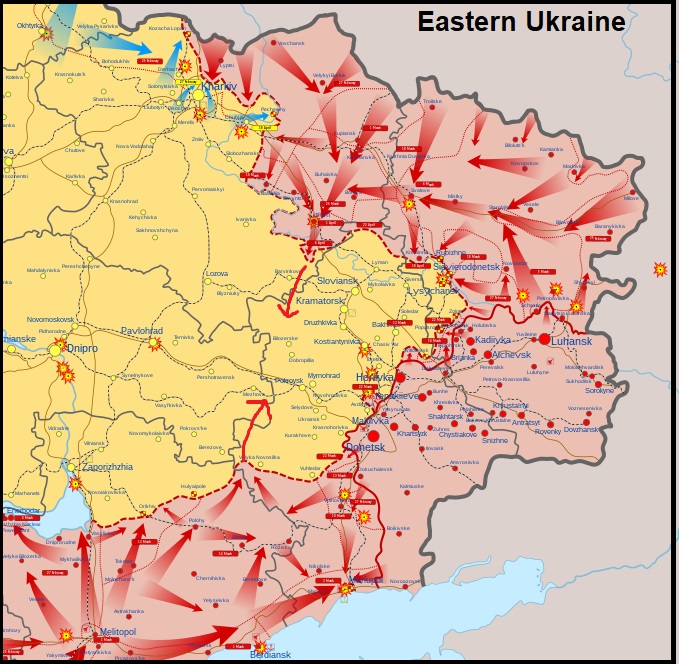
In a Mad Max event, the #1 store of value will be food. Forget anything dependent upon the power grid. When the United States wages war as in Iraq, the first thing they do is take down the power grid, the communications, and then the water supply. Step back and look at Putin and Ukraine. He seized the nuclear power station, the biggest in Europe, but he did not shut it down. He did not knock out the communications and he did not attack the water supply. All of that PROVES he had no intention of conquering Ukraine, but he was in fact defending the separation of Donbas.

If we were to get into a direct war with Russia or China, they will attack those three key sectors — power, communication, and water. How are cryptocurrencies going to survive such an event?

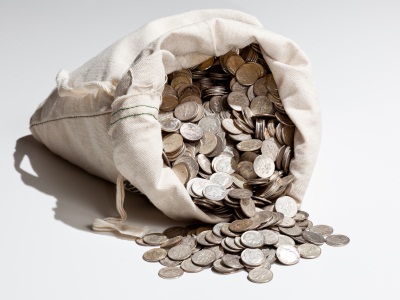
Call me old fashion, old-school, or just old. But the most PRACTICAL thing you can do is have pre-1965 silver coins that the average person can recognize and see the date knowing that it is valuable. We have all seen those videos where a person is offered a silver bar or a chocolate bar, and they take the chocolate. DO NOT judge everyone by yourself. Just because you understand something does not mean everyone does.

Cryptocurrencies are TRADING VEHICLES but not a long-term asset class. Our computer called the top in the cryptos, and it has been the ONLY unbiased forecaster out there. This is why so many major institutions and central banks look at our system — it has NO conflict of interest and NO HUMAN EMOTIONS (like Spock of Star Trek). Someone neck-deep in crypto will never see a decline because they are influenced by their own position.

Socrates independently writes over 1,000 reports every day covering markets around the world. We are NOT blocked in China or Russia because they KNOW this is written by a computer and it is objective. Here is a video providing just a quick overview of the various markets and economic statistics that are available. There are not enough analysts in the world to write these many reports daily.

New Jersey Dept of Environmental Police, Set up Snitch Line to Report Contraband Plastic and Styrofoam Users


Posted originally on the conservative tree house on May 4, 2022 | Sundance

Perhaps in the grand scheme of all things facing us, this action by New Jersey may seem a little silly; however, it’s still nuts.

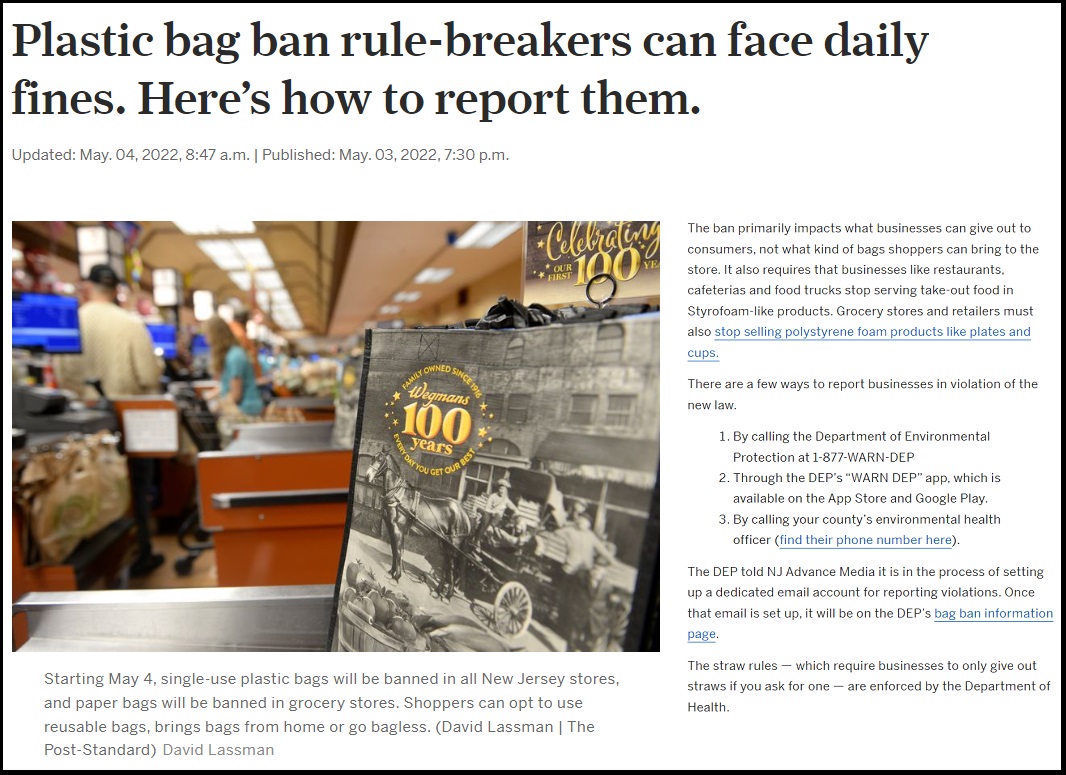
Comrades, starting today it is illegal in New Jersey to have plastic or paper bags in stores for shoppers.  Additionally, restaurants, cafeterias and food trucks are forbidden to serve take-out food in Styrofoam-like products. Also, all retailers must stop selling polystyrene foam products like plates and cups.  Drinking straws require a permit for restricted distribution as monitored by the Department of Health.

To ensure legal compliance within the Garden State, officials in New Jersey have established a snitch hotline for citizens to call the Dept of Environmental Police (DEP) and report dissident violators, while the state ministry of citizen compliance have created a “WARN DEP” app to facilitate easier snitching on your neighbors if you spot them using contraband containers.

“The ban will go into effect [May 4th] nearly 18 months after the law was signed by Gov. Phil Murphy.” ARTICLE

We cannot get to environmental justice without citizen participation, comrades.

Report this rule breaker, there’s an app for that!

Why is CASH King in Times of War?


Armstrong Economics Blog/USD $ Re-Posted May 3, 2022 by Martin Armstrong

COMMENT: Dear Martin,

So refreshing to see some theory regarding silver other than crazy goldbugs claiming JP Morgan artificially putting down t silver prices for XX years. Still what I find interesting is the weakness of the US stock market. Bonds getting dumped, Precious Metals getting dumped, EM’s getting dumped so everyone is just holding USD as cash? Take care.

Best,
Sant

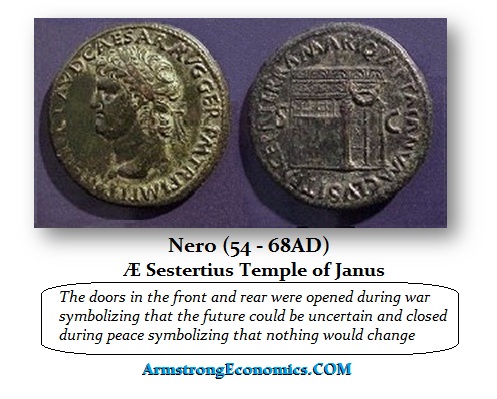
ANSWER: In times of war, UNCERTAINTY is always dominant. It is interesting that the Romans’ Temple of Janus had two doors, and in times of war they were left open, symbolizing that the future was uncertain. Hence, the winds of war could pass freely through the temple, warning they could also lose. During times of peace, the doors were closed, symbolizing security. This is why CASH becomes king in times of war. Even the ancient coin hoards are typically stashed during times of war.

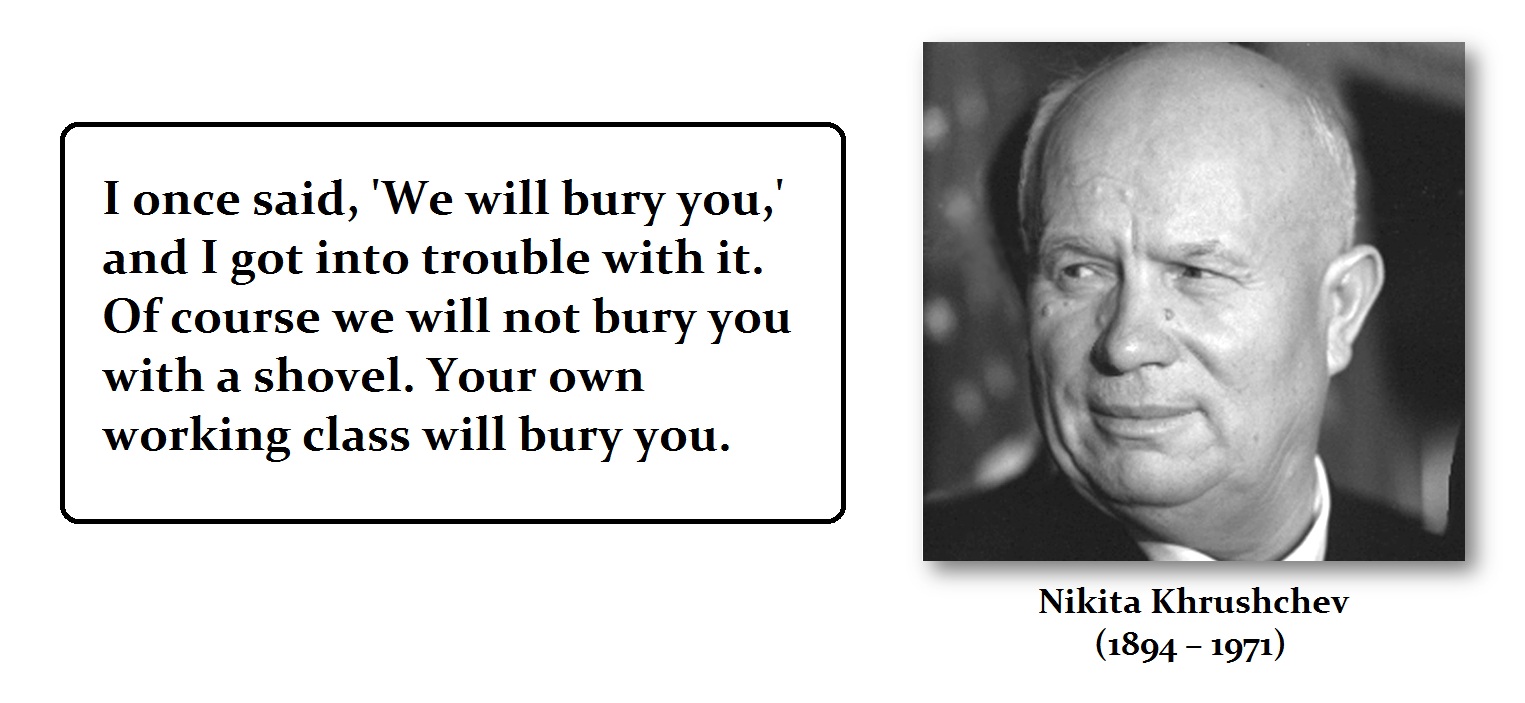
While some think that the Cuban Missile Crisis was when Kennedy took the nuclear deterrent to direct confrontation with Russia rather than attacking Cuba, I suggest that they look at the film the “Courier.” Kennedy did not reject the advice of his advisors to bomb Cuba, there was information flowing from a Russian dissenter who was concerned about nuclear war and the ideology of Khrushchev that communism would conquer the world. This is a totally different time. Putin is not a Communist, and he has no desire to conquer the world with an economic theory. Kennedy was following the advice of his advisers, who were NOT advocating to bomb Cuba. They knew they were fighting against an economic theory to conquer the world, which ironically is the objective of the World Economic Forum and Klaus Schwab.

Freezing assets as Biden has done to all Russians is unproductive. Nobody seems to have ever asked, “Have sanctions ever worked?” On July 24, 1941, Tokyo decided to strengthen its position in terms of its invasion of China by moving through Southeast Asia. On July 26, 1941, President Franklin Roosevelt seized all Japanese assets in the United States in retaliation for the Japanese occupation of French Indo-China. That was followed by Pearl Harbor less than five months later. It seems that our leaders are deliberately pushing the world into war. They need to justify the collapse in their fiscal mismanagement of the global economic system.

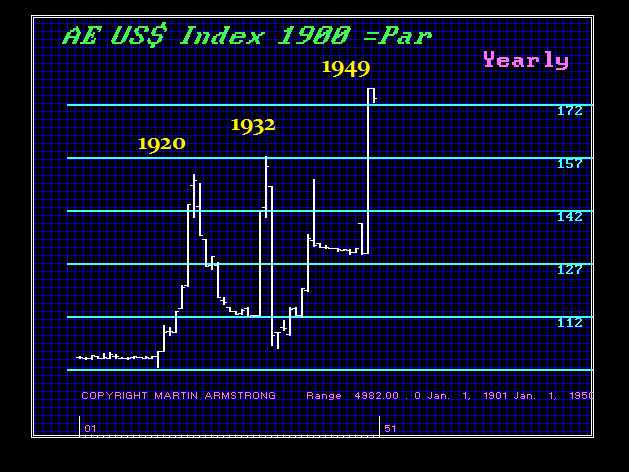
The dollar rose during World War I and during the Great Depression when most of Europe defaulted on its debt in 1931. The dollar spiked higher in 1940, but then the US government imposed controls during World War II. They even instructed the Fed to buy US debt at par which they finally rejected in 1951. Note that once the controls were lifted, the dollar soared again post-war.

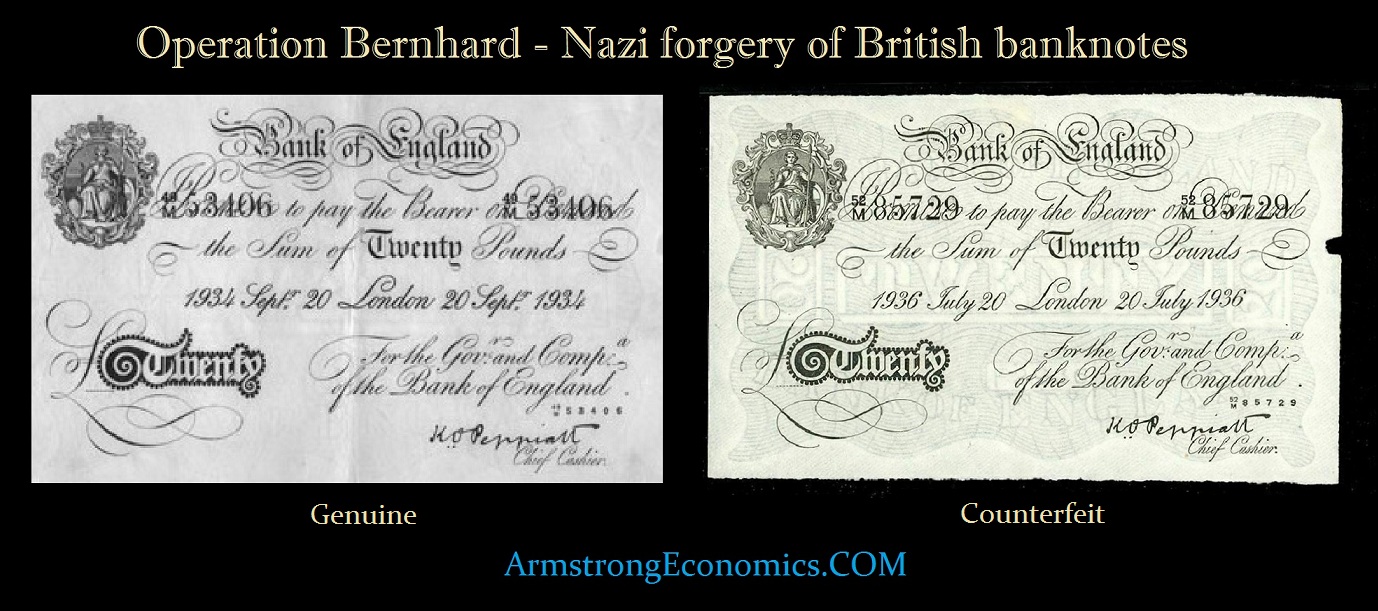
The dollar on a CASH basis has been the safe haven during war, mainly when the rest of the world is collapsing. This war will NOT be a rerun of the last two. Moving to digital currencies will be the kiss of death and render the financial system completely vulnerable to cyber attacks. The last time, there was counterfeiting of an opponent’s currency to undermine its ability to fund its defense. Even the British were counterfeiting the Continental Currency during the American Revolution.

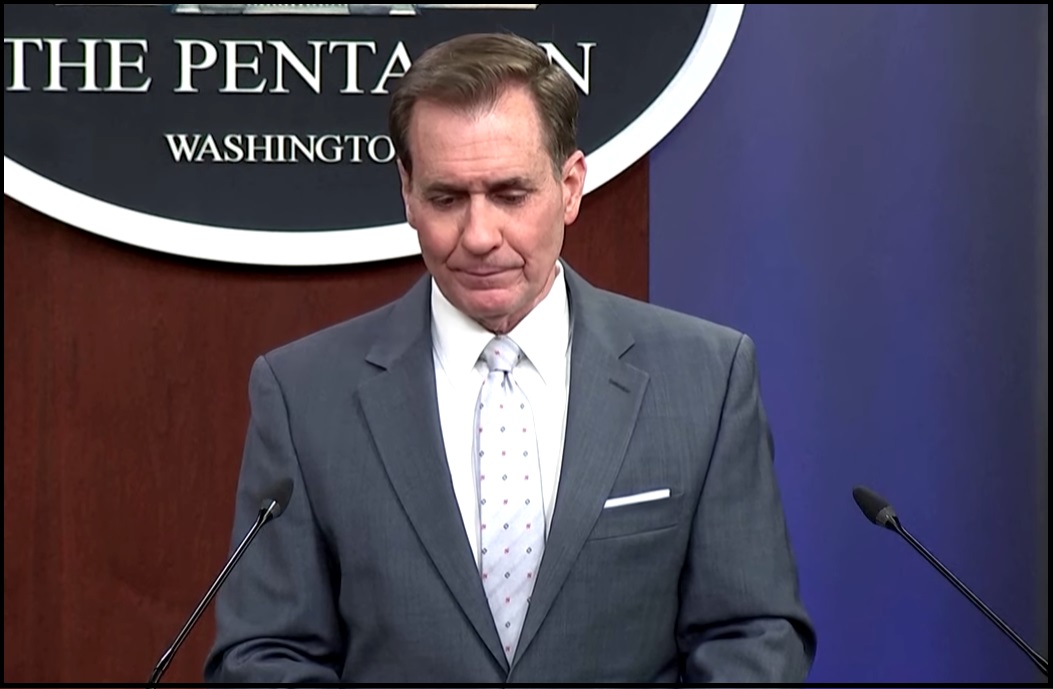
Spokesperson For World’s Largest Military Overwhelmed with Emotion for Ukraine During Press Briefing


Posted originally onthe conservative treehouse on April 29, 2022 | Sundance 

Comrades, the deep, long and sullen violins were playing tearfully today as the World War Reddit theatrical performance came heavily to the Pentagon.  Leading narrative engineer John Kirby was captivating in his role as profoundly sullen squire overwhelmed with the magnitude of the moment and the emotion of the struggle in Ukraine.

The Biden production company is attempting to raise another $33 billion for enhanced theater operations in the besieged European country.  Pentagon chournalists are collecting canned goods, including soundbites, to support the war effort; and the Defense Dept is broadcasting the theme to Chariots of Fire across NATO signals.

Meanwhile, emotions throughout Europe are running high as valiant Prince Volodymyr of Donbas assembles his polished armor and directs his trusted steed into the wind.

Yes, today the clouds loomed heavy as Director Kirby narrated his audience while fighting bravely to keep the spirit of Edward R Murrow alive.  The wide-eyed maidens held their collective breath waiting in the mournful stillness of the moment… You could hear a pin drop. WATCH:

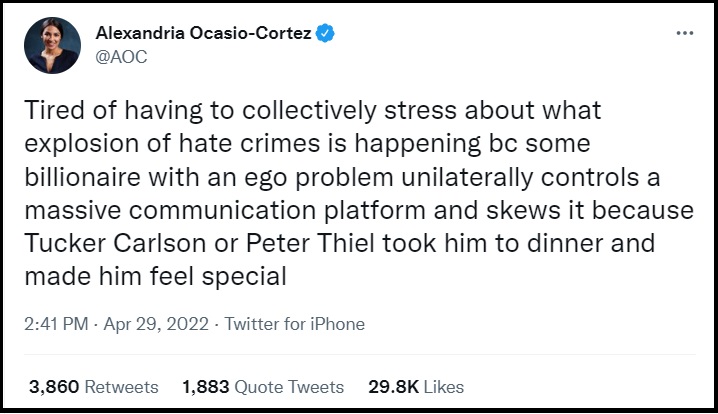
Congressional Representative Stressed About Twitter Causing Hate Crimes


Posted originally on the conservative Tree house on April 29, 2022 | Sundance

An emotionally unstable moonbat from the House of Representatives is “collectively stressed” because apparently Twitter ownership is directly connected to hate crimes on the streets.  (Source)

Being worried about Twitter creating hate crimes, is one fear higher than being chased by a turtle.

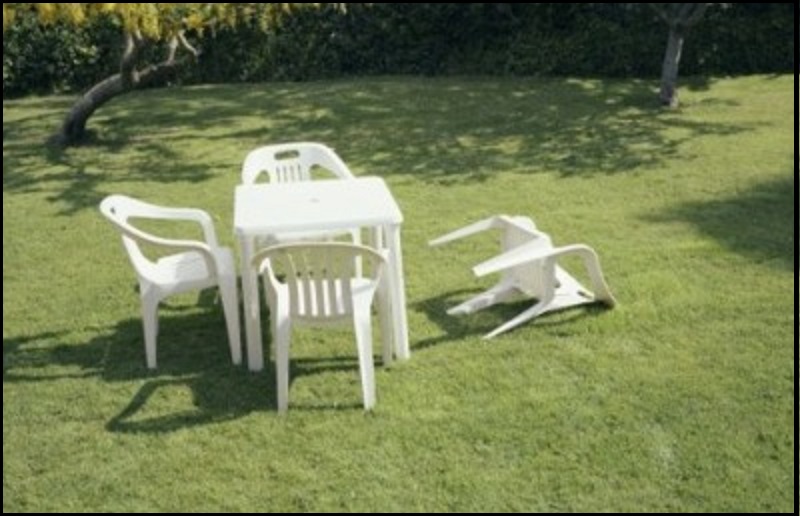
The Great Twitter Riots…..

…We Will Rebuild!

Florida Governor Ron DeSantis Remarks About New DHS Disinformation Bureau, The Ministry of Truth


Posted originally on the conservative tree house on April 29, 2022 | Sundance 

Comrades, earlier today dissident Governor Ron DeSantis spoke out against the latest effort of the Biden administration to create an official disinformation bureau with a dedicated mission to assist Big Tech and social media platforms in their control of speech. {Direct Rumble Link}

There is no dis-, mis-, or mal-information There is only information the Government wants you to hear, and the information the U.S. Govt disapproves of.  The DHS disinformation board is dedicated to dealing with the latter.

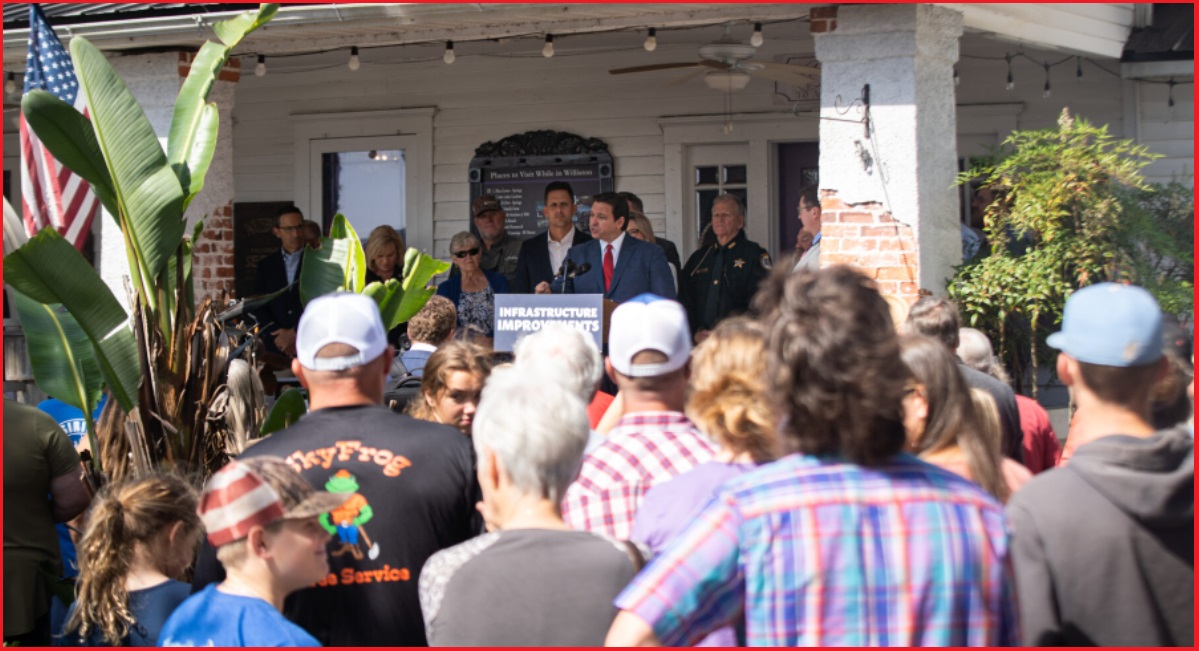
Governor DeSantis made his remarks during an announcement to expand Florida infrastructure.  WATCH:

BEA Release, Wages Rise 4.5 Percent but Inflation Rises 6.6 Percent, Workers Fall Further Behind


Posted originally on the conservative tree house on April 29, 2022 | Sundance

The Bureau of Economic Analysis (BEA) released March and first quarter (Q1) data today on personal income and outlays [DATA HERE].  The results show an increase in Q1 wages of 4.5%. However, inflation is running 6.6% on the items workers need to purchase.  The net result on Main Street is unsustainable inside the economy.  The U.S. stock market is responding negatively to this release.

It’s easy to get caught up in the esoteric weeds, so my effort here is to show just what is happening by putting an overlay of checkbook economics into the BEA release.  If we take out the noise it is very easy to see the problem.  I have modified TABLE-4 to put the results into simple understandable terms.

(Table 4, Source)

By looking at the far-right column (Q1 2022) you can see the problem.  Wage growth at $268.00, minus taxes paid $51.40, leaves disposable income or take-home pay at $216.60.  However, our expenses for living (shelter, food, utilities, energy, etc) cost $398.50, leaving a deficit for our income of $181.90.  We either dip into our savings to cover our expenses, or we go into debt.  This is not sustainable.

If you look at Q1 last year, you can clearly see where all of the inflation is coming from.  That massive increase in income came from the federal COVID bailout and stimulus funds.  $4 trillion directly pumped into the economy at a time when Biden justified massive bailout spending by saying they needed to offset the economic cost of prior COVID intervention (businesses and workers shut down).  That is the primary source of current inflation.

If you take out that Q1 spend from the economic activity, the U.S. economy was already contracting.  This is why CTH has continued to say our economy was in a state of contraction since June/July of 2021.  Everything after that massive dump of money was false economic activity; the GDP growth was artificial.  That bailout spending dried up in the fall and winter of last year and now we see the 2022 GDP going negative.

In essence the GDP contraction that we should have seen in 2021 was delayed by the massive infusion of cash in April of 2021.  However, that massive infusion of cash created inflation.  That inflation has been a crisis that grew from the summer of 2021 to its apex in the last month.

♦ So, what does all of this mean?

Let’s cut to the chase.  As CTH accurately predicted previously, inflation comes in waves because supplier purchases are done in contract terms of 30, 60 and 90 days.  As each contract for purchased goods expires, the new prices for future goods are changed.  We see waves of inflation in roughly three-month increments, and while prices were rising faster on a daily and weekly basis, those wave cycles started in October of 2021.

Wave 1, came Oct/Nov/Dec 2021.

Wave 2, came Jan/Feb/March 2022.

We talked about each wave as it was coming and as it arrived.  Ultimately, Wave-2 was bigger than Wave-1 as the cumulative increases the total supply chain and manufacturing flowed into the products we purchase.

♦ Where are we now?   There are two sub-sets:

• Inflation on durable goods is now at the apex.  The durable goods price flatlines right now as all production costs are embedded in the cost of the product.  The prices of finished goods are now set; inflation has caught up to production; the prices of on-shelf and inbound deliveries are higher, but stable.

Now, we enter the phase where consumer demand becomes the dominant factor in price.  Simultaneously, demand is contracting because the higher rate of inflation in highly consumable goods (energy, utility costs, housing, gasoline, food) is now a spending priority for consumers and eating a larger portion of wages.   As a result, the price of durable goods is now dependent on the ability of the consumer to pay for them.

Sellers of durable goods are going to be chasing a smaller customer base who can afford them.  Durable goods prices will remain static, and now durable goods prices will likely become part of the competitive equation.  The businesses within the durable goods sector are going to have to find customers in order to stay in business.  Incentives will show up this spring/summer as businesses need customers.   If you are a wise, careful and smart shopper for durable goods you will find deals

• Inflation on consumable goods is not yet at the apex.  It’s likely close to production parity, but prices pressures are still volatile in the upward direction. The price of gasoline and transportation overall will be a big factor in current prices of highly consumable goods.  We should see oil, gas and energy prices stabilize first.

Rents will likely increase for another three to six months, then stabilize (and, in my opinion start to fall late summer).

Housing overall is far more challenging as mortgage rates are climbing.  Refinancing as a method to bridge the income gap between wages and expenses is a big problem now in this phase.  There is going to be a period of massive fluctuations and instability in the housing market depending on region and employment stability as the recession phase of the total economy is going to bite hard.

For most regions with mixed blend underlying economies (products and services) macro housing prices have peaked in the last 15 days.  For ordinary housing purchases, not institutional investments, we should start to see price decreases again as the customer base for high prices shrinks.  Obviously, this is driven by inventory and regional specifics; however, I am talking in the aggregate within the macro housing situation.

Food prices still have some upward pressures through Memorial day.  Then a period of stability will settle, before the third wave of food inflation hits later in the summer/fall of this year; that’s when the increases in farming costs will reach the fork.

Late summer and fall food prices will likely be 15 to 20 percent higher than current prices at the supermarket.  The fresh foods will be on the upper side of the future price wave, and the processed foods on the lower end; however, both will increase.

The last factors in the food price are far more challenging to predict….  Supply?   Any problems within the food production cycle that impacts supply will drive prices, beyond what we already expect.  If there are major shortages, the prices will go even higher.

This food environment is unfortunately the best time for Big Agriculture, the Wall Street multinationals, to make the most profit.  The Big Ag multinationals will exploit every possible angle within inventory, supply and harvest controls to maximize their profit equation.  There are a great deal of unknown global variables right now that could impact U.S. food prices later this year.  The only certainty is that prices will further increase.

Joe Biden sucks.

.

Footnote, pray for good weather and stability this summer. If it is an active hurricane season, gasoline, oil exploration and refinery issues will make matters worse. The southern coastal areas, especially Florida, Louisiana and Texas need a non-dramatic summer.

Crisis is Shutting Down – Capital Flows Begin


Armstrong Economics Blog/Q&A Re-Posted Apr 29, 2022 by Martin Armstrong

QUESTION #1: Now that Canadian banks have proven themselves completely compromised by Trudeau and his bootlickers, is there a “safer” haven for $CAD? US$ accounts held by Canadian banks are available but are they really any better?

D

QUESTION #2: Dear Mr. Armstrong, Thanks to your Blog I learned a long time ago that Europeans should get their money out of Europe while they still can (into USA). I did that, but now the Wells Fargo bank asked me to close the account. Apparently because since Biden’s new government came to power a new Federal law requires now all banks (including in Florida) to get proof of a residence in the USA. I can not even enter the USA anymore because I’m not vaccinated. Could you please help? What can we do now? Thank you.
FV

ANSWER: I believe a European/Non-American can open an investment account such as a money market in the United States. I know that Merrill’s money market is done through a specific group at Merrill that only works with international clients. They then report back to your home country where you have an account. The hunt for money is really global now.

The US is already starting to cooperate with Europe given the capital flows to the US in the wake of the stupidity over Ukraine. As long as the West continues to fill the pockets of Zelensky, who is now believed to have $850 million stashed offshore, then there is no resolution. Zelensky has no incentive to negotiate an end to this as long as arms and money pour into Ukraine. Let Donbas go with Crimea, which is Russian anyhow, and stop pushing for World War III. The West simply wants war with Russia, or they would not be sending arms to Ukraine and pushing Zelensky to settle.

For now, the capital flows are pointing to the dollar as the safe haven given the prospects of war in Europe. This trend appears to be in motion into 2024. Thereafter, we have the risk of a global war on a grand scale.

The Refusal to Understand Economics


Armstrong Economics Blog/Economics Re-Posted Apr 27, 2022 by Martin Armstrong

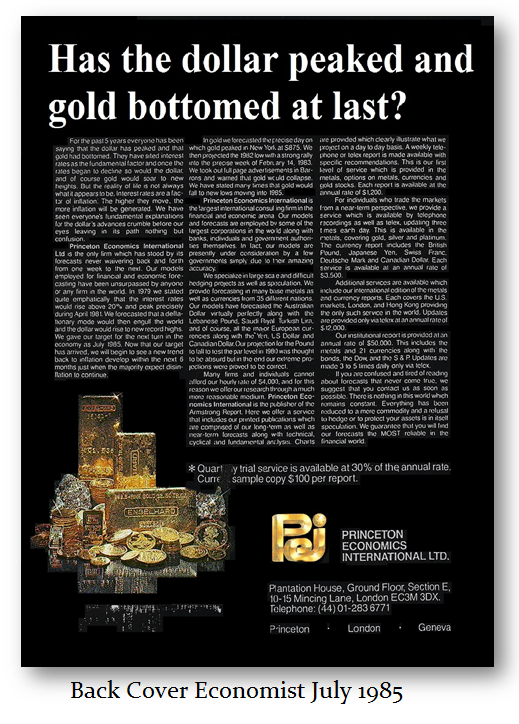
Once upon a time, I use to respect The Economist. I even took the back cover in July 1985 to announce that the Economic Confidence Model was beginning a new 51.6-year Cycle that was a Private Wave that would ultimately peak in 2032. I boldly announced the bottom in gold and the peak in the dollar taking the back cover every week in July 1985.

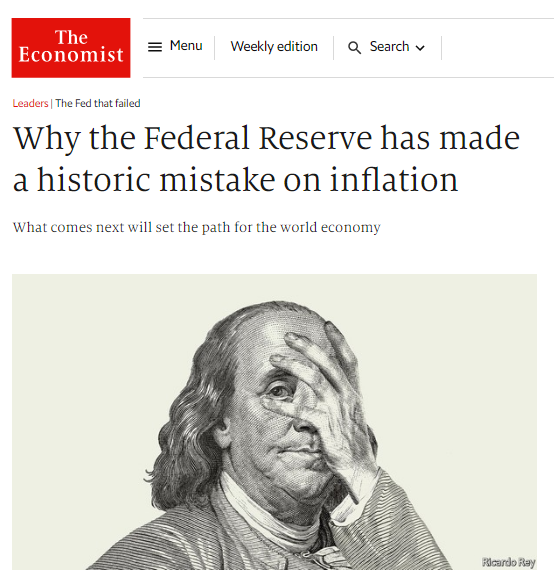
The Economist just released its cover article sadly demonstrating that the publication remains in the Dark Age of economics. They began:

“Central Banks are supposed to inspire confidence in the economy by keeping inflation low and stable. America’s Federal Reserve has suffered a hair-raising loss of control. In March consumer prices were 8.5% higher than a year earlier, the fastest annual rise since 1981. … It is the Fed, however, that had the tools to stop inflation and failed to use them in time.”

To say I am shocked at their reporting that is no better than a first-semester student in Economics 101. It reflects a complete lack of comprehension of how the economy even functions and adopts the politician view that they are NEVER responsible for inflation – it is always the central bank.

Clearly, they have not bothered to take notice that something major took place with the fall of Bretton Woods in 1971. Previously, the theory was if you borrowed, that was less inflationary rather than printing more money. Of course, that was a throwback to the days of Gresham’s Law when currencies traded in Amsterdam were based not on political-military power, but on the pure metal content. The debasement of the coinage by Henry VIII led to (1) the higher-based coinage being hoarded and (2) the decline in the value of English coinage trading in Amsterdam.

That theory became the Quantity of Money Theory which today is totally obsolete yet that is what we hear all the time when the Fed increased its balance sheet and therefore it should have been inflationary following 2008 but the Fed and other central banks could not create 2% inflation. That even led to some claiming MMT (Modern Monetary Theory) proves that the creation of money is NOT inflationary.

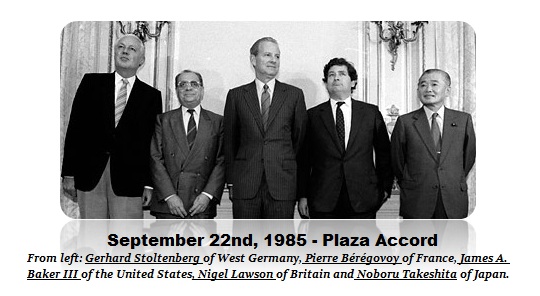
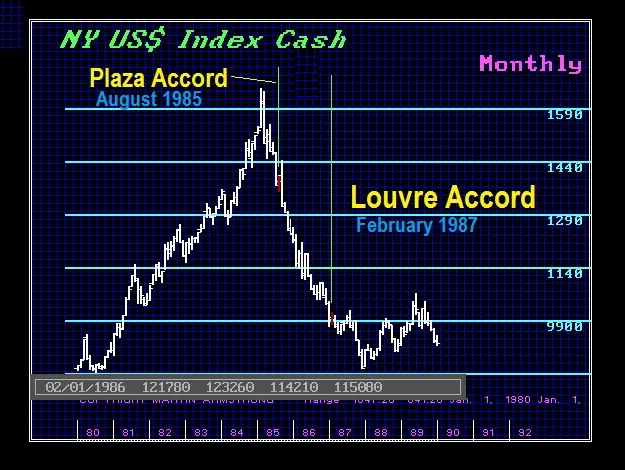
It was barely two months after we announced the beginning of a Private Wave in the Economist in July 1985 that in September 1985, the central banks were all called together and formed the G5 and then proclaimed that they wanted the dollar lower by 40%. This was James Baker’s brainchild that manipulating the dollar lower would reduce the US trade deficit and create jobs.

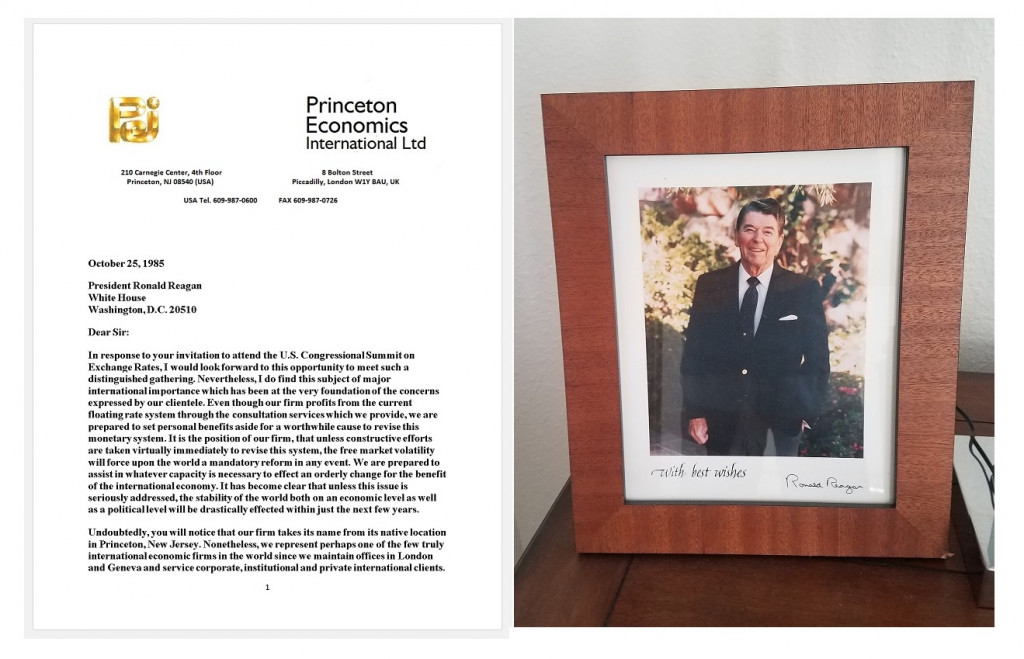
Letter Armstrong to Reagan October 1985 With Photo

I was summoned to be among the global experts who solicit advice but never listen. It is always a dog & pony show so they can pretend they summoned the top experts in the world and then announce what they intended to do anyhow. Of course, it is always pretended to be based on independent advice. However, that is just not how Washington or any government functions. So I wrote to President Reagan and warned that devaluing the dollar to reverse the trade deficit would lead to a crash.

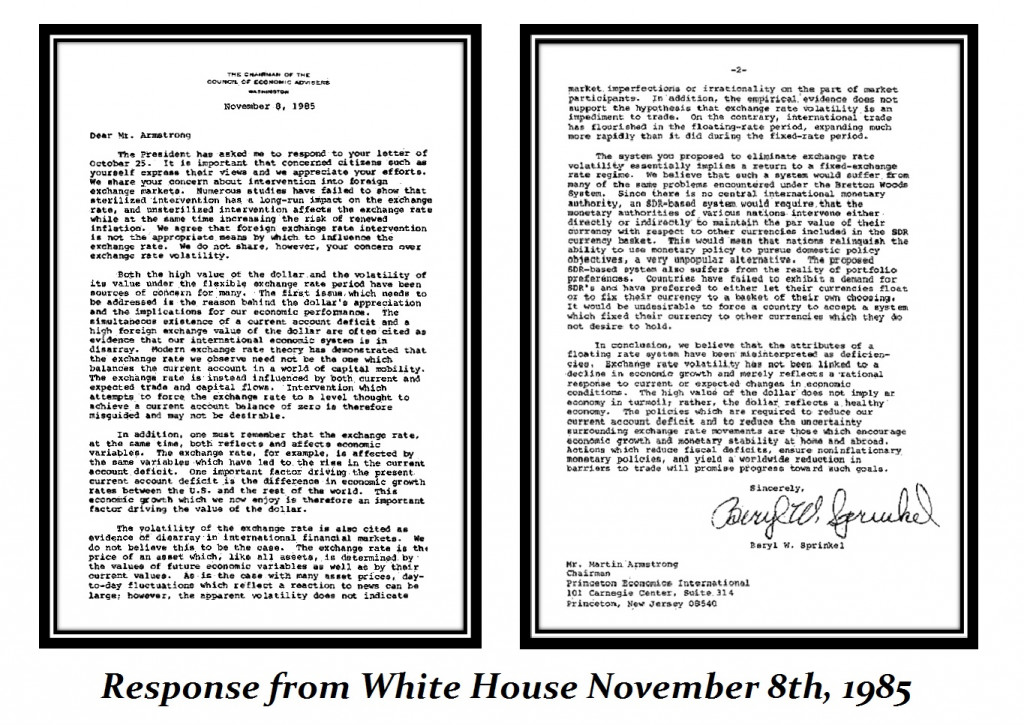
sprinkel-11081985

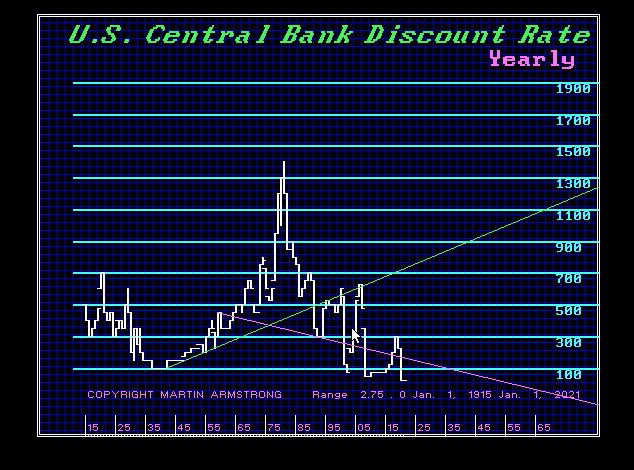
The present ordered Beryl Sprinkel who was the 14th Chariman of the Economic Advisers to the President (1985-1989) to respond. It had been the rise in interest rates to 14% under Paul Volcker to reduce inflation that led to the Deflation. Capital poured into the dollar for the high-interest rates which peaked precisely with the previous ECM wave in March 1981. Thereafter, the dollar soared driving the British pound down to $1.03 in 1985.

Clearly, the entire theory that the Economist is still clinging to currently is unsupported by the historical evidence. The raising of interest rates to stop inflation led to the explosion of the national debt thanks to the servicing costs. In 1980, the national debt stood at $907.7 billion. By 1989, the debt reached $2.857 trillion. The raising of interest rates created deflation near-term but expanded the inflation longer-term.

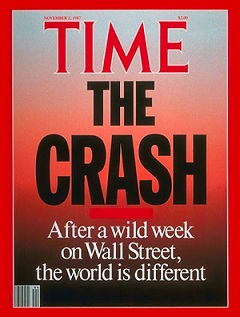
The Plaza Accord set in motion the 1987 Crash. They failed to understand that lowering the value of the dollar may have made US goods appear cheaper overseas to reduce the trade deficit, but at the same time, it also devalues all the US assets in the eyes of foreign investors. After selling more than one-third of the US national debt to the Japanese, the lowering of the dollar by 40% would mean a 40% loss on their holding of US debt.

As the dollar began a free-fall, the central banks began to realize this was a mistake. The Louvre Accord was an agreement, signed on February 22, 1987, in Paris, that aimed to stabilize the international currency markets and halt the continued decline of the US Dollar caused by the Plaza Accord. The agreement was signed by France, West Germany, Japan, Canada, the United States, and the United Kingdom. Italy declined to sign the agreement. The Group of 5 became the Group of 7 – G7 (now G20).

The G7 meeting of central bankers and finance ministers in Paris announced that the dollar was now “consistent with economic fundamentals.” They announced that they would only intervene when required to ensure foreign exchange stability. The objective was then to manage the floating currency system.

Democrats gained control of Congress in 1986 and immediately called for protectionist measures. The dollar depreciation agreed to in 1985 at the Plaza Accord, failed to really improve the trade perspective. In 1986, the trade deficit actually rose to approximately $166 billion with exports at about $370 billion and imports at about $520 billion. The object of manipulating currency to try to create jobs and alter trade flows proved to be completely false.

My concerns warning the White House that volatility would increase made back in 1985 were materializing. What they did not understand was that lowering the dollar in value also led to a shift in capital flows and the selling of US assets. Foreigners were suffering losses by financing U.S. trade by purchasing United States Treasury bonds in an attempt to ease the trade deficit criticism. We were advising the Japanese to buy gold on the New York COMEX, export it, and then resell which would also make it appear that the US exports were increasing. However, the lower dollar was then resulting in the importation of inflation into their own nations.

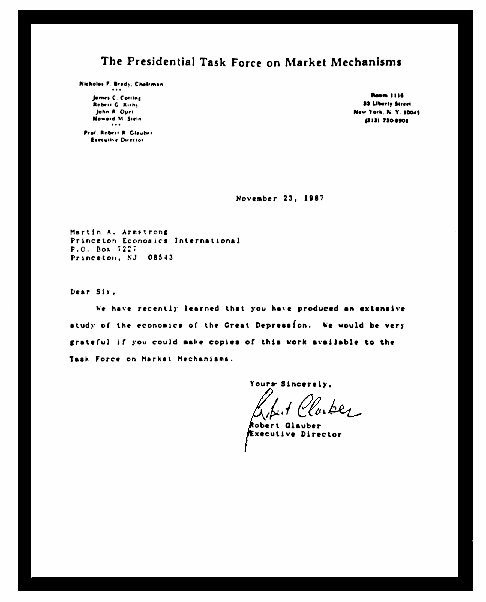
The press back then never understood the crash. I was called in by the Brady Commission charged with investigating the causes of the Crash. Of course, they would not blame the government. The best I could do was to prevent a witch-hunt on Wall Street and the final report casually mentioned that they believed foreign exchange had something to do with it.

There is probably nobody else who has dealt with more central banks than me from China to Switzerland and into the Middle East. To read this cover story by the Economist was indeed shocking. They are obviously still under the impression that inflation is the result of the rise and fall of the money supply that dates back to the days of Henry VIII. I dare say, things have changed slightly.

Today, governments have borrowed relentlessly. But the debt is acceptable now as collateral so national debts are simply money that pays interest. That is completely out of the scope of the central bank so it DOES NOT have the tools to prevent or create inflation. The politicians always want to spend whatever it takes to win the next election and then blame the central bank if it resulted in inflation. It is a sad day that the Economist is so out of touch its rambling and that of someone serious out of touch with reality.