Watch the Biden Launch…


[…] “They’re going to launch strategically all over the country,” an operative with knowledge of Biden’s strategy said. “They’ll have people in place in Iowa, New Hampshire, Nevada, South Carolina and roll out endorsements from elected officials all over the country, so when they come out they can have this show of force.”  (read more)

Watch the launch. Remember, nothing about the DNC club plan is happenstance; nothing is organic; everything is astroturf; everything is planned.  Planning, strategy, coordination and conniving scheme to position optics and narratives is the expertise of the club. This is what they do; this is all they do.  Pelosi and Schumer are part of the operational plan.

The DNC is predictable; it’s a club.  Inside the club the board members control everything. From the outside, it appears Joe Biden still holds the most board member votes.  The test run to bring out all the ‘creepy Joe’ trouble appears to have worked.  He goes silent and re-emerges having left the creepy memes in the past.  Smart play.

Again, planning and strategy is one of the key elements of the Democrat party.  It might seem weird at first, but the DNC club is not chaotic; and that is their weakness. It makes them predictable.

The chosen-one would generally come into play immediately after the democrats have set down a larger trumpeted baseline. The chosen-one roll out would be designed to flow from the Club’s baseline political narrative. The Democrats rarely, if ever, go off script….

Knowing it’s likely the ♦UniParty DNC is following a similar ♦UniParty RNC strategy, we can start to put the personal characteristics and political traits together and contrast them against 2016. Here’s the way it looks so far:

  • Senator Ted Cruz was to 2016…. as Senator Elizabeth Warren is to 2020
  • ♦Governor Jeb Bush was to 2016 as….
  • Senator Marco Rubio was to 2016… as Mayor Pete Buttigieg is to 2020
  • Governor John Kasich was to 2016… as Senator Bernie Sanders is to 2020
  • Senator Lindsey Graham was to 2016 as… Senator Kirsten Gillibrand is to 2020
  • Governor Mike Huckabee was to 2016… as Senator Corey Booker is to 2020
  • Senator Rand Paul was to 2016…. as Congresswoman Tulsi Gabbard is to 2020
  • Dr. Ben Carson was to 2016… as Robert Francis “Beto” O’Rourke is to 2020
  • Governor Chris Christie was to 2016 as… Governor J. Hickenlooper is to 2020
  • Governor Scott Walker was to 2016 as… Governor Jay Inslee is to 2020
  • Senator Rick Santorum was to 2016…. as Senator Sherrod Brown is to 2020
  • Governor George Pataki was to 2016 as…. Eric Swalwell is to 2020
  • Governor Rick Perry was to 2016…. as Senator Kamala Harris is to 2020
  • Governor Bobby Jindal was to 2016…. as Julian Castro is to 2020
  • Carly Fiorina was to 2016 as…. Senator Amy Klobuchar is to 2020
  • Governor Jim Gilmore was to 2016 as… Rep. Tim Ryan is to 2020

Reminder, despite their current stumbling with their executive suite efforts, anyone who is announcing their presidential bid ahead of Speaker Pelosi and the DNC delivering the election narrative (impeachment or similar) is not part of the DNC plan.

Pelosi and Club leadership will not easily give up on an impeachment plan that took months of effort.  They will work to modify it, shift angles of attack, adjust to Barr and yet still hope to retain the goal for as long as possible.

They don’t give up on these schemes easily….. As we saw admitted two weekends ago from Jerry Nadler, and reaffirmed this week, they are modifying their plans as each roadblock presents.

The “Chosen One” will surface during the April/May to June/July period when the legislative ‘impeachment‘ crew, the DNC crew and the media crew have been able to align the scheme for maximum political benefit.

We will most likely be able to identify the “Chosen One” by: (#1) the Pelosi narrative (when cemented) and everyone falls in line; and (#2) the “roll out” that accompanies the announcement. [ex. remember the Greek columns, trumpets, pomp, etc.?]

Watch the launch.

Donald Trump Files for Temporary Restraining Order Against Chairman Elijah Cummings…


Donald Trump, not President Trump, representing his affiliated private business interests, has filed for a temporary restraining order (full pdf below) against House Oversight Committee Chairman Elijah Cummings and his committee representatives and officers.

You might remember when Speaker Nancy Pelosi changed the House Rules earlier this year. Part of the rule changes were to modify the responsibilities of the House Government Affairs Oversight Committee.  Speaker Pelosi removed all other oversight responsibility and shifted the committee to a singular oversight role focused only on the White House.

Chairman Cummings is demanding the personal financial records of Donald Trump and all of his business interests around the Trump organization.  The demand includes all personal and private financial records including tax filings from individuals, officers and corporate entities within the Trump organization.  As a private, non-public corporation, this demand for financial records would encompass the entire Trump family.

In essence, Chairman Cummings is weaponizing his government office to target Donald Trump and all members of the Trump family.  This is not dissimilar to what President Obama and Elijah Cummings did when they weaponized the IRS to target their political opponents.  See: national heroine/patriot Catherine Engelbrecht.

When the IRS scheme was made public in 2011, the Obama plan shifted to use the intelligence operations of the U.S. Government to target their political opposition through the use of electronic surveillance and spy operations. Hence, this is one consistent continuum.  Chairman Cummings in 2019 is just a new iteration of the program.

Trump, not President Trump, has filed for a preliminary injunction to stop Chairman Cummings demand.  In the interim, while awaiting court arguments, Donald Trump and his business interests have filed for a restraining order.

.


Chairman Nadler Issues Subpoena For White House Lawyer Don McGahn…


Speaker Pelosi and Judiciary Chairman Nadler ‘s ‘obstruction‘ impeachment plan relies heavily on the use of former White House legal counsel Don McGahn.  The importance of McGahn is why Weissmann and Mueller invested so much time and energy parsing questioning McGahn through more than 30 hours of testimony.

Today, Chairman Nadler has issued a subpoena for McGahn to appear before congress for testimony.  Interestingly Nadler puts the demand date as May 21st, 2019; this would be ahead of the date (May 23rd) he has established for Robert Mueller to appear.

(Link to Tweet)

With all of these dates firming up on the calendar, the launch of the ‘chosen’ 2020 DNC presidential candidate must be very close.

Spygate and The Steele Dossier Were The Cover Story – The Real Issue is Years of Obama-era Surveillance and Political Spy Operations…


If you read the Weissmann/Mueller report carefully one aspect stands out strongly; the Mueller investigation was fully committed to The Steele Dossier.  An inordinate amount of the report is focused on justifying their investigative validity and purpose in looking at the claims within the Steele Dossier.

Repeatedly, the investigative unit references their mandate based around the Steele Dossier, and the mid-summer 2016 origin of the FBI counterintelligence operation.

Why?  Why was/is Crossfire Hurricane (July ’16) and the Steele Dossier (Oct. ’16) so important to the principle intelligence apparatus, and the Mueller team (’17, ’18, ’19)?

I believe former NSA Director Admiral Mike Rogers has told us the answer.  In early 2016 Rogers caught on to a massive and pre-existing weaponization of government surveillance and the use of collected NSA metadata for political spy operations.  Everything, that comes AFTER March 2016 is one big blanket cover-up operation….. ALL OF IT.

The Russian election interference narrative; the use of Joseph Mifsud, Stefan Halper, the London and Australian embassy personnel; Erika Thompson, Alexander Downer, U.S. DIA officials; everything around Crossfire Hurricane; and everything after to include the construct of the Steele Dossier; all of it was needed for the creation of an ‘after-the-fact‘  plausible justification to cover-up what Mike Rogers discovered in early 2016, AND the downstream unmasked records that existed in the Obama White House SCIF.

Fusion GPS was not hired in April 2016 to research Donald Trump.  The intelligence community was already doing surveillance and spy operations. They already knew everything about the Trump campaign. The Obama intelligence community needed Fusion GPS to give them a justification for pre-existing surveillance and spy operations.

REPORT THIS AD

That’s why the FBI, and later the Mueller team, are so strongly committed to, and defending, the formation of the Steele Dossier and its dubious content.

On Pages #11 and #12 of the Weissmann/Mueller report, the special counsel team outlines the purpose and intent of the probe as delivered by Deputy Attorney General Rod Rosenstein. Within these pages Mueller outlines the August 2nd Scope Memo that has previously been hidden and remains redacted through today.

Read the highlighted portion carefully to understand the scope of the instructions. Note the careful wording “the Special Counsel had been authorized since his appointmentto investigate allegations”… This means from Day #1 of the special counsel, the scope of the probe was always to investigate the claims within the Ohr/Steele Dossier:

The August 2nd Scope Memo additionally authorized the investigation of “certain other matters” specifically relating to Manafort (financial crimes), and Papadopolous and Flynn (FARA violations).

These paragraphs tell us a great deal about what originated the purpose of the FBI investigation and the continued purpose of the special counsel. Remember, the special counsel was a continuance of the FBI counterintelligence operation which officially began on July 31st, 2016. [The unofficial beginning was much earlier]

Understanding now that Mueller is saying from Day One he was investigating the Steele Dossier; here’s where we all need to question the assumptions.

Why is the Steele Dossier so important?

From the beginning most people have thought the Fusion-GPS objective was to dig up dirt on Trump for political exploitation. However, with all the recent information outlined there’s actually a more significant role for Fusion.

The overall intelligence apparatus of the U.S. government was already conducting political surveillance on their political opposition. The systems of the intelligence apparatus such as FISA-702(16)(17) databases searches were being exploited months (if not years) beforehand.

When NSA Director Admiral Mike Rogers discovered the use of the database he shut down contractor access on April 18th, 2016.

When Fusion GPS was hired by the DNC and Clinton team; also in April of 2016 immediately following the shut-down of FBI contractor access; it now appears the purpose was to provide cover for government surveillance already taking place. Perhaps part of that motive was fear of what NSA Mike Rogers might do.

The Obama administration (U.S. government intelligence apparatus) needed an external source of information that could cover their domestic surveillance and spy operations. That’s why Fusion GPS was hired, and why emphasis was put on using European and Australian intelligence contacts to create the plausible process to continue surveillance that was always taking place.

This corrupt weaponizing of the U.S. intelligence apparatus is MUCH BIGGER than anyone currently absorbs. The Steele Dossier was an eventual part of the cover-story.

When Peter Strzok and Lisa Page were discussing the “insurance policy” in August 2016, they were not discussing insurance from the perspective of their success, ie. Clinton elected; they were discussing insurance from the position of: if they failed.

If Clinton was elected, great; everything continues as normal. However, if Clinton was not elected the weaponization of government needed a cover story, a plausible legitimate reason for why political surveillance/spying was taking place. This is the insurance policy need…. This is why they needed the Steele Dossier.

Regardless of anything happening to stop them, the intelligence community was conducting surveillance of their political opposition. To validate that surveillance the intelligence community needed a plausible FBI counterintelligence operation. That’s where John Brennan (CIA) comes in.

REPORT THIS AD

Brennan manufactured the plausible excuse for an FBI operation to begin through the use of “unofficial channels” via Joseph Mifsud, Stefan Halper and eventually Alexander Downer via an Australian intelligence asset Erika Thompson; who was working in London with U.S. intelligence assets Terrence Dudley and Greg Baker, ie. the “Papadopoulos operation”.

While the overseas operation was working to create plausible explanation and start Crossfire Hurricane, back in the U.S. Fusion-GPS was contracted to supplement the appearances for a domestic parallel track. Fusion ran operations for the Russian appearances inside the U.S., ex. Trump Tower meeting.

For their effort, Fusion was using previously extracted FISA-702(16)(17) results to create more supportive evidence and plausible material. That Fusion effort led to the Steele Dossier.

However, in a similar way the Brennan operation needed the Australian Diplomat Alexander Downer to cross from “unofficial” into “official” channels, the Steele Dossier needs a way to cross from “unofficial opposition research” into “official investigative product” status.

REPORT THIS AD

Enter the FISA warrant and Carter Page.

A FISA warrant that could be built upon the Steele Dossier was what they needed.

The Steele Dossier is the investigative virus the FBI wanted inside the system. To get the virus into official status, they used the FISA application as the delivery method and injected it into Carter Page. The FBI already knew Carter Page; essentially Carter Page was irrelevant, what they needed was the Dossier in the system {Go Deep}.

With the communication from Alexander Downer (foundation for the EC), in conjunction with the Steele Dossier (foundation for the Page FISA), the CIA and FBI now held a plausible -albeit fraudulently obtained- basis to explain/justify all of their 2015 and 2016 political spying and surveillance activity. This is their insurance policy.

If Hillary wins the election, everything just evaporates into the ether. However, if Hillary loses the election – the fraudulent investigative evidence now protects all of the players for their role in weaponized intelligence spying and surveillance operations.

REPORT THIS AD

Andrew Weissmann was/is one of the DOJ participants who is well aware of the status of the operations as they proceed. In 2016 and 2017 Weissmann is being briefed by DOJ official Bruce Ohr who is carrying messages from Fusion-GPS and Chris Steele into the FBI.

Fraudulent justifications.

Just like the Susan Rice justification Memo, fraudulent justifications are what’s behind those paragraphs in the Rosenstein scope memos as delivered to Weissmann and Mueller.

Fusion GPS was not hired to research Trump, the intelligence community was already doing surveillance and spy operations. The intelligence community needed Fusion GPS to give them a plausible justification for already existing surveillance and spy operations.

See the difference?

Fusion-GPS gave them the justification they needed with the Steele Dossier.

That’s why the Steele Dossier is so important in the scope memos.

.

First Lady Melania Trump – Easter Egg Roll Reading Nook…


The Wonderful Things You Will Be

President Trump and First Lady Melania Trump Host 2019 White House Easter Egg Roll…


The 2019 Easter White House celebration takes place today with the 2019 Easter Egg Roll event.  President Trump and First Lady Melania start the festivities:

Are Two-Tier Monetary Systems a Possible Tool?


QUESTION: Mr. Armstrong; It seems few people even understand that there have been two-tier monetary systems. Do you think this can be a possible tool in the currency crisis you are forecasting for 2021?

Thank you;

Looking forward to Rome and meeting Mr, Farage as well

PC

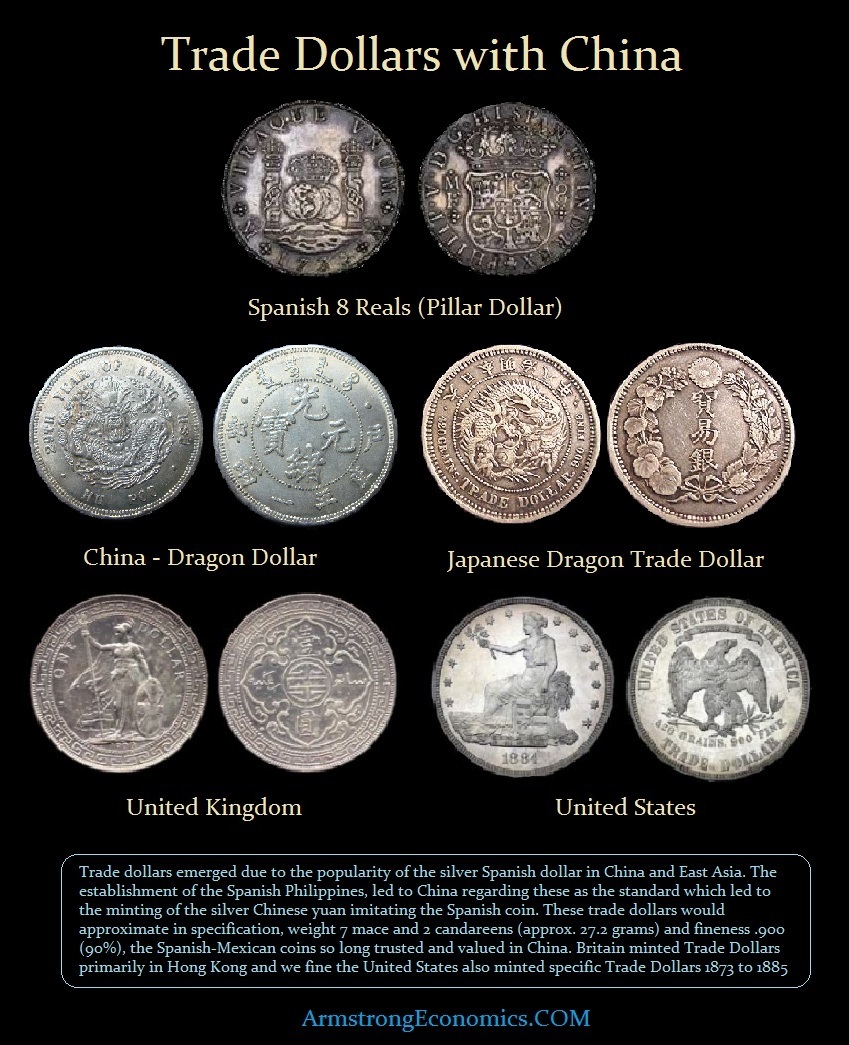
ANSWER: Various countries used to mint trade dollars in silver with different weights for external trade with China. That was a two-tier monetary system for trade during the 19th century. But there have been instances where there were two separate currencies that were also used as capital controls to isolate the domestic economy from the external international capital flows. This was the case with South Africa.

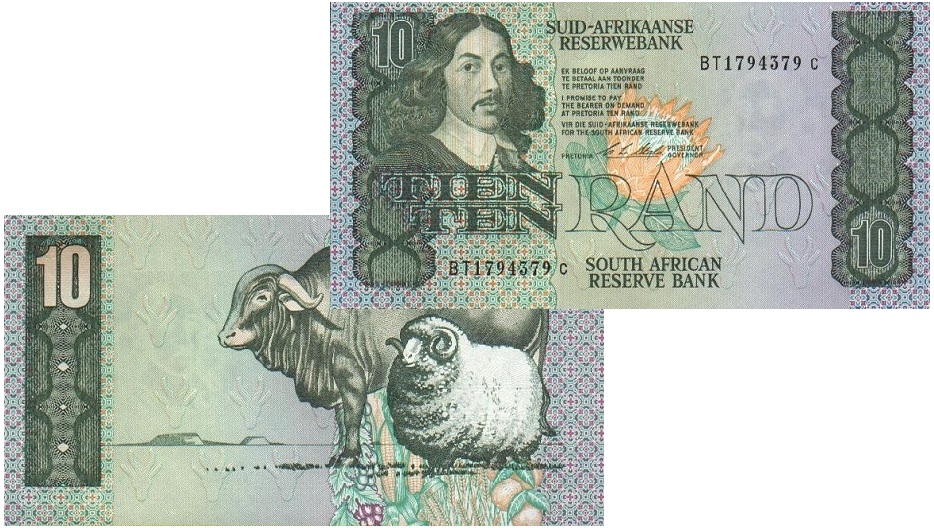
An important example of an official deliberate two-tier monetary system is the modern monetary history of South Africa. Until the late 1960s, South Africa had a fixed exchange rate for its currency. The rand was pegged to major foreign currencies, as was the case under the Bretton Woods system.

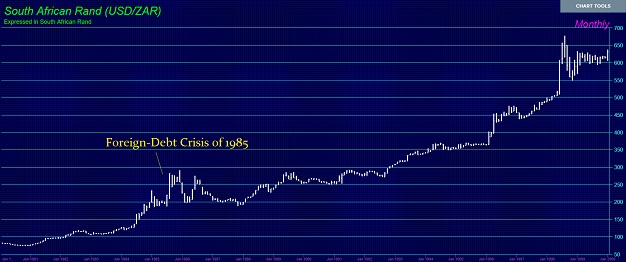
It was during 1979 when the South African government switched to a system that formally expressed parity against the dollar. The value of the rand followed changes in the balance of payments and moved roughly with sterling and other weaker currencies until 1985 when the dollar soared and the birth of the Plaza Accord took place.

The foreign debt crisis of 1985 caused the rand to depreciate at a spectacular rate and the dollar rose in value. The rand fell to an all-time low of less than 40 cents to the US$. The rand recovered somewhat in 1987, reaching 43 cents, but it declined steadily thereafter into 1998. The rand collapsed to about 26 cents against the US$ in late 1995. Between February 1, 1996 and May 1, 1996, the rand lost roughly 16% of its exchange value, falling from R3.7 to R4.33 = US$1, or a value of about 23 cents to the US$.

The government realized that its domestic policy objectives were incompatible with international investment. They then created a parallel currency to act as a two-tier currency unit they named the “Financial Rand.” This hybrid currency was used exclusively for the movement of nonresident capital during the 1980s and early 1990s. The Financial Rand developed out of currency-exchange controls instituted in the early 1960s, known as the “blocked rand.” The Financial Rand was available only to foreigners for investment in South Africa and was created by the sale of nonresidents’ assets in the country.

Therefore, South Africa created a formal two-tiered currency system, which insulated the country’s foreign reserves from politically motivated capital flight. Since any divestment by nonresidents was automatically met by new investment, and the price of the Financial Rand varied independently of the commercial rand, a stability was achieved.

The Financial Rand invariably stood at a discount to the commercial rand, but the size of the discount depended on South Africa’s relative attraction as an investment destination. The discount stood at almost 40% during most of 1992 during the political crisis. The Convention for a Democratic South Africa (CODESA) began in December 1991 at the Johannesburg World Trade Center, attended by 228 delegates from 19 political parties. Mandela remained a key figure and after de Klerk used the closing speech to condemn the ANC’s violence, he took to the stage to denounce de Klerk as the “head of an illegitimate, discredited minority regime”.

This confrontation caused the rand to collapse. CODESA 2 was held in May 1992, at which de Klerk insisted that post-apartheid South Africa must use a federal system with a rotating presidency to ensure the protection of ethnic minorities. Mandela opposed this idea and demanded a unitary system governed by majority rule. Following the Boipatong massacre of ANC activists, Mandela called off all negotiations, and called for a special session of the UN Security Council and proposed that a UN peacekeeping force be stationed in South Africa to prevent “state terrorism.” Calling for domestic mass action, in August the ANC organized the largest-ever strike in South African history, and supporters marched on Pretoria. The rand declined to about 20% by late 1993.

Reserve Bank governor Chris Stals, under pressure from the banking and business communities, said that the government would phase out the Financial Rand in 1994 or 1995, assuming that South Africa’s foreign currency reserves reached at least R20 billion and that the discount between the financial and the commercial rends narrowed to about 10%. Foreign currency reserves were low in early 1994 but thanks to a dramatic reversal of the capital outflow in 1993, foreign currency reserves increased throughout 1994 and into early 1995.

Finally, by March 1995, with foreign reserves of only about R12 billion, the government abolished the financial rand. The newly unified currency began to trade on international currency markets, marking a vote of confidence in South Africa’s business potential.

Only a two-tier currency system can possibly weather the economic storm on the horizon from the collapse of the European Union at the hand of this lethal combination of policies. The next banking crisis will most likely begin in the Eurozone due to a continued failure to resolve the systemic weaknesses of its construction. The failure to have consolidated the debts means that the failure on the state level will ripple through the entire European economy. In the United States, state debt is not used for reserves. The failure of California will only send bond seekers into the federal debt who are fleeing state and municipal debt. We see that in Europe as capital fled from most members concentrating in Germany, which is the US Treasury equivalent within the Eurozone. With the first bail-in under the BRRD agreement, the contagion will be devastating as was the case when Michigan closed its banks in 1933 in the USA.

The Financial Rand fell below the domestic commercial rand when the 1992 political crisis unfolded, and capital fled South Africa unwilling to invest in a nation that might move into civil war. The two-tier currency system can and does help to distinguish between domestic and international capital flows.

There is the potential to create a two-tier monetary system with a new type of international currency that is separate and distinct from that of the domestic currency. This would allow the US dollar to end its reserve status and end the clash between domestic and foreign policy objectives.


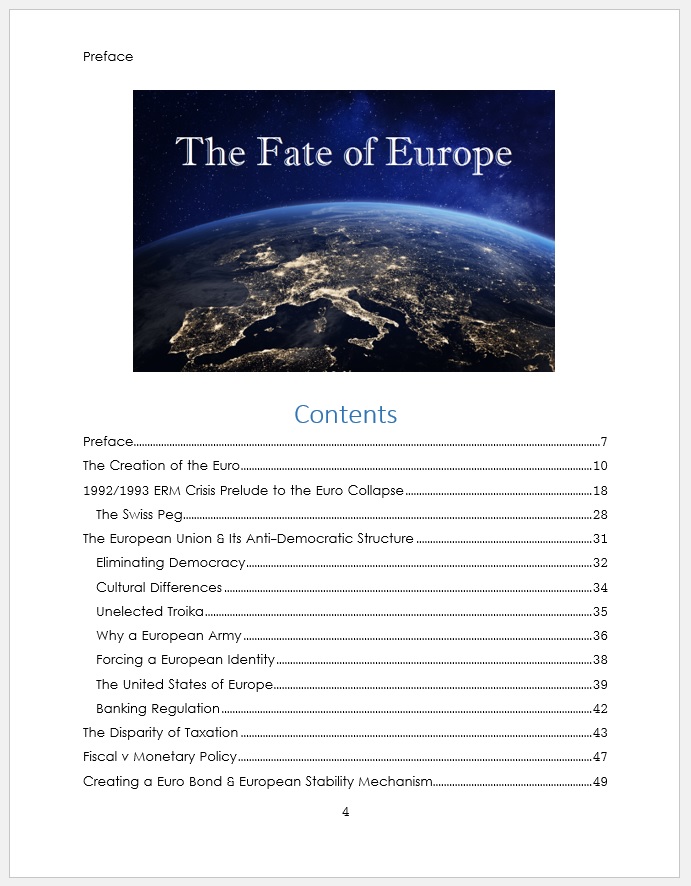
The Fate of Europe


QUESTION: Marty; Your capital flow models have been remarkable. Do you see Europe as ever getting its act together? We need support to get decisions approved as you know. Will you provide that for us to present to the men above?

Thanks.

Nice to see you in Europe. Rome should be great at this time of year.

PDC

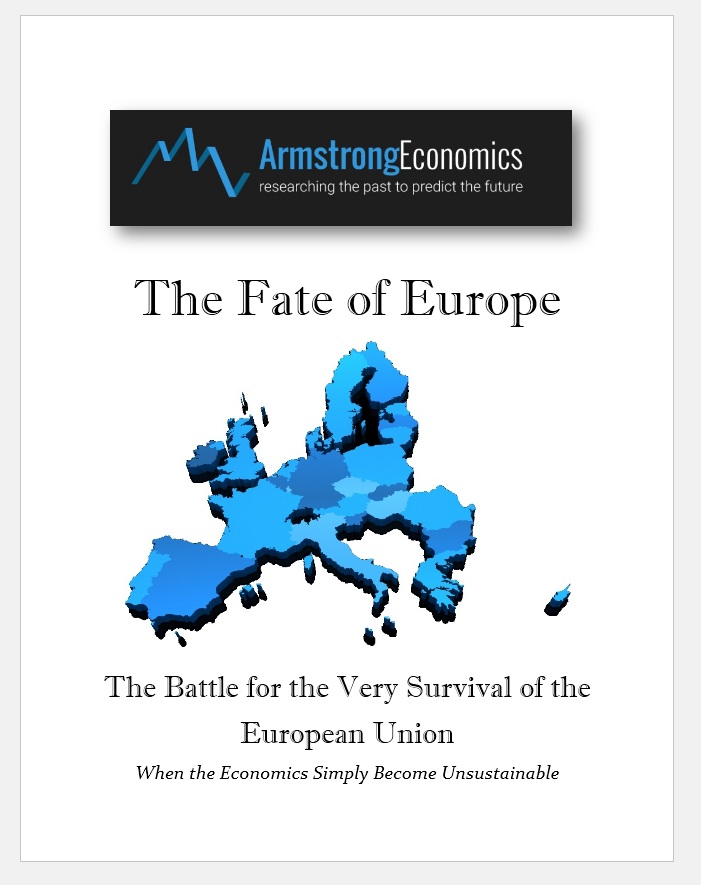
ANSWER: I have covered that is a special report for attendees. It took me a month to write this one. I have tried to cover every aspect so we can deal with the forecasting at the conference rather than all the supportive history. I understand that institutions need the support to justify their decisions. This is the report everyone needs for their files to CYA as the say for decisions.

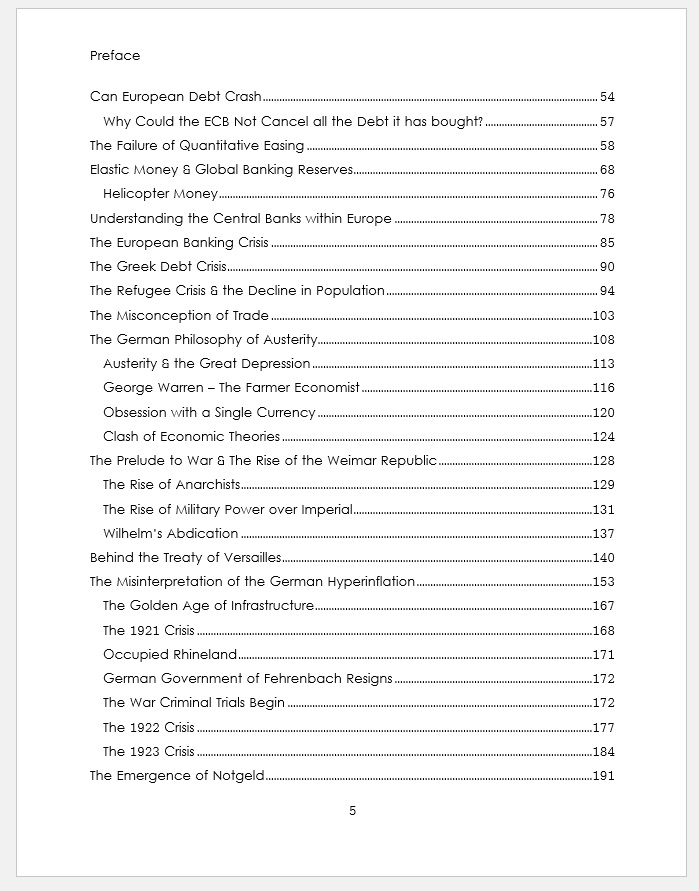
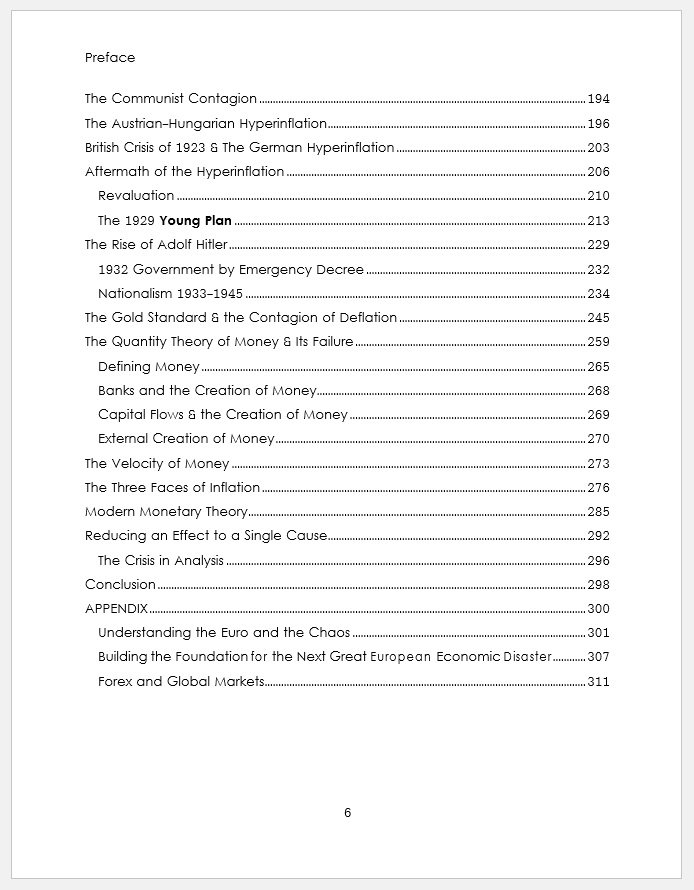
Things look very dicey for Europe and this will be a very interesting WEC. Here is the Index of the Report. I believe this will answer all questions and provide the backup you need to present to any board of directors.


The Consequence of War that Led to the German Hyperinflation


QUESTION: Everyone has a chart of the German DAX postwar. I have never seen a chart of the German stock market before the war. Do you have any?

HVS

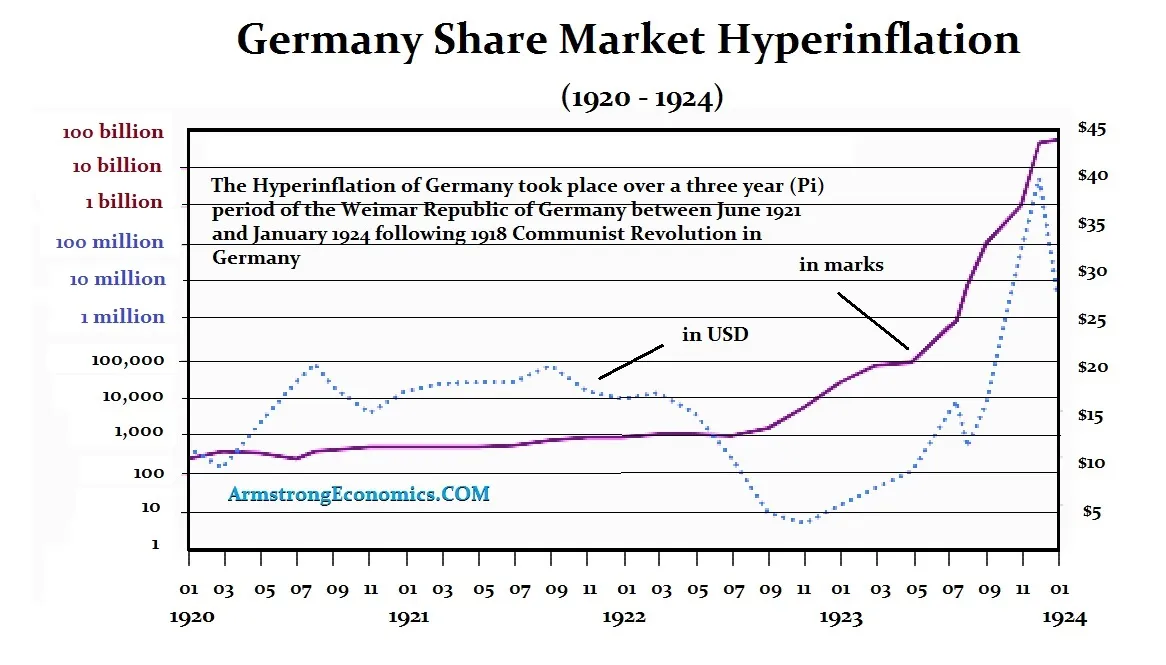
ANSWER: Yes. However, you must understand that because the world was on a gold standard, the arbitrage volatility was reflected in the bond and share markets when the currency was fixed. This is why the German share market closed in August 1914, along with just about everyone else. Here is a chart that show the performance of the German share market during the hyperinflation period. We have the DAX also extended back in time. But don’t forget, the DAX is a total return index. If we plot just price, you will see that the German share market looks very much like France.

The primary stock exchange in Germany was in Berlin. However, there were 21 exchanges in total. The origins of the Frankfurt Stock Exchange date back to medieval trade fairs during the 11th century. By the 16th century, Frankfurt developed into a wealthy and busy city with an economy based on trade and financial services. Annuities in particular were the hot items back then. It was in 1585 when the bourse was established to trade in fixed currency exchange rates. Currencies actually led to exchanges rather than shares. Eventually, Frankfurt developed into an early share market, competing with London and Paris. Mayer Amschel Rothschild and Max Warburg became very influential in the financial trade of Frankfurt.

The Frankfurt Stock Exchange had been a major international center. It was completely wiped out by World War I and its consequences. Back then, foreign shares and bonds traded on cross exchanges since money was fixed. German investors at the start of World War I dumped foreign bonds and shares, fearing that their capital would be restricted or confiscated. This is also why all the exchanges simply closed in Europe. Any capital they managed to free up from the sale of foreign investments was reinvested mostly in German government bonds. They were patriotic and believed in their government. However, by the end of the war, the Frankfurt Stock Exchange lost all foreign securities listings for bonds or shares. Frankfurt lost its standing as an international stock exchange entirely, and that would only begin to resurface in 1949.

In Europe, the fear of catastrophic declines in stock prices was met with controls at first. Overall, stocks and bonds were not allowed to trade below the price they had been trading at on July 31, 1914. Restrictions were also placed on capital. Money movement was highly restricted to preventing any large outflows of capital, forcing many into black markets. One means was to buy collector stamps and coins. They would then export especially rare stamps and then sell them in America. After two world wars, most of the rare stamps happened to be in America and gradually returned to Europe during the late 1960s.

With these restrictions in place, markets reopened in Europe. The London Times began printing stock prices for London and Bordeaux on September 19th and for Paris on December 8, 1914. In January 1915, all shares were allowed to trade on the London Stock Exchange, though with price restrictions. The St. Petersburg exchange reopened in 1917, only to close two months later due to the Russian Revolution. The Berlin Stock Exchange did not reopen until December 1917.

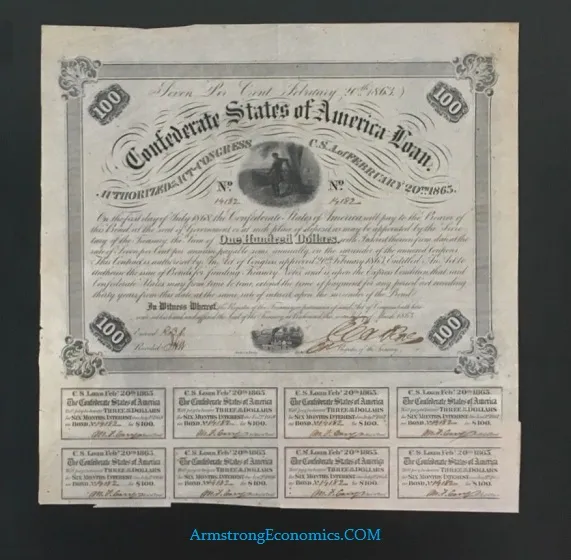
The loss of the war meant those who had invested in German bonds suffered the same fate as those Americans who invested in Confederate bonds. Indeed, to fund World War I, Germany relied more on raising money by selling bonds than imposing taxes. This had the net effect of wiping out the savings of the middle class and upper class. During the hyperinflation going into 1923, the losses in bonds were devastating, but in contrast, equities became a prized object among speculative investors. The Frankfurt stock exchange saw unprecedented losses in the bond markets and shares became the speculation objects that rose sharply going into 1923.

The German war costs covered by taxation, including state and federal combined, was only 13.9% which was lower than 18.2% taxation imposed in Great Britain for the war effort. German debt exploded after 1916. That is when the federal government’s short-term floating debt grew relentlessly, and by the end of the war it accounted for nearly one-third of the German national debt. The seriousness of the German debt crisis, which led to the postwar hyperinflation, was the fact that after 1916 German banks began to purchase more of the government’s floating debt. Government debt dominated the market and banks took on more public debt than private. When the public debt was marginalized by hyperinflation, it also wiped out the banking system.

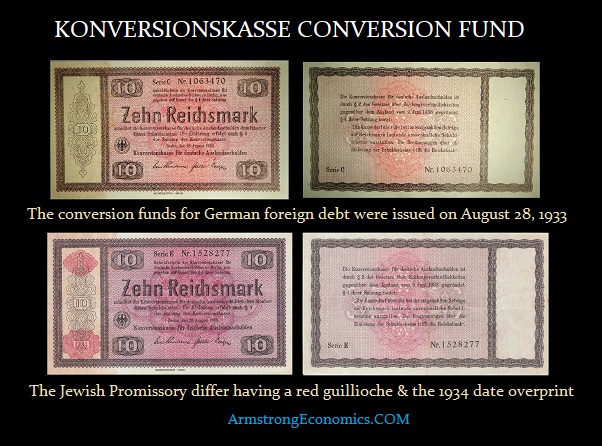
By the end of the war, the international contacts of the Frankfurt Stock Exchange had been lost. Inflation set in and reached its first peak in 1923. In October 1929, the Germany stock exchange prices crashed dramatically on the 25th. The world economic crisis ruled the following years. The economy only began to stabilize in 1932. The following year, the Nazis took over and centralized the nation’s economic policy. The Frankfurt Stock Exchange was merged with the Mannheim Stock Exchange and the number of exchanges nationwide was reduced from 21 to nine. Under the stringent Nazi economic regime, free trade was suffocated as Hitler defaulted on external debt. The majority of capital assets was directed to benefit the war economy. He even issued conversion fund certificates that were exchanged one for one with German marks if you sought to leave the country. This was part of the currency controls but they were worthless once you left the country.


Feynman’s Lost Lecture (ft. 3Blue1Brown)


Published on Jul 20, 2018

SUBSCRIBE 4.6M
Check out Grant’s channel: 3blue1brown: https://www.youtube.com/3blue1brown This video recounts a lecture by Richard Feynman giving an elementary demonstration of why planets orbit in ellipses. See the excellent book by Judith and David Goodstein, “Feynman’s lost lecture”, for the full story behind this lecture, and a deeper dive into its content. Tweet referenced at the start: https://twitter.com/3blue1brown/statu… Music by Nathaniel Schroeder: https://soundcloud.com/drschroeder/el… Music by Vincent Rubinetti: https://soundcloud.com/vincerubinetti… Support MinutePhysics on Patreon! http://www.patreon.com/minutephysics Link to Patreon Supporters: http://www.minutephysics.com/supporters/ MinutePhysics is on twitter – @minutephysics And facebook – http://facebook.com/minutephysics And Google+ (does anyone use this any more?) – http://bit.ly/qzEwc6