
Did Trump tell Chinese President Xi Jinping what he did with the Tomahawks during the main course or dessert?
Category World Economic Form
*(From the religion of Peace) – 3 killed & many injured after truck drives into pedestrians, crashes into Stockholm dept store
Muslims do what Muslims do!
Tillerson, Mnuchin and Ross Debrief on China Summit…
As President Donald Trump and President Xi Jinping wrapped up the summit in Mar-a-lago, overshadowed in media reports by U.S. missile strikes in Syria, President Xi joined with President Trump and focused on stressing the positive mood of the meetings between the world’s two biggest economies.

Team U.S.A insisted both President Trump and their delegation had made good on the pledge to raise concerns about China’s trade practices and said there was some headway. Team China and President Xi agreed to a 100-day plan for trade talks aimed at boosting U.S. exports and reducing China’s trade surplus with the United States.
Secretaries Tillerson (State), Mnuchin (Treasury) and Ross (Commerce) held a debriefing session with the media at the end of the summit. What a stunning difference in the approach and level of direct and concise communication. (Oh, and side note – Wilburne continues to crack me up, even in the reading of his responses.) Here’s the transcript:
 SECRETARY TILLERSON: […] I would open by saying the President was very happy to host President Xi at Mar-a-Lago these last two days. As those of you that have been here know, it was obviously a perfect weather day today, and it was a great opportunity for both the Presidents and their wives to really get to know one another and enjoy, share meals together, and work on important issues.
Each side did bring along senior delegations of officials — so, of course, we’re represented here — who also were able to build important relationships for a lot of work that’s still ahead of us.
I think what I would really want you to get a grasp of is that both the atmosphere, the chemistry between the two leaders was positive. The posture between the two really set the tone for our subsequent meetings between our high-level delegations. And I would tell you the exchanges were very frank. They were candid, they were open, and they were very positive. So I think all of us are feeling very good about the results of this summit in terms of what it did for setting a very constructive tone going forward.
The two leaders had positive, productive meetings. President Trump and President Xi agreed to work in concert to expand areas of cooperation while managing differences based on mutual respect.
The two Presidents reviewed the current state of the bilateral relationship and noted the importance of working together to generate positive outcomes that would benefit the citizens of both of our countries. President Trump noted the challenges caused by Chinese government intervention in its economy and raised serious concerns about the impact of China’s industrial, agricultural, technology, and cyber policies on U.S. jobs and exports. The President underscored the need for China to take concrete steps to level the playing field for American workers, stressing repeatedly the need for reciprocal market access.
The two sides noted the urgency of the threat of North Korea’s weapons program, reaffirmed their commitment to a denuclearized Korean Peninsula, and committed to fully implement U.N. Security Council resolutions. They agreed to increase cooperation and work with the international community to convince the DPRK to peacefully resolve the issue and abandon its illicit weapons programs.
The two sides had candid discussions on regional and maritime security. President Trump noted the importance of adherence to international norms in the East and South China Seas and to previous statements on non-militarization. He also noted the importance of protecting human rights and other values deeply held by Americans.
The two Presidents agreed to elevate existing bilateral talks to reflect the importance of making progress on issues. They established a new high-level framework for negotiations. The U.S.-China Comprehensive Dialogue will be overseen by the two Presidents, and it will have four pillars: the diplomatic and security dialogue; the comprehensive economic dialogue; the law enforcement and cybersecurity dialogue; and the social and cultures issues dialogue.
The two sides agreed to undertake an ambitious agenda and schedule to show progress and achieve meaningful results. President Trump welcomed President Xi’s invitation to visit China for a state visit at a future date. They agreed to work together in the interim to ensure successful and results-focused visits.
With that, I’d like to turn it to Treasury Secretary Mnuchin.
 SECRETARY MNUCHIN: Thank you. I would just like to reiterate that we had a very productive two days with our counterparts. And specifically we had a meeting this morning that was a breakout of the first comprehensive economic dialogue. We had very direct and frank conversations about how we would work together. Secretary Ross and I will be leading that jointly, and we will be focused on trade, investment, and other economic opportunities between both companies — countries.
We focused specifically on a more balanced economic relationship, specifically on trade. And we focused on the desire to have very specific action items both in the short term for the next time we get together, as well as what the goals are over the year. So I think we think the restructuring of the dialogue and having specifically a breakout that will address comprehensive economic opportunities across our different agencies both here and within China I think we felt was very productive, very good start in how we’re going to structure it, and again, very specific things that we talked about to look forward on making progress in the short term on.
Secretary Ross?
 SECRETARY ROSS: Thank you, Steven. I think in many ways, the most significant thing was a 100-day plan. Normally, trade discussions, especially between China and ourselves, are denominated in multiple years. This was denominated in the first instance in 100 days with hopefully way stations of accomplishment along the way. Given the range of issues and the magnitude, that may be ambitious, but it’s a very big sea change in the pace of discussions. And I think that’s a very very important symbolization of the growing rapport between the two countries.
Press Secretary SEAN SPICER: We’ll take a few questions. Steve.
♦ Q Secretary of State Tillerson, can I ask you about North Korea? Did the President say that he might use trade against China if they do not rein in North Korea? And did you get any specific commitments from China to do something about the North Korea problem?
SECRETARY TILLERSON: The Presidents’ discussions — President Trump and President Xi — on North Korea were very wide-ranging, very comprehensive, and more focused entirely on both countries’ previous commitments to denuclearize the peninsula. There was no kind of a package arrangement discussed to resolve this.
I think President Xi, from their part, shared the view that this has reached a very serious stage in terms of the advancement of North Korea’s nuclear capabilities. They discussed the challenges that introduces for both countries, but there’s a real commitment that we work together to see if this cannot be resolved in a peaceful way. But in order for that to happen, North Korea’s posture has to change before there’s any basis for dialogue or discussions.
President Trump indicated to President Xi that he welcomed any ideas that President Xi and China might have as to other actions we could take and that we would be happy to work with them, but we understand it creates unique problems for them and challenges and that we would, and are, prepared to chart our own course if this is something China is just unable to coordinate with us.
♦ Q Two quick questions for Secretary Tillerson, and one for Secretary Ross. Previous administrations have been very tough on North Korea — sorry — tough on China in terms of human rights violations. And I was wondering if that came up and if this administration plans to pressure the Chinese on human rights violations. And the second question, if I may have the opportunity to ask since you’re here on Syria — a lot of the American people are concerned that yesterday’s actions mean we’re going to war. And I was hoping if you could just clarify — is this just a one-fit situation, or is this going to be part of a — campaign to try to the Assad government?
SECRETARY TILLERSON: As to the discussions around human rights in China, I think America’s values are quite clear and they really occupied a core of all of our discussions. I don’t think you have to have a separate conversation, somehow separate our core values around human rights from our economic discussions, our military-to-military discussions, or our foreign policy discussions. They’re really embedded in every discussion, that that is really what guides much of our view around how we’re going to work together.
As to Syria, I think as was indicated in our statements last night, this particular strike that was carried out on the airbase from which the chemical weapons attack was launched was very deliberately considered by the President.
It is a response that we believe is both proportional and appropriate. And as we said last night, we will monitor Syria’s response to that strike in terms of whether they attack our own forces or coalition forces, or whether we detect that they are considering mobilizing to take additional chemical weapons attacks. And I’d say at this point the future will be guided by how we see their reaction.
♦ Q Thank you. And for you, Secretary Ross, I was wondering if talked to the Chinese about cracking down on any banks or companies that may be working with North Korea.
SECRETARY ROSS: As you know, Commerce fined ZTE, the second largest telecom company for making equipment in China, $1.170 billion recently. So they recognize that that shows our clear determination to crack down on that sort of activity.
SECRETARY MNUCHIN: And I would just also emphasize Treasury obviously manages multiple sanctions programs, some specifically towards North Korea, and we have had direct conversations with our counterparts in China about working with us on those.
♦ Q Did the Chinese agree to do anything that will make it easier for American companies to export to China?
SECRETARY MNUCHIN: I think there was definitely an acknowledgement by them on the trade issue that we do need to get to a more balanced trade environment. We did begin those discussions today, but I would just emphasize there was a lot going on in two days. And although we had some specific conversations, as Secretary Ross, mentioned, the plan is for us to develop a 100-day plan, and we would expect to see some very specific items on that.
♦ Q Will you move forward with a plan to label China a currency manipulator?
SECRETARY MNUCHIN: I would just comment on, I think as you know, the currency report is going to come out in the near future, and we will address that when it comes out.
SECRETARY ROSS: As other trade issues, you would not have expected us to reach agreement in a few hours of meetings. The issues are far more complex and far more deep rooted. But 100-days is a very, very short time for trade.
♦ Q Did you discuss the environment and environmental commitments? And what was your response if China asked for more commitments from the United States on that issue?
SECRETARY ROSS: That was not a major part of the discussion, nor do I recall the Chinese specifically raising it.
♦ Q There was anticipation that President Xi would come with some sort of gift for President Trump — infrastructure investment, something that would demonstrate a Chinese commitment to having more jobs in the U.S. Was there anything like that?
SECRETARY ROSS: The best gift was his presence and the relationship what was built up between our President and President Xi.
♦ Q Secretary Tillerson, Chinese media is reporting that President Trump was invited to visit China in 2017. Can you clarify just if that was the year that you’ve agreed to do this?
SECRETARY TILLERSON: The President did accept the invitation of President Xi to visit China. Now, the invitation was for a 2107 visit. The President said that he would look at the dates, and we would work with them to see when that visit might occur.
♦ Q Secretary Ross, could you give a couple of examples of the kind of way stations that people might see in the 100-day time?
SECRETARY ROSS: The exact way stations are a matter of negotiation itself. But, directionally, the objective is to increase our exports to China and to reduce the trade deficit that we have with them.
♦ Q When you say that there was a recognition by the Chinese and acknowledgement of the trade issue that it needs to be a more balanced environment, what did they say exactly? That seems like that’s sort of off message for them.
SECRETARY MNUCHIN: I don’t think it was off message at all. Again, I think they look at — we have very similar economic interests, and I think there are areas that they clearly want to work with us. And as Secretary Ross said the objective is for us to increase our exports to them. It’s a very big market, and there will be more opportunities for both exports as well as investments.
♦ Q We were told — sorry, did you want to say something, Secretary Ross?
SECRETARY ROSS: What I was going to say was simply that it was a very wide range of products that we discussed, not a particularly limited one. And the most interesting thing to me was they expressed an interest in reducing their net trade balance because of the impact it’s having on money supply and inflation. That’s the first time I’ve heard them say that in a bilateral context.
♦ Q We were informed that President Xi was informed of the Syria strikes during dinner yesterday, and so I was wondering if you could maybe explain what the reaction was from the Chinese as to this. They’ve usually been very opposed — in the U.N. at least — on acts against Syria.
And so since the three of you are here, we saw that all three of you were in the photo in the Situation Room, as this was playing out. So I’d be very interested to hear — especially it’s not common to see maybe the Treasury Secretary or the Commerce Secretary in those situations. So if you can say what role you were playing and maybe what your thoughts were while this was unfolding.
SECRETARY TILLERSON: The President did directly inform President Xi near the end of the dinner yesterday evening as the missiles that are launched were impacting, which was about 8:40 p.m. last night.
The President told President Xi that we had launched a strike against Syria as a result of Assad’s violation — multiple violations of the use of chemical weapons against his own citizens, including the killing of women, children, and babies. The President provided President Xi the number of missiles that were launched and explained the rationale behind it.
President Xi I think expressed an appreciation for the President letting him know and providing the rationale and said, as it was told to me, indicated that he understood that such a response is necessary when people are killing children.
Now, China has issued its own statements. I’m sure those are available to you. I have read them on them on the wire service, as well.
As to the Situation Room, before I turn it to the two Secretaries to give you kind of their color on what was going on, I think it is important for everyone to recognize a couple of things on the Syrian attack.
First, it was an overwhelming success. I think the performance our military and the expertise and the power of what the U.S. military is able to execute on a fairly short planning window was extraordinary. And I think all Americans, and, indeed, I think all our allies in the free world should take great comfort in what occurred with that strike last night. And Americans should be very proud of their men and women in uniform.
SECRETARY MNUCHIN: I would just not only echo what Secretary Tillerson said, but I think, as you know, the Treasury Department has very important functions in terms of sanctions and other intelligence — financial intelligence functions that I have been participating in. So on the National Security Council, the Treasury Department does participate in that.
We will be announcing additional sanctions on Syria as part of our ongoing effort to stop this type of activity and emphasize how significant we view this. And we expect that those will continue to have an important effect on preventing people from doing business with them.
♦ Q Can you elaborate on the sanctions a little bit?
SECRETARY MNUCHIN: Again, they will be coming out in the near future. But I would just say we view sanctions as being a very important tool, whether it’s North Korea or whether it’s Syria. These sanctions are very important and we will use them to the maximum effect.
SECRETARY ROSS: To me, the most dramatic thing about being in the Situation Room as he was making the decision was the thoroughness of the support and information that went into it, the consultation he did with a wide range of military and diplomatic and economic advisors, and the utter seriousness and thoughtfulness with which he made this very grave decision.
In terms of the strikes themselves, it’s my understanding that they took out something like 20 percent of the entire Syrian air force. So it was huge not just in terms of number of planes but relative to the scale of their air force.
♦ Q Secretary Tillerson, you talked about the great success. The AFP is reporting that the runway is still operational and is actually being used. Is that accurate? And can you comment on whether that was your intent, and if that puts a damper on the success of the operation?
SECRETARY TILLERSON: The runways were not the target due to the nature of the construction of those runways. Our military estimate was that we could not do serious damage to the runways. They are very thick and they’re constructed in a way that the ordnance that were used, while would have damaged them — the damage would have been easily repaired in a matter of hours.
So the targeting was selected very deliberately to render the airbase essentially inoperable as an operating base, and that means taking out all the infrastructure, the fueling capability, all the support infrastructure, hangars. And, indeed, there were a number of Syrian aircraft that were destroyed on the ground. Those were the targets that were selected for that very specific reason.
So the fact that planes may be landing in and out of there, they’re not refueling and they’re not able to certainly initiate any activity from that airfield today.
♦ Q Can I also ask you a follow-up on reports that the United States is investigating Russia’s role in the gas attacks themselves? How far are you in this investigation, and what’s your confidence level and the direction on that, please?
SECRETARY TILLERSON: I don’t have any particular information I think that it would be appropriate to share with you at this point. Obviously we continue to gather the information that we can through our intelligence sources, as well as shared sources from other countries as well. And so I don’t think it would be appropriate for me to comment on that at this time.
♦ Q Russia has come out very strongly against the attack, calling it an “act of aggression.” Do you have a message for the Russians or a response to that?
SECRETARY TILLERSON: I’m disappointed in that response from the Russians because it indicates their continued support for the Assad regime and, in particular, their continued support for a regime that carries out these type of horrendous attacks on their own people. So I find it very disappointing, but, sadly, I have to tell you, not all that surprising.
♦ Q There were reports prior to today that President Trump was planning to sign an executive order that would target countries that dump steel into the United States. Was that correct, and is he still planning to do so, if so?
SECRETARY ROSS: The practice is to announce executive orders and executive memoranda when they’re issued, not in response to rumors.
♦ Q Can you just if Westinghouse was talked about at all, and the scale of the bankruptcy of Westinghouse — was that even a topic?
SECRETARY ROSS: That was not a topic in today’s session, but we have been looking very carefully at that and the alternatives, both from an economic, from an energy generation and from a national security point of view.
SECRETARY MNUCHIN: And I would just comment that it — obviously, any such transaction that involved foreign investment would go through the normal CFIUS process.
Thank you.
MR. SPICER: Thank you guys very much. Have a great weekend.

Syria – It Doesn’t Matter Who Used The Chemical Weapons, The Issue is Extremism and Stability…
There is a predictable disconnect amid political followers who have not paid close attention to the direct Mid-East visitors to the Donald Trump White House regarding the origin of the chemical weapons use in Syria.
Focusing on who used chemical weapons is a moot point in the larger issue of the Syrian conflict. It doesn’t matter whether ISIS “rebels” deployed them or whether Bashir Assad used them against the “rebels” when contemplating President Trump’s response to stop using them. The victims are Syrians. The regional alliance members don’t care who used them. The message is to stop.


We could make a solid argument that either interested party: Bashir Assad or “the rebels” (al-Qaeda, ISIS, al-Nusra et al) had motive and opportunity to use them. We’ve written for several years about the manipulative intentions of both sides, all sides, in the Syrian conflict. We’ve also written about how Obama’s policies toward Syria armed and equipped all elements; gaining nothing except a horrific death toll and chaotic civil war as an outcome.
We’ve provided lengthy and cited research on arms into Syria from Obama, Clinton and Kerry. The Benghazi Brief outlined Man-Pads and chemical weapons delivered to Syria as an outcome of the collapse within Libya, which created the Jihadist weapons cache yard-sale. We’ve also documented weapons deliveries directly from the State Department using actual recorded audio admissions of Secretary Kerry to his Syrian benefactors.
Additionally, no-one questions whether Iraq’s Saddam Hussein delivered stock piles of his own chemical weapons to Syria, because it was well documented. Bashir Assad has previously used chemical weapons, and like Assad, Hussein used Chemical Weapons to kill 300,000 Kurds in Northern Iraq. None of this is in doubt.
To argue if Assad used them again last week is really an irrelevant issue when you stop and think about Bashir Assad’s political position in 2017.


2012 “NO ISLAM WITHOUT JIHAD” – members of the Free Syrian Army. Abu Khuder and his men fight for al-Qaida. They call themselves the ghuraba’a, or “strangers”, after a famous jihadi poem celebrating Osama bin Laden’s time with his followers in the Afghan mountains, and they are one of a number of jihadi organisations establishing a foothold in the east of the country now that the conflict in Syria has stretched well into its second bloody year.
They try to hide their presence. “Some people are worried about carrying the [black] flags,” said Abu Khuder. “They fear America will come and fight us. So we fight in secret. Why give Bashar and the west a pretext?” But their existence is common knowledge in Mohassen. Even passers-by joke with the men about car bombs and IEDs.
Which brings us to one of the issues everyone in media overlook: Assad’s 2017 motive NOT TO remove ISIS with any excessive urgency.
Currently there are two sides in the six year Syrian civil war: Assad and “the rebels”.
If you take out ISIS (‘the rebels’), you are left with Assad – a terrorist state. If you take out Assad you are left with ISIS – a terrorist state. The regional goal is to eliminate extremism. Both sides of the current Syrian coin are extremist.
If the bank told you they were repossessing your home just as soon as you finished the kitchen remodel, how quickly would you work in remodeling the kitchen.
Similarly, by actions and deeds the international community, and the regional community, have essentially told Assad he must step down from power as soon as he eliminates ISIS. Do you see any grand motivation for Assad to remove ISIS in that equation? This is the basis for the quagmire. Syria is FUBAR.
Syria is FUBAR and ordinary Syrians are being destroyed between the pendulum. Syria is FUBAR and despite the Russian and Iranian propaganda to the contrary, Bashir Assad is a terrorist and a dictator. Bashir Assad is to 2017 Syria what 1980’s Kaddaffi was to Libya.
Take ISIS, al-Nusra and al-Qaeda out of the equation, which is almost impossible because those affiliates are people -tens of thousands of people- and you still have terrorist Bashir Assad and terrorist group Hezbollah and the terrorist network of the Muslim Brotherhood. Syria is FUBAR because it is full of violent extremists.
Don’t kid yourself into believing that Bashir Assad is some grand magnanimous figure just because he is currently killing Sunni extremists (ISIS). Take away the “extremists” from the equation and Assad kills Sunni moderates. Either way you look at Syria one extremist element ends up killing ordinary Syrians. Syria is FUBAR.
Why haven’t you heard of a central political figure in opposition to Assad?
Because he kills them all, and their families, and the friends of the families; and the villages of the friends and families of anyone who would threaten his regime. Assad protects Assad, and sometimes as an extension of his own self-preservation he protects others; but Assad is always protecting Assad first and foremost.
It’s 2017!

Kaddaffi, Hosni Mubarak, Abdullah Salah, and Ben Ali. “The Arab Spring Dictators”
The Zoo’s Big Cat cages have been opened for more than seven years.
There’s no going back to the time of Zookeepers Hussein (Iraq), Bin Ali (Tunisia), Mubarak (Egypt), Kaddaffi (Libya) and Abdullah Salah (Yemen), being able to contain the rabid cats.
The congealed blood cannot be put back into the tube.
Similarly, it doesn’t matter who used the chemical weapons in Syria or where they came from, it’s all extremism. Can you fathom a scenario where Assad could ever be able to lead a united Syrian people?
Regardless of the Syrian outcome, regardless of Assad’s victory over “the rebels”, the congealed Syrian blood will not go back into the tube. He’s done; Assad has lost the majority of his own people.
The entire region understands this; Assad has no allies in proximity. Assad is the only Zookeeper remaining amid a land that has moved away from Zoo-keeping. It’s only Assad, Russia and Iran who are trying to deny the reality of the inevitable.
Assad is now the problem for the neighborhood.
This reality is why the 2017 exhausted Arab Coalition, and more importantly their majority populations, have called for changes in the views of western political leaders away from historic categories of factional segments (and elements of tribalism), and pleaded within Western voices to focus on “all extremism”.
“Extremism” in all it’s forms is now the focus of the region. Assad is viewed as part of the extremism. This is why it really doesn’t matter whether or not Assad carried out the chemical weapons attacks, or if the attack was a ‘false flag’ by “the rebels” to get rid of Assad.
President Trump launched a missile strike to send a message to all Syrians that use of chemical weapons will not be permitted. In the aftermath, Assad promised to fight ISIS harder.
Yeah, sure. And he’s motivated to do that because?….
Assad is an eight-track terrorist trying to convince the international community he’s a CD, without understanding the entire world, except his Syria, is digital.
No-one in the media has been assembling all of the dots of the direct talks that have been taking place between President Trump and the Regional Partners.

♦ Immediately following his inauguration, President Trump spoke to Saudi Arabia’s King Salman and gained his ideological and financial support for building a safe zone for Syrian’s as they rebuild.
♦ A week later, President Trump spoke at length to Egypt’s Fattah al-Sisi about their efforts.
♦ At the beginning of February – King Abdullah III of Jordan traveled to Washington to meet with Vice-President Mike Pence and discuss aide and assistance for regional security. Previously, in November 2016, King Abdullah spoke to President-elect Trump
♦ A week later – Benjamin Netanyahu arrived in Washington DC for a very warm and optimistic meeting with President Trump for talks on regional security.
♦ At the beginning of March – Egyptian foreign minister Sameh Shoukry visited Washington, met with members of Congress and held a long discussion with Secretary of State Rex Tillerson,
♦ Mid-March Palestinian Authority President Mahmoud Abbas met with an envoy from President Trump and told him that a peace deal is possible under the new president.
♦ Last Week (Monday) – Egypt’s President Abdel Fattah al-Sisi came to the White House for an official state visit, and a very warm greeting by President Trump.
♦ Last Week (Wednesday) – Jordan’s King Abdullah II follows al-Sisi with a visit to the White House and receives another very warm greeting by the U.S. President
Now pay attention to Secretary Tillerson:
Overall, the situation in Syria is one where our approach today and our policy today is, first, to defeat ISIS. By defeating ISIS we remove one of the disruptive elements in Syria that exists today.
That begins to clarify for us opposition forces and regime forces. In working with the coalition — as you know, there is a large coalition of international players and allies who are involved in the future resolution in Syria.
So it’s to defeat ISIS; it’s to begin to stabilize areas of Syria, stabilize areas in the south of Syria, stabilize areas around Raqqa through ceasefire agreements between the Syrian regime forces and opposition forces. Stabilize those areas; begin to restore some normalcy to them. Restore them to local governance — and there are local leaders who are ready to return, some who have left as refugees — they’re ready to return to govern these areas.
Use local forces that will be part of the liberation effort to develop the local security forces — law enforcement, police force. And then use other forces to create outer perimeters of security so that areas like Raqqa, areas in the south can begin to provide a secure environment so refugees can begin to go home and begin the rebuilding process.
In the midst of that, through the Geneva Process, we will start a political process to resolve Syria’s future in terms of its governance structure, and that ultimately, in our view, will lead to a resolution of Bashar al-Assad’s departure.
See the plan?
That is the “hope” this young man describes.
Syria – Pipeline – How The Press Will Not Tell the Truth about Syria
Armstrong Economics Blog/Press
Re-Posted Apr 8, 2017 by Martin Armstrong

With all the attacks upon Trump as having some covert connection with Putin to defeat Hillary when nothing hacked from the DNC was ever said to have been faked or altered, just released, one must wonder has this suddenly influenced Trump to attack Syria to prove he is not in league with Putin? If the military advisors are telling him it is Syria who has launched a chemical attack, he really should tread very lightly. This 180 degree turn for Trump may indeed be a trap.
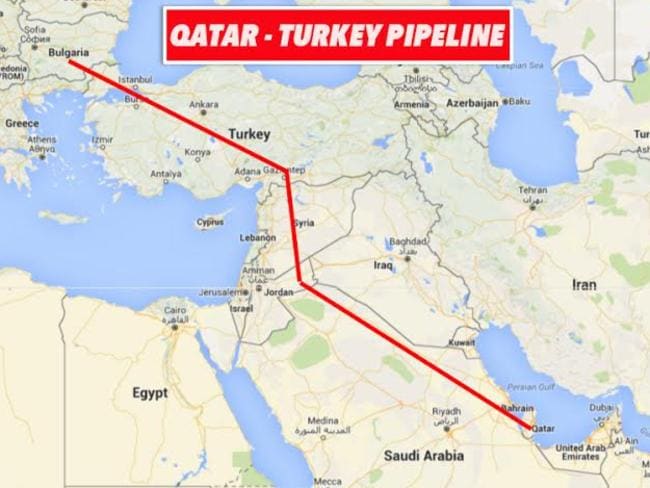
Back in December 2015, I explained what Syria was all about and why the Obama Administration wanted to invade to help Qatar get a pipeline through Syria to compete with Russia selling gas to Europe. I explained there were two pipelines one approved by Russia from Iran through Syria and the other Obama agreed to with Qatar also through Syria. The American press supported Obama by trying to make everyone believe Obama cared about innocent civilians being gassed. Nothing was further from the truth and the US was supplying the weapons to rebels who were slaughtering people and throwing them in mass graves. Obama turned a blind eye because the pipeline was more important than people in Syria.
Finally, after more than one year from when I reported the real truth behind Syria, the Australian Press has now broke the story. The question is why now? It seems the media will now switch the focus and claim Trump is the one doing this for the pipeline now that their favorite son, Obama, is out of the picture. Mainstream media is out to defeat Trump. That is what they are directed to do from their big corporate owners who Dan Rather exposed in 2008, but now defends the press as being honest and real and the devil is Trump claiming they are fake.
Interesting how they can hide the story to help Obama and then flip the same story to attack Trump. It looks like Trump is falling prey to being set up to think this is really about chemical weapons and saving people. Sorry – that was all BS. The evidence came out that it was the rebels supported by Obama who were using the chemical weapons. Investigations revealed that back in 2013, they used sarin gas – not the Syrian government.

Syria Chemical Attack: Push For Ousting Bashar al-Assad
Published on Apr 6, 2017
Support Us: http://www.freedomainradio.com/donate
MP3: http://www.fdrpodcasts.com/#/3643/syr…
Soundcloud: https://soundcloud.com/stefan-molyneu…
After reports of a chemical attack in Syria, the mainstream media and the political establishment are pushing for the ousting of Syrian President Bashar al-Assad. What do we actually know about this chemical attack and why has there been such a quick push for further United States intervention in the Middle East?
Sources: http://www.fdrurl.com/syria-chemical-…
Your support is essential to Freedomain Radio, which is 100% funded by viewers like you. Please support the show by making a one time donation or signing up for a monthly recurring donation at: http://www.freedomainradio.com/donate
Get more from Stefan Molyneux and Freedomain Radio including books, podcasts and other info at: http://www.freedomainradio.com
Amazon Affiliate Links
US: http://www.fdrurl.com/Amazon
Canada: http://www.fdrurl.com/AmazonCanada
UK: http://www.fdrurl.com/AmazonUK
President Bashar Al-Assad
I agree it doesn’t make any sense for Assad to be doing this; so why would he?
SKOUSEN: NKOREA TRIGGER FOR WW3
Both North Korea and Syria I would say.
RON PAUL: CHEMICAL WEAPONS ATTACK IN SYRIA LIKELY A FALSE FLAG
The question that no one is asking is why would Assad do this? Why that is important is there was no logical reason to gas anyone!
Syria Attack – ISIS False Flag To Give Establishment Their War With Assad, Russia
These kids and people are dead but I doubt it was never gas. Those pictures looked staged to me.

