Congressional Representative Stressed About Twitter Causing Hate Crimes


Posted originally on the conservative Tree house on April 29, 2022 | Sundance

An emotionally unstable moonbat from the House of Representatives is “collectively stressed” because apparently Twitter ownership is directly connected to hate crimes on the streets.  (Source)

Being worried about Twitter creating hate crimes, is one fear higher than being chased by a turtle.

The Great Twitter Riots…..

…We Will Rebuild!

Florida Governor Ron DeSantis Remarks About New DHS Disinformation Bureau, The Ministry of Truth


Posted originally on the conservative tree house on April 29, 2022 | Sundance 

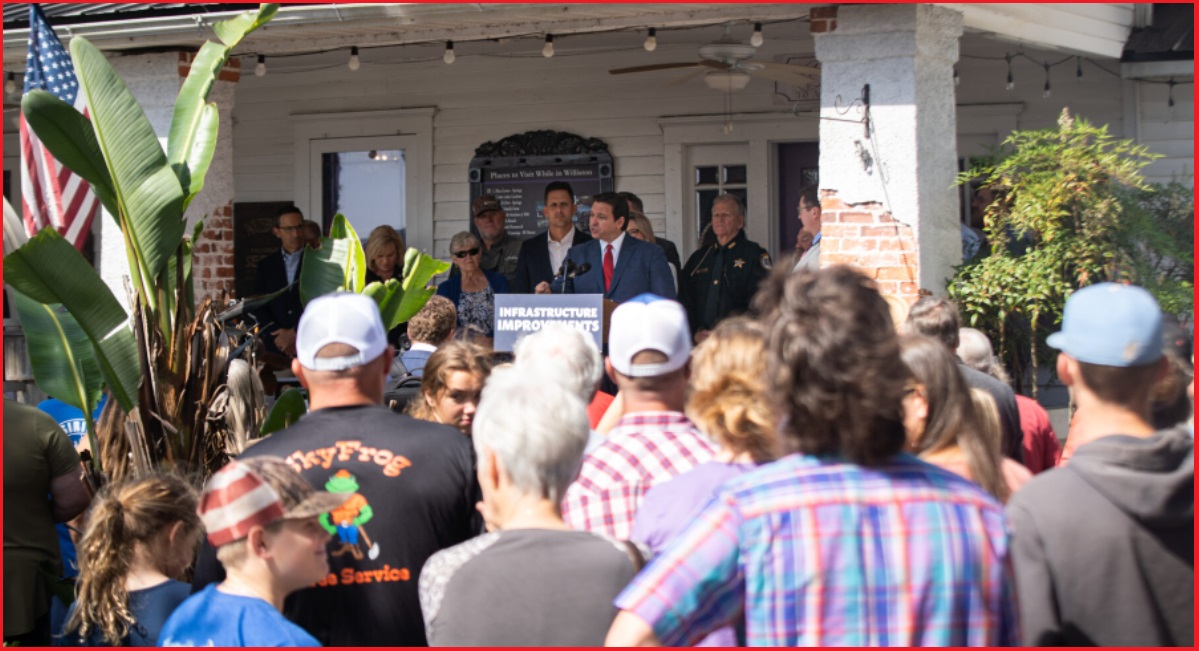
Comrades, earlier today dissident Governor Ron DeSantis spoke out against the latest effort of the Biden administration to create an official disinformation bureau with a dedicated mission to assist Big Tech and social media platforms in their control of speech. {Direct Rumble Link}

There is no dis-, mis-, or mal-information There is only information the Government wants you to hear, and the information the U.S. Govt disapproves of.  The DHS disinformation board is dedicated to dealing with the latter.

Governor DeSantis made his remarks during an announcement to expand Florida infrastructure.  WATCH:

BEA Release, Wages Rise 4.5 Percent but Inflation Rises 6.6 Percent, Workers Fall Further Behind


Posted originally on the conservative tree house on April 29, 2022 | Sundance

The Bureau of Economic Analysis (BEA) released March and first quarter (Q1) data today on personal income and outlays [DATA HERE].  The results show an increase in Q1 wages of 4.5%. However, inflation is running 6.6% on the items workers need to purchase.  The net result on Main Street is unsustainable inside the economy.  The U.S. stock market is responding negatively to this release.

It’s easy to get caught up in the esoteric weeds, so my effort here is to show just what is happening by putting an overlay of checkbook economics into the BEA release.  If we take out the noise it is very easy to see the problem.  I have modified TABLE-4 to put the results into simple understandable terms.

(Table 4, Source)

By looking at the far-right column (Q1 2022) you can see the problem.  Wage growth at $268.00, minus taxes paid $51.40, leaves disposable income or take-home pay at $216.60.  However, our expenses for living (shelter, food, utilities, energy, etc) cost $398.50, leaving a deficit for our income of $181.90.  We either dip into our savings to cover our expenses, or we go into debt.  This is not sustainable.

If you look at Q1 last year, you can clearly see where all of the inflation is coming from.  That massive increase in income came from the federal COVID bailout and stimulus funds.  $4 trillion directly pumped into the economy at a time when Biden justified massive bailout spending by saying they needed to offset the economic cost of prior COVID intervention (businesses and workers shut down).  That is the primary source of current inflation.

If you take out that Q1 spend from the economic activity, the U.S. economy was already contracting.  This is why CTH has continued to say our economy was in a state of contraction since June/July of 2021.  Everything after that massive dump of money was false economic activity; the GDP growth was artificial.  That bailout spending dried up in the fall and winter of last year and now we see the 2022 GDP going negative.

In essence the GDP contraction that we should have seen in 2021 was delayed by the massive infusion of cash in April of 2021.  However, that massive infusion of cash created inflation.  That inflation has been a crisis that grew from the summer of 2021 to its apex in the last month.

♦ So, what does all of this mean?

Let’s cut to the chase.  As CTH accurately predicted previously, inflation comes in waves because supplier purchases are done in contract terms of 30, 60 and 90 days.  As each contract for purchased goods expires, the new prices for future goods are changed.  We see waves of inflation in roughly three-month increments, and while prices were rising faster on a daily and weekly basis, those wave cycles started in October of 2021.

Wave 1, came Oct/Nov/Dec 2021.

Wave 2, came Jan/Feb/March 2022.

We talked about each wave as it was coming and as it arrived.  Ultimately, Wave-2 was bigger than Wave-1 as the cumulative increases the total supply chain and manufacturing flowed into the products we purchase.

♦ Where are we now?   There are two sub-sets:

• Inflation on durable goods is now at the apex.  The durable goods price flatlines right now as all production costs are embedded in the cost of the product.  The prices of finished goods are now set; inflation has caught up to production; the prices of on-shelf and inbound deliveries are higher, but stable.

Now, we enter the phase where consumer demand becomes the dominant factor in price.  Simultaneously, demand is contracting because the higher rate of inflation in highly consumable goods (energy, utility costs, housing, gasoline, food) is now a spending priority for consumers and eating a larger portion of wages.   As a result, the price of durable goods is now dependent on the ability of the consumer to pay for them.

Sellers of durable goods are going to be chasing a smaller customer base who can afford them.  Durable goods prices will remain static, and now durable goods prices will likely become part of the competitive equation.  The businesses within the durable goods sector are going to have to find customers in order to stay in business.  Incentives will show up this spring/summer as businesses need customers.   If you are a wise, careful and smart shopper for durable goods you will find deals

• Inflation on consumable goods is not yet at the apex.  It’s likely close to production parity, but prices pressures are still volatile in the upward direction. The price of gasoline and transportation overall will be a big factor in current prices of highly consumable goods.  We should see oil, gas and energy prices stabilize first.

Rents will likely increase for another three to six months, then stabilize (and, in my opinion start to fall late summer).

Housing overall is far more challenging as mortgage rates are climbing.  Refinancing as a method to bridge the income gap between wages and expenses is a big problem now in this phase.  There is going to be a period of massive fluctuations and instability in the housing market depending on region and employment stability as the recession phase of the total economy is going to bite hard.

For most regions with mixed blend underlying economies (products and services) macro housing prices have peaked in the last 15 days.  For ordinary housing purchases, not institutional investments, we should start to see price decreases again as the customer base for high prices shrinks.  Obviously, this is driven by inventory and regional specifics; however, I am talking in the aggregate within the macro housing situation.

Food prices still have some upward pressures through Memorial day.  Then a period of stability will settle, before the third wave of food inflation hits later in the summer/fall of this year; that’s when the increases in farming costs will reach the fork.

Late summer and fall food prices will likely be 15 to 20 percent higher than current prices at the supermarket.  The fresh foods will be on the upper side of the future price wave, and the processed foods on the lower end; however, both will increase.

The last factors in the food price are far more challenging to predict….  Supply?   Any problems within the food production cycle that impacts supply will drive prices, beyond what we already expect.  If there are major shortages, the prices will go even higher.

This food environment is unfortunately the best time for Big Agriculture, the Wall Street multinationals, to make the most profit.  The Big Ag multinationals will exploit every possible angle within inventory, supply and harvest controls to maximize their profit equation.  There are a great deal of unknown global variables right now that could impact U.S. food prices later this year.  The only certainty is that prices will further increase.

Joe Biden sucks.

.

Footnote, pray for good weather and stability this summer. If it is an active hurricane season, gasoline, oil exploration and refinery issues will make matters worse. The southern coastal areas, especially Florida, Louisiana and Texas need a non-dramatic summer.


Crisis is Shutting Down – Capital Flows Begin


Armstrong Economics Blog/Q&A Re-Posted Apr 29, 2022 by Martin Armstrong

QUESTION #1: Now that Canadian banks have proven themselves completely compromised by Trudeau and his bootlickers, is there a “safer” haven for $CAD? US$ accounts held by Canadian banks are available but are they really any better?

D

QUESTION #2: Dear Mr. Armstrong, Thanks to your Blog I learned a long time ago that Europeans should get their money out of Europe while they still can (into USA). I did that, but now the Wells Fargo bank asked me to close the account. Apparently because since Biden’s new government came to power a new Federal law requires now all banks (including in Florida) to get proof of a residence in the USA. I can not even enter the USA anymore because I’m not vaccinated. Could you please help? What can we do now? Thank you.

FV

ANSWER: I believe a European/Non-American can open an investment account such as a money market in the United States. I know that Merrill’s money market is done through a specific group at Merrill that only works with international clients. They then report back to your home country where you have an account. The hunt for money is really global now.

The US is already starting to cooperate with Europe given the capital flows to the US in the wake of the stupidity over Ukraine. As long as the West continues to fill the pockets of Zelensky, who is now believed to have $850 million stashed offshore, then there is no resolution. Zelensky has no incentive to negotiate an end to this as long as arms and money pour into Ukraine. Let Donbas go with Crimea, which is Russian anyhow, and stop pushing for World War III. The West simply wants war with Russia, or they would not be sending arms to Ukraine and pushing Zelensky to settle.

For now, the capital flows are pointing to the dollar as the safe haven given the prospects of war in Europe. This trend appears to be in motion into 2024. Thereafter, we have the risk of a global war on a grand scale.

The Refusal to Understand Economics


Armstrong Economics Blog/Economics Re-Posted Apr 27, 2022 by Martin Armstrong

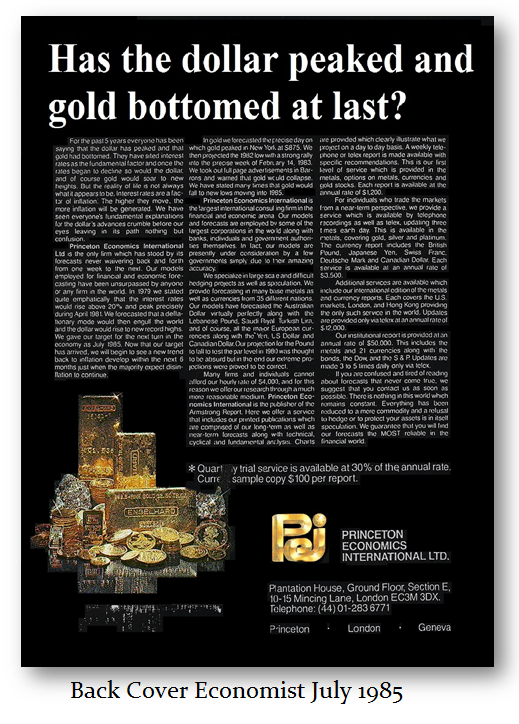
Once upon a time, I use to respect The Economist. I even took the back cover in July 1985 to announce that the Economic Confidence Model was beginning a new 51.6-year Cycle that was a Private Wave that would ultimately peak in 2032. I boldly announced the bottom in gold and the peak in the dollar taking the back cover every week in July 1985.

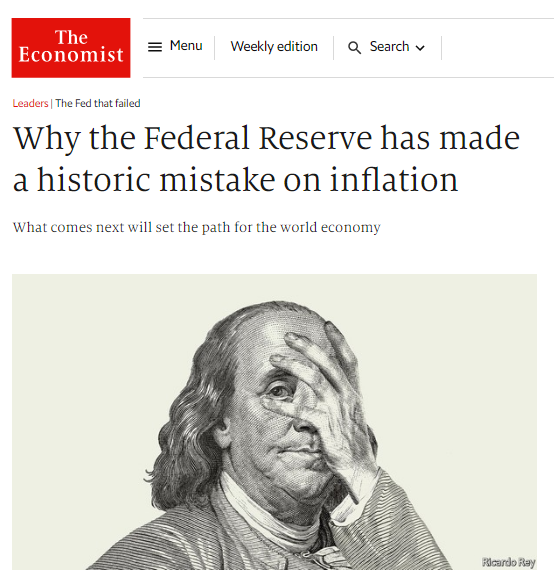
The Economist just released its cover article sadly demonstrating that the publication remains in the Dark Age of economics. They began:

“Central Banks are supposed to inspire confidence in the economy by keeping inflation low and stable. America’s Federal Reserve has suffered a hair-raising loss of control. In March consumer prices were 8.5% higher than a year earlier, the fastest annual rise since 1981. … It is the Fed, however, that had the tools to stop inflation and failed to use them in time.”

To say I am shocked at their reporting that is no better than a first-semester student in Economics 101. It reflects a complete lack of comprehension of how the economy even functions and adopts the politician view that they are NEVER responsible for inflation – it is always the central bank.

Clearly, they have not bothered to take notice that something major took place with the fall of Bretton Woods in 1971. Previously, the theory was if you borrowed, that was less inflationary rather than printing more money. Of course, that was a throwback to the days of Gresham’s Law when currencies traded in Amsterdam were based not on political-military power, but on the pure metal content. The debasement of the coinage by Henry VIII led to (1) the higher-based coinage being hoarded and (2) the decline in the value of English coinage trading in Amsterdam.

That theory became the Quantity of Money Theory which today is totally obsolete yet that is what we hear all the time when the Fed increased its balance sheet and therefore it should have been inflationary following 2008 but the Fed and other central banks could not create 2% inflation. That even led to some claiming MMT (Modern Monetary Theory) proves that the creation of money is NOT inflationary.

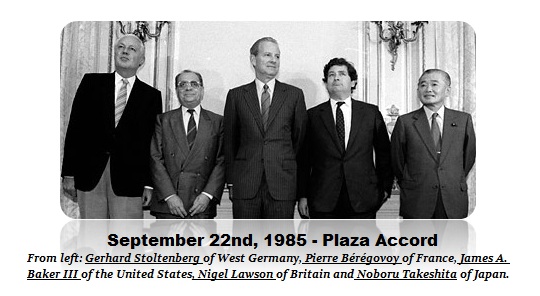
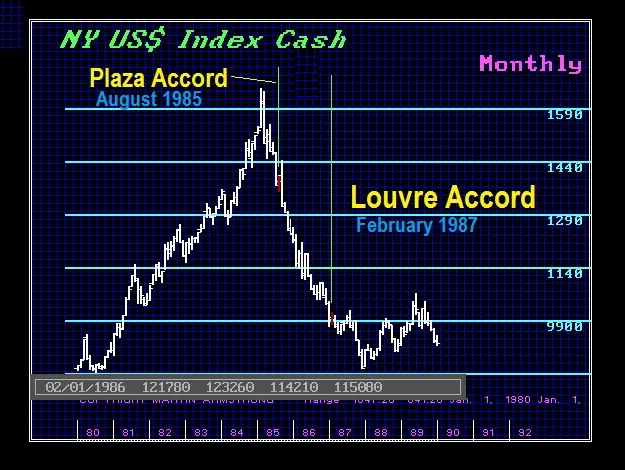
It was barely two months after we announced the beginning of a Private Wave in the Economist in July 1985 that in September 1985, the central banks were all called together and formed the G5 and then proclaimed that they wanted the dollar lower by 40%. This was James Baker’s brainchild that manipulating the dollar lower would reduce the US trade deficit and create jobs.

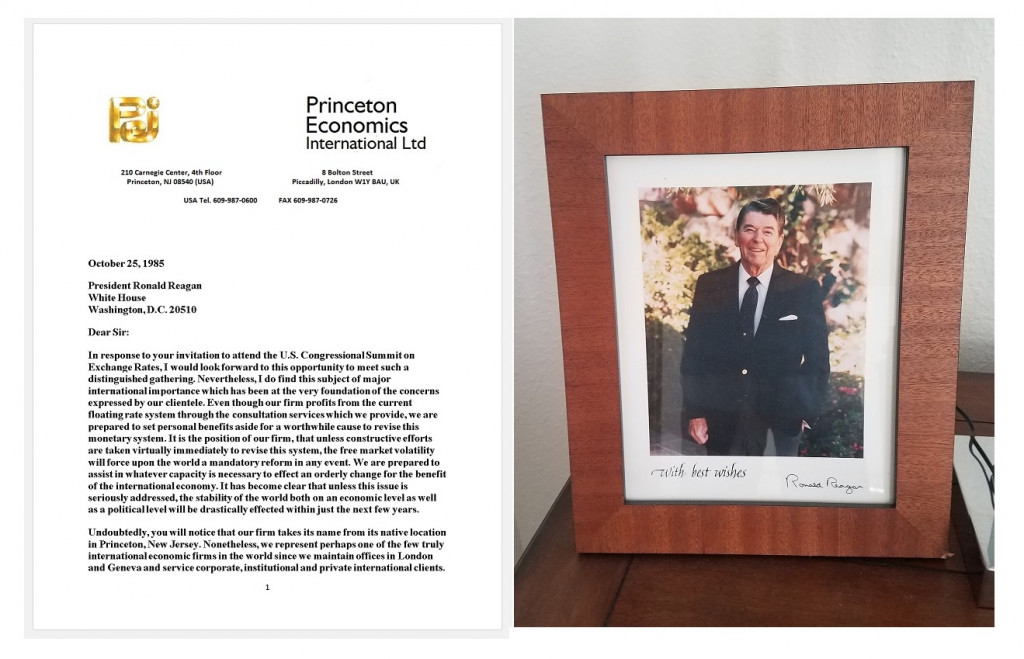
Letter Armstrong to Reagan October 1985 With Photo

I was summoned to be among the global experts who solicit advice but never listen. It is always a dog & pony show so they can pretend they summoned the top experts in the world and then announce what they intended to do anyhow. Of course, it is always pretended to be based on independent advice. However, that is just not how Washington or any government functions. So I wrote to President Reagan and warned that devaluing the dollar to reverse the trade deficit would lead to a crash.

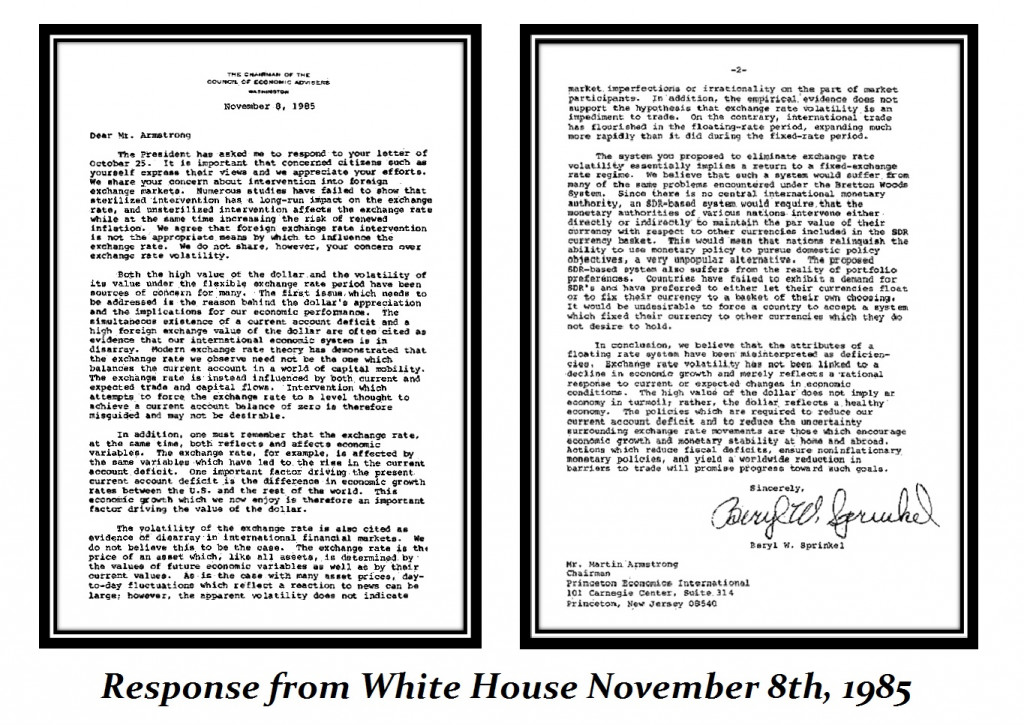
sprinkel-11081985

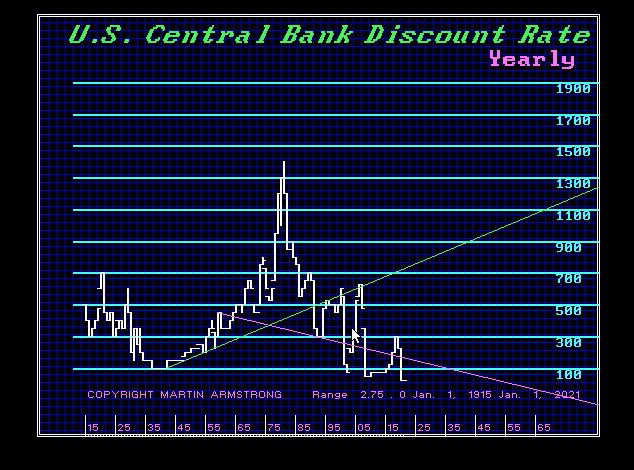
The present ordered Beryl Sprinkel who was the 14th Chariman of the Economic Advisers to the President (1985-1989) to respond. It had been the rise in interest rates to 14% under Paul Volcker to reduce inflation that led to the Deflation. Capital poured into the dollar for the high-interest rates which peaked precisely with the previous ECM wave in March 1981. Thereafter, the dollar soared driving the British pound down to $1.03 in 1985.

Clearly, the entire theory that the Economist is still clinging to currently is unsupported by the historical evidence. The raising of interest rates to stop inflation led to the explosion of the national debt thanks to the servicing costs. In 1980, the national debt stood at $907.7 billion. By 1989, the debt reached $2.857 trillion. The raising of interest rates created deflation near-term but expanded the inflation longer-term.

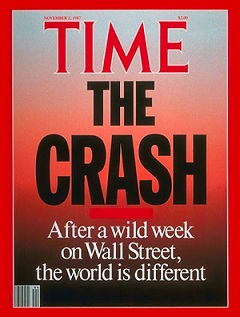
The Plaza Accord set in motion the 1987 Crash. They failed to understand that lowering the value of the dollar may have made US goods appear cheaper overseas to reduce the trade deficit, but at the same time, it also devalues all the US assets in the eyes of foreign investors. After selling more than one-third of the US national debt to the Japanese, the lowering of the dollar by 40% would mean a 40% loss on their holding of US debt.

As the dollar began a free-fall, the central banks began to realize this was a mistake. The Louvre Accord was an agreement, signed on February 22, 1987, in Paris, that aimed to stabilize the international currency markets and halt the continued decline of the US Dollar caused by the Plaza Accord. The agreement was signed by France, West Germany, Japan, Canada, the United States, and the United Kingdom. Italy declined to sign the agreement. The Group of 5 became the Group of 7 – G7 (now G20).

The G7 meeting of central bankers and finance ministers in Paris announced that the dollar was now “consistent with economic fundamentals.” They announced that they would only intervene when required to ensure foreign exchange stability. The objective was then to manage the floating currency system.

Democrats gained control of Congress in 1986 and immediately called for protectionist measures. The dollar depreciation agreed to in 1985 at the Plaza Accord, failed to really improve the trade perspective. In 1986, the trade deficit actually rose to approximately $166 billion with exports at about $370 billion and imports at about $520 billion. The object of manipulating currency to try to create jobs and alter trade flows proved to be completely false.

My concerns warning the White House that volatility would increase made back in 1985 were materializing. What they did not understand was that lowering the dollar in value also led to a shift in capital flows and the selling of US assets. Foreigners were suffering losses by financing U.S. trade by purchasing United States Treasury bonds in an attempt to ease the trade deficit criticism. We were advising the Japanese to buy gold on the New York COMEX, export it, and then resell which would also make it appear that the US exports were increasing. However, the lower dollar was then resulting in the importation of inflation into their own nations.

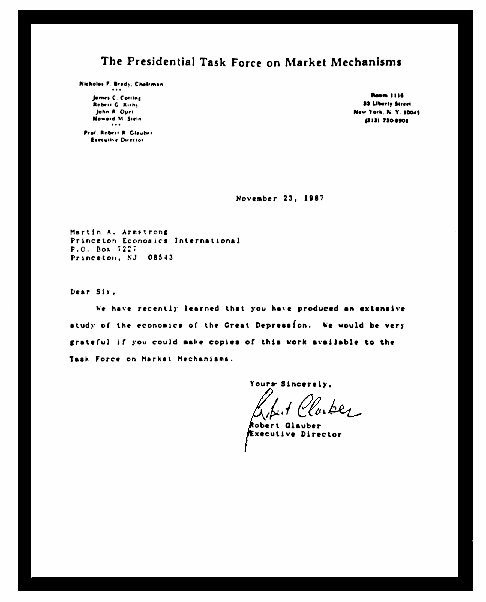
The press back then never understood the crash. I was called in by the Brady Commission charged with investigating the causes of the Crash. Of course, they would not blame the government. The best I could do was to prevent a witch-hunt on Wall Street and the final report casually mentioned that they believed foreign exchange had something to do with it.

There is probably nobody else who has dealt with more central banks than me from China to Switzerland and into the Middle East. To read this cover story by the Economist was indeed shocking. They are obviously still under the impression that inflation is the result of the rise and fall of the money supply that dates back to the days of Henry VIII. I dare say, things have changed slightly.

Today, governments have borrowed relentlessly. But the debt is acceptable now as collateral so national debts are simply money that pays interest. That is completely out of the scope of the central bank so it DOES NOT have the tools to prevent or create inflation. The politicians always want to spend whatever it takes to win the next election and then blame the central bank if it resulted in inflation. It is a sad day that the Economist is so out of touch its rambling and that of someone serious out of touch with reality.

Wealthy Flee Shanghai


Armstrong Economics Blog/China Re-Posted Apr 22, 2022 by Martin Armstrong

The lockdown in Shanghai has caused immeasurable damage to the people and battered an already stunted global supply chain. The wealthy are now fleeing the city, as numerous agencies have reported a large uptick in immigration requests. The Financial Times reported a 7-fold increase in the search term “immigration” among residents.

The media has downplayed this story as they do not want the people to remember governments’ capabilities. As with the fall of many great cities, the wealthy are the first to leave. Shanghai may be one of the richest cities in China, but it is not immune to government tyranny.

Only 25 deaths in Shanghai were attributed to the coronavirus, but over 25 million people directly suffered from this lockdown. The lockdown was not about safety. Warehouses are beginning to open, but the world’s largest port ceased operations. Again, no world leaders commented heavily on these major issues.

Pets of the “infected” were eliminated by the government. There were reports of people jumping from high rises and others begging the police to take them to jail with the hope of having a meal. No world leaders have commented on these human rights abuses as they were done in the name of COVID.

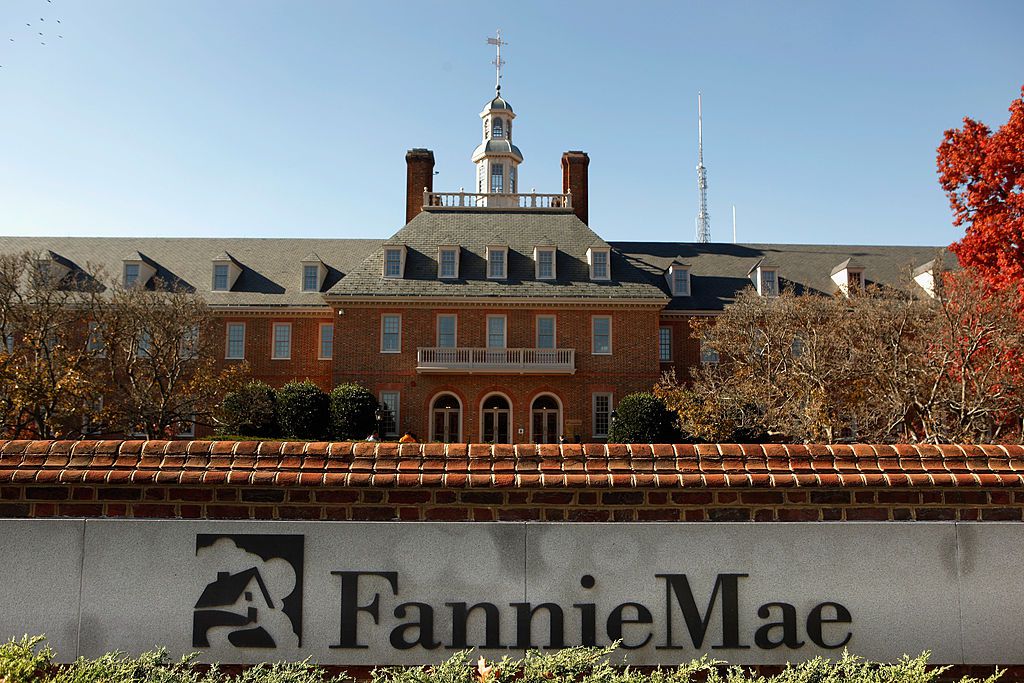
Fannie Mae Forecasts “Modest Recession” in 2023


Armstrong Economics Blog/Economics Re-Posted Apr 21, 2022 by Martin Armstrong

Fannie Mae forecasts a “modest recession in the latter half of 2023” and believes the house-buying frenzy will begin to cool in the US. The Federal Reserve’s hawkish direction to curb inflation has led the agency to believe that a “soft landing” for the US economy is unlikely.

“With the most recent inflation readings at levels not seen since the early 1980s and wage growth exceeding that which is consistent with a 2-percent inflation objective, we believe the odds of a soft landing are even lower. Returning to the Fed’s policy target, therefore, likely necessitates economic growth slowing sufficiently to lead to a rise in the unemployment rate, which would cool wage and price pressures.”

Naturally, they see mortgage rates rising. Home sales for 2022 are now predicted to decline 7.4% compared to their initial forecast of 4.1%, while sales in 2023 are expected to decrease by 9.7% (initial projection: 2.7% decline). Adjusted for inflation, Fannie Mae sees house price growth approaching 0% by the end of next year.

Mortgage credit is not a factor as it was during the Great Recession and the checks and balances are in place after the 2008 scare. New construction is also expected to help with the “eventual recovery” as there is a lower inventory relative to demographic demand. Mortgage rates are now hovering around 5% after rising 1.95 percentage points since the December low. A similar spike in mortgage rates occurred in 2013 and 2018 and led to a downturn in home sales.

Interestingly, Fannie Mae has specified that the coming “modest recession” is “COVID-driven” and even admitted that the business cycle is at play:

“We have previously posited that the current business cycle would likely be shorter than those of the past few decades. GDP growth surged in 2021 after the relaxation of many COVID restrictions – also supported by historic income transfers and monetary policy easing – which led to a swift recovery but also planted the seeds of inflation. Therefore, despite only two years having passed since the COVID-driven recession of 2020, the economy has already moved into what could be described as the mature stage of the business cycle. Specifically, the unemployment rate is below the “full employment” level, inflation is accelerating as growth slows, and the Federal Reserve is beginning to tighten policy. These conditions typically mark the beginning of the end of an economic expansion.”

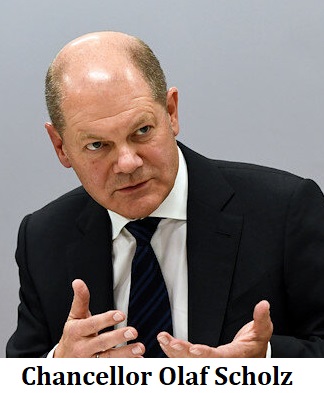
German Govt Release Inflation Data, Hyper Production Inflation Surpasses 30 Percent, Highest Rate Since 1949


Posted originally on the conservative tree house on April 20, 2022 | Sundance

The German government released their version of the producer price index for inflation, and they are reporting 30.9% inflation for products leaving German factories.  [DETAILS HERE] That’s the highest rate of inflation since shortly after the second world war.

The inflation rate is being driven mostly by energy costs which are more than 80% higher than last year.   However, each nation’s overall inflation rate is also driven by the amount of central bank spending they used during the COVID economic lockdowns.  The more any govt spent on subsidies, the more money they printed, the more they devalued their money and subsequently, the higher their current rate of inflation.

Germany is the largest economy in the European Union.  This level of inflation within Germany has major ramifications.

First, with this level of energy inflation Germany cannot afford to stop purchasing Russian energy products.  There’s no way for Germany to join or increase western sanctions against oil and gas they need to stay sufficient.  Germany is dependent on Russian energy.

Second, with Germany’s economy this vulnerable; and with Germany being so dependent on Russian energy; Germany will have to distance itself further from any Ukraine assistance.   In the background of western voices already being upset with Germany for not providing more support for Ukraine, their economic vulnerability explains their unwillingness.   The U.S. proxy war against Russia does not benefit Germany, at all.

Third, as a result of the first two points, Volodymyr Zelenskyy will be even more mad than he was yesterday.  Additionally, the German position makes Biden more vulnerable because it forces the U.S. to take a bigger public footprint on the entire operation.  This explains why the people in the background of the White House are saying Ron Klain needs to quickly extricate Biden from his unilateral focus on Ukraine.

If the White House doesn’t cut Zelenskyy loose soon, the anchor of fail Ukraine represents will further sink Biden.  Sooner or later the White House, Administrative Deep State, Dept of State and Intelligence apparatus along with the total foreign policy establishment and all the politicians who benefit financially from their use of Ukraine, are going to have to give up.

With countries like Germany needing to back away, it becomes harder for the Biden administration to retain the false front around NATO as a justification for their intervention and money laundering operations.

Additionally, if the French election goes to Le Pen on Sunday, well, katybar the door – because it’s complete and total game over…. Ukraine will be cut loose and someone from the CIA will assassinate Zelenskyy on the way out, leaving a note on the nightstand that says, “Putin did it.”

GERMANY – German annual producer price inflation topped 30% in March, the country’s Federal Statistics Office said on Wednesday. That’s its highest level since the agency began collecting data 73 years ago.

The biggest culprit? Energy prices, which rose nearly 84% from the same month last year. “Mainly responsible for the high rise of energy prices were the strong price increases of natural gas… which was [up] 144.8% on March 2021,” the statistics office said in a statement.

It is one of first signs of the huge impact Russia’s invasion of Ukraine is having on the German economy, Europe’s biggest. Producer prices rose by nearly 5% between February and March alone.

Consumers should brace themselves. Factory gate inflation feeds into retail prices, and shoppers can expect to spend more on everything from furniture to meat, according to Wednesday’s figures.

German consumer price inflation is already at a 41-year high, hitting 7.3% last month. Energy prices were the main contributor, up almost 40% from the previous month.  (read more)

March Retail Sales Report Shows Contraction in Non-Essential Consumer Spending


Posted originally on the conservative tree house on April 14, 2022 | sundance 

The U.S. Census Bureau {LINK} reports the March retail sales data {pdf LINK} showing a contraction in sales overall (excluding gasoline) and a massive contraction in on-line sales.  As we expected, we are seeing the continued demand side contraction for non-essential purchases.

First, when you review the data, keep in mind all of the statistics are based on dollars.  Currently the BLS calculates the rate of inflation at 8.5 percent year over year. So, when we look at retail sales figures, we must remember the items being sold cost more.  Any reported sales figures in a sector that do not exceed the inflation in that sector, indicates decline in units sold.

The top-line for March retail sales is 0.5% growth; however, the rate of inflation is 8.5%, so the amount of goods sold is substantially less than the 0.5% dollar increase would indicate.  Subtract the sales of gasoline (w/ massive price increases), and retail sales are negative (-0.3%) in March.  SEE TABLE-2

A good category to note the contraction in non-essential purchases is electronics and appliances.  Again, CORE inflation in that segment is around 6%, and yet total sales were only 3.3% higher, meaning less actual units sold.  Compared to 2021, electronics and appliance sales dropped 9.7%.

Showing how much people are pinched, gasoline prices are around 60% higher than this time last year, yet gas station sales only increased by 8.9%.  This means people are buying a lot less fuel at much higher prices.  People have shifted their transportation habits because gas costs so much.

Two more very interesting notes:

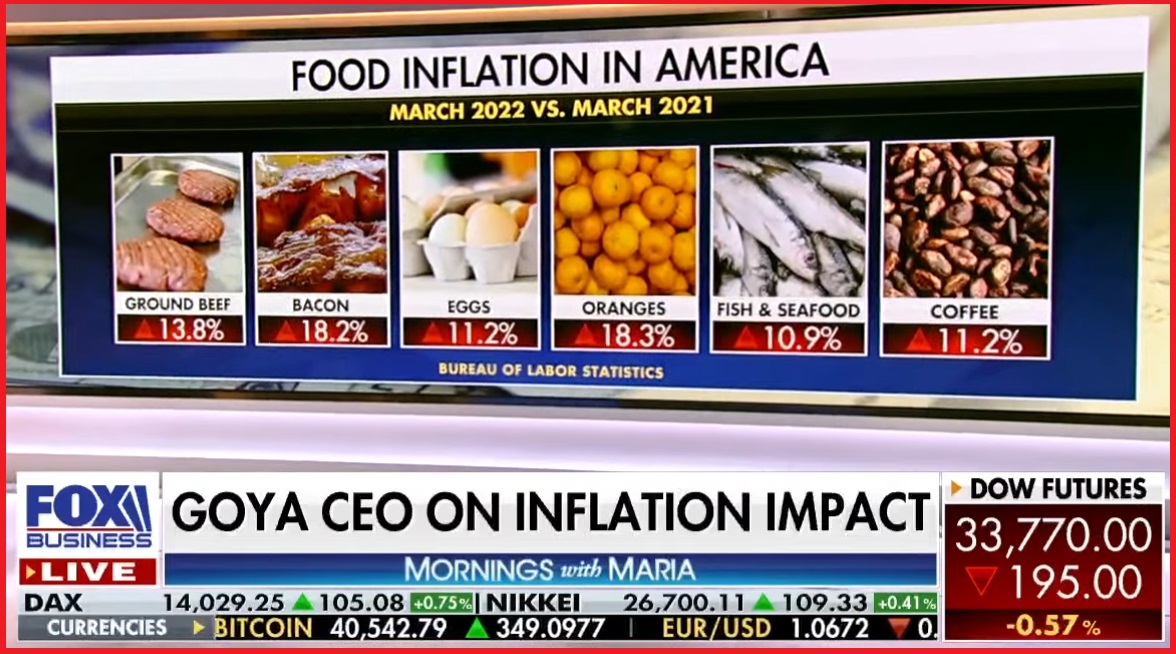
Food and beverage stores only reflected a 1.0% increase in sales, amid massive inflation in that sector.  People are buying less food at higher prices.  The year-over-year rate of retail sales increase for supermarkets is 8.4%, however, prices in the grocery store are well beyond 20%.  Again, food prices are changing shopping habits.   You can see the same trend in Health and Beauty Care products.  Consumers are being thrifty and prioritizing their expenses away from non-essentials.

Secondly, perhaps the most obvious shift in consumer spending is noted in on-line (nonstore) retailers.  March retail sales dropped 6.4 percent for on-line shoppers, again as a consequence of much higher on-line prices and some product unavailability.

The bottom line of the Retail Sales report is not unfamiliar to us.  What we are seeing is a lessening in overall consumer spending, as the costs for food, fuel, energy and housing have skyrocketed.   The demand for non-essential purchases is what we would naturally expect to see amid a nation having to make tough purchasing decisions based on inflation.

The economic policy of the people behind Joe Biden is catastrophic, and it appears to be a feature not a flaw.

That said, wise people -including people here- know how to extend their budgets and make use of raw ingredients for multiple purposed meals.  Keep doing that as much as possible to offset the dramatic increases in price.  Look for sales, use coupons, multipurpose products and be smart with purchase decisions.

We can and will get through this together.

If you have tips for people to assist with lowering costs of everyday items, please feel free to share them in the comments section below.  We always find excellent ideas around us for small ways to save.

Coming from a family whose Tupperware® was a matching set of Cool Whip containers, I can tell you there are times when being frugal is a valued skillset.  I welcome all the great advice we share as a community, and I will not let these horrible government officials remove joy.

I’ve been broke more than most, but I ain’t never been poor.

I appreciate you.

Inflation Rate Jumps to 8.5 Percent as Energy, Food and Gasoline Prices Skyrocket


Posted originally on the conservative tree house on April 12, 2022 | Sundance 

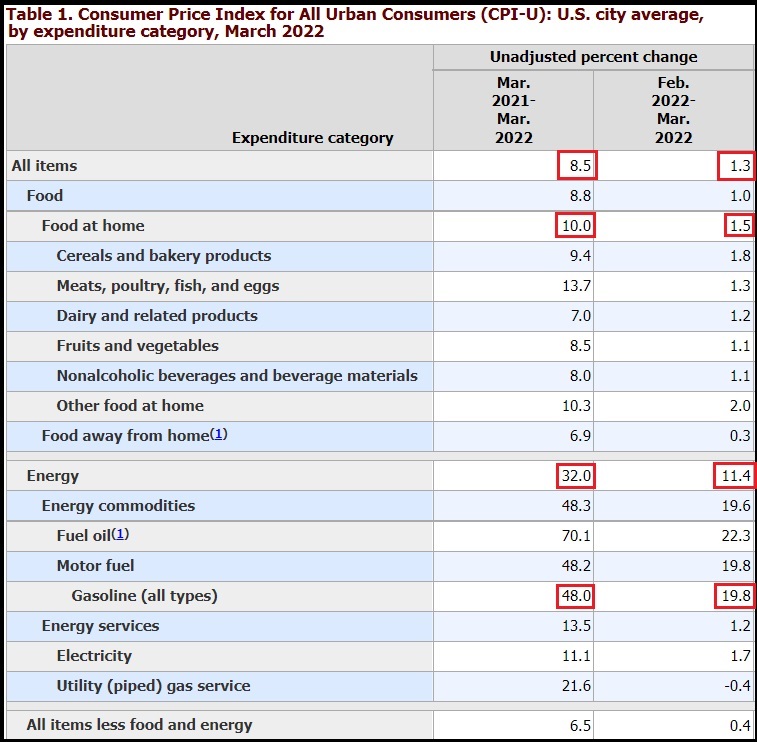
This is not going to be news to CTH readers and intellectually honest analysts.  The Bureau of Labor and Statistics has released the March consumer pricing data [DATA HERE] showing the recent surge in energy, gasoline and food costs that we have all felt.

The monthly increase of 1.3% brings the annual rate of inflation to 8.5 percent year-over-year.  However, the details tell the exact story we have been outlining for well over six months.   This is the second wave of inflation being recorded.  Grocery store prices (food at home), energy prices, and gasoline prices are all driving the inflation rate. [BLS Table 1]

Again, I modified Table-1 to take out the noise.  The data shows what we have felt for the past two months.  Working class families are feeling the pinch as their wages cannot keep pace with the increase in prices on products that are a priority.  Food, housing, gasoline, energy.

If we were using the old CPI method for analysis, current inflation would be well above 20%.

That said, there are issues also inherent and visible in the data for the non-food and energy segments, what I would call the durable goods side.  First, we are seeing the beginning of the durable good contraction getting quantified as we have previously discussed.   The prices for used vehicles, electronics, appliances and other non-critical durable goods are now flatlining, or even dropping in price.

Every indication within the economy indicates this is being caused by a demand contraction.  People are not purchasing durable goods because their disposable income is gone.  This lack of demand also shows up in wage rate suppression.  Despite high employment, wages are not rising – in part because there is excess productivity in the durable good economy.

You will note from Table-2 [available here] that food away from home, restaurant food, is not climbing as high as food at the grocery store (0.3% -vs- 1.5%).   Restaurants are trying to keep prices down and their profit margins are being eroded.  They are in a tough place, because if restaurants raise prices, they may lose customers who are already feeling pain in their checkbooks.  However, they cannot hold out much longer before raising prices, because the price increases are permanent.

The good news is the March data appears to quantify the apex of the second wave rate of inflation.  The rate of increase in food, fuel and energy will now start to moderate and slow down.  The prices may, likely will, keep going up, but they will go up less dramatically than they have in the past six months.  This price plateau will hopefully remain in place until late summer, that’s when the next harvest food costs will hit in Wave-3.

On the durable goods, what we will see now is a typical demand side issue.  Price increases for durable goods will quickly, if they are not already, be less connected to material costs and more connected to demand.   Obviously, the cost to manufacture, create, produce, transport and deliver durable goods is still experiencing upward pressure due to raw materials.  However, the demand variable will now enter more dominantly.

With wage growth meek and prices still rising on essentials like food, housing, energy and gasoline, demand for non-essential durable goods will drop. The demand decline should naturally put downward price pressure on appliances, electronics, used vehicles, etc.  Unfortunately, this also contracts the overall economy, creates unemployment, and indicates “stagflation.”

(MSM) – […] The consumer price index leaped 8.5% annually, the fastest pace since December 1981, the Labor Department said on Tuesday, likely cementing Federal Reserve plans for an unusually large half-point interest rate hike early next month. That increase is up from 7.9% in February and inflation now has notched new 40-year highs for five straight months. (more)

We will need to watch the service side closely now to see if consumers start to lessen travel, entertainment, and other service side expenses.

Protect your family.  Be frugal, wise and smart with expenses.  However, do not trouble yourself with dark imaginings.

If you are like most here, you have prepared yourself with commonsense actions and you are a doer who fixes problems, not a naysayer who sits around mulling over them.  Your family, kids and/or grandkids as well as your community can benefit from wise, albeit sometimes stern, counsel.  Stand strong, stand firm and stand resolute.

All of these challenges are simply that, challenges.  Work any problem as it arises, including for the kids.  And also remember, God is in charge, not you. So, listen to his instructions.  Listen to that instinct he buried within you.  Draw upon the strength that a loving God constantly provides.

Be a vessel for those who need hope.  Be a guiding light for those who feel distressed. Be cheerfully strong among everyone around you, and thankful for all the kindness you experience.  If you get stuck, start giving….

Ultimately, everything is a choice.  So, be the lighthouse, not the rocks.

P