Corporate Buy Backs


Many people are confused as to why corporations have been buying back their shares in mass. The latest figures for 2018 are in and they demonstrate that the S&P 500 listed companies spent more on dividends and buybacks in 2018 than they actually made in total reported earnings ($1.26 trillion vs $1.1 trillion). What is really fascinating is that of the 500 listed companies, 444 have bought back their own shares. Buybacks alone have actually come in at 66% of reported earnings over the last five years. Since 2014, buybacks and dividends combined have exceeded the total increase in S&P 500 market capitalization by $1.3 trillion. In other words, buybacks alone represent 87% of the increase in S&P 500 market capitalization during that period.

Buying back shares at this stage has been massive, but companies have been taking advantage of the cheap interest rates. When interest rates collapsed to artificially low levels, it became economically more efficient to buy back the shares at such a low cost, and this, in turn, will increase the dividend yields. This mix of low interest rates has had a reverse impact on equities. There is no question that companies are keenly aware of just how important their buyback programs are to their share prices. As long as interest rates are cheap, then it’s hard to see them stopping unless the cost of borrowing forces them to do so. This is also setting the stage for a shortage in equities when capital begins to realize that there is a huge problem brewing on the public debt side of the balance sheet.

Steve Bannon Discusses EU Election Victories and President Trump’s Strategic Visit to Japan…


Steve Bannon is in Paris, France as the nationalist wins in the EU parliamentary election results fill the headlines.  Additionally, Bannon gives his opinion on the strategic importance of President Trump’s recent state visit to Japan.

.

Economic security is national security“… I would emphasize the strategy within the multi-layered geopolitical economic reset is all President Trump.  The restoration of a sovereign U.S. economy, and the increases in Main Street American wealth, is Donald Trump’s primary agenda item.  The President listens to advisers on a variety of economic and trade matters, but the America-First policy strategy is all his.

Home Safe From Japan – Marine One Landing…


Excellent video of President Trump and First Lady Melania returning to the White House following a three-day state visit in Japan.   The video is even better if you play “Ride of the Valkyries” in the background:

MAGAnomics – Consumer Confidence Jumps in May – Main Street Defies Wall St…


Despite the professional doomsayer predictions from the professional financial class of Wall Street investment punditry, Main Street is upbeat and consumer confidence is strong.

Tariff-Man Winning

“Consumer Confidence posted another gain in May and is now back to levels seen last Fall when the Index was hovering near 18-year highs,” said Lynn Franco, Senior Director of Economic Indicators at The Conference Board. “The increase in the Present Situation Index was driven primarily by employment gains.

Consumers expect the economy to continue growing at a solid pace in the short-term, and despite weak retail sales in April, these high levels of confidence suggest no significant pullback in consumer spending in the months ahead.” (more)

Never is the disconnect between Wall Street and Main Street more visible than in the predictions -vs- reality for the growing/strengthening American middle-class.

The professional financial punditry can’t explain it.  Flummoxed academics run around bumping into walls amid economic numbers that continue to defy expectations.  All caused by a simple return to common sense ‘America First’ MAGAnomics.

Low unemployment (3.6%); wages growing (+3.2%); inflation stable (1.6%). These measures all have a cumulative impact on paycheck-to-paycheck Americans. Prices for durable goods are stable and wage growth is exceeding inflation. That means more disposable income in the middle-class…DUH. Which, when combined with the increased pay from lower middle-class tax rates, is exactly the intended outcome of MAGAnomics.

WASHINGTON (Reuters) – Consumer confidence jumped in May as households grew more upbeat about the labor market, suggesting the economy remained on solid ground despite signs that activity was slowing after being temporarily boosted by exports and a build-up of inventories.

The surge in confidence reported by the Conference Board on Tuesday came despite an escalation in tensions in the 10-month trade war between the United States and China, which sparked a sharp sell-off on Wall Street. It mirrors strength exhibited by another sentiment surveys in the middle of this month. (more)

World View v Domestic & Why It Has Been Always Wrong


COMMENT: Mr Armstrong, I want to thank you for I listened to the forecasts of analysts who said Europe and Emerging Markets were the best places to invest because the US was overpriced and would crash. I was introduced to you by a friend. I listened. I cut my losses and switched to the domestic market. Your analysis saved my future.

I cannot thank you enough.

HA

REPLY: I was a hedge fund manager. I used to manage a fund for Deutsche Bank (Track Record). The reason analysis is so bad is because of regulation. We have the SEC & CFTC and the regulations between them are incompatible. You could never have a fund domestically where you would actually hire a fund manager who made that decision for you. Because of the regulation, you had fragmentation. Funds that sold Munis, other tech, others IPOs, high growth, etc., etc. etc. There was no domestic fund that would make those decisions for you because there was no single entity that served as the regulator as is the case outside the United States. Too many chiefs and no Indians, as they say.

The offshore hedge fund began, not a real hedge, but as a fund where the manager made the decision and could invest in anything. Today, hedge funds have lost their way. The idea that they would offer an alternative strategy that would move opposite to standard funds was really a sales job. Often, hedge funds have not performed because of biased domestic views. That was NEVER the way I managed the fund. I was named “Hedge Fund Manager of the Year” back in 1998 because my strategy was to make that decision on a global scale of what to be in and out of. I was not trying to lose money deliberately as a hedge when the market rallied and I saw its mirror image. I never got that idea of a hedge fund nonsense. My job was to pick the winners on a global scale and avoid the danger areas like Russian back in 1998.

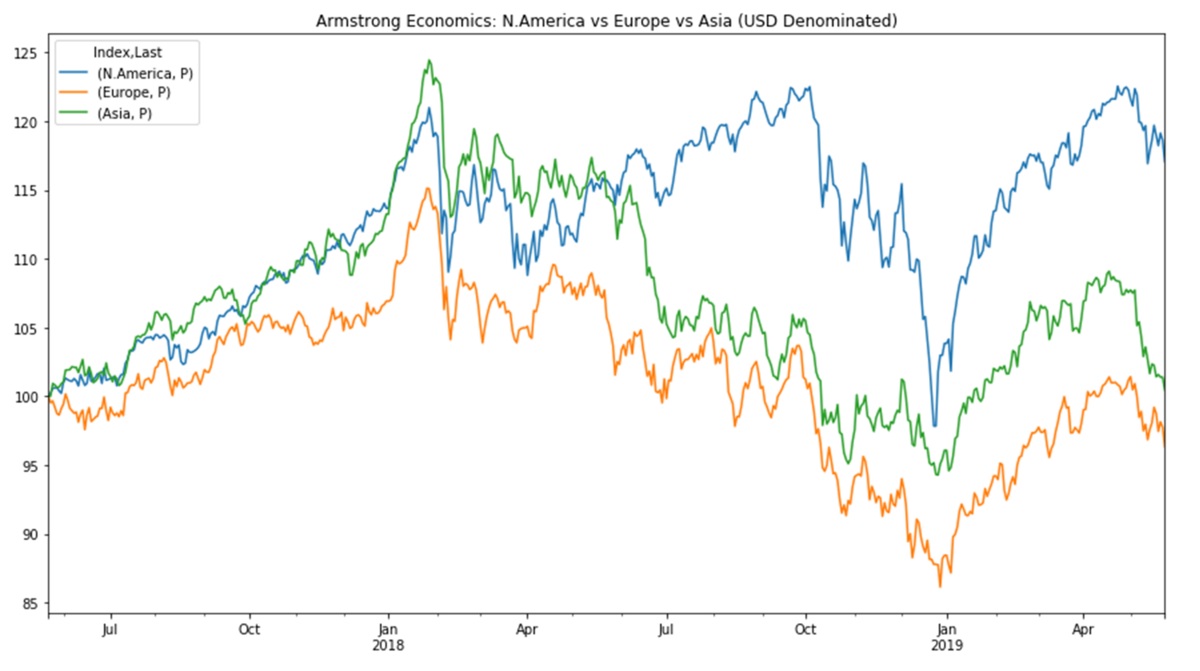
If we look at the world in REAL VALUE terms, that means we MUST look at everything filtered through currency. Here is our index of the world. We take Europe and Asia, combine the indices and then replot them in dollars. This clearly shows that we ABSOLUTELY MUST include currency into the analysis. We can see that the US share market has dramatically outperformed everything else in the world.

I had to always consider geopolitical risks. Knowing when there was a risk of war or political uprising was important. Understanding the trends in weather was critical, as was evident from the Great Depression. Even keeping an eye on earthquakes and correlating that to the global economy was also obvious from hist – e.g. the 1923 Japan Earthquake and the 1906 San Francisco Earthquake that eventually contributed to the creation of the Federal Reserve. The realization that the world economy was dynamic meant we had to respect the various different influences each factor played in the outcome of the whole.

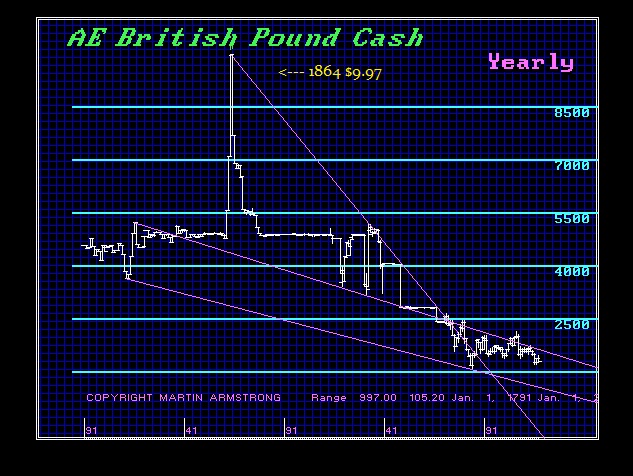
Yet, none of this would be possible without also considering capital flows and currency movements. The currency became the means for capital to vote on a global scale as to who it trusted and who it did not. Here we can see that the British pound reached $9.97 in 1864 against the dollar. It fell to $1.03 in 1985. The trend of the currency cannot be ignored.

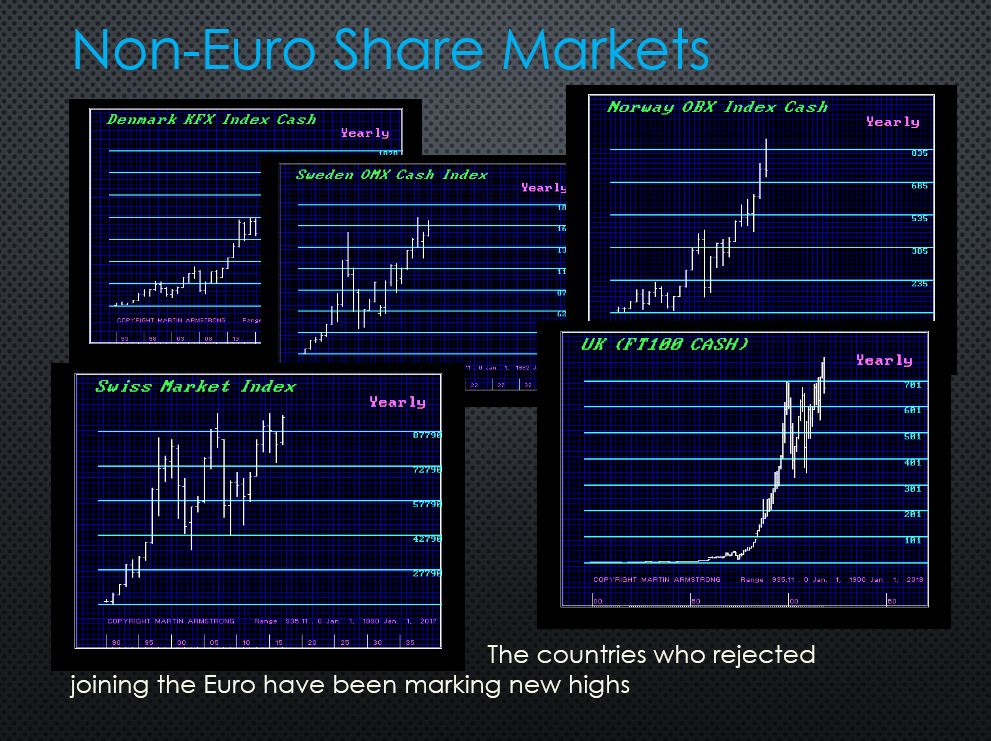
Here are the share markets based in euros. All peaked in 1999 to 2000, except Spain which entered the euro late. How any analyst could recommend Europe two years ago was just nuts. This demonstrates that they do not understand international capital flows or the importance of the currency in making such forecasts.


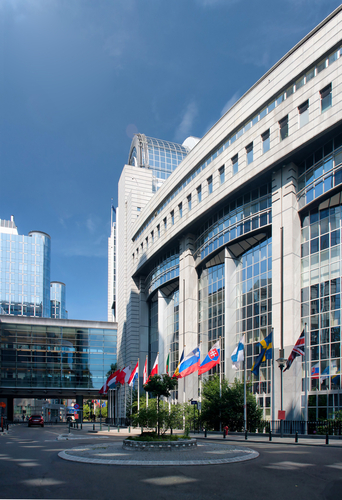
Now, look at the European share markets that are NOT in the Eurozone. They have all made record highs. The difference has been the currency and regulations pouring out of Brussels with self-interest in maintaining the European Project, even though it has failed.

This is not my opinion v everyone else. This is simply looking at the facts, not propaganda, and letting the fact lead to the conclusion.

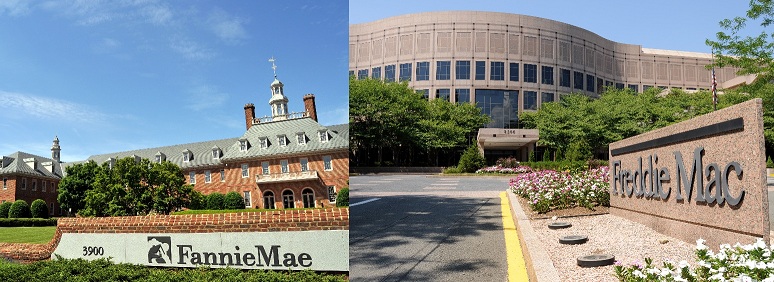
Fannie & Freddie to go Public in 2020?


QUESTION: Hi Martin ! always wondered What would be the outcome of Fannie/ Freddie going private ? they have been trying this for years, but now looks like they are giving it another try and may be successful under the guise of ” protect the taxpayer ” …. what do you think will be the ramifications especially for real estate REITS and MREITS as well as homeownership going forward .

Thank you

JD

ANSWER: Fannie Mae and Freddie Mac are two companies that are in the longest conservatorship perhaps on record. Because the law governing these agencies is separate from banking conservatorship law, judges have largely done nothing about Fannie and Freddie shareholder complaints to date. The government’s 2012 net worth took all of the money that they said was worthless back in 2008-2011 that was on the balance sheets. Keep in mind that FHFA was acting as conservator when this was all agreed.

Fannie Mae and Freddie Mac will be allowed to retain capital, but the Senior preferred securities purchase agreement will be amended and the lawsuits will be settled in order for the companies to go to the public markets and raise new money via selling new equity to investors. They would like to do an IPO by 2020. After the balance of the senior preferred gets written off, the warrants will be exercised and the junior preferred will likely equitize some or all of their shares to help facilitate the recapitalization of Fannie Mae and Freddie Mac. There will be risks that include higher capital requirements, a shorter timeline to recapitalization, more CRT/STACR deals, more regulation and/or lower guarantee fees.

Moreover, we face a period where the interest rate is going to enter a major divergence. Central banks will be forced to create interest rate caps on sovereign debt, assuming people will buy them at these low rates of under 3%. This all hinges upon confidence. When we begin to see economic stress in the sovereign markets, such as in Europe with the ECB unable to stop QE, sovereign rates will become merely artificial and irrelevant. The ECB moved to negative interest rates but that did not lower private interest rates.

Expect divergences as we move forward into the next cycle which will peak in 2024. Expect wild movements ahead on the yield curve as well.

World Trade & Competitive Advantage


QUESTION:

Hi Marty,

I was surprised to see this post. While I can understand from a dollars and cents perspective you may be for global trade and globalism itself, the American worker and American domestic businesses have suffered greatly in the last twenty years since jobs and companies moved to China and then sell us cheap stuff with zero tariffs.

Case and point, wages have stagnated. You don’t feel that because you are wealthy. Any job attached to a computer has fled to China and also India in search of cheap labor – leaving us unemployed. I have been laid off 6 times, and no there was nothing wrong with my performance. I am an overachiever and my performance reviews have always been glowing.

I don’t think it is worth the sacrifice of Americans lives and our economy, the sacrifice of the middle class, the throwing of millions more into poverty so China can have some of our jobs. Let them figure themselves out how to grow their own economy. They will have to discover the rule of law and individual freedoms more if that is to happen because from what I have read the people in China cannot afford to buy the products they make in their own factories their wages are so low. They have to enable their own people to afford to purchase things to drive their own economy vs stealing from us.

I support Trump in the trade war. The war has been going on a long long time Marty, you failed to acknowledge that. China has been taking us to the cleaners for a long long time. Why didn’t you state this fact?
I was surprised by how you did not even mention that in this post.

Perhaps you need more coffee to wake up? 😉

Thanks for the blog
A

ANSWER: I understand what you are saying but at the same time you are looking at only one side on the coin. Keeping products artificially higher means that the consumer is asked to subsidize that extra cost and that lowers their standard of living. If we really care about jobs, address the fact that we are overtaxing labor. Address the healthcare costs, not with something stupid like Obamacare which was a Ponzi scheme to force the youth to buy insurance they did not need or want. You can easily lower healthcare costs by addressing tort reform. Even Bernie’s ideas sound nice, but they will blow up in everyone’s face. He compares the US to systems overseas but neglects to point out that the doctors are public employees and there are no crazy lawsuits. If we want an even playing field, then address the over-taxation of labor and the cost of healthcare.

Even the Post Office hires part-time workers, for if they work less than 40 hours a week, they are not entitled to benefits. If you try to grow lettuce in the desert and it costs $10 per head, do you prevent the people from importing that for 50 cents?

It is called comparative advantage (see David Ricardo). We should import what China can produce more efficiently and we should encourage people to seek education and employment in a field in which we have a competitive advantage. Shipping out computer development overseas works in some areas, but others it results in far more development time, granted at a lower per hour cost. But most of that takes place because there is a shortage of talent in the United States in these areas.

It is important to look at this also from the consumer’s viewpoint – not just union labor.

The Shift from Public to Private Assets in Europe


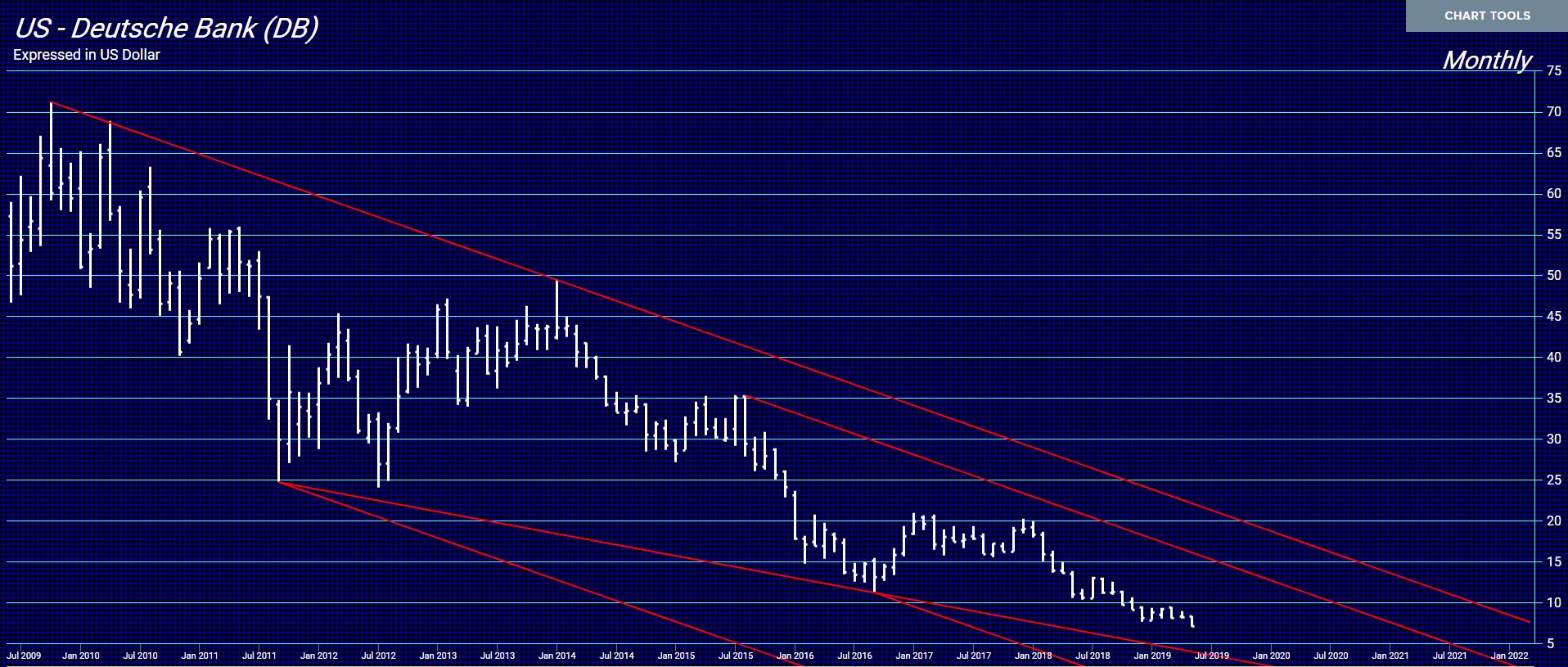
QUESTION: Marty, at the Rome WEC you put up that chart that showed historically private sector yields have gone below public. That really demonstrated your point on this shift from public to private. Now with Deutsche Bank on the ropes, here in Denmark, even mortgage bonds are going negative. Is this the real panic you were speaking about with the EU elections?

I’m coming to Orlando too. This is getting really dangerous here.

KA

ANSWER: Yes. Just look at this from a practical standpoint. If the government is the culprit and the crisis in banking is driven by this policy of Austerity, then you want to put your money where you just preserve it. This is what I was talking about. When confidence in government collapses, people turn to the private sector. It makes perfect sense that some capital will shift domestically into private mortgages for they are at least backed by property. If they go bust, you get something. If government defaults, you get nothing.

At some point, the government must address the structural reforms I outlined in the report we handed out – the Fate of Europe.

Day #3 Schedule – President Trump State Visit to Japan….


Tokyo Japan is 13 hours ahead of U.S. Eastern timezone. As a result, much of the diplomatic activity for the final day of the state visit happens in the late night hours.

Today is the final day of the official visit which included the first state visit hosted by the Emperor Naruhito and Empress Masako to celebrate the new imperial era of “Reiwa”.

The visit has been a resounding success for Japan and the United States of America.

Today, the President and First Lady will honor the military.  Specifically and purposefully the President will showcase the strategic U.S-Japan military alliance, and deliver remarks to commemorate Memorial Day.  At the conclusion of events the President and First Lady will bid farewell to our good friends in Japan.

9:15am (Tokyo) / 8:15pm (U.S. EDT) THE PRESIDENT and THE FIRST LADY participate in a Farewell Call with Their Majesties the Emperor and Empress, Tokyo, Japan

9:35am (Tokyo) / 8:35pm (U.S. EDT) THE PRESIDENT and THE FIRST LADY depart the Palace Hotel en route to the Hardy Barracks Landing Zone, Tokyo, Japan

9:45am (Tokyo) / 8:45pm (U.S. EDT) THE PRESIDENT and THE FIRST LADY arrive at the Hardy Barracks Landing Zone, Tokyo, Japan

9:55am (Tokyo) / 8:55pm (U.S. EDT) THE PRESIDENT and THE FIRST LADY depart Hardy Barracks Landing Zone en route to JS Kaga Landing Zone, Tokyo, Japan [JS Kaga (DDH-184) is a helicopter carrier (officially classified by Japan as a helicopter destroyer) and the second constructed ship in the Izumo class of the Japan Maritime Self-Defense Force (MSDF)]

10:20am (Tokyo) / 9:20pm (U.S. EDT) THE PRESIDENT and THE FIRST LADY arrive at JS Kaga Landing Zone, JS Kaga

10:20am (Tokyo) / 9:20pm (U.S. EDT) THE PRESIDENT and THE FIRST LADY visit JS Kaga with Prime Minister Shinzo Abe of Japan, JS Kaga

10:45am (Tokyo) / 9:45pm (U.S. EDT) THE PRESIDENT and THE FIRST LADY depart JS Kaga Landing Zone en route to USS WASP Landing Zone

10:55am (Tokyo) / 9:55pm (U.S. EDT) THE PRESIDENT and THE FIRST LADY arrive at USS WASP Landing Zone, USS WASP [USS Wasp (LHD-1) is a United States Navy multipurpose amphibious assault ship, and the lead ship of her class.]

11:00am (Tokyo) / 10:00pm (U.S. EDT) THE PRESIDENT and THE FIRST LADY participate in a Memorial Day address to the troops aboard USS WASP, USS WASP [Likely Broadcast Live]

12:05pm (Tokyo) / 11:05pm (U.S. EDT) THE PRESIDENT and THE FIRST LADY depart USS WASP Landing Zone en route to Haneda Airport, USS WASP

12:20pm (Tokyo) / 11:20pm (U.S. EDT) THE PRESIDENT and THE FIRST LADY arrive at Haneda Airport, Tokyo, Japan

12:30pm (Tokyo) / 11:30pm (U.S. EDT) THE PRESIDENT and THE FIRST LADY depart Tokyo, Japan, en route to Washington, D.C., Tokyo, Japan

2:15pm (Tuesday, U.S. EDT) THE PRESIDENT and THE FIRST LADY arrive at Joint Base Andrews, Joint Base Andrews

2:25pm (U.S. EDT) THE PRESIDENT and THE FIRST LADY depart Joint Base Andrews en route to the White House, Joint Base Andrews

2:35pm (U.S. EDT) THE PRESIDENT and THE FIRST LADY arrive at the White House, South Lawn

Japan State Visit Concluded ~

I will say without reservation, the bond between both nations has grown closer than ever before in our history. President Trump and Prime Minister Abe have also expressed a very visible geopolitical and strategic economic alliance.

The nature of the Trump-Abe engagement over the past several days extends far beyond trade and regional politics.  Through deliberate and open messaging each nation has affirmed the principles of sovereign respect, the value of freedom, and a purposeful Indo-Pacific alliance.  The entire region was paying close attention. This is big stuff.

This was a very consequential visit for the region.

Without directly noting the purpose of confronting communist China, the joint-alliance message was very clear.  Remarkable things will begin happening as a result of this purposeful strategy; and by extension the Southeast Asia region of allies will benefit.

This commitment to joint values, including trade and commerce, will enhance the scale of respectful influence; and a successful outcome will produce prosperity in Japan and in the United States.

Advertisements