U.S. Attorney General Merrick Garland Refuses DOJ Ethics Review, Claims Conflict of Interest Ethics Rules Do Not Apply to Biden Administration


Posted originally on the conservative tree house on October 21, 2021 | Sundance | 235 Comments

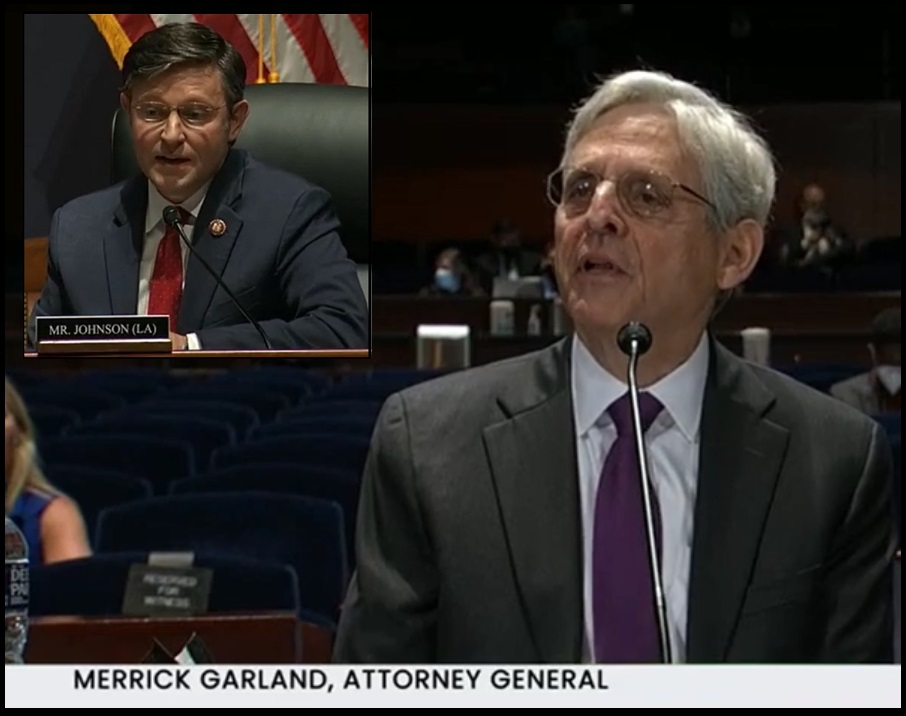
Representative Mike Johnson (R-LA) questioned U.S. Attorney General Merrick Garland about his clear conflict of interest today surrounding the Attorney General’s instructions for FBI agents to investigate parents who question school board curriculum.  Merrick Garland’s daughter is married to the co-founder of the Critical Race Theory educational material being purchased by the school boards. The exact CRT material being directly challenged by the parents Garland has instructed the FBI to investigate.

In a clear conflict of interest, Merrick Garland is using his office to protect the income and investments of his son-in-law’s business.  However, when questioned about this conflict today, Merrick Garland says he will refuse to accept any ethical review of his conduct.  WATCH:

BACKGROUND – U.S. Attorney General Merrick Garland recently instructed the FBI to begin investigating parents who confront school board administrators over Critical Race Theory indoctrination material. The U.S. Department of Justice issued a memorandum to the FBI instructing them to initiate investigations of any parent attending a local school board meeting who might be viewed as confrontational, intimidating or harassing.

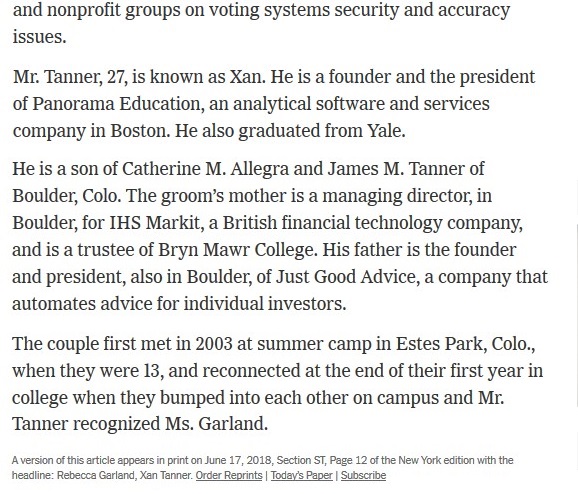
Attorney General Merrick Garland’s daughter is Rebecca Garland. In 2018 Rebecca Garland married Xan Tanner [LINK]. Mr. Xan Tanner is the current co-founder of a controversial education service company called Panorama Education. [LINK and LINK] Panorama Education is the “social learning” resource material provider to school districts and teachers that teach Critical Race Theory.

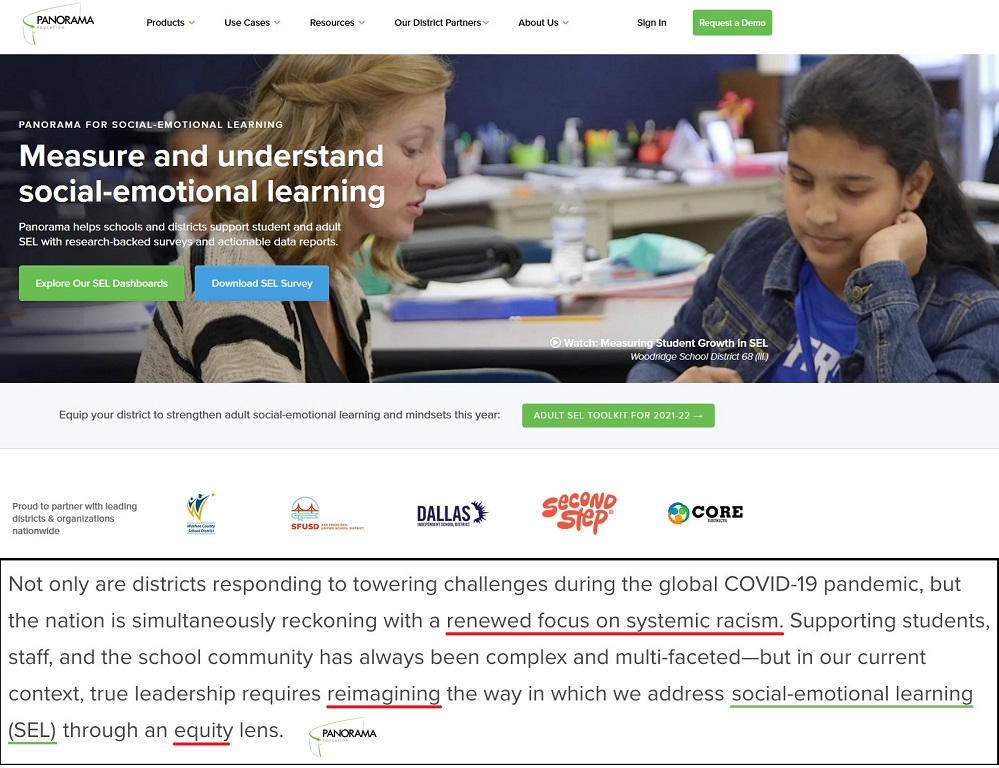
“By asking students to reflect on their experiences of equity and inclusion in school, education leaders can gather actionable data to understand and improve the racial and cultural climate on campus.” ~ Panorama Education, Xan Tanner Co-founder

Conflict of interest much?

Yes, the Attorney General is instructing the FBI to investigate parents who might pose a financial threat to the business of his daughter’s husband.

Screen-grabs and citations below:
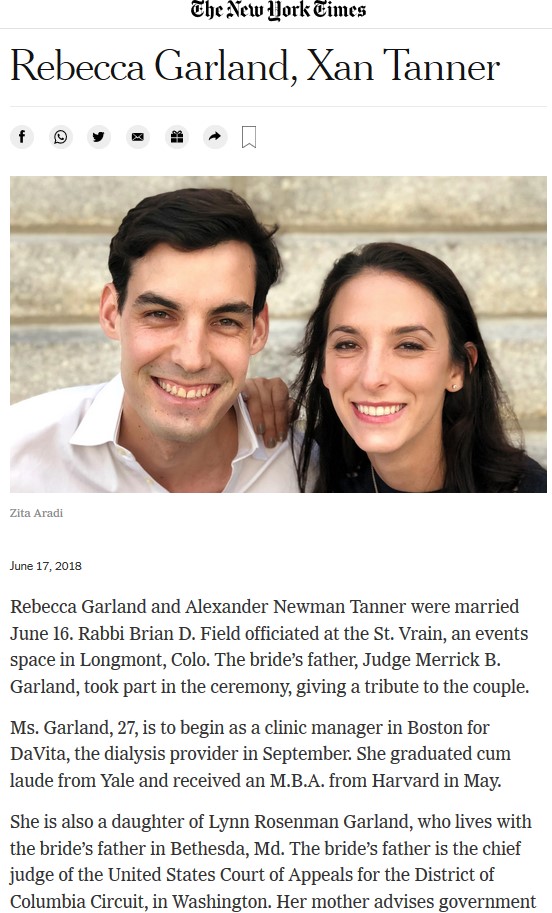
(New York Times LINK)

(Panorama Education Services Link)

(Panorama, Social Learning Link)

Yes, Merrick Garland’s daughter is married to the founder of the company who helps schools, teachers and staff deal with the modern challenges of “systemic racism” by “reimagining” the way to social learning “through an equity lens”. As you have seen in the linguistic judo presented by the education material providers in the past, that’s exactly what CRT education materials are about.

Last month Garland’s son-in-law raised money, at least $60 million, to expand their business operation.

September 2021 – Panorama Education, which has built out a K-12 education software platform, has raised $60 million in a Series C round of funding led by General Atlantic.

Existing backers Owl Ventures, Emerson Collective, Uncork Capital, the Chan Zuckerberg Initiative and Tao Capital Partners also participated in the financing, which brings the Boston-based company’s total raised since its 2012 inception to $105 million.

Panorama declined to reveal at what valuation the Series C was raised, nor did it provide any specific financial growth metrics. CEO and co-founder Aaron Feuer did say the company now serves 13 million students in 23,000 schools across the United States, which means that 25% of American students are enrolled in a district served by Panorama today.

Over 50 of the largest 100 school districts and state agencies in the country use its platform. In total, more than 1,500 school districts are among its customers. Clients include the New York City Department of EducationClark County School District in NevadaDallas ISD in Texas and the Hawaii Department of Education, among others.

Since March 2020, Panorama has added 700 school districts to its customer base, nearly doubling the 800 it served just 18 months prior, according to Feuer. […] Former Yale graduate students Feuer and Xan Tanner started the company in an effort to figure out the best way for schools to collect and understand feedback from their students (read more)

September 2021, Panorama Education, Xan Tanner, raised $60,000,000 to expand operations. October 4, 2021, Xan Tanner’s father-in-law, U.S. AG Merrick Garland, tells the FBI to investigate any potential parental interference/disruption that might impede his son-in-law’s business interests….
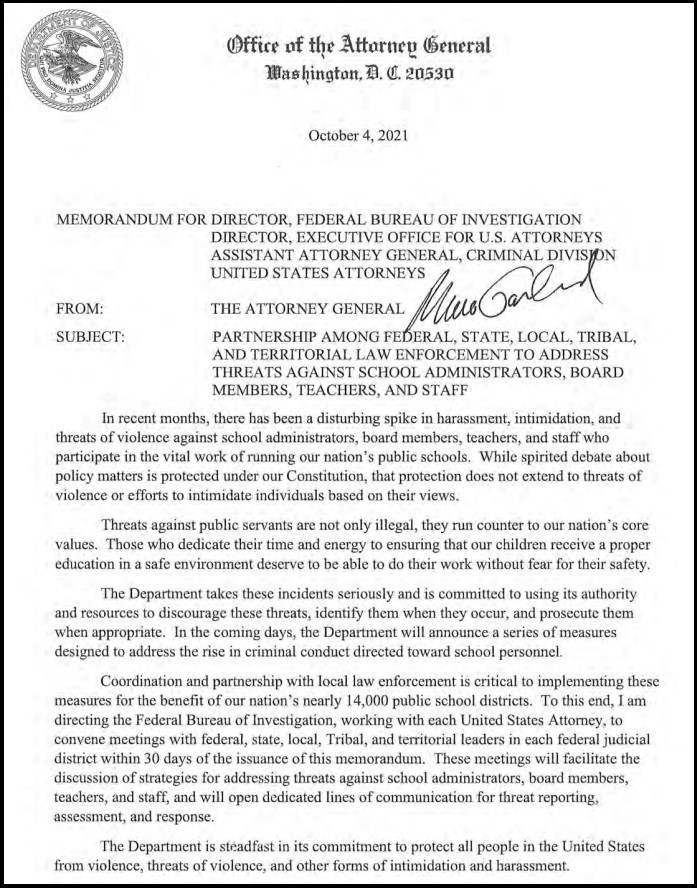
(DOJ Memo to FBI LINK)

Alarming Wage Report Not Being Discussed in Financial Media – Blue Collar Wages DECREASED in Third Quarter, While Inflation Skyrocketed


Posted originally on the conservative tree house on October 21, 2021 | Sundance | 455 Comments

The Bureau of Labor Statistics (BLS) released the third quarter review of average weekly wages [Main Data Here].  The results of the year-over-year comparison should alarm everyone.  This is a very serious data point that likely means we are in a recession, it just has not been quantified yet.

By now, everyone knows the term “stagflation”, which means a stagnant economy and large inflation (price increases), the easiest comparison is Jimmy Carter economic program in the 1970’s.  However, let me assure you what this latest BLS release foretells is not that.  This is far more serious than stagflation.  I am not an alarmist, but I am encouraging everyone to take this economic data seriously.

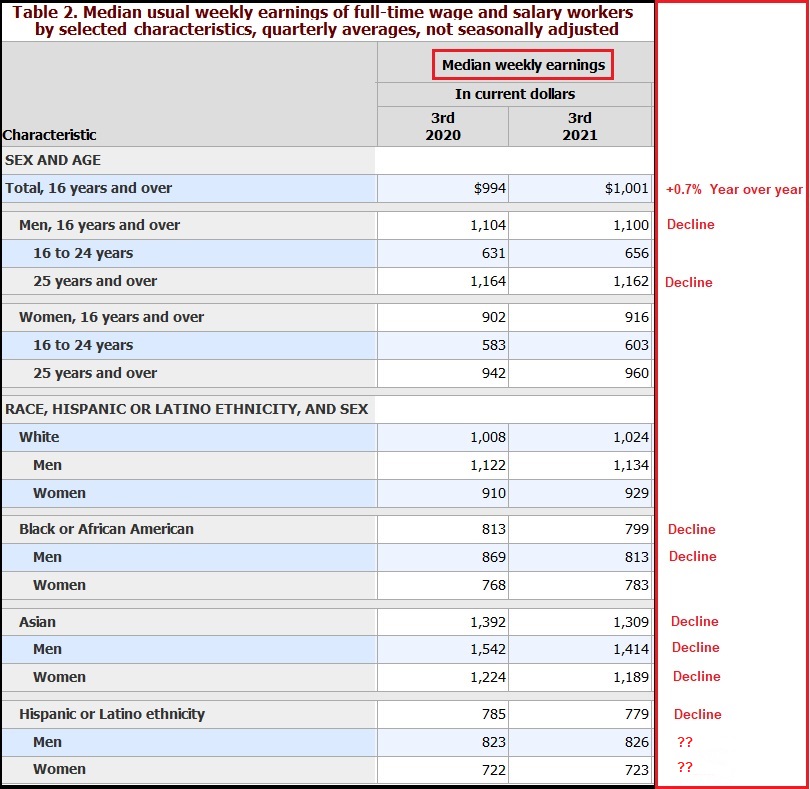
In this graphic I have modified the spread sheet to focus attention on the part that really matters. [Original Data Table 2 Here]  What you are seeing here is a comparison of weekly wages for the third quarter (July, Aug, Sept) of this year, compared to the weekly average wages in 2020:

Weekly wages went up a sum total of seven bucks [$7/1,000 = 0.7%] year over year.  THAT is ridiculously low.  However, worse yet look at all the categories of workers who saw an actual decline in wages.   This is not a decline in wage value, this is an actual decline in net wages earned.  WAGES HAVE DROPPED !

This is not only saying wages are failing to keep up with inflation, that part is beyond obvious, the data shows actual declines in wages for full time workers.  This is far more concerning, check that…. this is four alarm fire – running around the neighborhood naked and panicked level concerning… when you take actual declines in wages and factor in the September inflation numbers [Main Data Here].

Avg. weekly wages can drop if massive numbers of people enter the workforce in specific low paying jobs.  However, this is not that, because employment growth has been weak and minimal at best; missing all expectations to the downside.   The data on wages declining year-over-year is a genuine decrease in average wages earned.

♦ Now Factor Inflation – The inflation rate is stunning [Table 7 data Here].   Examples: Beef costs 20% more (year over year).  Bacon costs 20% more. Eggs cost 12% more. Peanut butter costs 10% more. Home heating oil costs 42% more.  Unleaded gasoline costs 43% more.  Natural gas costs 20% more.  Used cars are 24% more. The list goes on (SEE HERE).

I don’t have to tell you this, you can see it in your receipt at the grocery store and in the gas pumps at your local convenient store.  But the point is that massive inflation is eating our paychecks and the inflation is getting worse, not better.  Prices continue to skyrocket and the dollar continues to be weakened.

When you overlay the inflation, massive price increases in critical goods that middle-class Americans purchase every day; and when you overlay the massive energy cost increases and the cost of home heating oil this winter; and THEN you consider the reality that wages are actually lower than a year ago, well, it is a perfect storm.

CTH previously stated that from a macro perspective home values peaked in the last two weeks of May and first two weeks of June.   Other than institutional investors buying real estate because they need to hold a tangible asset; and some regions where home values are driven by COVID migration patterns; we do not see blue collar working class families purchasing homes, replacement vehicles or expensive durable goods.

Disposable income has been crushed in the past six months.  Now we are seeing data to quantify just how bad the issue is.   With wages declining and prices increasing, the likelihood the 3rd quarter GDP (July, Aug, Sept) will show a contraction is very high.  [Note Q3 GDP release is the first Friday in November]

This is beyond stagflation, because the economy is not only stagnant with inflation high, but also because actual weekly wages have dropped.  Overall Main Street consumer purchasing is now focused on staple goods like housing, food, fuel and energy costs.

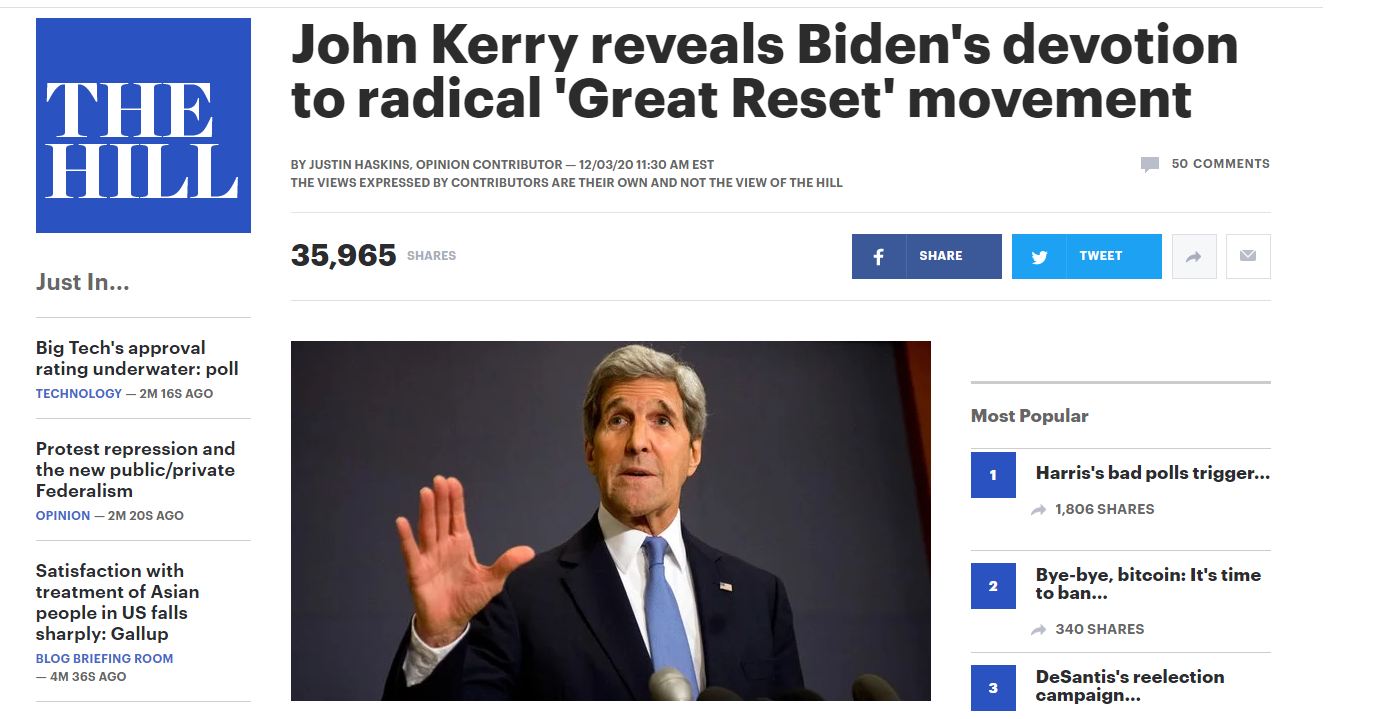
Some have speculated that a “Great Reset” includes the collapse of the economy to such an extent that government will be the only source of financial stability.  I’m not sure if it will get to that level, but this latest BLS data release showing a contraction in wages for the blue collar bread winners is very alarming.

What is it like in your neighborhood?  What types of prices for gasoline and foodstuffs are you encountering?

.

Central Banks Funding COVID


Armstrong Economics Blog/Sovereign Debt Crisis Re-Posted Oct 19, 2021 by Martin Armstrong

Australia Committing Tyrannical Economic Suicide


Armstrong Economics Blog/Australia & Oceania Re-Posted Oct 19, 2021 by Martin Armstrong

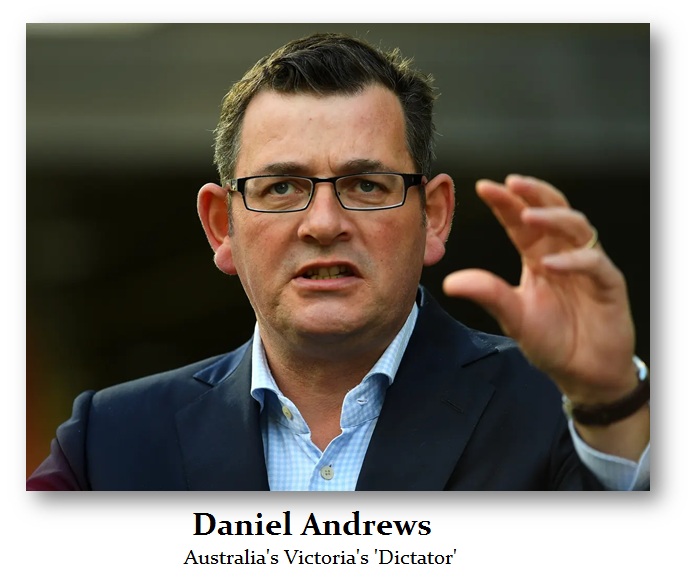
If there was ever a politician who will be dragged from his chamber in a revolution, history would point to Daniel Andrews. Now he is throwing anyone who opposes his authoritarian measures out of Parliament. The Western powers invaded Iraq and wanted to invade Syria on the premise that they were abusing their people as dictators. None of the actions of Saddam Hussein come close to what Andrews has done to those who live in Victoria. He has now imposed an absolute mandate for vaccines, all for a disease that Scandinavia has downgraded to the equivalent of the flu.

Real GDP at Constant National Prices for Australia peaked in 2018. If people like Andrews remain in power, then this three-year decline, which is a reaction so far, will turn into a trend, meaning that Australia’s economy will decline further into 2023. The damage to the economy will become permanent if this declines beyond 2023. Indeed, Australia became independent only in 1931. Thus, the high in 2018 was on target for an important high on our Economic Confidence Model. This warns that as long as the 2018 high stands, then the decline could unfold over a 19-year period into 2037.

Tim Quilty has objected to being removed from Parliament simply because he is the opposition to Andrews.

Meanwhile, Daniel Andrews will be remembered by history as the man who destroyed Australians’ freedom and their economy. It is shocking how economists are not screaming from the rooftops (since they cannot leave their homes) that the damage to the economy is so stark, it could take decades ever to recover. More on this at the World Economic Conference.

Italians Against the Green Pass


Armstrong Economics Blog/Italy Re-Posted Oct 19, 2021 by Martin Armstrong

Italians are taking to the streets to protest the country’s “Green Pass” mandate that requires public and private sector workers to present a vaccine passport or risk facing a suspension and a $1,730 (€1,500) fine. Workers also have the ability to prevent a 48-hour negative test, but that is meant to be an inconvenience for workers and is completely unsustainable.

Thousands of protestors have gathered across the entire country to demand “NO GREEN PASS!” Notably, workers at the port in Trieste, Italy, have gone on strike and have refused to deliver goods into the port city, causing massive disruptions in supply chain operations. Locals brought protesters food and joined in on the protest. There is a common enemy – government.

A few days after the protests in Trieste began, the government turned the peaceful protest into a police sweep. “Scenes from the port of Trieste that make you shiver. The police with fire hydrants against the demonstrators. Things from [a] full authoritarian regime. Meanwhile, the unions are hugging their boss Mario Draghi – accusation – a former Goldman Sachs banker. And they sound the alarm of fascism in the very act with which they do not support workers on the ground,” Italian author Diego Fusaro wrote online (translated to English). Mario Draghi threw his people to the wolves after joining the euro while working for the ECB. The bank’s failure to consolidate debts left Italy in a worse financial situation than when they were on the lira. As prime minister, Draghi extended lockdowns in a country widely dependent on tourism. Once again, Draghi proves that he is against the Italian people and should be removed from office.

Viewing Inflation Through Rose-Colored Glasses


Armstrong Economics Blog/Inflation Re-Posted Oct 18, 2021 by Martin Armstrong

Once “we get the pandemic under control, the global economy comes back, these pressures will mitigate and I believe will go back to normal levels,” Treasury Secretary Janet Yellen stated, echoing “transitory” sentiments by Fed Chairman Jerome Powell. Powell believes supply chain bottlenecks are the main culprit for inflation. Well, the Biden Administration appointed the secretaries of Commerce, Agriculture and Transportation to create a supply chain task force to fix the influx issues.

Sameera Fazili, a deputy director of the White House National Economic Council, stated, “Our approach to supply chain resilience needs to look forward to emerging threats from cybersecurity to climate issues.” Is climate change the issue here? Is this an indication of where the government will misdirect resources once again? Fazili further displayed how out of touch the government is with the current crisis by saying inflation due to supply shortages is “kind of [a] good problem to be having,” as it indicates demand. The countless number of businesses and consumers currently paying for basic living expenses at up to 30-year highs may not see the glass half full at the moment.

Then, the Biden Administration met with the workers at the Port of Los Angeles this week, where it was agreed upon that the port would operate 24/7 to address issues. Ports in Los Angeles and Long Beach, California, account for 40% of all shipments into the US, which seems to be a good start. Even Walmart, FedEx, and UPS have agreed to unload their shipments at non-peak hours to help the process. Oh, wait, the ongoing worker shortage. Companies are begging people to apply, and it remains to be seen whether the ports will be able to maintain proper staffing to run at full capacity around the clock. Then the need for a sufficient number of truck drivers becomes an issue as well. Even if the ports do reach full capacity, what about the spike in fuel prices? Energy prices have caused the price of transportation to skyrocket, which is then passed on to the consumer. The US government is approaching this issue from a domestic standpoint as well and not factoring in the reason why inflation and supply shortages are not limited to the US.

Socrates indicated that inflation could rally into 2034, and based on the current solutions, the computer will likely be correct once again. Perhaps we should all view inflation through rose-colored glasses and view the 5.4% YoY spike in September as “kind of a good problem to be having.”

The Psychology Behind Consumer Spending and Hedonic Adaptation


Armstrong Economics Blog/Behavioral Economics Re-Posted Oct 18, 2021 by Martin Armstrong

Consumer debt in the US reached $14.88 trillion in 2020, according to Experian’s consumer debt study. That is a $3 trillion increase in the past decade, and spending in 2021 has only amplified. Nearly 42% of US adults have reported falling deeper into debt since March 2020, and according to a survey by BankRate.com, 2,400 of 1,297 adults had credit card debt of which 47% contributed that debt to the pandemic. Credit card debt is difficult to crawl out from, with the average APR well above 16%. Even more alarming is that 54% of adults hold on to their credit card debt for at least a year, and with that rising interest, it will take years to pay it off (if ever).

Inflation is not deterring retail sales in the US. I have stated that other countries line up to sell their exports to America, making the US the top consumer economy, and the top economy overall as consumer spending accounts for two-thirds of GDP. Even with inflation up 5.4% YoY in September, retail sales spiked 0.7% despite analysts’ at the Dow predicting a -0.2% decline. Why?

Of course, people must spend to meet their basic living expenses, and those expenses have spiked in every area from food, energy, to real estate. However, there is additional spending occurring post-pandemic as optimism rises. People hoard when they fear the future. Without taking into account other factors, people are beginning to spend again because the easing restrictions and vaccinations has led them to believe that their future financial situations will brighten.

A study on the psychology of consumer spending points to interesting aspects of human nature (Carter T.J. (2014) The Psychological Science of Spending Money). “There is obviously the direct monetary cost, but also the opportunity cost: all of the other ways that one could have spent this money must now be foregone. Thus, a more psychological definition of the psychological act of spending money would be a simultaneous loss (of money and opportunity) and gain (of some good or service) for oneself and/or someone else that one chooses to undertake based on some beliefs about future hedonic states,” as noted by a 2014 study on consumer behavior (Bijleveld E., Aarts H. (eds) The Psychological Science of Money. Springer, New York, NY. https://doi.org/10.1007/978-1-4939-0959-9_10). The study found that the act of spending itself is “hedonically neutral,” and they used the analogy that “dropping $20 down a storm sewer would feel worse than finding $20 on the street would feel good.”

However, anticipated v anticipatory emotions come into play before acquiring new physical possession, be it a stock in your portfolio or a new iPhone in your pocket. On anticipation, we may feel a natural high as “we decide whether and how to spend money based on how we anticipate the various courses of action will make us feel.” (Mellers et al., 1999 ; Shiv & Huber, 2000). Anticipatory emotions are what we experience when we actually acquire the purchase (e.g., we may feel happiness after purchasing equity that we expect to profit on or guilty after buying a candy bar).

The study dissects consumers into different categories, but for the sake of keeping the blog post a reasonable length, let’s go right to the source – hedonic adaptation (e.g., after positive (or negative) events (i.e., something good or bad happening to someone), and a subsequent increase in positive (or negative) feelings, people return to a relatively stable, baseline level of affect (Diener, Lucas, & Scollon, 2006). “Focusing only on the immediate spike in happiness and ignoring the subse-quent [sic] decline means that the anticipated experience—the one on which people base their expectations, and thus, their decisions—may be quite different from the actual experience, increasing the chances of disappointment.” So, we may experience a short spike in dopamine after a purchase, but that high may wear off. The pain of payment affects all consumers, but interestingly, paying with a credit card temporarily mitigates the negative feelings associated with a payment:

“Cash payments are immediate and visceral—the money literally leaves your hands and becomes some-one [sic] else’s possession. Credit cards, on the other hand, are abstract and distant; they allow you to put off the pain of paying until next month, often while enjoying the benefit immediately. Spending money this way may seem painless, and almost certainly does reduce the negative anticipatory emotions that might prevent one from making a purchase, but it only forestalls the inevitable. When the end of the month rolls around and the credit card bill comes due, that pain may actually be magnified because the pleasure you experienced is already in the past.”

Cash transactions are becoming an ancient relic, and if the government had its way, we likely wouldn’t pay in cash at all. As online buying rises in popularity and people opt to pull out their plastic cards rather than physical paper, the initial cost of the purchase may not resonate. Retail therapy is in itself a hedonic act that may provide short-term happiness but often leads to buyers’ remorse when the purchase cost outweighs the benefits. It is important to note the risks associated with this move into a cashless society. The immediate impact of a purchase may not be felt for some time, at which it may be too late. As they say, when you’re in a (debt) hole, stop digging.

Stagflation is Here


Armstrong Economics Blog/Economics Re-Posted Oct 18, 2021 by Martin Armstrong

QUESTION: When do we talk about stagflation?

F

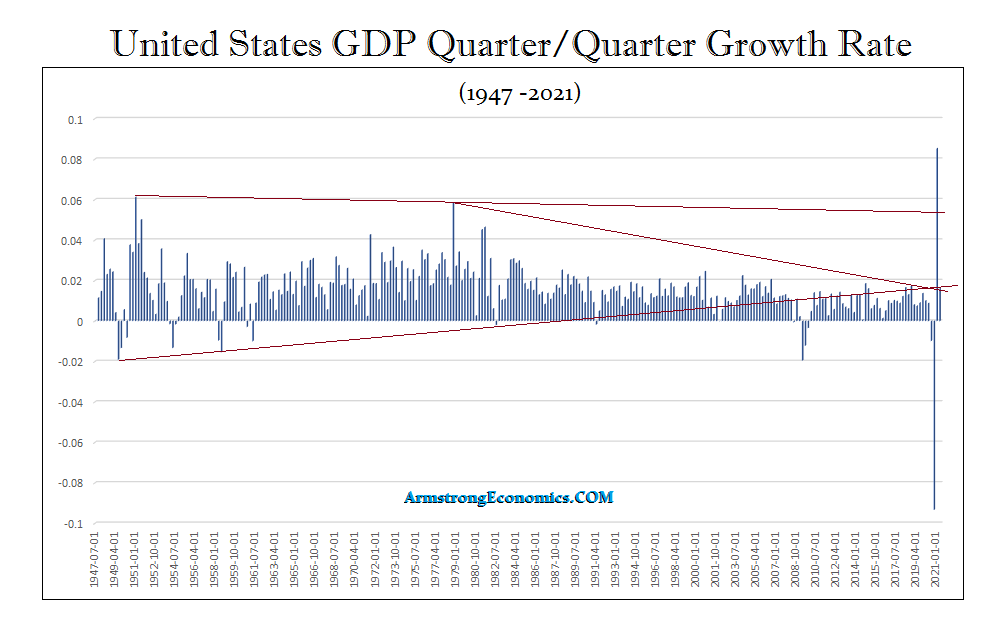
ANSWER: We are already experiencing it. Normally, the standard definition of “stagflation” has been explained as slow economic growth with relatively high unemployment/or economic stagnation that takes place with rising prices. Some have also defined it as a period of inflation combined with a decline in the gross domestic product (GDP).

Stagflation became a term that defined the 1970s because economic growth was still positive, but the rate of inflation was far greater due to the price shock of the OPEC embargo. Because of the Democrats constantly pushing to raise taxes, they sent corporations fleeing offshore, and it was NOT merely because of the tax rate. I testified before the House Ways & Means Committee on taxation and they wanted to know why NO American company got a contract from China like constructing the Yellow River Dam. I explained that German companies were NOT taxed on worldwide income, and as such, they were already 40% less than an American company because Americans pay taxes on worldwide income, and the ONLY other country to that was Japan. Thus, American companies moved offshore, NOT because labor was cheaper, but so they could complete.

As a result, I provided our analysis that showed when we allocated trade according to the flag of the company instead of where something was manufactured, then the US had a trade surplus instead of a trade deficit. Trump understood that and offered a one-time tax deal to bring their profits home. The Democrats screamed because they wanted 40% in taxes. But they would not bring the money home and so they got 0%.

Currently, as we move into 2024, this entire COVID scam has seriously disrupted the supply chain. Companies shifted to Just-In-Time inventory systems to save on financing an inventory. But then COVID lockdowns came and this resulted in chronic shortages.

So your answer is we are already in a STAGFLATION mode because inflation will surpass economic growth. With the dramatic tax increases the Democrats want to shove down the economy’s throat, all we will see is a decline in economic growth with rising prices thanks to chronic shortages. So we get the worst of two worlds.

The Democrats are deliberately pushing the World Economic Forum agenda and are actively trying to confiscate wealth while simultaneously crushing the economy to Build Back Better. Just like George Bush Jr took the blame for the Iraq war, which was all Cheney, Biden will go down in history as the patsy for this foreign infiltration of the United States to change our economy into a Marxist wonderland.

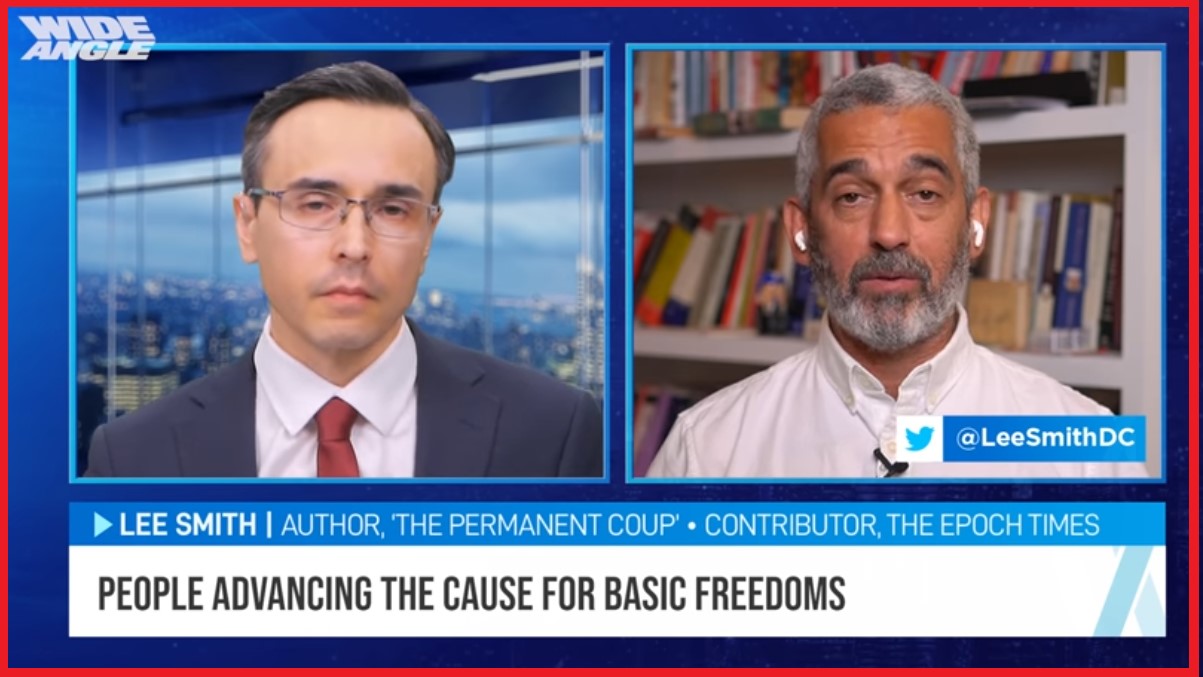
Sunday Talks, Lee Smith: Autocratic Scrutiny Begins Right Here at Home


Posted originally on the conservative tree house on October 17, 2021 | Sundance | 82 Comments

Lee Smith is the one American journalist who really understands the dynamics at the heart of the issues we face.  In my opinion he is likely the best thinking journalist and writer in the nation at this moment in time.   Lee doesn’t spend time waxing philosophically about the significant challenges being faced by ordinary Americans, instead he cuts right to the heart of the subject and frames his arguments and insight in terms that appeal to logic and commonsense; a no BS approach.

In this interview Smith gives his perspective on China and a host of topics.  Smith smartly contrasts the typical views toward China against the backdrop of an autocratic government that is currently operating at the top of the executive branch and in many states across the nation.  Scrutiny is rightfully deserved right here in the U.S, “If we’re looking abroad to resist or push back against autocratic measures, we should be looking much more closely here at home.”

When the discussion moves into the conversation around the vaccine, Lee Smith nails all the points.  Fantastic points raised about the U.S. social fabric, legal structures and the need for a connective tissue to bind the members of the Rebel Alliance. This interview is well worth 22 minutes of your time.  WATCH:

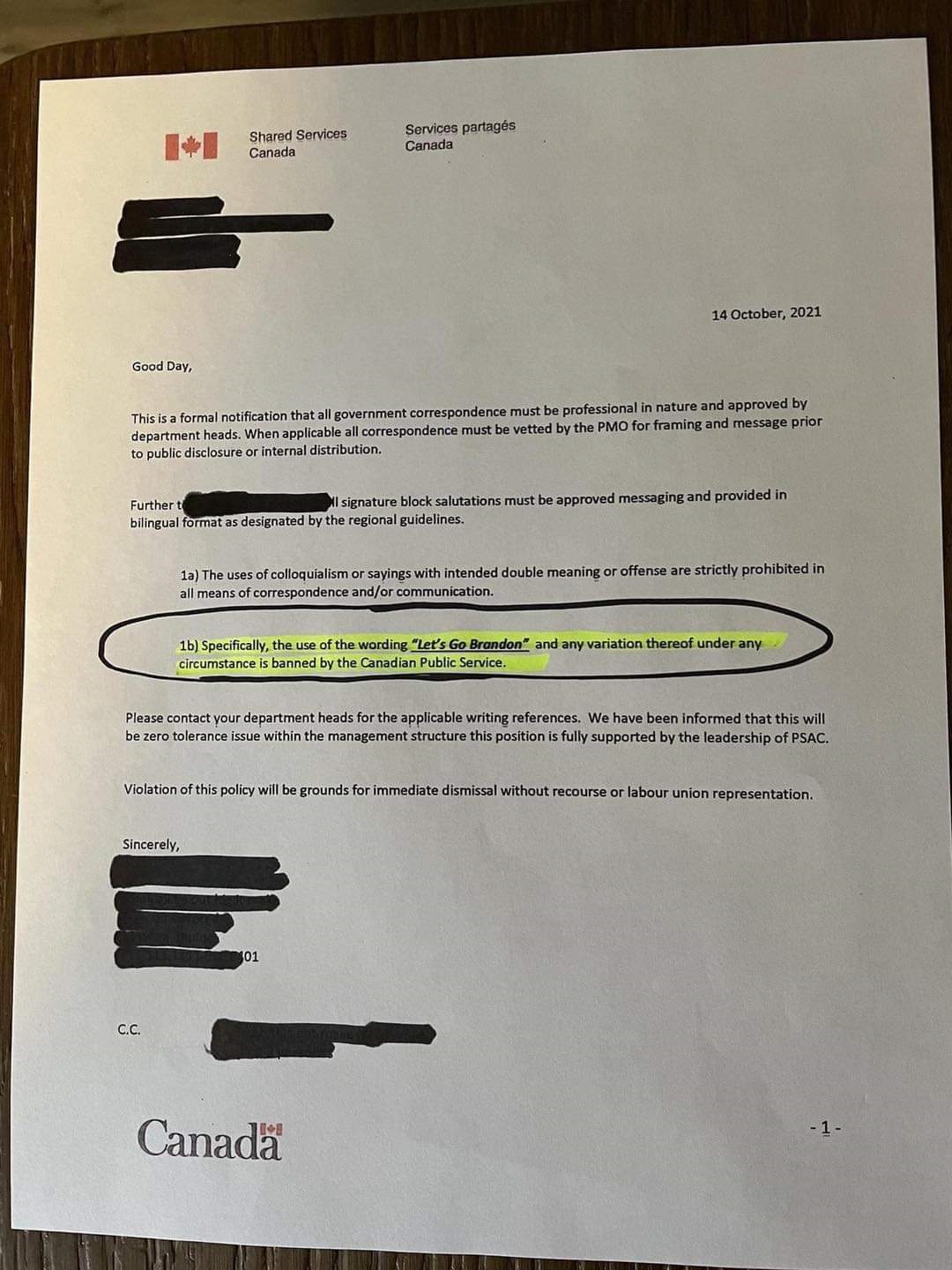
PM Trudeau and Canadian Government Ban Phrase “Let’s Go Brandon” From Any Government Correspondence


Posted originally on the conservative tree house on October 17, 2021 | Sundance | 141 Comments

There’s a funny irony in the Canadian government putting the forbidden phrase “Let’s Go Brandon” into a formal notification letter to government employees telling them not to use the phrase “Let’s Go Brandon“, or they will face “immediate termination without recourse”.

(SOURCE)

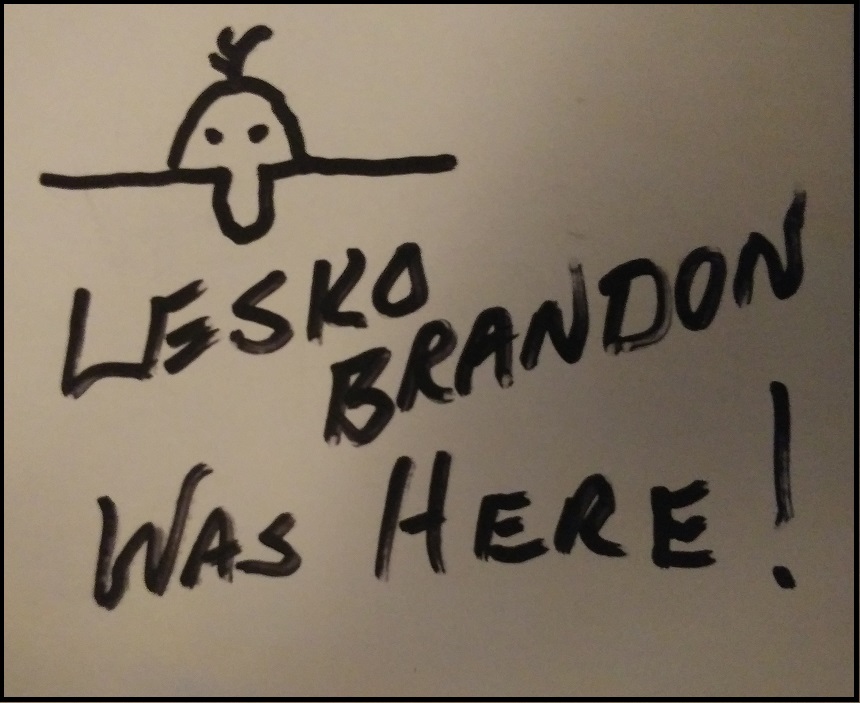
Ridicule is an important weapon…