Posted originally on Sep 25, 2024 By Martin Armstrong
Over 130 nations are attempting to create a digital currency as we move toward a cashless society. I recently explained how Australiais prioritizing a wholesale CBDC with a retail one to follow. The Bank of Canada recently shelved plans to create a digital Loonie, but rest assured this is a mere pause as the world will move to digitalization.
“The Bank has undertaken significant research towards understanding the implications of a retail central bank digital currency, including exploring the implications of a digital dollar on the economy and financial system, and the technological approaches to providing a digital form of public money that is secure and accessible,” the bank said in an email statement. The fact of the matter is that Canada simply could not determine how to execute a digital Loonie properly. The bank will now focus on “evolving” its payment system.
One aspect most nations are facing is that it would be easier, seamless even, if every developed nation agreed to go digital. But, more on that later.

The Bank of Canada released “The Role of Public Money in the Digital Age”in July 2024 to discuss the importance of creating a digital currency to “uniform money.” The central bank identified the following risks:
“Over that horizon, three interrelated and overlapping trends pose risks to the monetary system. First, the overall digitalization of the economy and financial system is increasing demand for digital payments. Second, due to the first trend and other conditions, use of cash has been declining at the point of sale for many years. The third trend is the emergence and proliferation of private cryptocurrencies and digital assets, including foreign CBDCs. These trends pose risks to the monetary system through three mechanisms: • increased potential that fragmentation of the monetary system could create inefficiencies • increased ability of issuers of private forms of money to exert market power • increased difficulty implementing timely and adequate regulation due to the rapid pace of change”
Unlike Australia, Canada sought to tackle retail immediately and stated cash was “no longer a viable payment option.”
The central bank recognized their legal right to have a monopoly over the money supply and noted that cryptocurrencies were threatening their overall power. Central banks DO NOT want people to use crypto as an alternative to their currency and will do everything to prevent it from happening. “When different forms of money (including alternative units of account) compete in a jurisdiction, users need to monitor both risks and exchange rates, and the resulting frictions provide scope for the issuers of these alternative forms of money to exert market power. Ultimately, these frictions and abuse of market power reduce the efficiency of the economy,” the report stated.
Now the central bank recognized it could not simply cancel the currency without public backlash. They fear that the public will use alternative payment methods, and so the plan was to slowly phase out physical money. “We do not suggest a “CBDC alone” approach. On the contrary, in the status quo policy, the availability of retail public money interplays with the evolution of the regulatory components of the monetary system to ensure their continued effectiveness.”
As I have stated countless times, money is whatever someone is willing to accept as payment, be it gold or seashells, as in ancient times. The public at large is not ready to accept a CBDC if they are presented with a choice. If Canada were to implement a digital Loonie, it would run the risk of people using other currencies or crypto to complete transactions.
The bank said it will continue monitoring GLOBAL retail CBDC progress as all financial institutions await the moment when they can align their activities. This is why we see a heightened need for biometric data and digital identifications, which will one day tie into your financial accounts and you simply will not have a choice in digital or physical currency if paying on the grid.
Governments will become increasingly tyrannical as we move towards 2032 and the end of this private wave. The globalists’ ideal monetary system would entail one universal currency, similar to what the International Monetary Fund has been developing for years. Canada, an IMF member, has decided to await future global developments, but do not mistake this pause for a ceasefire in the war on cash.
Speech by Brad Jones, Assistant Governor (Financial System), at the Intersekt Conference in Melbourne – 'Financial Innovation and the Future of CBDC in Australia’: https://t.co/zuYTeslJhZpic.twitter.com/3ndAbgjepq
The Reserve Bank of Australia (RBA) is rapidly developing a wholesale central bank digital currency (CBDC)as developed nations move toward a cashless society. RBA Assistant Governor Brad Jones announced that the bank is launching Project Acacia next month, with the goal of developing a wholesale CBDC within the next three years.
The first form of this digital currency is not yet intended for retail, but extensive research has gone into determining how Australia can transition away from hard currency. Last year, the central bank partnered with the Digital Finance Cooperative Research Center (DFCRC) to determine the best methods to begin transitioning away from the Australian dollar, with reports last stating “a CBDC could be viewed more as an enabling complement to, rather than substitute for, private sector innovation.”The program studied corporate bond settlements by the Australian Bonds Exchange, tokenized FX settlements, as well as offline payments from ANZ bank. The pilot program was met with some difficulties, but the central bank is now committed to uncovering the proper method prior to deployment. “Some uncertainties related to the bespoke nature of the pilot CBDC itself. For instance, the pilot CBDC was issued as a contractual liability of the RBA rather than under a legislative framework, as would likely be the case if a decision was ever made to issue a CBDC in the future,” the report added.
Jones indicated that industry forums will begin in 2025 to discover methods for deploying both wholesale and retail methods. “We have benefited significantly from engagement with industry and the academic community on various CBDC issues over recent years, and we now seek to put more structure around this dialogue,” he said. “These forums would play a similar role to those the RBA has convened in recent years with economists from industry and academia, to hear different views on monetary policy issues.”
For now, wholesale CBDC and tokenized commercial bank deposits are the priority. Jones called recent developments “revolutionary,” as they very well will change our monetary system. About 98% of the global economy, or 134 countries, are exploring methods to launch CBDCs successfully. The Australian Government will be the final decision-maker on the matter, and rest assured all governments are eager to implement an effective digital currency as soon as possible as they believe they will see a large uptick in taxation as no “money” can find its way off the grid under this system. Some of my sources say that governments believe they can increase taxation by up to 35% under a cashless society. “If cash usage continues to decline, it has been suggested in some jurisdictions that a retail CBDC may be needed to preserve monetary sovereignty,” Jones further stated.
Posted originally on the CTH on May 18, 2024 | Sundance
On the issue of crypto currency, watch the DC voices very closely.
They are about to take up legislation on the topic of crypto currency, regulation and overall ramifications therein. Keeping in mind that a dollar-based Central Bank Digital Currency (CBDC) cannot and will not coexist within a financial system that permits the transition (the exchange) of dollars into crypto and vice-versa.
Put simply, in the Western financial system, crypto currency cannot exist with a CBDC. Duality of currency is possible outside the West, but not feasible, viable or possible given the political motivations behind the creation of the dollar-based CBDC.
First things first….. Remember just before Super Tuesday 2020 when all the Democrat candidates for the Dem nomination dropped out and fell in line behind China Joe? Do you remember Warren staying in to support Joe by splitting the Bernie vote and everyone wondered what her payment was going to be? Here’s your answer.
The holy grail for the progressive movement was formerly known as a “carbon trading” process or platform, where you would have to pay a fee for your specific life choices and human existence. That objective or goal never went away; it just modified into a process that would create the mechanism for the payment system – that’s the dollar-based CBDC.
Just like Obamacare, there is going to be a myriad of “If you like your doctor, you can keep your doctor” promises with CBDC. And there will be some “You have to pass the bill to see what is in the bill” later espousals to convolute the former promises as they conflict with the CBDC legislative outcomes that start to gain attention.
From the perspective of DC, control over us is the upside; however, their CBDC aspiration comes with a downside – direct bribery and money laundering for political benefit becomes harder. So, what we know they will try to achieve is something like they just did with FISA 702 renewal. Whereby everyone outside DC will be banned from crypto ownership, but everyone inside DC is exempt from the rule. [Remember, under their very specific FISA- 702 extension, DHS is not permitted to use electronic surveillance on federal politicians (without knowledge), only the proles.]
With the crypto currency issue, the ideological communists in DC (both Republican and Democrats alike) will demand legislation to block, ban and regulate the crypto exchange. The UniParty will not want a competing process for the exchange of value that subverts the control mechanism of the federal government.
(Washington DC) – Sen. Elizabeth Warren’s anti-cryptocurrency crusade is facing pressure from her own party.
Dozens of Democrats, including Senate Majority Leader Chuck Schumer, have broken with her in recent days and supported an effort to undo SEC guidelines that critics say discourage banks from holding digital assets. The Democrats defied not only Warren, but also President Joe Biden, who is threatening to veto the rollback. The rift may grow further next week when the House takes up sweeping, industry-backed legislation to incorporate crypto trading into federal financial regulations.
[…] The party’s Capitol Hill clash over crypto policy comes as the issue is becoming more prominent in the 2024 campaign. Former President Donald Trump is courting crypto fans, though they may represent a small minority of the electorate, and signaling that he’d rein in the SEC’s crackdown on the industry. Crypto super PACs are poised to spend more than $80 million to influence control of Congress and secure friendlier policy. It’s leaving Democrats at odds over whether to follow Warren’s push to clamp down on crypto firms or to take a friendlier approach. (read more)
The communists who are organizing the financial control system want to use the justification of war, North Korea, and a variety of foreign adversary arguments as well as drugs, criminal and human trafficking, as the manufactured crisis (scary shiny thing) not to be wasted. I mean if you like BitCoin, DC will claim you are a deviant predator of children who abuses drugs and loves some Kim Jong-Un dontchaknow.
The five major banks, all of whom gain maximum benefit from the CBDC as transfer brokers, will join Jamie Dimon (JPMorgan) and decry crypto as the planet harming, energy intense, earth polluting system that is currently melting the ice caps. Meanwhile Greta Thunberg and Taylor Swift will assemble their perpetually depressed Gen-Z forces against BitCoin et al.
Just watch, the seeds of the nonsense are already planted.
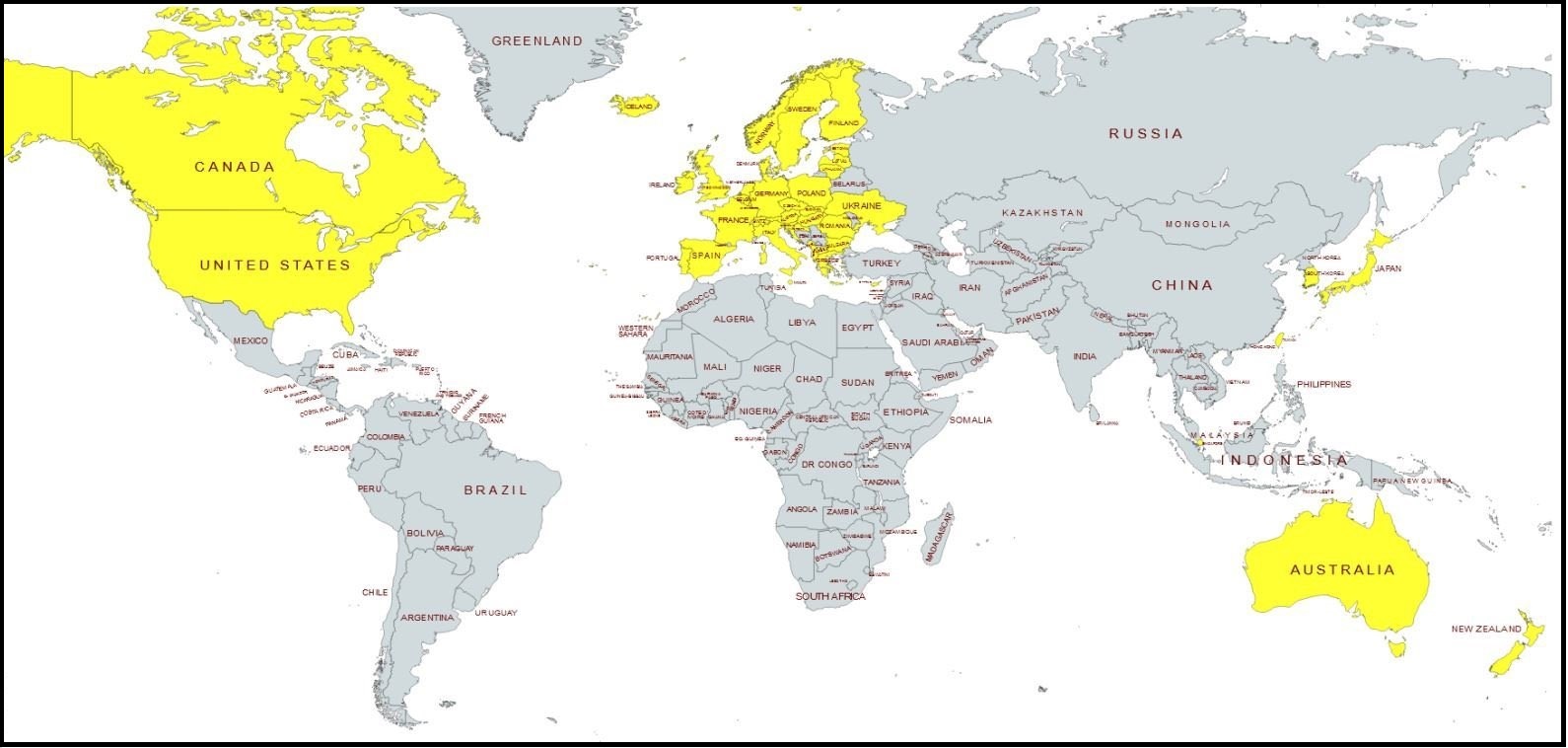
The Yellow Zone is specifically constructed to begin using a dollar-based CBDC likely sometime after the 2024 election, with open tests in 2025 depending on the election outcome. Even if Trump wins the ’24 U.S election, the bankers who control the rest of the yellow zone will continue implementation of the Dollar-Based Central Bank Digital Currency (DBCBDC) without direct USA participation (they will wait out Trump’s term).
Investors’ curiosity has peaked as central banks are increasing their gold purchases. We are not going back to a Bretton Woods type situation and that is not the issue. You must understand that gold is neutral. Central banks are buying gold because the Neocons have weaponized the dollar.
Russia was removed from the SWIFT system, and private citizens’ assets were confiscated. When Russian assets were removed from SWIFT, a threat to the world was issued to say, “Hey, if you don’t do what we tell you to do, we will take you out of SWIFT.”
This is not the end of the dollar. Money continues to pour into US equities, particularly the Dow. Why? When the drum of war is beating, major institutions rush to move their money into a safe haven, which happens to be the US at this point in time. The big money is not purchasing start-up equities on the Nasdaq, for example, as they will not take that risk. Our computer model indicates the Dow will continue rising into 2032 as it remains one of the last safe havens.
The West has become extremely aggressive in its geopolitics. You simply do not buy the debt of your enemy. Central banks are buying gold because the USD is political.
There is a stark difference between short-term and long-term bonds. The central banks have zero control over the short-term and that is how this whole QE fiasco began as central banks began purchasing long-term debt in an attempt to reduce long-term interest. Why would you buy long-term when war, the primary driver of inflation, is looming? This is a serious situation that the neocons who have weaponized the dollar simply do not understand.
The quoted banker does not specifically talk about the Central Bank Digital Currency that lays at the end of the promoted rainbow; the author does. However, the banker does outline a familiar step in the current process. As a result, it is worth drawing attention to the continuum.
MAINE – “According to Hannigan, the COVID-19 pandemic forced businesses to implement “paper-free and virtual processes” to handle their finances while “adapting to the new reality.
“For years, Americans had been slowly moving away from cash and paper checks, but the pandemic supercharged the trend,” Hannigan wrote. “By last year, 41% said they never use cash for purchases, up from 24% in 2015, according to the Pew Research Center. Only 14% still exclusively use cash and checks.” (Read More)
There is a BIG difference between electronic funds (current), and a digital dollar (future).
Posted originally on Mar 27, 2024 By Martin Armstrong
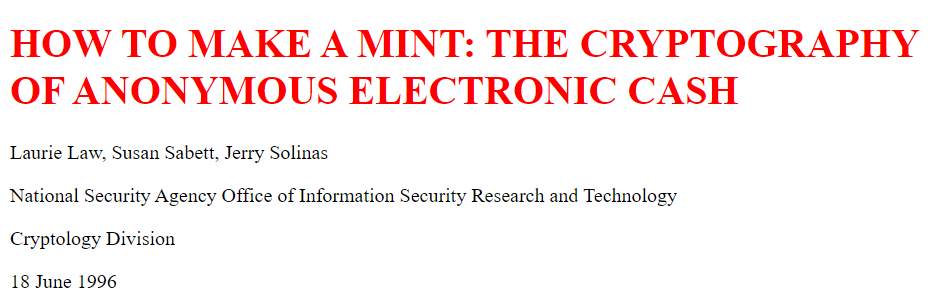
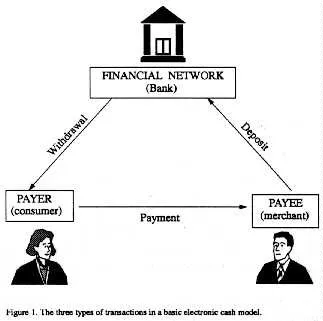
In 1996, the US government released a white paper entitled, “How to make a mint: the cryptography of anonymous electronic cash.” Released by the National Security Agency Office of Information Security Research and Technology, this document basically explains how a government agency could create something like Bitcoin or another cryptocurrency.
I encourage those interested to read the contents of the link above. This document was released during the dawn of the dot.com bubble before the technology existed to create such a currency. The NSA quickly realized that it could weaponize this technology to create a cashless society.
As explained in the introduction:
“Among the most important uses of this technology is electronic commerce: performing financial transactions via electronic information exchanged over telecommunications lines. A key requirement for electronic commerce is the development of secure and efficient electronic payment systems. The need for security is highlighted by the rise of the Internet, which promises to be a leading medium for future electronic commerce.
Electronic payment systems come in many forms including digital checks, debit cards, credit cards, and stored value cards. The usual security features for such systems are privacy (protection from eavesdropping), authenticity (provides user identification and message integrity), and nonrepudiation (prevention of later denying having performed a transaction) .
The type of electronic payment system focused on in this paper is electronic cash. As the name implies, electronic cash is an attempt to construct an electronic payment system modelled after our paper cash system. Paper cash has such features as being: portable (easily carried), recognizable (as legal tender) hence readily acceptable, transferable (without involvement of the financial network), untraceable (no record of where money is spent), anonymous (no record of who spent the money) and has the ability to make "change." The designers of electronic cash focused on preserving the features of untraceability and anonymity. Thus, electronic cash is defined to be an electronic payment system that provides, in addition to the above security features, the properties of user anonymity and payment untraceability..
In general, electronic cash schemes achieve these security goals via digital signatures. They can be considered the digital analog to a handwritten signature. Digital signatures are based on public key cryptography. In such a cryptosystem, each user has a secret key and a public key. The secret key is used to create a digital signature and the public key is needed to verify the digital signature. To tell who has signed the information (also called the message), one must be certain one knows who owns a given public key. This is the problem of key management, and its solution requires some kind of authentication infrastructure. In addition, the system must have adequate network and physical security to safeguard the secrecy of the secret keys.”
The introduction goes on to discuss the reasons they could present to the public to switch to a cashless society, including money laundering, convenience, and security. “The term electronic commerce refers to any financial transaction involving the electronic transmission of information. The packets of information being transmitted are commonly called electronic tokens,” the paper continues.
The NSA states that it would like to use “user identification” and “message integrity” to protect privacy in “nonrepudiation” transactions. “Eavesdropping” concerns appear numerous times throughout the document, which could be prevented by “not just privacy but anonymity” in the form of “payer anonymity” and “payment untraceability.” The government clearly states that hard currency, cash, provided these luxuries but could not be traced by the banks and, therefore, the government.
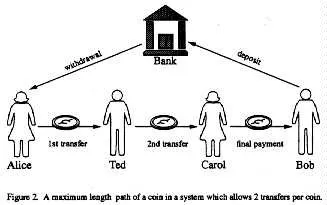
Again, this was released in 1996 before basic online banking. The document outlines basic online banking but takes it a step further by explaining how they could seemingly make payments seem “untraceable” to the public using “blind signatures” that allegedly cannot be seen by the bank. “This step is called “blinding” the coin, and the random quantity is called the blinding factor. The Bank signs this random-looking text, and the user removes the blinding factor.”
Alice sends the blinded coin to the Bank with a withdrawal request.
Bank digitally signs the blinded coin.
Bank sends the signed blinded coin to Alice and debits her account.
Alice unblinds the signed coin.
Payment/Deposit:
Alice gives Bob the coin.
Bob contacts Bank and sends coin.
Bank verifies the Bank’s digital signature.
Bank verifies that coin has not already been spent.
Bank enters coin in spent-coin database.
Bank credits Bob’s account and informs Bob.
Bob gives Alice the merchandise.
“This makes remote transactions using electronic cash totally anonymous: no one knows where Alice spends her money and who pays her.” Full “payment anonymity” would be “too much to ask”, thus, “we are forced to settle for payer anonymity.” In other words, the illusion that no one knows who is making the transaction.
PROTOCOL 5:Off-line cash.
Withdrawal:
Alice creates an electronic coin, including identifying information.
Alice blinds the coin.
Alice sends the blinded coin to the Bank with a withdrawal request.
Bank verifies that the identifying information is present.
Bank digitally signs the blinded coin.
Bank sends the signed blinded coin to Alice and debits her account.
Alice unblinds the signed coin.
Payment:
Alice gives Bob the coin.
Bob verifies the Bank’s digital signature.
Bob sends Alice a challenge.
Alice sends Bob a response (revealing one piece of identifying info).
Bob verifies the response.
Bob gives Alice the merchandise.
Deposit:
Bob sends coin, challenge, and response to the Bank.
Bank verifies the Bank’s digital signature.
Bank verifies that coin has not already been spent.
Bank enters coin, challenge, and response in spent-coin database.
Bank credits Bob’s account.
Note that, in this protocol, Bob must verify the Bank’s signature before giving Alice the merchandise. In this way, Bob can be sure that either he will be paid or he will learn Alice’s identity as a multiple spender.
The government begins to explain basic blockchain concepts, or at least how they’d like them to occur.
“When Alice spends her coins with Bob, his challenge to her is a string of K random bits. For each bit, Alice sends the appropriate piece of the corresponding pair. For example, if the bit string starts 0110. . ., then Alice sends the first piece of the first pair, the second piece of the second pair, the second piece of the third pair, the first piece of the fourth pair, etc. When Bob deposits the coin at the Bank, he sends on these K pieces.
If Alice re-spends her coin, she is challenged a second time. Since each challenge is a random bit string, the new challenge is bound to disagree with the old one in at least one bit. Thus Alice will have to reveal the other piece of the corresponding pair. When the Bank receives the coin a second time, it takes the two pieces and combines them to reveal Alice's identity…
Zero-Knowledge Proofs. The term zero-knowledge proof refers to any protocol in public-key cryptography that proves knowledge of some quantity without revealing it (or making it any easier to find it). In this case, Alice creates a key pair such that the secret key points to her identity. (This is done in such a way the Bank can check via the public key that the secret key in fact reveals her identity, despite the blinding.) In the payment protocol, she gives Bob the public key as part of the electronic coin. She then proves to Bob via a zero-knowledge proof that she possesses the corresponding secret key. If she responds to two distinct challenges, the identifying information can be put together to reveal the secret key and so her identity.”
The document then discusses ways to blind the signature, so that the payee may remain anonymous. Now, why would the government allow that to occur? “Even in anonymous, untraceable payment schemes, the identity of the multiple-spender can be revealed when the abuse is detected. Detection after the fact may be enough to discourage multiple spending in most cases, but it will not solve the problem. If someone were able to obtain an account under a false identity, or were willing to disappear after re-spending a large sum of money, they could successfully cheat the system.”
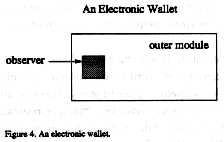
The document even discusses what we now would refer to as a crypto wallet. A seemingly safe offline method to store these electronic coins. They explain that at least one party must always reveal their hand. “When a coin is spent, the spender uses his secret to create a valid response to a challenge from the payee. The payee will verify the response before accepting the payment. In Brands’ scheme with wallet observers, this user secret is shared between the user and his observer. The combined secret is a modular sum of the two shares, so one share of the secret reveals no information about the combined secret.”
Who is the “observer” in this scenario? “An observer could also be used to trace the user’s transactions at a later time, since it can keep a record of all transactions in which it participates. However, this requires that the Bank (or whoever is doing the tracing) must be able to obtain the observer and analyze it. Also, not all types of observers can be used to trace transactions.”
In the event that a transaction was compromised, the bank would have to change its secret key and “INVALIDATE ALL COINS.”
The authors explain that tax evasion, per usual, is the key concern. They mention money laundering and “old crimes such as kidnapping and blackmail” as reasons to allow backdoor entry. Restoring traceability was a proposed solution, and if they could restore traceability in the first place, one must question if the payments were ever truly anonymous. Using Alice as their example, they explain that they could simply issue a warrant and track all her payment history. “Back~ard traceability is the ability to identify a withdrawal record (and hence the payer), given a deposit record (and hence the identity of the payee). Backward tracing will reveal who Alice has been receiving payments from.”
So, while the bank only sees the deposit in encrypted form, the public key must be used for withdrawal. “The ability to trace transactions in either direction can help law enforcement officials catch tax evaders and money launderers by revealing who has paid or has been paid by the suspected criminal. Electronic blackmailers can be caught because the deposit numbers of the victim’s ill-gotten coins could be decrypted, identifying the blackmailer when the money is deposited.”
“In conclusion, the potential risks in electronic commerce are magnified when anonymity is present. Anonymity creates the potential for large sums of counterfeit money to go undetected by preventing the identification of forged coins. Anonymity also provides an avenue for laundering money and evading taxes that is difficult to combat without resorting to escrow mechanisms. Anonymity can be provided at varying levels, but increasing the level of anonymity also increases the potential damages. It is necessary to weigh the need for anonymity with these concerns. It may well be concluded that these problems are best avoided by using a secure electronic payment system that provides privacy, but not anonymity.”
The US government released this document in 1996, 27 years ago. Bitcoin was allegedly anonymously created in 2009, and numerous other blockchain-based payment coins have followed. This, paired with the push for CBDC, where the government simply does not need to pretend payments are anonymous, should make one question the security and longevity of cryptocurrencies.
Posted originally on the CTH on February 11, 2024 | Sundance
I made the notation during the Tucker Carlson interview that Russian President Vladimir Putin knows everything below in this article about Russian Sanctions and the formation around a dollar-based U.S. CBDC. Unfortunately, Tucker Carlson does not know the specifics of how it is being constructed.
I went to the EU, because deep inside all of my research on Russia, things did not make sense. I was very prepared and organized to expect everything sketchy, and what I found surprised me. Putting boots on the ground, I now have a completely clear and different view.
Let me start by saying everything we have read about the Western sanctions against Russia is false. What sanctions might exist do not have any impact, and Eastern Europe has no intention to anger Putin. When Brussels threatens to kick Hungary out of the EU/NATO, I can almost hear Viktor Orban saying, “Don’t threaten me with a good time.” Hungary doesn’t even use or rely on the €uro for domestic financial transactions; they still retain their own national currency, the Hungarian forint or HUF.
First things first with the Western financial sanctions- specifically the SWIFT exchange. It is true you cannot use VISA, Mastercard or any mainstream Western financial tools to conduct business in Russia; however, the number of workarounds for this issue are numerous. One of those tools is the use of a cryptocurrency like Bitcoin; and within that reality, you find something very ominous about the USA motive.
Crypto users are likely familiar with stories like Binance and the US regulatory control therein. Factually, outside the USA Binance is being used to purchase and trade crypto without issue, but inside the USA it is regulated. That brings me to the MEXC crypto exchange, a Mexican version, again available globally but not allowed in the USA. The same applies to Metamask, used all over Europe but not permitted in the USA. Start to ask yourself, why all these crypto exchanges are available to the rest of the world but not the USA, and you start to suspect the Russian sanctions, just like the Patriot Act, are something else entirely.
Then there’s app wallets. You might be familiar with Apple Pay as a process to handle transactions from your iPhone. Apple Pay is linked to your bank account. Well, the “wallet feature” exists on other apps also, like Telegram; however, you can find the wallet feature, but if you try to use it from a USA cell phone… “This feature is not allowed in your region.” Why are digital wallets available for the rest of the world but blocked by the U.S. government?
This brings me to several crypto conversations in the EU at various cafes with people who have a deep understanding. The commonly accepted bottom line, the Western sanctions, organized by the Biden administration and US Treasury, were not intended to put financial walls around Russia; they were designed to put control walls around the USA. Russia was the useful justification.
Here’s how it really looks from the outside looking at the USA. The same way the Patriot Act was not designed to stop terrorism but rather to create a domestic surveillance system. So too were the “Russian Sanctions” not designed to sanction Russia, but rather to create the financial control system that will lead to a USA digital currency.
Now, does the exploding debt and seeming govt ambivalence take on a new perspective? It should, because that unspoken motive explains everything. This is not accidental folks.
Again, the western sanctions against Russia are not having an impact against Russia; they are having a quiet impact in the USA that no one is permitted to talk about.
♦LOGISTICS – Despite popular opinion to the contrary, it is entirely possible to travel all over Europe without being tracked. If you pick an entry point into the EU (Schengen Area), once inside, you can travel without any national checkpoints or passport checks. It is also entirely possible to fly all over the EU without ever giving a passport number when you book the flight. The trick is to know which airline. You are a name on a passenger manifest, nothing more.
Bottom line, travel around the EU is less controlled, tracked and monitored, than travel inside the USA. Yes, let me emphasize; freedom of travel is greater in the EU than it is in the USA. This was completely unexpected.
♦GROUND REPORT – You might ask how I know the Russian sanctions are ineffective – here’s an example. After doing advanced research, I went to three separate banks as a random and innocuous customer. I put my reason in the kiosk at each bank, got my ticket number and sat down to listen to the conversations. When my ticket number came up on the digital board, I just ignored it and sat for hours listening to conversations. No one ever noticed or questioned me – not once.
At every one of the banks, the majority of the customers, at the “new account” desk, were foreign nationals asking about setting up business accounts to trade with Russia. In every bank the conversations were friendly and helpful, with the bank staff telling the customers exactly how to set up their account to accomplish the transactions. No one was saying no; instead they were explaining how to do it in very helpful detail.
Within Russia, there are now 3rd party brokers with international accounts, an entirely new industry, which creates a layer of transactional capability for the outside company to sell goods into Russia. A Samsung TV travels from South Korea to the destination in the RU with the financial transaction between manufacturer and retailer now passing through the new ‘broker’ intermediary. Essentially, that process is what was happening in the banks for small to medium sized companies.
♦ Back to the crypto and digital wallet angle. In addition to financial/transactional brokers for durable goods into Russia, there is now an entire industry of selling telephone id’s with EU phone numbers to process the transactions that are blocked by the USA sanction regime.
Meaning, a person could buy a phone and register a phone number from within the EU, and then go back to the USA and access all the blocked/restricted financial processes [Binance (non-US), Metamask, MexC, Telegram digital wallet etc]. This would permit them to do untracked financial transactions into and out of Russia from the USA without the USG knowing about them (sanction workaround).
[DISCLAIMER: in the interest of my own legal risk, I did not do this; I’m just explaining.]
I am not smarter than the U.S. intelligence community, so what does this mean?
This means the U.S. government knows exactly why the Russian economy is thriving, the Ruble is stronger against the dollar, and there is nothing -not one thing- visible or different on the ground in Russia that an ordinary Russian citizen would notice. In fact, the Russian economy is doing fine, better than before the Ukraine conflict initiated, albeit with new financial industries created by the sanctions.
If the US government knows this, then why the sanctions?
Asked and answered. The Western sanctions created a financial wall around the USA, not to keep Russia out, but to keep us in. The Western sanction regime, the financial mechanisms they created and authorized, creates the control gate that leads to a U.S. digital currency.
In essence, the Ukraine war response justified a system that creates a digital dollar.
I will have more, but for now just think about this aspect.
Posted originally on Feb 2, 2024 By Martin Armstrong
Click here to watch the latest interview on 2 Vikings Podcast on Spotify.
A message from Frank Nilsen:
How does Martin believe central bank digital currencies will affect the future of finance, borrowing, and the overall economy? With rising government discontent and predicted collapses in confidence, what indicators should we watch to gauge the stability of government systems? What are the historical precedents for capital migration during times of war or conflict, and how are we seeing this take place today?
Martin A Armstrong is back on the 2 Vikings podcast again. He is a former financial advisor and hedge fund manager who gained prominence for his economic forecasting abilities. He started his career in the early 1970s and quickly became known for his unique approach to analyzing financial markets. One of Armstrong’s notable contributions to the field of economics is the development of the Economic Confidence Model (ECM). The ECM is a cyclical model that aims to predict economic and political events based on a series of mathematical calculations. According to Armstrong, these cycles repeat over time and can be used to forecast market trends with remarkable accuracy. Armstrong’s forecasting abilities gained widespread attention in the late 1980s when he accurately predicted the Black Monday stock market crash of 1987. His model also successfully predicted various other major events, including the Japanese asset bubble collapse in the early 1990s and the Russian financial crisis in 1998.
In addition to his economic forecasting work, Armstrong also founded Armstrong Economics, a research firm that provided economic analysis and consulting services to clients worldwide. The company’s clients included governments, central banks, and major corporations. While he gained recognition for accurately predicting major market events, he also faced legal troubles and was convicted of contempt of court. Armstrong spent several years fighting the charges against him and was ultimately convicted of contempt of court for refusing to hand over computer files related to his forecasting models. He was sentenced to prison in 2000 and remained incarcerated until 2011. You can see his story in the documentary “The Forecaster.” During his time in prison, Armstrong continued to write about economics and finance. He gained a following of supporters who believed in his forecasting abilities and viewed him as a victim of government persecution. Armstrong’s writings, which were published on his website, often delved into topics such as market manipulation, government corruption, and the flaws of the financial system. Since his release from prison, Armstrong has continued to publish his economic insights and analysis on his website. He has also been involved in various legal battles related to his case and has become an advocate for reforming the justice system. Armstrong continues to share his economic insights through his website but remains a controversial figure in the field of economics.
We talk about: 00:00 Allegations of election interference and financial corruption. 09:14 Discoveries made by accident, not intentional pursuit. 15:39 Refusing to sell, setting off chain of events. 17:32 Russia’s large natural resource reserves are tempting. 28:15 Congress to vote, circumventing, dangerous power grab, inflation. 31:15 Became largest institutional advisors in the world. 35:03 Historical revolts sparked democracy, not communication speed. 42:48 Urgent need for CBDCs to control debt. 48:12 Decrees make no sense, unsustainable federal spending. 51:20 Shocking dinner conversation at Mar a Largo. 58:18 Rising discontent may lead to stock market pullback. 01:04:21 High priest determined leap year, leading to corruption. 01:10:42 Gold brokers indicative of upcoming restrictions, collapse. 01:17:11 Migration increases traffic, taxes and bribery issues. 01:18:58 Model predicts war but people want peace. 01:24:09 AfD leader supports Brexit model for Germany. 01:32:28 Colombians pay for heart transplant to escape. 01:34:09 Government funds for medical procedures exploited. Enjoy!
Posted originally on the CTH on January 29, 2024 | Sundance
While Turkey is a NATO ally, Recep Erdogan strategically refused to participate in the process to ostracize Russia. True to Erdogan’s strategic political interests of being an influence broker, Turkey is the only NATO country that does not participate in the sanctions regime against Russia. Next month Russian President Vladimir Putin will travel to Turkey for diplomatic discussions.
Turkey represents the literal gateway for most Western travel into and out of Russia. However, first things first. Despite the position of Turkey, notice how Hungary receives all the EU admonitions for not supporting the Ukraine side of the conflict, while NATO/EU never criticize Turkey who never even joined the EU/Western sanctions regime. Inside that hypocritical contrast there is a revealing story.
Turkey established themselves as the neutral entity for future brokering negotiations between Russia and Ukraine. Turkey has multiple geopolitical ties to Russia, including the purchase of Russian military equipment. Apparently, despite the severity of the original sanction demand, Western interests -specifically the U.S. government- had no issue with Turkey proactively taking their ‘neutral’ position. Always remember this.
Given all of the domestic headlines in the USA, there is a very good reason for Americans to keep paying attention to all things that happen in the orbit of Russia right now. Many people ponder the issue of a dollar-based central bank digital currency; however, only a few people have paid attention to the self-fulfilling prophecy of the CBDC that was created by the Russian sanctions regime.
Those who ask about the possibility/probability of a dollar-based CBDC, and the possibility of the timeframe therein, should always be referenced back to the Western financial sanctions against Russia. It was that triggering point that put the USA and Western alliance on the irreversible path to the U.S CBDC, and the process is no longer a matter of “if” because the determining issue is no longer (primarily) in U.S. control.
The de-dollarization of half the trade globe, the general cleaving of finance that followed the Russian sanctions (see the efforts of BRICS+), has essentially created a system where major economic nations are trading between themselves in non-dollar-based exchanges. India trades with Russia in Rupes to Rubles. China trades with Russia on old fashioned ledgers of value (due to proximity somewhat of a quasi-bartering system); Iran, Saudi Arabia, Egypt, South Africa and a host of non-Western nations are all in various stages of direct trade in national currency outside the dollar zone.
At the core of the issue behind the question of a U.S. or dollar-based Central Bank Digital Currency, you will find this global financial cleaving. Intra-Western trade (USA, Canada, Australia, New Zealand, Japan and the EU) is still done in dollars, and trade done into the Western system is still done in dollars. Ex. if China wants to trade into the USA, they must complete transactions in dollars. However, trade from grey zone to grey zone nation is no longer contingent upon dollars.
Very few people are talking about these new financial trade alternatives. Yet ultimately, this cleaving is likely what will result in a dollar-based U.S CBDC. Remember, the need for alternative trade currencies was triggered in time by the immediacy of the sanctions against Russia. I do not believe the Western financial alliance thought the Russian allies could assemble the alternative so quickly.
If the DoS and CIA truly believed the sanctions would cripple Russia, it’s then likely our institutions vastly underestimated the prior diplomatic talks that preceded those sanctions. As a big picture consequence, no geopolitical issue is as connected to your kitchen table as anything that connects with Russia. So, pay close attention to how Russia is engaged by the rest of the non-Western world (grey zone), and you will get a good idea about the speed and timing of a pending U.S. CBDC.
As soon as the grey zone trade is predicted to take place in non-dollar terms, the U.S CBDC will be fast-tracked. The only way for President Donald Trump to stop the CBDC process would be to immediately end the Russia-Ukraine conflict and subsequently remove the sanctions. [And that might not even work.] As long as there are financial trade blocks based on dollars and who we like, there will be an easy justification for the financial cleaving to continue.
RUSSIA – Russian President Vladimir Putin will visit Turkey next month in a rare foreign trip to a NATO nation, according to a Kremlin announcement on Monday.
Yuri Ushakov, a top adviser to Putin on foreign policy matters, told the Interfax news outlet that “a visit is being prepared.” As to the purpose of the visit, Ushakov added: “I can say that Ukrainian issues will probably be one of the main subjects of negotiations.”
Though a key NATO nation, Turkey and its president, Recep Tayyip Erdoğan, serve as a rare diplomatic bridge between the Kremlin and its Western rivals. Since Russia’s full-scale invasion of Ukraine on February 24, 2022, Ankara has supported Ukraine with military supplies while refusing to join Western sanctions on Moscow.
Turkey has positioned itself as a mediator between the two nations, hosting two rounds of peace talks in Antalya and Istanbul in 2022. Turkey was also key to the Black Sea Grain Initiative that temporarily facilitated the export of agricultural products from southern Ukrainian ports amid Russia’s naval blockade.
Following a phone call with Ukrainian President Volodymyr Zelensky at the beginning of this month, Erdoğan said Ankara remains ready to help “establish lasting peace, stability and prosperity in our region.”
“We have previously acted as a host country for direct talks between the parties to the conflict,” the president said. “We are, as before, ready to do our best in this matter and act as a mediator….Ukraine in order to take joint steps with Russia certainly needs to soften its position.”
Putin last visited a NATO nation in 2020 when he traveled to Germany to meet with then-Chancellor Angela Merkel. His Western travel options have been limited by his war on Ukraine and the arrest warrant issued for him in 2023 by the International Criminal Court over alleged related crimes. (read more)
I really do not like Turkish President Recep Erdogan. His political policy is full of dangerous self-interest (Muslim Brotherhood) and thirst for power (recreation of the Ottoman empire). However, on the issue of ending this Russia-Ukraine conflict, I will admit Erdogan has positioned himself very well.
If Trump wins in November, Erdogan will play a major role in the end of hostilities.
You might even say Erdogan holds the key to eliminating the self-fulfilling prophecy of a US CBDC that Obama/Biden created.
I have created this site to help people have fun in the kitchen. I write about enjoying life both in and out of my kitchen. Life is short! Make the most of it and enjoy!
This is a library of News Events not reported by the Main Stream Media documenting & connecting the dots on How the Obama Marxist Liberal agenda is destroying America