Businesses Relocating to Texas Every Five Days


Armstrong Economics Blog/North America Re-Posted Dec 8, 2021 by Martin Armstrong
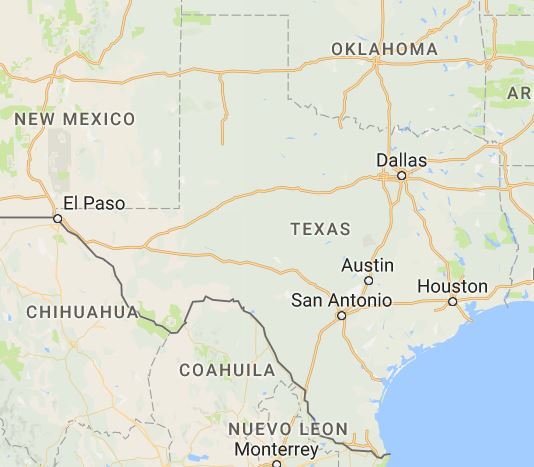
Companies are rapidly fleeing to Texas. Governor Greg Abbott has stated that Texas will soon become “the home of semiconductor manufacturing.” He would like to discontinue outsourcing the manufacturing of essential supplies and incentivize businesses to relocate. “The country made a mistake over the past one or two decades to farm out manufacturing of all these essential supplies, whether it be now semiconductors or could be health care supplies that we needed during the time of COVID, whatever the case may be, we need to not depend upon China or other countries for our essential needs, for things like semiconductors,” Abbott told reporters at Fox News.

South Korea’s Samsung Electronics Co. plans to build a $17 billion semiconductor facility in Taylor, Texas, which makes it the largest foreign direct investment in the state’s history. The plant will create 2,000 jobs alone. Increasing semiconductor production is crucial to combat the worldwide shortage and will help to smooth the overall supply crisis. Texas Instruments is also seeking to invest $30 million into semiconductor production.

Elon Musk reported that he plans to relocate Tesla’s headquarters to Texas as well after receiving a less than warm welcome in California. In the first eleven months of the year, over 70 businesses have relocated their headquarters to the southern state, meaning a new company relocates to Texas around every five days. Businesses are keen on more than just the tax breaks. Abbott boasted that Texas has “no mandates infringing upon individual liberty,” and has actively fought against any mandates. “The only mandate that applies is my executive order saying that nobody in the state of Texas can be mandated to take a vaccine shot,” Abbott said, noting that a COVID vaccine is “available for anybody who wants it, but there can be no mandates infringing upon individual liberty.”

Vaccine mandates are bad for business. The states imposing harsh restrictions do not understand the economic impact, while other states will see a lucrative benefit to fighting for human liberties.

Martin Armstrong Interview: COVID, Civil War, and Major Capital Shifts (Part 2)


Armstrong Economics Blog/Armstrong in the Media Re-Posted Dec 7, 2021 by Martin Armstrong

Click here to watch part two of the interview with Financial Sense’s most controversial and honest guest, Martin Armstrong.

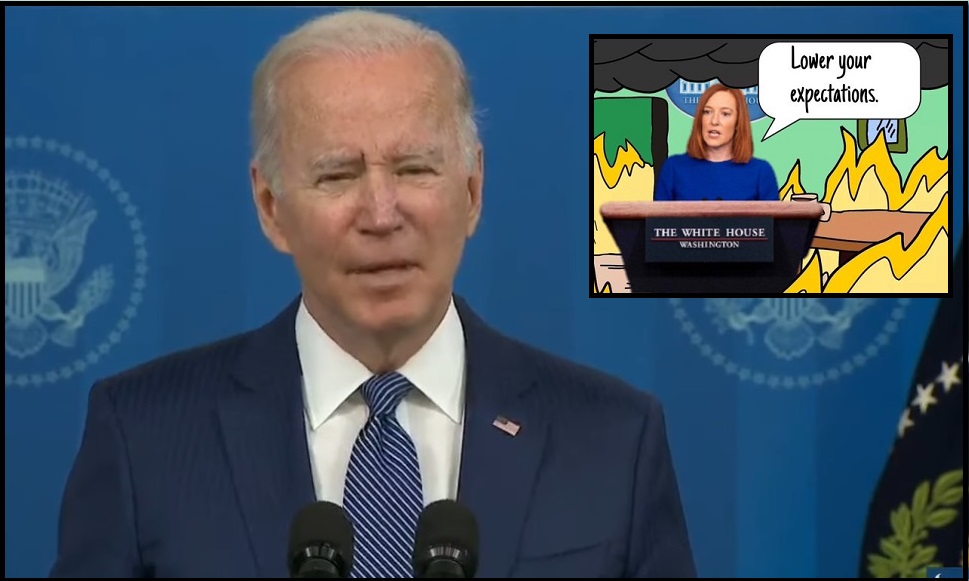
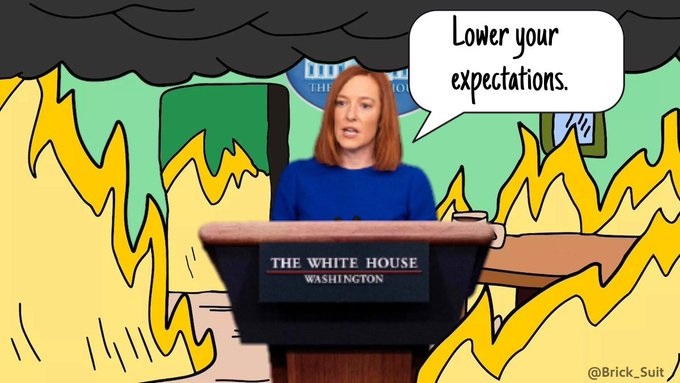
White House Tells Media to Lower Expectations on Government Transparency – Jennifer Psaki Refuses to Answer Questions About Hunter Biden and Sketchy Financial Interests


Posted originally on the conservative tree house on December 6, 2021 | Sundance | 114 Comments

White House Press Secretary Jen Psaki was asked today about whether the White House would be transparent with the reported divestiture of Hunter Biden and his financial relationships with communist Chinese government officials.  The press secretary refused to answer the question.  WATCH:

Eurozone Inflation at a Record High


Armstrong Economics Blog/Interest Rates Re-Posted Dec 6, 2021 by Martin Armstrong

Inflation in the doomed Eurozone increased 4.9% in November, marking the highest level of inflation since the creation of the euro. The larger economies within the bloc experienced a significant rise in inflation, with Germany posting a 6% increase and France experiencing a 3.4% rise. Other nations saw extreme spikes such as Estonia and Lithuania that reported increases of 8.4% and 9.3%.

Artificially lowering rates has backfired; the inverse relationship between reducing rates and increased inflation is now extremely apparent. Like the Federal Reserve, the European Central Bank (ECB) is aiming for a 2% inflation target. The ECB does not see anything wrong with its current policy. ECB President Christine Lagarde said that the bank will not raise rates in 2022, although they anticipate inflation to continue into the new year. “We still see inflation moderating in the next year, but it will take longer to decline than originally expected,” Lagarde stated in mid-November. Instead of changing the policy, Lagarde will simply revise inflation forecasts at the December meeting, marking the sixth consecutive time the ECB has done so. She should take a page from Powell’s book and retire the term “transitory” when discussing inflation.

The $99 Billion US Pet Industry


Armstrong Economics Blog/North America Re-Posted Dec 5, 2021 by Martin Armstrong

The pet industry is on the rise in the US, and consumer spending patterns show that pet owners are not reluctant to spend money on their companions. According to the American Pet Products Association (APPA), around 67% of US households have at least one pet, marking the highest level of pet ownership on record. As a result, the pet industry in America alone reached $99 billion in 2020, and analysts expect this figure to rise.

In fact, pets have become a staple in many American households to the point that one in ten pet owners are actually delaying having children to focus on their pets. Surprisingly, Zulily found that 42% of Millennials admitted that a key factor in becoming a homeowner was the desire to provide a larger space for their dog. Therefore, people are making major life decisions and purchases based on their animals’ needs. The APPA found that the average owner spends $1,380 annually per dog and $908 per cat. That amount could quickly spike if a pet falls ill or has special needs. Grooming, training, and boarding costs would also push this number higher for middle and upper-income owners.

Millennials are also driving sales for pet-related items, with 51% reportedly buying their pet a gift at least once per month. Again, online purchases are driving the trend, and experts expect a quarter of America’s pet supply purchases will be made online within the next two years.

A decade ago, Americans spent only $45.53 billion on pet supplies annually. That number has doubled and is on the rise. Consumers are willing to spend more money on their pets as they have advanced their status in American society from working domesticated animals to well-loved house pets.

November Jobs Report Massively Misses Expectations, 210k Added vs 535k Anticipated, Financial Media Confused


Posted originally on the conservative tree house on December 3, 2021 | Sundance | 153 Comments

The financial punditry class are befuddled, confused and perplexed. The Bureau of Labor and Statistics released the November jobs report [data here] showing a six figure miss from expectations.  Economists were expecting around 535,000 additional jobs; however, the U.S. added only 210,000 jobs according to the new data.

The situation itself is not that difficult to understand when you look at Main Street.  However, so many of the professional punditry class are confused because they only focus on the Wall Street economy, their only prism of reference for the last several decades.

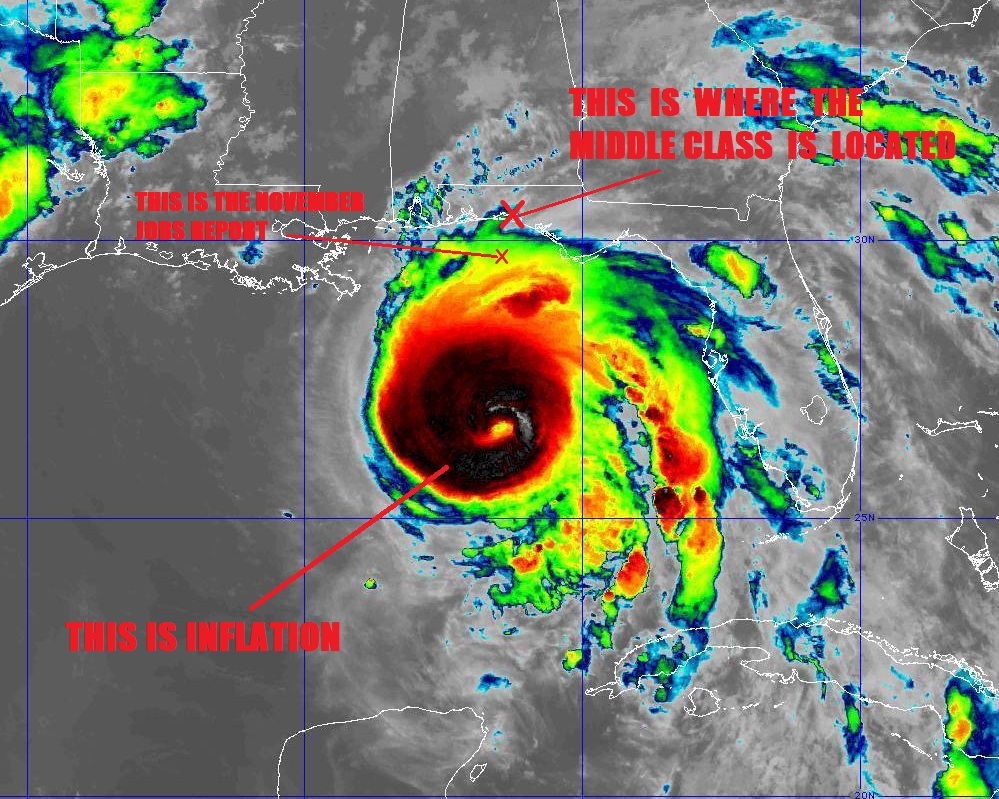
Americans are preparing, cutting back and hunkering down from the Hurricane that is Joe Biden’s inflation.

Inside the jobs numbers, you will note the areas where consumer spending contraction first hits: retail, luxury, leisure and hospitality, is the area where November employment was flat or jobs were lost.   DUH!

The ‘retail sector‘ lost 20,000 jobs in November.  Think about that.  What usually happens in November?  People are hired to handle holiday seasonal shopping…. but they weren’t… why not?  The professional economic punditry cannot figure it out, so they avoid those questions entirely.  Those questions hold the key to unlocking the understanding.  Does the “pretending not to know things” ring familiar?

The damn jobs report is simply reflecting how Main Street USA workers, consumers, spenders and survivors live when gasoline, energy and food costs necessarily skyrocket.  The November employment results are a reflection of the blue collar prepper mindset.  This is not hard to figure out.   As long as inflation continues to hit items that cannot be avoided, at a level that is two to five times the rate of wage growth, decisions are made that are based on checkbook economics.

The cognitive dissonance is quite remarkable look:

(Via MSM) –  The employment situation last month wasn’t what experts expected.   There were only 210,000 nonfarm payroll jobs added in November, coming in below the median estimate of 550,000 from economists surveyed by Bloomberg. This comes after October’s gain of over half a million, at 546,000.

Employment in leisure and hospitality was struck hard by the pandemic, and has been slowly making its way back. The industry still has a lot of ground to make up; it’s 1.3 million below pre-pandemic employment, as hiring dramatically slowed last month.

After two months of job gains of over 100,000, leisure and hospitality saw a gain of just 23,000. Instead, leading the way in November’s gains was the professional and business services industry, with 90,000 jobs. 

The pandemic may continue to play a role in hiring in the leisure and hospitality industry, according to Daniel Zhao, a senior economist at Glassdoor.

“I think what’s going on here is that the Delta wave is lingering. Even though there has been improvement in the public health situation, cases are still elevated — if not rebounding,” Zhao said. “That has a disproportionate impact on COVID-sensitive industries like leisure and hospitality and retail.”   But it could also be that people don’t want to work in such a low-wage industry. (read more)

They’re still blaming COVID, as if the virus is the explanation to justify all of Joe Biden’s massively failing policies.

Inflation is being fueled by legislative spending, monetary policy, fiscal policy, economic policy and Build Back Better.  Inflation is the unavoidable Hurricane bearing down upon us…..

The American middle class worker is prepping, boarding up the windows, bringing in their family, preparing to survive this storm and hunkering down.  It really is that simple.

I hope that metaphor helps explain the November jobs report.

DC Democrats Claim Victory Over Inflation With Temporary Two Cent Drop in Gasoline Prices – Their Emphasis Explains Why They Need Omicron


Posted originally on the Conservative tree house on December 2, 2021 | Sundance | 116 Comments

If you were still on the fence about Omicron being created/used specifically because the people behind Biden were worried about gas prices {Go Deep}, you can quit the straddle.

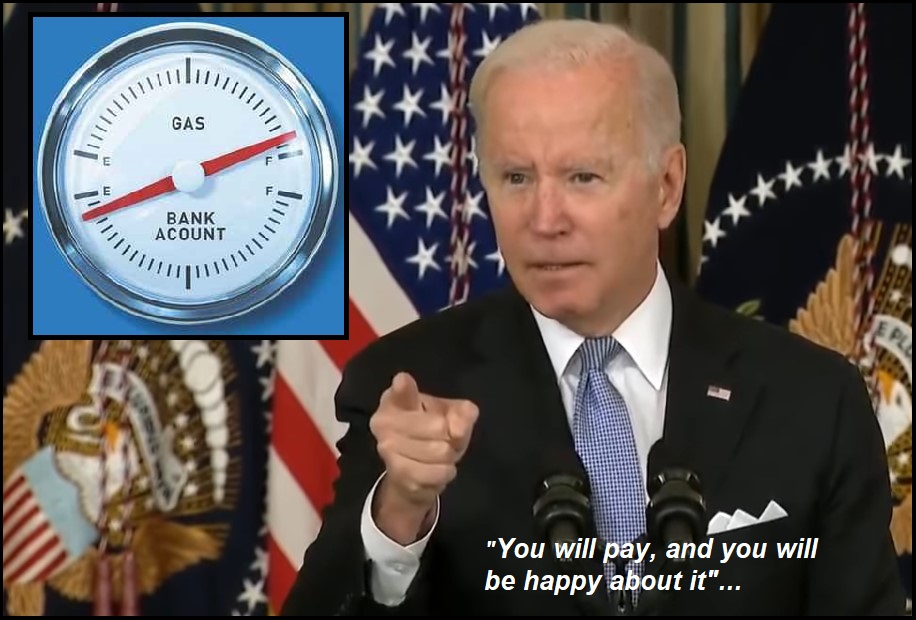
Energy inflation overall, and gasoline inflation specifically, is the Build Back Better communists’ Achilles heel.  The Biden administration is ideologically committed to climate change policy and as a result they have no supply-side tools to stop gasoline prices from necessarily skyrocketing.  They desperately need the fear of Omicron to shut down the demand side.

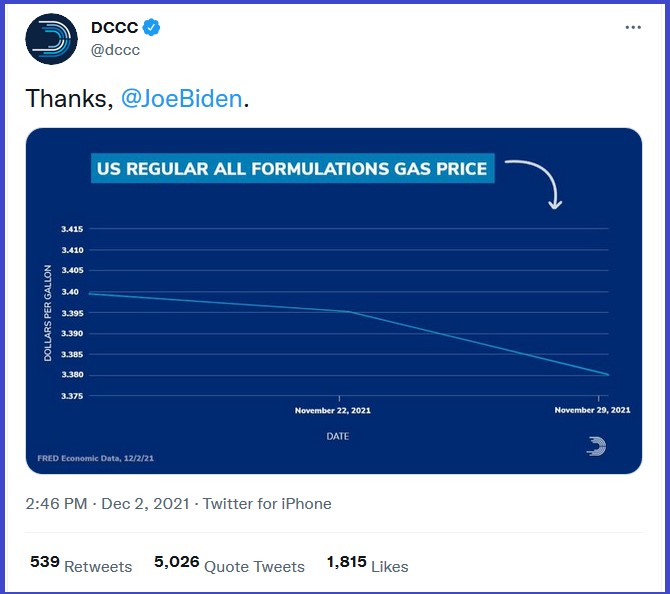
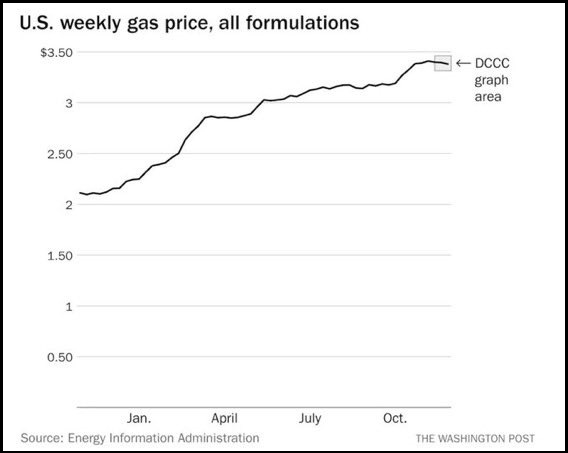
Ten days ago the communists said they were releasing 55 million barrels of oil from the strategic petroleum reserve {Go Deep}, approximately a three day supply of oil given the current level of demand.  Today the Democrat Congressional Campaign Committee (DCCC) laughably claim victory over a two cent drop in gasoline price.  Worse still is the gaslighting graph they use to show a downward trajectory on price:

The Y-axis is in increments of half a cent.  The X-axis is showing six days of impact.

Yes, gasoline fell from $3.39/gal to $3.38/gal in the six days after the strategic petroleum reserve release.  We are spared a single penny per gallon in gas price.

Even the leftist media recognize this type of propaganda only makes Democrats look more stupid. A longer review of the Joe Biden price for Gasoline puts that six day Democrat graph into perspective:

Knuckleheads….

All communists are knuckleheads.

That said, what this insufferable effort highlights is how much emphasis the Democrats are putting toward trying desperately to get away from the problem of inflation.

All of Biden energy policy, and all of Biden’s spending around the Build Back Better agenda, is designed to take us from where we are now into some distant place where fossil fuels are not the energy mechanism; that’s the Green New Deal component of this.  However, there is no policy for their transition – they stopped all current energy policy around oil and coal.

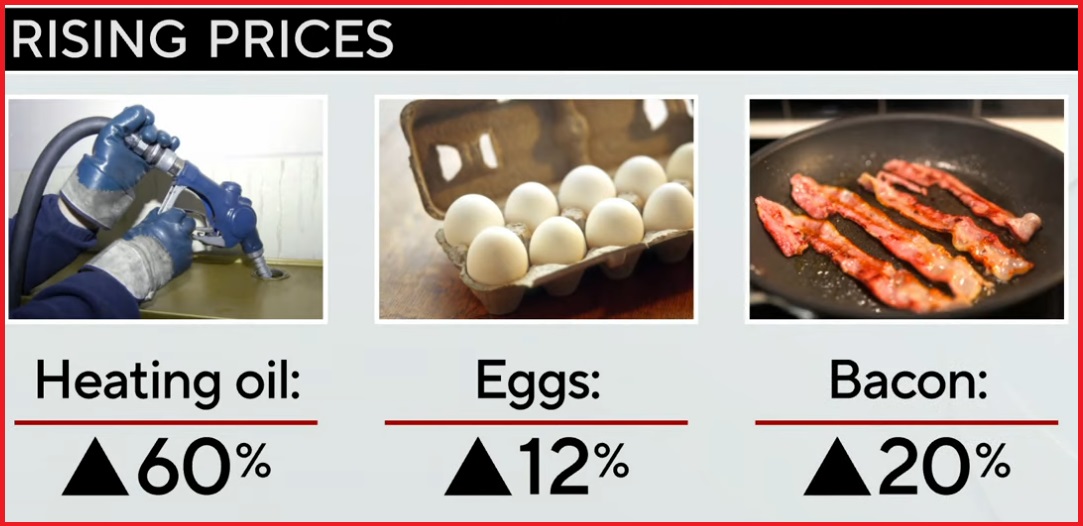
Biden halted pipelines, cancelled oil and gas leases, blocked expanded refinery capacity and regulated the entire U.S. oil industry into a place of diminished capacity.  That is why energy prices have, as Obama promised,  “necessarily skyrocketed.”  And, we ain’t seen nothing yet.  Depending on how cold it is this winter, you can expect natural gas and home heating oil to double in the next few months.

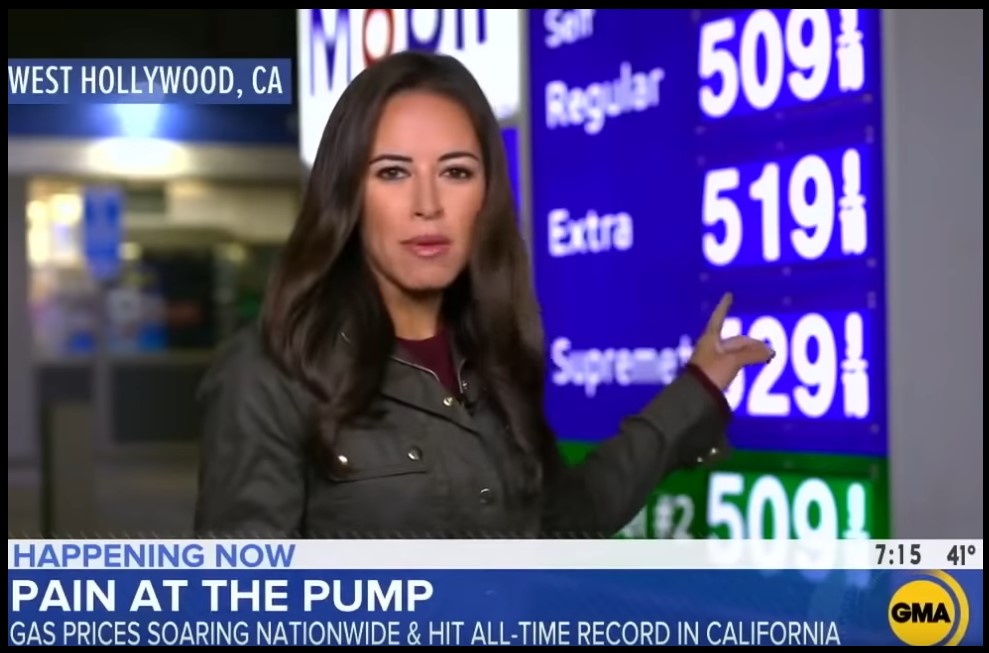
The near horizon looks pretty clear.  Gasoline will keep rising fast and will cost $6 to $7/gal before next spring.   There is no way under current Joe Biden policy to avoid this, unless he was to completely abandon his energy policy; that’s not likely.  The climate change ideologues, academics and far-left communists behind the Biden policy are not likely to see the catastrophic economic damage as a bad thing, instead they will likely say it’s the new normal.

With that level of supply side economic chaos seemingly unavoidable, the only way for Biden to try and mitigate political damage is an attempt to halt the demand side.  That’s why the administration needs Omicron.

It is more important for our government to use Omicron than all other governments because we are the spending and ideological center. That is why we are seeing a much bigger emphasis upon the fear of Omicron by our government; and that is why the descending levels of variant emphasis/fear fall in line depending on how closely other nations are aligned as allies.

Meanwhile… China, Iran and Russia (adversaries on an ideological level) know what is happening, and to the extent they can drive U.S. inflation even higher, they will.  Our adversaries know how to use Biden’s policy to make massive inflation hurt the U.S. disproportionately. This is why OPEC is giving Biden the middle finger on his ‘request’ to increase oil production, and this is why China is now triggering shipping quarantines. (more)

Again, as repeated previously, our window to prepare for a massive jump in inflation is slowly closing.  We are down to around 60 days, and then things will get really ugly.  The people behind Joe Biden know this.  Omicron is a tool they are attempting to use to moderate the speed of impact within the inflation window.

Increased Consumer Spending Among Scarcity


Armstrong Economics Blog/Behavioral Economics Re-Posted Dec 2, 2021 by Martin Armstrong

The global supply chain shortage amid rising inflation is abundantly prominent. The supply shortage could actually cause people to spend more despite rising prices. Adobe Analytics is already predicting a 10% increase in US online shopping purchases over the next month, totaling $207 billion. An Indiana Institute study explains “pandemic, panicked overbuying” amid shortages.

We all recall the toilet paper and water shortages at the beginning of the pandemic. Stores simply did not have these items in stock, and when they became available, people purchased more than they could possibly consume. Researchers found that scarcity triggered a desire to compensate for shortages by seeking abundance. The average consumer likely would not purchase $300 worth of toilet paper in one trip to the store, but under the pretense of scarcity, overspending impacts price judgments.

Consumers categorize purchases differently amid shortages as well. Typically, people associate a higher price tag with higher quality. “People who face scarcity are less likely to view less vs. more expensive options as belonging to different categories, and thus are open to differences at either or both ends of the price continuum,” co-author Ashok Lalwani stated.

Researchers at John Molson School of Business found two main methods consumers use to compensate for a lack of abundance: the scarcity-reduction route and the control-restoration route. The scarcity-reduction route will cause people to panic buy more than they need to reduce the prospect of running out. Coincidentally, this exacerbates the problem of shortages as people hoard items and they become unavailable to those who need them. The other method, the control-restoration route, occurs when people fear they cannot eliminate scarcity through efforts or spending (i.e., distractions or avoidance).

However,  the typical consumer is compelled toward competitive shopping behavior amid shortages. The researchers at the John Molson School of Business found that seeing images of empty shelves could trigger an increased consumption response. In fact, many are prone to accidental stockpiling where they add a few additional items to their cart that ends up totaling to more money and resources than they need.

Hopefully, we do not see the same level of panic buying that we did during the beginning stages of the pandemic. However, holiday shoppers are quick to snatch up deals and pile up on items in fear that they may not be available tomorrow.

Joe Biden Compares The Shortage of Pet Food, Chemical and Raw Material Commodities to the Scarcity of Cabbage Patch Dolls


Posted originally on the conservative tree house on December 1, 2021 | Sundance | 198 Comments

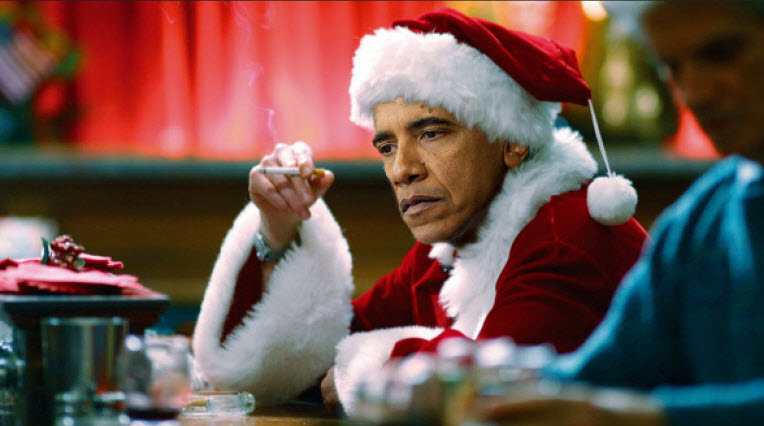
At some point you have to wonder if the Obama team behind the scenes is intentionally putting words in Biden’s teleprompter because they want him to be mocked in public.

Earlier today Joe Biden compared the shortage of essential products, pet foods, raw materials, petroleum products and chemicals in the U.S. (due to his self-inflicted energy policy) to the shortage of Cabbage Patch dolls in the 1980’s.  Seriously, you really cannot make this stuff up. WATCH:

I would hazard a guess the speechwriters debated using Tickle Me Elmo as an example, and then decided it was a just a smidge too far.

Good grief, this is enough to really make you wonder….  How long?

.

The Biden Economy – Black Friday Sales Drop 28 Percent from Pre-Pandemic Levels, Cyber Monday Sales Drop First Time in History


Posted originally on the conservative tree house on November 30, 2021 | Sundance | 91 Comments

Reports on the beginning of the Christmas holiday shopping season do not look good for retailers.  CNBC is reporting the Black Friday sales were down a significant 28.3% from pre-pandemic levels in 2019 [link].  The difference was not made up inside on-line sales as Cyber Monday had the first drop in sales in the history of tracking on-line sales [link].

The financial pundit spin, intended to protect the Biden administration, includes a talking point that U.S. consumers decided to make their holiday purchases early this year, therefore the holiday spending metric no longer applies.

As the narrative is built, people were concerned about shortages of products so they purchased them early in the year.  While part of that is likely true, early shopping is not that unusual and cannot account for such a massive drop in purchasing.

The same narrative was used to explain the drop in Cyber Monday sales: “Shoppers nationwide spent nearly $11 billion on digital sales on Cyber Monday, a tracking firm said — a decrease of 1.4% from last year and the first decline ever for a major shopping holiday.” […] “It spread out e-commerce spending across the months of October and November.”  There’s virtually no limit to how the financial media will avoid identifying the real motive for declining sales, inflation and the lack of disposable income.

Inflation continues to be a major issue for all middle-class workers, and there does not appear to be any end in sight for even more price increases.  As gas, energy and food prices jump so significantly the amount of disposable income available for other non critical purchases becomes limited.  This is a simple Main Street checkbook reality felt by most Americans and willfully avoided by the Wall Street pundits.

The question of spending and purchasing priority is best identified by asking consumers the question:  Can you afford to spend more this year, and will you?