Can the Sanction Work on North Korea


QUESTION: Mr. Armstrong, can the sanctions against North Korea succeed now that China is implementing them as well?

ANSWER:  The UN sanctions are curbs on everything from lead and fish exports to questionable North Korean companies. North Korea is in the middle of a serious drought that’s ruining crops. Food is an issue there so this intensifies an already dark humanitarian picture where estimates are that 40% of the population is already malnourished. Only the people can create regime change.

North Korea is in a very severe recession particularly since 2015. The sanctions directly impact the mining and manufacturing industries, which account for just over 30% of GDP. The increase in food shortages will not deter Kim Jong Un from his ambition of developing an arsenal of nuclear-tipped missiles. Only the people can overthrow him for he could care less about the people.

North Korea’s dependency on Chinese fuel is China’s main ace-in-the-hole. If the fuel is cut off, then we are looking at curtaining his air force and their electricity production will decline significantly.

To the extent that the sanction force the people to rise up, then they can work. Otherwise, Kim will not yield as long as he retains power.

The Myth of Modern “Global Markets” – Understanding Why Renegotiating National Trade is So Critical….


President Donald Trump has cancelled the Manufacturers Council and the Strategic Economic Advisory Board.  There are trillions of dollars at stake.  The members of the boards, and their representative companies, were being targeted by left-wing groups like Move-On.Org with boycotts and opposition.

There are massive international corporate and financial interests who are inherently at risk from President Trump’s “America-First” economic and trade platform.  Believe it or not, President Trump is up against an entire world economic establishment.

I will outline how it works below; and when you understand how it works in the modern era you will understand why the agents within the system are so adamantly opposed to U.S. President Trump.

The biggest lie in modern economics, willingly spread and maintained by corporate media, is that a system of global markets still exists.

It doesn’t.

Every element of global economic trade is controlled and exploited by massive institutions, multinational banks and multinational corporations.  Institutions like the World Trade Organization (WTO) and World Bank control trillions of dollars in economic activity.  Underneath that economic activity there are people who hold the reigns of power over the outcomes.  These individuals and groups are the stakeholders in direct opposition to principles of national economics.

The modern financial constructs of these entities have been established over the course of the past three decades.  When you understand how they manipulate the economic system of individual nations you begin to understand understand why they are so fundamentally opposed to President Trump.

In the Western World, separate from communist control perspectives (ie. China), “Global markets” are a modern myth; nothing more than a talking point meant to keep people satiated with sound bites they might find familiar.  Global markets have been destroyed over the past three decades by multinational corporations who control the products formerly contained within global markets.

The same is true for “Commodities Markets”.  The multinational trade and economic system, run by corporations and multinational banks, now controls the product outputs of independent nations.  The free market economic system has been usurped by entities who create what is best described as ‘controlled markets’.

U.S. President Trump smartly understands what has taken place.  Additionally he uses economic leverage as part of a broader national security policy; and to understand who opposes President Trump specifically because of the economic leverage he creates, it becomes important to understand the objectives of the global and financial elite who run and operate the institutions. The Big Club.

Understanding how trillions of trade dollars influence geopolitical policy we begin to understand the three-decade global financial construct they seek to protect.

That is, global financial exploitation of national markets.  FOUR BASIC ELEMENTS:

♦Multinational corporations purchase controlling interests in various national outputs and industries of developed industrial western nations.

♦The Multinational Corporations making the purchases are underwritten by massive global financial institutions, multinational banks.

♦The Multinational Banks and the Multinational Corporations then utilize lobbying interests to manipulate the internal political policy of the targeted nation state(s).

♦With control over the targeted national industry or interest, the multinationals then leverage export of the national asset (exfiltration) through trade agreements structured to the benefit of lesser developed nation states – where they have previously established a proactive financial footprint.

Against the backdrop of President Trump confronting China, and against the backdrop of NAFTA being renegotiated, revisiting the economic influences within the import/export dynamic will help conceptualize the issues at the heart of the matter. There are a myriad of interests within each trade sector that make specific explanation very challenging; however, here’s the basic outline.

For three decades economic “globalism” has advanced, quickly. Everyone accepts this statement, yet few actually stop to ask who and what are behind this – and why?

Influential people with vested financial interests in the process have sold a narrative that global manufacturing, global sourcing, and global production was the inherent way of the future. The same voices claimed the American economy was consigned to become a “service-driven economy.”

What was always missed in these discussions is that advocates selling this global-economy message have a vested financial and ideological interest in convincing the information consumer it is all just a natural outcome of economic progress.

It’s not.

It’s not natural at all. It is a process that is entirely controlled, promoted and utilized by large conglomerates and massive financial corporations.

Again, I’ll try to retain the larger altitude perspective without falling into the traps of the esoteric weeds. I freely admit this is tough to explain and I may not be successful.

Bulletpoint #1: ♦ Multinational corporations purchase controlling interests in various national elements of developed industrial western nations.

This is perhaps the most challenging to understand. In essence, thanks specifically to the way the World Trade Organization (WTO) was established in 1995, national companies expanded their influence into multiple nations, across a myriad of industries and economic sectors (energy, agriculture, raw earth minerals, etc.). This is the basic underpinning of national companies becoming multinational corporations.

Think of these multinational corporations as global entities now powerful enough to reach into multiple nations -simultaneously- and purchase controlling interests in a single economic commodity.

A historic reference point might be the original multinational enterprise, energy via oil production. (Exxon, Mobil, BP, etc.)

However, in the modern global world, it’s not just oil; the resource and product procurement extends to virtually every possible commodity and industry. From the very visible (wheat/corn) to the obscure (small minerals, and even flowers).

Bulletpoint #2 ♦ The Multinational Corporations making the purchases are underwritten by massive global financial institutions, multinational banks.

During the past several decades national companies merged. The largest lemon producer company in Brazil, merges with the largest lemon company in Mexico, merges with the largest lemon company in Argentina, merges with the largest lemon company in the U.S., etc. etc. National companies, formerly of one nation, become “continental” companies with control over an entire continent of nations.

…. or it could be over several continents or even the entire world market of Lemon/Widget production. These are now multinational corporations. They hold interests in specific segments (this example lemons) across a broad variety of individual nations.

National laws on Monopoly building are not the same in all nations. But most are not as structured as the U.S.A or other more developed nations (with more laws). During the acquisition phase, when encountering a highly developed nation with monopoly laws, the process of an umbrella corporation might be needed to purchase the interests within a specific nation. The example of Monsanto applies here.

Bulletpoint #3 ♦The Multinational Banks and the Multinational Corporations then utilize lobbying interests to manipulate the internal political policy of the targeted nation state(s).

With control of the majority of actual lemons the multinational corporation now holds a different set of financial values than a local farmer or national market. This is why commodities exchanges are essentially dead. In the aggregate the mercantile exchange is no longer a free or supply-based market; it is now a controlled market exploited by mega-sized multinational corporations.

Instead of the traditional ‘supply/demand’ equation determining prices, the corporations look to see what nations can afford what prices. The supply of the controlled product is then distributed to the country according to their ability to afford the price. This is how the corporation maximizes it’s profits.

Back to the lemons. A corporation might hold the rights to the majority of the lemon production in Brazil, Argentina and California/Florida. The price the U.S. consumer pays for the lemons is directed by the amount of inventory (distribution) the controlling corporation allows in the U.S.

If the U.S. harvest is abundant, they will export the product to keep the U.S. consumer spending at peak or optimal price. A U.S. customer might pay $2 for a lemon, a Mexican customer might pay .50¢, and a Canadian $1.25.

The bottom line issue is the national supply (in this example ‘harvest/yield’) is not driving the national price because the supply is now controlled by massive multinational corporations.

The mistake people often make is calling this a “global commodity” process. In the modern era this “global commodity” phrase is particularly BS.

A true global commodity is a process of individual nations harvesting/creating a similar product and bringing that product to a global market. Individual nations each independently engaged in creating a similar product.

Under modern globalism this process no longer takes place. It’s a complete fraud. Currently, massive multinational corporations control the majority of product inside each nation and therefore control the entire global product market and price.

EXAMPLE: Part of the lobbying in the food industry is to advocate for the expansion of U.S. taxpayer benefits to underwrite the costs of the domestic food products they control. By lobbying DC these multinational corporations get congress and policy-makers to expand the basis of who can use EBT and SNAP benefits (state reimbursement rates).

Expanding the federal subsidy for food purchases is part of the corporate profit dynamic. With increased taxpayer subsidies, the food price controllers can charge more domestically and export more of the product internationally. Taxes, via subsidies, go into their profit margins. The corporations then use a portion of those profits in contributions to the politicians. It’s a circle of money.

In highly developed nations this multinational corporate process requires the corporation to purchase the domestic political process (as above) with individual nations allowing the exploitation in varying degrees. As such, the corporate lobbyists pay hundreds of millions to politicians for changes in policies and regulations; one sector, one product, or one industry at a time. These are specialized lobbyists.

EXAMPLE: The Committee on Foreign Investment in the United States (CFIUS)

CFIUS is an inter-agency committee authorized to review transactions that could result in control of a U.S. business by a foreign person (“covered transactions”), in order to determine the effect of such transactions on the national security of the United States.

CFIUS operates pursuant to section 721 of the Defense Production Act of 1950, as amended by the Foreign Investment and National Security Act of 2007 (FINSA) (section 721) and as implemented by Executive Order 11858, as amended, and regulations at 31 C.F.R. Part 800.

The CFIUS process has been the subject of significant reforms over the past several years. These include numerous improvements in internal CFIUS procedures, enactment of FINSA in July 2007, amendment of Executive Order 11858 in January 2008, revision of the CFIUS regulations in November 2008, and publication of guidance on CFIUS’s national security considerations in December 2008 (more)

Bulletpoint #4With control over the targeted national industry or interest, the multinationals then leverage export of the national asset (exfiltration) through trade agreements structured to the benefit of lesser developed nation states – where they have previously established a proactive financial footprint.

The process of charging the U.S. consumer more for a product, that under normal national market conditions would cost less, is a process called exfiltration of wealth.

It is never discussed.

To control the market price some contracted product may even be secured and shipped with the intent to allow it to sit idle (or rot). It’s all about controlling the price and maximizing the profit equation. To gain the same $1 profit a widget multinational might have to sell 20 widgets in El-Salvador (.25¢ each), or two widgets in the U.S. ($2.50/each).

Think of the process like the historic reference of OPEC (Oil Producing Economic Countries). Only in the modern era massive corporations are playing the role of OPEC and it’s not oil being controlled, it’s almost everything.

Again, this is highlighted in the example of taxpayers subsidizing the food sector (EBT, SNAP etc.), the corporations can charge U.S. consumers more. Ex. more beef is exported, red meat prices remain high at the grocery store, but subsidized U.S. consumers can afford the high prices. Of course if you are not receiving food payment assistance (middle-class) you can’t eat the steaks because you can’t afford them. (Not accidentally, it’s the same scheme in the ObamaCare healthcare system)

Individual flower growers in Florida go out of business because they didn’t join the global market of flower growers (controlled market) by multinational corporate flower growers in Columbia and South America, who have an umbrella company registered in Mexico allowing virtually unrestricted access to the U.S. market under NAFTA.

Agriculturally, multinational corporate Monsanto says: ‘all your harvests are belong to us‘. Contract with us, or you lose because we can control the market price of your end product. Downside is that once you sign that contract, you agree to terms that are entirely created by the financial interests of the larger corporation; not your farm.

The multinational agriculture lobby is massive. We willingly feed the world as part of the system; but you as a grocery customer pay more per unit at the grocery store because domestic supply no longer determines domestic price.

Within the agriculture community the (feed-the-world) production export factor also drives the need for labor. Labor is a cost. The multinational corps have a vested interest in low labor costs. Ergo, open border policies. (ie. willingly purchased republicans not supporting border wall etc.).

This corrupt economic manipulation/exploitation applies over multiple sectors, and even in the sub-sector of an industry like steel. China/India purchases the raw material, ore, then sells the finished good back to the global market at a discount. Or it could be rubber, or concrete, or plastic, or frozen chicken parts etc.

The ‘America First’ Trump-Trade Doctrine upsets the entire construct of this multinational export/control dynamic. Team Trump focus exclusively on bilateral trade deals, with specific trade agreements targeted toward individual nations (not national corporations). ‘America-First’ is also specific policy at a granular product level looking out for the national interests of the United States, U.S. workers, U.S. companies and U.S. consumers.

Under President Trump’s Trade positions, balanced and fair trade with strong regulatory control over national assets, exfiltration of U.S. national wealth is essentially stopped.

This puts many current multinational corporations, globalists who previously took a stake-hold in the U.S. economy with intention to export the wealth, in a position of holding contracted interest of an asset they can no longer exploit.

Perhaps now we understand better how massive multi-billion multinational corporations and institutions are aligned against President Trump.

RELATED:

♦The Modern Third Dimension in American Economics – HERE

♦The “Fed” Can’t Figure out the New Economics – HERE

♦Proof “America-First” has disconnected Main Street from Wall Street – HERE

♦Treasury Secretary Mnuchin begins creating a Parallel Banking System – HERE

♦How Trump Economic Policy is Interacting With The Stock Market – HERE

♦How Multinationals have Exported U.S. Wealth – HERE


Report: Hope Hicks To Be Named White House Communications Director…


The Daily Caller is reporting that Hope Hicks will be named as Communications Director.  Most people familiar with the 2015 campaign origin will remember Hope Hicks as one of the very original members of the small campaign team.

(Via Daily Caller) Hope Hicks will be named the new White House communications director, The Daily Caller News Foundation has learned.

President Trump has offered the job to Hicks and she has accepted the position, according to a White House insider. Hicks has been close by Trump’s side since the early days of the campaign and is one of his most trusted staffers. She has been serving on the press team in more of a behind-the-scenes role as the director of strategic communications.

The communications director position has been open since President Trump fired Anthony Scaramucci in July, just ten days after the Mooch took over the position from former press secretary Sean Spicer. Trump ditched Scaramucci shortly after he decided to bring on Homeland Security Secretary John Kelly as his new chief of staff.  (link)

The Legal Challenge to Quantitative Easing


General view of the buildings of the Court of Justice of the European Communities

It has taken almost 10 years for the ECB’s controversial government bond purchases to finally reach the European Court of Justice (ECJ) to be reviewed as to their constitutionality. There have always been serious questions whether the PSPP (Public Sector Purchase Program) was compatible with the ban on monetary budgetary funding that has been imposed upon member states. Italy, for example, asked for an exemption from the budgetary constraints to take care of the refugees, The EU Commission said absolutely no!

The German high court has been hearing a case that proposes it rule that financing government budgets would not be covered by the mandate of the European Central Bank (ECB). That has long been a thorn in the side of Draghi that he was acting unconstitutional at the end of the day. The ECJ has been requested to expedite the procedure, because “the case requires a quick settlement” after almost 10 years?

The background of the case is three constitutional arguments are fairly straight forward against the PSPP. The ECJ has not answered these issues which has been preventing the German court from finally decide the constitutional complaints.

The argument claims that the European System of Central Banks, with the program for the purchase of securities of the public sector which it has set up, is contrary to the prohibition of monetary government financing (Article 123 TFEU) and the principle of limited individual authorization (Article 5 1 TEU in conjunction with Art. 119, 127 et seq. TFEU).Therefore, the Deutsche Bundesbank should not participate in this program and the German Bundestag and the Federal Government are obliged to take appropriate measures against the program.
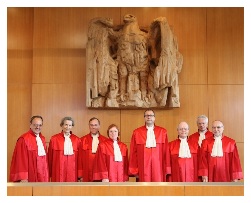
The plaintiffs in Germany wanted the Bundesverfassungsgericht to stop the Bundesbank’s participation in the ECB program. Germany, they argued, would suffer a complete loss if the bonds failed. The risk to the German national budget is disproportionate was their main point.

The ECJ has a political mandate which is strangely different from the Supreme Court of Germany or the United States for that matter.The ECJ has a mandate to promote integration within the EU, which is clearly a political element. If we add this political element, that one can see that the ECJ can view the purchase of government bonds as a permissible means of integration.

The ECB has clearly altered the bond market destroying liquidity. Banks are rushing to sell their bonds to the ECB in anticipation of rising rates which will cause their bond holdings to decline. Hence, the ECB has actually functioned as a place to dump financial toxic-waste.

The Germany Federal Constitutional Court has thus suspended further litigation pending the ECJ ruling.


The Federal Constitutional Court announced in a Press Release No. 70/2017 of 15 August 2017

Decision of 18 July 2017
2 BvR 859/15, 2 BvR 980/16, 2 BvR 2006/15, 2 BvR 1651/15
With the decision published today, the Second Senate of the Federal Constitutional Court has suspended the procedure concerning the question whether the Public Sector Purchase Program (PSPP) of the European Central Bank is compatible with the Basic Law for the purchase of public sector securities and asks the Court of Justice of the European Union several questions For a preliminary ruling. According to the Senate, there are important reasons for the fact that the decisions underlying the bond purchase program are in breach of the ban on monetary budgetary financing and go beyond the mandate of the European Central Bank for monetary policy and thus fall within the competence of the Member States. The Senate seeks the implementation of the accelerated procedure in accordance with Article 105 of the Rules of Procedure of the Court of Justice of the European Union, since the nature of the case requires its speedy completion.

Facts:

The PSPP is part of the Expanded Asset Purchase Program (EAPP), a framework program of the European Central Bank (ECB) for the purchase of assets. The PSPP accounts for the largest share of the total volume of the EAPP. On 12 May 2017, the EAPP achieved a total volume of EUR 1 862.1 billion; Of this total, EUR 1,534.8 billion accounted for the PSPP.

The complainants, by their constitutional complaints, claim that the European System of Central Banks, with the program for the purchase of securities of the public sector which it has set up, is contrary to the prohibition of monetary government financing (Article 123 TFEU) and the principle of limited individual authorization (Article 5 1 TEU in conjunction with Art. 119, 127 et seq. TFEU). Therefore, the Deutsche Bundesbank should not participate in this program and the German Bundestag and the Federal Government are obliged to take appropriate measures against the program.

Important considerations of the Senate:

1. Article 38 (1), first sentence, of the Basic Law guarantees to German nationals the right to democratic self-determination, which is enforceable with the constitutional complaint, in the scope protected by Article 79 (3) of the Basic Law. On the basis of the responsibility of integration, the German constitutional authorities have the duty, within the limits of their competences, to work towards compliance with the integration program. It is the task of the Federal Constitutional Court to examine whether measures taken by bodies, bodies and other bodies of the European Union are based on apparent excesses of competence or affect the non-transferable area of ​​the constitutional identity, with the result that German state institutions are not allowed to participate in their condition or implementation ,

2. There are doubts as to whether the PSPP decision is compatible with the ban on monetary budgetary financing.

(A) Article 123 (1) TFEU prohibits the ECB and the central banks of the Member States from purchasing debt securities directly from the institutions of the European Union and the Member States. Purchases on the secondary market may not be used to circumvent the objective pursued by Article 123 TFEU. A program dealing with the purchase of government bonds on the secondary market must therefore be provided with sufficient guarantees to ensure effective compliance with the prohibition of monetary government financing. The Senate is of the opinion that the Court of Justice of the European Union considers the terms which it sets out to limit the scope of the OMT program of 6 September 2012 within its scope as a legally binding criterion The purchase of government bonds.

(B) The PSPP covers bonds issued by States, state enterprises and other government bodies, as well as by European institutions. These bonds are purchased exclusively on the secondary market. However, for an infringement of the PSPP decision against Article 123 TFEU, it is argued that details of purchases are announced in a manner which could give rise to factual certainty on the markets that the Eurosystem will also purchase issued government bonds, The time limits between issuance of a debt instrument on the primary market and its acquisition on the secondary market is not verifiable, that acquired bonds are held to maturity until now, and that bonds with a negative return are obtained from the outset.

3. The PSPP decision could not be covered by the mandate of the ECB.

(A) monetary policy should be distinguished, in particular, from the economic policy which is primarily the responsibility of the Member States, in accordance with the wording, system and objective of the Treaties; The objective of a measure to be determined objectively, the means chosen to achieve this objective, and its link with other arrangements.

(B) From the Senate’s point of view, the PSPP decision could not be seen as a monetary policy measure, but rather as a predominantly economic policy measure, on the basis of an overall view of the relevant delineation criteria. While the PSPP has a stated monetary policy objective and is committed to the pursuit of this objective of monetary policy, But the economic policy implications arising from the volume of the PSPP and the associated predictability of the purchase of government bonds are already directly reflected in the program itself. This would render the PSPP disproportionate in relation to the underlying monetary policy objective. Moreover, the decisions constituting the basis of the program do not provide a comprehensible explanation which would allow the continuous continuity of the program to be reviewed on an ongoing basis during the several years of implementation of the decisions.

4. On the basis of the risk allocation between the ECB and the Bundesbank, the budgetary right of the German Bundestag, protected by Article 20 (1) and (2) in conjunction with Article 79 (3) of the Basic Law, and its overall budgetary responsibility by the PSPP decision Or its implementation in view of possible losses of the Bundesbank, can not be foreseen at present.

(A) An unlimited risk allocation within the Eurosystem and the resulting risks to the national central banks’ profit and loss account would constitute a violation of constitutional identity within the meaning of Article 79 (3) of the Basic Law if it were to recapitalize the national central banks with budgetary resources Which the Senate has committed to the approval of the German Bundestag in its jurisprudence to the EFSF and the ESM. For the success of the constitutional complaints, it is therefore important whether such a risk allocation can be excluded under the primary law.

(B) the decision-making by the Governing Council on the nature and extent of the risk-sharing between members of the European System of Central Banks is hardly determined by primary law. This could allow the ECB Council to amend the rules on risk-sharing within the Eurosystem, which could lead to risks to the national central banks’ profit and loss account and, moreover, to the overall budgetary responsibility of the national parliaments. Against this background, the question arises whether an unlimited risk allocation in the event of default of bonds of central governments and equivalent issuers between the national central banks of the Eurosystem against Article 123 and Article 125 TFEU and Article 4 (2) TEU With Article 79 (3) of the Basic Law).

Kim Jong-un Blinks


Well Kim Jong-un has blinked as he has now said he will wait before sending missiles towards the US Pacific territory of Guam. He said he was prepared for “the enveloping fire at Guam”, but he said he would watch what “the foolish Yankees” do before taking a decision.

I have warned that the risk was too great for Kim and the most likely reason he has blinked is because his missiles are not ready to really pull off that target. Secondly, if the US shoots them out of the sky, he will look like a fool and then we could see a regime change.

It is interesting how Gold closed precisely on the reversal and did not elect it. The markets somehow know more than opinions.

“There are Trillions of Dollars at Stake”…


There are trillions of dollars at stake; you might have heard us mention that before.  At no time was it more clearly evident than RIGHT NOW.

All anxiety is driven by the economics of politics.  Oh, they’ll point to other excuses; but those who understand the larger elements within multinational corporate and government finance totally understand this is all about money.

Economics is money. Money is Economics.

Every syllable and syntax by every oppositional entity, and the authorities who are directing them, are related to the current economic threat that is President Trump. Those who really understand this dynamic; those who are comprehensively willing to look at the biggest picture, can easily guide their friends and family through the motives of hate.

♦China is resisting the economics off President Trump with North Korea. ♦Russia is trying to resist the economics of Trump with Syria. ♦Mitch McConnell is resisting the economics of President Trump with antipathy and inaction.  ♦The Wall Street Journal is resisting the economics of Trump.  ♦Paul Ryan is resisting the economics of President Trump with budget delays and fiscal obfuscation.  ♦Professional corporate media, all sides, are desperately resisting the economics of Trump.  ♦The UniParty is resisting the economics of Trump.  ♦The swamp is resisting the economics of  President Trump.  ♦Adverse international interests are aligned to resist the economics of Trump. ♦CEO’s are resigning advisory boards because of the economics of Trump.  ♦Statues are being torn down to resist the economics of Trump.  ♦Millions of people are being manipulated specifically due to the economics of President Trump….

And remember, the economics of President Trump are YOUR economics.

“America First” is for YOUR future, your families future, America’s future.

Not his, yours.

“It must be always be remembered; there is nothing more difficult to plan, more doubtful of success, nor more dangerous to manage than a new system. For the initiator has the enmity of all who would profit by the preservation of the old institution and merely lukewarm defenders in those who gain by the new ones. ”

Niccolò Machiavelli

It has always been thus.

Government & Revolution – Is it Inevitable?


I have been warning that as governments move closer to this major event of a Sovereign Debt Crisis which begins next year with the start of the Monetary Crisis Cycle, they historically will ALWAYS, and without exception, bite the hand that has fed them. The object for government is survival of the fittest and that is them. This is never really about helping people as they raise retirement ages, punish the youth with school loans they cannot discharge, and exempt themselves from most laws that apply to us. This is also never about how to properly run the economy for the benefit of all. It always boils down to it being them against us. Throughout history, there has never been even one benevolent government that has ever surrendered power willingly for the good of the country or the people. That has NEVER happened even once. Power has always had to be ripped from their grasp either by the people, an internal coup, or some foreign invader.

Yes, not every revolution has to be blood flowing down the streets. It will depend upon the military. In the case of Russia, the military did the honorable thing and stood-down. That is indeed an extremely rare event. From Byzantium and the NIKA Revolt to Tiananmen Square Massacre, the military has often first just slaughtered the people following orders. The German soldiers killing the Jews said the same exact thing – they were just following orders. That has certainly not been the case even recently as in Venezuela where this soldier is killing his own people while standing behind a barricade that reads: “If the order is against the people your honour is to disobey.”

More-often-Than-Not, the revolutions throughout history come about when the taxes of government simply break the back of the economy. We are reaching one of those moments as we cross the threshold into 2018.

BREAKING: Biggest News Roger Stone Has Ever Broken


Sunday Talks: HR McMaster -vs- Chuck Todd


National Security Adviser HR McMaster appears on NBC ‘Meet the Press’ with Chuck Todd to discuss issues surrounding North Korea.   However, Todd predictably uses the first half of the interview to discuss the “Charlottesville Trump-is-racist narrative”, and then, rather sneakily, shifts the discussion into the “alt-right” -vs- McMaster angle.

Chuck Todd uses the “Bannon-wing talking points” and “allies within the White House” to draw out a division within the administration.  It’s obvious the MSM are ‘all-in’ on the strategy to highlight the division.  The second half of the interview finally focuses on North Korea.

At 08:06 the China as an economic enabler to DPRK comes in. Watch how HR McMaster responds on the economics of the North Korean issue.

Sunday Talks: Deception Karl Rove Attempts to Kneecap President Trump…


The right-side of the DC UniParty are exploiting the opportunity to undermine President Trump through heavy use of the “weak Charlottesville response” attack narrative.

Against the background of NAFTA renegotiation (beginning Wednesday), and with a trade confrontation with China imminent (Tomorrow), the U.S. Chamber of Commerce is seizing on this opportunity to dispatch all of their paid operatives to destroy the threat to multinational corporatism and globalist economic expansion, U.S. President Trump.

It’s the perfect anti-Trump storm formation, with a motive oblivious to the U.S electorate because the media have not discussed any of the trade aspects to President Trump’s economic national security agenda.  The big business lobby, Tom Donohue, multinational corporations and their paid advocates have free reign to attack Trump.

Enter Karl Rove:

A Jeanne in the Kitchen

I have created this site to help people have fun in the kitchen. I write about enjoying life both in and out of my kitchen. Life is short! Make the most of it and enjoy!

True the Vote

A group of Americans united by our commitment to Freedom, Constitutional Governance, and Civic Duty.

Zeee Media

Share the truth at whatever cost.

thefoghornexpress

De Oppresso Liber

De Oppresso Liber

The Most Revolutionary Act

Uncensored updates on world events, economics, the environment and medicine

America-Wake-Up

This is a library of News Events not reported by the Main Stream Media documenting & connecting the dots on How the Obama Marxist Liberal agenda is destroying America

TOTT News

Australia's Front Line | Since 2011

CherriesWriter - Vietnam War website

See what War is like and how it affects our Warriors

Murray Report

Nwo News, End Time, Deep State, World News, No Fake News

Scott Adams Says

De Oppresso Liber

Stella's Place

Politics | Talk | Opinion - Contact Info: stellasplace@wowway.com

livingbyathread

Exposition and Encouragement

Disrupted Physician

The Physician Wellness Movement and Illegitimate Authority: The Need for Revolt and Reconstruction

Easy Money Martin

Real Estate Lending