
Armstrong Economics Blog/ECM
Re-Posted Aug 13, 2019 by Martin Armstrong

There is a very Dark Cloud hovering over the world economy and at the center of this cloud lies not just Europe, but Germany – the strongest economy holding up all of Europe. The German manufacturing sector is in freefall. Trump will be blamed calling this the result of his Trade War. It is probably too late to get him to even understand that his advisers are old-school and completely wrong with respect to trade. Their obsession with currency movements is what they taught back in school during the 1930s. My advice to China, let the yuan float and Trump will quickly see that China has been supporting its currency, not suppressing it.
 Manufacturing indicators have deteriorated globally, yet in a very disproportionate manner. Trump will be blamed for this and his badgering the Fed to lower interest rates is also a fool’s game. Nobody looks at the elderly who were told to save for retirement and you will live off the interest. Their house values were undermined in the 2007-2009 New York Banker’s Mortgage-Backed scam that blew up the world economy from which we have been unable to fully recover. The younger generation cannot afford to buy a house as they are saddled with student loans thanks to the Clintons for degrees that are worthless as 65% cannot find jobs in what they have degrees for these days.
The insanity of those in power knows no boundary when it comes to stupidity around the world. All they have is interest rates and after more than 10 years of excessively low to negative interest rates failing to stimulate the economy in Europe, what do they do? They argue that all physical money must be eliminated because people are hoarding cash and thus defeat their lower interest rates policy. The IMF recommends confiscating all cash and then driving interest rates deeply negative to force recovery. They remain ignorant that they have destroyed the retirement of the elderly now, as well as the those who have yet retired because they command pension funds must invest in government bonds to various percentages ensuring that pensions will collapse as well.
Manufacturing has been contracting compared to the service sector even on a global basis. The financial markets have appeared to be disconnected from the underlying economic trends because capital smells a very big rat. Capital has been shifting toward preservation rather than how much profit can it make today. Even the 10-year 3-month interest rates in the USA have tipped into the inverted yield curve confusing many that this is a sign of impending doom. They fail to read the tea leaves that capital is looking for a place to just park. Traditionally, inverted yield curves take place during recessions and we are in one globally heading into a major low come January 2020.
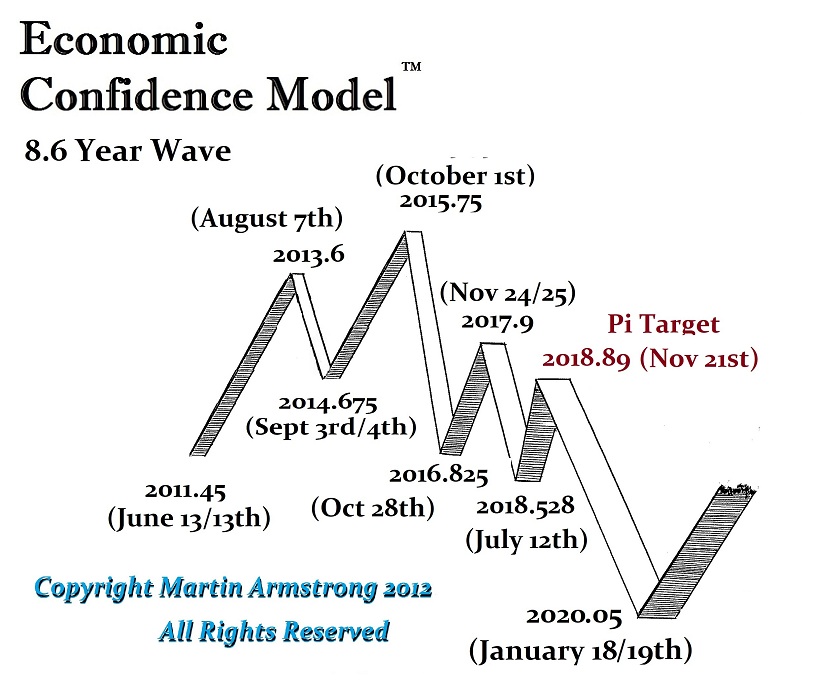
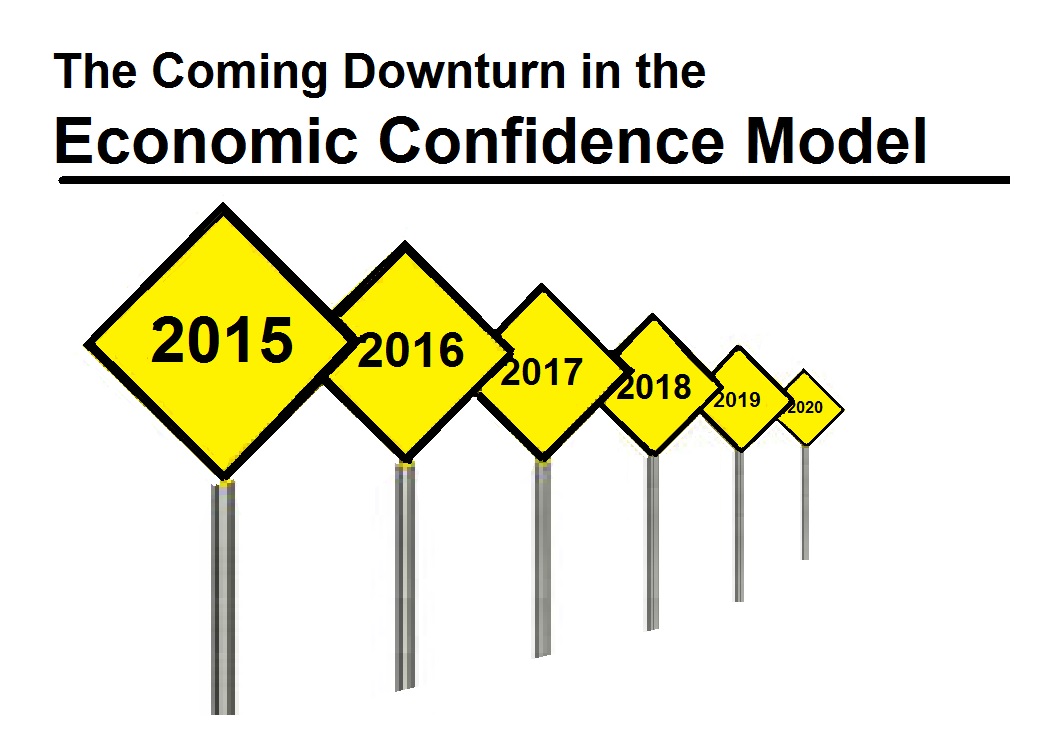 The Economic Confidence Model (ECM) has been on point despite the fact that schools warn you cannot forecast the business cycle yet the ECM has proven them wrong for decades. This particular cycle is exceptional. The central banks outside the USA have single-handedly destroyed their bond markets with Quantitative Easing. They are trapped and cannot allow interest rates to now rise to normal levels as they have kept the various governments on life-support.
While central banks have tried to “stimulate” the economy, federal, state, and local governments are in dire need of money and have been raising taxes and increasing enforcement. Government pensions are wiping out budgets in Europe, America, and Japan. The forces of the central banks have been directly opposed by the political fiscal side of government.
We are facing a very Dark Financial Storm from which there is no escape. There is no advice being given to so many governments to avoid this crisis and waking up next year to this error will be too late. There will be nothing that can be done to put it all back together and live happily ever after. Welcome to the reality we face. At least this will make for a very interesting WEC. Make no mistake about it. They will lay all the blame on Trump and attribute this to trade rather than finance.
Brexit Presents Unique Trade Opportunity for U.S. and U.K. Economic Alliance….
August 12, 2019
First rule in geopolitics, it’s always about the economics. Second rule in geopolitics: refer to rule #1. Understanding this basic truism is the key to understand how President Trump is able to be so effective. There are trillions at stake, and infinite interests.
“Economic security is national security.” ~President Trump
All politics circles back to the underlying economics; whether it is an individual financial self-interest for a specific politician, or whether it is a larger financial interest for a group or even a nation. Everything is always about the money, and that essential truth is why Donald Trump is so uniquely qualified, influential and stunningly effective. Today:

(VIA CBC) The United States would “enthusiastically” support a no-deal Brexit if that is what the British government decided to do, U.S. national security adviser John Bolton told reporters on Monday.
[…] As the United Kingdom prepares to leave the European Union on Oct. 31, its biggest geopolitical shift since the Second World War, many diplomats expect London to become increasingly reliant on the United States.
“If that’s the decision of the British government we will support it enthusiastically, and that’s what I’m trying to convey. We’re with you, we’re with you,” said Bolton, in London for two days of talks with British officials. The U.S. administration is seeking an improved U.S.-British relationship with Prime Minister Boris Johnson after sometimes tense ties between Donald Trump and Johnson’s predecessor, Theresa May.
A central message Bolton was making is that the United States will help cushion Britain’s exit from the EU with a free trade agreement that is being negotiated by U.S. Trade Representative Robert Lighthizer and his British counterpart, Liz Truss. (read more)
Also today from New Jersey:


Notice how President Trump doesn’t rely on John Bolton to deliver his message. President Trump builds inherent checks into the process when others deliver his messages about economic deals, strategies and trade proposals. Classic CEO Executive Trump.
It is not that President Trump doesn’t trust Bolton, but rather Trump understands a difference in political priority exists. Donald Trump isn’t a politician, he’s working through a plan for what he views (we agree) is bigger than any ideological aspects.
The economics of all things is the priority for President Trump…. step into that lane, or bring forth a policy directive that crosses into that economic lane, and you step into an administration agenda item completely controlled and directed by Donald Trump.
Every policy engagement from the big to the small goes through the prism of economics first and last. Essentially this is the foundation of the Trump doctrine. Brexit, Huawei, Iran, the larger EU etc. all cross paths with President Trump’s primary focus, U.S. economic wealth, influence and security.
Donald Trump isn’t leaving anything to chance or misinterpretation…. He’s full bore economic Obsessive Compulsive! …And unapologetic about it.
President Trump has single-handily, and purposefully, stalled the global economy and is forcing massive amounts of wealth back into the United States. In essence Titan Trump is engaged in a process of: (a) repatriating wealth (trade policy); (b) blocking exfiltration (main street policy); (c) creating new and modern economic alliances based on reciprocity; and (d) dismantling the post WWII Marshall plan for global trade and one-way tariffs.
Every minute element within this process, no matter how seemingly small, has President Trump’s full attention. He has assignments to many, but he relies upon none.
(Reuters) – The United States overtook Germany as the biggest supplier of imports into Britain for the first time since the early 2000s in the last financial year, the UK government said on Friday.
British trade minister Liz Truss has said the United States tops her priority list for post-Brexit trade deals and has been in Washington this week, along with Foreign Secretary Dominic Raab, to promote UK-US ties.
Imports from the United States increased by 14% to 78.27 billion pounds ($94.43 billion) in the year to April, the Department for Trade said, while imports from Germany fell by 0.1% to 78.26 billion pounds.
While Germany has long been Britain’s biggest source of imports, the United States was already Britain’s largest export market, with exports reaching a record high of 121.6 billion pounds in the last financial year.
“Now that the U.S. is our largest market for both exports and imports, there has never been a better time for us to make the most of this golden opportunity and deliver a free trade agreement with the US,” Truss said in a statement. (more)


Trump Administration Enforces Immigration “Public Charge” Laws – Green Cards Dependent on Self Sufficiency…
August 12, 2019
The White House has announced the Trump administration will enforce long-standing immigration laws that require entrants to be economically self-sufficient and limits public welfare benefits. An entry alien who is -or becomes- dependent on public welfare assistance, is known as a “public charge”. Aliens will be barred from entering the United States if they are deemed likely to become public charges, or welfare dependent.
These immigration rules have been in place for over 100 years, and generally were strictly enforced until the last 25 years. The Trump administration is re-enforcing the rules.
.
The enforcement action will have a direct bearing on the current immigration process as most border arrivals are economic migrants manipulating asylum claims. Immigration based on self-sufficiency has been U.S. law for generations.

[White House] – The Trump Administration is taking action to help ensure that non-citizens in this country are self-sufficient and not a strain on public resources.
* The Trump Administration is releasing a final rule that will protect American taxpayers, preserve our social safety net for vulnerable Americans, and uphold the rule of law.
* This action will help ensure that if aliens want to enter or remain in the United States they must support themselves, and not rely on public benefits.
* An alien who receives public benefits above a certain threshold is known as a “public charge.”
- Aliens will be barred from entering the United States if they are found likely to become public charges.
- Aliens in the United States who are found likely to become public charges will also be barred from adjusting their
immigration status.
* President Trump is enforcing this longstanding law to prevent aliens from depending on public benefit programs.
- The Immigration and Nationality Act makes clear that those seeking to come to the United States cannot be a public charge.
* For many years, this clear legal requirement went largely unenforced, imposing vast burdens on American taxpayers. Now, public charge law will finally be utilized.
ENCOURAGING SELF-SUFFICIENCY: Self-sufficiency has long been a basic principle of our Nation’s immigration laws that has enjoyed widespread support.
* Public charge has been a part of United States immigration law for more than 100 years as a ground of inadmissibility.
* Congress passed and President Bill Clinton signed two bipartisan bills in 1996 to help stop aliens from exploiting public benefits.
- This included the Personal Responsibility and Work Opportunity Reconciliation Act and the Illegal Immigration Reform and Immigrant Responsibility Act.
- As Congress made clear at the time, it is our national policy that aliens should “not depend on public resources to meet their needs.”
* Americans widely agree that individuals coming to our country should be self-sufficient, with 73 percent in favor of requiring immigrants to be able to support themselves financially.
PRESERVING THE SOCIAL SAFETY NET: We must ensure that non-citizens do not abuse our public benefit programs and jeopardize the social safety net needed by vulnerable Americans.
* Large numbers of non-citizens and their families have taken advantage of our generous public benefits, limited resources that could otherwise go to vulnerable Americans.
* 78 percent of households headed by a non-citizen with no more than a high school education use at least one welfare program.
* 58 percent of all households headed by a non-citizen use at least one welfare program.
* Half of all non-citizen headed households include at least one person who uses Medicaid. (White House Link)

How Trump’s ‘Racist’ Rat-Infested Remark Could Save Baltimore

Sweating, Pacing, Shouting Trump: Vision of a President in an Age of Video
Can the US Government Really Force the Dollar Lower?
Armstrong Economics Blog/Capital Flow
Re-Posted Aug 12, 2019 by Martin Armstrong
QUESTION: Hi Martin, What tools do the US have to TRY and manipulate their dollar lower (other than cutting interest rates) and in your opinion would they be successful? How much do they have in the Exchange Stabilization Fund? Do they have a defense plan to limit and control capital flows coming in?
Thanks,
RM
ANSWER: They lack any power to prevent a dollar rally. The Exchange Stabilization Fund (ESF) is a U.S. Department of Treasury emergency reserve fund that includes holdings of U.S. dollars (USD), other foreign currencies, and special drawing rights (SDR) funds. The financial statement of the ESF can be accessed at “Reports” or “Finances and Operations.” However, all previous attempts at manipulating currencies have ended in disaster. Yes, the U.S. could put capital controls to block capital coming in, but they would destroy the world economy if they even attempted such a hair-brain idea.
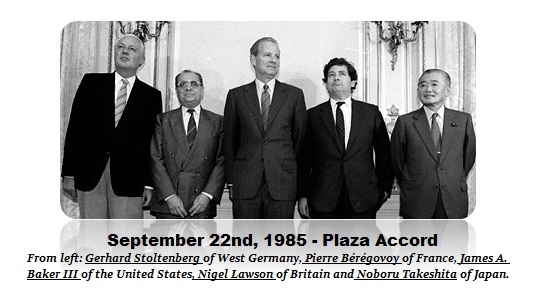
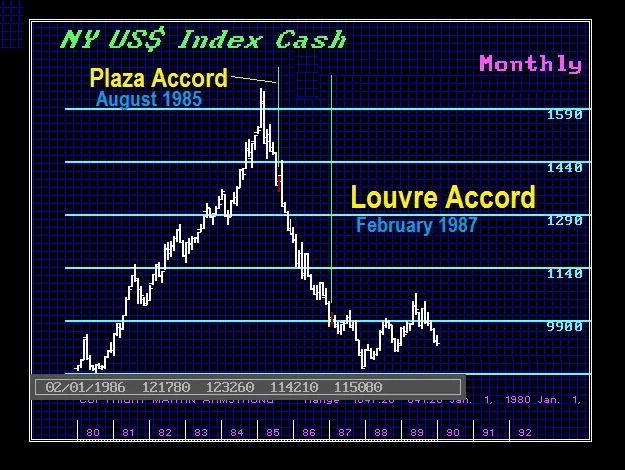
Lowering interest rates will not help for if capital fears survival elsewhere, the level of interest rates will mean nothing. Just look at the creation of the G5 at the Plaza Accord. The market had already turned so their manipulation was already in the direction of the decline. When the dollar fell too far and the other members complained, they then held the Louvre Accord. The markets saw them as incompetent and the dollar continued its cyclical decline on schedule.
Therefore, I have yet to find any period in history where there has been a coordinated effort that has ever succeeded.
Why Gold Stocks Rallied During the Great Depression
Armstrong Economics Blog/Gold
Re-Posted Aug 12, 2019 by Martin Armstrong
QUESTION: Hi Marty
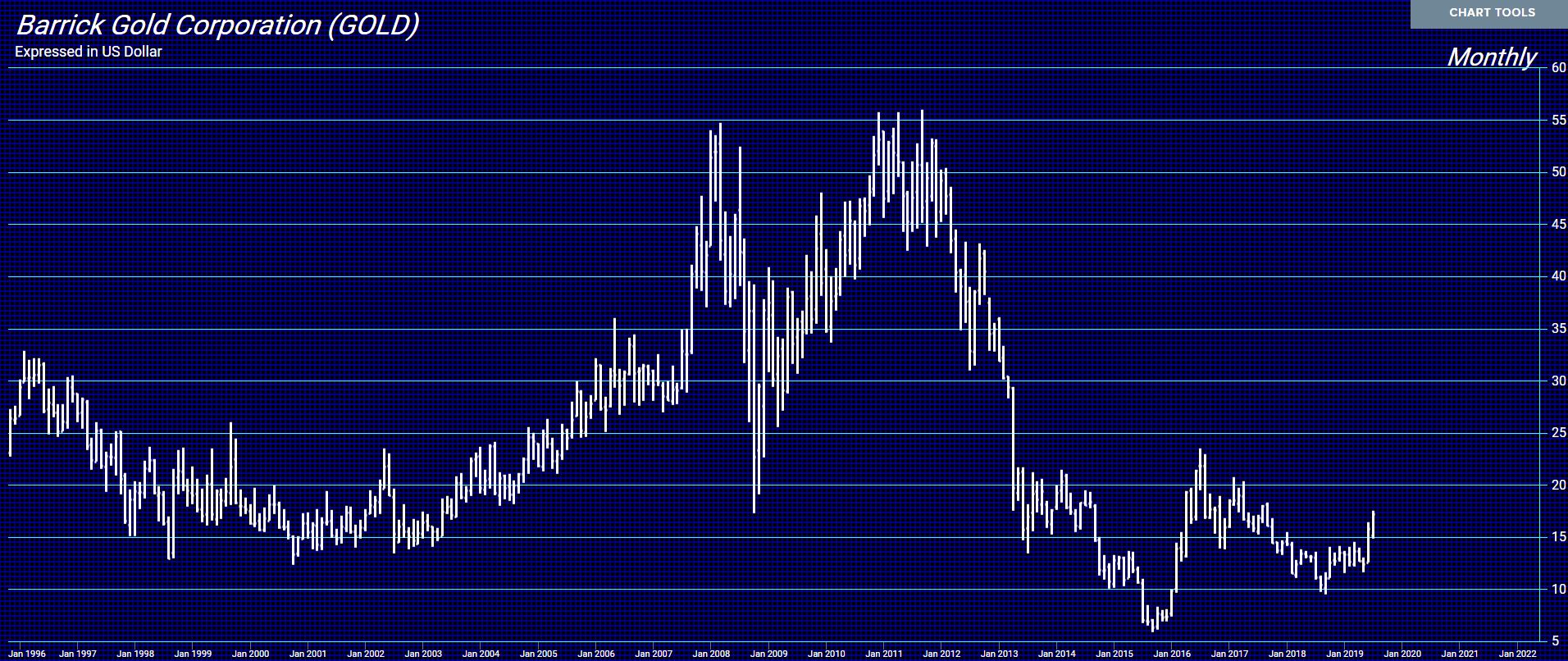
Can you enlighten us on what happened back in history to gold mining shares in terms of why shares did not collapse during the crash of 1929 compared to what happened to mine shares in 2008?
What happened to the shares held by the public in 1933 when FDR confiscated gold?
So you were safe holding the shares!
GG
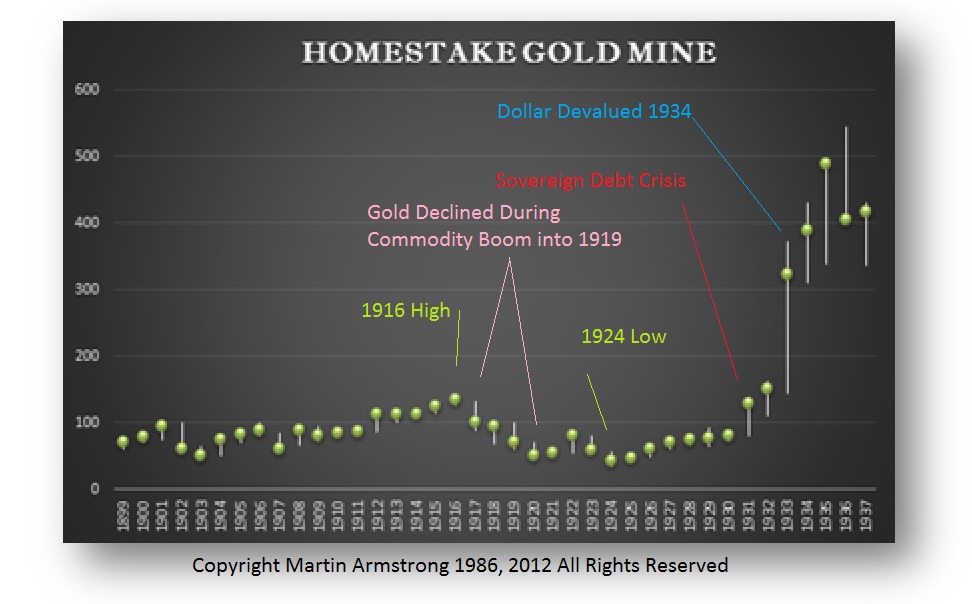
ANSWER: You must realize that gold was money under the gold standard. You can see how it declined following the commodity rally during World War I and eventually bottomed in 1924. During the Great Depression, cash was king and as such Homestake rallied into 1930, but then began to break out with the Monetary Crisis in 1931. The sharp rise came in 1934 with the devaluation of the dollar. Therefore, any comparison to modern times is irrelevant since we are not on a gold standard. Gold now responds in the opposite direction of the currency.
Sunday Talks: Steve Bannon Extensive Interview With Maria Bartiromo…
August 11, 2019
Former White House chief strategist Steve Bannon appears on Fox News with Maria Bartiromo for a wide-ranging discussion on current political and geopolitical events.
Topics include the U.S-Mexico border security and immigration; the 2020 democrat candidates (announced and unannounced); the bigger geopolitical issues behind the U.S-China trade conflict; Joe and Hunter Biden’s direct financial relationship to the Chinese communist government; the USMCA trade agreement; Trump’s leverage to increase an EU free economic alliance against China; and radical action by dems.

A Boy Learns About Taxes
Manufacturing Trade Advisor Peter Navarro Discusses China and Markets….
August 9, 2019
White House Manufacturing and Trade Policy Advisor Peter Navarro appears on CNBC to discuss the turbulent week on Wall Street and the current status of the U.S. trade position with China. Pundits are starting to accept that bigger tariffs are on the horizon. Team Trump is not backing down; and our U.S. position is much stronger.
On one hand, Wall Street loves cheap money (low fed rates). However, on the other hand 51% of all Chinese manufacturing is done by U.S. owned multinationals; and those corporations don’t want to see the retention efforts of China undermined with a lower dollar value (lower fed rate). As a consequence Wall Street is schizophrenic.
.
On the issue of manufacturers leaving China, Forbes has this outlook: “American businesses now have a month to prepare their supply chains for the impending tariff changes. Companies that do well will be the ones who have taken Trump at his word, rather than to doubt the Disruptor-in-Chief’s position on China. Further disruptions are coming to the U.S. supplier network, impacting how equity analysts view companies, recommend their stocks, and — in a broader sense — impacting the business cycle, already long in the tooth.” (link)


