The 2032 Paradigm Shift


Armstrong Economics Blog/ECM Re-Posted Aug 21, 2023 by Martin Armstrong

QUESTION: Marty, I have tried to convince some family members of the deep state and the trend in front of their eyes. No matter what I say, they ignore it and call me crazy. Should I give up?

DP

ANSWER: Look, the vast majority are simply the herd. They prefer not to think analytically. They feel comfortable thinking the government really cares. They still want to live the dream that Santa Claus is real. I would estimate that this represents at least 70% of the population, and at times it has risen to as high as 85%. I based that on simply looking at the election cycle. No president has ever won even 70% of the popular vote. The real decision makes, I would put at about 10%. They are the independents who vote on issues and will vote for either party. The rest are core Democrats and Republicans.

Physiologically, the need to remain as part of the herd. You will NEVER convince them. You can only preach to the choir. Looking at history, this will change, but it must come with pain and sorrow that forces them to reassess their life. Consequently, do not try to beat your head against a brick wall. Just say, when you open your eyes and mind, call me. They will remember that. They MUST come voluntarily. You cannot drag them any more than you can drag a horse to water.

Historically, there comes a time for a paradigm shift. That is when we should see at least 40% of the people who then support change. In the case of the American Revolution, Thomas Paine wrote Common Sense. That publication moved the people finally, and an uprising against the king. His work was so influential that the English struck tokens targeting him with the slogan:

END OF PAIN

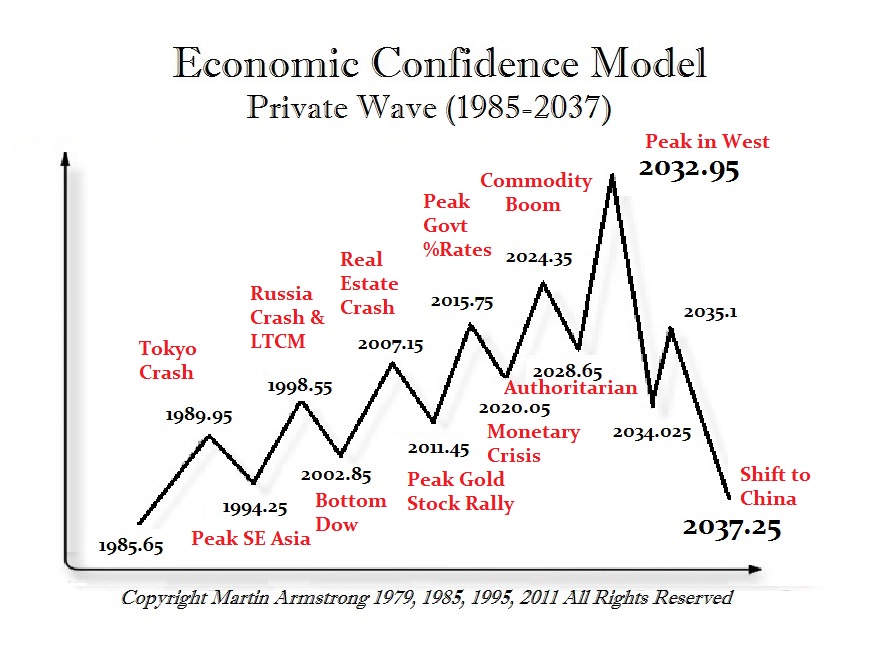
As we move closer and closer to 2032, we will see this shift post-2024. We should begin to witness this paradigm shift toward anti-government form by 2026. It will most likely explode in 2029. This is all necessary for the people must come voluntarily. It will be 2032 when we witness perhaps as much as 60%-75% of the people demanding the end of Republic forms of government.
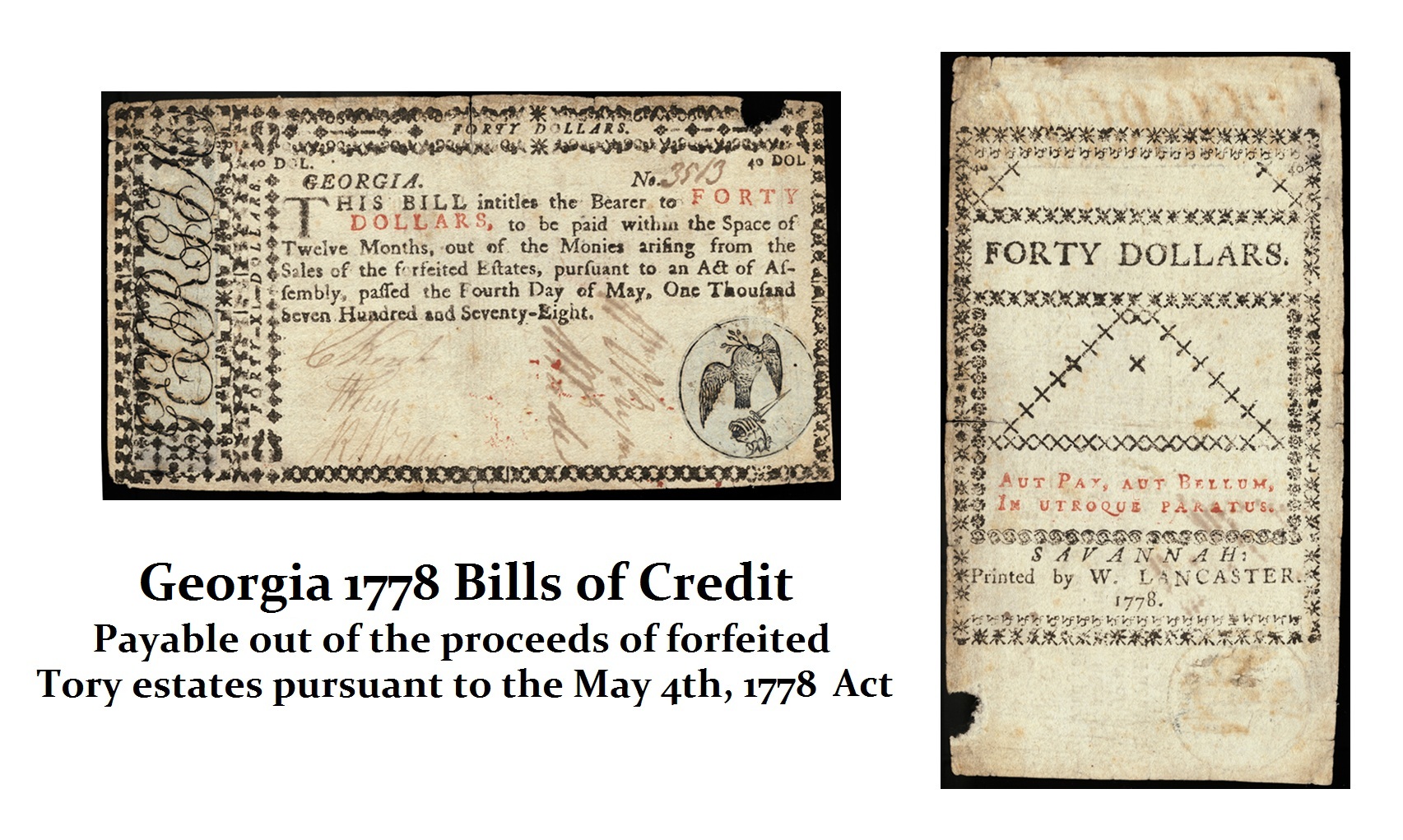
You will NEVER get 100% consensus on anything. Some people ask me what would happen if everyone used Socrates. I respond nothing different. But the question is rather absurd. There will NEVER be such a consensus. Here is a colonial note from George promising it is back by confiscating the assets of those who supported the king who could NOT voluntarily depart from the herd.

Categories: ECM

Japan Exports Fall in July, Driven by 14.3% Decline in Shipments to China


Posted originally on the CTH on August 17, 2023 | Sundance 

Some economic data released by the land of the rising sun points to a larger global weakness in manufacturing demand.   Within the data year-over-year exports from Japan fell in July by 0.3%, which is the first time since 2021 the contraction was noted.

Digging a little deeper, the weakness in Japanese exports is driven primarily by a decline in exports to China of 14.3% in July, which follows a 10.9% decline in June.  Japan is a component supplier to China, which would indicate the demand for Chinese products globally is substantially less than Beijing has previously admitted.

That said, Japan’s direct export of finished goods to the U.S. actually increased 13.5%, mostly driven by the export of electric vehicles.

However, 13.5% is identical to the overall decrease in Japanese imports.

Essentially, component parts to China are down, but completed finished goods to the U.S. are up.  Overall, the results from Japan point to a soft overall global economic status, the result of continued contraction of Western economic activity.

TOKYO, Aug 17 (Reuters) – Japan’s exports fell in July for the first time in nearly 2-1/2 years, dragged down by faltering demand for light oil and chip-making equipment, underlining concerns about a global recession as demand in key markets such as China weaken.

Japanese exports fell 0.3% in July year-on-year, Ministry of Finance (MOF) data showed on Thursday, compared with a 0.8% decrease expected by economists in a Reuters poll. It followed a 1.5% rise in the previous month.

[…] Japanese policymakers are counting on exports to shore up the world’s No. 3 economy and pick up the slack in private consumption that has suffered due to rising prices.

However, the spectre of a sharper global slowdown and faltering growth in Japan’s major market China have raised concerns about the outlook.

The World Bank has warned that higher interest rates and tighter credit will take a bigger toll on global growth in 2024. (read more)

Meanwhile, I would not bet against Michael Burry.

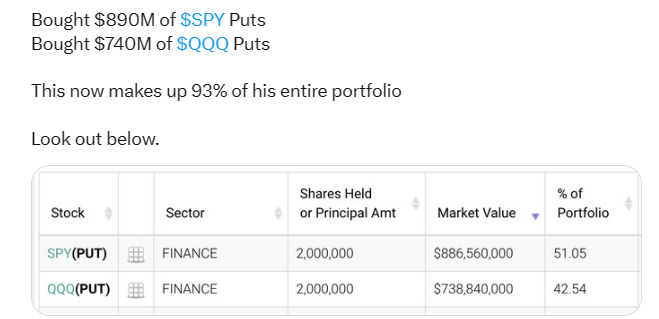
Burry is betting against the S&P 500 and Nasdaq 100 this week, according to his fund’s latest releases. Securities and Exchange Commission filings.  The filing shows that he is now holding options against the S&P 500, hedging $886.6 million against the index.

The filing also revealed that Burry sold his shares in Capitol One, First Republic, PacWest Bancorp, Wells Fargo and Western Alliance after betting on them earlier this year in Trying to make money from the regional banking crisis.  Burry also sold his stakes in Chinese e-commerce giants Alibaba and JD.com.

In addition, he bought $738.8 million in put options against the Invesco QQQ Trust ETF – a fund made up of popular high-tech Nasdaq companies, such as big tech companies Apple and Microsoft as well as Nvidia, Tesla and PepsiCo.

Burry has pulled money out of China investments and U.S. banks and is hedging against tech and the S&P.  He took these positions before the data from Japanese exports to China was released.

Moody’s Slashes Bank Ratings


Aemstrong Economics Blog/Banking Crisis Re-Posted Aug 10, 2023 by Martin Armstrong

Moody’s has cut the credit ratings of ten small and mid-sized banks. The agency cited higher funding costs, rising interest rates, and increased risked due to the failing commercial real estate sector. M&T Bank, BOK Financial, Webster Financial, Pinnacle Financial, Old National Bancorp, and Fulton Financial were among the banks that received downgraded ratings.

But it does not stop there. Moody’s is also reviewing six giant banks, including Trist Financial, Bank of New York, Cullen/Frost Bankers, State Street, Northern Trust, and US Bancorp, as they may also be downgraded. Eleven other banks such as Capital One, Citizens Financial, and Fifth Third Bancorp has their ratings changed to negative. Moody’s predicts a “mild recession” on the horizon for 2024. They believe the quality of assets will decline with certain banks facing increased risks due to their commercial real estate (CRE) portfolios.

“U.S. banks continue to contend with interest rate and asset-liability management (ALM) risks with implications for liquidity and capital, as the wind-down of unconventional monetary policy drains systemwide deposits and higher interest rates depress the value of fixed-rate assets,” Moody’s analysts wrote in an accompanying research note explaining the decision. The agency also noted that investors are vulnerable “to a loss of confidence.”

The US banking system is failing. Moody’s noted that rising interest rates would “exacerbate” the ongoing banking crisis, and they foresee the Federal Reserve continuing with hikes for longer than anticipated since inflation was never transitory. The Fed maintained artificially low rates for too long, and their attempts to ease inflation by hiking rates are failing, as is the ECB’s. We will see the behemoths like JPMorgan Chase sypher in failing banks, making it easier for agencies to switch to CBDC. European banks will be the first to fail, so keep an eye on Europe.

New Interview with Laura-Lynn Tyler Thompson


Armstrong Economics Blog/Armstrong in the Media Re-Posted Aug 5, 2023 by Martin Armstrong

Martin Armstrong joins us today. We’ll talk about the real motivations behind the war in the Ukraine and the future of fiat (paper) currency and why tangible assets like gold and silver should be considered as part of your financial planning.

They See It Coming – Fitch Joins S&P to Downgrade USA Credit Rating


Posted originally on the CTH on August 2, 2023 | Sundance 

Collapse is never a sudden occurrence; it is an outcome of gradual erosion over time. A weakening that takes place almost invisible to those who pass through the construct, until eventually, at an uneventful time in the mechanics of history, the process gives way.

Fitch has joined with the prior position of Standard & Poors to downgrade the USA credit rating. The weight of debt, in combination with reverberations from the continued hammering deep inside the political fundamental change operation, has triggered another flare.

In the bigger picture, this is a self-fulfilling prophecy driven by the latest focus on unsustainable economic policy, aka The Green New Deal. The efforts of the fiscal, monetary and economic policy are all aligned to shrink the U.S. economy, thereby creating the era of “sustainable energy” a possibility. Unfortunately, this is akin to a household intentionally shrinking their income while at the same time taking on credit card debt. The process itself is not sustainable.

(Reuters) – Rating agency Fitch on Tuesday downgraded the U.S. government’s top credit rating, a move that drew an angry response from the White House and surprised investors, coming despite the resolution of the debt ceiling crisis two months ago.

Traders’ immediate response was to embark on a safe-haven push out of stocks and into government bonds and the dollar.

Fitch downgraded the United States to AA+ from AAA, citing fiscal deterioration over the next three years and repeated down-the-wire debt ceiling negotiations that threaten the government’s ability to pay its bills.

[…] “In Fitch’s view, there has been a steady deterioration in standards of governance over the last 20 years, including on fiscal and debt matters, notwithstanding the June bipartisan agreement to suspend the debt limit until January 2025,” the rating agency said in a statement.

U.S. Treasury Secretary Janet Yellen disagreed with Fitch’s downgrade, in a statement that called it “arbitrary and based on outdated data.”

[…] In a previous debt ceiling crisis in 2011, Standard & Poor’s cut the top “AAA” rating by one notch a few days after a debt ceiling deal, citing political polarization and insufficient steps to right the nation’s fiscal outlook. Its rating is still “AA-plus” – its second highest.

After that downgrade, U.S. stocks tumbled and the impact of the rating cut was felt across global stock markets, which were in the throes of the euro zone financial meltdown.

In May, Fitch had placed its “AAA” rating of U.S. sovereign debt on watch for a possible downgrade, citing downside risks, including political brinkmanship and a growing debt burden. (read More)

What do Barack Obama and Joe Biden have in common?  They were both in office, executing an identical economic, fiscal and monetary policy, when the USA credit was downgraded.

Trying to Make Heads or Tails about Recessions


Armstrong Economics Blog/Economics Re-Posted Jul 28, 2023 by Martin Armstrong

QUESTION: Looking at Socrates,  do you think that these people who were constantly calling for a recession because there were two quarters that declined with covid really need revision? Socrates was correct, no recession. But it is showing major turning points in 2024 which seem to align with your old ECM forecast calling for commodity inflation into 2024. How would you define a recession?

EJ

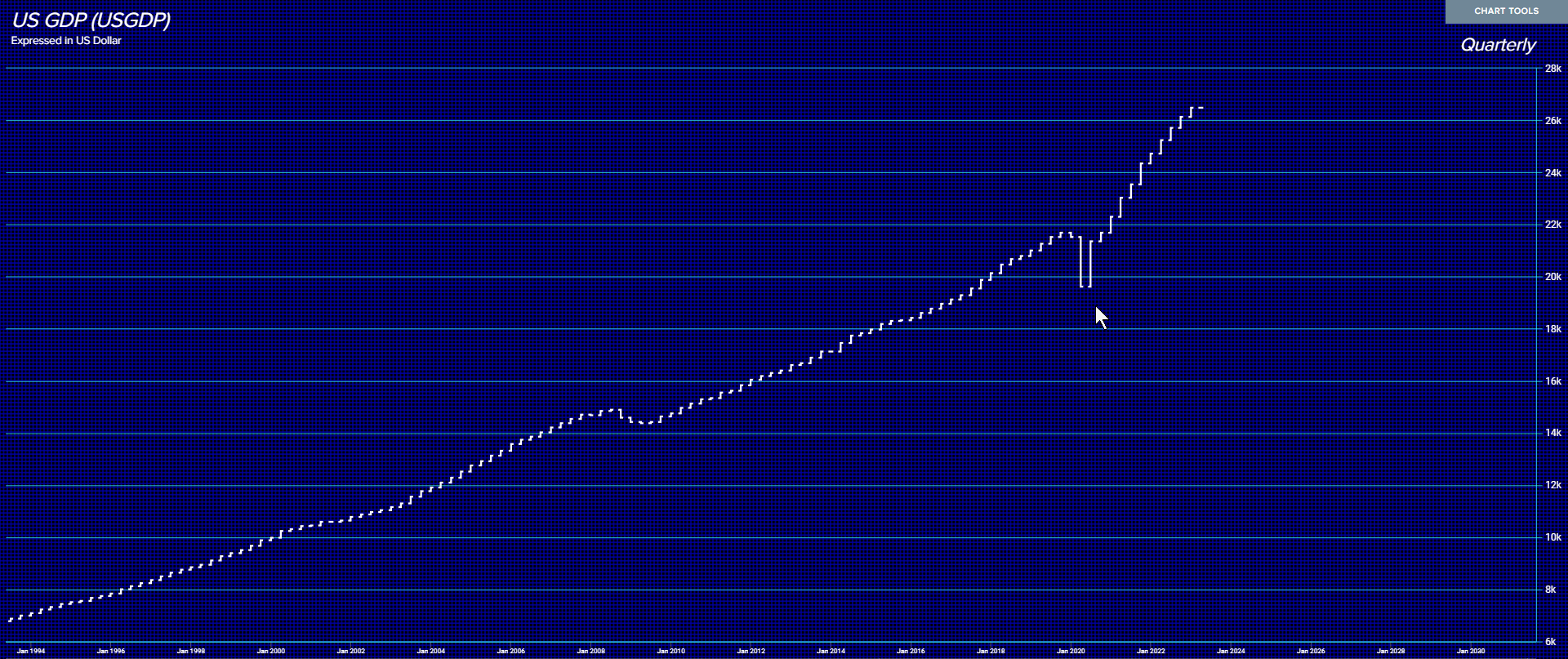
ANSWER: In trading, reactions are 1 to 3 time units. I believe that the same definition should be used for classifying a recession. They define a recession as two consecutive quarterly declines. If you look at the “Great Recession” of 2008-2009, you will see three consecutive quarterly declines and a rebound. If we look at the COVID recession caused by locking everyone down, that was just two consecutive quarterly declines.

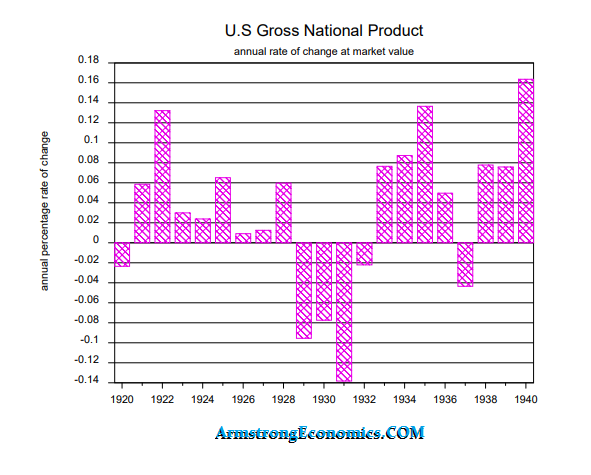
I personally would argue that a true economic recession MUST exceed three consecutive declines. Here is the chart of GNP from 1929 to 1940. There were three years of negative growth. I simply think that this definition of two quarters is wrong. You can have a slight decline of 1 to even 5%, but that does not suggest a recession. In the case of 1929, that was a decline of 9.5% in 1930 – the first year. Now look at the COVID Crash, which was also a decline of 9.53%. But the difference is that the COVID decline was forced and not natural. That is why it rebounded so quickly. Now the so-called “Great Recession” of 2008-2009 only saw a decline in GDP of 3.47%.

The “Great Recession” was not really so great. It wiped out real estate and bankers but did not fundamentally alter the economy. So who is right and who is wrong will always depend upon the definition. Yes, the AI Timing Arrays point to a recession starting Next Year by their definition. This will most likely be caused by the decline in confidence that will lead to UNCERTAINTY, and as such, the consumer will contract. Up to now, the continued expansion of the economy into 2024 has also been fueled by the shift in assets from public to private.

As originally forecast, we should have seen a commodity boom into 2023,

and we should expect a highly authoritarian attempt by 2028.

Why Academia Cannot Forecast Anything


Armstrong Economics Blog/Uncategorized Re-Posted Jul 22, 2023 by Martin Armstrong

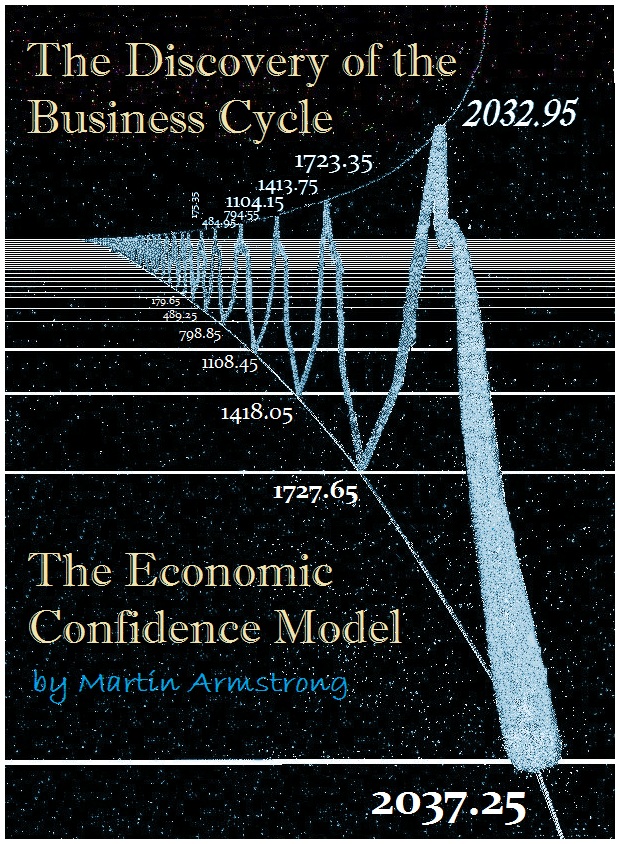
COMMENT: Mr. Armstrong, I have been impressed by your Economic Confidence Model. You said there would be no recession until after 2024. You were really the only one who said that. Now Bloomberg reported that the forecasters who “were first out of the box to predict a US recession” are now hedging their bets. They mention Deutsche Bank Vice Chair of Research Peter Hooper and Fannie Mae chief economist Doug Duncan. However, Nomura Securities International senior economist Aichi Amemiya still says a recession is coming, but “it’s getting to be a close call.”

Not one of the significant houses seems ever to get it right. I just wanted to say your model shines a light on the whole analysis field. I can’t wait for your Geometry of Time.

DF

REPLY:  Thank you. It has been a most interesting experience. As I said, this is something I bumped into. I did not go looking for such a model. It was something that found me, as many say it was my destiny, even growing up in a house with the address of 314 South Lippincott Ave, in Maple Shade, New Jersey.

These are the books I am trying to get out this year. The Geometry of Time will be next year. The Mark Anthony book should be on Amazon and Barnes & Noble in a couple of weeks. That is, using the coinage to demonstrate what the real story is behind Cleopatra. She was certainly not black as NETFLIX presented to rewrite history for the WOKE agenda. This is very similar to the USA using Ukraine in a proxy war to destroy Russia. Here, Cleopatra funded a war that the coinage was so massive; it still accounted for 20% of the money supply 100 years later.

The Modern Analysis is nearly finished. This goes precisely to the subject you have brought up. This is a reference book on my version of technical analysis, which is different from the mainstream, but it goes into the whole problem of analysis used by academics, which is blinding us to the reality of our actions.

The De-Dolarization demonstrates how this entire nonsense that hyperinflation is caused by just increasing the money supply, which is like saying the Great Depression took place simply because the stock market went down. Here too, the lack of any real investigative analysis has doomed the Eurozone because of the distorted view of the real cause of hyperinflation.

The Geometry of Time will be the companion to Modern Analysis for the 21st Century. This will deal with cycles from the how to the why. It has been academia’s refusal to embrace cyclical analysis and any form of technical analysis that prevent any worthwhile forecasting. This is why people like Larry Summers admit they cannot forecast the economy’s future.

Part of Oregon Wishes to Join Idaho


Armstrong Economics Blog/USA Current Events Re-Posted Jul 14, 2023 by Martin Armstron

The “Greater Idaho” movement is gaining traction, with 12 counties now voting to secede Oregon to Idaho. This is precisely on target as the US is set to separate into individual states with their own governing bodies. State rights are how the nation was intended, but the politicians do not always represent the views of the people. Oregon has become increasingly liberal in recent years, legalizing drug use (including methamphetamine, heroin, and cocaine), implementing light-on-crime policies, and far-left ideologies in schools and society in general. Oregon is the ninth most expensive state in the US and ranks 33rd in tax burdens despite not having a sales tax. Idaho, in comparison, has the 8th smallest tax burden and leans conservative.

Many may not know, but Oregon’s state lines were slightly adjusted 65 years ago in 1958. State lines may be redrawn with the approval of Congress and state legislatures. There was never a more vital need for state rights than now as two contradictory ideologies permeate America, eliminating what was once a united nation. Those supporting the Greater Idaho movement say that Oregon’s policies no longer represent their beliefs. “Idaho would have the satisfaction of freeing more than 380,000 rural Oregonians from woke progressive blue-state law,” the movement’s website states.

How does Idaho feel about this movement? The same way that people in Florida and Texas feel – do not move here if you’re going to continue to vote for the same policies that ruined your state. Some people truly do not realize that states vastly differ from one another due to political policies.

Another issue is that some of these counties are located in rural areas where jobs are scarce. “You look at the counties that we are proposing to add, they are through the roof. The average of those counties is 45% of those folks are on Medicaid,” Democrat Ilana Rubel said. “You look at the number on free and reduce lunch, in many of the cases its 95%, 100%. These are very, very low income counties folks.” I cannot confirm if her statistics are correct at this time, but yes, it is a problem.

This is a major issue as the east-west Oregon divide is reaching a breaking point. The people wishing to secede do not feel represented by their officials who are implementing increasingly extreme legislation. These movements will become prevalent across the US in the coming years. I say everyone who believes in the far-left ideology should head on over to a ruined blue state and live out their taxed, genderless, homeless, drug and crime-infested socialist version of utopia away from everyone else.

May Jobs Report Show 339,000 Jobs Gained, Worked Hours Declines, Unemployment Rate Increases to 3.7%


June 2, 2023 | Sundance 

There is a strong divergence within the May jobs report as released by the Bureau of Labor and Statistics (BLS) [DATA HERE].  Payrolls increased 339,000 in May from April and previous months were revised up by 93,000. That is good news.  However, the household survey, from which the unemployment rate is derived, showed employment down 310,000 jobs and the unemployment rate increased to 3.7%.

One of the aspects driving higher payroll starts are the number of people taking on additional part-time jobs.  This aspect is noted in a decline for the number of hours in the average workweek. As more PT jobs are added, the number of hours in a workweek declines. As noted in the BLS data, “the average workweek for all employees on private nonfarm payrolls edged down by 0.1 hour to 34.3 hours in May.

There were 161.0 million people working in April.  There are 160.7 million people working in May.

There were 5.7 million people unemployed in April.  There are 6.1 million unemployed people in May.

The unemployment rate increased from 3.4% to 3.7%.

There are 310,000 fewer people working in May than were working in April.  However, payrolls increased by 339,000 over the same timeframe. See graph above for where those jobs were gained.

(NBC) – […] Job gains were broad-based last month with health care contributing 52,000 and leisure and hospitality adding 48,000. Food services and drinking places led the increase in the latter industry, which had been adding an average of 77,000 jobs per month over the prior 12 months.

Overall, the U.S. economy added 339,000 jobs for the month, much better than the 190,000 Dow Jones estimate and marking the 29th straight month of positive job growth.

The unemployment rate rose to 3.7% in May against the estimate for 3.5%. The jobless rate was the highest since October 2022, though still near the lowest since 1969.

Olu Sonola, head of U.S. regional economics at Fitch Ratings, said the jobs report is a mixed bag.

“The strength of the payroll survey is clearly a big surprise, largely on the back of robust job growth in the healthcare sector and the business and professional services sector,” said Sonola. “However, the 0.3% increase in the unemployment rate is the highest monthly increase since April 2020.” (more)

WAGES – As noted within the BLS report, “In May, average hourly earnings for all employees on private nonfarm payrolls rose by 11 cents, or 0.3 percent, to $33.44. Over the past 12 months, average hourly earnings have increased by 4.3 percent.” Wage growth still lags inflation; the middle class is getting poorer.  However, with the fed focused on wage growth as the leading indicator of their false pretenses to combat inflation, wage growth is too high (they want around 3.0%).

The Biden economic and monetary policies are delivering the results they want.  Higher energy prices, higher costs of living, lower real wages and increased middle class pressure. The serf model.

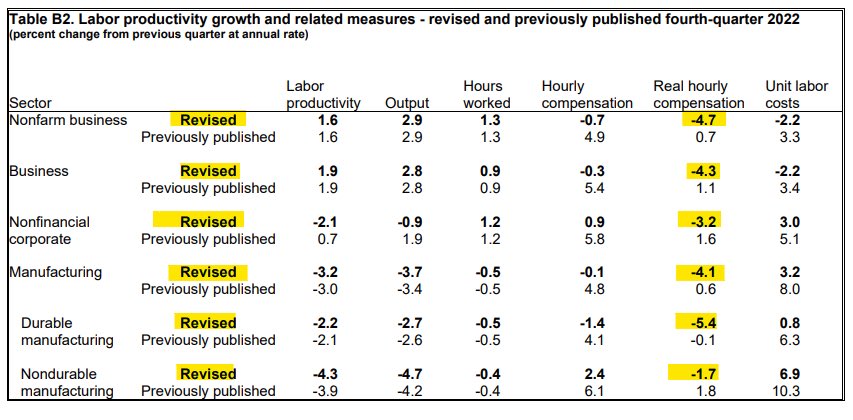
The BLS was forced to admit yesterday their Real Hourly Compensation growth was previously flawed.  [CHART DATA SOURCE]

That chart of revisions to real wages tells us a lot about the economic pain being felt by the working class in the U.S.  If it feels like you are working harder and going backwards in your ability to afford basic essentials, that’s because you are.

The prices for essential goods and services have risen at a much greater rate than the wages needed to afford them.  This is the result of Joe Biden’s energy policy, economic policy, and now magnifying monetary policy.

Our goods and housing costs are higher.  Our wages are not growing much.  The cost to borrow money to afford the gap is increasing.  This is unsustainable.

In my opinion, the economy overall – as a measure of units produced and sold – has been in a contracting position since the fourth quarter of 2021.  The appearance of economic growth, the value of goods and services, is an illusion that has been created by higher prices, ie. inflation.

Interview: Martin Armstrong on Why the CBDC Will Fail and a Great Depression is About to Begin


Armstrong Economics Blog/Armstrong in the Media Posted May 20, 2023 by Martin Armstrong

Rumble link Martin Armstrong on Why the CBDC Will Fail and a Great Depression is About to Begin