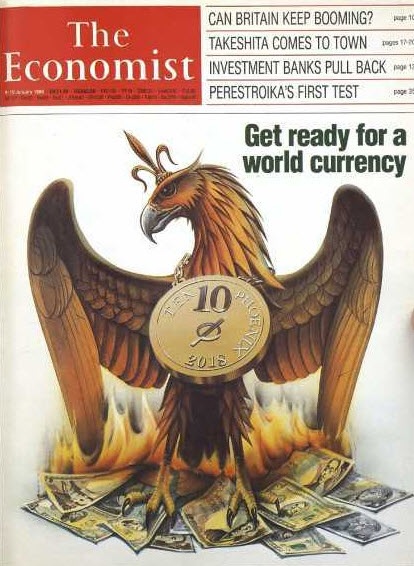
Get Ready for the Phoenix – The Reality of a One World Currency


QUESTION: Mr. Armstrong; Are you aware of the 1988 Economist article predicting that in 30 years from then we would all be using the same currency?  That is strangely your target of 2018 when you have warned that the Monetary Crisis will begin then. I met an attendee from your 1985 WEC there in Hong Kong. He said you gave that date of 2018 way back at that conference. Did the Economist take your work for that article?

PH

ANSWER: The Economist did not really make a forecast. They were just generalizing what might happen in 30 years from then. I do recall speaking to them back then, but I disagreed with the concept that everyone would be shopping with the same currency around the world. I was one of the people called in back in 1985 when they were creating the G5 (now G20) at the Plaza Accord. I had originally proposed back then that we adopt the SDR at the IMF as the new reserve currency.

After dealing with many governments at that time, it became crystal clear that this idea of a single world currency that people would be using in everyday commerce was not practical. It was at the Plaza Accord in 1985 when the idea of the Euro was born. This article in the Economist was inspired by this idea of surrendering monetary authority to a single government in Europe. We can see how screwed up the outcome has been. After working with governments in Europe and America, it was abundantly clear that a single currency that would be used in daily commerce by everyone would never exist without monumental collapse in governments and a new one world government. But that would not last very long as we see the rebellion in Europe against Brussels. It demands also the surrender of one’s culture.

This idea of a one world government where everyone willingly surrenders their sovereignty and culture to some central power is the stuff of movies. Here is a letter from the White House. The chief objection is universal. It requires the surrender of domestic policy objectives to international.

There is no possible way this is happening without the entire world collapsing and a single government emerges by FORCE. Politics as we know will could no longer function. Politicians argue vote for them and they will tax the rich and hand it to the poor. How can that take place in such a system? They could not promises nonsense against the global trend as they do currently. The policy would be determined at the central power and politicians would be subordinate in every country unable to offer anything to get elected.

I do not support the corruption that has engulfed the world. However, this idea that everyone will be using the same currency is a pipe-dream with no basis in reality for the amount of political change would require a bloodbath in revolution. It could NEVER unfold willingly with the political system we currently have. Even then, counter-revolutionary forces would emerge. It will not be just BREXIT, it will be countless civil wars against a central political institution.

The very best will be a single new reserve currency to replace the dollar. But every country would still need to retain its own currency because the business cycle cannot be defeated so while some countries benefit, others must suffer. The entire world cannot possibly have a trade surplus all simultaneously until we begin trading with other planets.


The Economist wrote:

Title of article: Get Ready for the Phoenix
Source: Economist; 01/9/88, Vol. 306, pp 9-10
THIRTY years from now, Americans, Japanese, Europeans, and people in many other rich countries, and some relatively poor ones will probably be paying for their shopping with the same currency. Prices will be quoted not in dollars, yen or D-marks but in, let’s say, the phoenix. The phoenix will be favoured by companies and shoppers because it will be more convenient than today’s national currencies, which by then will seem a quaint cause of much disruption to economic life in the last twentieth century.

At the beginning of 1988 this appears an outlandish prediction. Proposals for eventual monetary union proliferated five and ten years ago, but they hardly envisaged the setbacks of 1987. The governments of the big economies tried to move an inch or two towards a more managed system of exchange rates – a logical preliminary, it might seem, to radical monetary reform. For lack of co-operation in their underlying economic policies they bungled it horribly, and provoked the rise in interest rates that brought on the stock market crash of October. These events have chastened exchange-rate reformers. The market crash taught them that the pretense of policy co-operation can be worse than nothing, and that until real co-operation is feasible (i.e., until governments surrender some economic sovereignty) further attempts to peg currencies will flounder.


The new world economy
The biggest change in the world economy since the early 1970’s is that flows of money have replaced trade in goods as the force that drives exchange rates. as a result of the relentless integration of the world’s financial markets, differences in national economic policies can disturb interest rates (or expectations of future interest rates) only slightly, yet still call forth huge transfers of financial assets from one country to another. These transfers swamp the flow of trade revenues in their effect on the demand and supply for different currencies, and hence in their effect on exchange rates. As telecommunications technology continues to advance, these transactions will be cheaper and faster still. With unco-ordinated economic policies, currencies can get only more volatile.
….
In all these ways national economic boundaries are slowly dissolving. As the trend continues, the appeal of a currency union across at least the main industrial countries will seem irresistible to everybody except foreign-exchange traders and governments. In the phoenix zone, economic adjustment to shifts in relative prices would happen smoothly and automatically, rather as it does today between different regions within large economies (a brief on pages 74-75 explains how.) The absence of all currency risk would spur trade, investment and employment.

The phoenix zone would impose tight constraints on national governments. There would be no such thing, for instance, as a national monetary policy. The world phoenix supply would be fixed by a new central bank, descended perhaps from the IMF. The world inflation rate – and hence, within narrow margins, each national inflation rate- would be in its charge. Each country could use taxes and public spending to offset temporary falls in demand, but it would have to borrow rather than print money to finance its budget deficit. With no recourse to the inflation tax, governments and their creditors would be forced to judge their borrowing and lending plans more carefully than they do today. This means a big loss of economic sovereignty, but the trends that make the phoenix so appealing are taking that sovereignty away in any case. Even in a world of more-or-less floating exchange rates, individual governments have seen their policy independence checked by an unfriendly outside world.

As the next century approaches, the natural forces that are pushing the world towards economic integration will offer governments a broad choice. They can go with the flow, or they can build barricades. Preparing the way for the phoenix will mean fewer pretended agreements on policy and more real ones. It will mean allowing and then actively promoting the private-sector use of an international money alongside existing national monies. That would let people vote with their wallets for the eventual move to full currency union. The phoenix would probably start as a cocktail of national currencies, just as the Special Drawing Right is today. In time, though, its value against national currencies would cease to matter, because people would choose it for its convenience and the stability of its purchasing power.
…..
The alternative – to preserve policymaking autonomy- would involve a new proliferation of truly draconian controls on trade and capital flows. This course offers governments a splendid time. They could manage exchange-rate movements, deploy monetary and fiscal policy without inhibition, and tackle the resulting bursts of inflation with prices and incomes polices. It is a growth-crippling prospect. Pencil in the phoenix for around 2018, and welcome it when it comes

They Want to Put Nano-Chips into Currency So they can track every note


Believe it or not, Australia has a Black Economy Taskforce that hunts down citizens in every possible way. They look at where they send their kids to school and then inquire at the school who pays the bills and how. They are using technology to hack people’s phones of anyone suspected of hiding money to get all their messages and emails as well as where they call overseas. Their own website says:

The Black Economy Taskforce has been established to develop an innovative, forward-looking whole-of-government policy response to combat the black economy in Australia, recognising that these issues cannot be tackled by traditional tax enforcement measures alone.

The black economy refers to people who operate entirely outside the tax and regulatory system or who are known to the authorities but do not correctly report their tax obligations.

Michael Andrew, the head of this 1984 style Taskforce to spy on citizens, has proposed that the government should keep track of your $100 and $50 notes by implanting hi-tech nano-chips. He could simply scan your house to see where you are hiding money that the government can confiscate.

What I have been warning about is that government will not reform. Instead they will push us up against the wall and do everything against a free society to survive. This is simply how government responds every time throughout history. It is all about them paying their own pension at the expense of the citizen. They will always pretend the problem is the rich do not pay their fair share, but in reality, the crisis is the government will simply consume everything until it collapses.

So just recognize these bureaucrats are drunk with power for they look upon the people as stupid cattle to be slaughtered for their survival – them against us. Everything that was worth fighting for to preserve our way of life have been eliminated not by some foreign enemy, but by our rulers.

Are We Mushrooms being fed Mountains of Manure by Bureaucrats?


Government bureaucrats connive ways to gain power as they treat the people like mushrooms — they keep  us in the dark and feed us mountains manure and mainstream media conspire to make sure we remain buried so deep we cannot reach the surface for air. They foam at the mouth of the through of creating a cashless society. The abolition of cash would be absolutely “absurd” and it is interesting how they argue against creating voter ID requirements saying it will prevent minorities from voting because they are backward and do not live in the modern world. As stupid and racist as that argument really is by the left, can you imagine eliminating cash from people who are so backward according to their arguments?

The Bureaucrats love their slogan – “Cash is for Criminals” and will distort every possible instance to support the elimination of cash. There was terrorism and then there was drugs. Eliminate cash, they say, and you will eliminate all crime.

So on the one hand they are against any requirement to prove who you are to vote, but then they want to eliminate cash from people they also claim cannot even find where to get ID in a city. Interesting conflicts.

Mick Mulvaney Introduces “MAGAnomics”…


OMB Director Mick Mulvaney has an explanatory outline, promoted by the White House, explaining the administration’s economic principles: “MAGAnomics”.

Introducing MAGAnomics
By Mick Mulvaney – Wall Street Journal – July 13, 2017

If the Trump administration has one overarching goal, it’s to Make America Great Again. But what does this mean? It means we are promoting MAGAnomics—and that means sustained 3% economic growth.

For most of our nation’s modern history, a healthy American economy meant one that grew at roughly 3.5%. That was the average growth rate between the late 1940s and 2007. Since then, it has hardly topped 2%.

The difference between those two growth rates is staggering. If the American economy had grown at only 2% between the end of World War II and 2000, average household income would have been roughly $26,000 instead of $50,000.

Over the next 10 years, 3% growth instead of 2% will yield a nominal gross domestic product that is $16 trillion larger, federal government revenues $2.9 trillion greater, and wages and salaries of American workers $7 trillion higher.

For merely suggesting that we can get back to that level, the administration has been criticized as unrealistic. That’s fine with us. We heard the same pessimism 40 years ago, when the country was mired in “stagflation” and “malaise.” But Ronald Reagan dared to challenge that thinking and steered us to a boom that many people thought unachievable. In the 7½ years following the end of the recession in 1982, real GDP grew at an annual rate of 4.4%. That is what a recovery looks like, and what the American economy is still capable of achieving.

The focus of MAGAnomics is simple: Grow the economy and with it the wealth of, and opportunity for, all Americans.

MAGAnomics is for everyone, but especially for those who left for work this morning in the dark but came home after their kids were asleep. It’s for those who are working part-time but praying for a full-time job. It’s for folks whose savings are as exhausted as they are.

This president hears you. He knows America’s greatness doesn’t spring from higher taxes or unnecessary regulations or broken welfare programs. It doesn’t come from government at all. It comes from you.

If we enact the president’s broad agenda—if MAGAnomics is allowed to work—we will have set the stage for the greatest revival of the American economy since the early 1980s. It will remind people—including those who have forgotten, or those who don’t want you to remember—what a great America means. That is driving everything we do. (read more)

White House Link

Bill Warner, PhD: Islamic Reform Is Impossible


Published on Jul 14, 2017

How many times have you heard this, Islam just needs a reform. Well why does it need a reform? Well then it would be nicer without that jihad business. So let’s just reform it.

True AI and Fake Neural Net Forecasting Programs


QUESTION: Hello Marty,just came across an interesting project called Numerai

with the ambitious goal of creating a hedge fund to manage ALL the money in world(!) in an efficient manner using AI (machine learning, neural networks and whatever the data scientists can come up with).

At the core of this project is the historical data made accessible for free to the data scientists in encrypted form, but still usable since the structure is still there. The data scientists then compete with their AI methods against each other in auctions when evaluating their methods on a to them at auction time unknown validation set (latest data set).

The hedge fund will be the combination of the best AI methods driven in a purely evolutionary fashion with the purpose to allocate the money to where it is needed best. A nice feature is that the AI methods developed and put to use by a data scientist can be kept secret from the other data scientists and the hedge fund itself, The data scientist only needs to make the output of the AI algorithm available, pretty much like you do with Socrates :-).

The data scientist can always take his/her algorithm elsewhere if not happy with the hedge fund.

I think this sounds like a really innovative idea, but there might be some pitfalls that you would be able to highlight. For example I would expect your Socrates database to bigger than the Numerais at the moment.

Best Regards

/M

ANSWER: The problem with such a project is that the best of genius will fail. The complexity of the markets globally is far beyond description. Even the Global Market Watch is best in the financial main markets and less in agriculture and individual stocks. Why? It is all complexity. The GMW has now exceeded 150,000 possible patterns each day and counting. I just uploaded the latest 6 months of creation of patterns. It has blown my mind looking at what it has done. Moves greater than 40% on the upside it reclassified as phase transitions.
I have experimented with Neural Nets and other interesting attempts to recreate the structure of the human mind. Neural Nets are notoriously subject to complete failures. There is no such program that has been able to demonstrate consistency. This is all due to complexity.
The effort to create option models known as BlackScholes completely broken down and resulted in the Long-Term Capital Management debacle. That was covered in the book – When Genius Failed. The failure took place because they did not have the database. They only tested the algorithm back to 1971.
There is no such computer model that can possible accomplish that and quite frankly anyone claiming to have some Neural Net Artificial Intelligence you should beware because it is just a sales pitch. Ask who wrote the code. You will find no real system other than a simple expert system based upon IF this THEN that ELSE expect this.
I was recently approached with a plea to buy into our technology by a very major company offering unlimited resources to help expand it to all sectors. I must admit, that is an interesting concept.
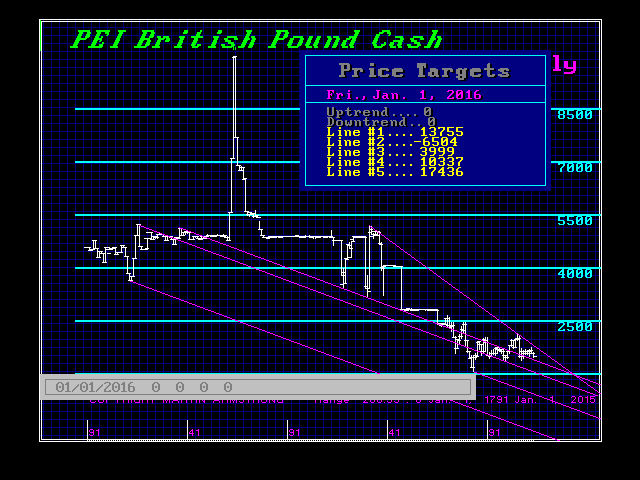
Anyone who claims to have such a system is pulling a sales promotion. You cannot rely upon a program to forecast the future on the cheap without a profound and in-depth database. The British Pound for example, all the data even in major data banks go back to 1971 and many only on a monthly closing basis. You cannot forecast trends without the full picture. A computer will not be able to learn all scenarios if the data does not cover all scenarios. Plain and simple. Just ask – SHOW ME THE DATA and WHERE DID YOU GET IT? 

T-Rex and Qatar Sign Diplomatic Memorandum of Understanding: No More Funding Terrorists or Extremists…


Secretary of State Rex Tillerson has been keeping an exhaustive schedule for the past week and especially in the past few days.  In the ongoing diplomatic effort against mid-east terror networks, the GCC/Trump coalition have kept up pressure against Qatar.

Kuwait is acting as the primary mediator between Qatar and the rest of the Gulf States; T-Rex conducted three days of shuttle diplomacy in an effort to assist and reassert the position of the Trump administration.  Tillerson traveled to Kuwait, Qatar, Saudi Arabia, UAE and back to Qatar with extensive meetings within each nation.

It would take a bazillion words to explain all the nuances, shifts, agreements and diplomatic ongoing efforts.  However, to keep it simple we boiled it down to the current, most consequential, outcome within this graphic:

Qatar has signed a promise to stop the financing of The Muslim Brotherhood; and just to keep them honest, the GCC and coalition nations are keeping them in the spotlight.

Note, the Gulf Cooperation Council, the gulf states, and the Mid-East coalition including Egypt and Jordan, are the ones confronting and managing the issues with Qatar.  President Trump and Rex Tillerson are in a supportive role.

#WINNING

The Break-in Not a Threat


QUESTION:

Good night, Mr. Armstrong:

I hope you are well and enjoying your front-beach house in the Sunshine State.

I read your blog every day, since 2011. I ask you:

1. Why your office was destroyed, on July 3rd?.

2. It was a threat to your work or to your person?.

3. Are you afraid for your life?.

I look forward to hearing from you as soon as possible.

Sincerely,

JV


ANSWER: No.  They just broken in it appears looking for system software. We do not keep anything in the office of that nature. Even the Socrates System, all that is on the web is the results – not the program. So they can hack all they want, the system is not accessible in such a manner.

Our office was not destroyed. They targeted our floor when there were banks and other operations in there which would have offered a better target. It was not a direct threat against me or the company. It was clearly an exploratory venture that yielded nothing.

I do not fear for my life. My problem was with New York, not Washington. New York banks control the Federal NY court (SDNY) and have used it to destroy any competition. REFCO, the Chicago Commodity Firm was charged and destroyed in NYC. Drexel Burnham was the Philadelphia firm where Michael Milken worked. It too was charged in NYC and destroyed. Frank Quatrone of First Boston did the DOT.COM IPOs. They were charged in NYC. You will find anyone who takes business from NYC is charged in NYC, destroyed, and then NYC banks absorb their business. It is a very carnivorous operation in NYC so that court is dangerously corrupt.

Compete with New York at your own risk.

When I have gone to Capitol Hill, I was introduced as this is the guy with model they were trying to suppress. The New York courts are the most corrupt in the nation. Judges can change the transcripts altering the words spoke in court in direct violation of 28 U.S. Code § 753.

The US Federal Court of Appeals (Second Circuit) is appalling and if I were president, that court would be closed, everyone fired, and the judges put on trial for treason. The Second Circuit Court of Appeals is supposed to supervise the lower District Court. The Second Circuit Court of Appeals (NYC) R E F U S E S to do its job. In US v Zichetello (see page 97), it had the audacity to admit the Judges are committing felonies changing transcripts, and wrote it did not have the “power” to tell them to obey the law. If the Court of Appeals has no power, then it should be shut down. The Court of Appeals wrote:

“The Southern District of New York follows a practice that is unusual and perhaps unique…. The court reporter does not release a transcript to the parties until after the judge reviews, and in some cases corrects, it. …  Because the parties receive only a printed transcript that incorporates the judge’s revisions, the parties are not informed of such revisions.

Courts do not have power to alter transcripts in camera and to conceal the alterations from the parties.11  Given the issues that arose in this case as a direct result of this practice, there appears to be little justification for continuing the practice in its present form.   To be sure, a procedure that corrects obvious mistakes in transmission is useful, and the parties have little interest in closely monitoring such a procedure so long as the alterations are cosmetic.   Monitoring by the parties, however, provides some assurance that only cosmetic changes will be made or, if not, that changes will correctly reflect what transpired in the particular proceeding.   Moreover, there is little cost in informing the parties of cosmetic changes or at least of directing court reporters to give parties access to the original transcript when they request it.

Nevertheless, whether we have the power to order a change in such a practice is unclear.12  We review judgments, and our review of the convictions and sentences here may not be an appropriate vehicle for the fine tuning of this practice.   However, we invite the judges of the Southern District to consider revision.”

Other court reporters as in Virginia call it “improbable conspiracy” theory. They wrote: “Accurate trial records are essential in protecting the validity and verification of trial cases. This is why tampering with court transcripts is considered a serious crime.” They seem to have had inquiries but do not want to admit that in NYC Federal Court SDNY they are still changing transcripts and the court reporters do not sign the transcript swearing they are correct.

The Dow & the Future


QUESTION: Mr. Armstrong,

I am fascinated by what you have accomplished in this model. You mentioned in your post about the Orlando conference a sling shot and phase transition, and I am trying to comprehend what that would look like exactly. Is that to say the DJIA wont complete its advance from 2015.75 to 2018,but that the cycle inversion underlying this market and the ECM will extend the high into 2020? When will the special report on these issues be released?

Thank you for the invaluable education,

NE


ANSWER: Yes. We can see from the Global Market Watch that the current year if it closed right here would imply a temporary high. That can change since it is based upon a dynamic view assuming each day that passes were the last trading day of the year. Nevertheless, it warns that we must stay on point.

There are two separate objectives – TIME and PRICE. With regard to PRICE, our three targets given back in 2011 were 18500, 23000, and 40,000. The minimum TIME objective was 2016/2017. Our next target in TIME becomes 2020 followed by 2022. This appears to be setting up for a major vertical move. This is why we will be reviewing how to trade a vertical market.


The markets are far more precise than anyone could have ever imagined. It is unfortunate that the analytical field is plagued by people pretending to be prophets or gurus like the old snake-oil medicine salesmen of the 19th century. Nobody can forecast anything from as personal opinion perspective on a consistent basis. Sure, everyone can make a single forecasting call based upon a gut feeling. But they cannot accomplish that on any consistent basis. This is all about a journey into a world of hidden order – the chaos theory. It is not being a prophet, guru or physic. Such titles reduce the analyst to a snake-oil salesman.

Very Extensive Discussion – An Hour With President Trump Aboard Air-Force-One…


On the flight to Paris President Donald Trump went back to the pool of traveling reporters and spoke with them for over an hour about current issues and events, answering a host of questions.  Initially the conversation was thought to be ‘off-the-record’, however the White House released a transcript of the press interview.

Here’s the transcript as reported by Bloomberg News: “TRUMP SPEAKS TO REPORTERS ON STEEL, BORDER WALL, PUTIN”.  For those following along with the ‘unwritten stories by media’ you will find great interest in the discussion segment about North Korea and China – Specifically, as we have continued to emphasize, the intended Trump direction to confront the DPRK through China Trade Policy.

THE WHITE HOUSE – Office of the Press Secretary – Internal Transcript, July 12, 2017, REMARKS BY PRESIDENT TRUMP IN AN OFF-THE-RECORD CONVERSATION WITH PRESS, Aboard Air Force One, En Route Paris, France – 9:15 P.M. EDT

On the visit to France:

♦ Q When were you last in Paris?  When were you last in France?

THE PRESIDENT:  So I was asked to go by the President, who I get along with very well, despite a lot of fake news.  You know, I actually have a very good relationship with all of the people at the G20.  And he called me, he said, would you come, it’s Bastille Day — 100 years since World War I. And I said, that’s big deal, 100 years since World War I. SO we’re going to go, I think we’re going to have a great time, and we’re going to do something good. And he’s doing a good job. He’s doing a good job as President.

On North Korea, China, and trade:

THE PRESIDENT: A big thing we have with China was, if they could help us with North Korea, that would be great. They have pressures that are tough pressures, and I understand. And you know, don’t forget, China, over the many years, has been at war with Korea — you know, wars with Korea. It’s not like, oh, gee, you just do whatever we say. They’ve had numerous wars with Korea.

They have an 8,000 year culture. So when they see 1776 — to them, that’s like a modern building. The White House was started — was essentially built in 1799. To us, that’s really old. To them, that’s like a super modern building, right? So, you know, they’ve had tremendous conflict over many, many centuries with Korea. So it’s not just like, you do this. But we’re going to find out what happens.

Very important to me with China, we have to fix the trade. We have to fix the trade. And I’ve been going a little bit easier because I’d like to have their help. It’s hard to go ***. But we have to fix the trade with China because it’s very, very none-reciprocal.

♦ Q Is that your bargaining chip with them to get on board with North Korea? Is, like, you want to —

THE PRESIDENT: Nobody has ever said it before. I say it all the time. Somebody said, what cards do you have? I said, very simple — trade. We are being absolutely devastated by bad trade deals. We have the worst of all trade deals is with China.

We have a bad deal with South Korea. We’re just starting negotiations with South Korea. South Korea, we protect, but we’re losing $40 billion a year with South Korea on trade. We have a trade deficit of $40 billion. The deal just came up.

That was another Hillary Clinton beauty. Remember she said it was five-year deal, and now it’s an extension period. She said this will put jobs in our country. She said we’ll make money with it. Great. We’re losing $40 billion a year. It’s a horrible deal. So we’re starting — we started, as of yesterday, renegotiating the deal with South Korea. We have to.

But the biggest strength we have are these horrendous trade deals, like with China. That’s our strength. But we’re going to fix them. But in terms of North Korea, our strength is trade.

♦ Q And do you think that’s going to bring them around?

THE PRESIDENT: Well, yeah, when I say reciprocal — you make reciprocal deals, you’re talking about hundreds of billions of dollars. But before I did that, I wanted to give it a good shot. Let’s see. And they helped us. I have a very good relationship with him. I think he’s a tremendous guy. But don’t forget. He’s for China. I’m for the U.S. So that’s always going to be.

So he could be a tremendous guy, but he’s going to do what’s good for China. And he doesn’t want 50 million people pouring across his border. You know, there are a lot of things. I understand the other side. You always have to understand the other side.

♦  Q What about steel?

THE PRESIDENT: Steel is a big problem. Steel is — I mean, they’re dumping steel. Not only China, but others. We’re like a dumping ground, okay? They’re dumping steel and destroying our steel industry, they’ve been doing it for decades, and I’m stopping it. It’ll stop.

♦ Q On tariffs?

THE PRESIDENT: There are two ways — quotas and tariffs. Maybe I’ll do both.

On healthcare:

THE PRESIDENT: No, I think, first, I want to do — well, we have a few things. We have a thing called healthcare. I’m sure you haven’t been reading about it too much. It is one of the — I’d say the only thing more difficult than peace between Israel and the Palestinians is healthcare. It’s like this narrow road that about a quarter of an inch wide. You get a couple here and you say, great, and then you find out you just lost four over here. Healthcare is tough.

But I think we’re going to have something that’s really good and that people are going to like. We’re going to find out over the next — you know, we just extended for two weeks. Which, that’s a big —

On the border wall:

♦ Q You were joking about solar, right?

THE PRESIDENT: No, not joking, no. There is a chance that we can do a solar wall. We have major companies looking at that. Look, there’s no better place for solar than the Mexico border — the southern border. And there is a very good chance we can do a solar wall, which would actually look good. But there is a very good chance we could do a solar wall.

One of the things with the wall is you need transparency. You have to be able to see through it. In other words, if you can’t see through that wall — so it could be a steel wall with openings, but you have to have openings because you have to see what’s on the other side of the wall.

And I’ll give you an example. As horrible as it sounds, when they throw the large sacks of drugs over, and if you have people on the other side of the wall, you don’t see them — they hit you on the head with 60 pounds of stuff? It’s over. As crazy as that sounds, you need transparency through that wall. But we have some incredible designs.

But we are seriously looking at a solar wall. And remember this, it’s a 2,000 mile border, but you don’t need 2,000 miles of wall because you have a lot of natural barriers. You have mountains. You have some rivers that are violent and vicious. You have some areas that are so far away that you don’t really have people crossing. So you don’t need that. But you’ll need anywhere from 700 to 900 miles.

Plus we have some wall that’s already up that we’re already fixing. You know, we’ve already started the wall because we’re fixing large portions of wall right now. We’re taking wall that was good but it’s in very bad shape, and we’re making it new. We’re fixing it. It’s already started. So we’ve actually, in the true sense — you know, there’s no reason to take it down or ***.  So in a true sense, we’ve already started the wall.

On Donald Trump, Jr.:

THE PRESIDENT: Don is — as many of you know Don — he’s a good boy. He’s a good kid. And he had a meeting, nothing happened with the meeting. It was a short meeting as he told me — because I only heard about it two or three days ago.

As he told me, the meeting went — and it was attended by a couple of other people who — one of them left after a few minutes — which is Jared. The other one was playing with his iPhone. Don listened, out of politeness, and realized it wasn’t . . . .

Honestly, in a world of politics, most people are going to take that meeting. If somebody called and said, hey — and you’re a Democrat — and by the way, they have taken them — hey, I have really some information on Donald Trump. You’re running against Donald Trump. Can I see you? I mean, how many people are not going to take the meeting?

On President Putin and Russia:

♦ Q Are you mad that Putin lied about the meeting that you had with him, especially about —

THE PRESIDENT: What meeting?

♦ Q At the G20, when he said that you didn’t — you know, you accepted that the hacking wasn’t real.

THE PRESIDENT: He didn’t say that. No. He said, I think he accepted it, but you’d have to ask him. That’s a big difference. So I said, very simply — and the first 45 minutes, don’t forget, most of the papers said I’d never bring it up. Had to be the first 20 to 25 minutes.

And I said to him, were you involved with the meddling in the election? He said, absolutely not. I was not involved. He was very strong on it. I then said to him again, in a totally different way, were you involved with the meddling. He said, I was not — absolutely not.

♦ Q Do you remember what the different way was that you asked —

THE PRESIDENT: Somebody said later to me, which was interesting. Said, let me tell you, if they were involved, you wouldn’t have found out about it. Okay, which is a very interesting point.

♦ Q But did you say, okay, I believe you, let’s move on?

THE PRESIDENT: What I said, I asked him, were you involved? He said, very strongly — said to him a second time — totally different — were you involved? Because we can’t let that happen. And I mean whether it’s Russia or anybody else, we can’t let there be even a scintilla of doubt when it comes to an election. I mean, I’m very strong on that.

And I’m not saying it wasn’t Russia. What I’m saying is that we have to protect ourselves no matter who it is. You know, China is very good at this. I hate to say it, North Korea is very good at this. Look what they did to Sony Studios. They were the ones that did the whole deal to Sony. You know, we’re dealing with highly sophisticate people.

So, China is very good. You have many countries. And you have many individuals that are very good at this. But we can’t have — and I did say, we can’t have a scintilla of doubt as our elections and going forward.

♦ Q Have you told him that?

THE PRESIDENT: I told him. I said, look, we can’t — we can’t have — now, he said absolutely not twice. What do you do? End up in a fistfight with somebody, okay? Because then I brought up Syria, and I said —

♦ Q Afterwards?

THE PRESIDENT: Very shortly there afterward. And I said, there’s so much killing in Syria. We got to solve Syria. We’ve got to solve Ukraine. And you know, I’ve always said — and I’m not just talking about Russia — we’re a lot better off — like it’s a good thing that I have a good relationship with President Xi. It’s a good thing I have a good relationship with every one of them — Modi — you saw that. Every single one of them of all 19 — there’s 20 with us. All 19, I have a great relationship with.

More on the Visit to France and Trade:

So we’re doing well. I mean, we’re doing well and we’re having a good time. Now what we’ll do is we’ll go celebrate with the President of France — we have a good relationship — open up a little trade with them. But it’s got to be fair trade. I mean, every deal we have is bad. It’s got to be fair trade.

I mean, the European Union, as an example — I’m all for the European Union, but we have things that we can barely sell into the European Union. They’re very protectionist. And we’re not. And you have to be reciprocal.

To me, the word reciprocal is a beautiful word. Because people can say, we don’t like a border tax or we don’t like this or we don’t like that. But what they can’t say is that, if you’re selling a motorcycle and they’re coming into your country and not paying tax, and they’re going into another country and paying 100 percent tax, people understand that’s not fair. So we say we make it reciprocal.

More on President Putin and Russia, and on energy:

♦ Q Do you think you’ll invite Putin to the White House?

THE PRESIDENT: I would say yes, yeah. At the right time. I don’t think this is the right time, but the answer is yes I would.

Look, it’s very easy for me to say absolutely, I won’t. That’s the easy thing for me to do, but that’s the stupid thing to do. Let’s be the smart people not the stupid people.

The easiest thing for me to tell you is that I would never invite him. We will never ever talk to Russia. That all of my friends in Congress will say, oh he’s so wonderful, he’s so wonderful.

Folks, we have perhaps the second most powerful nuclear country in the world. If you don’t have dialogue, you have to be fools. Fools. It would be the easiest thing for me to say to Maggie and all of you, I will never speak to him, and everybody would love me. But I have to do what’s right.

And, by the way, I only want to make great deals with Russia. Remember this, I have built up — we’re getting $57 billion more for the military. Hillary was going to cut the military. I’m a tremendous fracker, coal, natural gas, alternate energy, wind – everything, right? But I’m going to produce much much more energy than anyone else who was ever running for office. Ever. We’re going to have clean coal, and Hillary wasn’t. Hillary was going to stop fracking. She was going to stop coal totally. Hey, in West Virginia I beat her by 42 points. Remember, she went and sat with the miners and they said get the hell out of here. So, I was going to — if Hillary got in, your energy prices right now would be double. You’d be doing no fracking. You’d be doing practically no fossil fuels.

So Putin, everything I do is the exact opposite. I don’t believe — in fact, the one question that I didn’t ask him that I wish I did — but we had so many other things going, and really the ceasefire was a very complicated talk, it was a very important talk to me because I wanted to see if we could start a ceasefire.

***

Now, why does that affect Russia? Because Russia makes its money through selling of oil, and we’ve got underneath us more oil than anybody, and nobody knew it until five years ago. And I want to use it. And I don’t want that taken away by the Paris Accord. I don’t want them to say all of that wealth that the United States has under its feet, but that China doesn’t have and that other countries don’t have, we can’t use.

So now we no longer have the advantage. We have a tremendous advantage. We have more natural resources under our feet than any other country. That’s a pretty big statement. Ten years ago, five years ago even, you couldn’t make that statement. We’re blessed. I don’t want to give it up. I don’t want to say oh, okay, we won’t use it. But think of it. So, if Hillary is there, you’re going to have a far less amount of fuel. Therefore, energy prices will be much, much higher. That’s great for Russia.

So, the next time I’m with Putin, I’m going to ask him: who were you really for? Because I can’t believe that he would have been for me. Me. Strong military, strong borders — but he cares less about the borders — but strong military, tremendous. We’re going to be an exporter of fuel this year. We’re going to be exporting. What was the first thing I signed when I got in? The Keystone Pipeline, and the Keystone Pipeline goes from Canada all the way through our country right into the Gulf, and the ships are there to take it all over and compete with Russia.

More on Energy:

The first thing I signed, the first day, was the Keystone Pipeline. That first * was the Keystone and the Dakota Access Pipeline — also Dakota Access. Now, what does that mean? Dakota Access takes it to the Pacific. Who do they compete with? Russia. Hillary would have never signed — that was with the reservation — she would have never signed it. I was given great credit for that one. That was a tough one. First day. It’s also 48,000 jobs between both of them. The other one I signed, that was the Keystone. That was dead. That was dead for two years. It was never going to happen. I revived it on day one. You know, you’ll check, please check it. I have to be exactly accurate. They’ll say, oh I wasn’t totally accurate. But that goes to the Gulf, right? Competes with Russia.

More on Energy and Russia:

THE PRESIDENT: So now oil is getting to be record low — and gas — because we’re producing so much. That means Russia — and you know Russia *** is having a little hard time because it has come down so much.

On Russia sanctions:

♦ Q But you wouldn’t sign a new sanctions bill if it passes the House?

THE PRESIDENT: Well, I’m not talking about new, I’m talking about the old sanctions. Wait, we got to get this right. Ready? I think I said it right but just in case. We have very heavy sanctions on Russia right now. I would not and have never even thought about taking them off. Somebody said, Donald Trump wants to — I don’t want to take them off.

♦ Q Putin didn’t raise that with you?

THE PRESIDENT: He never raised it. We did, I think, talk about the sanctions that Congress wants to pass, but it was very brief. Much of it was talked about Ukraine. Look, we talked about the elections. We talked about Ukraine and Syria. Not in that order. We talked about Syria and Ukraine. But I will just tell you, I didn’t say this to him. We didn’t talk about this aspect of it. I would never take the sanctions off until something is worked out to our satisfaction and everybody’s satisfaction in Syria and in Ukraine.

I saw a report and I read a report that Trump wants to take off the sanctions. I’ve made a lot of money. I’ve made great deals. That’s what I do. Why would I take sanctions off without getting anything?

On allegations of collusion with Russia:

THE PRESIDENT: What pressure? I didn’t — I did nothing. Hey, now it’s shown there’s no collusion, there’s no obstruction, there’s no nothing. Honestly, the whole thing, it is really a media witch hunt. It’s been a media witch hunt. And it’s bad for the country. You know, when you talk about Russia, if Russia actually did whatever they want to do, they got to be laughing, because look at what happens — how much time. . . .

They feel it’s a witch hunt, the people. There are a lot of people. And those people vote. They don’t stay home because it’s drizzling. We proved that. But every single party chairman said that my base is substantially stronger than it was in November. That’s a big compliment. That’s a big compliment. And I feel it.

And I think what’s happening is, as usual, the Democrats have played their card too hard on the Russia thing, because people aren’t believing it. It’s a witch hunt and they understand that. When they say “treason” — you know what treason is? That’s Julius and Ethel Rosenberg for giving the atomic bomb, okay? But what about all the congressmen, where I see the woman sitting there surrounded by — in Congress.

So I think it’s a good thing. When Hillary Clinton spent her ads — you know, she spent almost 100 percent of her ads on anti-Donald Trump ads. You know that. Every ad was an anti ad. When the election came, nobody knew what she stood for.

I heard tonight, and I saw tonight, and I read tonight that they’re making a big mistake. And I a lot of the Democrats feel — they say, we’re putting all our money into this Russia stuff and it’s making Trump stronger. Because my people and the people that support me, who are incredible people, those people are angry because they feel it’s being unfair and a witch hunt.

***  END