The Dallas Cowboys, together with team owner Jerry Jones, take a collective knee at the start of the Monday Night Football game to display their unity with… well, something probably. Stick a fork in the financial future of the NFL, it’s done; finished.
The only thing that was saving the NFL from full organizational collapse was the advent of Fantasy Football Leagues and the subsequent betting and fan-based league play therein.
Never underestimate the inability of any business organization to inoculate itself with idiot resistant policies once they enter the arena of identity politics. It has always been thus:
.
There is something profoundly hilarious in the face of team owner Jerry Jones looking so smug, as if he’s figured out how to navigate this insufferable financial minefield. He didn’t. Now watch the slow-motion financial implosion… that smugly look will change quickly as he watches his organizational bank account drain. Which is faster than the knee he promised to never take. By Thanksgiving; you’ll see. Bigly.
I’m sorry, but I just can’t stop laughing. Play stupid games, win stupid prizes.
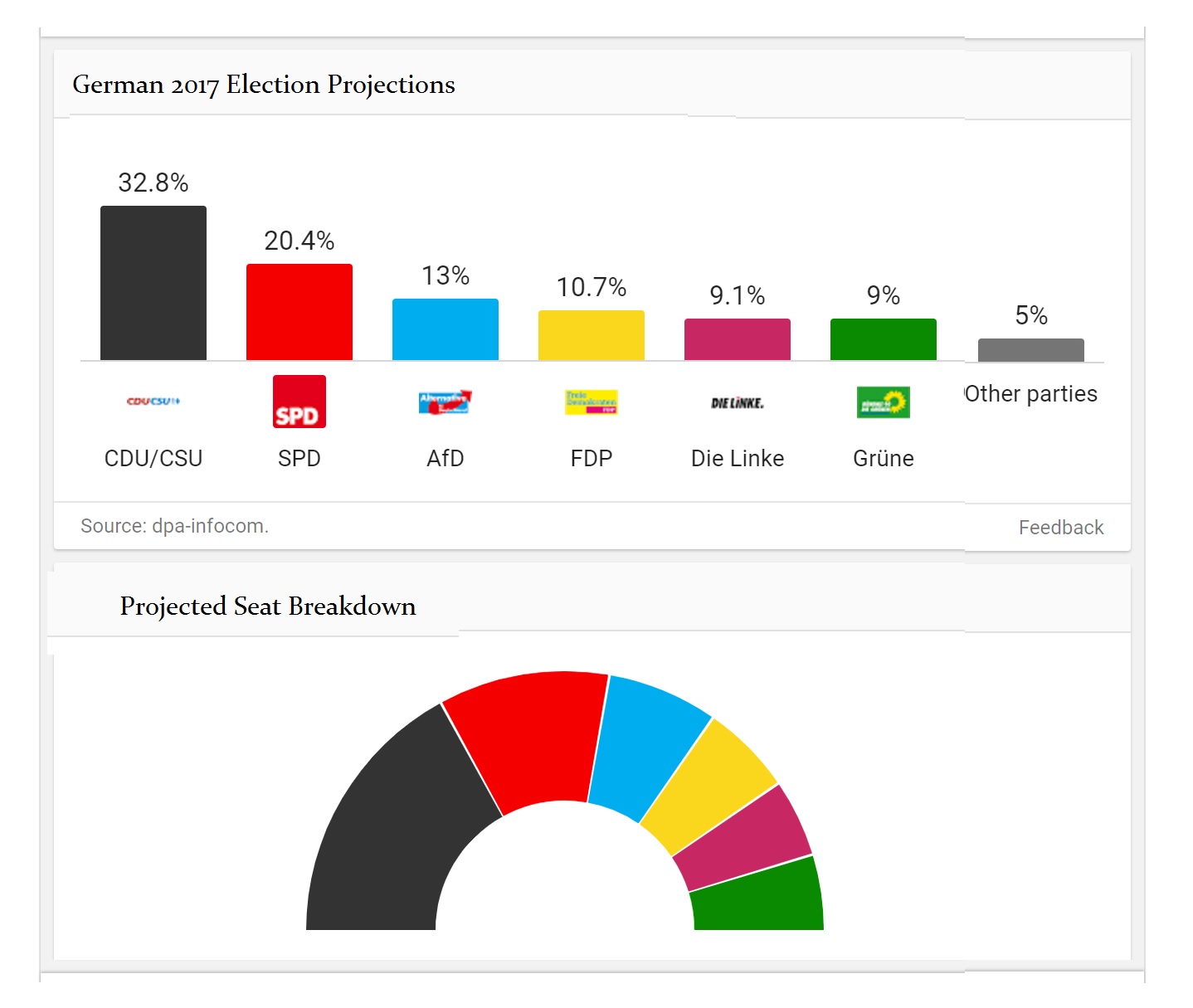
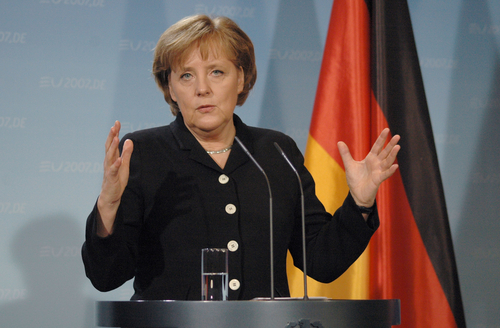
There German election was on par with the global trend that is rising up against the establishment as we have known it. Angela Merkel has been accused of weakening her respective coalition partner. The election result of the Bundestag election shows that not only the SPD has to worry about losing ground, but the Union of the CDU and the CSU in Bavaria has been substantially weakened.
Merkel has always created a coalition by incorporating the key program points of the other parties into the Union. However, the election saw the Union lost nearly 9%, which is a historic defeat. In addition, there is a real rift emerging now with the CSU in Bavaria, where the CSU fell below 40% for the first time. In both cases, this has been caused by the refugee issue Merkel has tried to pretend is not a crisis.
Merkel has drastically underestimated the AfD and the refugee crisis. She concentrated on the Greens and the SPD and tried to bury the other parties with extremist labels. The AfD Merkel tried desperately to paint into the Nazi corner. She has failed to understand that the refugee crisis is a real crisis and it has undermined the people’s feeling of security.
The Union and the SPD wanted to negotiate the issue of refugees and migration. The SPD under Martin Schulz even was proposing that they should be allowed to vote. Without any comprehension of how serious the refugee crisis has been, Merkel attacked even the German-Turks in the TV duel as Turkey told Turks not to vote for Merkel. Schulz raged against the German-Turks despite the fact that the Turks in Germany were not refugees and had been there for decades. Merkel positioned the CDU to the left of the center with the SPD in her entire term of office and wanted to put the key to their long-term strategy in this election of socialism.
Merkel’s Grand Coalition has seem a significant vote amounting to 46.8% voting against everything she stands for. The people have elected the FDP, the Greens, or the Left Party, while the bourgeois-conservative voters have moved to AfD. The union lost a million voters to the AfD, which was remarkable. This goes to the substance of the refugee crisis.
Merkel and her Grand Coalition have tried to downplay this political disaster. While Merkel has clung to power, the CSU is demanding concessions how in light of its loss to the AfD in Bavaria. Merkel may still be in office, but she suffered a defeat that was morally decisive as was the case with Hillary Clinton.
Merkel’s CDU has been unable to prevent voters from abandoning her Grand Coalition. She has indeed not strengthen the Grand Coalition, but weakened it. With the economy turn down and the inability of the ECB to cope with the deflation, the prospects moving forward for the Grand Coalition appear to be headed for a major political collapse.
Merkel’s failed strategy of setting up a left-green-conservative Volksspartei in the center for the CDU has meant that Germany is currently almost unregulated as Merkel has tried to be the Chancellor embracing all points of view except the AfD.
Germany’s Social Democrats (SPD) were hoping to at last oppose Merkel. However, they lost 5% from the 2013 election which has reduced them to a diminish socialist party. The SPD won just 20.5% of the vote, which was the party’s worst result in the 19 general elections since the creation of the federal republic. This demonstrates what our model has been forecasting that we are in the collapsing stages of socialism. Martin Schulz his SPD party had no choice but to go into opposition “to defend democracy against those who question it and attack it,” after dropping to a post-war low.
Talk of the SPD abandoning Merkel and joining a black-yellow-green coalition with the FDP and Greens, does not look to be promising. The opinion makers in both parties are radical opportunists but not really team players. This would produce a coalition of just 40.1% against the CDU’s 32.5%.
Merkel has clearly abandoned the conservatives, which puts tremendous pressure on the CSU in Bavria. The CSU has made it clear that they must position themselves to the AfD given the attitude in Bavaria. This position is completely incompatible in a coalition with the Greens. It is as good as incompatible with a FDP. The CSU could not possibly align with the Greens without being in complete opposition with the AfD.
Merkel’s previous political strategy has called into question coalition politics. Yet after 12 years in power, many say that Merkel would have to be dragged out by the hair. The see the CDU as too corrupted by holding power too long. The CDU has lost all vision of where the people really stand. The AfD has offered these “deplorables” as Merkel called them an alternative, because the CSU was not able to penetrate the Union.
Merkel has won the first place and she has become a chancellor for a 4th term. But because the German political parties are in ruins, the question arises whether being chancellor even matters in this environment within Germany. Some fear that Germany will go the way of the Netherlands or Spain and muddle along temporarily governed by provisional rule until a new election is unavoidable in the end. Merkel’s underestimating the Refugee Crisis may seal the fate of Germany moving forward. An those who saw the Euro defeating the dollar; well good luck. The rend is down long-term.
Against the backdrop of a revised set of administration rules on visa issuance and restricted nationalities; and considering the previously argued ‘Trump travel ban’ guidelines expired Sunday; the Supreme Court has cancelled their hearing of arguments in opposition to the former travel restrictions and visa guidance.
(Via Associated Press) – 1:40 p.m. – The Supreme Court has canceled arguments set for Oct. 10 in the dispute over President Donald Trump’s travel ban, after Trump rolled out a new policy Sunday.
The unsigned order from the justices Monday asks both sides to weigh in by Oct. 5 about what to do with the case.
The court had been ready to hear argument about the legality of a 90-day ban on travelers from six mostly Muslim countries and a 120-day ban on refugees from around the world.
The ban expired Sunday and was replaced by a new policy that affects eight counties and has no expiration date. Those countries are Chad, Iran, Libya, North Korea, Somalia, Syria, Venezuela and Yemen. Chad, North Korea and Venezuela were not covered by the earlier ban. (link)
In addition both Chad and Venezuela are pushing back against Homeland Security guidance that led to their inclusion on the revised travel restrictions:
♦Chad’s government says it learned “with astonishment” of the decision by the U.S. government that its country is on a list whose nationals will be prohibited from entering the United States.
A government statement Monday said the government expresses its incomprehension about the “official reasons for this decision; which contrasts with Chad’s constant efforts and commitments in the fight against terrorism at regional and global levels.”
Chad’s government called for a better appreciation of the situation and for Trump to reconsider the decision which it says “undermines the image of Chad and the good relations between the two countries.” (LINK)
♦Venezuelan President Nicolas Maduro (nee-koh-LAHS’ mah-DOO’-roh) says the Trump administration’s decision to include Venezuelan officials on a travel ban is a form of “political and psychological terrorism.”
His foreign ministry issued a statement Monday saying that the travel restrictions violate the values of the United Nations charter and international law and are part of a continuing effort by the U.S. to oust Maduro from power.
The ministry said it is considering “all necessary measures” to defend Venezuela’s sovereignty and national interest. (LINK)
Once again Merkel fails to win the popular vote in Germany. Angela Merkel’s Christian Democratic Union lost 9% compared to the last elections. Nevertheless, her party has remained as the largest party in Germany’s parliament. Merkel’s CDU won 32.5% of the popular vote far less than any president in the United States history. That was a major decline for Merkel yet she will still rule Germany and Europe for that matter.
Germany’s electorate is more divided than ever before. The AfD won seats for the first time and they now came in as a strong 3rd position. Traditionally, power has either been held by the Christian Democratic Union (CDU) plus its sister Christian Social Union (CSU) party, or the Social Democratic Party (SPD). This year, however, the AfD will be making things more interesting and will play a far more crucial role as they exploit the Refugee Crisis with each and every terrorist act.
Puerto Rico has been devastated by Hurricane Maria. CTH can confirm there is almost no communication with the majority of those impacted by the devastating impact of Hurricane Maria. Local officials are using satellite phones to gain residents the ability to contact their friends and family in the U.S. mainland. Critical infrastructure has been severely compromised. Cell phone service is sporadic to non-existent.
Adding to and amplifying the problem was a general dependency on government assistance, by a large portion of the population, for basic needs prior to the storm. The comfort of dependency has now worsened the desperation of the people on the island.
(Via Fox News) A humanitarian crisis grew Saturday in Puerto Rico as towns were left without fresh water, fuel, power or phone service following Hurricane Maria’s devastating passage across the island.
A group of anxious mayors arrived in the capital to meet with Gov. Ricardo Rossello to present a long list of items they urgently need. The north coastal town of Manati had run out of fuel and fresh water, Mayor Jose Sanchez Gonzalez said.
“Hysteria is starting to spread. The hospital is about to collapse. It’s at capacity,” he said, crying. “We need someone to help us immediately.”
The death toll from Maria in Puerto Rico was at least 10, including two police officers who drowned in floodwaters in the western town of Aguada. That number was expected to climb as officials from remote towns continued to check in with officials in San Juan.
Authorities in the town of Vega Alta on the north coast said they had been unable to reach an entire neighborhood called Fatima, and were particularly worried about residents of a nursing home.
“I need to get there today,” Mayor Oscar Santiago told The Associated Press. “Not tomorrow, today.”
Rossello said Maria would clearly cost more than the last major storm to wallop the island, Hurricane George in September 1998. “This is without a doubt the biggest catastrophe in modern history for Puerto Rico,” he said.
A dam upstream of the towns of Quebradillas and Isabela in northwest Puerto Rico was cracked but had not burst by Saturday afternoon as the water continued to pour out of rain-swollen Lake Guajataca. Federal officials said Friday that 70,000 people, the number who live in the surrounding area, would have to be evacuated. But Javier Jimenez, mayor of the nearby town of San Sebastian, said he believed the number was far smaller.
Secretary of Public Affairs Ramon Rosario said about 300 families were in harm’s way.
The governor said there is “significant damage” to the dam and authorities believe it could give way at any moment. “We don’t know how long it’s going to hold. The integrity of the structure has been compromised in a significant way,” Rossello said. (read more)
.
The U.S. military is the tip of the spear in attempting to get aid and supplies to the residents in coordination with FEMA and emergency officials. CTH had numerous conversations today with teams trying to get as much into the island as possible.
The leadership of the 26th Marine Expeditionary Unit (MEU) and Expeditionary Strike Group 2, met with key leaders with Federal Emergency Management Agency (FEMA) and the Puerto Rico National Guard to plan and coordinate for Hurricane Maria response efforts in Puerto Rico. The Department of Defense (DoD) is supporting FEMA, the lead federal agency, in helping those affected by Hurricane Maria to minimize suffering and is one component of the overall whole-of-government response effort. (U.S. Marine Corps video by Cpl. Adam D. Edwards)
Round three of NAFTA begins this weekend in Canada. According to a leaked possible itinerary obtained by Reuters the auto-sector “rules of origin” will be discussed on Tuesday or Wednesday.
The auto sector rules of origin have been exploited by China to send auto manufacturing parts into Mexico, including massive electronic components, where they are assembled and shipped into the U.S. under NAFTA. This trade maneuver is an exploitation, a back-door per se’, of the NAFTA agreement by China which Secretary Ross and USTR Robert Lighthizer are committed to stopping.
Secretary Wilbur Ross explains in this recent CNBC interview. WATCH:
Theresa May’ Florence speech is being seen by many as a betrayal of BREXIT. Instead of getting on with it, she has said that there will be a longer transition period even two years beyond 2019 into 2021. She said that Europeans will still be able to come and work in Britain into 2021 but under a “registration system” that many fear will still allow terrorists to enter from Europe.
Prime Minister May said that the temporary transitional arrangements “will not go on for ever”and will end around two years after Britain leaves the European Union (EU) in 2019. She made it clear that “[d]uring the implementation period, people will continue to be able to come and live and work in the UK.” She did also say that “[t]here will be a registration system, an essential preparation for the new regime.”
Dragging this on has many concerned. While she says businesses should have the time to plan, quite honestly, two years is plenty of time. The way the markets are looking going forward, Britain may find itself engulfed in the European banking crisis even before 2019.
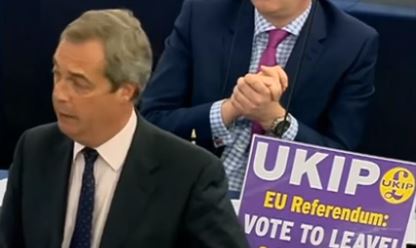
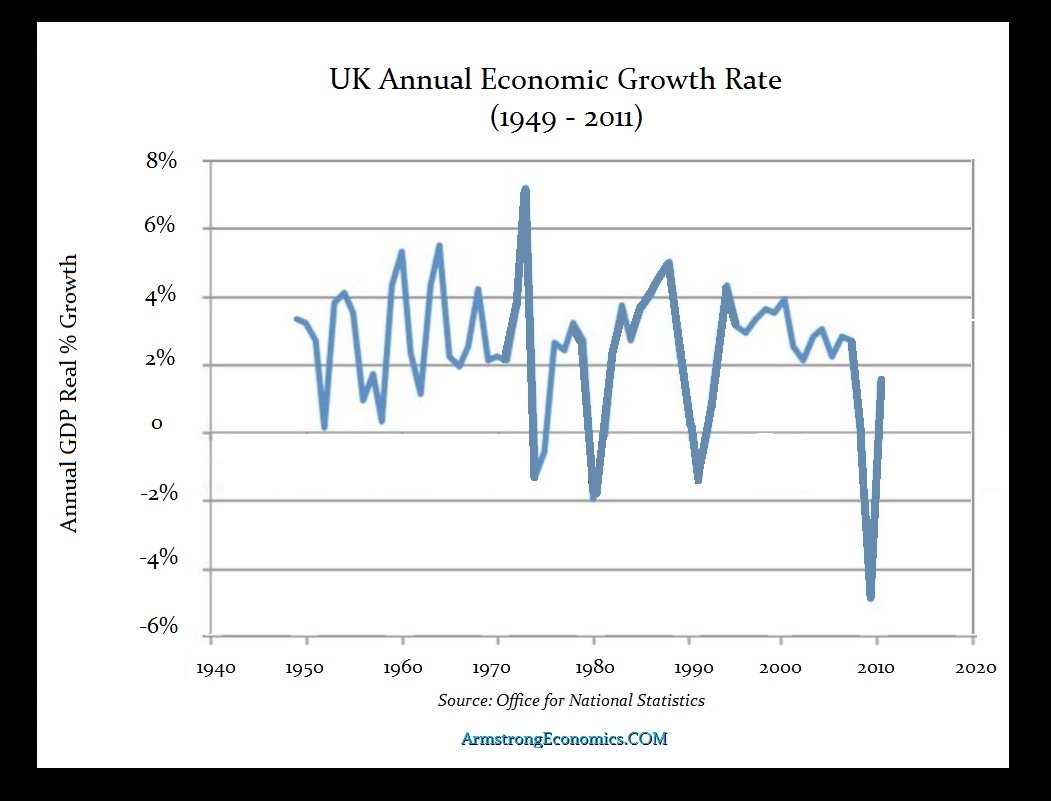
The Yorkshire MEP Jane Collins, who was preparing to run for the leadership of UKIP, has said she would step aside and Nigel should come back. Most people say he is by far the most effective politician perhaps in Europe as a whole. In my opinion, all Nigel has to do is show this chart on TV. British GDP has gone nowhere but down since it joined the EU. Britain is in Europe, but it should never be part of the EU – plain and simple.
The German election takes place tomorrow, with Chancellor Angela Merkel the favorite to defend her position against Martin Schulz for a fourth term in power. The AfD will for the first time win seats Bundestag elections. The the union parties and the SPD are losing approval while Merkel’s party, CDU / CSU, polls at just 34%, which is two percentage points less than the last election.The SPD is polling at just 21% with the left at 11% and the FDP at 9%. The AfD, according to the opinion research institute Insa, is gaining two points and comes to 13%, the Greens increase one point to 8%.
Polls currently show that Merkel’s Christian Democratic Union (CDU) party – with its Bavarian sister party, the Christian Social Union (CSU) – will be the largest party after the Bundestag election, but they will fall short of a majority once again so there will have to be coalition government with the SDP. This is what is harming Germany and Europe for it gives the impression that Merkel has a mandate when she cannot win 51% of the German vote.
Therefore, the wildcard remains the AfD and if they come in at a higher level than expected, there will be an ongoing battle that will turn against Merkel in the next two years. If the AfD come in above 15%, then the shape of the coalition government may be different than expected. As one German politician put it, you will have to drag Merkel out by the hair to get her to to leave office. Therefore, expect no change in the course of direction for Europe. As long as Merkel is still there, it will be more of the same but worse with ever increasing taxes and more deflation. You cannot reverse the course of Europe without changing the leadership.
The German Bundestag election campaign has seen a total black-out of any discussion of the major crisis that is building in Europe. Nobody is mentioning that Euro crisis, ECB monetary policy, disintegration of the EU, refugee crisis, pension crisis, the municipalities on the brink of insolvency, or the drastic increases in taxation coming AFTER the election that will only lower disposable incomes and extend deflation.
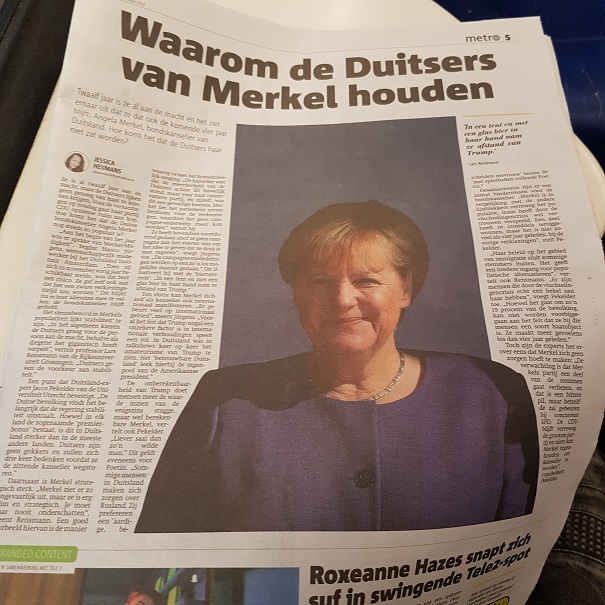
The politicians, and the press, are in full swing to hide the real trend at foot. The press is running stories why the Germans Love Merkel, yet she has never won even 40% of the popular vote. Even the press outside of Germany is in on the “selling” of Merkel because she is the leader of Europe – good – bad – indifferent.
Perhaps the monetary policy of the ECB has set the stage for a serious monetary crisis over the coming years that will seriously disrupt the German economy, in one way or another, depending upon the industry.Mario Draghi has experimented with negative rates which has kept the Eurozone governments on life-support – but they have not used the time to reform anything.
Draghi’s experiment has altered the economy and the financial sector in Europe. They now are faced with two equally unfortunate alternatives: if the ECB continues its monetary policy, many banks in Europe will slip into bankruptcy.Today, the traditional business models are no longer working because most banks with zero and negative interest rates have lost the most important source of revenue – deposits. A simple mathematical calculation projects widespread bank insolvencies in Europe as we enter the next decade.
The events in Barcelona demonstrate that there is a denial of any democratic government in the Eurozone. The elites have made the decision to federalize Europe and nobody is allowed to leave. Brussels learned nothing from BREXIT and this disintegration of the EU will worsen as the economics turns against it. The disintegration of the EU is only further enhanced by the refugee crisis. No other Arab country will accept the refugees such as Saudi Arabia or UAE. They know better. Two of the terrorists in Britain were refugees.
The negative interest rates have carved out huge holes in the pensions of Europe. Some members have issued 100 year bonds at less than 2.5% and 50 year bonds as in Switzerland below 1%. This is merely a reflection of deflation projected out for extended periods of time.
The German Bundestag election is void of any discussion of the trouble in the EU or how Germany will be affected in beginning after the election. There is no mention of imposing a turnover tax on the internet and no mention of forcing companies to prepay all the VAT even on a 5 year contract covering installments. The desperate need for cash among the governments is not being addressed. Nobody seems to think twice that the governments constantly need a greater proportion of private sector money to stay afloat and this in itself is driving the deflation.
The United States leading diplomat, Secretary of State Rex Tillerson, makes the historic case for peaceful denuclearization to the U.N. Security Council.
.
[Transcript] SECRETARY TILLERSON: Well, good afternoon. And I appreciate the opportunity to address the Security Council again, and I thank this month’s – this month’s chair, Ethiopia.
Members of the Security Council talk often of threats to global security.
The focus of today’s Security Council meeting is an issue of worldwide implications: nuclear proliferation.
At a time when stabbings, crudely constructed bombs, and trucks driven into crowds of innocent men, women, and children are often our enemies’ weapons of choice to attack us, it is easy to become complacent and see the threat of nuclear attacks as a relic of the Cold War.
The threat of a nuclear attack remains a grim reality. Those who would trigger such a horrific scenario pose a unique threat to the security of peace-loving nations.
The challenge for each of us is, “How can we decrease the threat posed by nuclear weapons, not just to our own people, but people the world over?”
Today I want to put four points forward:
The first is to highlight the positive trajectories of nations that have voluntarily relinquished nuclear weapons.
The second is to emphasize the moral burden of possessing nuclear weapons, and the enormous responsibility that accompanies stewardship of such devastating weapons, as well as the technologies and nuclear materials that go into them.
The third is to make clear acquiring nuclear weapons capability does not provide security, prestige, or other benefits – but instead represents a path to isolation and intense security scrutiny from the global community, as those responsible nuclear powers will check such uncertain, unpredictable threats.
And lastly, all nations, but most particularly the current nuclear powers, must recommit to sound nuclear security practices and robust and effective non-proliferation efforts in order to keep nuclear weapons and associated materials and technology out of the hands of irresponsible nations, terrorists, and non-state actors.
There are historical precedents of nations abandoning their nuclear weapons programs and arsenals out of self-interest. Belarus, Kazakhstan, South Africa, and Ukraine all weighed the risk and responsibility of nuclear weapons and made the decision to eliminate their nuclear programs or give up their nuclear weapons.
As the apartheid regime in South Africa ended, the country’s leaders eliminated its nuclear weapons and joined the Non-Proliferation Treaty as a non-weapon state. After the dissolution of the Soviet Union, Belarus, Kazakhstan, and Ukraine willingly gave up the nuclear weaponry that the Soviet collapse bequeathed to their territories. And, over the years, several other countries were willing to abandon clandestine nuclear weapons development efforts when reassured by the United States and others that their relationships with us and the global community enabled them to meet their national security needs without such tools.
The Republic of Kazakhstan is a particularly illustrative example of the wisdom of relinquishing nuclear weapons.
In partnership with the United States, and aided by the Cooperative Threat Reduction Act spearheaded by U.S. Senators Sam Nunn and Richard Lugar, Kazakhstan opted to remove from its territory former Soviet weapons and related nuclear technologies, and joined the Non-Proliferation Treaty as a non-weapons state.
This courageous decision by the leaders of Kazakhstan greatly reduced the prospect of nuclear weapons, components of nuclear weapons, or nuclear materials and dual-use technologies from falling into the wrong hands. Nuclear weapons introduced complexity into relations with other countries, and they introduced the risk of miscalculation, accident, or escalation.
Kazakhstan’s actions represented a key step in that country becoming part of the community of nations. As a result of letting go of nuclear weapons, the world does not look on Kazakhstan as a potential nuclear aggressor or a rogue state. It did not make enemies of its nuclear neighbors, Russia or China.
Today Kazakhstan has overwhelmingly been at peace with its neighbors, and its trade relations are robust. This year, it hosted World Expo 2017, an event in Astana, which showcased the sources of future energy and investment opportunities in Kazakhstan to attendees from around the world. This is a modern nation making a substantial contribution to regional and international peace and prosperity. Kazakhstan has only benefitted from its early decision.
In my previous career, I met President Nazarbayev on many occasions and had the opportunity to ask him about this decision. He is more at peace with his choice than ever. He once remarked to me, “It was the best thing I ever did for our young country.”
Ukraine made a similar courageous choice. Even after Russia’s incursion – incursion into its territory in Crimea and east Ukraine, a violation of Moscow’s commitments under the Budapest Memorandum – Ukraine’s leaders reaffirmed yet again the wisdom of their decision to remove nuclear weapons. Their friends and allies quickly came to their aid in response to this violation of their sovereignty with a strong, unified set of sanctions on Russia and are steadfastly committed to ending this conflict through full implementation of the Minsk accords.
By rejecting the power of nuclear weapons, both of these two proud nations are in a better place than they would have been otherwise. They reduced the danger of nuclear conflict and helped reduce the chances of such capabilities falling into the hands of irresponsible third parties.
As the only nation on Earth to have used nuclear weapons in warfare, the United States bears a heavy responsibility to exercise proper stewardship of nuclear weapons and to lead in working with other nations to reduce global nuclear dangers.
It is a blessing, and perhaps in many ways a miracle, that nuclear weapons have never been used again. All the peoples of the world pray that they will never be. Experience is a hard but wise teacher and has taught everyone the grim moral responsibility that accompanies nuclear weapons.
The United States is reliant upon nuclear deterrence today not only for the purposes of safeguarding our own security interest but also those of our allies who otherwise might feel the need to acquire such weapons themselves. Such deterrence and such relationships have contributed to the absence of war between the great powers since 1945 and indeed to the fact that nuclear weapons themselves have never been used again.
We’re all fortunate that John F. Kennedy and Nikita Khrushchev, when they stood on the brink of a nuclear holocaust during the Cold War, came to a common understanding of the fearful and awesome power of nuclear weapons. As potential human extinction loomed over the Cuban Missile Crisis, the dominant emotion was fear. Nuclear weapons brought the most powerful men in the world no comfort, but it did make clear the need to minimize the risk of ever repeating this near-miss of a catastrophe by permitting nuclear capabilities to spread further.
Just this week, the world learned of the passing of a little-known but important figure in the history of the Cold War. His name was Stanislav Petrov, and he is sometimes referred to as “the man who saved the world.” In 1983, Petrov was a Soviet military officer on duty at a nuclear early warning center when his computers detected a barrage of incoming American nuclear missiles. He said, “I had all the data to suggest” it was true. He said, “If I had sent my report up the chain of command, nobody would have said a word against it.” He said, “All I had to do was to reach for the phone to raise the direct line to our top commanders, but I couldn’t move. I felt like I was sitting on a frying pan.”
Petrov had a hunch that the computer had made an error, and fortunately he was right about a false alarm. Instead of notifying his commanders to prepare an immediate nuclear counterattack, he instead called army headquarters and reported a system malfunction. This episode illustrates just how high the risk factor is with nuclear weapons, especially when decisions to use them are entrusted or could be entrusted to sometimes unreliable technologies or fallible human judgment. Countries who want nuclear weapons must ask themselves: Am I prepared to deal with this type of scenario in my own country?
The history of the Cuban Missile Crisis and the Soviet early warning malfunction illustrate how challenging it can be even for the most experienced and most sophisticated nuclear possessors to control nuclear dangers.
Rogue regimes fail to appreciate the responsibilities inherent to nuclear weapons. They wish to develop or expand their holdings of nuclear weapons in what they claim to be a search for security, but in fact they desire to use such tools to intimidate and coerce their neighbors and destabilize their regions. Such acquisitions risk creating an escalating spiral of regional or global instability and conflict, not just as a direct result of their own proliferation, but by prompting other nations to undertake their own nuclear weapons programs in response. In such circumstances, nuclear weapons are not instruments of mutual deterrence and strategic stability, but instead are tools of destabilization.
Rogue regimes may have persuaded themselves that they pursue nuclear weapons to establish and enhance their security and prestige, but, in fact, nuclear weapons are more likely to undermine both. There’s a very good reason why almost every country in the world has joined the Non-Proliferation Treaty: All parties can know that they will not in the future face the threat of nuclear catastrophe from any new direction.
If would-be proliferators seek security or to improve their standing in the world or to enhance the prosperity of their citizens and their people’s hope for a brighter future, proliferation will not provide these things. There are much better, proven ways for nations to establish and enhance their standing, such as deepening their trade integration with the rest of the world, adhering to international standards and agreements, and participating in humanitarian activities.
The Korean Peninsula serves as a stark example of these differing paths. While North Korea has shunned the international community and let its people starve while it relentlessly pursues nuclear weapons, South Korea has opted not to pursue nuclear weapons and is fully engaged with the international community. As a result, South Korea has grown into one of the world’s great economic powers, with a GDP over 100 times that of its neighbor to the north.
By contrast, though North Korea may assume that nuclear weapons will ensure the survival of its regime, in truth, nuclear weapons are clearly only leading to greater isolation, ignominy, and deprivation. Continued threats against us – against us, the U.S., and now, the entire global community, will not create safety for the regime, but will rather stiffen our collective resolve and our commitment to deterring North Korean aggression.
North Korea is a case study in why nations must work to preserve and strengthen global nonproliferation norms. As we look to the future, the international community’s record of enforcing compliance with nonproliferation obligations and commitments is not what we need it to be.
It is partly for lack of such accountability that we find ourselves in the situation we are in with North Korea at the moment. Though it joined the Non-Proliferation Treaty in the mid-1980s, North Korea never came into full compliance with the treaty, and cheated on every subsequent arrangement designed to remedy that noncompliance and rein in the nuclear threat it now presents.
There are also lessons here for Iran, which was on its own pathway to develop nuclear weapons – in violation of its Non-Proliferation Treaty and nuclear safeguards obligations and multiple, legally binding UN Security Council resolutions. Iran seems keen to preserve for itself the option to resume such work in the future, even while sponsoring international terrorism, developing missile systems capabilities of delivering nuclear weapons, and destabilizing its neighbors in a dangerous quest of regional hegemony.
The collective responsibilities of meeting such proliferation challenges will require more from all of us. As President Trump said in his speech on Tuesday, “If we are to embrace the opportunities of the future and overcome the present dangers together, there can be no substitute for strong, sovereign, and independent nations.” As strong, sovereign, and independent nations, we must work together, bilaterally, regionally, and globally, to stem the tide of proliferation. Sovereign states acting in unison will produce a global good.
We especially urge Russia to examine how it can better support global nonproliferation efforts. As the world’s two most powerful nuclear states, Russia and the United States share the greatest responsibility for upholding nonproliferation norms and stopping the further spread of nuclear weapons.
We have cooperated well before: the United States and the Soviet Union worked together closely in drafting most of the text that became the Non-Proliferation Treaty, which helped keep proliferation under control through the Cold War. Washington and Moscow did this, moreover, notwithstanding their own Cold War rivalry and the many problems in their bilateral relationship. In the post-Cold War era, Russia worked hard to improve accountability for its nuclear stockpile dispersed across the former Soviet Union, and we engaged closely in cooperative efforts – through the Nunn-Lugar program – to reduce the risk of weapons or material falling into the hands of proliferators or terrorists.
Unfortunately, in recent years, Russia has often acted in ways that weaken global norms and undercut efforts to hold nations accountable. Examples include violating its own obligations under the Intermediate-Range Nuclear Forces Treaty, flouting the security assurances it made at the end of the Cold War, impeding efforts to build on the legacy of past international efforts on nuclear security, and seeking to weaken the International Atomic Energy Agency’s independence in investigating clandestine nuclear programs.
If Russia wants to restore its role as a credible actor in resolving the situation with North Korea, it can prove its good intentions by upholding its commitments to established international efforts on nuclear security and arms control.
Cooperation from China is also essential if the international community is to bring North Korean nuclear and missile threats under control and prevent a catastrophe spiraling of instability and conflict on the Korean Peninsula.
If China truly desires to denuclearize the Korean Peninsula, to promote stability, and to avoid conflict in that sensitive region, right on its own border, now is the time to work with the rest of us, the rest of the international community, to put the kind of pressure on North Korea that can change its strategic calculation before it’s too late.
And lastly, we must be fully aware that there are non-state actors who will never conform to international norms governing nuclear weapons.
Their grand-scale terror attacks, beheadings, crucifixions, burnings, rapes, torture, acts of enslavement expose ISIS, al-Qaida, and other groups as those who seek to find glory through death and destruction.
Their eagerness to commit atrocity makes clear that, if given the chance, they would commit death and destruction on an even larger scale. And there is no scale larger than a nuclear attack on one of the world’s cities.
Many jihadist groups aspire to detonate a nuclear device in the heart of a booming metropolis. Their mission is to kill our people and send the world into a downward spiral. We must never allow this.
We must continue to work to secure nuclear technologies, blueprints, and materials at their sources and disrupt proliferation networks.
We must deepen information sharing between intelligence agencies in order to identify actors and identify when nuclear materials have been or may be diverted from legitimate uses.
And we must revive the practice of creating alternative career and job opportunities for nuclear experts, so they do not sell their skills on the black market.
But ultimately, the best means to halt jihadists in their quest for nuclear weapons is to destroy them long before they can reach their goal.
Whether on the battlefield, in the streets, or online, terrorism must be given no quarter.
We must remain ever vigilant against the spread of ISIS and other Islamist groups in new locations, whether in Africa, Asia, Europe, or elsewhere.
One of the great successes of the campaign of the Coalition to Defeat ISIS in Iraq and Syria has been uprooting ISIS from formerly safe havens in which they could freely mastermind attacks against targets the world over. These efforts must continue.
As a body committed to security, we must treat nuclear proliferation with the seriousness it deserves.
For those of us on the Security Council, counteracting nuclear threats begins with full enforcement of the UN Security Council resolutions all member-states are bound to implement. To make sure all nations are able to play their part, we must continue to work for full and effective implementation of UN Security Council Resolution 1540.
But signing treaties and passing resolutions is not enough. Stopping nuclear proliferation also entails exercising other levers of power, whether diplomatic, economic, digital, moral, or, if necessary, military.
Ultimately, we each have a sovereign responsibility to ensure that we keep the world safe from nuclear warfare, the aftermath of which will transgress all borders.
The United States will continue to halt – to work to halt the proliferation of nuclear weapons. We ask all peace-loving nations to join us in this mission.
I have created this site to help people have fun in the kitchen. I write about enjoying life both in and out of my kitchen. Life is short! Make the most of it and enjoy!
This is a library of News Events not reported by the Main Stream Media documenting & connecting the dots on How the Obama Marxist Liberal agenda is destroying America