Posted originally on the conservative tree house on January 17, 2022 | sundance | 230 Comments
I have intentionally not written about the terrorist attack in Colleyville, Texas, because my initial review saw significant parallels to the first ISIS attack on U.S. soil which took place in 2015 at Garland Texas, carried out by Elton Simpson and Nadir Soofi.
In the Garland attack the FBI organized, facilitated and coordinated the attack. The FBI even drove the terrorists to the attack venue and then left once the shooting began. Yes, you read that correctly, the first ISIS attack on U.S. soil was organized by the FBI. {Go Deep} CTH dug deep on the 2015 Garland attack, so it wasn’t too difficult to spot the similarities between Garland 2015 and Colleyville 2022.
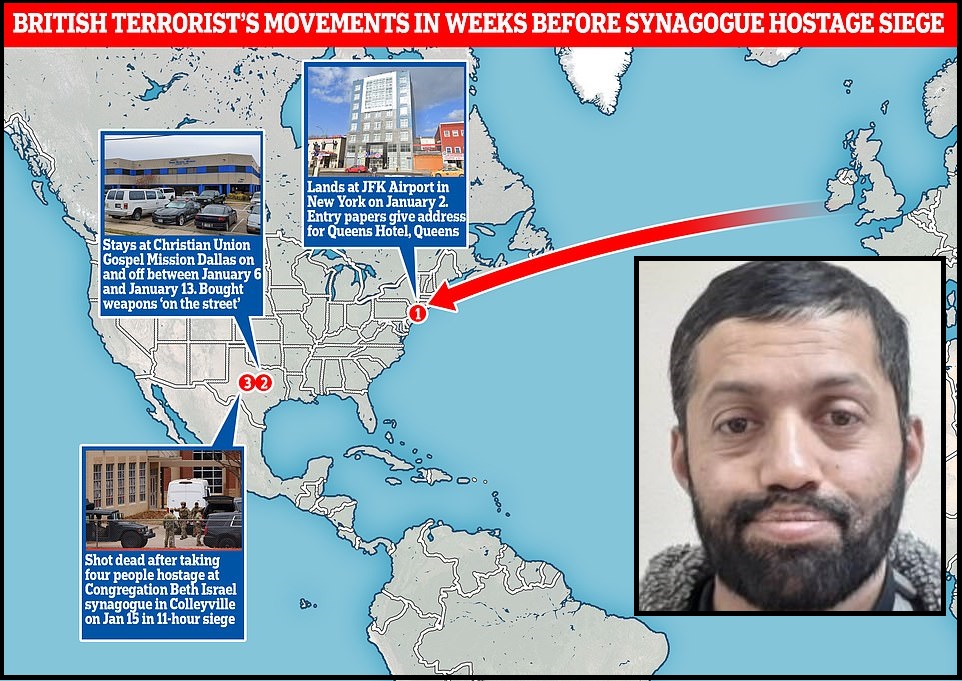
♦ Colleyville, Texas – Malik Faisal Akram, who was known as Faisal Akram, had a well known Islamic extremist history to British and American intelligence. Akram ranted, prior to his travel to the U.S, that he wished he had died in the 9/11 terror attacks. He was a regular visitor to Pakistan, and reportedly a member of the Tablighi Jamaat group set up to ‘purify’ Islam. To say the U.S. intelligence system knew Faisal Akram would be an understatement. The FBI knowledge of Akram has now been confirmed by The Daily Mail.
So, the questions become: (1) how did Faisal Akram gain a visa to enter the United States? (2) Who did he visit? (3) Who gave him the weapon? (4) Who facilitated his travel and targeting operations; and lastly, (5) who financed and assisted him in his attack?
Unfortunately, the most obvious answer is just like the 2015 Garland example, the FBI was his enabler.
Akram entered the synagogue around 11am Saturday morning as a service was live streamed online. Akram shouted anti-Semitic rants at the Jewish members, took them hostage and then demanded the release of convicted terrorist Aafia Siddiqu, whom he referred to as his ‘sister’. The location in Colleyville seems significant, because ‘Lady al-Qaeda’ is being held in a federal prison about 20 miles from Colleyville, at FMC Carswell in Fort Worth.
(Daily Mail) – The Texas rabbi who escaped from British gunman Malik Faisal Akram after a 12-hour stand-off on Saturday said he welcomed him into his synagogue because he ‘looked like he needed shelter’ and gave him a cup of tea.
Rabbi Charlie Cytron-Walker also explained that he threw a chair at Akram at Beth Israel Congregation in Colleyville, Texas, on Saturday so that he and two other hostages were able to escape.
[…] The rabbi also revealed that towards the end of the stand-off, he feared he would be killed because the gunman wasn’t ‘getting what he wanted’.
‘It didn’t look good. It didn’t sound good. We were terrified.’
The hostages only escaped when he threw a chair in the gunman’s face and bolted for the exit.
SWAT teams killed the gunman afterwards, once all of the hostages were out safely.
‘When I saw an opportunity where he wasn’t in a good position, I made sure the two gentlemen who were still with him, that they were ready to go. The exit wasn’t too far away.
‘I told them to go, I threw a chair at the gunman and I headed to the door and all three of us were able to get out without even a shot being fired,’ he said. (read more)
BACKGROUND on FBI – The FBI was fully aware of the Boston Marathon bombers, the Tsarnaev brothers, before they executed their plot. The FBI took no action. The FBI knew about the San Bernardino terrorists, specifically Tasfeen Malik, and were monitoring her phone calls and communications before her and Syed Farook executed their attack killing 14 people and leaving 22 others seriously injured. The FBI took no action. The FBI knew Colorado grocery store shooter Ahmad Alissa before he executed his attack. The FBI took no action.
The FBI knew in advance of the Pulse Nightclub shooter (Omar Mateen) and were tipped off by the local sheriff. The FBI knew in advance of the San Bernardino Terrorists (Tashfeen Malik). The FBI knew in advance of the Boston Marathon Bombers (the Tsarnaev brothers) tipped off by Russians. The FBI knew in advance of the Parkland High School shooter (Nikolas Cruz). The FBI knew in advance of the Fort Hood shooter (Nidal Hasan), and the FBI knew in advance of Colorado grocery store shooter Ahmad al-Aliwi Alissa. The FBI took no action.
As mentioned, the case of the first recorded ISIS attack on U.S. soil was in Garland, Texas in 2015. The FBI not only knew the shooters (Elton Simpson and Nadir Soofi) in advance, BUT the FBI ALSO took the shooters to the venue and were standing only a few yards away when Simpson and Soofi opened fire. Yes, you read that correctly – the FBI took the terrorists to the event and then watched it unfold. “An FBI trainer suggested in an interview with “60 Minutes” that, had the attack been bigger, the agency’s numerous ties to the shooter would have led to a congressional investigation.”
Remember, shortly before the 2018 mid-term election, when Ceasar Syoc – a man living in his van – was caught sending “energetic material that can become combustible when subjected to heat or friction”, or what FBI Director Christopher Wray called “not hoax devices”? Remember how sketchy everything about that was, including the child-like perpetrator telling a judge later that he was trying to walk back his guilty plea, because he was tricked into signing a confession for a crime he did not create.
Or more recently, the goofball plot to kidnap Gretchen Whitmer that involved 18 suspects, twelve of them actually working for the FBI as the plot was hatched? And we cannot forget the January 6th. DC protest turned insurrection effort, which is clearly looking like an FBI inspired and coordinated effort.
Have we forgotten the Atlanta “Olympic Park Bombing”, and the FBI intentionally setting up transparently innocent, Richard Jewel?
Then, there’s the entirety of the FBI conduct in “Spygate”, the demonstrably evident FBI operation to conduct political surveillance against Donald Trump using their investigative authorities; and the downstream consequences of a massive institutional effort to cover up one of the biggest justice department scandals in the history of our nation. The original effort against Donald Trump used massive resources from the DOJ and FBI. Heck, the coverup operation using the Mueller/Weissmann special counsel used more than 50 investigative FBI agents alone.
And of course, the FBI still had 13 extra agents available to rush to a NASCAR racetrack to investigate a garage door pull-down rope that might have been perceived as a noose; but the serial rape of hundreds of teenage girls, eh, not-so-much effort – even when they are standing in front of the FBI begging for help.
[At this point, I am increasingly convinced by evidence the FBI themselves are the perpetrators involved in sex trafficking, human smuggling and abduction as part of their operational mission.]
It is important to realize what exactly happened in the case of the Olympic gymnasts and the rape of hundreds of teenage girls. When the victims and parents told the FBI about what Larry Nassar was doing, the FBI did not bungle the investigation. The FBI did not investigate.
But worse…. after the parents kept coming back to the FBI to ask what was going on, and report that other parents were now reporting that new rapes and assaults were ongoing, the FBI told those parents an investigation was ongoing. Except it wasn’t. The FBI was lying.
As the FBI was telling the victims they were investigating Larry Nassar, the FBI was doing no such thing. The FBI was lying to the victims and their families. The FBI was not taking any action whatsoever to address the multitude of claims against Nassar.
After the FBI was caught lying about their conduct, they then lied to the internal oversight, the OIG, about everything surrounding their conduct. The FBI didn’t make a mistake, or drop the proverbial ball, they intentionally and specifically maintained the sexual exploitation of teenage girls by doing absolutely nothing with the complaints they received. This is not misconduct, this is purposeful.
Then, as if to apply salt to the open wound of severe FBI politicization….what did the FBI do with the Hunter Biden laptop?
What the Federal Security Service (FSB) is to the internal security of the Russian state; so too is the FBI in performing the same function for the U.S. federal government.
The FBI is a U.S. version of the Russian “State Police”; and the FBI is deployed -almost exclusively- to attack domestic enemies of those who control government, while they protect the interests of the U.S. Fourth Branch of Government. That is the clear and accurate domestic prism to contextualize their perceived mission: “domestic violent extremists pose the greatest threat” to their objective.
Put another way, “We The People”, who fight against government abuse and usurpation, are the FBI’s actual and literal enemy.
Let me be very clear with another brutally obvious example. Antifa could not exist as an organization, capable to organize and carry out violent attacks against their targets, without the full support of the FBI. If the FBI wanted to arrest members of Antifa, who are actually conducting violence, they could do it easily – with little effort.
It is the absence of any action by the FBI toward Antifa, that tells us the FBI is enabling that violent extremist behavior to continue. Once you accept that transparent point of truth, then, you realize the FBI definition of domestic violent extremism is something else entirely.
The FBI is not a law enforcement or investigative division of the U.S. Department of Justice. The FBI is a political weapon of a larger institution that is now focused almost entirely toward supporting a radical communist agenda to destroy civil society in the United States.
The current mission of the FBI is to facilitate, preserve and protect the administration of Joe Biden. The attack in Colleyville presents as a purposeful distraction from a multitude of extremely bad headlines overwhelming the administration as a direct result of leftist policy.
Something intentional happened to allow Faisal Akram entry into the U.S, and anyone who continues to push the fraudulent “honorable FBI rank and file talking point”, is, at this point in history, willfully and purposefully operating to deceive the American people on behalf of government interests who are intent on destroying us.
It is not a difference of opinion any longer. It is now just a matter of accepting what is staring us in the face.
If billionaires paid their fair share, we could allegedly solve world hunger. How?
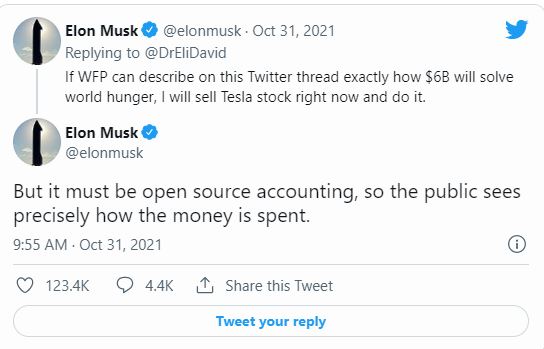
David Beasley, director of the UN’s World Food Programme (WFP), called out billionaires such as Elon Musk and Jeff Bezos for not donating funds to solve world hunger. “Just $6 billion could keep 42 million people from dying,” Beasley claimed. Musk took to Twitter with a bold offer — he would personally donate $6 billion if the WFP could explain precisely how they would spend the funds. Furthermore, the richest man in the world is asking the WFP to provide a public record of exactly how the money will be spent.
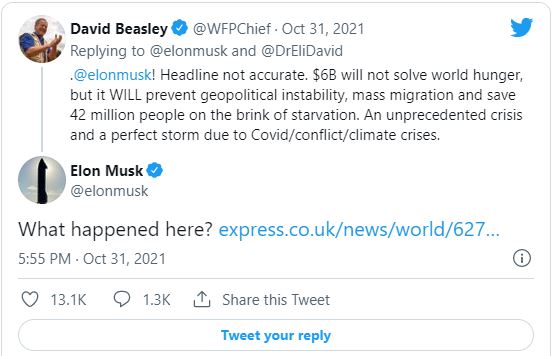
David Beasley replied to Musk, “Headline not accurate. $6B will not solve world hunger, but it WILL prevent geopolitical instability, mass migration and save 42 million people on the brink of starvation. An unprecedented crisis and a perfect storm due to Covid/conflict/climate crises.” In other words, $6 billion will not solve world hunger as the people managing that sum of money could never keep it out of their pockets. Musk replied to Beasley with a link to an ongoing, unpunished, child sex abuse scandal where UN “peacekeepers” abused hungry children. The details are too grotesque to publish here, but make no mistake about it — the UN is not an entity intent on saving the world. They had to turn down a generous donation of $6 billion because they knew that they could never report the paper trail, and the results would likely be a request for more money.
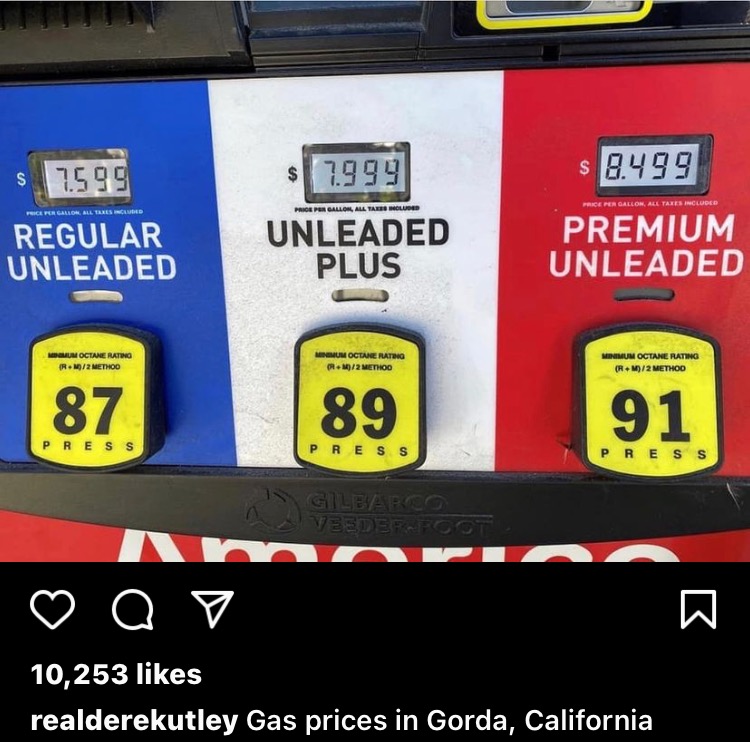
European Union leaders are scrambling for solutions to the energy crisis, but their feared friend from the East has reminded them that a solution exists. According to the Associated Press, gas prices in the EU have spiked to 95 euros from about 19 euros per megawatt-hour in the past year. Around 90% of gas is imported to the EU, and Belgian Prime Minister Alexander De Croo said that the only long-term solution is to invest in renewable energy. “And in the long term, there is only one solution — invest more in renewable energy so we are less vulnerable to price fluctuations for fossil fuels,” he said.
Hungarian Prime Minister Viktor Orban blamed the Green Deal plan for higher prices, which aims to reduce greenhouse emissions by 55% by 2030, with the goal of becoming carbon neutral by 2050. Some leaders are pointing to the use of nuclear energy, such as France, Bulgaria, Croatia, Czech Republic, Finland, Hungary, Poland, Romania, Slovakia, and Slovenia. However, the 27-nation bloc has not designated nuclear power as a sustainable investment yet.
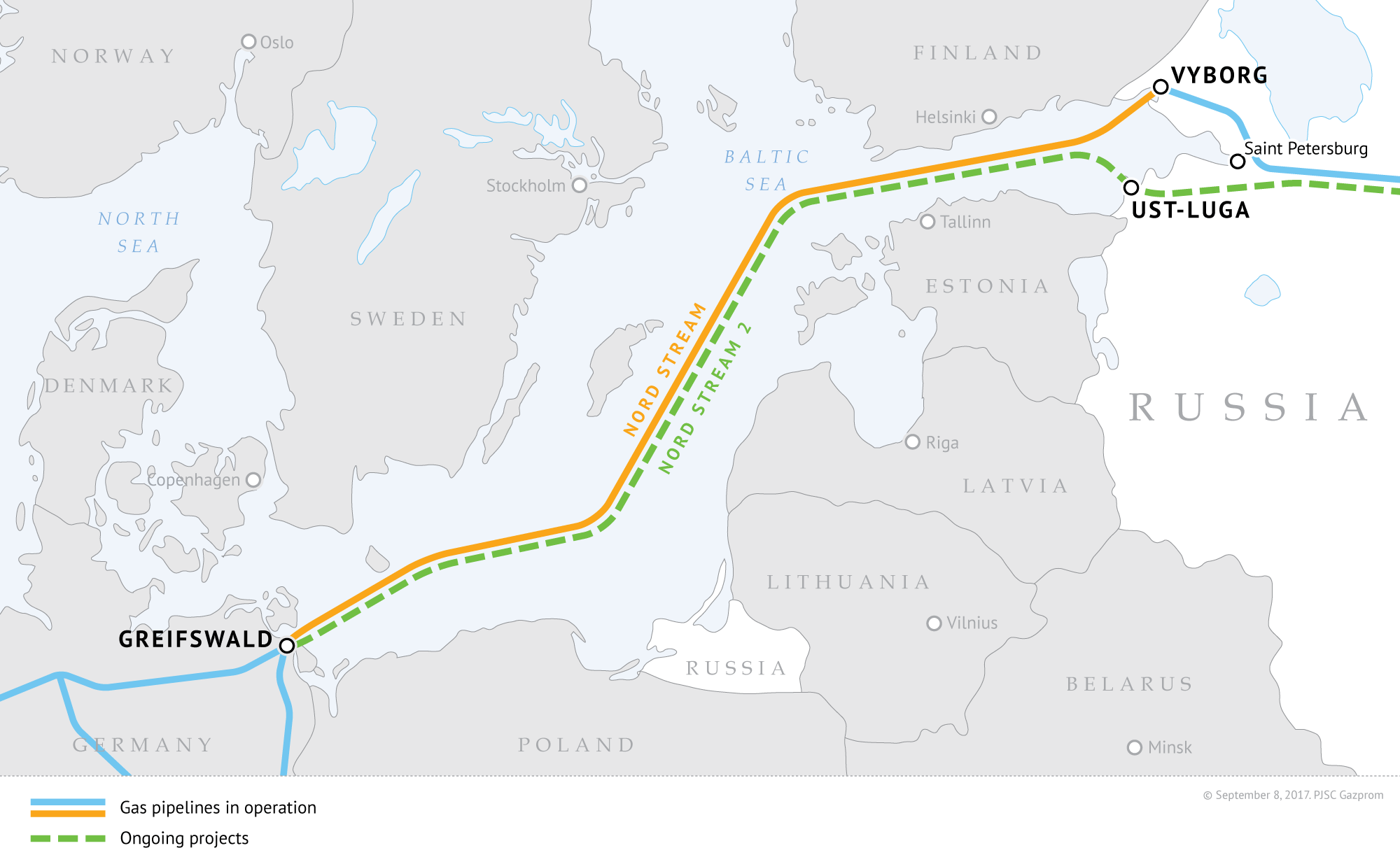
(Nord Stream 2 Pipeline)
In comes Putin and the controversial Nord Stream 2 pipeline that would carry much-needed gas from Russia to the EU beneath the Baltic Sea. “If the German regulator gives approval tomorrow, supplies of 17.5 billion cubic meters of gas will start the day after tomorrow,” Putin said. The Russian president has previously criticized the EU for not signing long-term contracts and failing to work with Russia on energy trade. European Commission President Ursula von der Leyen said that relying on gas from Russia makes the bloc “vulnerable,” but it seems that they are already vulnerable and in a worsening situation with no solution in sight. EU energy ministers are set to meet in December, where they are likely to kick around solutions while ignoring the one that is a pipeline away.
China has begun to ration fuel amid the ongoing energy crisis. As reported by the BBC, trucks in China may only fill their tanks with 100 liters (10% capacity) of diesel, with other areas reportedly only allowing 25 liters. The city of Fuyang is limiting purchases and charging drivers a surcharge of up to 300 yuan to fill up their tanks. The fuel shortage will affect both domestic and international goods as trucks simply cannot drive to their destinations. Despite surging demand, all fossil fuels are in tight supply and have seen drastic upticks in price. Jeremy Stevens, Chief China Economist at Standard Bank, told the BBC from Beijing that companies have already begun using diesel generators to maintain factory operations. World leaders are urging this instant switch to renewable energy and net-zero emissions, but the technology does not currently exist to power the world. The energy crisis will contribute to supply shortages worldwide.
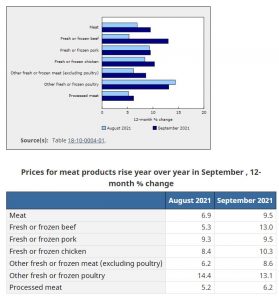
(Image from Statistics Canada: Prices for meat products rise year over year in September)
Canada’s CPI rose 4.4% YoY this September, according to Statistics Canada. Every major sector saw gains, but meat prices spiked 9.5%, marking the fastest pace of growth since April 2015. Canada’s Food Price Report for 2021, released in December 2020, predicted that meat prices would rise 4.5% to 6.5% in 2021, a drastic underestimate. Dr. Sylvain Charlebois, project lead and Director of the Agri-Food Analytics Lab at Dalhousie University warned people that they should develop “immunity” to rising prices. “Immunity to higher food prices requires more cooking, more discipline and more research. It’s as simple as that.” Gaslighting the people to believe they need to change their lives, rather than government change their policy, is at play once again.
Let me remind you that Bill Gates and others have been advocating for a move to 100% synthetic beef. But his logic only applies to the “rich” countries such as the US and Canada. “Weirdly, the US livestock, because they’re so productive, the emissions per pound of beef are dramatically less than emissions per pound in Africa,” Gates said in an interview in February 2021. “So no, I don’t think the poorest 80 countries will be eating synthetic meat. I do think all rich countries should move to 100% synthetic beef. You can get used to the taste difference, and the claim is they’re going to make it taste even better over time. Eventually, that green premium is modest enough that you can sort of change the [behavior of] people or use regulation to totally shift the demand.” This ties into the climate change agenda and the idea that starvation can help us shift to zero CO2. I should mention that the article added a disclaimer that Bill Gates is an “investor either personally or through Breakthrough Energy Ventures in several of the companies he mentions below, including Beyond Meats, Carbon Engineering, Impossible Foods, Memphis Meats, and Pivot Bio.”
Biden and Trudeau have made it known that they are on board with the climate change agenda, so that could be a preview of what is to come. Back to Statistic Canada’s December report – the forecast lists COVID-19 restrictions and the oil price war for rising food prices. Perhaps a certain pipeline could have assisted the fuel crisis. Yet, Biden rescinded the permit early in his presidency, and Trudeau feigned disappointment but did not push back on the matter. Basically, the two main components that the report notes are somewhat within government’s control.
How will this affect Canadian families? So far, the average food expenditure for a family of four is C$13,907, a 5% increase of C$695 compared to last year.
Once “we get the pandemic under control, the global economy comes back, these pressures will mitigate and I believe will go back to normal levels,” Treasury Secretary Janet Yellen stated, echoing “transitory” sentiments by Fed Chairman Jerome Powell. Powell believes supply chain bottlenecks are the main culprit for inflation. Well, the Biden Administration appointed the secretaries of Commerce, Agriculture and Transportation to create a supply chain task force to fix the influx issues.
Sameera Fazili, a deputy director of the White House National Economic Council, stated, “Our approach to supply chain resilience needs to look forward to emerging threats from cybersecurity to climate issues.” Is climate change the issue here? Is this an indication of where the government will misdirect resources once again? Fazili further displayed how out of touch the government is with the current crisis by saying inflation due to supply shortages is “kind of [a] good problem to be having,” as it indicates demand. The countless number of businesses and consumers currently paying for basic living expenses at up to 30-year highs may not see the glass half full at the moment.
Then, the Biden Administration met with the workers at the Port of Los Angeles this week, where it was agreed upon that the port would operate 24/7 to address issues. Ports in Los Angeles and Long Beach, California, account for 40% of all shipments into the US, which seems to be a good start. Even Walmart, FedEx, and UPS have agreed to unload their shipments at non-peak hours to help the process. Oh, wait, the ongoing worker shortage. Companies are begging people to apply, and it remains to be seen whether the ports will be able to maintain proper staffing to run at full capacity around the clock. Then the need for a sufficient number of truck drivers becomes an issue as well. Even if the ports do reach full capacity, what about the spike in fuel prices? Energy prices have caused the price of transportation to skyrocket, which is then passed on to the consumer. The US government is approaching this issue from a domestic standpoint as well and not factoring in the reason why inflation and supply shortages are not limited to the US.
Socrates indicated that inflation could rally into 2034, and based on the current solutions, the computer will likely be correct once again. Perhaps we should all view inflation through rose-colored glasses and view the 5.4% YoY spike in September as “kind of a good problem to be having.”
Consumer debt in the US reached $14.88 trillion in 2020, according to Experian’s consumer debt study. That is a $3 trillion increase in the past decade, and spending in 2021 has only amplified. Nearly 42% of US adults have reported falling deeper into debt since March 2020, and according to a survey by BankRate.com, 2,400 of 1,297 adults had credit card debt of which 47% contributed that debt to the pandemic. Credit card debt is difficult to crawl out from, with the average APR well above 16%. Even more alarming is that 54% of adults hold on to their credit card debt for at least a year, and with that rising interest, it will take years to pay it off (if ever).
Inflation is not deterring retail sales in the US. I have stated that other countries line up to sell their exports to America, making the US the top consumer economy, and the top economy overall as consumer spending accounts for two-thirds of GDP. Even with inflation up 5.4% YoY in September, retail sales spiked 0.7% despite analysts’ at the Dow predicting a -0.2% decline. Why?
Of course, people must spend to meet their basic living expenses, and those expenses have spiked in every area from food, energy, to real estate. However, there is additional spending occurring post-pandemic as optimism rises. People hoard when they fear the future. Without taking into account other factors, people are beginning to spend again because the easing restrictions and vaccinations has led them to believe that their future financial situations will brighten.
A study on the psychology of consumer spending points to interesting aspects of human nature (Carter T.J. (2014) The Psychological Science of Spending Money). “There is obviously the direct monetary cost, but also the opportunity cost: all of the other ways that one could have spent this money must now be foregone. Thus, a more psychological definition of the psychological act of spending money would be a simultaneous loss (of money and opportunity) and gain (of some good or service) for oneself and/or someone else that one chooses to undertake based on some beliefs about future hedonic states,” as noted by a 2014 study on consumer behavior (Bijleveld E., Aarts H. (eds) The Psychological Science of Money. Springer, New York, NY. https://doi.org/10.1007/978-1-4939-0959-9_10). The study found that the act of spending itself is “hedonically neutral,” and they used the analogy that “dropping $20 down a storm sewer would feel worse than finding $20 on the street would feel good.”
However, anticipated v anticipatory emotions come into play before acquiring new physical possession, be it a stock in your portfolio or a new iPhone in your pocket. On anticipation, we may feel a natural high as “we decide whether and how to spend money based on how we anticipate the various courses of action will make us feel.” (Mellers et al., 1999 ; Shiv & Huber, 2000). Anticipatory emotions are what we experience when we actually acquire the purchase (e.g., we may feel happiness after purchasing equity that we expect to profit on or guilty after buying a candy bar).
The study dissects consumers into different categories, but for the sake of keeping the blog post a reasonable length, let’s go right to the source – hedonic adaptation (e.g., after positive (or negative) events (i.e., something good or bad happening to someone), and a subsequent increase in positive (or negative) feelings, people return to a relatively stable, baseline level of affect (Diener, Lucas, & Scollon, 2006). “Focusing only on the immediate spike in happiness and ignoring the subse-quent [sic] decline means that the anticipated experience—the one on which people base their expectations, and thus, their decisions—may be quite different from the actual experience, increasing the chances of disappointment.” So, we may experience a short spike in dopamine after a purchase, but that high may wear off. The pain of payment affects all consumers, but interestingly, paying with a credit card temporarily mitigates the negative feelings associated with a payment:
“Cash payments are immediate and visceral—the money literally leaves your hands and becomes some-one [sic] else’s possession. Credit cards, on the other hand, are abstract and distant; they allow you to put off the pain of paying until next month, often while enjoying the benefit immediately. Spending money this way may seem painless, and almost certainly does reduce the negative anticipatory emotions that might prevent one from making a purchase, but it only forestalls the inevitable. When the end of the month rolls around and the credit card bill comes due, that pain may actually be magnified because the pleasure you experienced is already in the past.”
Cash transactions are becoming an ancient relic, and if the government had its way, we likely wouldn’t pay in cash at all. As online buying rises in popularity and people opt to pull out their plastic cards rather than physical paper, the initial cost of the purchase may not resonate. Retail therapy is in itself a hedonic act that may provide short-term happiness but often leads to buyers’ remorse when the purchase cost outweighs the benefits. It is important to note the risks associated with this move into a cashless society. The immediate impact of a purchase may not be felt for some time, at which it may be too late. As they say, when you’re in a (debt) hole, stop digging.
I have created this site to help people have fun in the kitchen. I write about enjoying life both in and out of my kitchen. Life is short! Make the most of it and enjoy!
This is a library of News Events not reported by the Main Stream Media documenting & connecting the dots on How the Obama Marxist Liberal agenda is destroying America







 Centinel2012