Minnesota created its own mega welfare system during the pandemic, kept expanding at the state level, it grew from $15 billion in 2022-23 to $21 billion in 2024-25, and is expected to reach $23 billion next fiscal year. $42 of every $100 new spending goes to the state welfare system. The majority goes to HHS.
I discussed the prevalent fraud within the Somalian-run Feeding Our Future program, where over $300 million intended to feed needy children wound up in the hands of criminals. Former Acting U.S. Attorney Joseph Thompson said the investigation unveiled “schemed stacked upon schemes” that stole tens of millions from Medicaid. “It feels never-ending,” Thompson said in September, when announcing that eight people had been charged with defrauding the housing stabilization services program of around $8.4 million in total. “I have spent my career as a fraud prosecutor and the depth of the fraud in Minnesota takes my breath away. The fraud must be stopped.”
The story worsens at every turn. The FBI first reported that Somalia was recruiting men from Minnesota to participate in terrorist training camps. “We really got a wake-up call in 2010-11,” Former Hennepin County Sheriff Rich Stanek said. “Young people were going back to Somalia to participate in terrorist training camps and terrorist actions when they had no clear ties back to their culture. They were born here in the U.S. but felt a need or were radicalized to go back.” The crime has been overlooked by state lawmakers, leading to a widening network.
Somalians involved in these social program scams have sent a bulk of the money back to Somalia through Hawala. Hawala is an informal, trust-based system for transferring value that operates outside formal banks. It is prime grounds for sanction evasion and money laundering. The program is prominently used within the African community, who can send funds to a local hawaladar, along with a commission, who then sends the transaction details and code to another recipient. The recipient then provides the code to a counterpart broker and receives the funds in their local currency. There is no customer identification, records, or licensing, and it’s a surprise that the government has permitted such a program to operate.
At my direction, @USTreasury is investigating allegations that under the feckless mismanagement of the Biden Administration and Governor Tim Walz, hardworking Minnesotans’ tax dollars may have been diverted to the terrorist organization Al-Shabaab.
— Treasury Secretary Scott Bessent (@SecScottBessent) December 1, 2025
An unknown sum stolen from the state was sent directly to Al-Shabaab, a Somali-based terrorist organization. Treasury Secretary Scott Bessent is investigating the ties, as it is believed $1 billion from Minnesota was sent overseas.
Again, the case continues to worsen as the investigations continue. Minnesota reported a massive rise in autism cases at the same time that new autism centers began emerging. In fact, the reporting rate grew so significantly that it caused the nationwide rate of autism to increase.
Costs for autism centers and service providers increased 700% in the past five years. The state had around 41 providers in 2018, but that figure has multiplied to 328. The amount these providers received also multiplied over the same five-year span by 3,000% from $6 million to $192 million.
Asha Farhan Hassan, a 28-year-old Minneapolis woman, pocketed nearly half a million dollars from the scheme and worked with other members of her community to defraud the state $14 million under the premise of treating children with autism. She was charged wire fraud for sending hundreds of millions to Africa. She also purchased real estate in Kenya with taxpayer funds. Hasaan billed Medicaid for fake therapy session, using untrained staff with no medical backing. She paid off parents between $300 and $1,500 per month to keep their kids enrolled in the fake program.
State politicians profited from the fraud as well. A former Minneapolis mayoral aide, Abdi Nur Salah, pleaded guilty to stealing taxpayer funds. Democratic lawmakers received over $50,000 from criminals involved in the Feeding Our Future scam. AG Keith Ellison, his councilman son, mayor Jacob Frey, and Representative Ilhan Omar all received donations from the fraudsters. Ellison has received tens of thousands in donations from fraudsters for his re-election campaign, and naturally, has not investigated the fraud. Minnesota State Senator Omar Fateh received $11,000 in donations from defendants. Minneapolis Mayor Jacob Frey received political donations from 9 defendants in the case as well.
People with deep pockets have protected these criminals from prosecution. During one trial investigating $41 million in missing funds, a stranger delivered a bag to a juror containing $120,000 in cash. The anonymous woman who dropped off the bag warned that more money would be available if the juror voted to acquit the defendants. The juror reported the incident to the authorities, leading the judge to order all jurors to turn their phones over to the FBI to determine who had been paid off, but “Juror 52,” the only person of color on the jury, was the only one targeted. The FBI later charged three defendants on the case of gathering $200,000 in funds to blackmail people connected to the case.
The criminals had hoped the juror would buy into identity politics. Rep. Ilhan Omar believes she is above the law and insists any investigation into Somali-led crime is racist. “My answer was the US government will do what we tell the US government to do. We, as Somalis, should have that confidence in ourselves. We live in this country. We pay taxes in this country. It’s a country where one of your own sits in Congress … The woman you sent to Congress is aware of you and has the same interest as you,” she said during a 2024 interview.
The Minnesota City Council also deemed investigations “racist.” These politicians are using identity politics to gas light the public and protect criminals who are stealing from all Americans. Trump revoked Temporary Protective Status from Somalians for a reason. People from tribal communities are not able to easily assimilate into American culture. These fraud schemes have taken funds away from US taxpayers and sent them overseas to support terrorism. Then we have US representatives like Omar who do not represent US interests. All of this occurred under Tim Walz who has built his entire political career on identity politics.
Posted originally on Dec 9, 2025 by Martin Armstrong |
The Canadian military had been contracting in recent years, but new recruitment incentives have changed the course. There is no better time to recruit fresh blood than when the economy turns down.
An October 2025 Auditor General’s report found that the Canadian military was not attracting enough applicants to meet quotas. Prime Minister Mark Carney declared a 20% pay wage for private in the Regular Force retroactive to April 1, 2025. Military Service Pay benefits were increased and the process to join was streamlined.
New Canadian Armed Forces (CAF) members receive C$10,000 when they complete basic training, C$20,000 when they are qualified in a trade, and an additional C$20,000 after their first contract expires if they re-enlist. This funding is in addition to the normal private pay salary, which increased by 20%.
Youth unemployment was last tracked at 14.7% in September 2025, heavily rising from the 9% low seen in 2022, more than double the national rate of unemployment (7%). A full-time entry level position brings in around C$30,000, but new military recruits can earn that in a few months by completing basic training.
The military offers comprehensive health and dental coverage, 4-6 weeks of paid vacation, educational reimbursements, pension plans, relocation allowances, and specialized bonuses. Health coverage expands to family members and the military will reimburse childhood education expenses. Pension plans begin on day one and can be transferred to civilian sectors.
The average Canadian youth cannot afford a home or even a rental, but CAF members received specialized housing benefits. The Canadian Forces Housing Differential (CFHD) offer a monthly taxable allowance with a cap of 25% of income with compensation packages varying by rank and location.
Now, this is not an ad for the Canadian armed forces, but it is easy to see why the youth are eager to enlist. “There is a common misconception that most people joining are between the ages of 18 and 22,” says Captain David White and instructor at the Canadian Forces Leadership and Recruit School. “We do skew towards a younger side, however a lot of candidates that we see coming through are in their late 20’s, late 30’s, and even in their 40’s.” In fact, the compensation is attracting all eligible candidates.
Most nations will see a similar trend as people seek to stabilize their financial situations amid rising unemployment and downsizing in the private sector.
Posted originally on Dec 9, 2025 by Martin Armstrong |
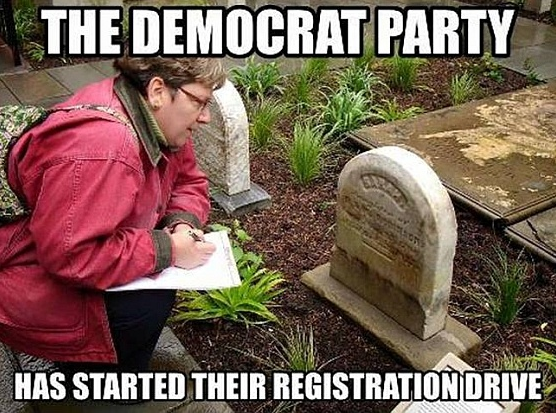
Hundreds of thousands of voters will be purged from the voter rolls ahead of the 2026 elections. Assistant AG Harmeet Dhillon and the Department of Justice discovered that over 260,000 dead people are registered to vote, along with thousands of noncitizens.
“We’ve checked 47.5 million voter records. We found 260,000 plus dead people enrolled in the states’ voter rolls, which is pretty concerning,” Dhillon stated. “There are several thousand non-citizens who are enrolled to vote in federal elections. This is very concerning. And the DOJ is partnering with local law enforcement where appropriate to prosecute people who have unlawfully voted in our elections.”
States hold their own voter registrations and can select not to audit their rolls. The federal government recently sued North Carolina for access to their voting records and plans to expand the search nationwide ,as not everyone is willing to comply. The federal government currently has 14 pending lawsuits against states that do not want fair elections. They’re refusing to provide their records, even though many of these states voluntarily provide their voter rolls to nonprofit groups,” Dhillon continued.
Who is voting on behalf of the dead? Only 19 individuals have been charged in the past decade with casting a vote on behalf of a dead relative but it is unlikely that only 19 people have committed such an act when hundreds of thousands of people are enrolled. It begs the question: why are states preventing the federal government from auditing voter registrations?
States refusing to comply declare it a matter of security and privacy. They claim that the federal agencies should not be able to access information that they already possess—Social Security numbers, personal addresses, licenses, and so forth. Voter groups of advocates pushing a very specific agenda believe that the government will prevent certain groups from voting or unfairly purge eligible voters.
Federal law, including the National Voter Registration Act (NVRA), Help America Vote Act (HAVA), and Civil Rights Act of 1960, requires states to maintain accurate voter rolls AND permit the federal government to inspect those rolls. The Democrats running these states are blatantly preventing clean and secure elections while wasting millions in public funds to fight the Trump Administration.
COMMENT: Marty, Thank you for the WEC. I agree with many, it was your best ever. I have re-watched it twice and pick up new things every the time. The contrast of arrays on Europe vs USA confirms sadly that Socrates will be correct and your effort to prevent WWIII will fail. But it does appear that you may succeed in keeping the US out of war here in Europe. I am taking my family out of here. They are introducing a conscription bill here in Germany. Thank you for that. You can smell war is in the air. The press will not tell the truth and there is nothing Putin can do or say that they do not criticize and subconsciously are telling Europeans Russia is weak and can be easily defeated.
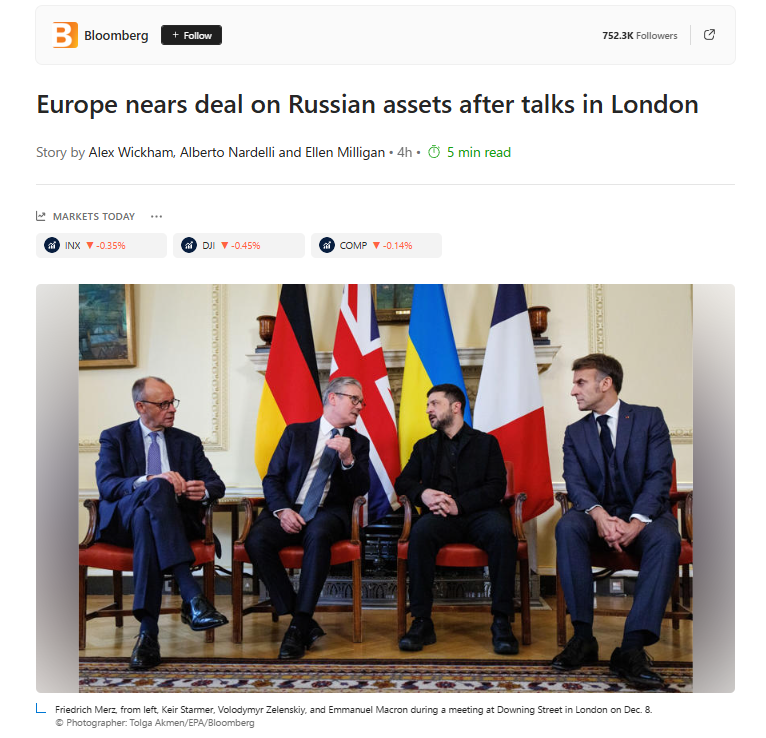
Our European powers have again rallied behind Ukraine on Monday after President Trump blasted Zelensky a day prior, accusing him of not bothering to read the U.S.-proposed peace plan to end the Russia-Ukraine war. British Prime Minister Keir Starmer said: “We stand with Ukraine.” German Chancellor Merz and French President Macron concurred.
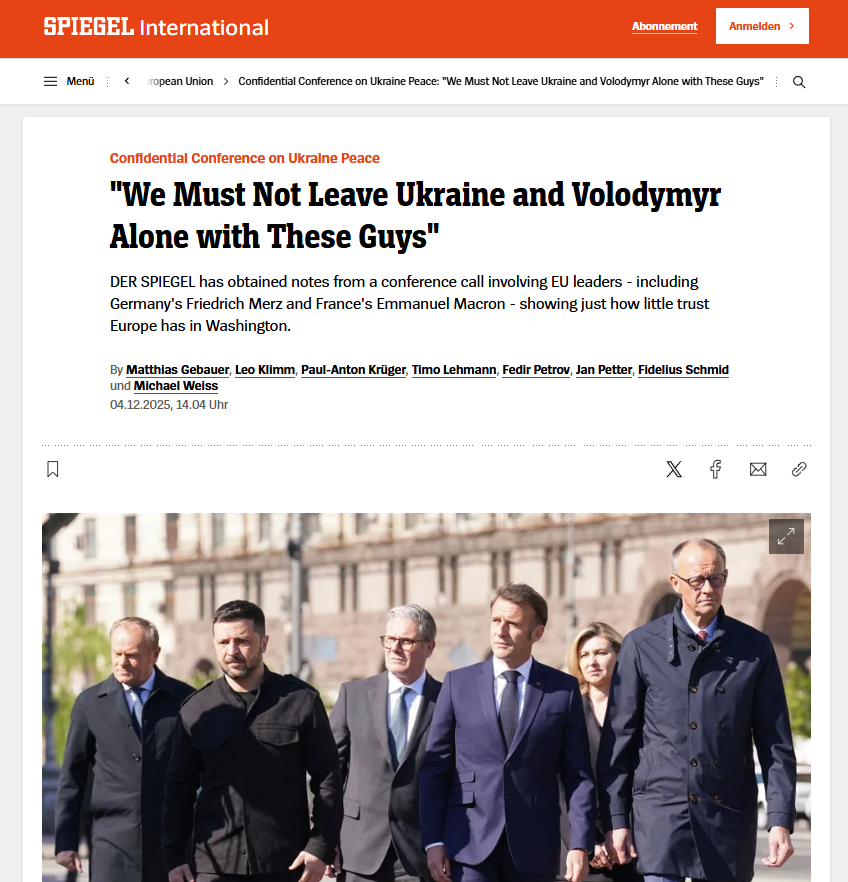
Here in Germany, DER SPIEGEL, German Chancellor Friedrich Merz and French President Emmanuel Macron in a secret call said that the U.S. could betray Ukraine and Europe. I think this is in line with your peace plan and they reject. They did not want to hear Trump say that Europe is erasing its culture with migration and has become irrelevant.
Nobody seems to ask how many Europeans are they willing to sacrifice this time for war? I would have thought Europe would have learned. That clip you had of Merkel and Hollande saying the purpose of creating the EU was to eliminate war seems to only refer to internally. So now they want all of Europe to invade Russia. It never ends. I really do not understand why humanity always loves war.
PVB
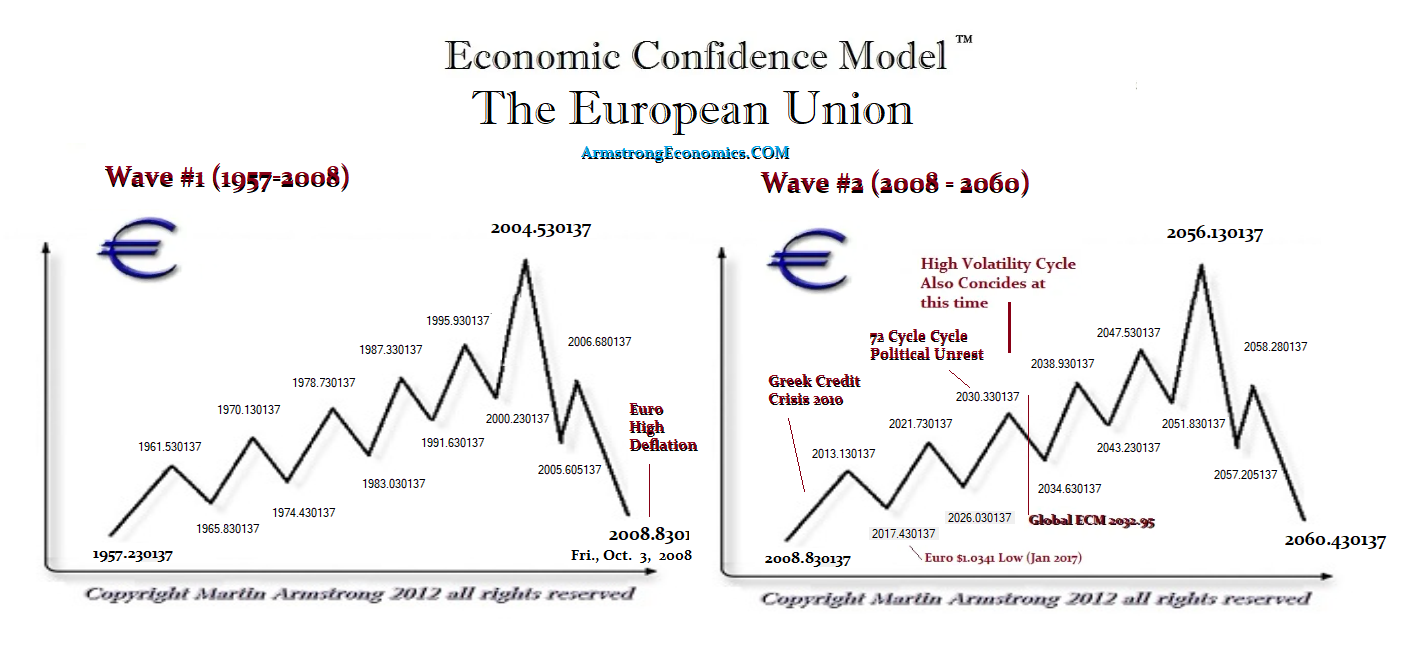
REPLY: We are about to enter the 3rd Wave 2026.03137 (January 11-12, 2026). It is highly questionable if the EU will survive beyond 2030.330137. Europe will never accept peace because these leaders are broke and they are robbing Russians in front of the entire world.
Up to 80% of the “Russian Assets” that have been seized, belong to Russian individuals – not the state. On the private-side: reporting in 2023 estimated that private Russian property subject to freeze in the EU (yachts, villas, private accounts, corporate holdings, etc.) amounted to about US $58 billion. But the foreign reserves that were seized are not purely state assets. The central bank was holding foreign accounts of all various Russian companies and individuals doing business with the West. This is a violation of International Law and the EU does not give a shit because the European Press is so anti-Russia that they will never report the truth.
As of early 2025, Swiss authorities reported that around 7.4 billion Swiss francs (≈ US $8.4 billion) in Russian-owned assets had been frozen. That includes assets linked to individuals / companies subject to sanctions (real estate, luxury goods, etc.) as well as holdings tied to the Russian Central Bank. Under Swiss law, outright confiscation of legally acquired private assets of Russians — simply because they are Russian — was deemed unconstitutional (as of 2023) by the Swiss Federal Council (not a “court”) on February 15th, 2023 accepted the conclusion of a working group from the Federal Office of Justice (FOJ) that confiscation of frozen private Russian assets would be unconstitutional under Swiss law and violate the legal order.
The lies that the EU are using is lets say you have money on deposite in a bank, that bank then places reserves at the central bank, the EU seizes all the assets of the Russian central bank and pretend they are the assets of the state. They are clearly showing that the EU cannot be trusted and any non-European client with funds in the EU shoi;d get the funds out of there before you will never see them again. One prominent case involved Mikhail Fridman, a Russian oligarch. In April 2024, a court within the EU system (the General Court of the European Union) ruled there was insufficient evidence to keep him on the sanctions list. That effectively challenged the freeze on his assets under EU sanctions — at least insofar as the justification for listing him was concerned. Following that, Fridman initiated further legal action: he sued a national government (of Luxembourg) over damages arising from his asset freeze, and has also launched arbitration under international investment-treaty rules.
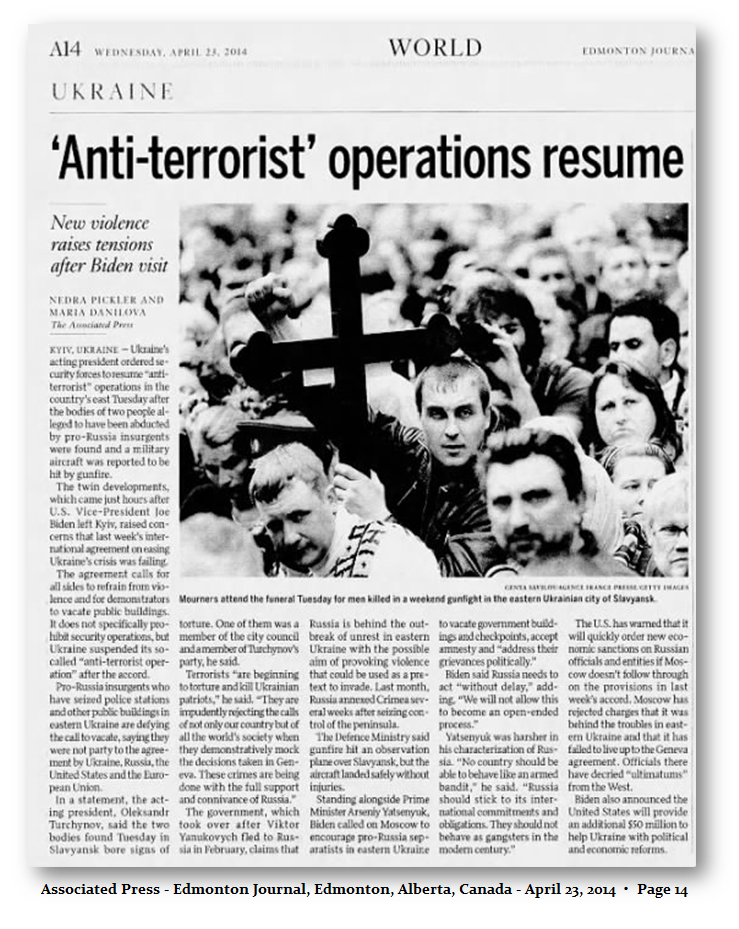
The EU has violated international law and has ignored the fact that the Ukrainian Civil War was instigated by Ukrainians in Kiev and classified everyone in the Donbas as a Terrorist. Putin even requested that they rescind that terrorist classification to justify attacking the ethic Russians in Crimea and the Donbas.
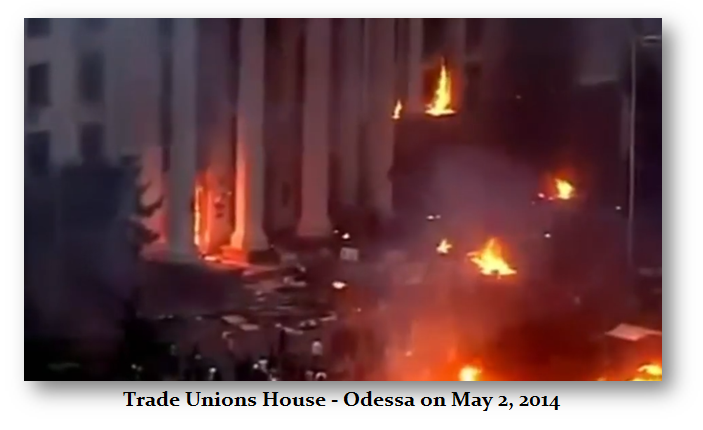
Only after the Ukrainians were openly killing Russians on the streets of Odessa and burned them alive did the Donbas declare its independence for which Kiev then declared them to be terrorists. The West wanted this war with Russia and the press refuses to report the truth cheering on World War III with every story they write. Our computer warns this will be the end of European civilization.
Billions are vanishing and these politicians speak nothing about the corruption in Ukraine which makes one wonder what they are making on the sidelines? Public reporting on exactly which European companies have active contracts to supply weapons to Ukraine is often partial, aggregated, or confidential to protect politicians. Many supply-contracts are mediated via governments, export licences, or procurement coalitions. The fact that these politicians NEVER criticize Zelensky for the corruption is telling implying they have their hand in this cookie jar.
Even when companies are known, shareholding data of individual EU politicians (members of parliaments, governments, etc.) is typically very opaque, rarely if ever disclosed in a way that connects them to defense-industry shareholdings — meaning publicly documented cases are very limited. That said, some European companies known to supply Ukraine (or facilitate supplies), there is little or no verifiable public evidence that EU-politicians are significant shareholders in them.
Czechoslovak Group (CSG) defense conglomerate has explicitly supplied Ukraine. According to publicly available data, in 2022 roughly 41% of its revenue came from deliveries to Ukraine; in 2023 it was around 23%. Its exports include 155 mm and 152 mm artillery rounds, T-72 “Avenger” tanks, BMP-1/2 infantry fighting vehicles, multiple-launch rocket systems (e.g. RM-70 Vampire, BM-21 MT STRIGA), self-propelled howitzers (DANA M2, DITA), among others.
Then there is Rheinmetall (Germany). Again, I found no public breakdown showing “Rheinmetall → Ukraine” under a named contract. Yet, Rheinmetall is widely regarded as one of the major European defense manufacturers benefiting from the surge in European military spending tied to the war. Its business boom is strongly correlated with increased demand for ammunition, armored vehicles, and other military equipment in response to the war.
Smaller or mid-sized European firms are also on the take. The number of smaller or midsize European ammunition / defense-component firms are in supply chains that now support Ukraine or NATO rearmament. For instance, a 2025 academic study on European ammunition & grenade manufacturing outlines structural shifts in supply-chains, partly driven by demand related to Ukraine as reported in the Scandinavian Journal of Military Studies.
In addition, institutional decisions within the European Union have reinforced these flows of money for arming Ukraine. As of early 2025, Defense News analysis estimates that about 60% of total aid is used in the U.S., about 25% is spent in Ukraine, and the remaining ≈15% elsewhere. In November 2025, EU lawmakers voted to deepen integration between the EU defense industry and Ukraine — under a programme allocating €1.5 billion, including €300 million for a “Ukraine Support Instrument.” That suggests EU-based defense contractors (like CSG, Rheinmetall, and others) are likely beneficiaries without and disclosure if any politicians are personally benefiting like Pelosi in the United States.
Despite substantial arms business, I found virtually no credible, publicly verifiable cases where an EU politician is documented as a shareholder — or major shareholder — in a company supplying Ukraine. This is simply being covered up. Shareholding disclosures for many European politicians do not always require them to declare holdings in privately held or non-public companies (especially defense firms). They made sure the laws they write always exonerate themselves.
Even when holdings are declared, they rarely specify the scale, affiliated subsidiaries, or whether the company has defense contracts — so linking a politician to “arms supply to Ukraine” becomes nearly impossible. I have found NOBODY in the press who has even bothered to produce any well-documented examples of a sitting EU politician with material shareholding in a firm known to supply Ukraine. WHY? Curiously, a 2025 Scandinavian Journal of Military Studies on ammunition supply-chains mentions “companies and inter-institutional relationships,” but does not document any politician ownership.
Many defense firms are privately held or structured via holding companies / trusts, which makes public shareholding disclosures harder to trace. There are no political transparency rules worth anything and they vary significantly across EU member states. Some require only limited disclosure; in others politicians may hold stakes indirectly (via holdings, blind trusts, family businesses, pension funds), complicating public traceability.
What we do know is certain, is that contract arms pipelines typically involve governments, intermediaries, export licences, not direct commercial sales — meaning “company X supplies Ukraine” may not appear in public procurement lists even if equipment ends up on the battlefield.
The combination of opacity (in shareholding) and indirect contract pipelines means that even well-informed public investigations may miss such connections because this is kept very behind the curtain. When these politicians constantly advocate war, if they are making a fortune on supplying Ukraine and sending people to their deaths, it seems nobody is willing to even open the door and ask a question when European War is now becoming inevitable.
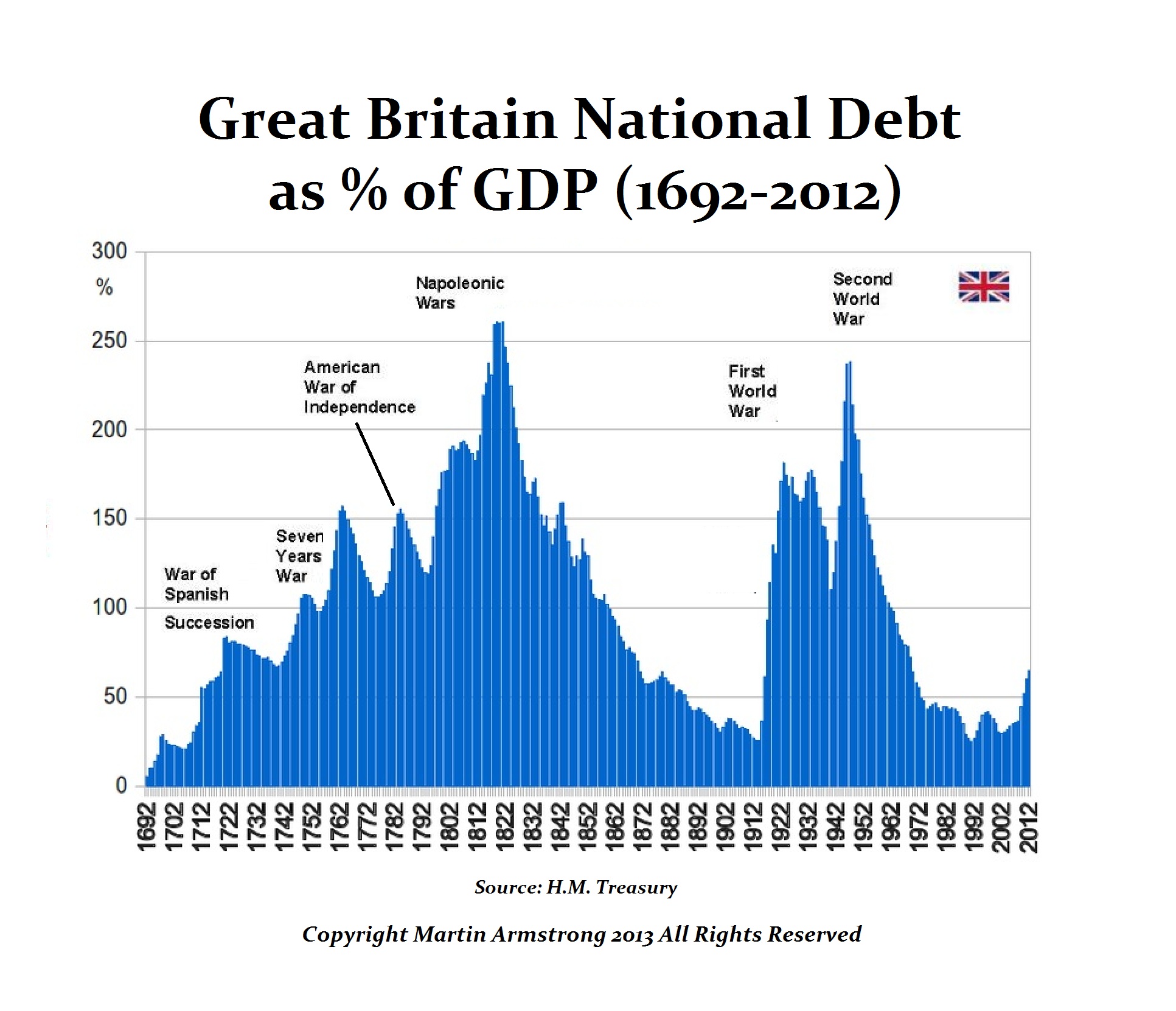
The United States became the financial capital of the world after Britain entered World War I with no direct threat against the British people. Britain’s official declaration of war on August 4th, 1914, was primarily in response to Germany’s violation of Belgian neutrality. However, the reasons were more deeply rooted. Britain was not threatened. It claimed that the Belgian Neutrality Treaty (1839) was violated because Germany’s Schlieffen Plan required invading France through neutral Belgium. Britain was a guarantor (along with other powers) of Belgian neutrality under the 1839 Treaty of London. Ignoring this violation, Britain claimed it would call into question their credibility as a treaty guarantor and great power. That decision ended London as the financial capital of the world and it moved to New York.
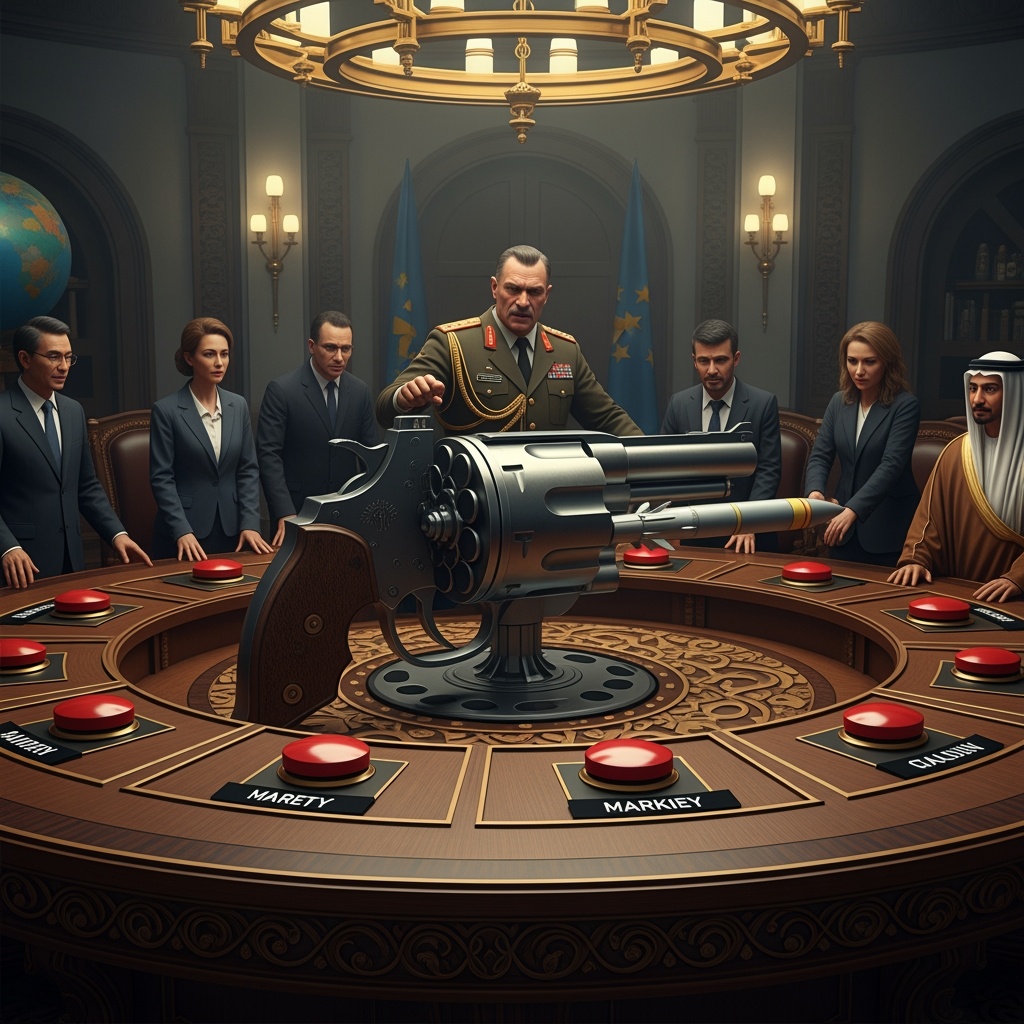
I have been fighting hard behind the curtain to keep the US out of this next European War to conquer Russia. They will lose. They are playing Russian Roulette with Nuclear Weapons. NATO claims Russia will never push the button because they know what that would mean. But since the EU is NOT trying to force Russia out of Ukraine, this is about the conquest of Russia. If I was Putin and I know the objective is to totally destroy Russia, I would push the button.
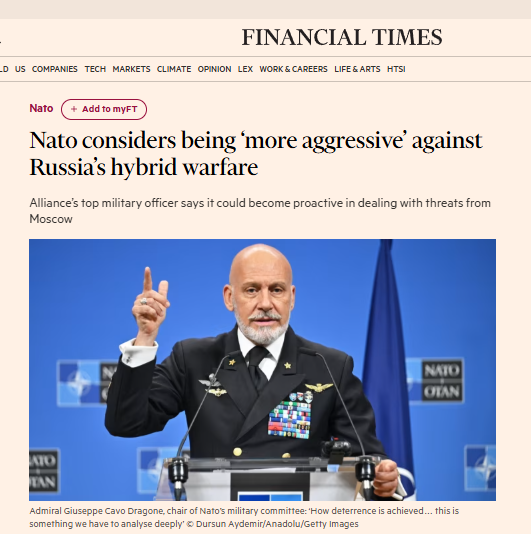
Admiral Giuseppe Cavo Dragone, chair of NATO’s Military Committee, has recently suggested that a “pre-emptive strike” against Russia could, under certain circumstances, be justified as a form of defensive action. He argued that NATO needs to shift from being purely reactive (responding after attacks) to possibly “being more aggressive or proactive instead of reactive.” He acknowledged that considering “pre-emptive strikes” would depart from NATO’s traditional posture — but that under the pressure of ongoing “hybrid warfare” (cyber-attacks, sabotage, airspace violations, etc.), such options are being studied. He specifically said that in certain contexts a pre-emptive strike “could be considered a defensive action.”
This is what I have warned about. There are NO RATIONAL people in NATO. What he is justifying is I walk into a bar and punch you in the face calling it self-defense because if KNOW you really wanted to hit me first. If we strip away the Ukrainian BS and propaganda, reliable sources in Ukraine confirm that Russia has used hypersonic missiles and Ukraine claim that they have been able to intercept them 25% of the time is nonsense. They must launch all 32 missiles of a Patriot Missile System to even have a possible chance at interception. As with everything Ukraine puts out, there is hardly anything that can be verifiable. They are more concerned about pretending that they are successful to keep the money flowing in for their Lamborghinis and Ferraris in Monaco. Europe is not going to hold up very well in a conflict with Russia – it is suicide.
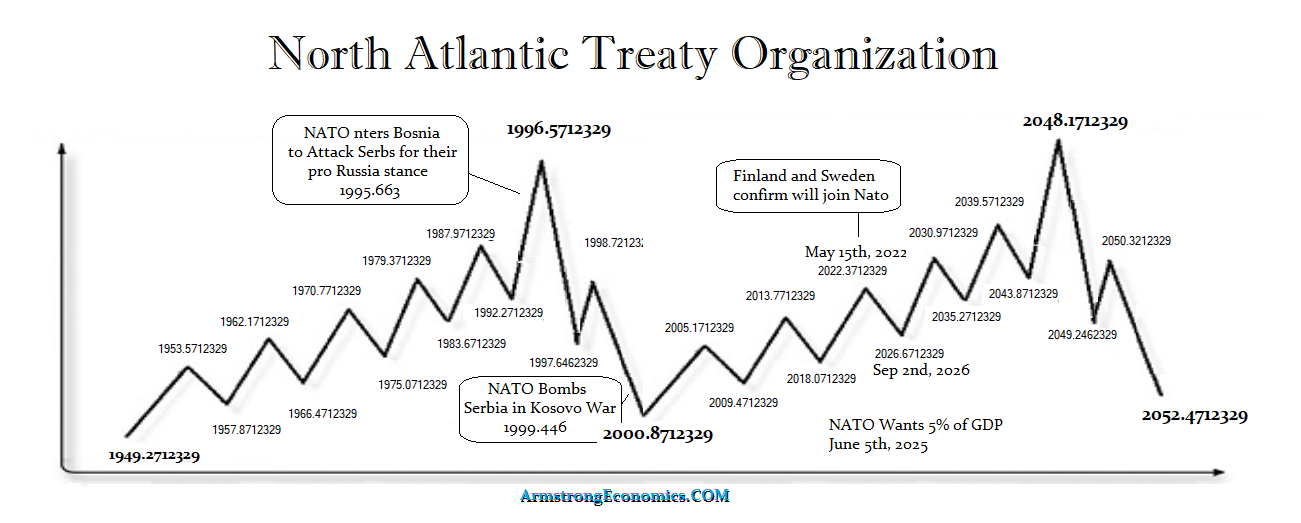
I cannot take credit for turning Trump. Perhaps I have contributed, but I have no confirmation. His new strategy warns Europe faces “the real and more stark prospect of civilizational erasure.” It also asserts that if present-day trends continue with immigration, demographic shifts, low birth rates, cultural/political changes, and suppression of free speech or democratic norms, “the continent will be unrecognizable in 20 years or less.” Yes, this is what our model is forecasting. The EU may not exist post 2030. Trump’s strategy also says some NATO members “will become majority non-European,” and that raises “open questions” about whether they will see their alliance with the U.S. the same way as original members. We are completing the 3rd wave by September 2nd, 2026. Here too, NATO and the Neocon began to implement this war with Russia in 2021 which was 72 years from its founding in 1949. NATO is in its death throes between 2026 and 2030.
Humanity’s gravitation toward war is a deeply complex phenomenon with roots in multiple overlapping domains—psychological, social, economic, political, and evolutionary. Rather than a single cause, it’s better understood as a tragic interplay of many factors. People who are drawn to positions of power involving conflict are deeply entrenched in tribalism. Humans evolved in groups that competed for resources. This fostered strong in-group/out-group dynamics, where loyalty to one’s group and suspicion or hostility toward outsiders could enhance survival. War emerges from such people because of their flawed character. It is amplified group identity—nationalism, ethnicity, religion, or ideology.
The Neocons told President Reagan he should not meet with Gorbachev even though they could not call him a communist, so they reverted to tribalism telling Reagan “you can never trust a Russian.” There is no discussion with these people. I have tried and they have only proven that I was an idealistic fool who though I could make then seek the light instead the darkness they carry with them. They always reject peace and live consumed by their hatred.
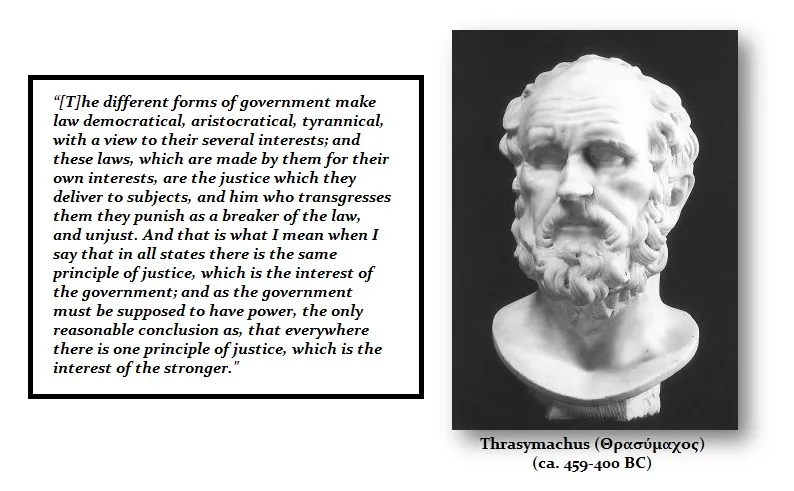
States and rulers have often used war to consolidate power, divert attention from domestic problems, or achieve geopolitical goals. The realist is forced to argue that in a world (no matter what its form Republic, Democracy, Dictatorship, or Monarchy), the thirst for power is the same just as justice is the same regardless of the form of government. Corruption, authoritarianism, lack of democratic checks, and poor governance can make war more likely. Leaders will far too often prioritize personal or regime survival over peace as we are witnessing in Europe rigt now. Historically, empires expanded through warfare, driven by economic exploitation and ideological beliefs in supremacy. The legacy of arbitrary borders and exploited grievances continues to fuel conflicts. Right now, European leaders are being driven by economic necessity to retain power, but simultaneously, they are blinded by ideological beliefs in supremacy that they can displace the United States and rise from the ashes this time from war.
Posted originally on Dec 8, 2025 by Martin Armstrong |
European Central Bank President Christine Lagarde steps in every time a government attempts to implement monetary policy. The centralized power now has the final say, sorry, but sovereignty is not an option for European Union members. Italy proposed declaring gold an asset of the people, but Lagarde has found a way to prevent that from happening.
Prime Minister Giorgia Meloni’s ruling coalition stated that the Bank of Italy’s 2,452 metric tons of gold reserves, estimated to be worth $300 billion, is the property of the people. Senator Lucio Malan of Fratelli d’Italia asserted that gold held by the central bank belongs to the people during the 2026 budget review. “Not even the Bank of Italy can act unilaterally with the gold,” Senator Malan said in an interview, adding that the purpose is “to safeguard the gold reserves from future misuse.”
Now, the fact that this proposal even arose is a sign that the government is desperate. Italy knows it is under fiscal stress and people are losing faith in fiat currency. The government wants to control those gold reserves to hedge against itself. If Italy succeeds in re-writing control over gold reserves, it sets a precedent across the eurozone that gold could be its way to bail out budgets. “For the people” equates to “for the social welfare system,” as politicians could then say they need to liquidate reserves to pay for services that will be provided to the people.
“The Italian authorities are invited to reconsider the draft provision, also with a view to preserving the independent performance of the basic ESCB-related tasks of the Banca d’Italia under the Treaty,” the ECB said in a formal statement. Gold reserves are to be managed by national central banks, and the ECB believes there is no “concrete purpose” for transferring legal ownership. “The Bank of Italy is no different from any other national central bank,” Lagarde said. “This is not a trivial issue, because Italy is the third largest holder of gold among the central banks.”
That gold belongs to the bureaucrats in Brussels, or at least, that is the line of thinking among the ECB. Europe is due for a panic cycle in 2026 and 2032. Centralized government will be the catalyst for the European Union failing. The sovereign debt crisis is unavoidable at this point. Europe wants war as an excuse to default without the people turning on their own governments. Gold will rise as a store of value because the underlying confidence in the monetary system and government is failing. The ECB wants to protect itself, as do individual member nations who now realize they are unable to shield themselves from the collective of Brussels as everyone must perish on this sinking ship.
Posted originally on Dec 8, 2025 by Martin Armstrong |
The United Kingdom has eroded all citizens’ individual rights. No one is safe, even if they are thousands of miles away. Around 33 people are arrested each day for voicing opinions or engaging in legal actions that the government does not approve of. In 2023, authorities arrested over 12,000 people across England and Wales, citing the Communications Act and the Malicious Communications Act.
Arrests have increased and surpassed national borders. A man from Yorkshire was on holiday in Florida, participating in a favorite state pastime of marksmanship. He posted a picture of himself holding a rifle on social media, which should be perfectly legal. The rifle was lawfully owned and he was on private land. Nevertheless, the image was reported to the authorities, who descended on his home in the middle of the night. He spent the night in jail and later appeared at Bradford Magistrate Court where he faced up to six months imprisonment.
“‘I have not been able to sleep, I’ve lived in fear of a knock at my door for the last three months. I haven’t spoken to my neighbours for four months. It has damaged my ability to run my business,” the man told reporters. “I thought 1984 was a book, not an instruction manual.”
“1984” has been an instruction manual for the UK and other governments who are carefully monitoring every citizen, waiting for a misstep. Cameras are absolutely everywhere; it is only a matter of time before they start using drones to monitor citizens as they did in the book.
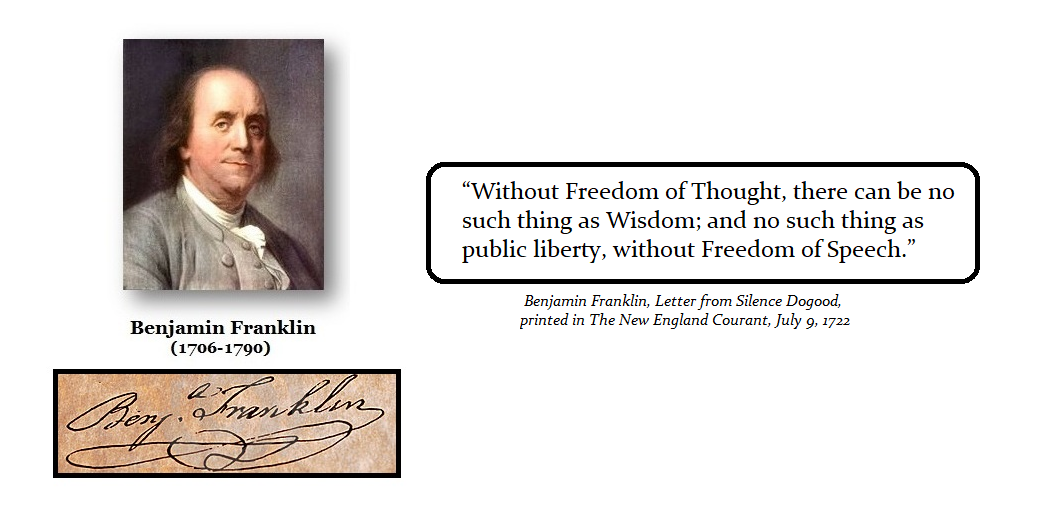
I have warned for decades that political systems enter decline when confidence shifts from government to the people. The crackdown on protests, censorship of dissenting views, and judicial overreach are the classic signs of a government losing legitimacy. The government insists it is “protecting” the public, when in reality, these measures are an attempt to maintain control over a population that sees government as the problem.
Thought control is merely the beginning. We are looking at Western governments implementing capital controls and restricting the freedom of movement.
The British people are experiencing what history has illustrated time and time again. Tyranny does not appear suddenly. Rather, it creeps into daily life until the people finally say “enough.” Until then, the ruling class will continue to believe they can legislate obedience, silence opposition, and cling to a system already in decline.
Posted originally on Dec 8, 2025 by Martin Armstrong |
Inflation in the US is on the rise, as indicated by the Personal Consumption Expenditures price index that rose 0.3% in September. Inflation now sits at 2.8%, above the Fed’s target, while unemployment continues to rise. This is the data the Federal Open Market Committee will review when it meets for the last time in 2025.
Gasoline prices spiked 4.1% in September, the leading cause of the overall rise in headline CPI. Shelter costs are continuing to rise, up 0.2% on a monthly basis. Housing alone has contributed 1.7 percentage points to CPI. Housing combined with health care created two-thirds of the annual increase in inflation. Naturally, this is an area of concern—these are the basic necessities for existence.
Grocery prices have not waned, with food at home rising to 2.7% in September. The overall food index is at 3.1%–notable annual rises include meats/poultry/fish/eggs (+5.2%) and nonalcoholic beverages (+5.3%); cereals/bakery (+1.6%), fruits/vegetables (+1.3%), and dairy (+0.7%).
Looking at employment, nonfarm payrolls rose by 119,000 in September, surpassing market expectations. Unemployment now stands at 4.4%, up 0.1% from the month prior, at the highest level since October 2021. The Labor Department revised job figures for July and August to show a decrease of 33,000 positions. We’ve seen a number of corporations impose mass layoffs this year. The data is skewed from the government shutdown. The Bureau of Labor Statistics said it will not bother to publish the full October jobs report.
The data is never accurate; the agency is bypassing October and admittedly overreporting numbers in the summer. I do not see much reassurance from the September jobs report.
Posted originally on Dec 8, 2025 by Martin Armstrong |
President Trump released the 2025 National Security Strategy (NSS) of the US, released by the White House on December 4th, 2025, marks a potentially profound shift in US foreign policy. He has criticized Europe and insisted on ending the perception and preventing the reality, of NATO as a perpetually expanding alliance. This 33-page document specifically embraces an ‘America First’ doctrine, rejecting global hegemony and ideological Neocon crusades that are always in favor of war and world dominance. The Neocons constantly claim Putin wants to invade Europe so we have to expand NATO to their border to prevent him from doing so as if Russia was still communist from the old cold war days.
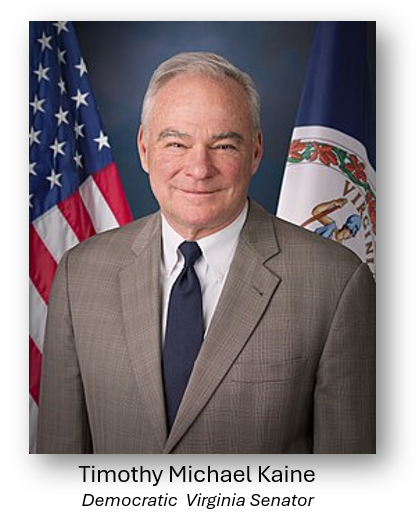
Trump is shifting the focus to a more pragmatic, transactional realism focused on protecting core national interests rather than Neocon desire to conquer the world. In 2023, Sens. Tim Kaine (D-Va.) and Marco Rubio (R-Fla.), two dangerous Neocons, authored legislation requiring that any presidential decision to exit NATO must have either two-thirds Senate approval or be authorized through an act of Congress. These Neocons pushed this legislation and the got it to pass stuffed in the fiscal 2024 National Defense Authorization Act, which President Joe Biden signed into law probably with an autopen fed into the machine by Antony Blinken or Victoria Nuland.
I would argue that Trump can sidestep these Neocons citing presidential authority over foreign policy. Congress can try, but the Constitution does not clearly give Congress the power to force a president to remain in a treaty such as NATO. This is one of the biggest unresolved constitutional gaps in U.S. foreign-relations law. Article II gives the president power to make treaties with the advice and consent of the Senate (two-thirds vote). It says nothing about who has the power to terminate treaties.
Presidents Have Terminated Treaties Unilaterally
If we look at history and precedent, presidents of both parties have withdrawn from treaties without prior congressional approval, including:
1854 – Franklin Pierce withdrew from the U.S.–Swiss treaty
1899 – McKinley ended parts of the U.S.–China treaty
1979 – Carter unilaterally withdrew from the U.S.–Taiwan defense treaty
2002 – George W. Bush exited the ABM Treaty
2020 – Donald Trump withdrew from the Open Skies Treaty
Congress never successfully blocked any of these actions. Consequently, this long-standing practice builds a strong historical precedent (though not formally adjudicated). Therefore, this Neocon act introduced by Tim Kaine and Marco Rubio, which in their mind would send everyone else’s children to die for their personal hatred and glory, is by no means “airtight,” and would expose the bloodthirsty Neocons for what they really are since this law sets up a direct constitutional conflict with Congress if a president does try to withdraw as I have recommended.
Our American children are at risk just as they were coming home in body-bags from Vietnam when President Johnson lied to the American people admitted we were never attacked and Robert McNamara who admitted before he died that they were wrong and thought Russia was involved confirming they were not and it was “just a civil war.” I just had a meeting with a vet from the Iraq War who lost his leg all for another lie – weapons of mass destruction that never existed.
These Neocons are consumed with power and hatred and that is a lethal combination. They have usurped US foreign policy for personal glory and hatred. This has been a strategic coup by unelected Neocons who have created endless wars for personal vendettas. Approximately 35% of the current publicly held U.S. national debt can be attributed to the direct costs of past wars and the interest accrued on that borrowed war spending. The average American is paying for the Neocon warmongering with higher mortgage rates because this war expenditure continually expands and will never be paid off. These Neocons have undermined the living standards of the people all for their personal hatreds and glory to rule the world.
Trump should declare he was pulling out of NATO; I would force Congress into a legal position and launch an investigation of any Senator or Representative to ensure that they are not profiting in any way from the war expenditures they are advocating.
The Supreme Court has generally held that institutional conflicts between the branches are political questions best resolved through the political process rather than through judicial intervention. But we are dealing with Neocons here who have engaged in a covert coup of American foreign policy, which to me is treason. Perhaps we need Treason Trials like Roman Emperors Tiberius and Caligula to get our country back from the brink.
In court, you have to have what is called “standing” to bring a case. I cannot bring a case against you for not paying your child’s college bills. Only your child would have “standing” to bring the action provided you did not guarantee the college. Here, the only party with standing would be Congress itself, but it is not clear that the Republicans in Congress would support such a suit. If they did, they you know who should be hauled out of Capital Hill in chains.
It would take Congress which has the strongest standing to sue over a presidential withdrawal from NATO. Perhaps you could argue Americans who own property in NATO countries might be able to claim standing. This type of claim is less certain.
Even if the Supreme Court took up the case, it’s not clear who would win because the constitutional question is murky. Congress has never mounted a direct legal challenge to a president withdrawing from a treaty. Article II gives the president power to make treaties with the consent of Congress but it does NOT give the power to Congress to even negotiate a treaty.
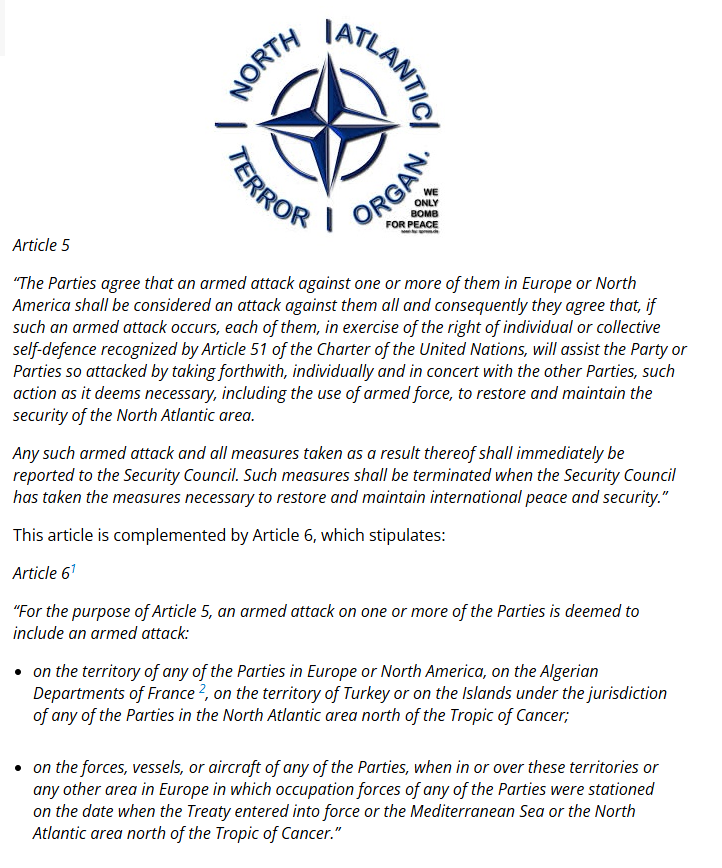
Article 5 under the NATO treaty is fundamentally voluntary in its implementation. This is a critical and often misunderstood point. The Wording of Article 5 Itself states:
“…each of them will assist the Party or Parties so attacked by taking forthwith, individually and in concert with the other Parties, such action as it deems necessary, including the use of armed force…”
The crucial phrase is “such action as it deems necessary.” This grants each member nation the sovereign right to decide what form its assistance will take. There is no prescribed, automatic obligation to declare war or deploy troops. Rubio thinks that it would not be voluntary and has no problem sleeping a night knowing your son or daughter will die for his personal hatred. All my friend from high school who died for Vietnam all for lies. As McNamara said, it was just a civil war and that is Ukraine which we instigated thanks to Victoria Nuland, John. McCain, and Antony Blinken.
Meanwhile, Trump can also undermine NATO without formally leaving, even if he chooses not to follow my recommendation and get out. He could refuse U.S. support by withholding ambassadors or keeping troops from participating in military exercises. While several lawmakers in February called for new legislative measures to guard against these risks, nothing serious has materialized since. Again, any lawmaker who sells out our country for war should be removed from any government position whatsoever.
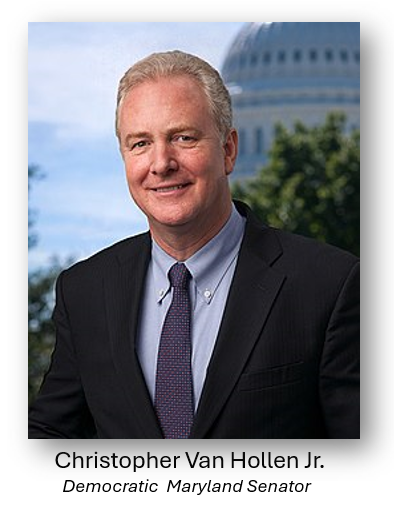
“Following Trump’s threats in his first term, the Congress — recognizing the vital importance of NATO — acted on a bipartisan basis to prevent any future presidents from unilaterally withdrawing,” Sen. Chris Van Hollen (D-Md.), a member of the Senate Foreign Relations Committee, said in a statement. He is another Neocon. NATO is not important to America. “While Trump may resort to his old tricks, we’ll continue working to shore up NATO and stand ready to fight back against any attempts to undermine the strength of this alliance.”
Kaine, one of the authors of the NATO guardrail, slammed Trump’s rhetoric on the alliance and argued the U.S. “is safest when we link arms with our allies.” He is an idiot that peace is NEVER achieved with force. He also said: “Donald Trump’s disparaging comments about NATO are disturbing, and my hope is that the legislation we passed will ensure the United States continues to participate in this crucial alliance.”
We should stand aside, let Europe destroy itself for the third time, and then pick up the pieces but no Marshall Plan this time. I would promote legislation that prohibits any legislator from voting for war unless they have a family member that are willing to hand a gun and say here, go kill a bunch a people. They have no problem sending other people’s children to war while exempting their own.
October 13, 1960
The Third Kennedy-Nixon Presidential Debate
It has been the Neocon agenda or having bases everywhere that has undermined the economy in the face of constant US overreach as a failure that weakened America. President Kennedy said that in his campaign debate with Nixon in 1960. It was the building of basdes everywhere that increased the dollars and that brought down Bretton Woods and the gold standard all for the Neocon agenda. Kennedy’s remarks set off a gold panic in 1960 as people feared the US would contract and no longer fund the defense of Europe. Kennedy said:
“The difficulty, of course, is that we do have heavy obligations abroad, that we therefore have to maintain not only a favorable balance of trade but also send a good deal of our dollars overseas to pay our troops, maintain our bases, and sustain other economies.”
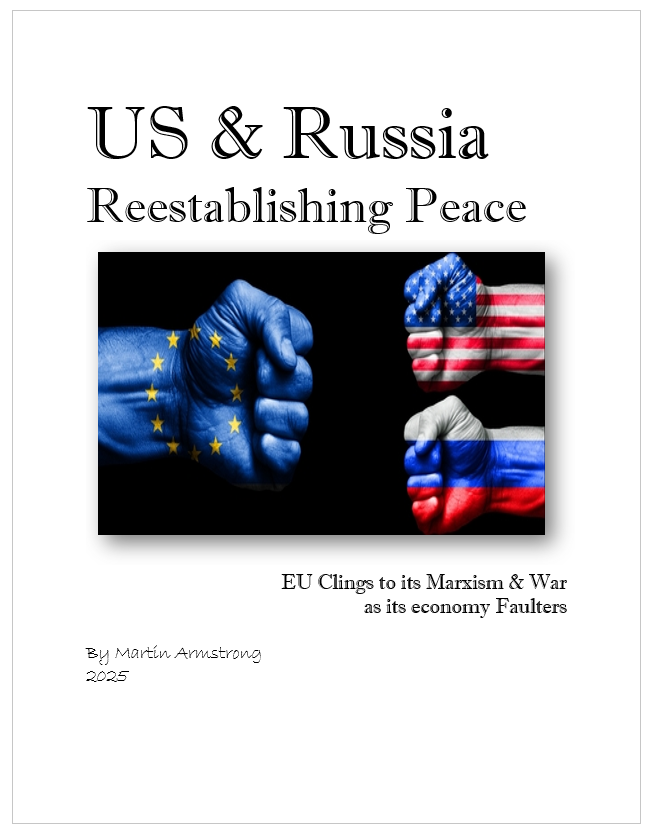
I laid out in the peace proposal that the real enemy would be the EU – not Russia. That has proven to be correct. There was even a secret meeting where Macron and Merz instructed Zelensky no peace. There is way too much money at stake in addition to all the billions flowing into the pockets of Ukrainian and EU politicians, no peace means the EU gets to keep the over $300 billion in Euroclear. If you actually look closely, you will see that the EU has violated international law for about 80% of that money belongs to private Russians, not state assets. This is all about keeping American sending billions with no accountability that EU lawmakers get their shares.
Any American legislator who votes to keep sending money to Ukraine and NATO should reveal all net wealth personally and their family including second degree. War is the MOST profitable war to enter office broke, and leave a multi-millionaire. Trump’s approach is all about ushering in a “new golden age” for the United States, which the Democrats keep trying to prevent simply because it is Trump – not that the policies are good, bad, or indifferent. Politics is no longer about the country or the people, it is to embarrass the opponent regardless of the issue just to win.
Trump’s 33-page document organizes US strategy around three pillars: Homeland defense, the Western Hemisphere, and economic renewal. Secondary focuses include selective partnerships in Asia, Europe, the Middle East, and Africa.
Here are the major shifts in strategy compared to the previous strategies of not just Biden/Neocons, but also Trump’s first term:
From global cop to regional hegemon: Unlike Biden’s 2022 NSS (which emphasized alliances and great-power competition) or Trump’s 2017 version (which named China and Russia as revisionists), this document ends America’s “forever burdens” abroad. It prioritizes the Americas over Eurasia, framing Europe and the Middle East as deprioritized theaters.
Ideological retreat: Democracy promotion is explicitly abandoned – “we seek peaceful commercial relations without imposing democratic change” (tell that to the Venezuelans). Authoritarians are not judged, and the EU is called “anti-democratic.”
Confrontational ally relations: Europe faces scathing criticism for migration, free speech curbs, and risks of “civilizational erasure” (e.g., demographic shifts making nations “unrecognizable in 20 years”). The US vows to support the “patriotic” European parties resisting this, drawing Kremlin-like rhetoric accusations from EU leaders.
China policy: Acknowledges failed engagement; seeks “mutually advantageous” ties but with deterrence (e.g., Taiwan as a priority). No full decoupling, but restrictions on tech/dependencies.
Multipolar acceptance: Invites regional powers to manage their spheres (e.g., Japan in East Asia, Arab-Israeli bloc in the Gulf), signaling US restraint to avoid direct confrontations.
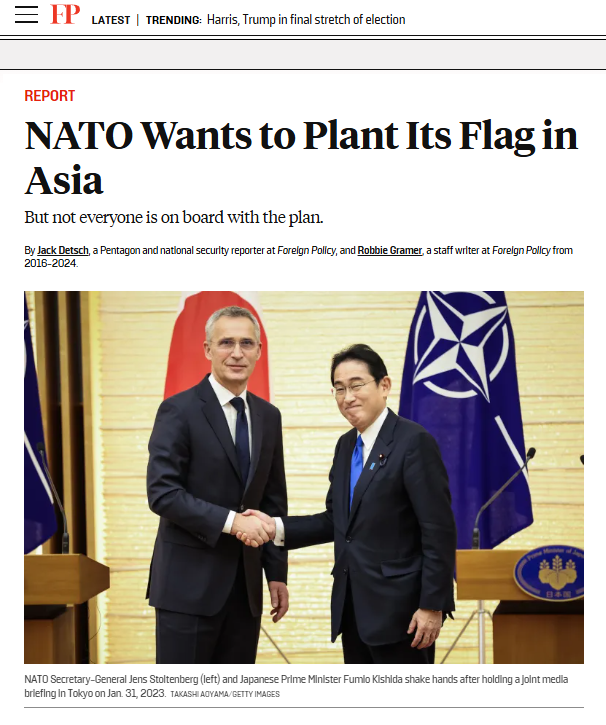
We are looking at a seismic shift in America’s approach to NATO. As I have said, NATO should be shut down for its sole purpose in like a Mafia protection racket. It is not there to promote peace, it keeps getting money only by constantly claiming that Russia wants to conquer Europe. It has even tried to expand into Asia to create war with China agains to keep its money flowing in endlessly. NATO is a ruthless retirement home for Neocons.
Trump has put normalizing relations with Russia among ‘core interests’ where the days of empire building are over. I have explained that only the Roman Empire achieved peace because people realized it was more beneficial to be inside the Empire with free trade than on the outside looking in. Sanction have NEVER worked even once. Neocons have constantly sought to wage economic war under the theory that will bring down their hated opponent.
The US MUST abandon Ukraine!!!!! It is far too corrupt and ONLY when the billions stop flowing into the pockets of the elite Ukrainians will this war ever come to an end. The propaganda of the NATO and the EU to keep this corruption and money flowing has been to instill fear in Europeans to convince them that Russia as an existential threat. Managing European relations with Russia will require significant US diplomatic engagement. The EU is not prepared for peace because it needs that $300 billion just to stay alive until 2027 at best.
December 2025 is a Double Directional Change and then by February we have a Panic Cycle. From January on, the dire economic conditio0n within the EU will continue to force their had to push for war with Russia and they will most likely stage a false flag.
I have created this site to help people have fun in the kitchen. I write about enjoying life both in and out of my kitchen. Life is short! Make the most of it and enjoy!
This is a library of News Events not reported by the Main Stream Media documenting & connecting the dots on How the Obama Marxist Liberal agenda is destroying America














 Subscribe to alerts for each new postEmail *



 Centinel2012