California’s Congresswoman Maxine Waters Calls for Trump Impeachment Because Putin Invaded Korea?


The long list of reasons Maxine Waters says Trump should be impeached simply reflect why she is totally incapable of being anyone’s representative in Congress. She said Putin supplied the bombs for Aleppo that killed children. First of all, that took place under Obama before the election, and it is plainly documented that it was the USA supplying arms to al-Qaida and the Obama Administration tried to distance itself when mass graves were discovered where the rebels were killing numerous people with US supplied arms. How can you impeach Trump for something that took place before the election? The mass graves were discovered December 26th, 2016.

Then, Waters says Trump should be impeached because Russia hacked the DNC and exposed all the lies the Democrats were fostering. Obama himself said Russia did not hack the voting machines. Obama  plainly said“We stand behind our election results, which accurately reflect the will of the American people.” Assuming Russia did the hacking of the DNC, no Democrat ever said all the emails exposing the lies were false. The hack simply showed the truth. If the Democrats keep talking about Russia hacking the DNC enough without admitting there was no hack of voting machines, they hope to make people think Russia actually changed the vote.

But the most insane part is she then said Trump should be impeached because Putin invaded Korea. Sorry, Putin did not invade Korea and if he did, the West would probably cheer if it was the North. She is just totally incompetent to serve in Congress. You cannot impeach a president for something he may have done prior to office. She confuses her timelines and obviously has no sense of geography. This is the quality of people California sends to Washington along with Dianne Feinstein and Nancy Pelosi.
ECB under Pressure to Reverse Direction


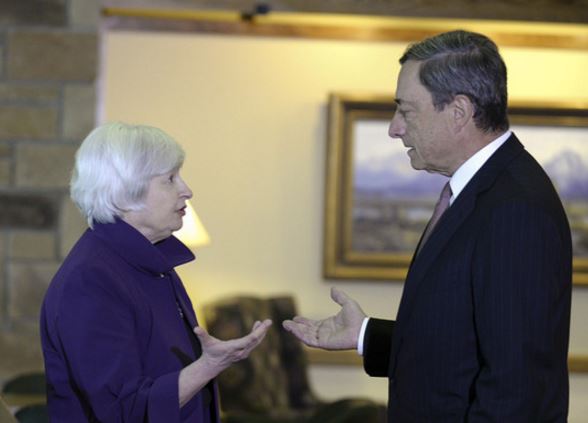
yellen-draghi

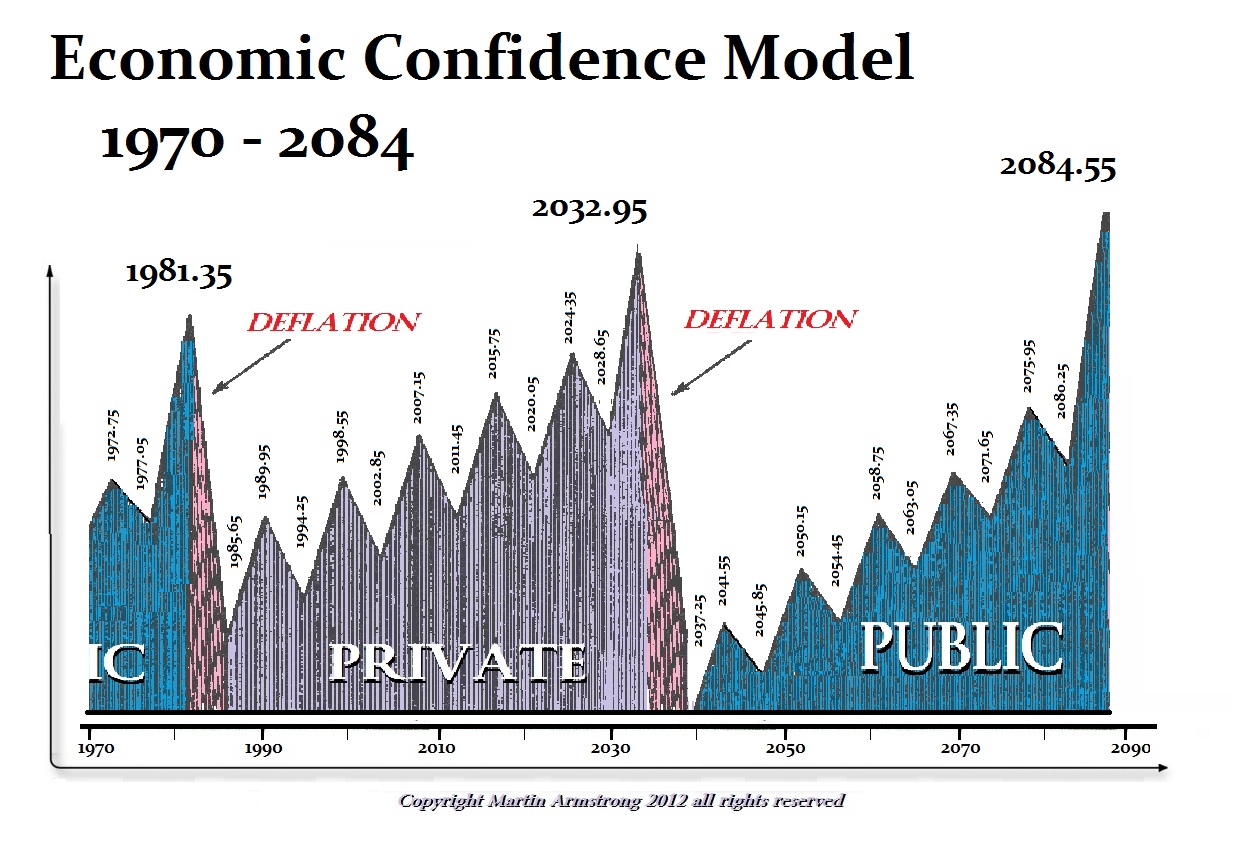
The European Central Bank (ECB) is coming under fresh pressure to increase interest rates, not merely from the standpoint that the Federal Reserve has been doing since the turn in our Economic Confidence Model 2015.75, when the first rate hike took place in December 2015. While there was little immediate reaction to the Fed’s decision to raise rates once again, Mario Draghi is struggling to explain his failed policy of negative rates that have utterly failed to reverse the downward pressure in the economy of Europe since 2008.

russia-capital-flows-10-13-2016


Euro outflows 2016

The latest data coming from the ECB and Eurostat is causing Draghi sleepless nights and cold sweats. Non-euro area investors have been net sellers of Eurozone debt securities in 2016 for the first time since the introduction of the euro. The total net outflows of investment capital from the Eurozone debt securities amounted to €192 billion in 2016, up from €30 billion in purchases during 2015. Once the ECM turned October 1st, 2015 (2015.75), indeed everything in global capital flows shifted right on time.

ECM-1970-2084

The bulk of the net sales have been government debt securities totaling €116 billion. Our model, on the other hand, has been forecasting the shift away from government debt to private sector assets. The latest data from Eurostat confirms that that forecast was also correct. The non-euro area investors remained net purchasers of only Eurozone equities, but that did decline by about 50% to from €268 billion in 2015 to €126 billion in 2016.

The Real Reason Governments are Blaming Youtube for Terrorism 


Governments do not and never had appreciated “Free” Speech; and our founders knew that and its why we have the 1st and 2nd amendments.

WW III Is Near as Russia Is Militarizing Rockets to Take Out US Satellites Leaving Amerca Defenseless 


It’s obvious to anyone with military training that in today’s world, if there was a war, the wind would be the one that dominated in space. Take out your opponents satellites and GPS and you are finished.

The Plight of Mall REITs Linked to Poor Retail Market


From Crush the Street, by Joshua Enomoto

It’s one of the great contradictions of the real economy. Despite soaring job growth and surprisingly robust sentiment, the retail market continues to underperform. Even more bizarre, U.S. consumer sentiment hit multi-year record highs recently. In fact, this confidence barometer has been on the rise since 2008. If so many people are that enthused about the economy, why don’t retailers and the retail market have anything to show for it?First off, a large spike occurred in the inflation expectation index between December of last year through the end of February. That would suggest that consumers are buying products “in bulk” to avoid what they anticipate is a rise in prices. It’s not such a far-fetched idea. Ever since the Great Recession when so many families’ savings were gutted, a cynical and survivalist mentality may have proliferated. The retail market would receive a temporary boost, but over the long-term, the trend would not last.In fact, that’s exactly what we’re seeing. The last three months registered strong nominal sales for several retailers. The problem is that the total revenue is being split and allocated towards different sectors like e-commerce — these are competitive channels that simply didn’t exist 20 years ago.

Major retailers now have to compete on two fronts — the online world, and the traditional brick-and-mortars. The former is growing by leaps and bounds at the expense of the latter. Because of this dramatic shift in consumer shopping behavior, multiple companies are forced to close their doors. Why have them open and incur steep overhead costs when you can make better sales online?

retail market, mall REITs

From a business perspective, it makes perfect sense. But as more companies wake up to this trend, the retail market risks fracturing. That’s because when the big shops close for good, they eliminate the foot traffic that was once there. This siphoning inevitably spells trouble for already embattled retail real estate investment trusts, or REITs.

Mall REITs control the vast properties occupied by major shopping centers and strip malls. For decades, business was good. Anybody that wanted anything in the pre-internet era had to go to a retail establishment, and retailers were willing to pay top dollar for prime real estate. Mall REITs were making money hand over fist.

But all that changed with e-commerce. Physical location no longer carried the magnitude of advantage it once did. As consumers began buying discretionary items through their computers, the brick-and-mortars fell below their break-even point. When they closed, they took the cash flow of mall REITs with them.

The initial closures were the mom-and-pops. But when the majors started collapsing, mall REITs suddenly found themselves in a sea of red ink. And that’s exactly why so many publicly-traded variants have fallen underwater. There’s no one to pick up the slack. Worse yet, in the retail market, nobody wants to.

Shell’s New Permian Play Profitable At $20 A Barrel


Tyler Durden's picture

Authored by Rakesh Upadhyay via OilPrice.com,

OPEC’s worries about the booming U.S. oil production have increased significantly with the big three oil companies’ interest in shale. Exxon Mobil Corp., Royal Dutch Shell Plc, and Chevron Corp., are planning $10 billion of investments in shale in 2017, a quantum jump compared to previous years. All the naysayers who doubted the longevity of the shale oil industry may have to modify their forecasts.

OPEC lost when they pumped at will as lower oil prices destroyed their finances, and now they are losing their hard-earned market share as a result of cutting production. Shell’s declaration that they can “make money in the Permian with oil at $40 a barrel, with new wells profitable at about $20 a barrel” is an indication that Shell is here to stay, whatever the price of oil.

The arrival of the big three oil companies with their loaded balance sheets is good news for the longevity of the shale industry.

The oil crash, which started in 2014, pushed more than 100 shale oil companies into bankruptcy, causing default on at least $70 billion of debt, according to The Economist. Even the ones that survived haven’t been very profitable, according to Bloomberg, which said that the top 60 listed E&P firms have “burned up cash for 34 of the last 40 quarters”.

Therefore, during the downturn, the smaller players had to slow down their operations, but this will not be the case with the big three.

“Big Oil is cash-flow positive, so they can take a longer-term view,’’ said Bryan Sheffield, the billionaire third-generation oilman who heads Parsley Energy Inc. “You’re going to see them investing more in shale,” reports Bloomberg.

The majors are attempting to further improve the economics of operation. Shell said that its cost per well has been reduced to $5.5 million, a 60 percent drop from 2013. Instead of drilling a single well per pad, which was the norm, Shell is now drilling five wells per pad, 20 feet apart, which saves money previously spent on moving rigs from site to site.

Shell is not the only one—Chevron expects its shale production to increase 30% every year for the next decade. Similarly, Exxon plans to allocate one-third of its drilling budget this year to shale, and it expects to quadruple its shale output by 2025.  

“The arrival of Big Oil is very significant for shale,” said Deborah Byers, U.S. energy leader at consultant Ernst & Young in Houston. “It marries a great geological resource with a very strong balance sheet.”

$30 billion has been spent on land acquisitions in the Permian basin since mid-2016, which is a favorite among oil companies.

Considering the new projects and the resurgent shale boom, Goldman Sachs expects oil output to increase by 1 million barrels a day year-on-year. The outcome is an oversupply in the next couple of years.

“2017-19 is likely to see the largest increase in mega projects’ production in history, as the record 2011-13 capex commitment yields fruit,” the U.S. investment bank said in a research note on Tuesday, reports Reuters.

The U.S. Energy Information Administration expects the U.S. oil production to top 10 million barrels by December 2018, a level only surpassed in October and November 1970.

OPEC is running out of options.

Modern Day Snake Oil – Is 2% Growth As Good As It Gets?


Tyler Durden's picture

Authored by Mike Shedlock via MishTalk.com,

There have been 11 recessions and 11 recoveries since 1949.

The current recovery is the slowest recovery since 1949 and closing in on the becoming longest.

Growth since the 2nd quarter of 2009 is a mere 2.1%. The Wall Street Journal asks Is Two Percent as Good as It Gets?

“The growth seen during the recovery might, for a while, be as good as it gets,” the Federal Reserve Bank of San Francisco’s John Fernald, Stanford University’s Robert Hall, Harvard University’s James Stock, and Princeton University’s Mark Watson said in a study to be presented among Brookings Papers on Economic Activity.

Inquiring minds may wish to download the Brookings’ report entitled Disappointing Recovery of Output After 2009 but I found it a waste of time.

Okun’s Law 

The report was mostly mathematical gibberish based on Okun’s Law.

Okun’s law (named after Arthur Melvin Okun, who proposed the relationship in 1962) is an empirically observed relationship between unemployment and losses in a country’s production. The “gap version” states that for every 1% increase in the unemployment rate, a country’s GDP will be roughly an additional 2% lower than its potential GDP. The “difference version” describes the relationship between quarterly changes in unemployment and quarterly changes in real GDP. The stability and usefulness of the law has been disputed.

Clearly, Okun’s Law is at least as useless as any widely believed economic law, which is to say totally useless.

The supporting paper consists of 90 pages of largely unintelligible garbage such as the following.

Commendable Effort

The Wall Street Journal managed to condense 90 pages of nonsense down to 2 pages of nonsense. That’s a highly commendable effort, and the best one could reasonably expect.

Here’s the conclusion: “The causes aren’t entirely clear.”

I searched the 90-page report for the worddebt“. Care to guess the number of hits? I bet you can: zero.

Modern Day Snake Oil

I was discussing economic indicators with Pater Tenebrarum at the Acting Man Blog a couple of days ago. He pinged me with the correct takeaway.

Economic forecasting is not a science, and it is actually not the task of economic science to make forecasts (contrary to what is commonly asserted). Forecasting is akin to the task of the historian. Mises called speculators “historians of the future”.

Economic laws only play a role insofar as they can be used as constraints for a forecast. The problem is that all these models simply look at the data of economic history, at statistical series that always turn tail “unexpectedly”, driven by human action.

All these mathematical models are complete humbug. It is modern-day snake oil.

Still, it’s pretty clear that the market cares nothing for top-down or bottom-up forecasts of economic activity…

Dollar Collapse Continues – Over 80% Of Post-Trump Gains Gone


Tyler Durden's picture

When the dollar was soaring, it was ‘unequivocally’ a reflection of the strength (or potential strength) of the US economy and its safe-haven, cleanest-dirty-short status. Since The Fed hiked rates for the 3rd time in 11 years, however, the dollar has done nothing but decline

Erasing over 80% of post-Trump gains…

The Dollar Index has also plunged back to a 98 handle…

Tax Revolt in Belarus Turning to Mass Arrests


Belarus Protest March 2017

Belarus president Alexander LukashenkoFor weeks now, thousands of people have gone public in Belarus to protest against a special tax for “little workers” and demanded the resignation of Aleksandr Grigoryevich Lukashenko who has been the autocratic President of Belarus, in office since July 20th, 1994. Lukashenko had issued a decree that people who work less than six months a year have to pay a tax of 189 euros. This was to prevent “social parasitism”, which he explained was the justification. In view of the protests, he temporarily suspended the decree, but the crisis is getting worse.

Lukashenko is seen by many as really a dictator. His police arrests those who were going to speak at the protest and they stormed the human rights office arresting people there in advance. The instability building in Belarus is really serious. Additionally, Lukashenko has lashed out at Russia and accused Moscow of violating their 20-year old border agreement, in a escalating dispute that has become a source of tension with his country’s neighbor and strongest ally. It appears that we will see the collapse of the current government by 2020.

Russia and Belarus share a border under a 1996 deal that set up a commonwealth known as the Union State. However, in February 2017, Russia set-up checkpoints at crossings into Belarus in response to Mr Lukashenko’s decision to introduce five-day visa waivers for citizens of 79 countries, including the US and EU member states. This has provoked tensions with Russia which is concerned that Belarus will move towards the west.

Everywhere we look around the global, tensions are building in conflicts both domestic and international. This is on schedule for building in intensity going into the peak of the next wave of the Economic Confidence Model hitting in 2022-2023. We must keep this in mind relative to markets moving forward.

NATO Troops moved from Germany to Poland on Weekend


Vilseck-Orzysz

Soldiers were moved on the weekend from the garrison at Vilseck and were restationed at Orzysz in Poland close to the border with Belarus. This was a NATO unit consisting of units from the USA, Great Britain and Romania. With tensions building between Belarus and Russia, this particular troop reassignment is interesting to say the least.