Teamsters Local 707 Goes Bankrupt


Teamsters

The Pension Crisis on the horizon is far worse than anyone can imagine. This is the final straw that will break the back of socialism the same as communism fell. Pensions are in a state of crisis for they lost money in stock in the 2007-2009 crash and then sold the bottom shifting to government bonds and then interest rates plummeted when they needed 8% to survive. The management skills have been nonexistent for the propaganda has always been that government bonds present no risk when in fact they are UNSECURED DEBT and the riskiest of all investments long-term.

2017 CountdownYellow Roadway company is one example of how things have changed. The company was allowed to skip its pension contributions for 18 months. When the company restarted paying again, it was at 25% of the previous rate. The Pension Fund for local 707 began to implode, with roughly 700 workers paying into a fund supporting more than 4,000 retirees. Local 707’s fund pays out $48 million a year — and takes in $7.5 million in contributions. Those who have been contributing will get nothing at all for the contributions. The whole thing is a house of cards that caves in.

We wrote in the Pension Report: “As we approach 2017, everything you once thought was secure for your future will unravel.” Indeed, the Sovereign Debt Crisis and the Pension Crisis start to surface here in 2017.

The Obama-Boehner Debt Crisis


Boehner-Obama

The debt deal struck by President Barack Obama and the then House Speaker John Boehner back in October 2015, was done purposefully to ensure that the debt crisis would not unfold under Obama and the Democrats.  John Boehner never saw a government role of red tape he never cherished.  The debt deal was absurd that the $20 trillion mark for the US debt ceiling as of March 15, 2017 would become permanent. Sure, on the one hand this could lead to a severe budgetary crisis this summer if the Democrats try to use this to discredit Trump since the media will blame Trump and not Obama.

The March 15, 2017 (Ides of March) date will be used by the media to try to stop Trump tax cuts. As always, politicians put-off whatever they can to keep hiding the truth to create fake reality and the press chimes in. This date marks the end of the debt deferral scheme struck by Obama and Boehner. When this delay expires, the deficit limit is supposed to be frozen at $20 trillion. It then becomes a law AND SOME PEOPLE ARE ALREADY TOUTING THE END OF THE WORLD. Of course, without reform and debt restructure, this cannot become reality. A rise in interest rates alone will increase the servicing and blow-through the debt ceiling. So expect a lot of yelling and incrimination – but at the end of the day, they will still have to raise the debt ceiling – AGAIN! Welcome to 2017!

SovDebtCycle-86-R

Yes, this debt crisis is right on time with our forecast made decades ago. Of course, the politicians will be faced with the collapse of socialism. Where will the money come from to keep all of these programs going? The Democrats will call for a massive tax increase as if that will produce something different than a Great Depression as Europe has inflicted upon the Greeks. Honestly, politicians should NEVER be allowed to play with spending. They cannot manage anything and their self-interest of pretending to do a job while lining their own pockets should be a criminal act.

Everything could come to a halt and the Democrats will then try to blame the Republicans. This is how government works – always create a crisis and blame the other party. Obamacare is falling apart as more and more insurers bailout, costs skyrocket, and Social Security goes off the cliff. The Democrats will try desperately to prevent tax reductions for they are closet communists because they want to control your assets with a backdoor where the multinational corps can pay for exceptions. The deficit limit must then be further increased, but oddly enough, Trump is probably the best person to deal with a debt crisis. Trump will at least understand the debt and has previous spoke about restructuring the debt.

All this chaos can reach havoc proportions in the debt markets, but the stock market can be the biggest benefactor for parking money when bonds are not a wise choice. Obama pushed the biggest tax increases for Obamacare off into 2017 to prejudice the next president. Last September I wrote: “Come 2017, we are likely to see Obamacare also collapse.”  Obama has done a tremendous amount of damage as did Boehner. They created the Veteran Health Crisis not paying to take care of the troops and instead gave them a suicide crisis hotline to call rather than healthcare. The lethal combination of backroom dealing has left Trump with little room for action unless he makes a real reform. Just watch how even the press will not attribute everything to Trump.

Trump inherits a pre-programmed time-bomb and Obama has organized protests to try to make sure Trump is blamed for everything Washington created since World War II. The Democrats want to prevent Trump from lowering taxes on companies and citizens, build walls and add border guards to stop the drug trade and increase security authorities because of terrorism. Trump vowed to do more for the veterans when the Democrats cut everything they could in the VA and military. Then there is Trump’s plan to cut off funds to intervening in the world and spend that money home on an infrastructure program.

So as the National Debt is reaching $19,979 trillion, debt has more than 160% since 2000. Under Obama, there was a massive expansion of new debts on the order of nearly $10 trillion dollars taking advantage of cheap interest rates. Obama increased the debt more than the past 43 US presidents combined in nominal terms. Nevertheless, the USA has the only economy that is viable in the West. The American banking system is not shaking as is the case in Europe.

The US economy is holding up the world for about 70% of the US economic output is generated by domestic consumption. If the American consumer stops, Europe and Asia collapse in overall economic growth. So the debt crisis looming on the horizon depends entirely up how bad the Democrats and the press try to spin this to hurt Trump, but they will shoot themselves in the foot. This time, the mainstream media will more likely than not create a serious economic decline in public confidence by trying to pin all the blame on Trump. On top of all this, Moody’s downgraded 24 governments during just the first half of 2016. The rating agencies will downgrade the USA now only because Trump is in office and they do whatever the establishment tells them to do.

NY Teamsters Pension Becomes First To Run Out Of Money As Expert Warns “Pension Tsunami” Is Coming


Tyler Durden's picture

The New York Teamsters Road Carriers Local 707 Pension Fund has won the unfortunate award for “First Pension to Officially Run Out of Money.”  According to the New York Daily News, and a host of angry former truck drivers who’ve had their pension benefits slashed, the Pension Benefit Guaranty Corp. (PBGC) has officially been forced to step in and take over payments to retirees of the Local 707, albeit at a much lower rate.

Teamsters Local 707’s pension fund is the first to officially bottom out financially — which happened this month.

“I had a union job for 30 years,” Chmil said. “We had collectively bargained contracts that promised us a pension. I paid into it with every paycheck. Everyone told us, ‘Don’t worry, you have a union job, your pension is guaranteed.’ Well, so much for that.”

“It’s a nightmare, it has just devastated all of our lives. I’ve gone from having $48,000 a year to less than half that,” said Chmil, one of five Local 707 retirees who agreed to share their stories with the Daily News last week.

“I don’t want other people to have to go through this. We need everyone to wake up and do something; that’s why we’re talking,” said Ray Narvaez.

Of course, the Teamsters 707 and other Teamster pension boards attempted to submit plans that would have cut benefits in order to prolong payments to retirees but those plans were universally rejected by the Obama administration…better that the pensions just run out of cash completely.  Per Pensions & Investments:

The Obama administration is in denial about the necessity of cutting pension benefits under the Multiemployer Pension Reform Act of 2014 to try to put distressed multiemployer plans on sounder financial footings and make them more sustainable. It must face reality and order the Treasury Department to stop blocking action.

So far the department, required under the act to approve proposed reductions, has rejected proposals by the Teamsters Central States, Southeast & Southwest Areas Pension Plan and the Road Carriers Local 707 Pension Fund.

Ten plans total have applied for cuts, including the New York State Teamsters Conference Pension and Retirement Fund, Syracuse, whose Aug. 31 application is too new to be listed on the Treasury’s website.

The Road Carriers 707 application stated that the plan projects it will become insolvent in February — only about five months away — absent suspension of benefits.

As desperate as the plan’s financial situation appears to be, the Treasury denied the application.

And while the Local 707 pension was the first to dry up, it certainly won’t be the last…

Also on the brink of drying up are the pensions for two Teamster locals — 641 and 560 — in New Jersey, union officials said. Plus 35,000 Teamster members upstate who are part of the money-hemorrhaging New York State Teamsters Pension Fund.

Bigger than all of New York’s Teamster locals combined is the Central States Pension Fund — another looming financial disaster that could leave 407,000 retirees without pensions across the Midwest and South.

Teamster


Meanwhile, under the maximum benefits provided by the PBGC, many former Teamsters, like Ray Narvaez, said their monthly retirement checks have been slashed by two-thirds.

Then Narvaez, like 4,000 other retired Teamster truckers, got a letter from Local 707 in February of last year.

It said monthly pensions had to be slashed by more than a third. It was an emergency move to try to keep the dying fund solvent. That dropped Narvaez from nearly $3,500 to about $2,000.

“They said they were running out of money, that there could be no more in the pension fund, so we had to take the cut,” said Narvaez, whose wife was recently diagnosed with cancer.

The stopgap measure didn’t work — and after years of dangling over the precipice, Local 707’s pension fund fell off the financial cliff this month. With no money left, it turned to Pension Benefit Guaranty Corp., a government insurance company that covers pension.

Pension Benefit Guaranty Corp. picked up Local 707’s retiree payouts — but the maximum benefit it gives a year is roughly $12,000, for workers who racked up at least 30 years. For those with less time on the job, the payouts are smaller.

Narvaez now gets $1,170 a month — before taxes.

Of course, as the Central States Pension General Counsel notes, the real “pension tsunami” will come when the massive “municipal and state plans go down next.”

The same crisis now hitting Local 707 has been stewing among numerous Teamster locals around the country for the past decade, he said, and that includes in upstate New York.

The trucking industry — almost uniformly organized by Teamsters — has suffered enormous financial losses in its pension and welfare funds due to a crippling combination of deregulation and stock market crashes, Nyhan said.

“This is a quiet crisis, but it’s very real. There are currently 200 other plans on track for insolvency — that’s going to affect anywhere from 1.5 to 2 million people,” said Nyhan. “The prognosis is bleak minus some new legislative help.”

And it’s not just private-sector industries that are suffering, he added.

“Municipal and state plans are the next to go down — that’s a pension tsunami that’s coming,” he said. “In many states, those defined benefit plans are seriously underfunded — and at the end of the day, math trumps the statutes.”

We’re looking at you Illinoi

US Economy Grew 1.9% In Q4, Unexpectedly Missing Expectations Despite Stronger Consumer Spending


Tyler Durden's picture

Following a series of better than expected GDP-feeding prints, consensus had expected Q4 GDP to tick higher in the first revision released today, rising from 1.9% to 2.1%. However, that did not happen and instead, the revised print came in unchanged at 1.9%. Notable underlying revisions include: an upward revision in consumer spending, both in services and goods; a downward revision to business investment, mostly in intellectual property products and equipment; and a downward revision to state and local government spending, primarily in structures.

Despite the headline miss, the revised data showed a solid rebound in Personal Consumption Expenditures, which rose 3.0%, higher than the 2.6% expected; furthermore, printing at 2.05% annualized, Consumption alone was higher than the overall GDP of 1.86%.

The reason for the miss was a decline in Fixed Investment which slid from 0.67% to 0.51% as initial CapEx reads appear to have been weaker than expected, coupled with a negative revision to both Private Inventories, down from 1.00% to 0.94% and the contribution from Government, which subtracted another 0.15% point.


Net trade remained flat, and was the biggest detractor from Q4 growth, taking away some 1.7% as the Q3 surge of exports to China was offset.

Of note: PCE prices failed to hit the expected 2.2% increase in the quarter, rising 1.9%, after increasing 1.5% in Q3, thus giving the Fed some more breathing room before hiking. Additionally, core PCE rose 1.2%, after rising 1.7% in the prior quarter, suggesting to Janet Yellen there is still some price slack, and the possibility of a rate hike may be more remote.

For the year 2016, real GDP increased 1.6% , compared with 2.6% in 2015. The increase in real GDP in 2016 reflected increases in consumer spending, residential investment, state and local government spending, exports, and federal government spending. These contributions were partly offset by declines in private inventory investment and business investment. Imports increased.

Q1 GDP At Risk As Trade Deficit Balloons Near 9 Year Highs


Tyler Durden's picture

On the heels of a disappointing revised Q4 GDP print, the US trade balance for January printed a $69.2 billion deficit. This is the second largest deficit since August 2008 (slightly smaller than the March 2015 plunge) as the dollar surge has not helped.

The biggest driver the deficit increase was  4.8% MoM increase in Consumer Goods (notably Auto exports rose 9.3%)

The $69.2bn deficit is considerably worse than the $66.0 billion expectations, and is lower than the lowest analyst expectation.

Certainly not a good sign for Q1 GDP expectations.

As BofAML notes, combining trade data with inventories for January, this slices 0.2pp from Q1 GDP tracking, leaving us at 1.8% for the quarter.

The USD strength has not helped…


So time for another rate hike to reverse that recent drop in the USD and stymie the US economy even more via its trade d

China CIPS v Western SWIFT System


Dollar-Yuan-Transfer

COMMENT: Marty; Some people are trying to claim that China in bypassing the Swift System, they are undermining the dollar. The latest absurd statement is that Japan will bypass the dollar and SWIFT System to transact using China’s CIPS system in inter-bank settlement. I really had to laugh at how ignorant this statement is for it would mean Japan will no longer sell anything in the USA. It seems that these people so desperate to kill the dollar clutch at anything and we just laugh in the trading rooms. I think you should address this statement for the naive people out there who are clueless as to real international trade.

RPD

REPLY: Yes, I agree, You are right. The average person out there may read these headlines that are written by people without a single day of real world experience. They seem to confuse clearing and investment and their analysis is always against the dollar. They try to create a myth that somehow the Yuan will kill the dollar, which is what they said about the Euro. CIPS v SWIFT is about clearing – not investment money and it has no impact about parking money. The The crisis in BitCoin has been created by more that 90% of the volume has been in China as it was being used to get money out of China into dollars. Let’s set the record straight – SWIFT (Society for Worldwide Interbank Financial Telecommunication) is by no means a U.S. dollar exclusive system. Visa International supports approximately 180 transaction currencies, thus enabling the processing of international transactions – NOT exclusively dollars all through the SWIFT system! Twenty-six currencies can be used in the net settlement between Visa International and the participating members, the choice of currency being decided by each member involved in the settlement.

Ever since China began to set up a competition to the Western financial institutions back in 2013, there have been countries in the East dealing with China who have begun to use the CIPS System. That makes perfect sense when you are dealing with China. However, that does not mean that CIPS can compete with the SWIFT System with regard to trade in the West. Japan joining CIPS is by no means to the exclusion of SWIFT.

The SWIFT is an industry-owned limited liability cooperative society set up under Belgian law – not US Law. It is controlled by its member banks (including central banks) and other financial institutions. SWIFT’s business is to supply secure messaging services contributing to greater automation of financial transaction processes and to provide a forum for financial institutions to address issues of common concern in the area of financial communication services.

SWIFT was founded in 1973 by 239 banks from 15 countries. Since then, there has been a steady increase in the number of financial institutions and countries connected to SWIFT. By the end of 2002, more than 7,400 financial institutions from 198 countries were connected. There are three categories of SWIFT users: members (shareholders), sub-members (ie subsidiaries controlled by members) and participants. Members can benefit from all the services offered by SWIFT, whereas participants only have restricted access to a range of services that relates to their business.

SWIFT participants include securities brokers and dealers, investment management institutions, fund administrators, money brokers and various other institutions, mainly from within the securities business. By the end of 2002, SWIFT provided services to 2,203 members, 3,079 sub-members and 2,183 participants. The average daily value of payment messages on SWIFT is estimated to be above €6 trillion. National Bank of Belgium (NBB), which is the central bank of the country in which SWIFT’s headquarters are located, acts as lead overseer of SWIFT, supported by the G10 central banks. The NBB is responsible for the day-to-day oversight relationship with SWIFT – not the Federal Reserve.

Visa International operates through SWIFT and it is a private association owned by 21,000 financial institutions worldwide. It consists of six regional divisions: Asia-Pacific; Canada; Central & Eastern Europe, Middle East & Africa (CEMEA); European Union; Latin America & Caribbean; and United States. Membership is limited to deposit-taking financial institutions and to bank-owned organizations operating in the bank card sector, such as Carte Bleue in France and Servizi Interbancari in Italy. The Visa International Base II system clears transactions and facilitates settlement. Visa International supports approximately 180 transaction currencies, thus enabling the processing of international transactions – NOT exclusively dollars! Members can choose to receive their transaction reports in any of these currencies.

Twenty-six currencies can be used in the net settlement between Visa International and the participating members, the choice of currency being decided by each member involved in the settlement. The necessary foreign exchange operations are executed with two banks, one located in London (Barclays) and one in New York (Citibank).

The attempt by China to set up CIPS to compete with the SWIFT System is political and not purely economic. This idea that Japan and China will not participate in SWIFT is absolutely absurd. That would mean even credit cards would not be valid in the West.

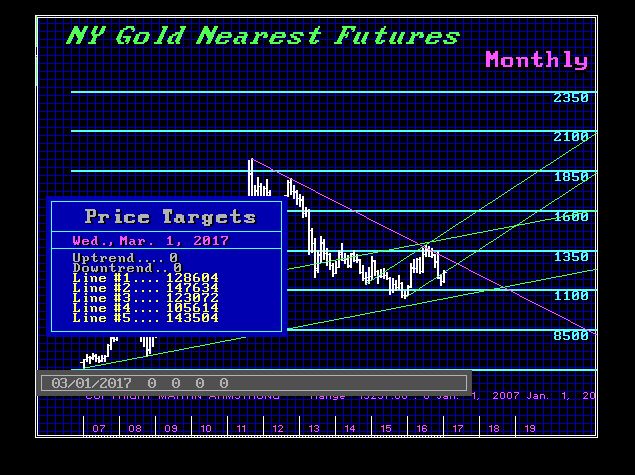
Gold for the Close of February


GCNYNF-M March Targets

QUESTION: Marty, you said towards the end of the bear market in gold, it will start to align with the stock market. Are we approaching that period since this has been gold and stocks both rising opposite of what the goldbugs have been forecasting?

LWR

ANSWER:  Yes. We are running out of time for the downside in gold. This does not say we are breaking out right now. In fact, the next Benchmark was the February 27th, which we published in the 2016 Gold Report. We would need to close February above 1306 to imply that a breakout is unfolding and a closing below 1255 today will still be bearish. Gold is moving into a tight range where technical resistance stands at 1286 area and support at 1230.

The rise in gold is unfolding despite the rise and expected rise in interest rates. Likewise, gold has been rising with the US share market. This is part of the tangible asset rally as capital begins to drift away from public sector debt. A collapse in confidence means ALL tangible assets rise – not just gold.

However, we are still basing. The rally does not yet appear to be sustainable. A closing today below 1255 after trading above that right on the Benchmark day no less, warns that we are preparing to change trend, but it is just not right now. Let’s see the closing for February.

Fukushima residents being forced to move back to radioactive wasteland


If those people don’t want to go back pay them a fair price for their homes and let them move elsewhere. If there is any question about the levels get independent surveys and get it resolved, but don’t force people to move back into a potentially bad situation.

Deep State War? Russian Officials Keep Dying Unexpectedly


Tyler Durden's picture

Six Russian diplomats have died in the last 60 days. As Axios notes, all but one died on foreign soil. Some were shot, while other causes of death are unknown. Note that a few deaths have been labeled “heart attacks” or “brief illnesses.

1. You probably remember Russia’s Ambassador to Turkey, Andrei Karlov — he was assassinated by a police officer at a photo exhibit in Ankara on December 19.

2. On the same day, another diplomat, Peter Polshikov, was shot dead in his Moscow apartment. The gun was found under the bathroom sink but the circumstances of the death were under investigation. Polshikov served as a senior figure in the Latin American department of the Foreign Ministry.

3. Russia’s Ambassador to the United Nations, Vitaly Churkin, died in New York this past week. Churkin was rushed to the hospital from his office at Russia’s UN mission. Initial reports said he suffered a heart attack, and the medical examiner is investigating the death, according to CBS.

4. Russia’s Ambassador to India, Alexander Kadakin, died after a “brief illness January 27, which The Hindu said he had been suffering from for a few weeks.

5. Russian Consul in Athens, Greece, Andrei Malanin, was found dead in his apartment January 9. A Greek police official said there was “no evidence of a break-in.” But Malanin lived on a heavily guarded street. The cause of death needed further investigation, per an AFP report. Malanin served during a time of easing relations between Greece and Russia when Greece was increasingly critiqued by the EU and NATO.

6. Ex-KGB chief Oleg Erovinkin, who was suspected of helping draft the Trump dossier, was found dead in the back of his car December 26, according to The Telegraph. Erovinkin also was an aide to former deputy prime minister Igor Sechin, who now heads up state-owned Rosneft.

If we go back further than 60 days…

7. On the morning of U.S. Election Day, Russian diplomat Sergei Krivov was found unconscious at the Russian Consulate in New York and died on the scene. Initial reports said Krivov fell from the roof and had blunt force injuries, but Russian officials said he died from a heart attack. BuzzFeed reports Krivov may have been a Consular Duty Commander, which would have put him in charge of preventing sabotage or espionage.

8. In November 2015, a senior adviser to Putin, Mikhail Lesin, who was also the founder of the media company RT, was found dead in a Washington hotel room according to the NYT. The Russian media said it was a “heart attack,” but the medical examiner said it was “blunt force injuries.”

9. If you go back a few months prior in September 2016, Russian President Vladimir Putin’s driver was killed too in a freak car accident while driving the Russian President’s official black BMW  to add to the insanity.

If you include these three additional deaths that’s a total of nine Russian officials that have died over the past 2 years that WeAreChange.com’s Aaron Kesel knows of – he notes there could be more.

As Kesel explains, it’s worth noting that governments, specifically the CIA, have for long periods of time had chemical concoctions that can induce a full systematic shutdown of a person’s nervous system and in some cases cause someone’s’ heart to explode.

Former CIA employee Mary Embree discusses the infamous heart attack gun and how she was tasked with finding a chemical concoction that would cause a heart attack. The weapon was first made public during the Church Committee hearings in 1975 by former CIA director William Colby. It was said to be very lethal and untraceable, by using this weapon a murder is made to look natural while the poison dissolves in hours.

It seems highly unlikely and improbable to write off that six Russian officials would die in under 60 days in such an influx in various different mysterious ways without a catalyst. And let’s not forget RT founder and former Putin aide Mikhail Lesin was found dead in 2015 from a blunt weapon that was originally blamed on a heart attack so assassination can’t be taken off the table and ruled out in any of these cases. Turkey and Russia already accused NATO of a false flag attack killing Karlov the Russian-Turkish Ambassador. NATO also had a dead diplomat Yves Chandelon mysteriously die of a gunshot wound to the head in his car a week before the death of Karlov. Chandelon was the Chief Auditor in charge Of Counterterrorism funding.

“Turkey and Russia have the will not to be deceived by this false flag attack,” they said.

Don’t forget that on Christmas day, a Russian military jet went down over the Black Sea, killing 60 members of the Red Army choir and 33 others that just adds to the massive coincidence list.

On a final note, former acting director of the U.S. Central Intelligence Agency (CIA), Michael Morell openly conspired to “covertly” kill Russians and Iranians in Syria in an August 2016 interview with Charlie Rose. While Morell was talking about killing Russian and Iranian soldiers it is definitely a strange piece to add to this puzzle.

Are we witnessing a battle between the deep state and Russia in a spy versus spy plotline or is this all just a freak coincidence?

Jorge Ramos: America Is ‘Our Country, Not Theirs’—‘And We Are Not Going to Leave’


I would guess that is treason he better watch it!