Fed & Interest Rates


DowIntRates-1929

James Bullard, president of the St. Louis Fed, in a March 3, 2017 interview with the Wall Street Journal, “The recent data aren’t that different from what they were at the time of the January meeting and we didn’t really use the January meeting to set up a March rate hike.” He also offered an important response to what I have been warning about all along. “The one thing that has changed a lot is equity prices.” Historically, the Fed has always responded to stock market rallies despite the fact that recently they have been unwilling to cite asset prices as a reason for a change in interest rates. I have warned that as the stock market rises, they will have NO CHOICE but to raise interest rates for they will be criticized about creating an asset bubble.
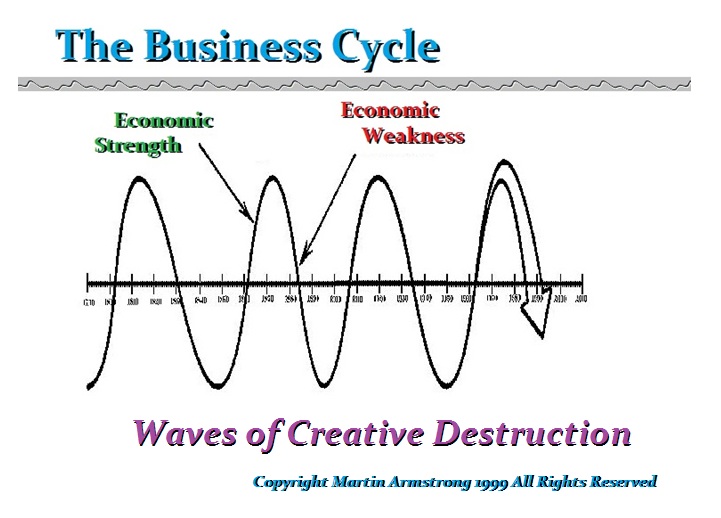
BusinessCycle-Waves of Creative Destruction

Bullard for the first time let the cat out of the bag. Yet this is the number one question I have always gotten from central bankers all the time. They do not like to publicly admit it, but they will always be blamed for asset bubbles. They cannot prevent them any more than they can prevent the crash. Nevertheless, Western Culture presumed, ever since Marx, that government plays a role and can be master of the economy. Paul Volcker in his Rediscovery of the Business Cycle said the truth before he became Fed Chairman August 6th, 1979  until August 11th, 1987 just a month before the Crash of 1987. Volcker himself said that Marxist-Keynesian Economics has failed:

“The Rediscovery of the Business Cycle – is a sign of the times. Not much more than a decade ago, in what now seems a more innocent age, the ‘New Economics’ had become orthodoxy. Its basic tenet, repeated in similar words in speech after speech, in article after article, was described by one of its leaders as ‘the conviction that business cycles were not inevitable, that government policy could and should keep the economy close to a path of steady real growth at a constant target rate of unemployment.’ …

But it was not until the events of 1974 and 1975, when a recession sprung on an unsuspecting world with an intensity unmatched in the post-World War II period, that the lessons of the ‘New Economics’ were seriously challenged.”

No matter what they say, the Fed will raise rates when assets rise. They will interpret that as speculation which will lead to inflation BECAUSE that is how Congress will see it as will mainstream media. Consequently, they will have no choice but to raise rates to fight an asset bubble.

Even Market Watch keeps reporting the overall bearishness of the majority of analysts. They wrote base upon the Wall Street soothsayer John Hussman: “This is the most dangerous and overvalued stock market on record — worse than 2007, worse than 2000, even worse than 1929.” Ironically, the more the press keeps touting what has become a perpetual bearishness, the Fed is also afraid to raise rates for they do not want to be blamed for a crash.

This is why the Fed keeps telegraphing they will raise rates to see if the market responds. That provides them deniability if a market declines before they take any action.

Happy Pi Day – Tomorrow is the Ides of March


Pi Day-R

While today is know as Pi Day, tomorrow is the fateful Ides of March and indeed to Trump we must say – Beware! It clearly appears that the Treasury has been deliberately trying to get rid of its cash reserves which stood at $435 billion before the election. They obviously expected President Hillary Clinton would be in the White House and the Democrats would control Congress so there would be no problem in raising the debt ceiling as always.

However, Trump resiodes not Hillary and it clearly seems that the Treasury since January 20th has moved into high gear to create an intentional crisis to blame Trump with 70 years+ of deficit spending post-World War II. The Treasury’s cash has vanished and it has collapsed rapidly down to $88 billion. The massive drain of cash has been deliberate. Never has such a raid decline taken place.
There is a coming disaster thanks to the Obama/Boehner selling out the country. Politicians know that they can do anything as long as you push it off into the future after they leave office for all blame will fall of the next person holding office. Hence, Trump will be blamed for the entire debt – just watch. This will not end nicely.

More Evidence Surfaces – NSA Director Mike Rogers Did Not Aid Obama’s Surveillance Scheme…


Source: More Evidence Surfaces – NSA Director Mike Rogers Did Not Aid Obama’s Surveillance Scheme…


Gallery

Kim Jong-un threatens ‘MERCILESS’ attack on America in retaliation for South Korea drills

This gallery contains 2 photos.


Kim Jong Un is either a total idiot or totally crazy or I guess both!.

Can the EU Return to just a Trade Union?


greek-protest-natzi

QUESTION: Hi Marty,

When the EU reaches their “Oh shit!” moment will it be able to devolve back into an Economic union? Is there any possibility that the fall in the Euro will rescue the EU?

Regards,
F

ANSWER: Human nature seems to dictate that will not happen. The attempt by the elite to force a federalized government will only foster the resentment. The Foreign Minister Witold Waszczykowski of Poland said: “We now know what that is, an EU under the dictate from Berlin.”  The Greeks are resentful of Germany as are the Spanish and Italians and we see the same trend emerging in France. This attempt to force a single government upon Europeans has only fanned the flames the burning wounds from previous world wars.

Those who have taken up jobs in Brussels have no job without a federalization of government. So you have tens of thousands of people who suddenly will be out of work and then you have pensions they voted for themselves. They have far too much self-interest NOT to compromise. It will be an all or nothing affair and that is the sad ending for the EU. It will be too late to return to a simple trade union like NAFTA.

US deploys drones in South Korea capable of striking North Korean targets


Trump is not Obama!

$21,714 For Every Man, Woman And Child In The World – This Global Debt Bomb Is Ready To Explode


Tyler Durden's picture

Authored by Michael Snyder via The Economic Collapse blog,

According to the International Monetary Fund, global debt has grown to a staggering grand total of 152 trillion dollars.  Other estimates put that figure closer to 200 trillion dollars, but for the purposes of this article let’s use the more conservative number.  If you take 152 trillion dollars and divide it by the seven billion people living on the planet, you get $21,714, which would be the share of that debt for every man, woman and child in the world if it was divided up equally.

So if you have a family of four, your family’s share of the global debt load would be $86,856.

Very few families could write a check for that amount today, and we also must remember that we live in some of the wealthiest areas on the globe.  Considering the fact that more than 3 billion people around the world live on two dollars a day or less, the truth is that about half the planet would not be capable of contributing toward the repayment of our 152 trillion dollar debt at all.  So they should probably be excluded from these calculations entirely, and that would mean that your family’s share of the debt would ultimately be far, far higher.

Of course global debt repayment will never actually be apportioned by family.  The reason why I am sharing this example is to show you that it is literally impossible for all of this debt to ever be repaid.

We are living during the greatest debt bubble in the history of the world, and our financial engineers have got to keep figuring out ways to keep it growing much faster than global GDP because if it ever stops growing it will burst and destroy the entire global financial system.

Bill Gross, one of the most highly respected financial minds on the entire planet, recently observed that “our highly levered financial system is like a truckload of nitro glycerin on a bumpy road”.

And he is precisely correct.  Everything might seem fine for a while, but one day we are going to hit the wrong bump at the wrong time and the whole thing is going to go KA-BOOM.

The financial crisis of 2008 represented an opportunity to learn from our mistakes, but instead we just papered over our errors and cranked up the global debt creation machine to levels never seen before.  Here is more from Bill Gross

 My lesson continued but the crux of it was that in 2017, the global economy has created more credit relative to GDP than that at the beginning of 2008’s disaster. In the U.S., credit of $65 trillion is roughly 350% of annual GDP and the ratio is rising. In China, the ratio has more than doubled in the past decade to nearly 300%. Since 2007, China has added $24 trillion worth of debt to its collective balance sheet. Over the same period, the U.S. and Europe only added $12 trillion each. Capitalism, with its adopted fractional reserve banking system, depends on credit expansion and the printing of additional reserves by central banks, which in turn are re-lent by private banks to create pizza stores, cell phones and a myriad of other products and business enterprises. But the credit creation has limits and the cost of credit (interest rates) must be carefully monitored so that borrowers (think subprime) can pay back the monthly servicing costs. If rates are too high (and credit as a % of GDP too high as well), then potential Lehman black swans can occur. On the other hand, if rates are too low (and credit as a % of GDP declines), then the system breaks down, as savers, pension funds and insurance companies become unable to earn a rate of return high enough to match and service their liabilities.

There is always a price to be paid for going into debt.  It mystifies me that so many Americans seem to not understand this very basic principle.

On an individual level, you could live like a Trump (at least for a while) by getting a whole bunch of credit cards and maxing all of them out.

But eventually a day of reckoning would come.

The same thing happens on a national level.  In recent years we have seen examples in Greece, Cyprus, Zimbabwe, Venezuela and various other European nations.

Here in the United States, more than 9 trillion dollars was added to the national debt during the Obama years.  If we had not taken more than 9 trillion dollars of consumption and brought it into the present, we would most assuredly be in the midst of an epic economic depression right now.

Instead of taking our pain in the short-term, we have sold future generations of Americans as debt slaves, and if they get the chance someday they will look back and curse us for what we have done to them.

Many believe that Donald Trump can make short-term economic conditions even better than Obama did, but how in the world is he going to do that?

Is he going to borrow another 9 trillion dollars?

A big test is coming up.  A while back, Barack Obama and the Republican Congress colluded to suspend the debt ceiling until March 15th, 2017, and this week we are going to hit that deadline.

The U.S. Treasury will be able to implement “emergency measures” for a while, but if the debt ceiling is not raised the U.S. government will not be able to borrow more money and will run out of cash very quickly.  The following comes from David Stockman

 The Treasury will likely be out of cash shortly after Memorial Day. That is, the White House will be in the mother of all debt ceiling battles before the Donald and his team even see it coming.

 With just $66 billion on hand it is now going to run out of cash before even the bloody battle over Obamacare Lite now underway in the House has been completed. That means that there will not be even a glimmer of hope for the vaunted Trump tax cut stimulus and economic rebound on the horizon.

Trump is going to find it quite challenging to find the votes to raise the debt ceiling.  After everything that has happened, very few Democrats are willing to help Trump with anything, and many Republicans are absolutely against raising the debt ceiling without major spending cut concessions.

So we shall see what happens.

If the debt ceiling is not raised, it will almost certainly mean that a major political crisis and a severe economic downturn are imminent.

But if the debt ceiling is raised, it will mean that Donald Trump and the Republicans in Congress are willingly complicit in the destruction of this country’s long-term economic future.

When you go into debt there are consequences.

And when the greatest debt bubble in human history finally bursts, the consequences will be exceedingly severe.

The best that our leaders can do for now is to keep the bubble alive for as long as possible, because what comes after the bubble is gone will be absolutely unthinkable.

The US Government Now Has Less Cash Than Google


Tyler Durden's picture

Authored by Simon Black via SovereignMan.com,

In the year 1517, one of the most important innovations in financial history was invented in Amsterdam: the government bond.

It was a pretty revolutionary concept.

Governments had been borrowing money for thousands of years… quite often at the point of a sword.

Italian city-states like Venice and Florence had been famously demanding “forced loans” from their wealthy citizens for centuries.

But the Dutch figured out how to turn government loans into an “investment”.

It caught on slowly. But eventually government bonds became an extremely popular asset class.

Secondary markets developed where people who owned bonds could sell them to other investors.

Even simple coffee shops turned into financial exchanges where investors and traders would buy and sell bonds.

In time, the government realized that its creditworthiness was paramount, and the Dutch developed a reputation as being a rock-solid bet.

This practice caught on across the world. International markets developed.

English investors bought French bonds. French investors bought Dutch bonds. Dutch investors bought American bonds.

(By 1803, Dutch investors owned a full 25% of US federal debt. By comparison, the Chinese own about 5.5% of US debt today.)

Throughout it all, debt levels kept rising.

The Dutch government used government bonds to live beyond its means, borrowing money to fund everything imaginable– wars, infrastructure, and ballooning deficits.

But people kept buying the bonds, convinced that the Dutch government will never default.

Everyone was brainwashed; the mere suggestion that the Dutch government would default was tantamount to blasphemy.

It didn’t matter that the debt level was so high that by the early 1800s the Dutch government was spending 68% of tax revenue just to service the debt.

Well, in 1814 the impossible happened: the Dutch government defaulted.

And the effects were devastating.

In their excellent book The First Modern Economy, financial historians Jan De Vries and Ad Van der Woude estimate that the Dutch government default wiped out between 1/3 and 1/2 of the country’s wealth.

That, of course, is just one example.

History is full of events that people thought were impossible. And yet they happened.

Looking back, they always seem so obvious.

Duh. The Dutch were spending 68% of their tax revenue just to service the debt. Of course they were going to default.

But at the time, there was always some prevailing social influence… some wisdom from the “experts” that made otherwise rational people believe in ridiculous fantasies.

Today is no different; we have our own experts who peddle ridiculous (and dangerous) fantasies.

Case in point: this week, yet another debt ceiling debacle will unfold in the Land of the Free.

You may recall the major debt ceiling crisis in 2011; the US federal government almost shut down when the debt ceiling was nearly breached.

Then it happened again in 2013, at which point the government actually DID shut down.

Then it happened again in 2015, when Congress and President Obama agreed to temporarily suspend the debt ceiling, which at the time was $18.1 trillion.

That suspension ends this week, at which point a debt ceiling of $20.1 trillion will kick in.

There’s just one problem: the US government is already about to breach that new debt limit.

The national debt in the Land of the Free now stands at just a hair under $20 trillion.

In fact the government has been extremely careful to keep the debt below $20 trillion in anticipation of another debt ceiling fiasco.

One way they’ve done that is by burning through cash.

At the start of this calendar year in January, the federal government’s cash balance was nearly $400 billion.

On the day of Donald Trump’s inauguration, the government’s cash balance was $384 billion.

Today the US government’s cash balance is just $34.0 billion.

(Google has twice as much money, with cash reserves exceeding $75 billion.)

This isn’t about Trump. Or even Obama. Or any other individual.

It’s about the inevitability that goes hand in hand with decades of bad choices that have taken place within the institution of government itself.

Public spending is now so indulgent that the government’s net loss exceeded $1 trillion in fiscal year 2016, according to the Treasury Department’s own numbers.

That’s extraordinary, especially considering that there was no major war, recession, financial crisis, or even substantial infrastructure project.

Basically, business as usual means that the government will lose $1 trillion annually.

Moreover, the national debt increased by 8.2% in fiscal year 2016 ($1.4 trillion), while the US economy expanded by just 1.6%, according to the US Department of Commerce.

Now they have plans to borrow even more money to fund multi-trillion dollar infrastructure projects.

Then there’s the multi-trillion dollar bailouts of the various Social Security and Medicare trust funds.

And none of this takes into consideration the possibility of a recession, trade war, shooting war, or any other contingency.

This isn’t a political problem. It’s an arithmetic problem. And the math just doesn’t add up.

The only question is whether the government outright defaults on its creditors, defaults on promises to its citizens, or defaults on the solemn obligation to maintain a stable currency.

But of course, just like two centuries ago with the Dutch, the mere suggestion that the US government may default is tantamount to blasphemy.

Our modern “experts” tell us that the US government will always pay and that a debt default is impossible.

Well, we’re living in a world where the “impossible” keeps happening.

So it’s hard to imagine anyone will be worse off seeking a modicum of sanity… and safety.

Do you have a Plan B?

“The Biggest Show Of Force Since World War II”: Japan To Send Its Largest Warship To South China Sea


Tyler Durden's picture

The tension over the disputed territory in the South China Sea is about to escalate to another level: according to a Reuters report, Japan is preparing to to dispatch its largest warship on a three-month tour through the South China Sea beginning in May, in “its biggest show of naval force in the region since World War Two.”

Japan Maritime Self Defense Force’s helicopter carrier Izumo

The 249 meter-long (816.93 ft) Izumo is as large as Japan’s World War Two-era carriers and can operate up to nine helicopters. It resembles the amphibious assault carriers used by U.S. Marines, but lacks their well deck for launching landing craft and other vessels.

While China claims almost all the disputed waters despite the regular complaints of other nations in the region, and its growing military presence has fueled concern in Japan and the West, with the United States holding regular air and naval patrols to ensure freedom of navigation, so far Japan’s territorial claims have involved the Senkaku island chain in the East China Sea; that however appears to be changing as Japan seeks to stake a military presence in the contested region.

The Izumo helicopter carrier, commissioned only two years ago, will make stops in Singapore, Indonesia, the Philippines and Sri Lanka before joining the Malabar joint naval exercise with Indian and U.S. naval vessels in the Indian Ocean in July, before returning to Japan in August.

Why create another point of Chinese antagonism over the region? “The aim is to test the capability of the Izumo by sending it out on an extended mission,” said one of the sources who have knowledge of the plan. “It will train with the U.S. Navy in the South China Sea,” he added, asking not to be identified because he is not authorized to talk to the media. A spokesman for Japan’s Maritime Self Defense Force declined to comment.

  Taiwan, Malaysia, Vietnam, the Philippines and Brunei also claim parts of the sea which has rich fishing grounds, oil and gas deposits and through which around $5 trillion of global sea-borne trade passes each year. Japan does not have any claim to the waters, but has a separate maritime dispute with China in the East China Sea.

 Japan wants to invite Philippine President Rodrigo Duterte, who has pushed ties with China in recent months as he has criticized the old alliance with the United States, to visit the Izumo when it visits Subic Bay, about 100 km (62 miles) west of Manila, another of the sources said. Asked during a news conference about his view on the warship visit, Duterte said, without elaborating, “I have invited all of them.”

He added: “It is international passage, the South China Sea is not our territory, but it is part of our entitlement.” On whether he would visit the warship at Subic Bay, Duterte said: “If I have time.”

Japan’s unexpected flag-flying operation comes as the United States is conflicted between taking a tougher line with China and making concessions ahead of Xi’s visit to Trump next month. Washington has criticized China’s construction of man-made islands and a build-up of military facilities that it worries could be used to restrict free movement. Beijing responded in January said it had “irrefutable” sovereignty over the disputed islands after the White House vowed to defend “international territories”.

As Reuters notes, Japan in recent years, particularly under Prime Minister Shinzo Abe, has been stretching the limits of its post-war, pacifist constitution and has been making aggressive pushes for a return to militarism. It has designated the Izumo as a destroyer because the constitution forbids the acquisition of offensive weapons. The vessel, nonetheless, allows Japan to project military power well beyond its territory. Based in Yokosuka, near to Tokyo, which is also home to the U.S. Seventh Fleet’s carrier, the Ronald Reagan, the Izumo’s primary mission is anti-submarine warfare.

Sturgeon To Give May An “Ultimatum” As UK Preapres For Critical Vote Ahead Of Article 50


Tyler Durden's picture

Britain’s minister for leaving the European Union, David Davis, urged lawmakers not to hold back PM Theresa May’s ability to negotiate a Brexit deal in talks she could trigger as early as this week. Davis on Sunday called on lawmakers to vote to drop two amendments that were added to a bill authorizing the talks with the bloc’s other member states, saying May should be able to enter with no strings attached the WSJ reported.

On Monday the Brexit bill returns to the House of Commons, the U.K.’s lower house, for debate after the House of Lords said it wanted guarantees that EU citizens living in the U.K. could stay after Brexit and that Parliament could vote on the final terms. The final bill must be approved by both houses. Should the bill pass Monday, the government could invoke Article 50 as early as Tuesday according to weekend press reports, but negotiations in Parliament could last several days. The Brexit spokesman for the main opposition Labour Party, Keir Starmer, told Sky News he expects the government to trigger it on Wednesday or Thursday.

Even if the House of Commons votes in favor of the amendments, May is expected to keep her timetable of triggering by the end of the month. But it would underline how small her majority is in the lower house. Complicating matters is a tweet moments ago by BBG political editor Laura Kuenssberg, who reported that Scotland’s Nicola Sturgeon will give May an ultimatum: give Scotland a different Brexit deal or she’ll call for section 30, the indyref process.

On the topic of Brexit, Reuters reported on Sunday that David Davis is also drawing up “contingency plans” for Britain in the unlikely event it has to walk away from divorce talks with the European Union without a deal. Ahead of the start of Article 50 negotiations, which could be triggered as early as Tuesday, a committee of lawmakers warned it would be a serious dereliction of duty if the government failed to plan for the possibility of not reaching an exit deal. “I don’t think, firstly, that is remotely likely,” Davis told the BBC’s Andrew Marr Show, responding to the report. “It’s in absolutely everybody’s interest that we get a good outcome.”

Parliament’s Foreign Affairs committee warned that a breakdown in negotiations would be a “very destructive outcome,” causing economic harm to both sides as well as creating uncertainty and legal confusion for individuals and businesses.

 “The simple truth is we have been planning for the contingency – all the various outcomes, all the possible outcomes of the negotiations,” Davis said. “One of the reasons we don’t talk about the contingency plan too much is that we don’t want people to think ‘Oh, this is what we’re trying to do.'”

Asked when May would trigger talks, Davis declined to name a specific date. “Each date has different implications in terms of when it could be responded to by the (European) council … I’m not going to get into the details why, but there’s politics in terms of achieving success.”

Finally, for a frank, “on the ground” take on the current state of Brexit, here is an excerpt from Bill Blain’s latest Morning Porridge edition: