Energy Bills to Rise Across US


Posted originally on Jun 11, 2024 By Martin Armstrong 
ACairconditioning

The EPA is demanding that we abandon coal and fossil fuels without an alternative. The agency is seeking to shut down American power plants in favor of renewables. Energy prices are already reaching new highs. The National Energy Assistance Directors Association (NEADA) and the Center for Energy Poverty and Climate (CEPC) issued a warning that Americans should expect at least an 8% increase in energy bills this summer.

No, global warming is not the culprit. The hot summer is in line with cyclical weather patterns. America lost its ability to remain energy independent the very day Joe Biden entered the White House and signed away countless laws prohibiting production. The average AC bill was $661 over the summer months, according to CEPC and NEADA. These agencies believe those in the Mid-Atlantic and Pacific regions of the US will see a rise in energy prices by 12.2%, raising costs from June to September to $691 and $693. Those in the East South Central are expected to see a 10.1% hike over the same period and will pay around $774. East Noth Central is expected to see a 9.8% energy bill uptick ($581), while New England and West South Central will see rises of 5.3% ($760) and 1.8% ($581).

Naturally, these costs are on the low spectrum of estimates. Most of us pay far more to cool our homes over the summer. One must wonder why the EPA and Biden Administration believe it is appropriate to adhere to these climate change goals for Agenda 2030 when the average American is already struggling to afford cooling.

We are already paying for the slow switch from natural gas and coal to renewables. Energy companies have been forced to gradually make the switch, and soon, there will be no alternative. Once they completely banish fossil fuels, cooling one’s home will become a luxury. Anyone can look at their monthly billing to see how much their heating and cooling expenses have risen on a monthly and annual basis and it is far beyond 8%. Personally, I am seeing a rise of around 30%.

This is one of an array of basic living essentials that have multiplied in price in recent years under the Biden Administration. We allowed our leader to cripple our infrastructure and ability to remain energy independent. We are currently allowing him to sign even more restrictive pieces of legislation that will only force us to stretch our dollars thin to maintain our current lifestyles. Is anything Build Back Better yet?
Build-to-Rent Communities Grow in Popularity


Posted Jun 7, 2024 By Martin Armstrong 

BuildtoRentHomeStarts2022

You will own nothing. Accessory Dwelling Units (ADUs) have grown in popularity in recent years. America has recently imported a concept stemming from across the pond in the UK to pacify housing fears. Build-to-rent (BTR) communities are becoming a common development as the majority of Americans struggle to either afford or find housing.

Around 23% of Americans own property. YouGov conducted a poll that found that 60% of Americans believe the old model whereby 30% of one’s income would equate to affordable housing. That is simply not possible for over a quarter of Americans who spend far more than 30% on their mortgages. Almost half (49%) of renters spend 30% or more on shelter, while 19% spend over half of their take-home pay to the landlord. According to the survey, 46% of homeowners are worried about making their monthly mortgage payments, compared to 69% of renters.

Build-to-rent communities usually mimic a typical suburbia rather than an apartment complex. Amenities and property management is often included, which is why this concept was once reserved for retirees and the aging population. This is a deal for investors who may purchase homes within the development communities. They are usually priced higher than typical rentals as the home is within a more desirable community with stable tenants and a lower turnover. As for the tenants, they are not gaining any equity and are forgoing a valuable asset.

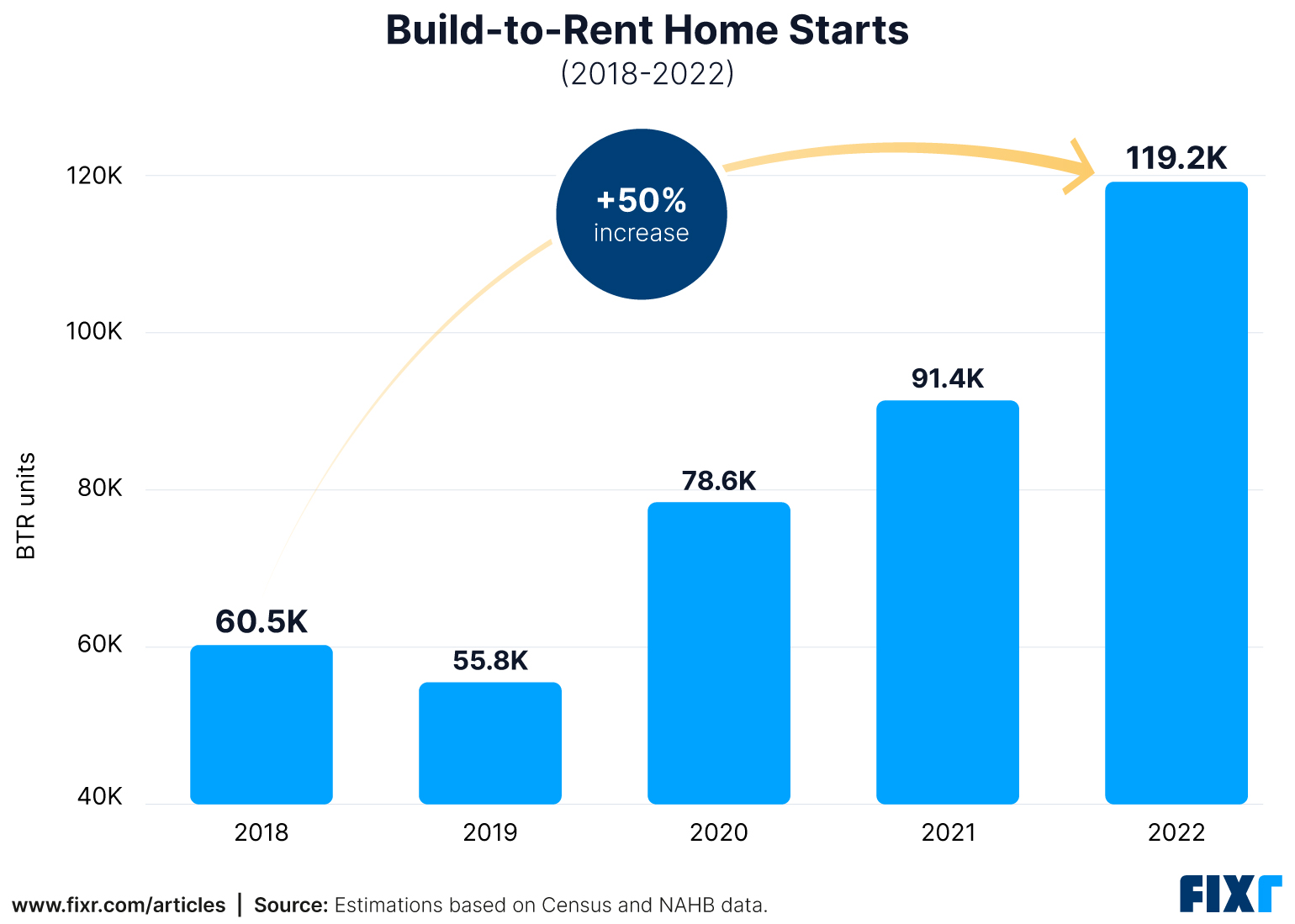
Fixr reported that build-to-rent communities are set to grow within the next two years based on data from the NAHB but will remain somewhat stagnant in 2023 due to massive growth in recent years. Over 119,000 homes using this model were built in 2022, marking a 50% increase from 2018. In the last five years, Charlotte, NC, experienced a 621% uptick in built-to-rent communities, followed by Jacksonville, Florida (353%), Greenville, South Carolina (265%), while Phoenix, Arizona, experienced a 280% uptick.

The younger generation, who want to begin expanding their families but cannot afford to own them, is primarily attracted to these growing complexes that provide the feel of homeownership without the asset. Everyone needs a place to live. Families, especially with young children, do not tend to move around as often with school zoning and other aspects. Homeownership and the traditional American dream of the house with the white picket fence have been transformed.