Financial Capitol of the World & Its Migration


WorldEconomy

QUESTION:

I am a great admirer of your Socrates model, but there’s one thing in your personal pronouncements that seem to contain a contradiction. On the one hand you are predicting a decline of the U.S.A. and other western economies, mainly caused by excessive government interference in the economy. However, on the other hand you are predicting a rise in the prominence of China occurring simultaneously with the decline in the Western economies, yet the Chinese economy is still dominated by State-owned enterprises (SOEs) and that is unlikely to change anytime soon. Can you please explain this apparent contradiction?

Also, you (perhaps justifiably) continually put the boot into Western governments for their excessive involvement in their economies and yet you rarely, if ever, criticise the Chinese government’s heavy involvement in the Chinese economy. Why the double standard? Is Socrates is actually predicting a near-term decline in Chinese government involvement in their economy? And is there an allied Socrates prediction for increased democracy in China in the near-term?

Thanks for your great service,

Andrew.

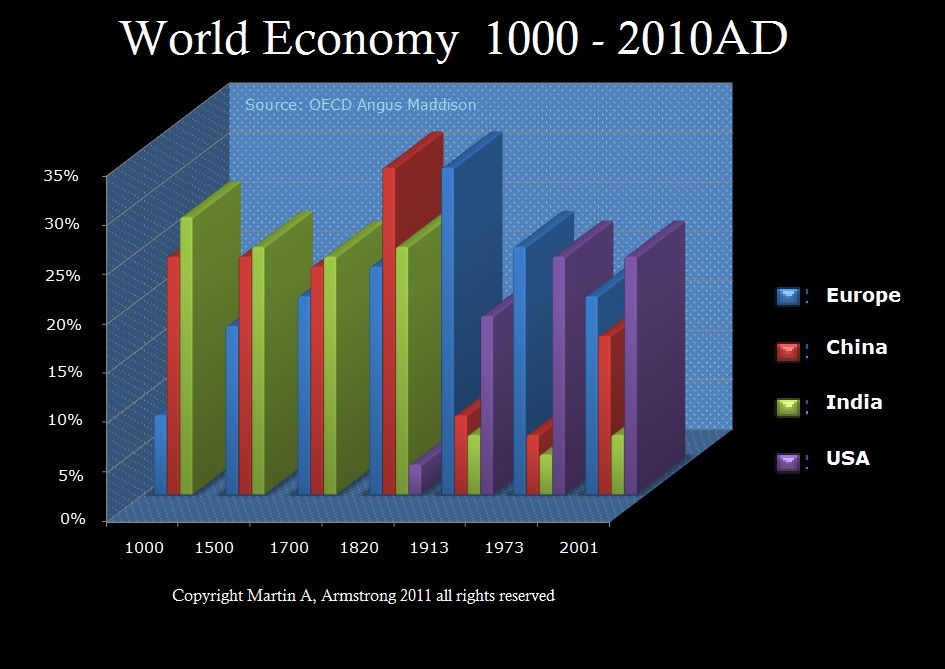
ANSWER: You are missing the timing and overlap. It is true that the Chinese government is still trying to manage its transition to a free economy. Ultimately, that will happen. However, the difference between the former communist regions such as Europe, Russia, and China, in comparison to Western Europe, such as North America, Australia, New Zealand, and Japan, is significant whereas the former region has people who do not depend on government and the latter still expects government to be there to take care of us until we die. A collapse in government in the former communist regions will not be as devastating to the common people and it would be in the Western developed world. China and Russia learned that Marxism failed. It is simply our turn in the West to experience the same as they did with the collapse of socialism.

After 2032, the financial capital of the world will simply migrate to China. It always migrates. You are assuming that the government of China will survive in its current form. They too will change and alter. In the West, governments are not interested in reform. They are only interested in holding on to power. This is simply how empires, nations, and city-states have always historically failed.

China is moving through its reform stage that began in 1989.95. We should see the first political shake up by 2021/2022. That is simply how long it will take from the beginning in 1989.95. They are simply at a different point in their own cyclical history.


Deutsche Bank – The Meltdown Crisis


db-exposure

Ten of the large hedge funds are withdrawing from Deutsche Bank. What must be understood here is that Deutsche Bank is the main clearing house for trades in Europe. The problem the hedge funds have is where do they move for clearing? Short-term, they can move to New York or London. With over $60 trillion derivative book at the Deutsche Bank, the government is totally incapable of even understanding how to deal with this crisis. We are looking at a major crisis in confidence.

Merkel is simply out of her mind to adhere to this insane policy of a bail-in. How can hedge funds stay with clearing at Deutsche Bank when she takes this position that would set off a catastrophic global meltdown. It still appears that Merkel will have to blink. Once people realize this is the real crisis, then the German debt market should turn down rather hard.

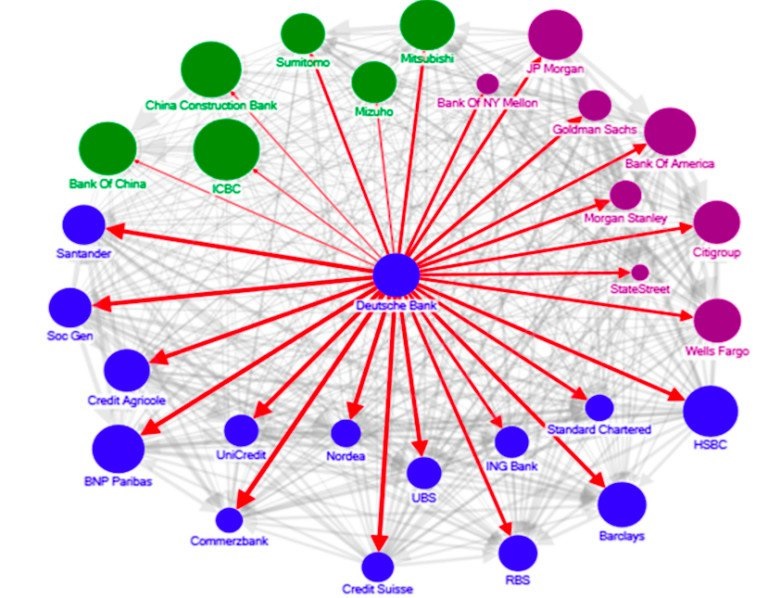
The pressure is clearly building based upon how my own phone is melting down. This illustration based upon IMF data, illustrates the global contagion. I “BELIEVE” that Merkel will be compelled to blink. We may see an announcement this weekend at the latest where she must address this issue. The implications of a global contagion go far beyond Germany.

Investors in Deutsche Bank are obviously looking to Merkel and whether or not she will step up to the plate here. DB shares have plummeted more than 50 percent this year. The prospect of bailing out Deutsche Bank is particularly a problem when Merkel seeking a fourth term in an election next year. Her view is to hold to what she took as a position. Hence, must the world suffer for her personal political career once again?

The EC attack on Apple has led to a backlash where the US Justice Department in retaliation wants a multibillion-dollar fine from DB. This is also contributing to the problem of DB being in the cross-hairs of US prosecutors who also seek to further their political career not unlike Merkel.

Merkel’s spokesman said the government sees “no grounds” for talk of state funding for DB. This simply cannot stand in the face of a major global contagion. The government would have to step in if Deutsche Bank was really in major trouble and hedge funds reducing exposure are abandoning the bank. You can bet by tomorrow, every bank will be trying to reduce their exposure to DB by the weekend.

John Cryan, Deutsche Bank’s chief executive officer, has come out publicly saying that raising capital “is currently not an issue,” and as far as a bailout from government, he has stated Merkel’s position that such support is “out of the question for us.” This entire crisis is actually set in motion by Merkel who championed to keep taxpayers off the hook in a crisis. She pushed for bail-ins and not bail-outs and this has made it far more difficult for governments to support banks in Europe. The Bank Recovery and Resolution Directive, which is the cornerstone of Europe’s efforts to tackle too-big-to-fail banks, takes the position that the need any such extraordinary public financial support indicates that a firm is “failing or likely to fail,” that will trigger the resolution. Now, support for banks is highly restricted and has devastated Greece, Italy, and Portugal. Consequently, if Merkel now intervenes on Deutsche Bank’s behalf, she is basically saying the law is for everyone else but Germany. That will lead to internal protests within the EU.

Internationally, if Merkel’s governing coalition does not step up to support Deutsche Bank, the political fallout globally will in itself cause a major crisis probably by November.  Clearly, the need for some sort of state intervention would outweigh calculations about the political fallout. Merkel will cause the international chaos if DB fails and it can fail if this bank run continues. DB needs to be restructured but when it is the biggest in Europe, it cannot be merged as a shotgun wedding. Its business must reduce risk for itself and the connection of other banks. The German government could assume a stock investment. The legal restrictions prevents extraordinary support as state aid that would distort competition by favoring one company over another. Under the EU law, the German government could just take an equity stake. That would not be a bailout in the classic terms that Merkel opposed. It must be carried out at current market conditions. They cannot arbitrarily supply money at some agreed upon share price that is away from the market.

Euro HangingOne loophole under EU regulation would allow Merkel bailout DB provided it is only to “remedy a serious disturbance in the economy of a member state and preserve financial stability.” This must be only a temporary measure. This would qualify and she can claim that she is following the EU law and it is not different from country to country. However, EU state-aid rules require junior creditors and shareholders to share losses. Therein lies the problem of a global contagion.

If Merkel actually tried to inject government funds into Deutsche Bank or purchase its capital instruments, it may do so only if there is a capital shortfall identified. Still, there must be no advantage to DB from a competition perspective. The interesting problem that would emerge, highlights the clearing crisis. The European Union would then NEED British banks for clearing. In the face of BREXIT, they are not likely to concede that at any time, so there is another nail in the coffin of the euro.

The Fish Bowl Economy & Academics


fish-bowl-economy

QUESTION: Hi Marty, I hope you’re doing well. Having been a follower of yours for some time now, and been enlightened from that, I am ever in your debt for what you have shared and (hopefully!) will continue to share. I am an economic history student studying at the University of Edinburgh, and I have to say the professors are consistently bamboozled when I bring anything up that I read on your blog! I am going into my second year now and am in particular very much interested in population flows. I am trying to set up my own ‘database’ to store all of this information and subsequently start creating my own analyses in a similar image of our dear friend Mr. Socrates. To get to my point, I am wondering how you went about initially setting up Socrates, what sort of coding or programs you were using and if there were any big potholes to try and avoid when setting up something like this? I am in absolute awe of Socrates and yourself, but I am enticed by the challenge of doing something I can call my own. Any help at all is very much appreciated I hope to hear from you soon!

Kind regards,

C

ANSWER: Yes, you will find traditional economics fall short of reality. They rest upon supply and demand, yet assume they can stimulate demand with Keynesian economics to raise or lower interest rates. They are clueless with regard to international trends because that would mean that they could not manipulate any economy, for there are always external factors they have no control over. Consequently, all theories are based upon what I call the “Fish Bowl Economy” that assumes everything is self contained and nothing external will enter their perfect world.

From a programming standpoint, there are no off-the-shelf programs to do what is necessary. Languages are really much the same. VB and C are the main languages, but then there are specialties like Prologue, etc. I was always into artificial intelligence from the start. The pitfall to avoid is to NEVER presume anything. Just let the data reveal the truth. As soon as you make an assumption, you will fail. Migration has always contributed to dictating the rise and fall of nations. Let the data show you the way. That is the exciting path to discovery.

World Trade Collapsing On Schedule


world-trade-2

The World Trade Organization (WTO) has warned that there is a “dramatic slowing of trade growth” unfolding. The WTO has revised downward its projections, saying trade is now on track this year to grow at the slowest pace since 2009.

The hunt for taxes is destroying the world economy and on January 1, 2017, all governments will begin sharing info on foreigners. The assumption is that anyone doing anything outside the USA is hiding money from taxes. With this attitude, world trade will continue to collapse into 2020.

Merkel May Be the Worse Politician in all of History


merkel-13

Germany’s Chancellor Angela Merkel has got to be the worse politician in history when it comes to understanding the economy. Merkel has ruled out any state assistance for Deutsche Bank AG in the year heading into the national election in September 2017 according to Focus magazine citing unidentified government officials. Merkel is just incapable of making any rational decisions whatsoever. This policy means any German who has money in Deutsche Bank is at risk and she may set off a major banking crisis if there is a run on the bank in mass. She is also saying that by no bail-out, government is not responsible for this crisis. They have been bribed by banks to begin with to allow them to do whatever with a relaxed regulation standard and then she wants to deny any responsibility. He thinking that to bail them out will cause inflation that will hurt the people, she ignores that no bailout will hurt the least sophisticated people who trusted government. Anyone who reads this would naturally move their money out of Deutsche Bank. Hello? Is anyone home? Is there a light on in that dark region of their mind? Massive Quantitative Easy by Draghi buying even junk bonds has failed to produce inflation.

This is the very same policy Merkel applied to Greece that resulted in her image collapsing in July 2015 so she then opened the gates to the refugees. Merkel’s economic ideas are so devastating it is a complete joke. She will destroy the German economy for a bail-in with Deutsche Bank will shatter the German economy and most likely result in the final destruction of the euro.

If the Deutsche Bank AG goes down, we are talking about the biggest bank in Germany and Europe for that matter. She will utterly destroy the entire economy and this may be the tipping point that send massive waves of capital rushing into the dollar. She is deliberately imposing massive deflation upon Europe that no possible quantitative easing by Draghi could possible overcome. What Merkel has done to Europe is beyond comparison to any politician in history. This is a prime example of what we get when you put economic policy into the hands of people who have ZERO experience.

If the German people lose their savings, just how will the economy be stimulated by the ECB buying junk corporate bonds? If the PEOPLE do not spend, no level of negative interest rates will EVER reverse the economic trend. This is the worse possible decision any head of state could carry out. She will single-handedly destroy the EU and Britain may name BREXIT day a national holiday known as British Independence when this is all over.

What Actually Is Transitory


1.2% growth is basically zero and it will only get worse as the government takes more and more out as taxes trying to pay for all their programs. Very soon they will pull out so much that the economy will contract and could very well collapse as there is no way to stop the decline once the government has taxed the people to the point that can pay for the basics. In Hillary get in this will come around 2020 maybe 2022. If Trump gets in he may be able to postpone it 10 years maybe longer if we are lucky.

The Curse of Cash = Curse of Elitist Authors


the-curse-of-cash

The government has its pawns cheering the end of money. They are screaming that $1.4 trillion exists in cash and half of that is $100 bills. Justine Underhill writes that ending cash could be great for the economy. I think that is only great for government for this is all about getting more taxes. Kenneth Rogoff, the great mouth piece for the government advocating the end of cash, put out another bullshit propaganda piece in book for: The Curse of Cash. He argues because of tax avoidance and criminal activity, there should be no cash. Rogoff says that the world is drowning in cash and this is what has been making us poorer and less safe. In The Curse of Cash, Rogoff argues that getting rid of most paper money would is the only way forward. He cares bothing for the people, and assumed the elitist approach to the issue.

The Experiment: Capitalism versus Socialism


From TownHall
The Experiment: Capitalism versus Socialism
David Legates
Posted: Sep 21, 2016 12:01 AM

germany

Experimentation is a major tool in the scientist’s arsenal. We can put the same strain of bacteria into two Petri dishes, for example, and compare the relative effects of two different antibiotics.

What if we could do the same with economic systems? We could take a country and destroy its political and economic fabric through, say, a natural disaster or widespread pestilence – or a war. War is the ultimate political and economic cleansing agent. Its full devastation can send a country back almost to the beginning of civilization.

We could then take this war-torn country and divide it into two parts. It would have similar people, similar climate, similar potential trading partners, similar geography – but one part is rebuilt using capitalism as its base, while the other rebuilds using socialism and its principles. We’d let the virtues of each system play out and see where these two new countries would be after, say, fifty years.

Don’t you wonder what the outcome might be? Well, as it turns out, we have already performed The Experiment. It’s post-war Germany.

Following the devastation of World War II, Germany was split into two parts. The German Federal Republic, or West Germany, was rebuilt in the image of the western allies and a capitalist legal-political-economic system. By contrast, the German Democratic Republic, or East Germany, was reconstructed using the socialist/communist principles championed by the Soviet Union. The Experiment pitted the market economy of the West against the command economy of the East.

On the western side, considering what’s being taught in our schools, one might expect that “greedy capitalism” would create a state where a few people became the rich elite, while the vast majority were left as deprived masses. Socialism, by contrast, promised East Germany the best that life had to offer, through rights guaranteed by the state, including “human rights” to employment and living wages, time for rest and leisure, health care and elder care, and guaranteed housing, education and cultural programs.

So the Petri dishes were set, and The Experiment began. In 1990, after just 45 years, The Experiment abruptly and surprisingly ended – with reunification back into a single country. How did it work out?

In West Germany, capitalism rebuilt the devastated country into a political and economic power in Europe, rivaled only by its former enemy, Great Britain. Instead of creating a rich 1% and a poor 99%, West Germans thrived: average West Germans were considerably wealthier than their Eastern counterparts. The country developed economically, and its people enjoyed lives with all the pleasures that wealth, modern technologies and quality free time could provide.

By contrast, East Germany’s socialist policies created a state that fell woefully behind. Its people were much poorer; property ownership was virtually non-existent amid a collectivist regime; food and material goods were scarce and expensive, available mostly to Communist Party elites; spies were everywhere, and people were summarily arrested and jailed; the state pretended to pay its workers, and they pretended to work. A wall of concrete, barbed wire and guard towers was built to separate the two halves of Berlin – and keep disgruntled Eastern citizens from defecting to the West. Many who tried to leave were shot.

By the time of reunification, productivity in East Germany was barely 70% of that in West Germany. The West boasted large, vibrant industries and other highly productive sectors, while dirty antiquated factories and outmoded farming methods dominated the East. Even staples like butter, eggs and chicken – abundant and affordable in West Germany – were twice as expensive in the eastern “workers’ paradise.”

Coffee was seven times more expensive, while gasoline and laundry detergent were more than 2½ times more expensive. Luxury items, like automobiles and men’s suits were twice as expensive, color televisions five times more costly. About the only staple that was cheaper in East Germany were potatoes, which could be distilled into vodka, so that lower caste East Germans could commiserate better with their abundant Russian comrades.

Moreover, state-guaranteed health care in the East did not translate into a healthier society. In 1990, life expectancy in the West was about 3½ years longer than in the East for men, and more than 2½ years longer for women. Studies found that unfavorable working conditions, psychological reactions to political suppression, differences in cardiovascular risk factors and lifestyles, and lower standards of medical technology in East Germany were largely responsible for their lower health standards.

The socialist mentality of full employment for everyone led to more women working in the East than in the West. This pressure resulted in better childcare facilities in East Germany, as mothers there returned to work sooner after giving birth and were more inclined to work full-time – or more compelled to work, to put food on the table, which meant they had to work full-time and run the household. This also meant East German children had far less contact with their parents and families, even as West Germans became convinced that children fared better under their mothers’ loving care than growing up in nurseries.

As the education system in East Germany was deeply rooted in socialism, the state ran an extensive network of schools that indoctrinated children into the socialist system from just after their birth to the university level. While it’s true that today East Germans perform better at STEM (science, technology, engineering, math) studies than their Western counterparts, that may be explained in part by the influx of numerous poorly educated immigrants to former West German areas, and the extensive money invested in the eastern region since reunification.

However, schools of the East were not intended to establish creative thinking, which results in creativity and innovation. Rather, they were authoritarian and rigid, encouraging collective group-think and consensus ideas, rather than fostering outside-the-box thinking, novel philosophies and enhanced productivity. Thus, East German technology was slow to develop and students were often overqualified for available jobs.

Did the East gain any advantage? Nudism was more prevalent in the East, if that was your thing. Personal interaction was higher too, because telephones and other technologies were lacking. But even though East Germany was much better off than other Soviet satellite countries (a tribute to innate German resourcefulness), East German socialism offered few advantages over its capitalist western counterpart. In fact, in the years since reunification, homogenization of Germany has been slow, due largely to the legacy of years lived under socialist domination, where any work ethic was unrewarded, even repressed.

Freedom was the single most important ingredient that caused West Germany to succeed. Freedom is the elixir that fuels innovation, supports a diversity of thought, and allows people to become who they want to be, not what the state demands they must be. When the government guarantees equality of outcomes, it also stifles the creativity, diversity, ingenuity and reward systems that allow people and countries to grow, develop and prosper. The Experiment has proven this.

These days in the United States, however, forgetful, unobservant and ideological politicians are again touting the supposed benefits of socialism. Government-provided health and elder care, free tuition, paid day care and pre-school education, guaranteed jobs and wages are all peddled by candidates who feel government can and should care for us from cradle to grave. They apparently think East German socialism is preferable to West German capitalism. Have they learned nothing from The Experiment?

A friend of mine believes capitalism is greedy and evil – and socialism, if properly implemented, will take us forward to realizing a better future. I counter that The Experiment proves society is doomed to mediocrity at best under autocratic socialism. Indeed, those who turn toward the Siren call of socialism always crash upon its rocks. But my friend assures me: “Trust me, this time it will be different.”
That’s what they always say.

Germany About to Raise Property Taxes Significantly


tubingen-2r

The greatest problem with real estate is you cannot pick up and leave. The Federal Council in Germany is planning to re-evaluate the approximately 35 million homes in Germany. It is now expected that the result is likely to be a significant increase in the property tax. Administrative expenses for the state fund-raising action is very significant and more than 50% of municipalities were in financial trouble BEFORE the refugee crisis.

This is the final stage of property before capital begins to shift to equities. The significant difference appears before a major crisis or Dark Age event. The property becomes the target of taxation and as taxes become insane, property values decline. The end game is people just leave. This is how what use to be vibrant places to live become ghettos. If the cycle become extensive and people migrate just walking away, you go through the phase such as Detroit and move on to situations like Rome. They have no choice but to abandon the property. This can be created by excessive taxation or political instability such as an invasion.