
Category Supply Side Inflation
Interesting Video
Posted originally on the CTH on January 7, 2023 | Sundance
Given the nature of our current political dynamic, some may find this interesting; I did.
Because it is rather lengthy, I have prompted the video to begin at a certain place pertinent to our current conversation. Just hit play and then exit when you find yourself no longer interested; but try to stick with it at least through to the Senator Mark Warner and Adam Waldman stuff. WATCH:
.
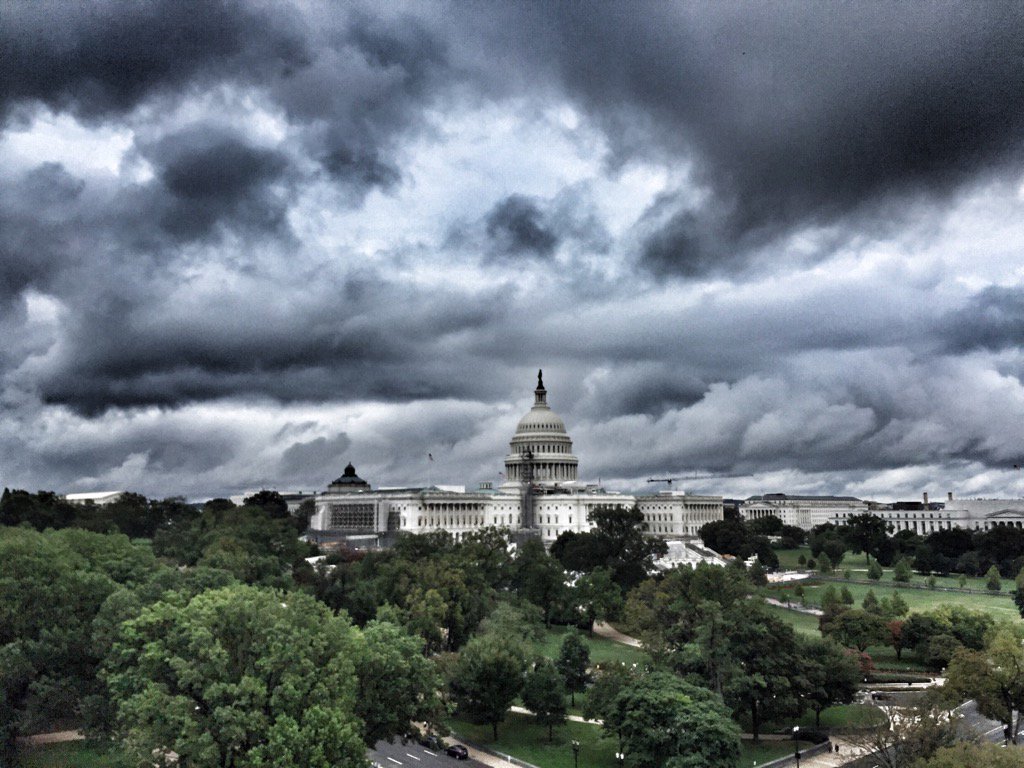
Truth Social launches DMs, remains sanctuary from social media Gestapo
Devin Nunes Published originally on Rumble on December 21, 2022
This is a good move by Truth Social creating Direct Messaging (DM) for their users.

18th Century Copper Riots & Private Money
Armstrong Economics Blog/Civil Unrest Re-Posted Jan 6, 2023 by Martin Armstrong
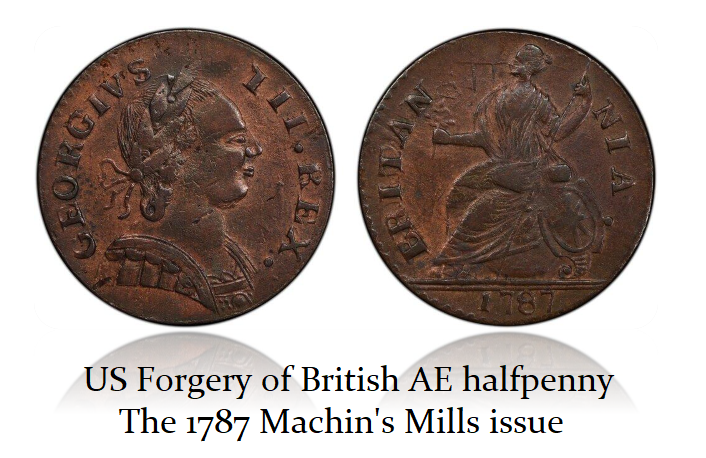
During the reign of King George III (1760–1820) the first issue of halfpennies actually was not issued until 10 years after his accession to the throne in 1770. Consequently, the vast number of halfpennies in circulation were actually all counterfeits. Indeed, counterfeiting became rampant at first because there was a coin shortage. In 1771, it was declared that counterfeiting copper coins were to be a serious crime. Nevertheless, this really made no difference. Over the course of the next twenty years, the majority of copper coins in circulation were forgeries. Even in the American Colonies, a favorite pastime was to counterfeit British halfpennies.
Coppers of this type are thought to have been minted from mid-1787 through 1788 and probably into 1789. Interestingly, it appears Thomas Machin first produced halfpence dated to the contemporary year as well as examples backdated to 1778. As the mints in Connecticut, New Jersey, and Vermont failed, their equipment ended up at Machin’s Mills. Along with imitation British halfpence, Machin’s Mills also produced illegal Connecticut coppers and some legal Vermont Coppers, with most of their Vermont coins being struck over counterfeit Irish halfpence. The illegal coining operation continued at Machin’s Mills until around early 1790, which was longer than any of the legal mints in New England.
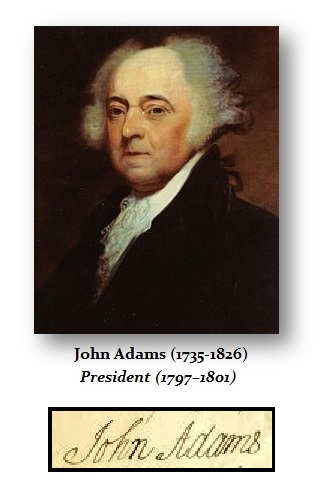
John Adams wrote to John Jay on April 10. 1787
“There is a vast sum in Circulation here of base Copper: to the amount of Several hundreds of thousands of Pounds. very lately these half Pence are refused every where: I suppose in Consequence of some Concerted Scheme. and it is supposed that they will be all purchased for a trifle and Sent to the United States where they will pass for good metal, and consequently our Simple Country men be cheated of an immense sum.2 The Board of Treasury, may be ordered with out the avowed Interposition of Congress, to give the alarm to our Citizens. and the seperate States would do well to prohibit this false Money from being paid or received.3
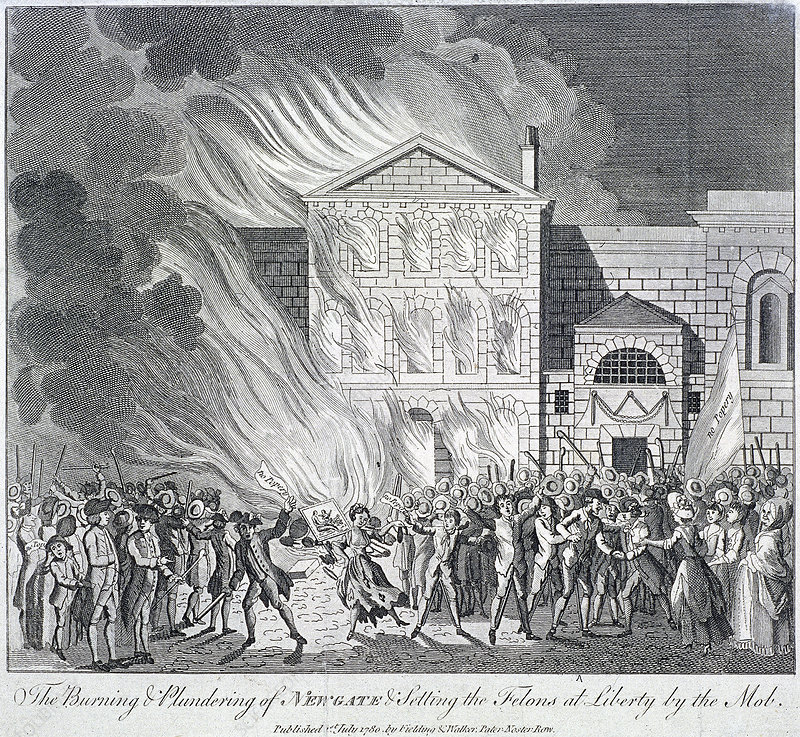
There was religious tension in Britain that still lingers to this day against Catholics. The Gordon Riots of 1780 took place over several days instigated by the anti-Catholic sentiment that again erupted with the passage of the Papists Act of 1778. That was an attempt to reduce official discrimination against British Catholics with the first legislation of the Popery Act of 1698. At the time, Lord George Gordon was the head of the Protestant Association. He argued that the law would enable Catholics to join the British Army and once in they would then use the army to plot treason. The protest became the excuse to burn people’s possessions, engaged in widespread rioting and looting, and they even used the opportunity to attack both Newgate Prison and the Bank of England. This was by far the most destructive riot in the history of London.
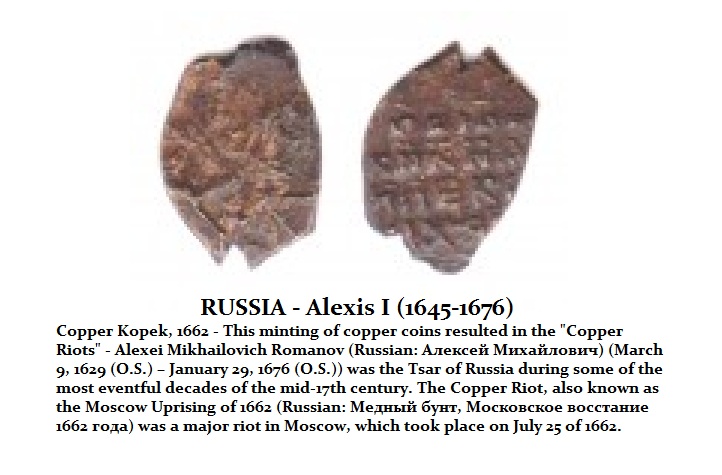
From the mid-1600s, the world money supply was increased largely with copper coins. Russia, in particular, began to overvalue the copper coins. Money is always fiat for its value is typically dictated by the government. Overvaluing copper as in the 17th and 18th centuries, led to the same trend of overvaluing silver during the 19th century. The result of this monetary manipulation by the Russian government led to what became known as the Copper Riots of 1662.
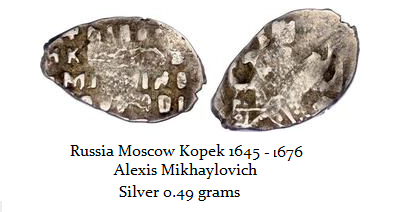
The Russian government began producing copper coins and monetizing them to be of equal value to silver Kopek currency with an average weight of about half of a gram to meet expenses during the mini-Ice Age. The effort failed and silver vanished from circulation as people began hoarding them causing the entire economy to collapse. The copper money was naturally devalued in purchasing power and then there were widespread counterfeiting operations since the official value of the copper coinage became far in excess of the cost of production. The economy collapsed into a deflationary black hole as businesses shut down and unemployment rose dramatically. This erupted into what has become known as the Copper Riots of 1662.
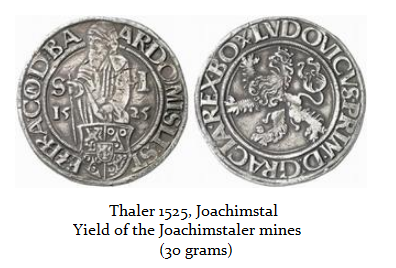
The German bankers, the Fuggers, emerged as the leading Augsburg merchant-banker, who then provided loans to local rulers secured with the silver produce of their mines. The discovery of vast silver mines eventually led to the development in 1525 of the one-ounce silver coin that was the thaler from which we derive the name “dollar” as the alternative to the British pound after the American Revolution. The Joachimsthaler of the Kingdom of Bohemia was therefore the first thaler ideally with a weight of 31 grams or one troy ounce.
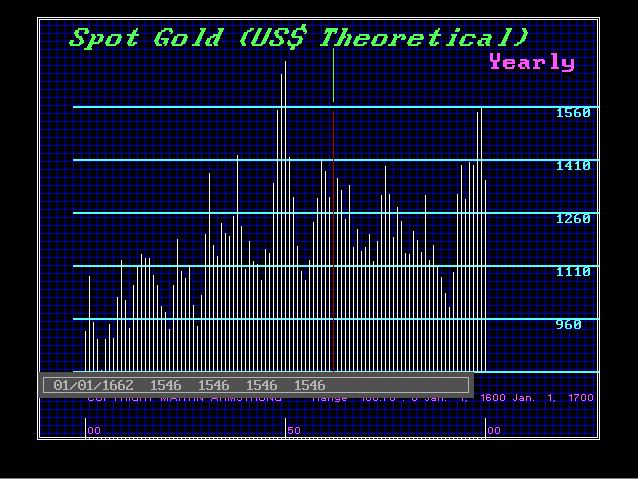
As the silver mines were declining, the decline in the supply of silver led to the rise of copper coinage during the next century. This was not an isolated incident confined to Russia. There was a shortage of precious metals going into 1662. It was most profound in Russia. Nevertheless, the price of gold rose sharply from the low of 1655 in a 7-year bull market. This also reflected the deflationary atmosphere that was emerging thanks also to the mini-Ice Age which was peaking during the 17th century yet would last well into the mid-19th century.
It was Spain’s silver mine known as the great red Cerro Rico or ‘Rich Hill’ that towered over the city of Potosí in Bolivia. It had been mined since 1545 by drafted armies of natives. The great silver boom of c1575-1635 was when Potosí alone produced nearly half the world’s silver. But the mine’s yield was starting to decline. By 1678, native workers became scarce and the output of the mines began to dwindle. This was the royal mint that produced vast amounts of ‘pieces of eight’, which became the precursor of the American dollar. The shortage of labor ended up being augmented by purchasing African slaves from the Dutch who were buying them under the pretense that they were the spoils of war, which had been the justification for slaves from ancient times.
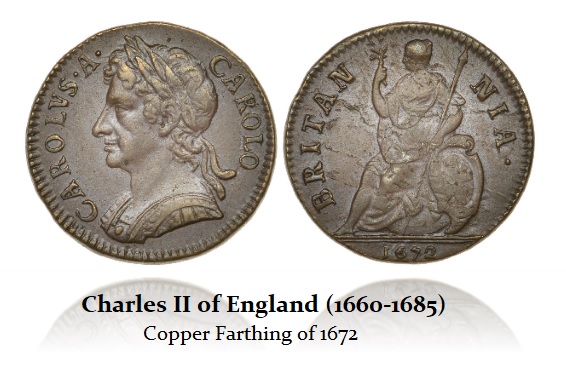
As the quantity of new silver in the world monetary system was declining, we begin to see the rise of copper coinage make its first appearance under James I of England (1603-1625). Due to a shortage of small coins, James I authorized John Harrington to issue tin-coated bronze farthings in 1613, and three main types were minted – the last being a slightly larger copper farthing without the tin coating. The first halfpenny was introduced in 1672 by Charles II (1660-1685). Charles II issued some copper halfpennies and farthings in 1672 for a single year but issued farthings again in 1873. The next issue of a farthing was struck in a tin but during 1684 and 1685.
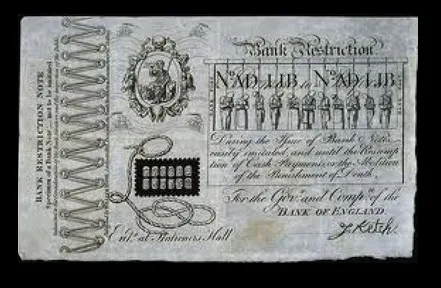
However, in 1694 the Bank of England was established to raise money for King William III’s war against France. The Bank started to issue notes in return for deposits. Therefore, the money supply for the first time began to include paper currency. By 1695 the first fraud took place. The authorities prosecuted Daniel Perrismore for forging sixty £100 notes. This incident caused the Bank of England to introduce a watermark in the paper to prevent such fraud. This was further enhanced by making counterfeiting subjected to the death penalty as a felony resulting in the confiscation of all your wealth and throwing your family out of the street as well. Pictured here, is a protest imitation note. The law was being prosecuted on the mere possession of a forged note. The complaint here was that these one-pound notes were easily forged and innocent people were duped, thereby committing a felony by mere possession. They were being hanged with no proof that they created the forgery – merely that they possessed one. This was creating an incentive not to even accept the notes in transactions.
George I, II, and III all issued copper halfpennies. George III’s halfpennies were dated 1770 to 1772. The economic hard times no doubt contributed to the riots of 1780. After those events, at Newgate Prison in March 1782 a female alleged counterfeiter of halfpennies was hanged. She was then fixed to a stake and burned before the debtor’s door at Newgate prison in London as a further example of not to counterfeit.
In a letter to Lord Hawkesbury on April 14th, 1789, Matthew Boulton, who is considered the Grandfather of modern coinage, commented
“In the course of my journeys, I observe that I receive upon average two-thirds counterfeit halfpence for change at toll-gates, etc., and I believe the evil is daily increasing, as the spurious money is carried into circulation by the lowest class of manufacturers, who pay with it the principal part of the wages of the poor people they employ”.
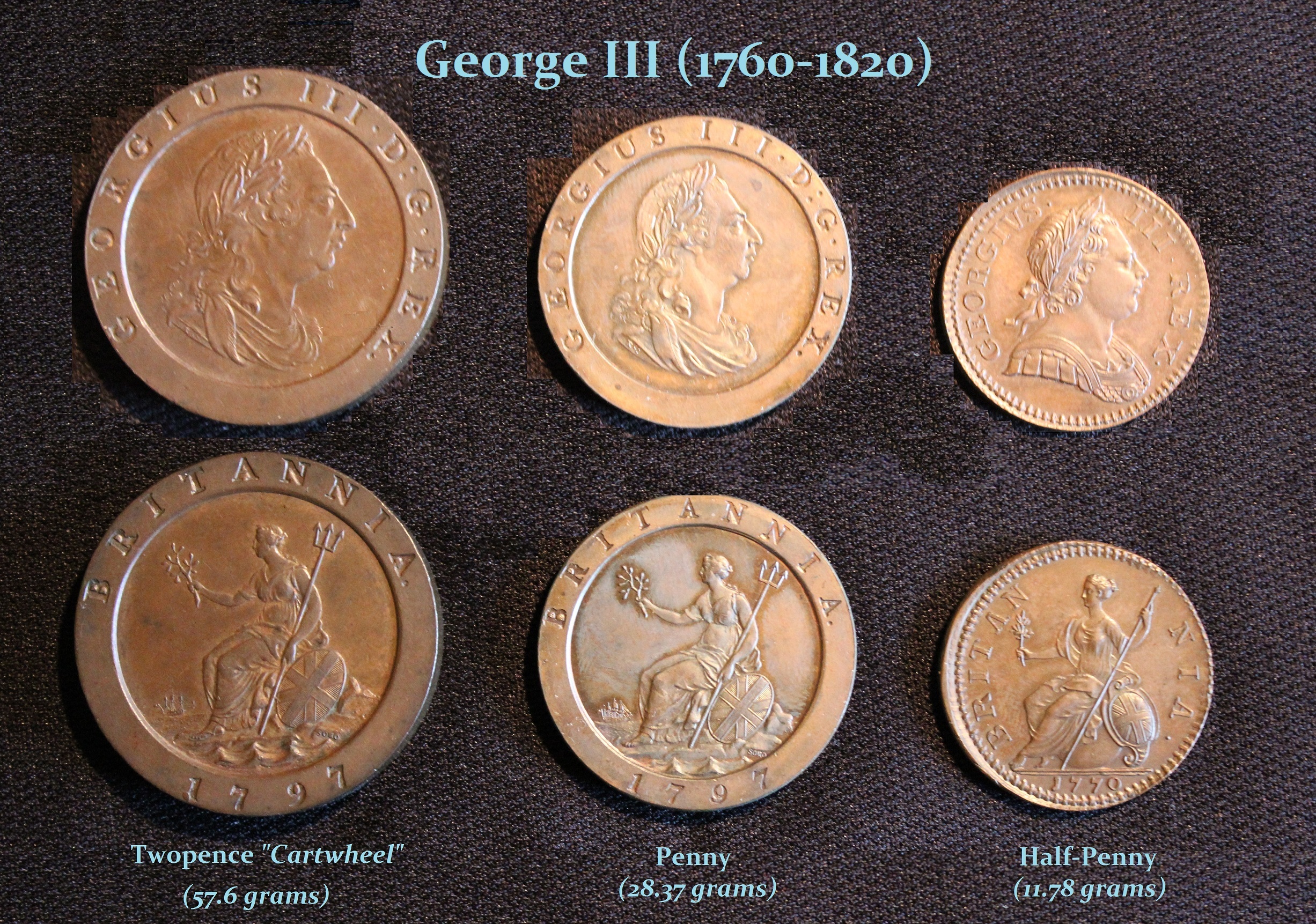
Boulton’s contract in 1797 to produce the Cartwheel pennies and twopences, thwarting the counterfeiters, did not extend to producing the halfpenny, though Boulton had expected that it would, and had prepared patterns of the appropriate size and weight in accordance with his ideas on the intrinsic value of copper coins. The reason the government gave for the omission of the denomination from the contract was that a large number of de facto halfpennies (including tokens and fakes) would be driven out of circulation and Boulton would be unable to produce enough coins to meet the demand that would ensue.
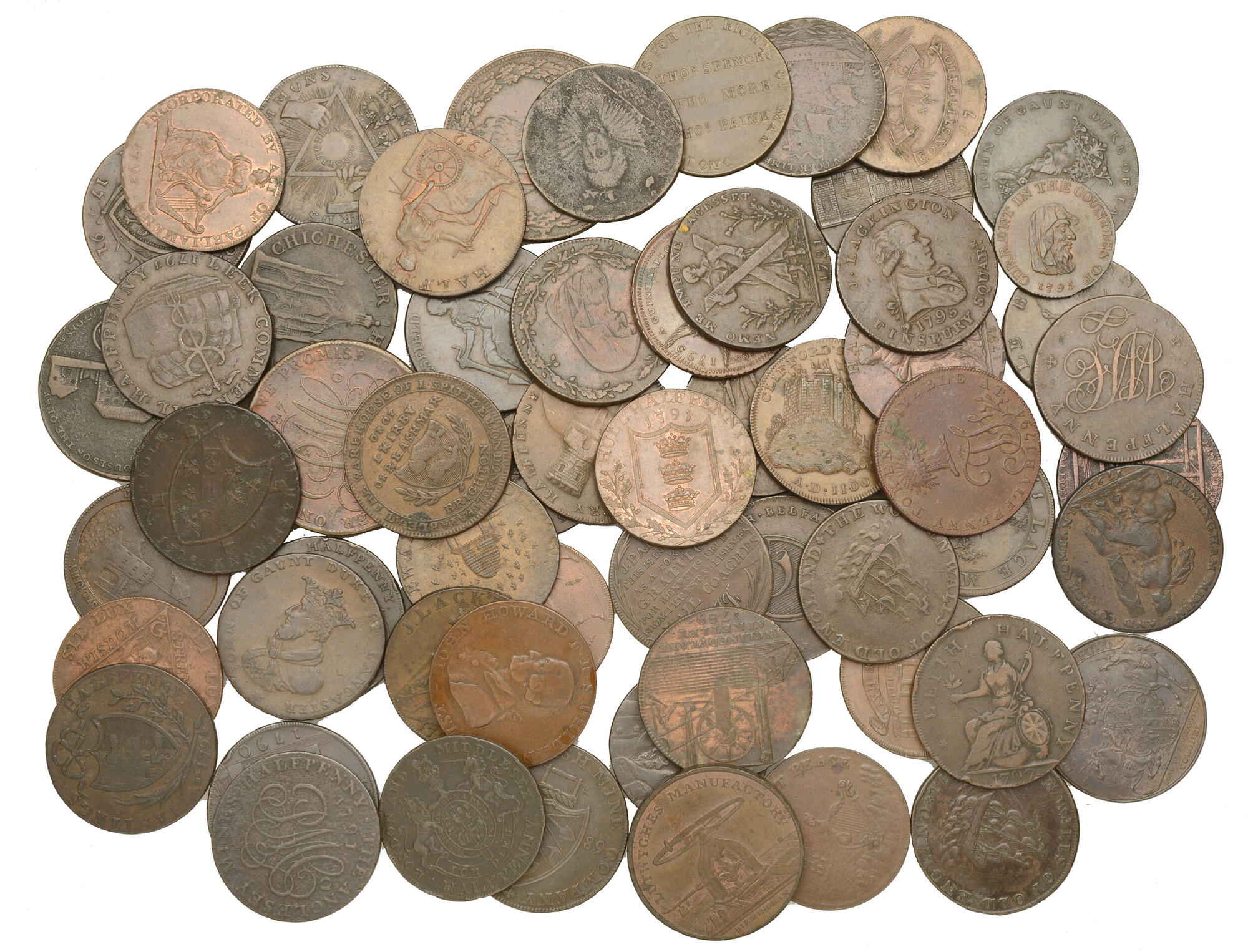
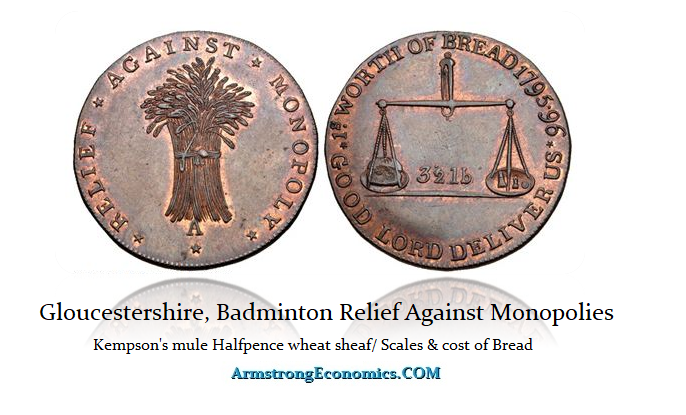
To avoid being hung for counterfeiting and burned at the stake, there was a multitude of halfpenny tokens. Many were of a political nature as this one complaining about the cost of bread. The government yielded to the private halfpenny tokens which became the majority of the small change. The overall public demand for legal halfpennies soon forced the government to change its mind, and in 1798 a contract was issued to Boulton for him to produce halfpennies and farthings dated 1799.
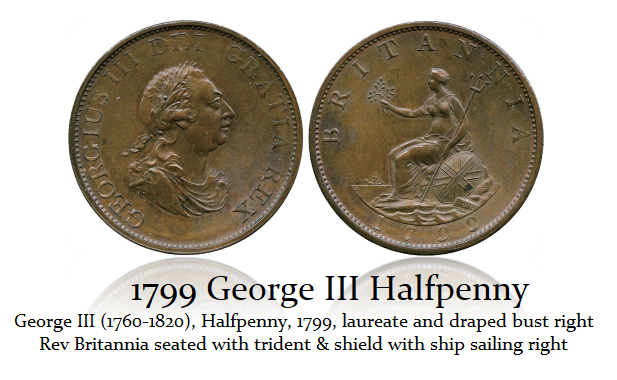
Interestingly, it was also at this time when inflation sent the price of copper rising, and consequently, the weight of the coins was reduced slightly, which resulted in them not being as popular as expected. In 1806 a further 427.5 tons of copper was struck into halfpennies by Boulton, but the price of copper had risen again and the weight was even less than the 1799 issue. This time, however, there was no unfavorable reaction from the public, so perhaps the national obsession with “intrinsic value” had run its course.
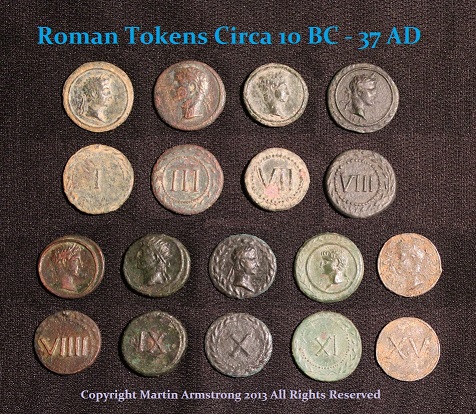
This was a very curious period where private money dominated the money supply for halfpennies. There are other periods where this has emerged in history primarily due to the shortage of real official money. One of the earliest such periods was during the reign of the Roman Emperor Tiberius (14-37AD).
Tiberius was legendary to be a frugal emperor. His deliberate contraction in creating new money led to the Financial Panic of 33AD. As far as Quantitative Easing, that too was nothing new. Tiberius offered loans INTEREST-FREE, but they had a limitation of three years. This was to prevent people from being forced to sell their estates further depressing land values.
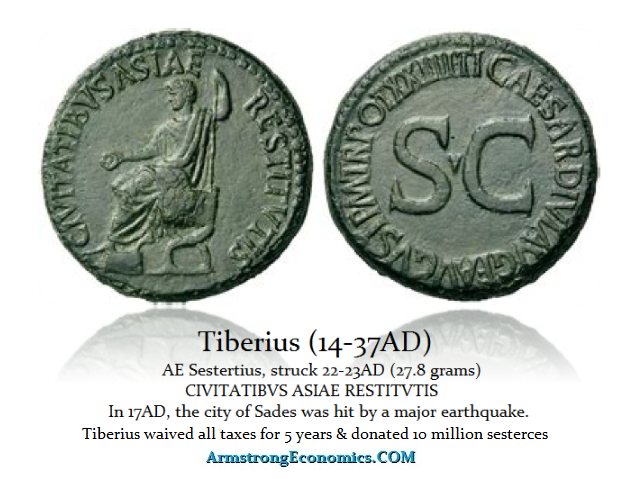
There was a major earthquake in Asia, modern Turkey, and this was so devastating, he issued coins stating they were for the relief of Asia. He also waived all taxes in the region for 5 years – something our modern-day politicians would never dream of.
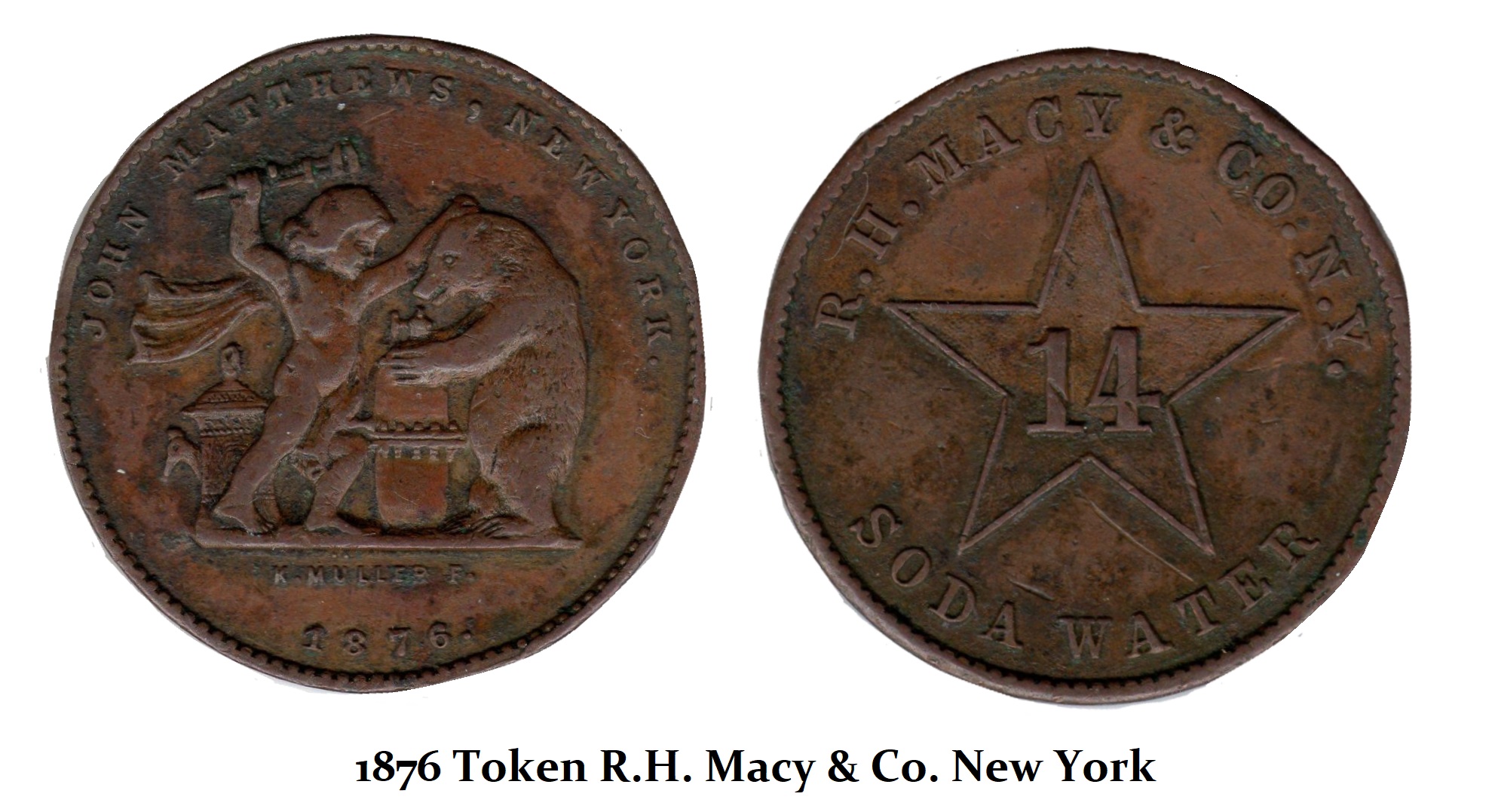
The lesson from history reveals that at times there emerges the acceptance of private money. During the 1870s, we also see private tokens circulating as money in the United States. Collectors call them the Hard Times Tokens. The very same thing took place during the American Civil War.
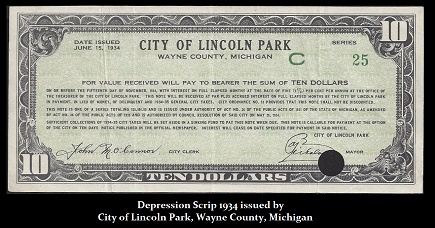
During the Great Depression, the shortage of money led to more than 200 cities issuing their own paper currency. As long as everyone in town accepted it, these Depressions Scrips enable people to work and to be paid locally when there was simply not enough federal money to go around.
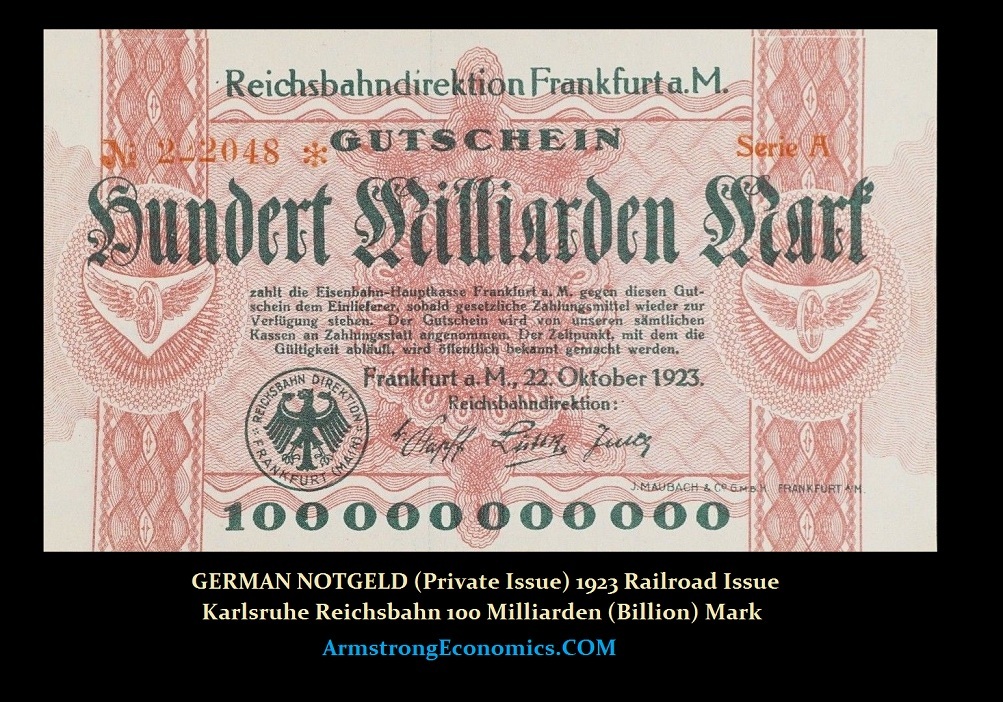
During the Hyperinflation in Germany of the 1920s, there again we see private currency being printed known as NOTGELD. Therefore, in the end, when the confidence in government declines, society is compelled to return to a barter-based society and that is when we begin to see private forms of money take hold.
The Coming Revolution – The End of Brazil
Armstrong Economics Blog/Central America Re-Posted Jan 6, 2023 by Martin Armstrong
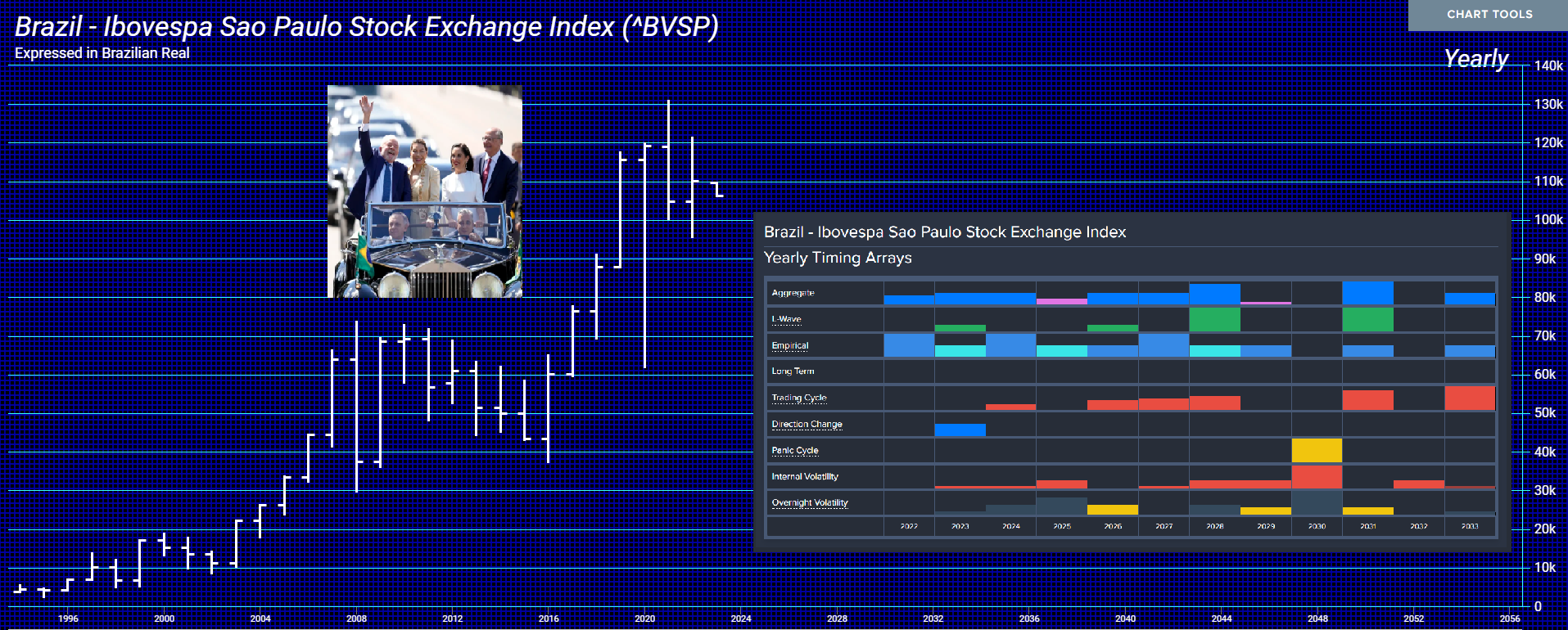
The leftist press immediately claims that any assertions of a rigged election in Brazil are as baseless as the Hunter Biden laptop. Our model shows that the election was in fact bogus and it was in a series of global elections that are being rigged to create this global leftist agenda. For any newspaper to immediately proclaim Bolanaro left the country amid “baseless” claims shows that they are just propaganda and part of the agenda.
Our model showed a serious Directional Change would take place in 2023, but we are looking at the complete collapse of Brazil and a major revolution unfolding in 2030. Leftist governments have ALWAYS, and without exception, resulted in declining economic growth. NEVER has even just one ever produced any economic benefit to the whole of any nation. Brazil has sealed its fate and it will take the rest of the continent with it. South and Central America have been plagued with Marxism and that is why the continent has been unable to rise from its knees. Even the Pope has been infected with this philosophy which is why he is always commenting on the economy rather than religion. This has led to many Catholics now saying – He Ain’t My Pope.
The Real Cost of War
Armstrong Economics Blog/War Re-Posted Jan 6, 2023 by Martin Armstrong

COMMENT: Good Morning Mr. Armstrong, a long-time reader and client of Socrates and your conferences. I just read your entry for Belarus drafting 18 to 60-year-olds. I had a feeling that eventually, that would take place here in the states. I can tell you without a doubt, I will never comply. My family has served in WWII and Vietnam. We have given enough. I absolutely despise our government. I am wondering if this is part of the continued collapse of the government. With such low recruitment levels and the political fallout from the past few years, they must realize people will not be forced to serve. Especially those with the means to defend themselves. Is this a main component of civil unrest here with separatist movements? Just curious if you can elaborate on what you think will happen when they institute a draft here.
All the Best.
J
REPLY: My family has fought in every war since the American Revolution. My cousin still has the musket on his wall from the American Revolution. I lost half of my high school friends to Vietnam and my father and his three brothers were all in World War II and my grandfathers on both sides of the family were in World War I. There is no question that in a time of war, the first shot fired is both silent and never against an enemy. It is always against any truthful reporting of events.
The Defense Casualty Analysis System (DCAS) Extract Files contain records of 58,220 U.S. military fatal casualties of the Vietnam War. The government propaganda site, Wikipedia also directed by the Deep State, has low-balled the casualties claiming in total, all US and allied military deaths reached 282,000. We claim that is a victory for the VC lost 444,000 to possibly 666,000. The civilians who died have been low-balled with estimates of 405,000 up to 627,000. Just turn to Britannica and you get:
“In 1995 Vietnam released its official estimate of the number of people killed during the Vietnam War: as many as 2,000,000 civilians on both sides and some 1,100,000 North Vietnamese and Viet Cong fighters.”
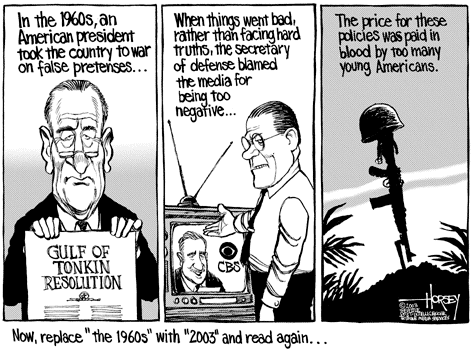
President Lydon Johnson knew there was no reason to enter Vietnam. He knew we could not get out easily. Still, he committed the country to war because the Neocons wanted it.
Audio Player
00:00
00:00
Use Up/Down Arrow keys to increase or decrease volume.

This is a famous photograph from Vietnam that is probably the most memorable of all time. You see South Vietnamese forces following terrified children. At the center is 9-year-old Phan Thi Kim Phùc, as she and other children are running from an aerial napalm attack on suspected Viet Cong hiding places on June 8, 1972. The plane accidentally dropped napalm on South Vietnamese troops and civilians. As always, just the collateral damage of war. The terrified girl had ripped off her burning clothes while fleeing. This photo was taken by Nick Ut of The Associated Press that captured the horror of Vietnam worldwide. It was 1972 when President Nixon said enough and promised to bring the troops home.
This 9-year-old make girl running from napalm, Phan Thi Kim Phúc, had profoundly changed her forever. Such people are tormented for a lifetime. They wake up at night dreaming over and over about the horror of those events for the rest of their lives. Kim Phúc was bitter and full of hatred she said. Later, she picked up the Bible and converted to Christianity. Today, she lives in Toronto with her family and helps other children victims of war around the world. It is those who survive who are profoundly tortured for the remainder of their lives. That is the real cost of war that nobody cares about.

The official estimate of civilian deaths in World War II stands at a total of 70–85 million. The actual military deaths were 21,000,000 to 25,500,000. There is ALWAYS an equal amount of civilian deaths in times of war. Those in power never want to talk about that.
Bidenomics – Amazon Announces 18,000 Layoffs, and They Are Not Alone – Imports and Exports Drop
Posted originally on the CTH on January 5, 2023 | Sundance
That slow grinding creak you hear in the background; that’s the U.S. economic engine running without oil and beginning that slowdown phase just before it stutters and stalls completely. Alas, the pretending continues…
As noted by the Wall Street Journal, an economic gaslighting institution with a central mission to maintain pretenses, “business surveys show U.S. factory activity declined in December, the Institute for Supply Management and S&P Global both said this week. Separately, S&P Global said Thursday that U.S. services-sector businesses reported a decline in output for the third month running in December.” This comes as “U.S. imports dropped more, by 6.4% on the month, as Americans cut back on holiday-related purchases, including items from other countries such as computers and autos.”
Keep in mind, November retail sales—which included consumer spending at stores, online and at restaurants—fell 0.6% from the prior month for their biggest decline of 2022, according to the Commerce Department. Manufacturing output declined in November as well, the Fed reported, while U.S. home sales fell for a record 10th straight month.
Into this mix of economic metrics, driven by a collapse in disposable consumer income and high energy prices, now we begin to see the number one business expense being curtailed.
(Market Watch) […] Amazon.com Inc layoffs will affect more than 18,000 employees, the highest reduction tally revealed in the past year at a major technology company as the industry pares back amid economic uncertainty.
The Seattle-based company in November said that it was beginning layoffs among its corporate workforce, with cuts concentrated on its devices business, recruiting and retail operations. At the time, The Wall Street Journal reported the cuts would total about 10,000 people. Thousands of those cuts began last year. (more)
Amazon is not alone, “Vimeo said Wednesday that it will cut its workforce by 11% as part of a broader effort to reduce costs, citing deteriorating economic conditions” (link). Additionally, Salesforce Inc. is laying off 10% of its workforce and reducing its office space in certain markets, extending a brutal period for tech job cuts into the new year.”
We can anticipate more reports like this from Reuters, “Samsung Electronics Co Ltd’s quarterly profit will likely plunge 58% to its lowest in six years as a global economic downturn saps demand for electronic devices and clouds the outlook for the memory chip industry. With consumers and businesses reducing spending and investment in the face of high inflation and climbing interest rates, smartphone makers and other clients held back memory chip orders, while smartphones sold for less as demand suffered, analysts said.”
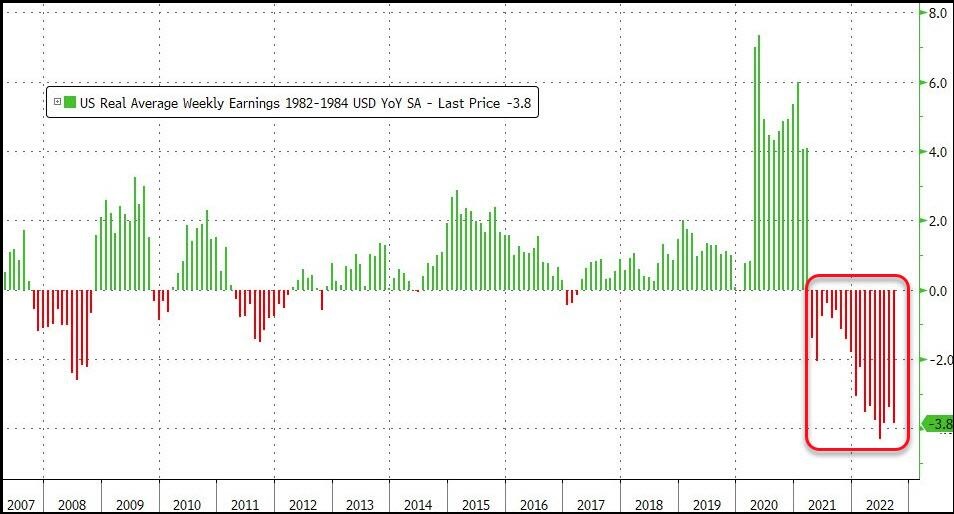
Electronics, cars, furniture, durable goods of all types and varieties are plummeting in sales. Consumers are being squeezed by inflation, housing, energy and food costs, and spending priorities are being reevaluated yet again. Compare the impact on ‘real wages’ -vs- the 2007/2008 economic crisis.
From a purely fraudulent accounting perspective, however, the drop in U.S. imports will help boost calculations of U.S. economic growth in the fourth quarter because trade deficits subtract from overall output, or gross domestic product.
U.S. consumers not purchasing imported goods makes the health of the U.S. economy look less bad; but it’s an illusion akin to smiles in the bread lines.
In other economic news, I did some real estate analysis over the past several days and it’s safe to say there is a steep downward trajectory in the data I use. Again, home values are nuanced on a regional level, but my model is pretty close in averaging.
If buyers do not absorb the seller’s loss in equity (which no one should ever do), in my SWFL area a $450k home listing is going to sell around $380k at the high side (actual value based on economic indicators and buyer ability). That rough estimate, while slightly offset due to general inflation, should trend nationally over the next 12 to 18 months. That means macro home prices dropping around 15 to 20% nationally over the next 12 months.
If you are a home buyer, put your offers around 15 to 20% below current asking price without any emotional attachment to it. Don’t flinch, remain ambivalent and walk away if refused. The recovery to current price will take around a decade. If you are a seller and get an offer within -10% of asking, consider yourself lucky and jump on it.

Nunes: Schiff pushed Twitter to ban journalist for exposing his fake Ukraine whistleblower
Devin Nunes Published originally on Rumble on January 4, 2023
The corruption just keeps pouring out of the DC Swamp, you wouldn’t think that much crap could exist in one spot, but it does!

Inflation & the Tricks of the Trade
Armstrong Economics Blog/Inflation Re-Posted Jan 5, 2023 by Martin Armstrong

Our inflation models came in at 32% for 2022. This does not include things like paper clips to bring down the entire average. This number is the basic core inflation that consists of food, energy, and transportation. We do not include housing values which rose about 11% in 2022, but because that is the national average, it understands places such as Texas and Flordia and over states California and areas such as Chicago.
Our index attempts to reflect the national core inflation of things that most people use. The largest increase was obvious fuel between gasoline and diesel used in trucking and homes averaging 65%+, eggs were up nearly 50%, flour rose by 25%, cooking oil 23%, Butter was up 35%, Chicken by 14%, and Rice by 18%.
The more things you throw in, the lower the inflation rate. The national average rise in rental rates was 7.8%, in Florida it was 8.5%, and in NYC 1.5% when controlled.
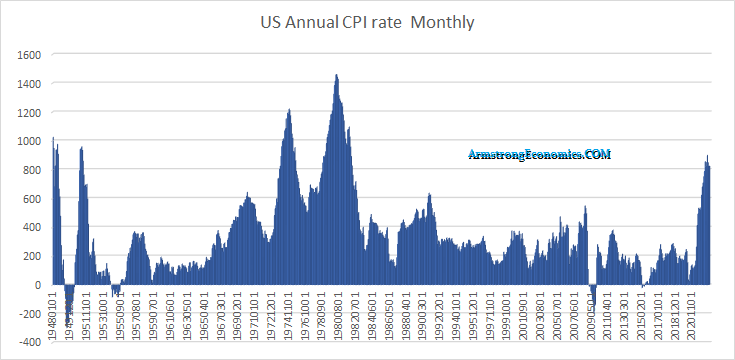
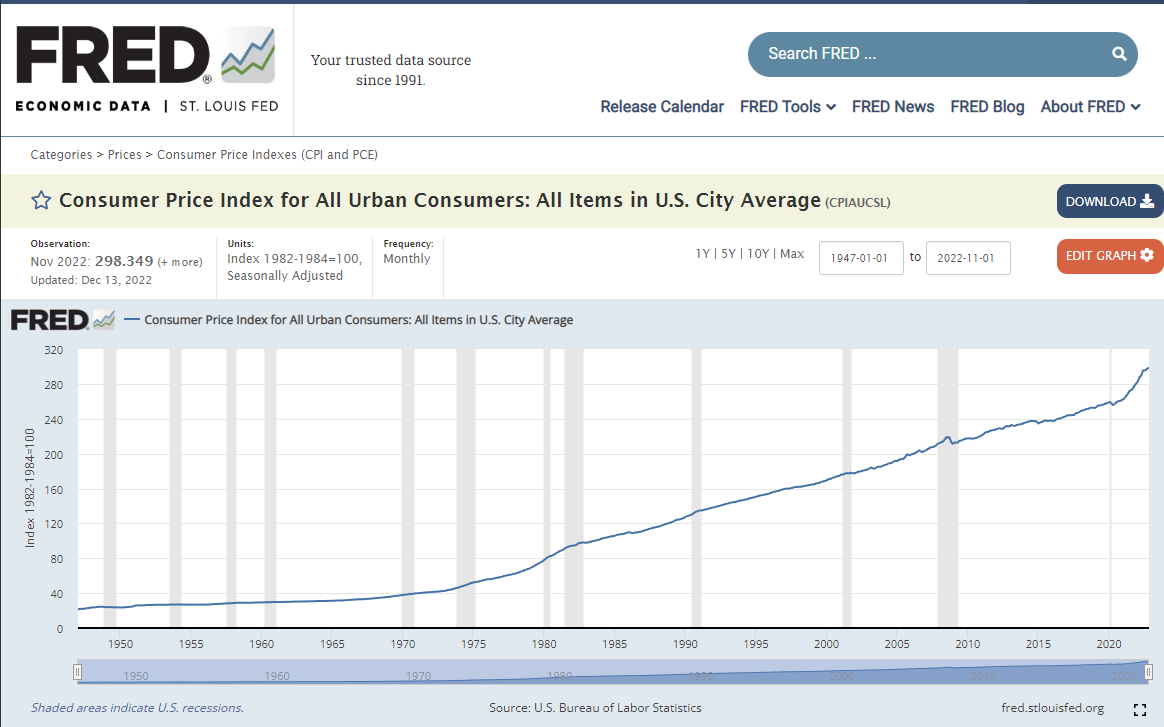
If we broaden the list to include rents and coffee, which was up 15%, we can bring it down to about 27%. The Fed broaden the scope so widely that the rate come down to about 7%. The more you include, the lower the inflation rate. The object is to reduce government spending which is indexed to the CPI.
War Against Conservatives
Blog/Press
Posted Jan 10, 2021 by Martin Armstrong
Spread the love
People are leaving Facebook, Instagram, Twitter, and were moving to Parlar. Google and Apple removed the Parlar APP and then Amazon kicked then off of AWS. This is a complete purge going on of all conservatives. We are in the midst of nothing short of a real live Russian version of a revolution. Cheer up – you get to see what it was like to live history in a major confrontation between left and right. But make no mistake about it, the super-rich remains in power just behind the curtain. They own the press and social media while they use the virus to prevent people from gathering or organizing. It is their way or no way. Their motto: Resistance is Futile!
 Centinel2012