EU Taxpayers Brace As Deepening Banking Crisis Means Euro-TARP Looms


Tyler Durden's picture

Authored by Don Quijones via WolfStreet.com, 

If the ECB scales back stimulus, banks face even greater risk of collapse. But now there’s a new solution

Events are moving so fast in Europe these days, it’s almost impossible to keep up. While much of the attention is being hogged by political developments, including the election in the Netherlands, Reuters published a report warning that the European banking sector may face even higher bad loan risks if the ECB begins to scale back its monetary stimulus programs, something it has already begun, albeit extremely tentatively.

The total stock of non-performing loans (NPL) in the EU is estimated at over €1 trillion, or 5.4% of total loans, a ratio three times higher than in other major regions of the world.

On a country-by-country basis, things look even scarier. Currently 10 (out of 28) EU countries have an NPL ratio above 10% (orders of magnitude higher than what is generally considered safe). And among Eurozone countries, where the ECB’s monetary policies have direct impact, there are these NPL stalwarts:

  • Ireland: 15.8%
  • Italy: 16.6%
  • Portugal: 19.2%
  • Slovenia: 19.7%
  • Greece: 46.6%
  • Cyprus: 49%

That bears repeating: in Greece and Cyprus, two of the Eurozone’s most bailed out economies, virtually half of all the bank loans are toxic.

Then there’s Italy, whose €350 billion of NPLs account for roughly a third of Europe’s entire bad debt stock. Italy’s government and financial sector have spent the last year and a half failing spectacularly to come up with a solution to the problem. The two “bad bank” funds they created to help clean up the banks’ toxic balance sheets, Atlante I and Atlante II, are the financial equivalent of bringing a butter knife to a machete fight. So underfunded are they, they even strugggled to hold aloft smaller, regional Italian banks like Veneto Banca and Popolare di Vicenza, which are now pleading for a bailout from Rome, which in turn is pleading for clemency from Brussels.

What little funds Atlante I and Atlante II have left are hemorrhaging value as the “assets” they’ve been used to buy up, invariably at prices that were way too high (often at over 40 cents on the euro), continue to deteriorate. The recent decision of Italy’s two biggest banks, Unicredit and Intesa Sao Paolo, to significantly write down their investment in Atlante is almost certain to discourage the private sector from pumping fresh funds into bailing out weaker banks.

Which means someone else must step in, and soon. And that someone is almost certain to be the European taxpayer.

In February ECB Vice President Vitor Constancio called for the creation of a whole new class of government-backed “bad banks” to help buy some of the €1 trillion of bad loans putrefying on bank balance sheets. Constancio’s idea bore a striking resemblance to a formal proposal put forward by the European Banking Authority (EBA) for the creation of a massive EU-wide bad bank that, in the words of EBA president Andrea Enria, would “make it much easier to achieve critical mass and to create a well functioning market for (impaired) assets.”

Here’s how it would work, according to Enria (emphasis added):

The banks would sell their non-performing loans to the asset management company at a price reflecting the real economic value of the loans, which is likely to be below the book value, but above the market price currently prevailing in illiquid markets. So the banks will likely have to take additional losses.

The asset manager would then have three years to sell those assets to private investors. There would be a guarantee from the member state of each bank transferring assets to the asset management company, underpinned by warrants on each bank’s equity. This would protect the asset management company from future losses if the final sale price is below the initial transfer price.

One of the biggest advantages of launching an EU-wide bad bank is that it would avoid the sort of public “resistance” that would occur if it was done at a national level, says Enria. Italian lenders would presumably be able to continuing pricing bad loans at or around 40 cents on the euro on average, even though their real value — i.e. the current value priced by the market — is often much lower. The difference between the market price, if any, and the price the banks end up receiving for their bad debt will be covered by Europe’s taxpayers.

If given the green light, the scheme would pave the way to the biggest one-off bail out of European banks in history. It would be Euro-TARP on angel dust, with even fewer checks and balances and much less likelihood of ever recovering taxpayer funds. According to a banker source cited by Reuters, while Germany has not yet endorsed the EBA plan, the EU documents describe the development of a secondary market for NPLs as a priority. According to Enria, the EBA hopes to finalize matters “at the European level” in the Spring.

The documents also include proposals for a wider “restructuring of banking sectors” as states address the NPLs problem. This “could lead to mergers among EU banks after they offload their bad loans,” a banking industry official said.

In other words, EU taxpayers would have to spend potentially hundreds of billions of euros saving yet more banks from the consequences of their own acts and bail out their bondholders and potentially their stockholders too, with funds desperately needed in other areas. Those banks, once saved and their balance sheets cleansed, would then be handed on a platter to much bigger banks. In return, taxpayers would end up with an even more concentrated, consolidated, interconnected financial system that is even more prone to abuse, corruption, and excess.

The ECB’s policy isn’t about creating inflation but about keeping a financial system and a currency union from collapsing upon each other. Read…  ECB Trapped in its Own “Doom Loop” as Inflation Surges

Dutch Election Results Confirm ‘Far Right Populism’ Still On The Rise In Europe


Tyler Durden's picture

Authored by Alex Gorka via The Strategic Culture Foundation,

Those who support the idea of globalism and strive for closer European integration believe the results of the Dutch election indicate the tide has been stemmed, with Eurosceptics and «populist» forces on the defensive. The buck stops here. This is the end of domino effect. The reshaping of Europe has been prevented. The pro-NATO, pro-EU establishment elites are to see glory days again.

Is it really so if you get to the bottom of it?

The future of Europe remains to be at stake, including the UK, Germany and France. Will the concept of United Europe exist in one form or another? Will Scotland stay in the United Kingdom? Will Germany and France distance themselves from the United States? Some of these questions could be answered sooner than expected.

This year may become a turning point with the votes to take place in Germany, France and, probably, Italy. In a month, France will have a new president and Germans will have a new parliament elected in September. The example of the Netherlands may have little influence on the votes.

Let’s look at the facts. Geert Wilders’ Party for Freedom made a substantial gain. It won 20 seats (of 150) according to the preliminary results, which is 5 seats more than in the previous election in 2012. The two governing parties got half as many seats as at the last election in 2012. The prime minister’s Party for Freedom and Democracy lost 8 seats and its coalition partner, the Labor Party (PvdA), lost 29 – an impressive defeat!

Actually, it’s a significant loss for those who ruled the country and a big gain (not big enough but still) for the right wing Eurosceptics led by Wilders. Many key points of the Party for Freedom’s program were «borrowed» by PM Mark Rutte’s People’s Party for Freedom and Democracy (VVD) and Christian Democrats. The popularity was raised due to the tough stance taken in the conflict with Turkey – something Wilders had been calling for. Actually, Prime Minister Rutte was riding to power on a wave of anti-migrant, anti-Islam sentiments.

The Sybrand Buma’s Christian Democratic Appeal (CDA) is all but certain to participate in the next governing coalition with 19 seats won (12, 5%) – an increase of 6 seats. The party has gained ground by adopting a tough line similar to Rutte’s on immigration, adding a focus on communal values and a touch of nationalism to tap voter concerns about Dutch identity. It has proposed introducing singing the national anthem in schools and mandatory community service. According to Sybrand Buma, Her Majesty Queen Máxima should renounce her Argentine citizenship (she was born in Buenos Aires). The CDA presence in government would ensure a conservative stamp on any coalition.

Media rarely mention the fact that another right wing anti-EU and anti-migrants party – the Forum for Democracy – took part in its first election to win 2 seats (1,8%) – not a bad start for a party created only in September 2016. It calls for restoring ties with Russia among other things.

The main result is opposite to what it appears to be at first glance. The outcome of the Dutch election conforms to the current trend – Euroscepticism is on the rise across Europe. The winning forces are often called populist but in reality they are anti-establishment movements which emerged as a result of voters being fed up with left or right windbags. People want them gone and the entire political landscape in Europe fundamentally changed.

Socialists have few chances in France and the chances of Angela Merkel becoming Chancellor again are dim enough. Martin Schultz is a serious rival to reckon with.

Newly founded or old anti-establishment parties continue to make gains. Perhaps not today, but they will come to power. In a couple of months Marine Le Pen may become President of France to radically reform European politics. Even if she loses, Le Pen will remain the most popular politician in the country who is able to win the presidential election in 2022. Artificial creations designed by experts for a particular task, like Emmanuel Macron, for instance, can’t stop it. Nothing can prevent the new wave of politicians from coming to power.

The Dutch election has not changed anything. It has failed to turn the tide. The EU continues to fall apart. The European integration will never be the same. More and more EU members challenge the existing pattern.

The March 16 vote in the Netherlands is far from being a harbinger of Eurosceptics’ movements fading away. Quite to the contrary, it has confirmed the trend – the Old Continent is going through changes. We’ll never have the EU we once knew. The process may temporarily slow down but it’s too late to stop it.

Israel Threatens To Destroy Syrian Air Defense Systems


Tyler Durden's picture

Two days after Syria claimed it had shot down an Israel jet over its territory on Friday morning, an incident Israel denied even if it admitted violating Syria’s sovereign airspace by engaging in an air raid near Palmyra, the Israeli defense minister threatened to destroy Syrian air defenses after they shot (but allegedly did not down) at Israeli warplanes, which violated Syrian airspace and bombed targets on Syrian soil.

Next time, if the Syrian aerial defense apparatus acts against our planes, we will destroy it,” Avigdor Lieberman told Israeli Public Radio on Sunday, in a statement which seemed to lend credence to the Syrian contention that it had taken down an Israel jet.

It was not exactly clear why Israel was so offended by Syria “acting against” its planes which were located above Syrian airspace at the time of shooting. In any case he warned that “we won’t hesitate. Israel’s security is above everything else; there will be no compromise.”


An Israeli F-15 fighter jet

The minister was referring to the previously reported morning raid of the Israeli Air Force, the latest of several reported over the past few years, in which Israel claimed it targeted weapons bound for the Lebanese militant movement Hezbollah. Israel says it has to protect itself from advanced weapons which the militants try to obtain from the Syrian government. Syria shot surface-to-air S-200 missiles at the Israeli planes as they were flying back from the night mission. As noted above, Damascus claims it shot down one of the planes, although Israel still denies.

The Israeli media said one of the Syrian missiles was intercepted by Israel’s Arrow air defense system. According to RT, it was the first time Israel officials have confirmed combat use of the advanced anti-missiles, which are originally meant to intercept heavy long-range ballistic missiles. The Israeli military is investigating whether the decision to fire Arrow interceptors against the Syrian anti-aircraft missiles was justified, according to Haaretz.

The former prime minister and defense minister, Ehud Barak, said Saturday that the involvement of the system forced Israel to acknowledge cross-border military activity. “It could be that with more thorough thought, it wasn’t worth firing,” Barak said at a community lecture in Be’er Sheva. “We have usually tended to reserve what would be called ‘room for denial’ for Syrian President [Bashar] Assad,” he added.

While Israeli acknowledgment of an intervention in Syria is rare, it is not unprecedented. Last April, Prime Minister Benjamin Netanyahu confirmed for the first time that an attack on dozens of Hezbollah targets in Syria was indeed conducted by Israeli warplanes, as speculated by the media.

And, perhaps to give Syria just the opportunity to “provoke” it, on Monday morning, according to several media reports Israel has again bombed a Hezbollah convoy in Syria. It was unclear as of publication time if Syria had retaliated

The Exchange Stabilization Fund – What Is It?


US Treasury Bldg

Apparently, some people have discovered the Exchange Stabilization Fund and are now touting this as some major power in manipulating the world economy. This is simply an emergency reserve fund of the US Treasury Department, which is typically used for foreign exchange intervention. This arrangement really goes back to the birth of the G5 and is the alternative to having the central bank intervene directly in foreign exchange. This is a Treasury function, which allows the US government to try to influence currency exchange rates without affecting domestic money supply created by the Federal Reserve.

Unlike those who are trying to sell newletters touting this as the new great manipulator, it holds less than $125 billion in funds which includes special drawing rights (SDR) from the International Monetary Fund. Trust me, there is no such great power that can manipulate the world economy. They have done their best to try to prevent the dollar from rising. They will fail as they did in 1987 and every other attempt to peg currencies. They are INCAPABLE of altering the capital flows.

Are Cycles Universal or Regional?


PopulationOfRome

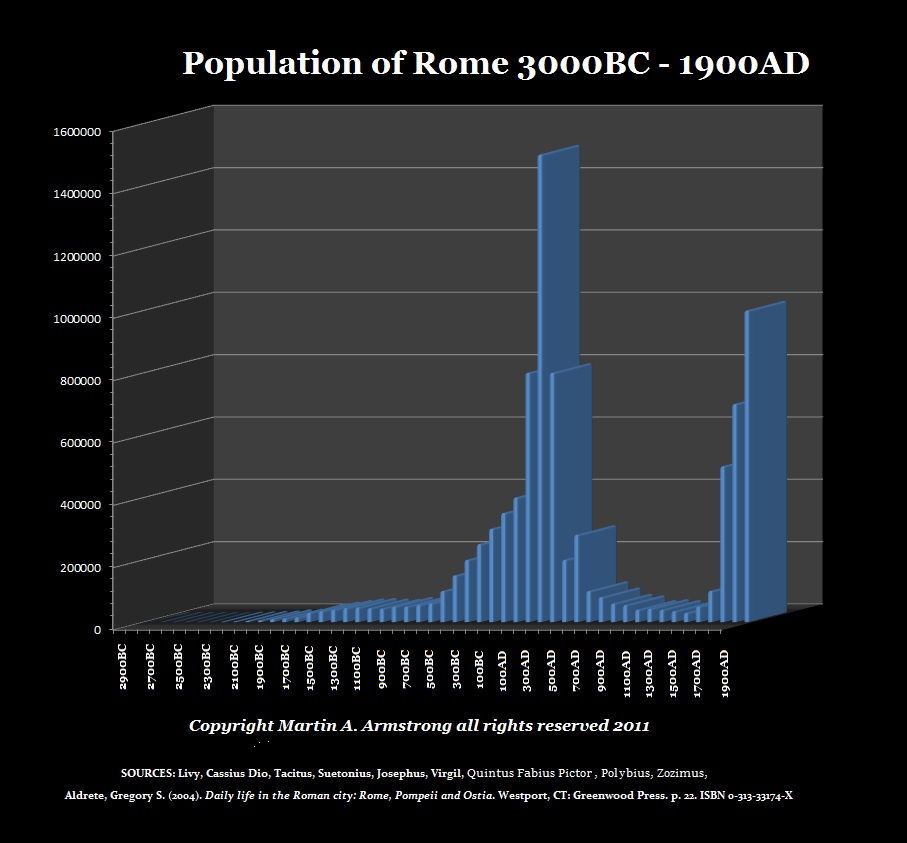
QUESTION:  I have a question regarding cycles. You provide some very detailed, historic references showing why certain events are occurring now (again). Is there a disposition for something that occurred in the past to be destined re-occur for a particular region/country (i.e. Greeks abandoning property due to excessive taxation) because it happened once and now the propensity to repeat that causal action again is “in their DNA”. Is that something we as Americans do not yet possess because we have not been around long enough to experience a “fall of Rome” type event?

SM

ANSWER: Cycles are based upon two element – (1) nature and (2) human nature. Some regions will be prone to natural disasters while others are not. Ironically, many of the best ports where cities grew such as Tokyo and San Francisco just as examples, were great harbors because of earthquakes. The landscape in California is strikingly beautiful compared ot the flat plain in Oklahoma, again because of earthquakes. The rocks that appear in Central Park in New York City are there because an earthquake fault runs through New York City making the harbor what it was. Hence, there are cycles that impact only on a regional basis due to nature.

With regard to Greeks walking away from inheritance because they cannot pay the tax, this is inherent to all societies when government goes too far. They imposed harsh laws in Vancouver against foreign real estate buyers and the market crashed. Because it was a local law, they moved to Victoria and Toronto. In Australia, they are seizing properties own by foreigners and selling them off. All of these types of interventions are reactions to events set in motion externally.

realestate

That said, this is the US cycle for real estate as a national whole. I just bought a house in Florida at about 50% of its 2007 high value. Trophy spots for the high end where people are just parking money we warned would make new highs going into 2015.75 – but that is not the bulk of the market. Why is the US market (minus trophies) down hard when that is not the case in other countries? The difference is the regional issue. In the USA, many people have 30 year mortgages. In Canada, the best you can get is a 10-year fixed mortgage. In Germany, you can get up to a 15-year fixed mortgage.

We must understand that property values are LEVERAGED, so if the money for fixed rate loans dries up because of interest rate hikes and political uncertainty, then real estate prices MUST fall. This is all because of the leverage that was deliberately injected into the real estate market during the Great Depression for property fell  in value so far, only cash buyers could buy anything. Farm land fell in value to below what it was sold for by the government more than 80 years before.

Real estate is different from stocks and gold. Yes it is a place to park money. However, be careful because without mortgages available, it falls further than other tangible assets because it has been LEVERAGED! Moreover, it is a fixed asset meaning you cannot leave with it. Therefore, people are forced to simply walk away when (1) the tax burden is too high and (2) there is war and the region is being invaded.

Deutsche Bank: “The Probability Of A Negative Shock Is High”


Tyler Durden's picture

For the second week in a row, Deutsche Bank’s strategist Parag Thatte has a somewhat conflicted message for the bank’s clients: on one hand, he writes that positive economic surprises continue “but are getting less so”, and although the divergence between har data surprises and sentiment is diminishing the bank is somewhat confident that a “pullback in the very near term is unlikely” (here DB disagrees with Goldman Sachs). However, Thatte is increasingly hedging, and notes that because a “rally without a 3-5% sell-off that is typical every 2-3 months is now running over 4 months and is in the top 10% of such rallies by duration”, he cautions that “the probability of seeing a negative shock is high” especially since Q1 buyback blackout period has begun.

Here are the key observations from the Deutsche Bank strategist:

  • The equity market rally has been going uninterrupted for a long time, driven by the unusual resurgence of positive data surprises. Strong data surprises drove equity inflows and fund positioning, adding to the steady support from buybacks. An expectation that positive data surprises were likely to persist underpinned DB’s call 2 weeks ago that a pullback was unlikely in the very near term. The bank takes stock of the current situation below:
  • Duration of rally now in top 10%. The rally without a 3-5% sell-off that is typical every 2-3 months is now running over 4 months and is in the top 10% of such rallies by duration.

  • Data surprises positive but getting less so. While incoming data in the last week has continued to surprise to the upside relative to consensus, it has done so at a more modest rate and DB’s data surprises index, the MAPI, is now declining off its highs.

  • Divergence between sentiment and hard data surprises diminishing. Attention has focused on the divergence between sentiment data which has run up strongly and hard data which has so far lagged. In terms of surprises, i.e., relative to what’s priced into consensus forecasts, hard data surprises have fallen back to neutral over the last two weeks, while sentiment surprises have declined this week but remain elevated. The surge in sentiment data is getting built into consensus forecasts and sentiment surprises also moving down to neutral over the next 3-4 weeks.

  • Fund positioning already trimmed in line with neutral hard data surprises. US funds have already been trimming equity exposure for the last three weeks in line with the decline in hard data surprises suggesting funds may already be anticipating a modest slowdown in overall data. Real money equity mutual funds are already close to neutral but asset allocation funds and long-short equity hedge funds are still overweight. Macro hedge funds are exposed to short rates positions in our view, not long equities.

  • Inflows accelerate. The pace of US equity fund inflows has accelerated over the last 4 weeks ($36bn). However flows have been closely tied to overall data surprises and could start to moderate in turn.

  • Buyback blackout period has begun. Heading into the Q1 earnings season, the pace of buybacks will slow as an increasing number of companies enter earnings blackout periods starting this week.

* * *

DB’s summary take on near-term equity moves:

Continued muddle through most likely in the near term. The fundamental drivers as well as demand-supply considerations for equities point to a continued muddle through in the near term. However history suggests that with the duration of the rally already in the top 10% by duration, the probability of seeing a negative shock is high. But the medium term outlook remains robust with the unfolding growth rebound having plenty of legs while from a demand-supply point of view flow under-allocations to US equities and robust buybacks remain very supportive.

* * *

Away from equities, the picture in rates, commodities and currencies based on trader flows is as follows:

  • Oil falls but still expensive and long positioning still elevated. Following the November OPEC supply-cut announcement oil prices became very expensive on our medium term valuation framework for oil and commodities based on the trade-weighted dollar and global growth (Trading The Commodity Underperformance Cycle, Apr 2013). The decline in oil prices over the last two weeks has trimmed the extent of overvaluation but leaves oil prices slightly above the upper-end of the historical 30% overvaluation band which has marked extremes (currently $48). Net long positions are off of recent record highs but remain quite elevated.
  • Extreme short positions remain an overhang for rates moving up. Bond yields fell sharply after the rate hike this week much like they did after the December one. While real money bond funds remained close to neutral going into the FOMC this week, leveraged funds shorts in bond futures remained near extreme highs. Outside of HY funds which saw a large outflow as oil prices fell this week, bond funds have continued to receive robust inflows. Indeed duration sensitive funds have this year completely recouped all of the outflows seen in the aftermath of the elections.
  • Gold valuations stretched again. Gold prices have rallied on the back of a return of inflows into gold funds this year reversing the modest outflows in Q4. Massive cumulative inflows since early 2016 ($40bn) remain an overhang. Gold longs had been declining heading into the FOMC meeting. Gold prices have again disconnected sharply to the upside from the historical drivers of the dollar and the 10y yield as well as global growth. Copper long positions continued to slide for a 6th straight week.

  • Shorts in the Mexican peso, the best performing currency this year, have collapsed to neutral. Mexican peso shorts fell sharply last week to the lowest levels in over 15 months as gross shorts fell sharply while longs also rose. Aggregate long dollar positions had been rising going into the FOMC meeting reflecting rising shorts in the yen and sterling even as euro shorts were pared.

Why Do Leftists And Globalists Hate Tribalism So Much?


They the globalists/New Word Order/One World Government believe that can create a Utopia with them on the top managing/ruling the entire world. The problem is that it isn’t possible to do that no matter who was trying.

Bitcoin’s ‘Fork’ In The Road


Tyler Durden's picture

Authored by Vinny Lingham,

I’ve been very surprised with the amount of vocal support for a Bitcoin Hard Fork – especially from many Bitcoin supporters who believe it is either inevitable or “not a bad thing”. I get it, but you’re wrong. I know everyone is tired of the scaling debate. I’m not going to go into the technical details around this debate for this post, but instead, I’m going to focus this post on debunking the non-technical arguments for a Hard Fork and highlighting the ensuing confusion and market impact that a contentious Bitcoin Hard Fork will have, if we indeed have a split between Bitcoin Core and Bitcoin Unlimited.

Exchanges today have just confirmed they will be listing BTU as an altcoin if there is a Hard Fork?—?this scares me because although the industry person knows what an altcoin is?—?the average person outside the industry doesn’t. This was the catalyst for my post today.

I have predicted that Bitcoin should hit $3,000 by end of this year?—?but not if there is a contentious Hard Fork.

Keep in mind that the hope of this post is that it changes the mindset around support for a contentious Hard Fork, which creates another Bitcoin, because I believe this needs to be avoided at all costs. In fact, if any of the scenarios below begin to play out, we’re already in trouble… If you agree with the logic below, translate this post into Mandarin and any other language and let’s convince miners and the community to not consider even doing a Bitcoin Unlimited Hard Fork.

Also, even after the big bug in Bitcoin Unlimited yesterday, more nodes are back up and running signalling it. I know many people don’t believe it will happen and they may be right, but we cannot ignore a persistent and growing threat to the ecosystem and so I’m speaking out about it now.

For more background on the Bitcoin Unlimited vs Segwit debate, check the bottom of this post for links, including a number of technical reasons why a Hard Fork is a risky proposition for Bitcoin. I’m also not delving into the technical debate as that has been done ad nauseam elsewhere.

Bitcoin’s greatest asset is its brand awareness!

It’s inarguable that Bitcoin is the single strongest brand in the crypto space. I believe it probably received $2–5bn in free media exposure over the years. A Hard Fork would create 2 brands of Bitcoin?—?essentially handing over some brand value to Bitcoin Unlimited. I wrote a post about Bitcoin’s power and network effect over 2 years ago?—?it’s worth reading if you haven’t.

The moment there is a hard fork, we are going to allow brand confusion to step in. This is a HORRIBLE idea.

The security of the Bitcoin network comes from the computational hash power that the miners bring. This is driven by the price of Bitcoin?—?higher the price, more hashing power. High prices are in turn driven by market demand. Market demand is driven by PR & media and the long term narrative that Bitcoin is the first and only true cryptocurrency which is a long term store of value. If we mess with this, I believe we can expect negative consequences…

When the media declared Bitcoin was dead in 2014, it took us a long time to recover, price wise.

Bitcoin Unlimited will just become an altcoin if it doesn’t have majority support?—?why does it matter?

In the event that 35–50% of miners broke away and created an altcoin, in this case?—?Bitcoin Unlimited, we would essentially then have 2 coins. Bitcoin (BTC) & Bitcoin Unlimited (BTU). One could argue that BTU is not Bitcoin, but it may still be called Bitcoin by the man on the street. For instance, if he buys what he thinks is Bitcoin, to buy some gift cards at Gyft, only to discover that he bought the wrong Bitcoin?—?can you imagine the issues that merchants are going to have now in dealing with the customer support fallout. In all or many cases, they may even remove Bitcoin as a payment method, unless the business is Bitcoin only, in order to avoid customer confusion or the risk of the individual coins fluctuating in price between purchase and usage.

As much as the crypto world is smart enough to understand the differences, the average person barely understands Bitcoin today and forcing them to tell the difference between BTU & BTC is going to be a big challenge.

Let’s not forget some other important points: Roger Ver (the force behind Bitcoin Unlimited aka Bitcoin Jesus) also owns Bitcoin.com (and a number of other strong domain names) and he also owns a couple of hundred thousand Bitcoins (apparently around 300k BTC).

When Bitcoin forks, everyone who is holding BTC, would receive an equal amount of BTU?—?so Roger would have presumably 600k coins (300BTC +300 BTU) according to industry rumours.

The moment Bitcoin splits, he is able to legitimize Bitcoin Unlimited using Bitcoin.com?—?which for the uninitiated would actually be a legitimate source of information, and is highly ranked on search engines like Google. Bitcoin Unlimited would effectively become Bitcoin.com. My first company was in search engine marketing?—?I know this world all too well.

If there was a fork and Roger wanted to pump Bitcoin Unlimited, he could literally dump all his Bitcoin (BTC) holdings into the market. I don’t want to even guess what 300,000+ coins being moved in a short space of time would do to prices, especially after a contentious hard fork where new money investors would already be on the sidelines. This happened to Ether Classic after the Ether Fork?—?the Ether Foundation sold off 90% of their coins and depressed the price. Just the threat of this alone will cause the market to tank for BTC, just for starters. If Roger wants to kill Bitcoin’s price and legitimacy, there is no reason to not fear this and the market will start pricing in this risk.

Roger would not be the only person to sell down BTC. Other BTU loyalists who have two sets of coins would do the same, initially in order to drive down BTC. Conversely, all the long term BTC holders would now receive equal amounts of BTU. Even the most hard core BTC Hodlers would probably sell down BTU with all their BTU coins in order to try and crush it. Given the importance of BTC as a reserve asset in altcoins, many traders could use weakness in price to short BTC and drive their altcoin prices up.

Long story short?—?none of these scenarios (or any others I can think of) play out well for Bitcoin, either in the markets or the media and this fundamental divide means that you’re going to have increased volatility from both sides, as more coins will pour into the market?—?crushing any demand side driven rally.

The whole point about Bitcoin being a long term store of value is that there are only 21m coins, ever. Stability, security and scarcity are the differentiation properties of Bitcoin, a contentious Hard Fork attacks these properties and will be strongly reflected in the price. After a Hard Fork, we will be sitting with 33m “Bitcoins”, on track for 42m and we’ll be having arguments about which one is the legitimate Bitcoin for years to come. You can expect legal cases to arise around the use of the brand, as the Ethereum Classic Investment Trust has shown.

Imagine someone says: I want to buy Bitcoin. Next question is: Which one?! After that, the very next question will be :

“What if one of these coins fork again?—?then we will have 63m coins, and so on and so forth.”

But, aren’t two coins are better than one! The market will adjust!

Let’s say the price of Bitcoin today is $1,000?—?if doing a 75%/25% split would now mean that you have have 2 coins, this should mean they are worth $1,000 ($750+$250). So, I did a simplified calc based on Metcalfe’s law, and it estimated the new coins combined could be worth more than 33% less almost immediately after a Hard Fork due to reduced network effects, and that’s assuming everything went well… With the ensuing FUD and negative press/media?—?you can expect this to drop even further! Bitcoin’s enemies can’t wait for an opportunity like this.

Creating two networks destroys network effects (payment providers, merchants, etc) and the Bitcoin price is non-linear to size of network, so the two coins combined will not equal the same price. You can compare this to the Ether split, as Bitcoin is at scale ($20bn) and Ether wasn’t at the time and it definitely set them back.

Bitcoin has died many times, it can survive a Hard Fork! Even Ethereum did.

Let’s start over. Ethereum is a B2B facing platform?—?consumers & media don’t know or really care about it. Bitcoin is a $20bn asset class. And yes, after the media declared Bitcoin dead after the last “bubble”, it took us 2+ years to rebuild the price by generating demand organically. The media attention this time during the recovery and cross the price of gold does not even come close to last time when it was taking off like a rocket. If a split is portrayed badly in the media and creates confusion, we will possibly go into another 2 years of sideways and down. Do we have that much time again with other competitors on the heels? And let’s be frank, a Hard Fork is not Bitcoin dying. It’s Bitcoin duplicating. Now we have two Bitcoins, both won’t die, maybe one will. Which one is the real Bitcoin? Do not underestimate how many enemies Bitcoin has?—?a fork will just give them all the ammunition they need to confuse the market.

Who cares if 30% of the miners fork off?

Bitcoin’s price is a function of faith and network security, given the large amount of computing power that goes into it. Metcalfe’s law dictates that the value of the network is the square of the network. By splitting the network even 70/30, it’s inarguable that it’s less secure. Yes, it could rebuild but, depending on the price of each coin after the split, hash power may move from one coin to the other. These are highly specialized machines and one coin surges in price, you can expect hash power to follow suit.

Remember that one of the biggest mining companies, Bitmain, is now signaling support for Bitcoin Unlimited. It’s very clear that the current difficulty of Bitcoin makes it harder and harder to compete in this market, but after a Hard Fork, there would need to be a difficulty adjustment on both new forks, given the reduced hash power?—?this opens up the opportunity for Bitcoin mining companies to sell more hardware to miners on both sides of each coin.

The sales of mining equipment are a huge economic disincentive to maintain the status quo without a block size increase, unless the Bitcoin price surges which I don’t believe will happen unless Segwit is adopted and then this debate is over. I called 1300 as a key resistance level and it’s proving to be.

Bitcoin was largely built on the premise that economic forces and self interest would help govern the security of the network. We talk a lot about decentralization but the reality is that the hardware that powers Bitcoin is produced by a handful of companies who also control mining pools which can be used against the network.

Bitcoin has a product & people problem, not a technical problem. A fork will resolve it because both sides get what they want.

The real issue, I believe is two-fold. The community wants Bitcoin to be all things to all people?—?Roger wants cheap coffee transactions, Core wants to ensure its sufficiently decentralized and secure, Vinny wants a store of value, etc.

We have a governance problem in Bitcoin and we have no way to resolve conflict except to fight about it, publicly and given that it’s quasi-democratic, unless we all agree on something, nothing gets done. This has burned a lot of people and I can see why we have so many altcoins out there trying to replace Bitcoin.

Bitcoin cannot be all things to all people, at least, not a for a long time. Right now, it needs to be stable, secure and unchallenged. We can continue to argue amongst ourselves as a community, but for now I am against any contentious Hard Fork that would see us creating two separate code bases with two different brands of Bitcoin.

Companies like Coinbase, BitPay, Gyft, BitPesa, Bitgo and many others have invested years to build consumer adoption and understanding of Bitcoin and create outlets for people to use it. A fork now would undermine all these efforts, investments and limit adoption of Bitcoin in general. Unlike in the Ethereum Hard Fork, 100s of companies use Bitcoin and this would lead to a lot of counterproductivity. Companies should be focused on advancing adoption of their products, not in protocol fights. This debate has already been a strain on the community.

I understand and appreciate many of the different perspectives?—?some which I have not had the time to mention in this post, but given a balance of risks to the Bitcoin ecosystem, I believe that the adoption of Segwit right now is imperative in order for us to get to the next stage in the evolution of Bitcoin and remove the risks of a contentious Hard Fork. The Core Dev team has had a lot of criticism leveled at them and clearly they are not good at community relations, managing perceived conflicts of interests (like Blockstream’s involvement), which has resulted in emotions flaring up against them which is causing an uprising of sorts as we are now seeing. Technically, however, it’s inarguable that they are the best technical team in Bitcoin today.

If we all just breathe out, and put aside our differences and emotions (even just for a while), let’s accept that doing a Hard Fork right now is NOT in the best interest of Bitcoin and let’s please just adopt Segwit.

This post is not trying to be an endorsement or critique of either BU or Core. This post is asking the community to put aside their differences and come together to prevent an irreparable splinter.

I’ll keep posting more links below, but here one for starters:

Another Senior Russian Official Has Died


Tyler Durden's picture

Since the day of Donald Trump’s election, high-ranking Russian officials have been dropping like flies and today’s reports that a top official of Russia’s space agency has been found dead brings the total to eight.

As we noted previously, six Russian diplomats have died in the last 3 months – all but one died on foreign soil. Some were shot, while other causes of death are unknown. Note that a few deaths have been labeled “heart attacks” or “brief illnesses.”

1. You probably remember Russia’s Ambassador to Turkey, Andrei Karlov — he was assassinated by a police officer at a photo exhibit in Ankara on December 19.

2. On the same day, another diplomat, Peter Polshikov, was shot dead in his Moscow apartment. The gun was found under the bathroom sink but the circumstances of the death were under investigation. Polshikov served as a senior figure in the Latin American department of the Foreign Ministry.

3. Russia’s Ambassador to the United Nations, Vitaly Churkin, died in New York this past week. Churkin was rushed to the hospital from his office at Russia’s UN mission. Initial reports said he suffered a heart attack, and the medical examiner is investigating the death, according to CBS.

4. Russia’s Ambassador to India, Alexander Kadakin, died after a “brief illness January 27, which The Hindu said he had been suffering from for a few weeks.

5. Russian Consul in Athens, Greece, Andrei Malanin, was found dead in his apartment January 9. A Greek police official said there was “no evidence of a break-in.” But Malanin lived on a heavily guarded street. The cause of death needed further investigation, per an AFP report. Malanin served during a time of easing relations between Greece and Russia when Greece was increasingly critiqued by the EU and NATO.

6. Ex-KGB chief Oleg Erovinkin, who was suspected of helping draft the Trump dossier, was found dead in the back of his car December 26, according to The Telegraph. Erovinkin also was an aide to former deputy prime minister Igor Sechin, who now heads up state-owned Rosneft.

If we go back further than 3 months…

7. On the morning of U.S. Election Day, Russian diplomat Sergei Krivov was found unconscious at the Russian Consulate in New York and died on the scene. Initial reports said Krivov fell from the roof and had blunt force injuries, but Russian officials said he died from a heart attack. BuzzFeed reports Krivov may have been a Consular Duty Commander, which would have put him in charge of preventing sabotage or espionage.

8. In November 2015, a senior adviser to Putin, Mikhail Lesin, who was also the founder of the media company RT, was found dead in a Washington hotel room according to the NYT. The Russian media said it was a “heart attack,” but the medical examiner said it was “blunt force injuries.”

9. If you go back a few months prior in September 2016, Russian President Vladimir Putin’s driver was killed too in a freak car accident while driving the Russian President’s official black BMW  to add to the insanity.

If you include these three additional deaths that’s a total of nine Russian officials that have died over the past 2 years… until today…

As AP reports, a top official of Russia’s space agency has been found dead in a prison where he was being held on charges of embezzlement.

A spokeswoman for Russia’s Investigative Committee, Yulia Ivanova, told the state news agency RIA Novosti that the 11 other people in Vladimir Evdokimov’s cell were being questioned.

Investigators found two stab wounds on Evdokimov’s body, but no determination had been made of whether they were self-inflicted.

Evdokimov, 56, was the executive director for quality control at Roscosmos, the country’s spaceflight and research agency.

He was jailed in December on charges of embezzling 200 million rubles ($3.1 million) from the MiG aerospace company.

So, while motive is unclear in all of these cases, that brings the total number of dead Russian officials in the past two years to ten. Probably nothing…

The Broken Bond Market – All Noise, No Signal


Tyler Durden's picture

Via Global Macro Monitor blog,

The Fed tightens on Wednesday and bonds rally.  What the hay?

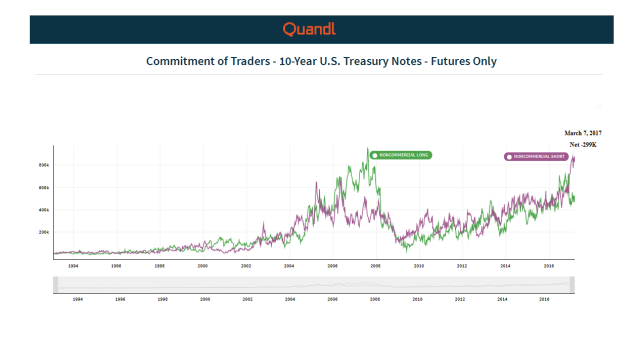
GaveKal, Jeff Gundlach,  and Jim Bianco nailed it in that every spec and their mother are/were short 10-year Treasuries.

Source: Quandl (see here for interactive chart)

But this is only a small part of the story:  The global bond markets are broken.

There are no signals, there is no noise.  Trying to infer any sense of economic or financial information from bond yields is futile.

QE Distortion

The intervention into the bond markets by central banks through quantitative easing (QE) in the big four sovereign bond markets – U.S., Japan, Eurozone, and UK – has created a structural shortage of risk-free instruments and distorted the most important price in the world — the yield on 10-year hard currency sovereign bonds.

Furthermore, past QE in the U.S, coupled with the recycling of foreign capital flows back into the U.S. bond market, has, in particular, created an acute structural shortage of longer-term Treasury securities.  The totality of short positions of the fast money in both the cash and derivatives market are probably a much larger proportion of the effective float of longer-term marketable Treasury securities than what the market currently perceives.  Hence the stickiness of U.S. bond yields.

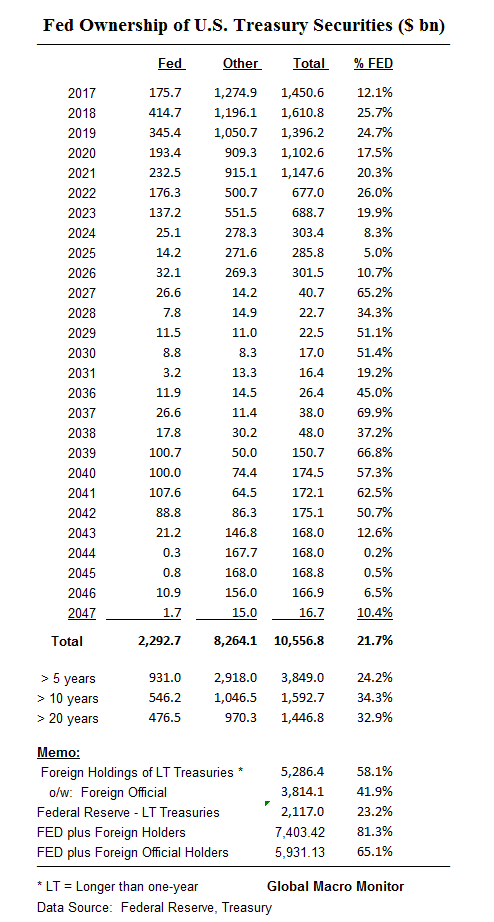
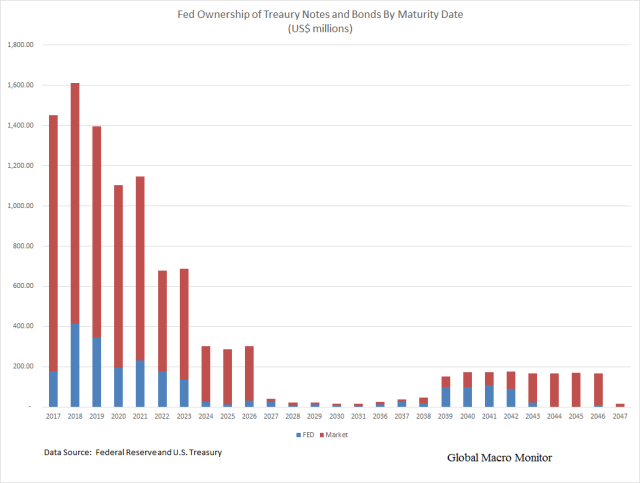
Fed and Foreign Ownership of the U.S. Yield Curve

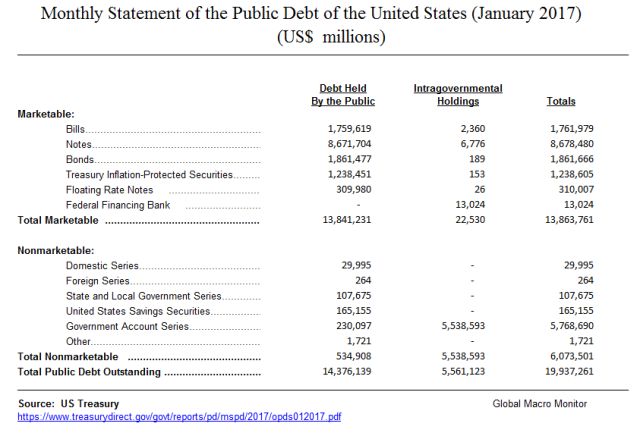
The table and chart below illustrate just how small the actual float of longer-term marketable U.S. Treasury securities is available to traders and investors.  The data show the Fed owns about 35 percent of Treasury securities with maturities 10-years or longer.  Note the data only include notes and bonds and excludes T-Bills.

The Fed’s holdings combined with foreign ownership of longer maturities — more than 1-year — exceeds 80 percent of marketable Treasuries outstanding.   The Fed combined with just foreign official holdings, mainly, foreign central banks,  is 65 percent of maturities longer than 1-year.  Thus, almost 2/3rds of tradeable Treasuries longer than 1-year are held by entities with no sensitivity to market forces.

Note, the Treasury International Capital  (TIC) data does not break down foreign holdings by year of maturity, only by short-term and long-term – that is, greater than 1-year.

.

.

Foreign Holding of Treasuries

We hear a lot these days about a 1994 bond market debacle.  We lived through that bond bear and it wasn’t fun.   However, the microstructure of the Treasury market  is entirely different today than it was back then.

First,  the Fed did not hold long-term Treasuries.   Second,  foreign holdings of Treasuries were only about 15 percent of the outstanding debt versus around 50 percent today and everybody, including, Ross Perot, who said the trade was “a no brainer”,  were levered long riding the yield curve – short short-term, long long-term.

Foreign inflows,  mainly the result of the recycling of U.S. current account deficits,  resulted in Alan Greenspan’s bond market conundrum and the Fed losing control of the yield curve just prior to the 2007-08 financial crisis.

In this environment, long-term interest rates have trended lower in recent months even as the Federal Reserve has raised the level of the target federal funds rate by 150 basis points. This development contrasts with most experience, which suggests that, other things being equal, increasing short-term interest rates are normally accompanied by a rise in longer-term yields.

…In the current episode, however, the more-distant forward rates declined at the same time that short-term rates were rising. Indeed, the tenth-year tranche, which yielded 6-1/2 percent last June, is now at about 5-1/4 percent. During the same period, comparable real forward rates derived from quotes on Treasury inflation-indexed debt fell significantly as well, suggesting that only a portion of the decline in nominal forward rates in distant tranches is attributable to a drop in long-term inflation expectations.

Alan Greenspan,  Feb 2005

A paper published by the Federal Reserve Board (FRB) in 2012 estimated the impact on interest rates of the capital flow recycling into the U.S. bond market,

We find that a $100 billion increase in foreign official inflows into U.S. Treasury notes and bonds lowers the 5-year yield by roughly 40 to 60 basis points in the short run. However, our VAR analysis shows that in the long-run, when we allow foreign private investors to react to the effects induced by a shock to foreign official holdings, the estimated effect is roughly -20 basis points per $100 billion. Putting these results into context, between 1995 and 2010 China acquired roughly $1.1 trillion in U.S. Treasury notes and bonds. A literal interpretation of our long-run estimates suggests that if China had not accumulated any foreign exchange reserves during this period, and therefore not acquired these $1.1 trillion in Treasuries, all else equal, the 5-year Treasury yield would have been roughly 2 percentage points higher by 2010. This effect is large enough to have implications for the effectiveness of monetary policy. – FRB

Extrapolating the above analysis to the current stock of foreign official Treasury holdings of around $4 trillion leads to nonsensical results, such as the 5-year yield should be 800 basis points higher than it is today.   Obviously, the analysis should truncate the dependent variable – 5-year note yield — and ceteris paribus (other things being equal) does not hold in the real world.

But we should not miss the article’s main point that market interest rates would be much higher if not for foreign central bank interventions into their FX markets and the recycling of those reserves back into the Treasury market.    We take the above analysis seriously but not literally and wonder if the Trump Administration considers it when they rail on “so-called” currency manipulators.

The Yield Curve During Monetary Tightening

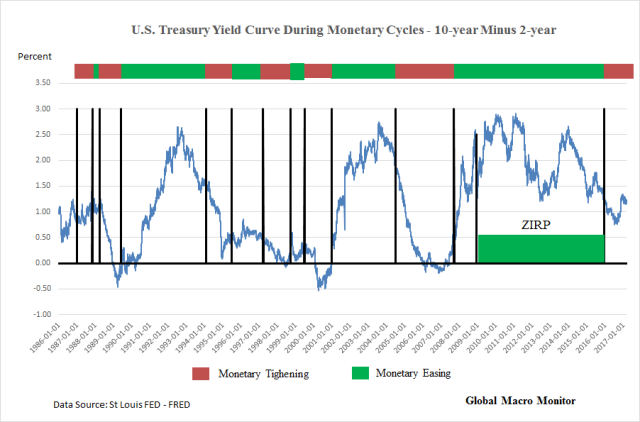
We have looked at the data and constructed some charts that show that in monetary tightening cycles in the U.S. the yield curve (10-2 years) usually flattens.

.

In only two of the past six prior tightenings did the 10-year bond rise in yield from the day of the first tightening to the day of the first easing.  This is entirely possible due to the fact the Fed often “tightens until something breaks” and the bond market front runs the expected easing cycle.

During the 2004-07 tightening cycle,  the era of the Greenspan bond market conundrum,  for example, the 10-year yield managed to rise only a maximum of 64 bps during the entire cycle from a beginning yield of 4.62 percent to a cycle high yield of 5.26 percent.   This as Greenspan raised the fed funds rate by 4.25 percent, from 1.0 percent to 5.25 percent.

Was the market forecasting the coming financial crisis?   Hardly.

Alan Greenspan blames the Fed’s loss of control of the yield curve, mainly due to the recycling of capital flows by foreign central banks,  as a major cause of the housing bubble.  Notice the importance of the 10-year yield on the allocation of resources and on how its distortion can be at the root of financial and economic bubbles.

This Time Is Different

Those dreaded words, “this time is different.”   We should warn readers that this time is truly different, however.   When the Fed first raised interest rates in December 2015, for example, the 10-year yield was at 2.24 percent and more than 50-75 percent lower than at the beginning of any other monetary tightening cycle over the past 30 years.  There are many “unprecedents” in this cycle and therefore more uncertainty.

.

Forecasting With The Yield Curve

Given the technical distortion of the bond market, we find it kind of silly with statements such as “what is the bond market telling us?”   Nothing!

There is no price discovery.  Given the intervention and distortion to bond yields caused by the Fed and foreign central banks, who knows what the right interest rate is for longer-term Treasury securities.

We will never forget the words of a prominent market strategist when rates were super depressed.

“ We’re in a depression. That is what the bond market is telling us.”

Even at the Friday close,  we hear equity traders are worried about why the 10-year yield is so low and fell after Wednesday’s Fed tightening.

Information Feedback Loops

One of just many dangers of the lack of price discovery in the bond market is the potential formation of positive feedback loops, where other markets fail to discount these distortions and act accordingly.   That is, for example, the equity markets sell off because they freak out interest rates are declining when they should be rising.  Or the private sector fails to invest in CapX as they wrongly anticipate an economic downturn because of falling or excessively low bond yields.   Their actions thus become a self-fulfilling prophecy.

A flatter than normal yield curve could also adversely affect bank lendingLook at how financial stocks have been underperforming recently as the yield curve has flattened about 7 bps this year.

Conclusion

Welcome to Bond Market Conundrum 2.0.

Asset prices are artificially elevated and foreign exchange rates are distorted due to the repression of the risk-free interest rates because of lack of supply.   Capital has been misallocated and the Fed has once again lost control of the yield curve simply by the very fact it owns the yield curve.

Monetary policymakers probably won’t regain control of the yield curve until they begin to reduce their balance sheets and the supply/demand balance moves closer to equilibrium.

That’s when we suspect everybody and their mother will front run the central bank selling and we will have the real bond market debacle some in the market have been expecting. Will or can that day ever come?  We don’t know.

Of course,  governments could go on a tax cut/spending binge and increase the primary supply of government bonds.   Possible but doubtful and a longer term story,  if any.

Until then?   We still believe bonds are in a slow bleed bear market, which will see fits of massive nutcracking short covering, as interest rates slowly drift higher.

Remember,  there are no signals, there is no noise.   Here’s to hoping the markets understand that.

A Few Caveats

The data points presented above should be taken as rough, but good, approximations.  The dates of each source of data may differ and the same is true for the different data sources.

Furthermore, we may be entirely wrong in our conclusions.

Abraham Lincoln used to tell a story as a young Illinois circuit court lawyer when trying to convince the jury to render a verdict in his favor.

The story goes that Lawyer Lincoln was worried he had not convinced the jury during the closing argument of a civil case against a railroad.   The jurors had gone to lunch to deliberate.  Lincoln followed them and interrupted their dessert with a story about a farmer’s son gripped by panic,

“Pa, Pa, the hired man and sis are in the hay mow and she’s lifting up her skirt and he’s letting down his pants and they’re afixin’ to pee on the hay.” “Son, you got your facts absolutely right, but you’re drawing the wrong conclusion.”

The jury ruled in Lincoln’s favor.

Similarly, when looking at data and charts — the facts —  we often draw the wrong conclusion about future direction.

Stay tuned.

Data Appendix