Morgan Stanley: “Only One Thing Will Allow Central Banks To Keep The Party Going”


Tyler Durden's picture

Last week, we presented readers with the latest note from SocGen strategist. Albert Edwards, who explained why after so many years of false rate hike starts, the market not only responded to last week’s hike in a dovish manner – interpreting last Wednesday’s 0.25% hike as a 0.25% rate cut- but as Goldman Sachs showed previously, the dovish reaction was one of the strongest ones since the financial crisis, in other words: “the market no longer believes the Fed.” This is what Edwards said, citing his FX colleague Kit Juckes:

[T]he Fed’s reluctance to send an aggressive tightening signal, instead preferring to again shuffle upwards its dots just slightly, has disappointed markets. But to be fair, the problem isn’t really with the famous dots. It’s with the market, which just doesn’t believe the Fed will tighten as fast as they say they plan to (see left-hand chart below). If the market took the FOMC at their word and discounted a 3% Fed Funds rate at the end of 2019 and beyond, then we’d probably have a 3% nominal 10-year Treasury yield by now.”

That said, a 3% Fed Funds rate would also lead to steep selloff in risk assets as the dividend yield on the S&P, currently at about 2%, would be about 1% below the risk free rate, leading to a wholesale “great rotation” out of stocks.

And while the market may not believe the Fed is ready – and willing – to push rates that high, the relationship also cuts both ways.

As RBC also noted last week, explaining that while the Yellen put is alive and well, the market will simply not tighten financial conditions on its own, forcing Yellen to aggressively hike further… which the Fed may be reluctant to do.

That is the argument in a note released late last week by Morgan Stanley’s credit strategists, who note that while the party is still going strong, some 93 months into the current cycle, it may not continue should the Fed engage in an aggressive rate hike scenario. This is what they say:

At 93 months, the current cycle is already longer than all but two post-war recoveries (out of 12 total). We could certainly debate why this expansion is already longer than normal, but strong growth is clearly not the reason. In fact, quite the opposite – a lackluster economic backdrop for years, leading to massive central bank support,has likely kept the cycle going more than anything else. Last year is a good example. As we show below, early in the year, with oil collapsing and the economic data rolling over, recession risks were seemingly rising. As Exhibit 3 shows, central banks across the globe responded. Even the Fed provided stimulus (verbally) by allowing the market to go from pricing in almost three rate hikes at the end of 2015 to almost zero rate hikes in summer 2016. Markets recovered, and the economic data followed.

What is Morgan Stanley’s conclusion? Simple: for the party to continue, not only must the Fed revert back to its quasi-dovish mode, but for that to happen the recent economic “rebound” has to end (the sooner the better), extinguishing any reflationary impulse, removing the impetus for Yellen to hike aggressively further, and allowing the Fed to remain on hold for an indefinite period of time.  In short: “In our view, for the cycle to last another several years, we want to see more of the same – a continued environment of ‘ok’ growth and low inflation, which allows central banks to keep the party going.”

Hopefully Trump, whose policies threaten to upstage this delicate balance benefitting the 1%, has read the memo.

The Coming New Schism within the Catholic Church?


Pope Francis


Just when you though the chaos of the 2016 Elections in the States was unusual, we are witnessing the fragmentation of society at every level and around the globe. There is a trend toward the end of one of these Private Waves and that is the polarization of groups. Yes Democrats and Republicans always fought on Capitol Hill, but the people accepted the election and moved on. This time, there are funds being raised and Obama has refused to leave Washington waging war against Trump and Jarrett is his commander and chief. Europe is polarized between left and right and the French system has completely collapsed so it has become to impossible to forecast a party since they have disintegrated into a free-for-all.

During the 3rd Century, that is when Christianity really took off as well as the Christian Persecutions. There were pagans who blamed the Christians for making the gods mad and they were thus punishing the Romans. The Christians argued that the pagans were praying to false gods. Even religion went into this polarization phase. We are witnessing that between the extreme Muslim sects and Christianity right now, but we are also witnessing this trend within each religion.

The Catholic Church is no exception. Pope Francis has caused a polarization among Catholics that is starting to bubble to the surface. On the one had, Pope Francis has divided the Church not furthered its existence. He has kick-started the polarization directly within the Catholic world dividing into warring political camps as we see in politics. The Pope is seen as a hero by progressive Catholics and a scourge of of the Earth by conservatives. His political statements have done far more damage to religion than most people are even willing to look at.

Pope Francis is regarded by conservatives as a very dangerous man for he is embracing Marxism and the socialist agenda that subjugates the individual freedoms elevating the state first, people second. The Pope has spoken against globalized capitalism and he has even written a major encyclical on the environment. He has championed migrants in Europe only fueling the crisis within Europe and sending conservatives away from attending church. The Pope has seriously distorted being charitable with forced state action, which is not unjustified and a denial of basic freedoms. He has been embraced by socialists seeking to ex-appropriate other people’s money for their version of what the world should be. Pope Francis has emerged as the champion of “progressives” clearly in the camp of Karl Marx. This has begun to cause the Catholic Church to be identified with the progressive left and that has led to conservatives feeling they just do not fit in the Catholic Church. His comments are crossing the line between Church and State.

Pope Francis seems to desire overturning the Catholic doctrine saying that the faithful who are divorced and civilly remarried lacking an annulment must refrain from receiving holy communion. In this area, he is also very progessive but has not quite crossed that line to make it official. Many fear that the Pope is looking to overturn Catholicism’s ancient and countercultural teachings on sexual ethics. This is adding wood to the fire that some see the beginning of a new schism within the Church in the future.

Back in 2014, Pope Francis fired the German bishop for spending too much on his private residence of about $43 million. Bishop Franz-Peter Tebartz-van Elst became known as the “bling bishop” for being extravagant. Pope Francis fired him for he was not in alignment with his vision of a “poor church for the poor.”

Marx Cardinal_ReinhardThe Vatican announced Wednesday the pontiff had accepted the resignation of Bishop Franz-Peter Tebartz-van Elst, who had reportedly spent some 31 million euro ($43 million) on a new residence and complex in his Limburg diocese in western Germany while at the same time reducing salaries for staff in the name of financial austerity.

Cardinal Reinhard Marx in Germany effectively said that Catholics could not vote for the AfD. The Cardinal has helped to unbalance the Catholic Church going so far as basically offering support to Chancellor Angela Merkel, who created this refugee crisis to further her own political standing when she was criticized for being harsh of Greece. What many are not looking at is there has been a decline in Christianity became many see this an political and hypocritical on far too many levels.

Pope Francis has admitted that there is a “hemorrhage” of priests and nuns from the Catholic church. There has been a loss in clergy. The Pope commented on how nuns and priests have just quit claiming that modern society discourages lifelong commitments as in the soaring divorce rate. He further said that people conduct their lives based on “a la carte” choices. But there has been a decline in attending church that is not restricted to just the Catholics.  This is a trend which is infecting Christianity as a whole, and is reflected in the Podesta emails revealed the Democrats disliked Catholics and Evangelical Christians. Hillary’s staff said Catholics are “severely backwards” and further demeaned them saying they don’t know “what the hell they’re talking about.”Then you have Democratic leader Nancy Pelosi who recently said: “They pray in church on Sunday and then prey on people the rest of the week.”


Some are attributing this to a new Age of Populism. Pope Francis seems to have embraced being a populist: plain-spoken, with little regard for fusty rules and institutions, and occasionally vicious with political adversaries. Strangely, these are attributes one sees in modern politicians. Will his legacy simply be that he is part of the populist insurgency we see around the world? Pope Francis has criticized Trump for his anti-immigration bans. However, if Trump is a populist, and career politicians try to dismiss, is Pope Francis a populist to the opposite side?

The Long Run Economics Of Debt Based Stimulus


Tyler Durden's picture


Onward vs. Upward

Something both unwanted and unexpected has tormented western economies in the 21st century.  Gross domestic product (GDP) has moderated onward while government debt has spiked upward.  Orthodox economists continue to be flummoxed by what has transpired.

What happened to the miracle? The Keynesian wet dream of an unfettered fiat debt money system has been realized, and debt has been duly expanded at every opportunity.  Although the fat lady has so far only cleared her throat (if quite audibly, in 2008) and hasn’t really sung yet, it is already clear that calling this system careening toward a catastrophic failure.

Here is the United States, since the turn of the new millennium (starting January 1, 2001) real GDP has increased from roughly $10.5 trillion to $18.6 trillion, or 77 percent.  Over this same time government debt has spiked nearly 250 percent from about $5.7 trillion to $19.9 trillion.  Obviously, some sort of reckoning’s in order to bring the books back into balance.

Throughout this extended episode of economic and financial discontinuity, the government’s solution to jump-starting the economy has been to borrow money and spend it.  Thus far, these efforts have succeeded in digging a massive hole that the economy will somehow have to climb out of.  We’re doubtful such a feat will ever be attained.

In short, additions of government debt over this time have been at a diminishing return.  Specifically, at the start of the new millennium the debt to GDP ratio was about 54 percent.  Today, it’s well over 100 percent.

US GDP and US federal debt, indexed (1984 = 100). Mises noted back in the late 1940s already that “it is obvious that sooner or later all these debts will be liquidated in some way or other, but certainly not by payment of interest and principal according to the terms of the contract.”  If it was obvious then, it is glaringly obvious today. Greece and Cyprus demonstrated what happens when modern socialist welfare states have no independent access to a printing press and are thus unable to extend and pretend in the traditional Keynesian way. The Potemkin village disintegrates on the spot at the first whiff of suspicion. All the nations that have postponed the reckoning by printing money and the flight forward mechanism of amassing even more debt have simply made the eventual denouement more profound – click to enlarge.

The idea that the government could spend borrowed money to grow the economy out of debt has become patently ridiculous.  Nonetheless, government economists continue to advocate these policies because, academically, they have no other alternatives.  At the same time, politics may now conspire to push the U.S. government into debt default.

Arrested Development

This week the Obama administration’s debt ceiling suspension expired, and a debt ceiling of $20.1 trillion was triggered.  This reestablished debt ceiling is just a horse’s hair above the U.S. government’s current debt level.  Furthermore, getting the debt ceiling lifted will likely require an epic Congressional battle, including elaborate displays of Kabuki theater.

There’s a possibility a new debt ceiling agreement won’t be reached before the Treasury’s money runs out sometime in late-summer or early-fall.  This would put the U.S. government in a position of not being able to pay its debts.  At a minimum, even if some Congressional deal’s worked out at the 11th hour, the full faith and credit of the U.S. government will be tarnished.

Best case, a timely debt ceiling resolution will cut into President Trump’s plans to boost the economy by borrowing money and spending it on infrastructure and defense.  This will also cut into his plans to reduce taxes.  A stumble in either of these areas could prompt a long overdue stock market panic.

The debt ceiling could become a real problem this time, as the treasury has massively drawn down the cash balance it amassed by issuing humongous amounts of debt to US money market funds in 2016. In the final quarter of 2016, i.e., the dying days of the Obama administration, the federal deficit exploded by a stunning 208 billion dollars – click to enlarge.

The fact is, perpetual economic growth is required to sustain life as we know it in today’s debt-driven economic social order.  Any slight blip, such as 2008, massively disrupts the lives of hundreds of millions of people.  What’s more, economic growth must be at a level where the plebs believe they’re adequately reaping the fruits of their labors.

What that rate of economic growth happens to be is uncertain.  But so far the U.S. economy of the 21st century has failed to attain it.  What is known is that an economy that expands at 3 percent annually, will double the average living standard every 24 years.  In contrast, an economy that expands at an annual rate of 2 percent, will take 36 years to double the average living standard.

The average annual rate of real GDP growth of the U.S. economy in the 21st century has been at a 1.78 percent state of arrested development.  The average annual rate of real GDP growth of the U.S. economy for the 16 preceding years was 3.43 percent – nearly double.  Alas, it has been 12 years since the U.S. economy’s eked out a single year of 3 percent GDP growth.

In spite of statistical distortions reaching fresh heights of absurdity year after year (their goal is generally to make “inflation” look smaller and GDP larger than they really are), economic output as measured by GDP is seemingly on a permanent downward trajectory. Many European countries look even worse. For instance, France had strong growth for more than two decades after WW2, but it collapsed thereafter. Today, government spending in France accounts for 58% of GDP and the country’s microscopic growth rates have become downright embarrassing. But don’t worry, Europe’s political elites and bureaucrats continue to prosper! – click to enlarge.

The Long Run Economics of Debt Based Stimulus

“In the long run, we are all dead,” said 20th Century economist, John Maynard Keynes.  This, in a nut shell, was Keynes’ rationale for why governments should borrow from the future to fund economic growth today.  Why wait for recessions to do the work of equilibrating the economy when a little counter-cyclical stimulus can push growth onward and upward?

J.M. Keynes is certainly dead, but we are still alive and can rightly be referred to as his victims. Keynes is often depicted reading a book, but evidently he must have read the wrong book. And all those who assert that he “didn’t really mean it this way or that way”  should perhaps take the time to read what he wrote. Keynes really was a Keynesian!

Of course, attempting to spend a nation to prosperity using borrowed money is not without consequences.  In the short run, an illusion of wealth can be erected.  In the long run, that illusion slips into decay and disrepair.

Over the past week we’ve been roaming the streets of Mexico City, visiting family and conducting  field research on your behalf.  In particular, we’ve been investigating the chronic effects of what happens when a government spends too much borrowed money, and then attempts to lighten its debt burden by inflating its currency. 

What follows a brief summation of our findings.

On surface, what happens is what you’d expect.  The currency gets utterly destroyed.  This has the effect of blowing the price of just about everything – especially imports – through the roof.  But it’s what happens after which is less obvious.  For the ill-effects of a debased currency express themselves in asymmetric ways.

On a Saturday afternoon walk through the historic city center along Avenida Francisco I. Madero between El Zócalo and the Palacio de Bellas Artes we were greeted with the appearance of consumer prosperity.  Bustling crowds of shoppers made their way through the chic fashion stores that are interspersed between historic 17th and 18th century colonial mansions and buildings.  Modern skyscrapers were in the distance.

Similarly, during a Friday night visit to El Moro, the famous churro and chocolate restaurant that has been in operation since 1935, we encountered a line extending out the door and down the street.  Customers were dressed to impress.  There was hardly a hint of economic hardship about the place.

The original El Moro outlet in Mexico City.

But venture outside the most inner streets of the city’s center and the conditions quickly deteriorate.  An endless sea of multilevel residential dwellings mixed with commercial and industrial properties in varying degrees of decay extend for miles and miles across the high altitude Valley of Mexico.  It appears that, perhaps 50 or 60 years ago, these structures were clean and well-kept.  However, that was before crumbled concrete and exposed rebar became the norm for these vast residential dwellings.

Contrary to what Keynes posited, counter-cyclical debt based stimulus didn’t produce the nirvana of rising long run living standards.  Rather it produced the disparity of stagnating GDP and rapidly rising government debt.  Later it produced the hell of declining living standards over the long run.

The truth is, in the long run we’re not all dead.  Actually, some of us are still here, living with the consequences of shortsighted economic policies.

Residents of Mexico know this all too well.  In the United States, the scope and magnitude of debt has been able to support an illusion of prosperity.  Still, as far as we can tell, many residents are experiencing the transformation of small pockets of slums into vast expansive ghettos.

Storing up a small hoard of gold and silver bullion may’ve never been more critical than the present, in the off chance the inevitable dollar debasement comes sooner rather than later.  So, too, one would be well advised to develop a side hustle now.  From our observation, everyone in Mexico City was working… though many didn’t have jobs.

On Monday we traveled north of the city limits to the ruins of the ancient pre-Aztec city of Teotihuacán.  There we climbed up the Pyramid of the Sun and into the open areas of the Pyramid of the Feathered Serpent.  We walked the Avenue of the Dead toward the Pyramid of the Moon.

Teotihuacán – view from the pyramid of the moon. Aztec priests once ripped out the hearts of sacrificial victims to appease their gods (among those in need of appeasing were Huiztilopochtli, the god of war and the sun, Tlaloc the rain god and not to forget, good old Xipe, a.k.a. “Our Lord, the Flayed One”, god of sacrificial pain and suffering. And you should see their mama… (wait for it). The Aztecs had a god for everything, so there was a lot of sacrificing to do.

At its peak, around 450 AD, Teotihuacán was the largest city in the pre-Columbian Americas, with a population estimated at 150,000.  Yet by the 6th century the population began to decline and the city ceased to exist sometime in the 7th or 8th century.  No one quite knows what happened.

Well, here she is… Coatlicue, the primordial earth goddess, mother of the gods, the sun, the moon and the stars. Judging from her teeth, this multi-tasker was a carnivore.

One theory is that the city’s decline coincided with an extended drought.  Another is that there was an internal uprising.  Maybe a 99 percent situation developed. We kicked a few rocks.  We put our ears to the ground.  We looked.  We listened.

The spirits didn’t answer.  They didn’t have to.  We’d already seen and heard enough.

North Korea “One Step Closer To ICBM Launch” After Successful Test Of “New Type” Rocket Engine


Tyler Durden's picture

One day after Rex Tillerson warned that the US is contemplating a pre-emptive military attack on North Korea, the isolated nation announced it has conducted a ground test of a new type of high-thrust rocket engine that leader Kim Jong Un is calling a “revolutionary breakthrough” for the country’s space program, the North’s state media said Sunday. Kim attended Saturday’s test at the Sohae launch site, according to the Korean Central News Agency, which said the test was intended to confirm the “new type” of engine’s thrust power and gauge the reliability of its control system and structural safety.

A previous demonstration of a “new rocket engine” in this undated photo released
by North Korea’s KCNA in Pyongyang September 20, 2016

Kim called the test “a great event of historic significance” for the country’s indigenous rocket industry, the KCNA report said. He also said the “whole world will soon witness what eventful significance the great victory won today carries” and claimed the test marks what will be known as the “March 18 revolution” in the development of the country’s rocket industry. The report indicated that the engine is to be used for North Korea’s space and satellite-launching program.

The claim of a successful test of the high-thrust rocket engine would put North Korea a step closer to being able to launch an intercontinental ballistic missile, as Mr. Kim said the country would do this year in his new-year address, the WSJ reported.

North Korea is banned by the United Nations from conducting long-range missile tests, but it claims its satellite program is for peaceful use, a claim many in the U.S. and elsewhere believe is questionable.

As AP further reports, North Korean officials have said that under a five-year plan, they intend to launch more Earth observation satellites and what would be the country’s first geostationary communications satellite — which would be a major technological advance. Getting that kind of satellite into place would likely require a more powerful engine than its previous ones. The North also claims it is trying to build a viable space program that would include a moon launch within the next 10 years.

Saturday’s engine test, at North Korea’s Sohae Satellite Launching Station, near its border with China, came as U.S. Secretary of State Rex Tillerson was en route to Beijing for a series of meetings with Chinese leadership that were to include discussions about how to rein in Pyongyang’s nuclear threat. On Friday, Tillerson told reporters in Seoul that the U.S. wasn’t interested in conducting direct talks with North Korea to halt its weapons program, saying instead that tighter sanctions enforcement and the possibility of a military strike were being considered as part of a continuing North Korea policy review by the White House.

“All options are on the table,” Tillerson said.

It’s unclear whether this test was deliberately timed to coincide with Tillerson’s visit, but Pyongyang has been highly critical of ongoing U.S.-South Korea wargames just south of the Demilitarized Zone and often conducts some sort of high-profile operation of its own in protest. Earlier this month, it fired off four ballistic missiles into the Sea of Japan, reportedly reaching within 200 kilometers (120 miles) of Japan’s shoreline.

Japan, which was Tillerson’s first stop before traveling to South Korea and China, recently held its first civilian missile evacuation drill over concerns of an unexpected North Korean attack.

While building ever better long-range missiles and smaller nuclear warheads to pair with them, North Korea has marked a number of successes in its space program. It launched its latest satellite — the Kwangmyongsong 4, or Brilliant Star 4 — into orbit on Feb. 7 last year, just one month after conducting what it claims was its first hydrogen-bomb test. It put its first satellite in orbit in 2012, a feat few other countries have achieved. In 2013, rival South Korea launched a satellite into space from its own soil for the first time, though it needed Russian help to build the rocket’s first stage.

In a controversial attempt to contain the threat from a potential North Korean missile attack, last week, the US military also began the deployment of its THAAD anti-missile system in S. Korea, despite Russia and China objecting to the move as being “counter-productive.” Beijing said THAAD’s deployment was harming the “regional strategic balance,” since it might damage China’s nuclear deterrent capabilities and potentially fuel US first-strike ideas. Moscow said Washington was “instigating an arms race in the subregion.”

“We do not oppose South Korean taking necessary measures to protect its security, but these measures cannot be based upon harming the security interests of South Korea’s friendly neighbor, China,” Chinese Foreign Ministry spokeswoman Hua Chunying said on Friday, as quoted by Reuters. Washington and Seoul however continue to maintain that the deployment of THAAD is a “defensive” measure against Pyongyang, and countries “other than North Korea” have nothing to worry about, according to US Defense Secretary James Mattis

CONGRESS SCRAMBLES TO PROTECT THE CIA


The CIA has overstepped tn bounds and needs to be brought back under control.

Taxing Property Going Crazy


Dog House Property Tax

The Left is fighting so hard to keep dominating everyone else, that it is hard not to see how society in starting to implode in the West. In Norway, the hunt for taxes has been so bad, they have now even been raising property taxes to include a dog house in the back yard.

Meanwhile in Greece, people are not taking property that is left to them because they cannot pay the inheritance taxes to accept the property. This was one of the final stages in the collapse of Rome. People just walked away from their property because of taxes.

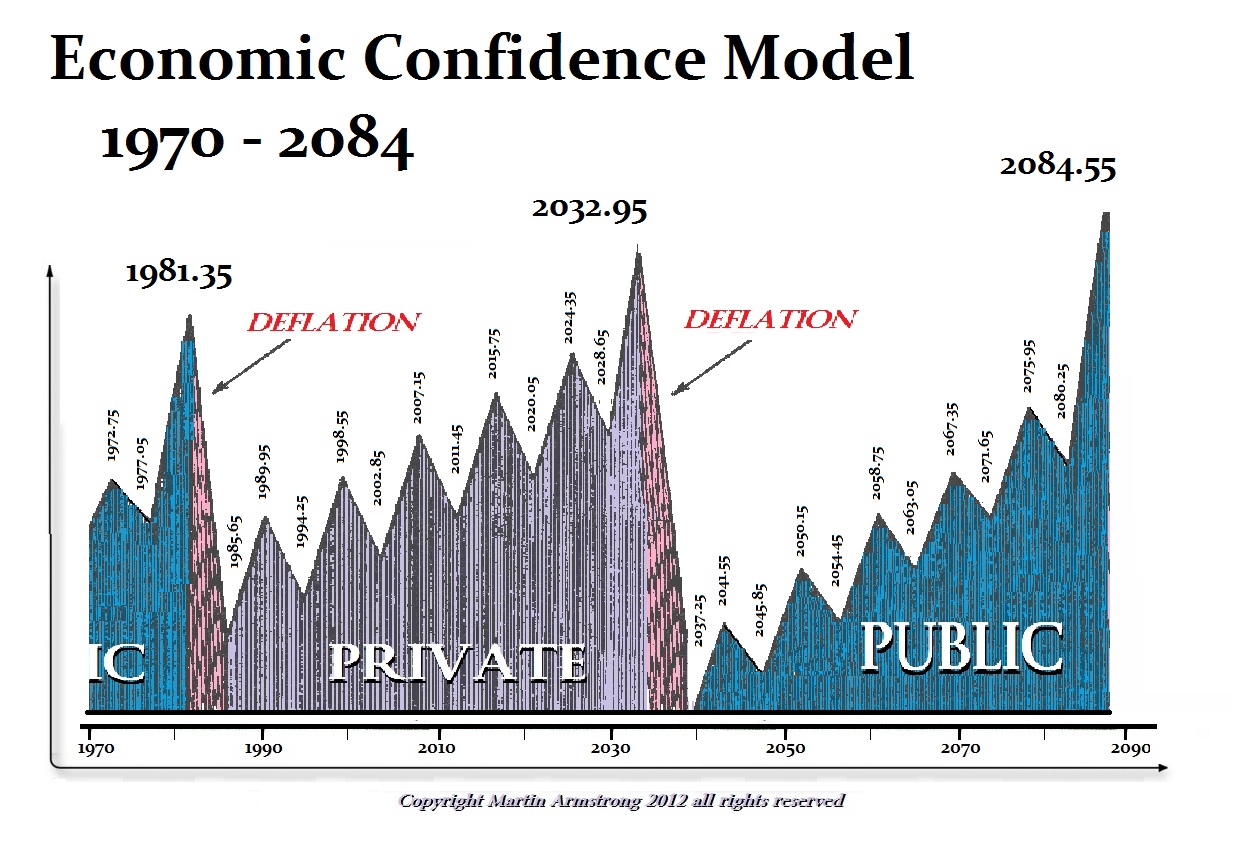
Why the Crash & Burn is Public not Private


ECM-1970-2084

QUESTION: Hi Mr. Armstrong,
You mentioned the crash and burn applies to government assets, not private sector assets. Can the private sector stand on it’s own two feet?
Thanks again,
MB

Continental Currency-6th-$8-2-26-1777

ANSWER: There are times when the private sector cannot stand and everyone runs to bonds/cash. Likewise, there are times when government can no longer stand and the only thing that survives is private assets. This took place during the collapse of the Weimar Republic (German Hyperinflation) and it has been the case throughout history even at the birth of the USA and the collapse of the Continental Currency.

Sectors Capital Movement

Whenever something happens in one sector, people turn to the next one. Capital will move from region to region and within each region there is still a domestic cycle. The 1987 Crash send capital fleeing from the USA to Japan. Then there was the Japanese Bubble 1989 and capital fled to South East Asia. That then peaked and capital began to rush to Europe for the birth of the Euro. That then peaked and it began to flow back to the USA.

People get burned on real estate, they then move to stocks. The get burned in stocks, then run to bonds/cash. Then they run to commodities. The key remains when there is a great alignment, which we are headed into. That warns the big Crash & Burn lies in government not private for this one

How Mexico treats its own illegal immigrants from South America


Do as I say not as I do … lol

EURUSD Tumbles As Le Pen Support Jumps


Tyler Durden's picture

Given the collapse of European VIX to record lows, one could be forgiven for thinking that there’s nothing to worry about. However, a one point jump in first-round support for French far-right presidential candidate Marine Le Pen has sparked a notable drop in EURUSD this morning.

European FX investors look anything but comfortable…


Overall however, according to the polls, Le Pen is unlikely to win…

But then again – Brexit and Trump proved that mea

Dollar Drops As Consumer Inflation Expectations Crash To Record Lows


Tyler Durden's picture

Having warned in November 2015 of a “deflationary mindset”, University of Michigan survey director Richard Curtin notes that things have done nothing but get worse.

While reflation trades run amok in capital markets, real people’s expectations of inflation in the medium-term has collapsed to its lowest on record…


In the latest massive setback for the Federal Reserve, which is desperate to break the recent “deflationary mindset” to have gripped the US population (see Japan for the results), long term inflation expectations declined to the lowest level since 1980: an annual rate of 2.2% was expected in the next five years, down from 2.5% last month and 2.3% in December. Just 6% expected long term deflation. These lows were supported by the fewest complaints of rising prices eroding their living standards—just 6%, the lowest since 2002 and barely above the all-time low of 4%.

Sponsored By Legg Mason

Need A Strategy For Income? Find Out About The Three Rs of Dividends

ClearBridge Dividend Strategy Portfolios target total return, risk management and dividend potential. Discover the strength of Legg Mason – A Leader In Separately Managed Accounts.

And this is weighing on the dollar…


The Dollar Index is very close it slowest since the election – seemingly erasing the hope of reflation and exuberance.