The Crisis is Turkey


President Recep Tayyip Erdogan of Turkey is finding his dreams of an all-powerful resurrection of the Ottoman Empire are falling apart. Qatar has come to the aid of Turkey offering $15 billion in a loan, but keep in mind that the entire issue with Syria began with Qatar proposing a pipeline through Syria to compete with natural gas with Russia. Therefore, it is in Qatar’s best interest to keep Turkey trying to invade Syria. The price will be the pipeline, which we seriously doubt will ever take place.

Erdogan has sent the Turkish economy into a downward spiral for some time. Its soaring inflation has exceeded 100% and rising debt-to-GDP of about 70% under President Recep Erdogan’s regime has been a growing problem. As central banks pumped money into the system over the past decade, nations like Turkey and other emerging market economies used the opportunity to raise more and more “cheap” debt to boost their productivity. Turkey has attracted capital from Europe seeking higher yields because of the negative interest rates policy of the ECB. Now we have a crisis in Turkey that is also the result of Draghi’s Quantitative Easing that drove capital to Turkey and FAILED to revived the European economy.

Erdogan’s dream of restoring the Ottoman Empire is no joke. It has been European money seeking higher yield that kept him in power. It is curious how those who seek dictatorial power are the ones who dream of restoring the power of empires long since dead. Erdogan has wanted to recreate the Ottoman Empire just as the dream of the reestablishment of the old Roman Empire as was the desire behind Napoleon and Hitler. The days of Empire Building are long gone and Erdogan has been living in the past. His goal was to expand his country’s military operations in Syria and this, he hoped, would be the first step as with Hitler’s invasion of Poland.

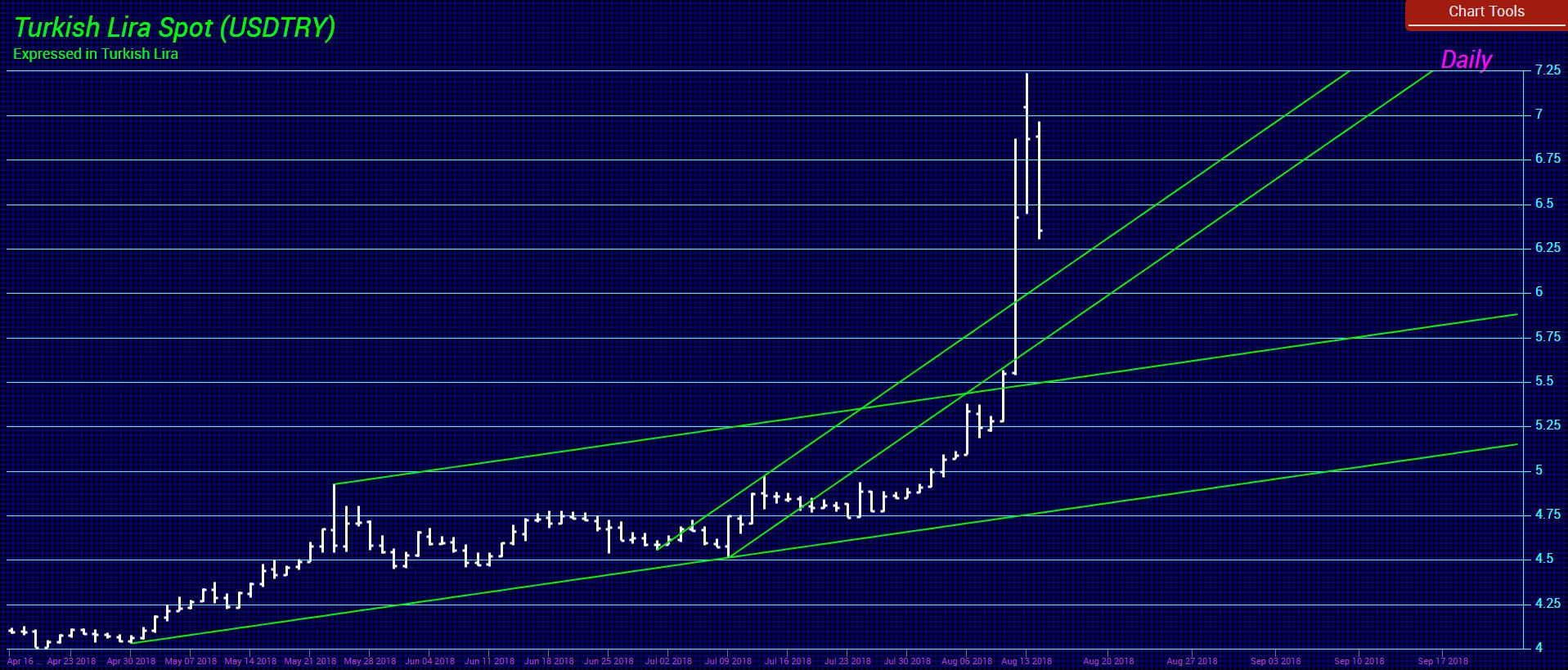
Nevertheless, the Turkish lira collapse and the expensive dollar have been conspiring against him reflecting his disastrous management of the economy and the collapse in confidence among the Turkish people. There remain serious questions about elections in Turkey being rigged to keep him in power. Therefore, on the one hand, Erdogan is attracted to dealing with Russia who is on the opposite side of the game board with Qatar. Erdogan has the free markets moving against him and he is more likely to turn to Russia than the West to retain personal power and the free markets show what most likely the real sentiment of the Turkish people was for the fake elections. Consequently, Erdogan turned to Qatar because he was desperate for money to retain personal power. If he loses the support of his military, then they will side with the people and Erdogan’s head may end up on a spike. Qatar will discover they are dealing with someone who will not be loyal to them either. Yet, the financial markets are working against Erdogan and as the crisis continues to evolve in the months ahead as $15 billion will not reverse the crisis, Turkey can hardly afford military adventures. Erdogan will be more likely to turn to Russia when he cannot retain power otherwise. He can blame the USA all he wants publicly, but the free markets are conspiring against him and that includes his own people.

Many European institutions rushed into Turkey and bought their bonds at 20%. Many Spanish banks had capital was invested in Turkish bonds to get the higher yield to the tune of on average 20%+. Based on the phone calls, there are way too many institutions who invested into Turkey. They simply assumed that NO government defaults because the powers that be will always bail out the bondholders. This time the IMF is really powerless. They can make some noise and others will say the crisis is subsiding. However, this is just talking. There is nobody who can save Turkey at this point as long as Erdogan remains in power. Qatar will discover that Turkey is a bottomless pit. They will try to now ease the crisis with words because of the extensive foolishness of banks and pension funds who bought Turkey bonds to try to get yield.

The fall in the Turkish lira has also benefited the Syrian Army, which launched an offensive on the last large mercenary fortress in Idlib. Turkey was actually against the offensive because it feared that it would fall to Syria and that is against Erdogan’s dreams of taking more territory. What is not really looked at internationally is the plain fact that Turkey does not have its own arms industry. Erdogan needs arms to be imported and as the lira crisis materialized, his Turkish operation Olive branch and shield of the Euphrates in Syria become rapidly too expensive. Back in January 2018, the Siyasi Haber newspaper reported that an estimated $400 million was being spent on Operation Olive Branch alone. Erdogan has spent over $1 billion so far in his attempt to conquer that region of Syria.
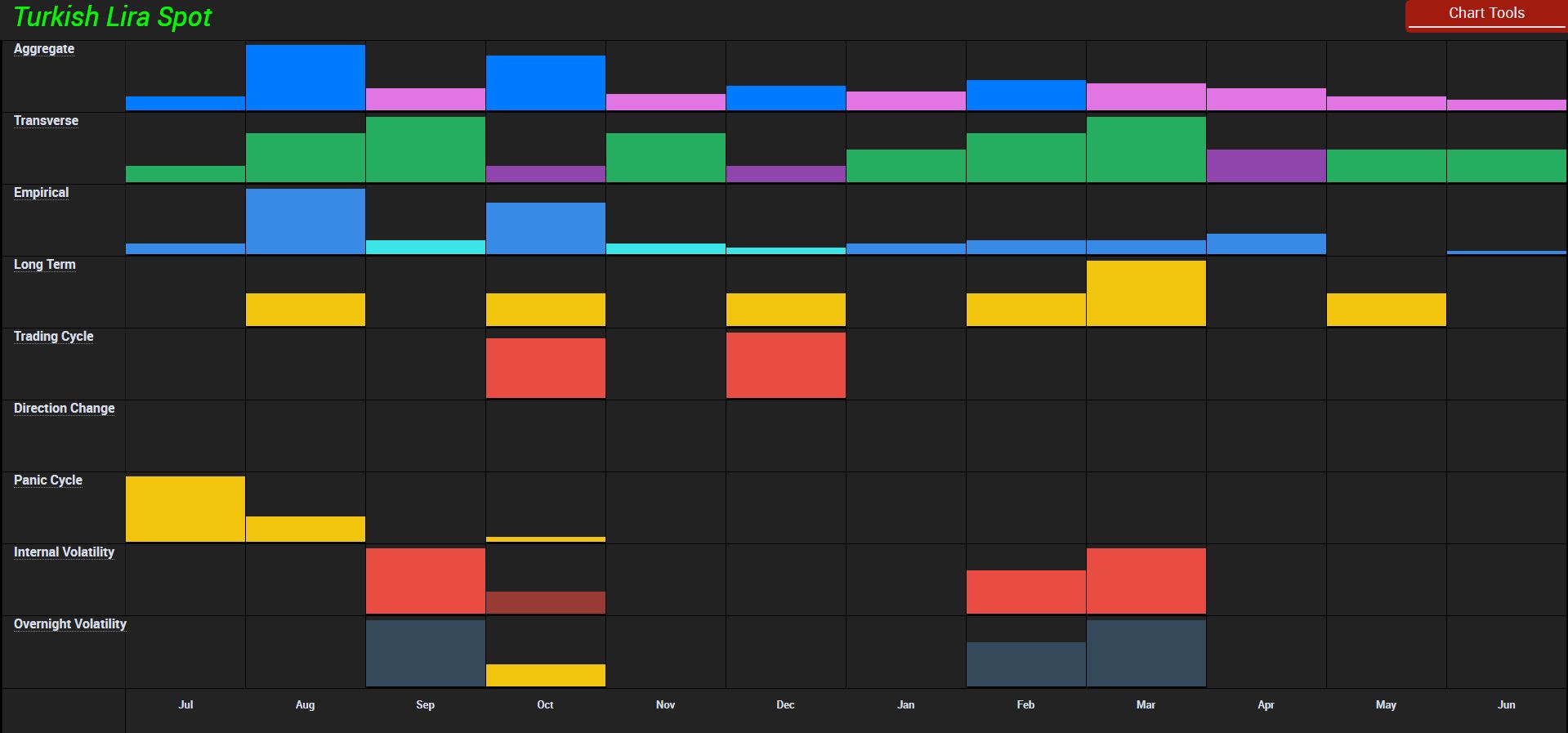
Instead of building his economy and benefiting the people of Turkey, Erdogan has been more interested in resurrecting the Ottoman Empire. It has been his mismanagement of the economy and his hostile attitude even to Greece that is behind the Turkish Lira Crisis. He has lost the confidence of his own people! August has been our target for the crisis and so far the computer has been correct on that score. However, volatility will remain high going into October and then we see it will return as the new year begins. Qatar coming to the rescue should help support the lira for now. Those who are wise had better sell their Turkish bonds and step oy of this trade. August should prove to be only a temporary low for the lira

July Retail Sales Growth: 6.4% “Unexpected”, “Well Beyond Expectations”, “well beyond what experts predicted”…


Remember that 2016 conversation about retail inflation, Q2 wage growth, durable goods spending and non-durable goods expenditures…  Well, in a growing economy; a bigly expanding economy; with wages actually increasing as an authentic outcome of expanded hiring and jobs, jobs, jobs… in conjunction with lowered tax rates…. you get more money in your pocket.

This natural Main Street dynamic leads to increased consumer spending, specifically in the retail sectors influenced by who?… Oh, yeah, those middle-class economic beneficiaries of all the above.

The expert financial pundits are shocked, shocked I tell you… shocked; when, all of a sudden, the convergence of MAGAnomic Main Street policies delivers results.  DUH!

The Commerce Department – Economic and Statistics Administration – released the figures from July 2018 retail sales today (full pdf available here), showing an incredibly strong .5% increase in spending in July, bringing a 6.4% increase year-over-year;  and the results have dropped the jaws of the “experts”:

“Economists polled by Reuters had forecast retail sales nudging up 0.1 percent in July.” (link)

“Retail spending in the United States increased a half-percent during the month of July — well beyond what experts predicted.” (link)

“U.S. retail sales rose more than expected in July as households boosted purchases of motor vehicles and clothing, suggesting the economy remained strong” (link)

(pdf link)

With expanded jobs available; higher wages and the highest workforce in the history of the country currently; and with more U.S. workers re-entering the workforce again; and with expanded optimism and opportunity; the retail sector is a natural benefactor.

Notice the drop in the “sporting goods, hobby, etc.” sector?  Americans love to work… when you’re working, you’re earning…. when you’re earning you ain’t playing as much etc.

Retail sales growth is directly related to the middle-class.  Retail store volume is directly related to the wealth of the middle class.  Build a strong Main Street and you simultaneously build a strong, financially secure, middle-class.  It is a self-fulfilling economic prophecy; this is common sense.

Remember, two-thirds of our GDP, and the subsequent economic growth measured by GDP growth, is directly influenced by retail sales.  The more goods Americans purchase, the higher our GDP growth in the making, manufacturing, distribution and selling of those goods.   This is the Main Street growth cycle dynamic never discussed when all of the economic emphasis is on a service-driven economy (Wall Street).

BIG PICTURE – As a direct result of President Trump’s multifaceted economic strategy, manufacturing companies are having to look at TCO which is “Total Cost of Ownership”. You see, President Trump is not only approaching manufacturing growth policy from the trade-agreement and investment side, his policies also approach the larger impacts on raw material, energy and labor.

This multi-pronged policy approach forces companies to look at transportation and location costs of manufacturing. In combination with more favorable tax rates; if domestic costs of material and energy drop, in addition to drops in regulatory and compliance costs of operating the business, the total operating cost differences drop dramatically.

This means labor and transportation costs become a larger part of the consideration in “where” to manufacture. All of these costs contribute to the TCO. Transportation costs are very expensive on durable goods imported. If the durable goods are made domestically, the transportation costs per unit shipped drop significantly. The TCO analysis then further reduces to looking at labor.

U.S. Labor is more expensive, yes. However, if material costs, energy costs, regulatory costs, taxes and transportation costs are part of the TCO equation – then higher labor costs can be offset by the previously mentioned savings.

… […] Chinese wages have been rising by about 15% a year since 2000. As a result, the Chinese labor cost in dollars per unit of output is now about four times what it was in 2000. We estimate that about 25% of what is now offshored would come back if companies quantified the total cost. These products would generally have characteristics such as high freight cost vs. labor cost, frequent design changes, volatility in demand, intellectual property risk, and regulatory and compliance requirements. (link)

For two years CTH has repeatedly stated that under Trump’s proposals “total costs” drop so dramatically, that off-shored manufacturing is no longer the best play. We are seeing that shake out right now. For the first time in 30 years companies are reviewing the TCO of products and finding less and less financial reasons for off-shore manufacturing.

Their response?….  Well, we need more workers !!

Winnamins baby… moar winnamins.

Multinational Wall Street -vs- Main Street U.S.A…


Originally outlined a year ago. Reposted by request. At the heart of the professional/political opposition the issue is money; there are trillions at stake.

President Trump’s MAGAnomic trade and foreign policy agenda is jaw-dropping in scale, scope and consequence. There are multiple simultaneous aspects to each policy objective; however, many have been visible for a long time – some even before the election victory in November ’16.

If we get too far in the weeds the larger picture is lost. CTH objective is to continue pointing focus toward the larger horizon, and then at specific inflection points to dive into the topic and explain how each moment is connected to the larger strategy.

Today we repost an earlier dive into how MAGAnomic policy interacts with multinational Wall Street, the stock market, the U.S. financial system and perhaps your personal financial value. Again, reference and source material is included at the end of the outline.

If you understand the basic elements behind the new dimension in American economics, you already understand how three decades of DC legislative and regulatory policy was structured to benefit Wall Street and not Main Street. The intentional shift in fiscal policy is what created the distance between two entirely divergent economic engines.

REMEMBER […] there had to be a point where the value of the second economy (Wall Street) surpassed the value of the first economy (Main Street).

Investments, and the bets therein, needed to expand outside of the USA. hence, globalist investing.

However, a second more consequential aspect happened simultaneously. The politicians became more valuable to the Wall Street team than the Main Street team; and Wall Street had deeper pockets because their economy was now larger.

As a consequence Wall Street started funding political candidates and asking for legislation that benefited their interests.

When Main Street was purchasing the legislative influence the outcomes were -generally speaking- beneficial to Main Street, and by direct attachment those outcomes also benefited the average American inside the real economy.

When Wall Street began purchasing the legislative influence, the outcomes therein became beneficial to Wall Street. Those benefits are detached from improving the livelihoods of main street Americans because the benefits are “global”. Global financial interests, multinational investment interests -and corporations therein- became the primary filter through which the DC legislative outcomes were considered.

There is a natural disconnect. (more)

As an outcome of national financial policy blending commercial banking with institutional investment banking something happened on Wall Street that few understand. If we take the time to understand what happened we can understand why the Stock Market grew and what risks exist today as the financial policy is reversed to benefit Main Street.

President Trump and Treasury Secretary Mnuchin have already begun assembling and delivering a new banking system.

Instead of attempting to put Glass-Stegal regulations back into massive banking systems, the Trump administration is creating a parallel financial system of less-regulated small commercial banks, credit unions and traditional lenders who can operate to the benefit of Main Street without the burdensome regulation of the mega-banks and multinationals. This really is one of the more brilliant solutions to work around a uniquely American economic problem.

♦ When U.S. banks were allowed to merge their investment divisions with their commercial banking operations (the removal of Glass Stegal) something changed on Wall Street.

Companies who are evaluated based on their financial results, profits and losses, remained in their traditional role as traded stocks on the U.S. Stock Market and were evaluated accordingly. However, over time investment instruments -which are secondary to actual company results- created a sub-set within Wall Street that detached from actual bottom line company results.

The resulting secondary financial market system was essentially ‘investment markets’. Both ordinary company stocks and the investment market stocks operate on the same stock exchanges. But the underlying valuation is tied to entirely different metrics.

Financial products were developed (as investment instruments) that are essentially wagers or bets on the outcomes of actual companies traded on Wall Street. Those bets/wagers form the hedge markets and are [essentially] people trading on expectations of performance. The “derivatives market” is the ‘betting system’.

♦Ford Motor Company (only chosen as a commonly known entity) has a stock valuation based on their actual company performance in the market of manufacturing and consumer purchasing of their product. However, there can be thousands of financial instruments wagering on the actual outcome of their performance.

There are two initial bets on these outcomes that form the basis for Hedge-fund activity. Bet ‘A’ that Ford hits a profit number, or bet ‘B’ that they don’t. There are financial instruments created to place each wager. [The wagers form the derivatives] But it doesn’t stop there.

Additionally, more financial products are created that bet on the outcomes of the A/B bets. A secondary financial product might find two sides betting on both A outcome and B outcome.

Party C bets the “A” bet is accurate, and party D bets against the A bet. Party E bets the “B” bet is accurate, and party F bets against the B. If it stopped there we would only have six total participants. But it doesn’t stop there, it goes on and on and on…

The outcome of the bets forms the basis for the tenuous investment markets. The important part to understand is that the investment funds are not necessarily attached to the original company stock, they are now attached to the outcome of bet(s). Hence an inherent disconnect is created.

Subsequently, if the actual stock doesn’t meet it’s expected P-n-L outcome (if the company actually doesn’t do well), and if the financial investment was betting against the outcome, the value of the investment actually goes up. The company performance and the investment bets on the outcome of that performance are two entirely different aspects of the stock market. [Hence two metrics.]

♦Understanding the disconnect between an actual company on the stock market, and the bets for and against that company stock, helps to understand what can happen when fiscal policy is geared toward the underlying company (Main Street MAGAnomics), and not toward the bets therein (Investment Class).

The U.S. stock markets’ overall value can increase with Main Street policy, and yet the investment class can simultaneously decrease in value even though the company(ies) in the stock market is/are doing better. This detachment is critical to understand because the ‘real economy’ is based on the company, the ‘paper economy’ is based on the financial investment instruments betting on the company.

Trillions can be lost in investment instruments, and yet the overall stock market -as valued by company operations/profits- can increase.

Conversely, there are now classes of companies on the U.S. stock exchange that never make a dime in profit, yet the value of the company increases. This dynamic is possible because the financial investment bets are not connected to the bottom line profit. (Examples include Tesla Motors, Amazon and a host of internet stocks like Facebook and Twitter.) It is this investment group of companies that stands to lose the most if/when the underlying system of betting on them stops or slows.

Specifically due to most recent U.S. fiscal policy, modern multinational banks, including all of the investment products therein, are more closely attached to this investment system on Wall Street. It stands to reason they are at greater risk of financial losses overall with a shift in fiscal policy.

That financial and economic risk is the basic reason behind Trump and Mnuchin putting a protective, secondary and parallel, banking system in place for Main Street.

Big multinational banks can suffer big losses from their investments, and yet the Main Street economy can continue growing, and have access to capital, uninterrupted.

Bottom Line: U.S. companies who have actual connection to a growing U.S. economy can succeed; based on the advantages of the new economic environment and MAGA policy, specifically in the areas of manufacturing, trade and the ancillary benefactors.

Meanwhile U.S. investment assets (multinational investment portfolios) that are disconnected from the actual results of those benefiting U.S. companies, and as a consequence also disconnected from the U.S. economic expansion, can simultaneously drop in value even though the U.S. economy is thriving.

♦The Modern Third Dimension in American Economics – HERE

♦How Multinationals have Exported U.S. Wealth – HERE

♦The “Fed” Can’t Figure out the New Economics – HERE

The FED Begins to Question the Economic Assumptions – HERE

♦Treasury Secretary Mnuchin begins creating a Parallel Banking System – HERE

♦Proof “America-First” has disconnected Main Street from Wall Street – HER

Breaking: Jeff Colyer Concedes To Kris Kobach in Kansas GOP Primary…


Delivering a very classy and uniting concession speech current Kansas Republican Governor Jeff Colyer concedes the GOP primary race to Kansas Secretary of State Kris Kobach.

TOPEKA, Kan. — A week after the highly contested vote for the Kansas GOP gubernatorial primary, Gov. Jeff Colyer has conceded the race to Secretary of State Kris Kobach.

In a statement Thursday night Colyer said he believed he was doing the right thing by conceding, and hoped to see Kansas remain in republican hands. At the time of the announcement, Kobach led Colyer by 345 votes after Sedgewick and Johnson Counties certified their votes Thursday. A total of 91 out 105 counties had certified their results.

Colyer went on to say he would endorse Kris Kobach in the run. Kobach will now face Democratic Sen. Laura Kelly in the general election in November. (watch video concession statement here)

It really is a very classy concession speech.  Top shelf.  Well done.

Nervous Pandas Get Twitchy Watching Shrinking Bamboo Forest…


It’s not a bluff; it’s never a bluff…. He doesn’t bluff.  I’ve looked through the interviews, writing and granules of opponents describing hundreds of deals, and I cannot find a single person who ever said that Donald Trump was bluffing during any negotiations.

NYT cont. […] In recent days, officials from the Commerce Ministry, the police and other agencies have summoned exporters to ask about plans to lay off workers or shift supply chains to other countries.

With stocks slumping and the currency dropping 9 percent against the dollar since mid-April, censors have been deleting a torrent of criticism online, some of it directed at President Xi Jinping’s leadership.  State news outlets, by contrast, have sought to promote the official line, with the authorities restricting the use of the phrase “trade war.”

[…] If the trade war escalates — and Mr. Trump has shown no sign of backing down — some worry that the public’s faith in the economy could be shaken, exposing the nation to much more serious problems than a drop in exports. New economic data on Tuesday showed slower growth in investment and consumer spending, and there are fears that the financial crisis in Turkey could spread.

China’s leaders have argued that they can outlast Mr. Trump in a trade standoff. Their authoritarian system can stifle dissent and quickly redirect resources, and they expect Washington to be gridlocked and come under pressure from voters feeling the pain of trade disruptions.

But the Communist Party is vulnerable in its own way. It needs growth to justify its monopoly on power and is obsessed with preventing social instability. Mr. Xi’s strongman grip may be hindering effective policymaking, as officials fail to pass on bad news, defer decisions to him and rigidly carry out his orders, for better or worse.  (read more)

It would appear that Chairman Xi, like Justin from Canada, is rolling the economic dice based on advice from those close to him, and betting the 2018 mid-term elections will block President Trump from carrying out the America-First, pro-middle-class, U.S. trade reset.

In a typical Beijing maneuver Chairman Xi appears to be counting on the stupidity of the American voter to help China create leverage in the aftermath of POTUS Trump destroying all former dragon trade strategies.

If the MAGA movement can hold the 2018 mid-term elections, and if we can deliver Trump the victory he/we need, there is going to be a seismic shift in the entire global trade system the likes of which have never been contemplated.  A massive shift so economically consequential it is simply too incredible to even quantify.

Trillions will pour into the U.S.

Sarah Sanders White House Press Briefing – 2:30pm EST Livestream


Press Secretary Sarah Huckabee Sanders delivers the White House press briefing for Tuesday August 14, 2018.  Anticipated start time 2:30pm EST:

UPDATE: Video Added

WH Livestream LinkFox News Livestream LinkGST Livestream Link

The Flames of Envy


The achievements of others can either inspire us to excel or foster envy that brings destruction.  The choice is ours and the Islamic world has chosen the latter.

The so-called Palestinians have devised a new form of terrorism to wage against their highly achieving neighbors.  Motivated by envy that springs from insecurity and bitterness, their youth are launching combustible kites and helium-filled balloons over the Gaza border that explode into an inferno in Israel.  Today, a huge incendiary kite from Gaza landed on kibbutz power lines, causing loss of power for several hours.  The raging fires reflect the Palestinians’ own rage that fills their illiterate, unproductive, empty lives.

During this fire jihad, they have thus far destroyed more than 82,000 acres of forest and agricultural land, with its produce and wheat fields devastated, avocado groves scorched, the bee industry and wild life burned alive.  The 7,000 acres of nature reserves, which also contains the 75-acre Karmiya Reserve, an animal and reptile habitat, are turned to cinders.  The estimate of loss is in the billions of dollars.  The Israelis are dealing with the loss of homes, their every possession, their livelihoods, while also suffering from respiratory illnesses from the fouled air and stench and Post Traumatic Stress Disorder from the constant barrage of rockets.  Eighteen hundred acres of food are demolished.  The desert and swampland that the Jewish pioneers of almost a century ago rescued and restored from Arab neglect are now in complete ruin.

Who are these despoilers and what motivates them? Islamic jihadis are raised in a loveless household, forced marriages where the man may have four young wives with severely limited rights, bearing and treating their numerous offspring as objects, and eagerly declaring their willingness to martyr their children for the cause.  From early childhood, Palestinians are taught to hate the miniscule landmass they covet for Allah and learn to detest the citizens for the happiness and innovations enjoyed in Israel.  As youths, they are intentionally deprived of every creative outlet (music, dance, art), forbidden from socializing and celebrating birthdays, and commanded to pray five times a day, so that participation in riots can provide them with a welcomed, albeit perilous, excitement beyond the harsh restrictions of the culture.  This upbringing prepares them for the malignant influence of Mahmoud Abbas, who keeps them distraught, agitated and provoked by announcing the next Days of Rage, rallies to explode into violence, when their lives have little else to occupy them. These are the despoilers and these are their motives.

There’s a psychological reason for their use of kites.  In her book, The Jihadi Dictionary, Nancy Hartevelt Kobrin explains, the “jihadis do not live in an empathic world or in reality, so they misuse just about everything. In their interior world, everyone is a mere object rattling around in their minds.”  They’ll make bombs in the kitchen, a room for nurturing and bonding, stuff them in toys, designed for imaginative play, and weaponize small children, because the Koran says, “slaughter not of the animal but of the infidel.” They misuse knives for cutting food as hard weapons in the Palestinian Knife Intifada, and playthings (dolls and kites) to deliver destruction and death.  Other perversions include sexual distortions, their Female Genital Mutilation (FGM), the prevalent homosexuality with Bacha bazi boys, their confusion of good with bad, right with wrong.  Their use of symbolism is a cognitive deficit, a result of their emotional deprivation as children.

Muslims, as a whole, are known for creating little for mankind’s benefit.   Mohammed’s followers were usually acquired at the end of the sword and their supposed inventions were purloined from the conquered non-Muslim world.  Islamic arches were adapted from Roman arches,  Arabic numerals from Hindu symbols (glyphs), and their cryptography from ancient Egypt.  Their physicians were primarily captured Jews who practiced medicine and their astronomers and cartographers were traced to Jewish astronomers and cartographers.  Their calligraphy, although ornamental, is exacting, with no room for imaginative originality.  Their art is geometric and precise. A warring nation encourages conquest, not creativity.

As Sir Winston Churchill astutely declared, “Individual Muslims may show splendid qualities, but the influence of the religion paralyzes the social development of those who follow it.  No stronger retrograde force exists in the world.”  The destruction through the centuries was wrought by the Mohammedans, Al Qaeda, Al Shabaab, Arabs, Fatah, Hamas, Hezbollah, Iran, Islamic State (IS), Muslims, Muslim Brotherhood, Moors, Palestinians, Sunni, Shi’a, Wahhabi, all who follow the laws of the militant, proselytizing Islamic faith.  The Arab dons the terrorist’s hat when he prepares to murder but assumes the Palestinian hat when he seeks world sympathy.


Why does the world continue to send foodstuffs and provisions to those who persist in destroying Israel’s food source and provisions, and where will they send them when the Muslim migrants conduct the same destruction by fire in Sweden, Denmark, Germany, France, the Netherlands, England, the United States?  The Islamic tide is rising worldwide.  They have created nothing that benefits the world and, therefore, have no veneration or will to save it from destruction. Their motivation is misery and resentment; their goal, the destruction of what is not theirs.  Those who choose martyrdom admit their unhappiness in this life and seek escape to 72 virgins in heaven.  If their home environment is not changed, there can be no psychological changes.  They will not plant and care for fruit trees or tend innocent animals; they will not mature into compassionate human beings.  They will have no compunction about their criminality and destruction as long as they are consumed by impotent jealousy and vengeance.

But their non-Muslim neighbors, Israel, will continue to plant new orchards on the ashes of the old.

NOTE:  On the evening of submitting this essay for publication, one of several headlines reads: Sweden is Burning: Migrant Gangs Unleash Coordinated Fire-Bomb Rampage Across Multiple Cities.

By Tabitha Korol

https://tinyurl.com/y7e6z63d


Stunning MAGAnomic Sentiment: Small Business Optimism Survey Second Highest Reading in History….


The National Federation of Independent Businesses (NFIB) is an assembly and survey of small business owners throughout the U.S.  In the latest survey (full pdf here) overall optimism is the second highest ever recorded at 107.9 (the highest reading was 108 in 1983).

The full press release is available here.  The full pdf of the survey is available here. The executive summary outlines the overall content and highlights the sentiment amid Main Street U.S.A.:

[…] Although some panned any celebration of the 4.1 percent second quarter GDP growth, small business owners beg to disagree. At least in the small business sector of the economy, Main Street’s performance over the last 21 months is unprecedented based on reports for the past 45 years by hundreds of thousands of NFIB’s member firms. Owners have never been so optimistic for so long. This has translated to improved employment and investment spending that buoys GDP growth, even at the end of what will be the longest expansion in modern history.

Consumer sentiment is at record high levels. Consumer spending, which accounts for 70 percent of our economy, posted 4 percent growth in Q2. Historically revised data show that consumers have been saving much more than thought, and income gains in recent months have been solid, providing support for spending in the second half. The record levels of firms reporting higher compensation is a clear indication that wages will be rising further in the second half.

COMPENSATION ANALYSIS: Reports of higher worker compensation gained a point from June to a net 32 percent of all firms, 3 points below May’s record reading of 35 percent. Plans to raise compensation rose 1 point to a net 22 percent, historically strong.

Government measures of wage and compensation gains follow movements in NFIB plans to raise compensation but with a 3 quarter lag, so government reports of rising compensation will increase even more in the second half of the year.

Owners complain at record rates about labor quality issues, with 88 percent of those hiring or trying to hire in June reporting few or no qualified applicants for their open positions. The frequency of reports of positive profit trends was unchanged at a net negative 1 percent, one of the very best readings in the survey’s 45 year history.  (report)

♦ 35% of all businesses have raised wages; 22% more plan to raise wages.  As CTH continues to note, the Bureau of Labor Statistics report on wage growth lags behind the actual NFIB survey results direct from the employers.

♦ 70% of all U.S. workers work in small businesses.

Again for emphasis: This is MAGAnomics in action.  Main Street is benefiting.  Blue and White collar Main Street is benefiting.  The Middle-Class is the primary beneficiary.

For more than 30 years the Main Street economic engine has been intentionally stalled by U.S. economic policy that has favored Wall Street and pushed a service-driven-economy narrative on the U.S. workers.   Using targeted MAGAnomic Main Street policy President Trump has reversed the trend.

Main Street, and the U.S. Middle Class, is growing again.

Enjoy this.

President Trump really is “a blue-collar billionaire“.

Another Terrorist Attack in London: Jihadist Hits 15 Cyclists With Vehicle…


Sadly another jihadist attack hits the heart of London, England, today as a terrorist used a car to drive directly into pedestrians and cyclists only a few yards away from an earlier, almost identical, attack. Thankfully, no-one was killed; several cyclists were hit by the vehicle and treated for injuries.

(Via The Daily Mail) The Westminster terror suspect who ploughed into at least 15 cyclists and pedestrians appears to have travelled to London from his Midlands home in a Ford Fiesta bought just two months ago, MailOnline can reveal today.

The man, who is in his late twenties, is refusing to speak to police who have identified him and believe he was not known to Scotland Yard or MI5 before the shocking carborne rush hour attack this morning.

But security sources have suggested the suspect is from the Birmingham area and was known to police in the West Midlands.

The vehicle police say he ‘deliberately’ used as a weapon was registered in Nottingham but written off by insurers in the Autumn of last year before being put back on the road and sold again eight weeks ago.

Today the terror suspect looked dazed as he was dragged from the smoking silver Ford Fiesta by around a dozen armed officers who had their rifles trained on him.

The horrifying moment the driver sped through crowds at up to 50mph before ploughing into barriers outside the Houses of Parliament was caught on CCTV.

A ‘loud bang’ followed by screams echoed around Parliament Square at 7.30am this morning and footage uncovered by the BBC shows the car swerve the wrong way down the road and ‘intentionally’ veer through crowds before smashing into a security barrier.

Two uniformed police officers manning the checkpoint designed to withstand a high speed lorry attack are shown diving away and detectives are investigating if they were the true targets.

Three people were injured and one female cyclist is being treated for serious but not life-threatening injuries in hospital, which MailOnline understands is a broken hip. (read more)

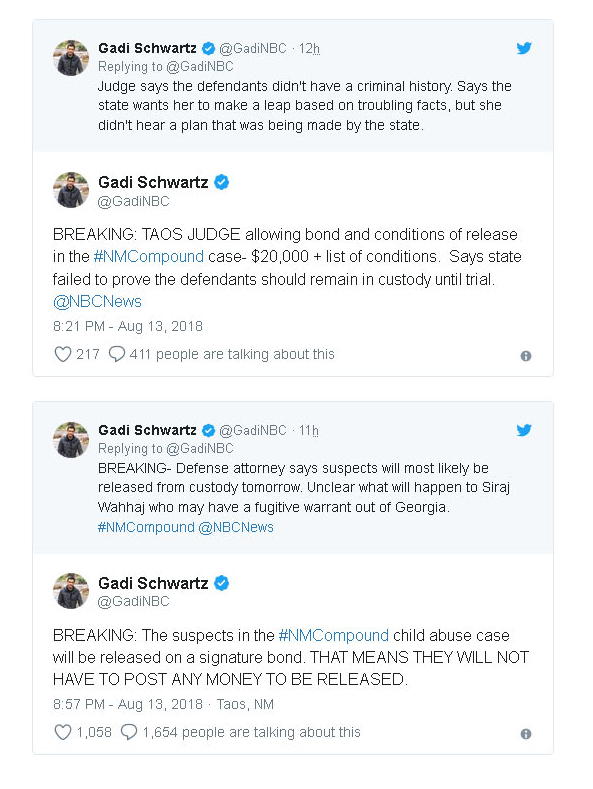
Unbelievable: New Mexico Judge Allows Jihadis Released on Signature Bond…


Unbelievable. Just unbelievable.  The five extremists of the New Mexico jihadist compound, where a 3-year-old was murdered, are being released from custody pending trial without any bail whatsoever.  They are free on a a mere signature bond; a promise to return for trial.

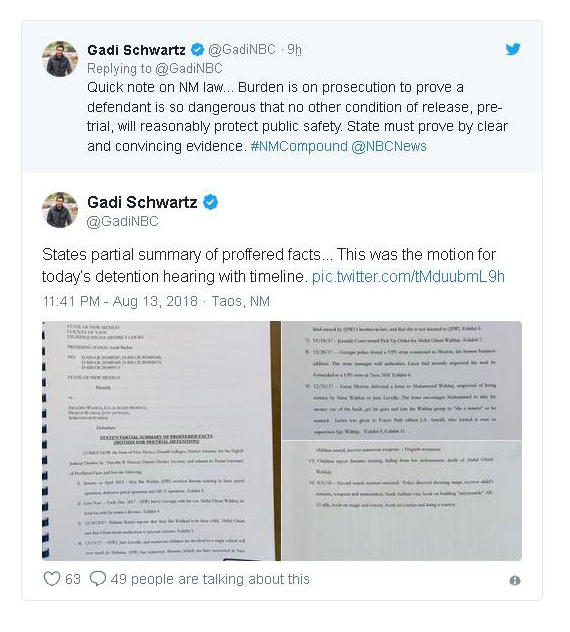
(Via Daily Caller) A New Mexico state judge ruled Monday that five alleged Muslim extremists accused of training children to conduct school shootings do not have to remain in jail while they await trial for child abuse.

Judge Sarah Backus released the five defendants, Siraj Wahhaj, Hujrah Wahhaj, Subhannah Wahhaj, Jany Leveille, and Lucas Morten, on a $20,000 “signature bond,” according to the Albuquerque Journal. That means that the defendants will not have to pay money unless they violate the conditions of their release.  (read more)

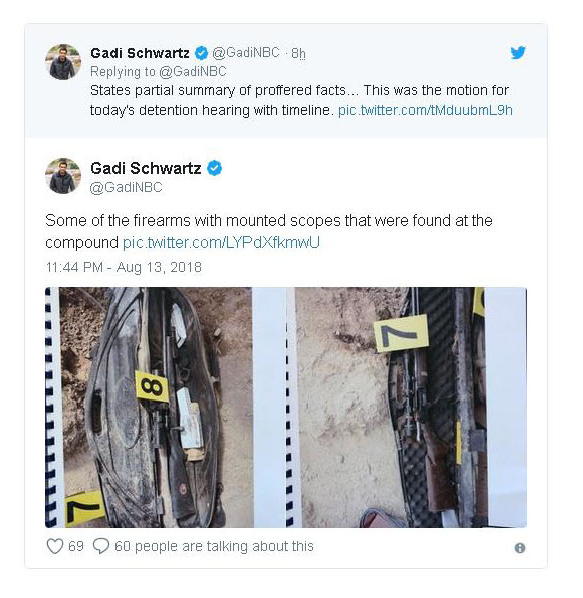
Remember, this is the same DOJ/FBI who cleared the compound and then had to return because the property owner found weapons and ammunition missed by local, state and FBI investigators.  While contemplating their release, let that sketchy aspect sink in.