IMF New Currency on ECM April 10th


Armstrong Economics Blog/ECM Re-Posted Apr 17, 2023 by Martin Armstrong
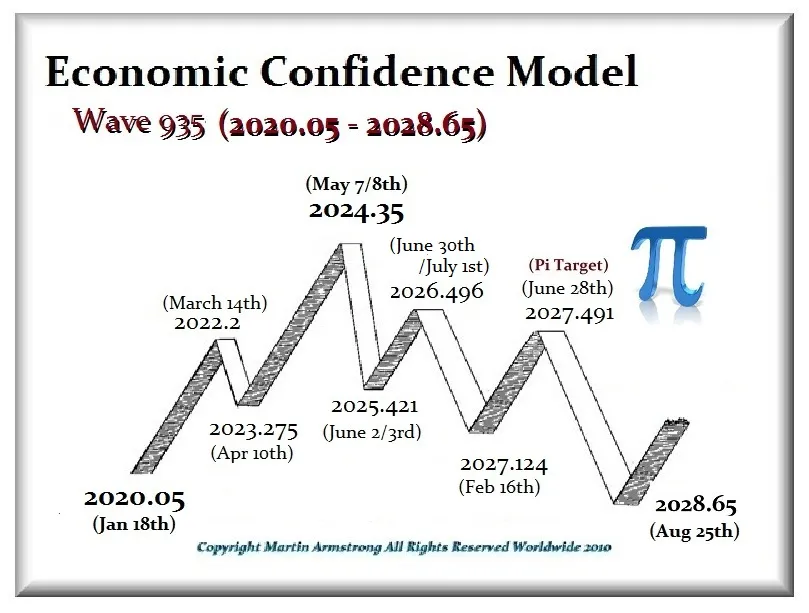
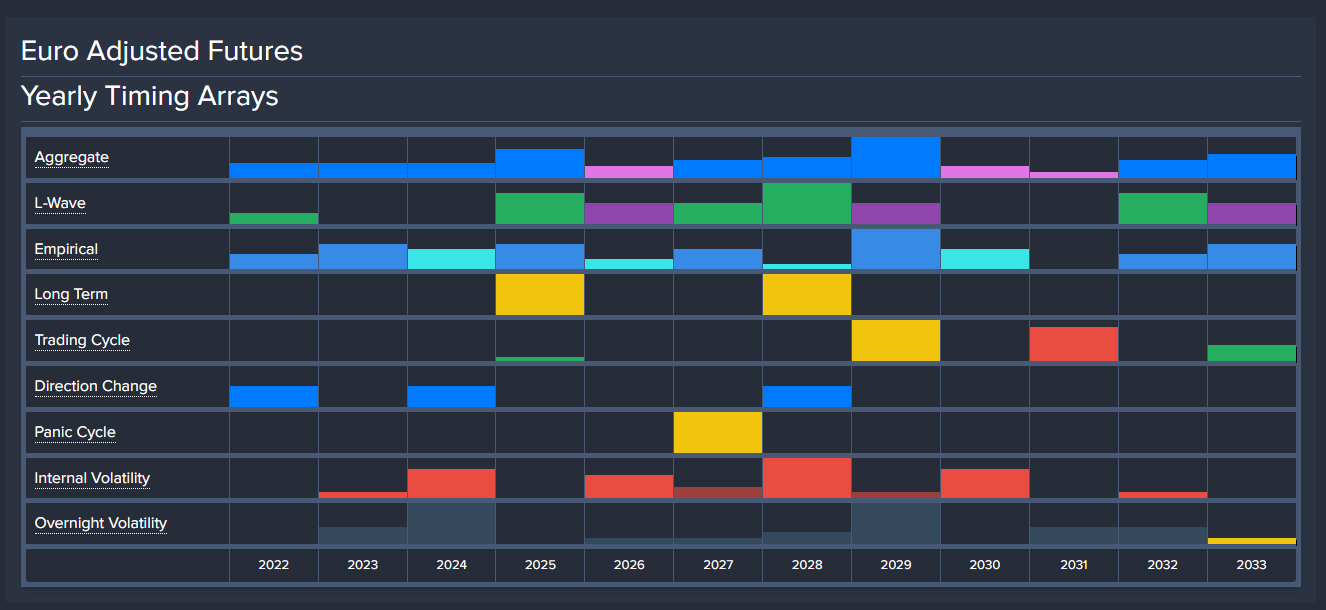
COMMENT #1: On April 10th the IMF released UNICOIN, est Voila! Zee beginning of zee end?

Lawrence

COMMENT #2: Marty, the ECM target was way too much. The Pentagon Papers was one thing, but precisely April 10th is when the IMF announced its new currency to dominate the world. Your ECM is just incredible. Why so many things of great importance take place on this model is proof that there is a hidden order behind everything.

TJ
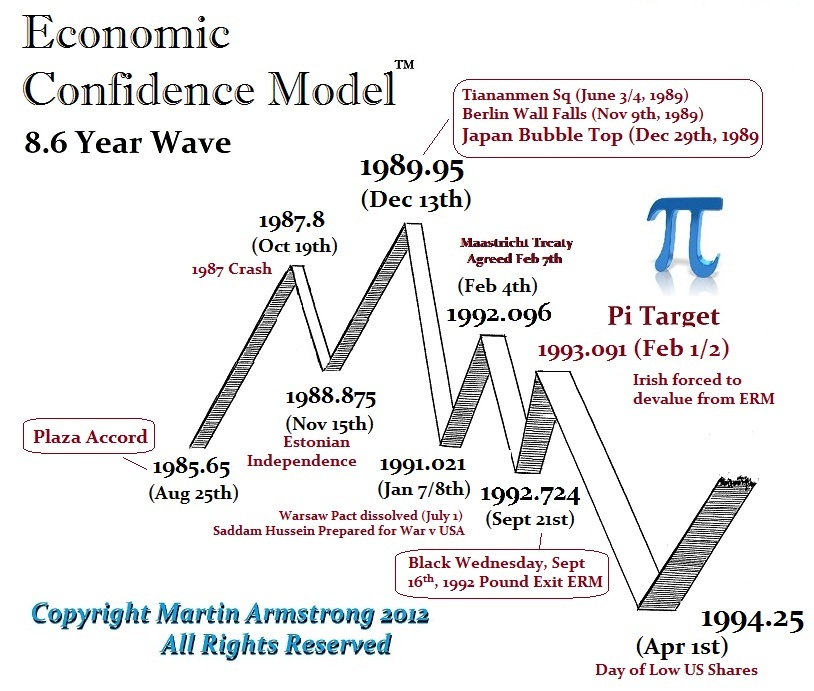
COMMENT #3: Marty, As you know, I was there at your 1987 conference for the Crash which was caused by the G5 manipulation of the currency that began in 1985. That culminated in the collapse of communism and the Japanese crash of 1989. Here we have once again the IMF announcing on the very day of the ECM April 10th, that they are releasing their new currency to replace the dollar. This looks like it will impact the entire world economy and the war you have been warning about post-2024.

I don’t know how this model works even to the precise day. It is easy to see why they tried to kill you thinking it was just your opinion and influence. They refuse to consider that perhaps there is something much more at stake than anyone’s opinion.

Thank you for this eye-opening discovery.

EK

REPLY: I do not know why this will work to the price day in wave after wave. Even the 2007 target was the very day of the crash in the mortgage-backed market. They were calling it Armstrong’s Revenge on the floor. They locked me up but it still was working as scheduled proving it was never my “influence” that they were so convinced about. There is something there, and it is about time we acknowledge it.
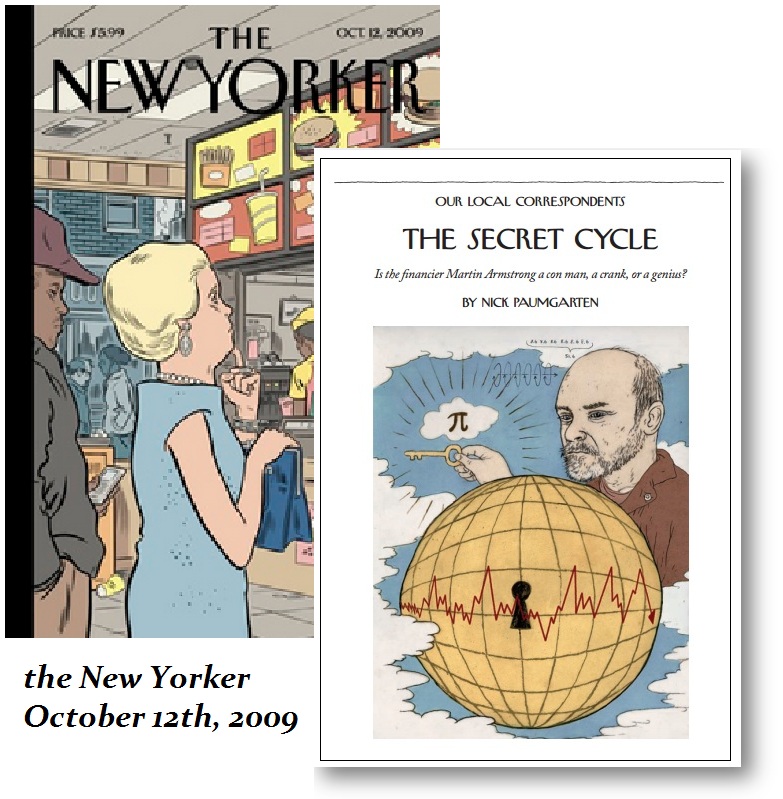
The government was furious when the New Yorker wrote about this model and called it the Secret Cycle. I believe that caused the journalist a lot of trouble. If there is a hidden order, that means the government cannot manipulate society as it thinks it can. This is why we are headed into 2032. They are fighting for their survival. They are pushing for digital currency, will terminate all paper money, and then you will see that they will restrict us from buying or selling anything they do not approve

Welcome to the 21st century of Economic Slavery. This is also the Third Millennium of the Anno Domini or Common Era in the Gregorian calendar spanning the years 2001 to 3000 (21st to 30th centuries).  As I have warned, reactions are always TWO or THREE units of TIME and everything is FRACTAL. We are in the same position on a grand scale as April 10th, which was 2.15 years into this cycle. We are approaching the 2150 years target and our republican forms of government globally will not survive.
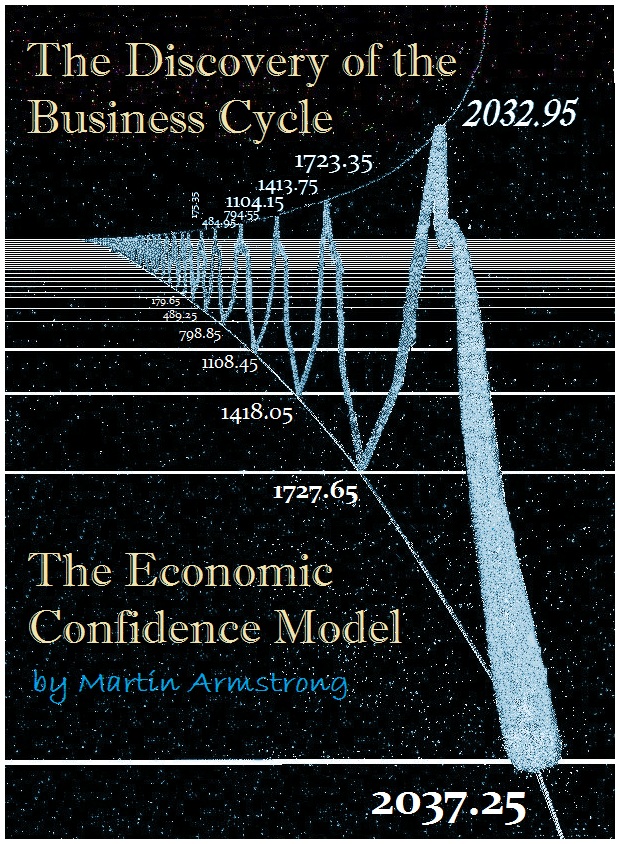
I am working long days to finish this book on the ECM. I promise it will be an eye-opener as you have said.

Only 32% of Lenders Profited on Mortgages in 2022


Armstrong Economics Blog/Real Estate Re-Posted Apr 13, 2023 by Martin Armstrong

The talking heads have been warning of a housing crash, but that is not what Socrates indicated. The 30-year fixed rate is around 6.89% at the time of this writing. Housing costs continue to rise, causing the costs of servicing mortgage debt to rise. Housing inventory is limited, and a recent report explains why we saw mass layoffs in the banking sector. The demand is still there and it is a sellers’ market. Cash is king when it comes to real estate for those who can afford it. Mortgage lenders are in trouble. In fact, only 32% of mortgage companies were profitable in 2022 compared to 98% in 2020.

The Mortgage Bankers Association (MBA) recently announced that independent mortgage banks and subsidiaries of chartered banks lost around $301 for every mortgage they financed in 2022. This marks a 113% decline from the prior year’s average and the first-time banks are seeing losses on mortgage products. This is not 2008 when banks handed out loans to anyone who asked.

“The rapid rise in mortgage rates over a relatively short period of time, combined with extremely low housing inventory and affordability challenges, meant that both purchase and refinance volume plummeted,” said Marina Walsh, CMB, MBA’s Vice President of Industry Analysis. “The stellar profits of the previous two years dissipated because of the confluence of declining volume, lower revenues, and higher costs per loan.” Production costs reached a high of $10,624 per loan last year. Productivity was 1.5 loans originations per production employee, down from 2.5 per employee the year prior, and an indicator of why we are seeing layoffs in the banking sector. No one is refinancing at these rates either and most chose a fixed rate, as we saw what happened in 2008 with adjustable costs.

First-time mortgages reached an all-time high of $323,780 last year, up from $298,324, the largest annual increase since the MBA began collecting data. The increased cost of loans increased the cost of serving mortgages. The MBA expects volume to decline further in 2023 before rallying in 2024 and 2025. The banking crisis may lead to banks and lenders selling off their mortgage debts once they cannot afford to service the debt. Again, the housing crisis today is not relative to the 2008 crash.

Tucker Carlson Outlines the Ramification of Trillions in U.S. Treasury Bonds No Longer Needed as Global Securities


Posted originally on the CTH on April 5, 2023 Sundance

For his opening monologue and first interview tonight, Fox News host Tucker Carlson outlined the ramification of non-western nations now trading in alternative currencies to the U.S. dollar.   {Direct Rumble Link Here]  As the dollar diminishes in value, and as an outcome of Biden using U.S. treasury bonds as part of the sanction regime against Russia, various non-western nations now perceive holding dollars as exposing themselves to risk.

Carlson is joined by Luke Gromen who accurately notes the dollar as a global trade currency may continue, but foreign nations holding U.S. treasury bonds as an asset will likely start contracting.  The result of U.S. treasury bonds returning after maturity with no repurchase, would be an inability of the U.S. to borrow against their sale. This could, perhaps likely will, severely diminish the amount of money the U.S. congress can spend.  WATCH:

None of this should come as a surprise to those who have paid attention. Factually, in March of last year, one month after the Russian sanctions were announced, the International Monetary Fund’s (IMF) Deputy Managing Director said the sanctions against Russia are likely to undermine the US dollar’s global dominance as a trade currency.  Everyone could see this coming.

(Inside Paper) – March 2022 – […] “The dollar would remain the major global currency even in that landscape, but fragmentation at a smaller level is certainly quite possible,” Gopinath said in an interview with the Financial Times.  She went on to say that some countries have already begun to renegotiate the currency in which they are paid for trade.

According to Gopinath, the drastic restrictions imposed by Western countries in response to Russia’s military operation in Ukraine may result in the formation of small currency blocs based on trade between individual groups of countries.  Furthermore, the use of currencies other than the dollar or the euro in global trade would result in a further diversification of central banks’ reserve assets. (read more)

The efforts of NATO and the western alliance to crush the Russian currency have failed.  The Russian ruble currency has jumped back from the sanctions and is now even stronger than before the sanctions were put into place.

With China and India supporting ongoing trade with Russia, and with Saudi Arabia responding coldly to the U.S. working on a deal with Iran for nuclear weapons, the geopolitical strategy of NATO, G7 and the proverbial western alliance increasingly looks like it will backfire.

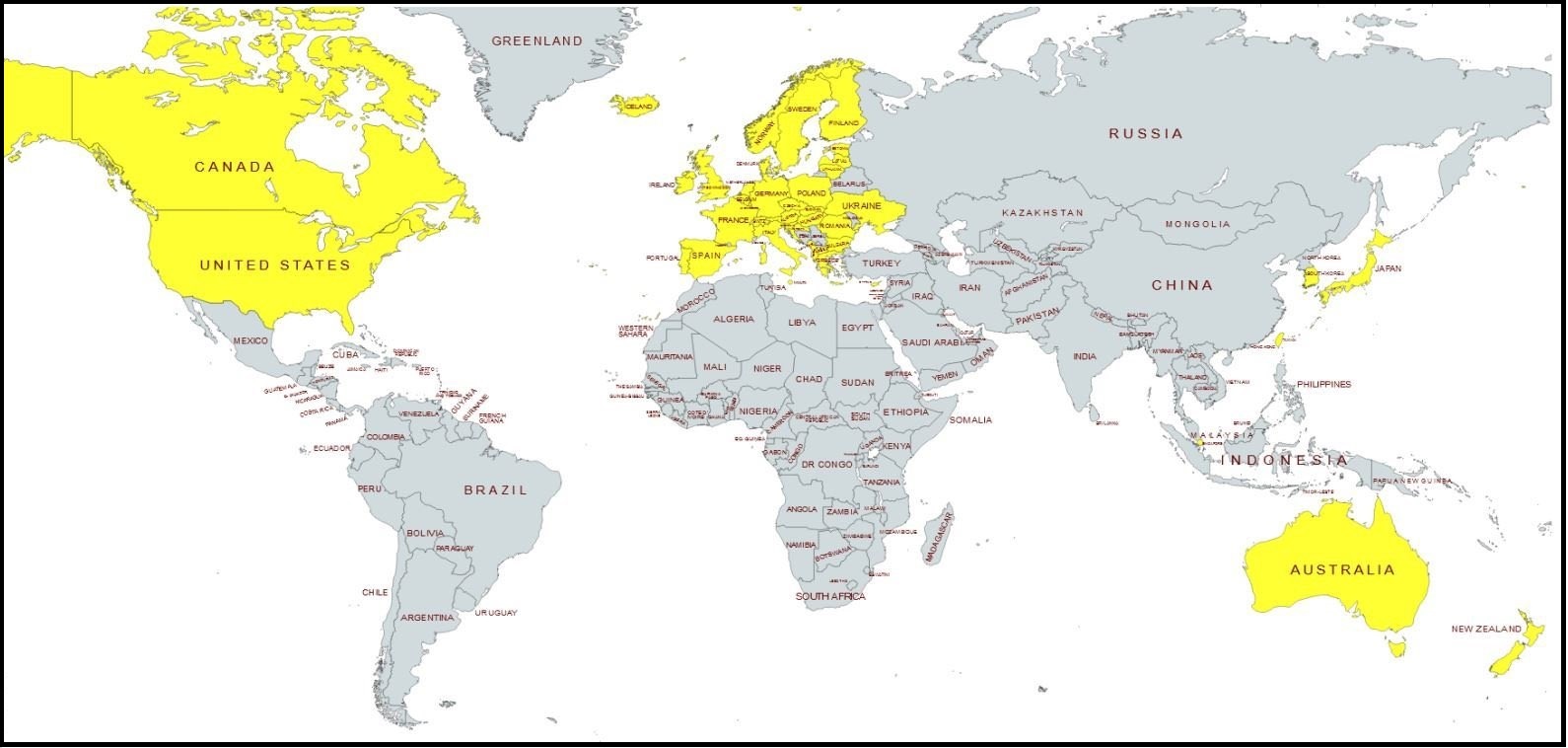
Yellow Team -vs- Gray Team: Remember, China just brokered a deal to lessen hostilities between Iran and Saudi Arabia. The fulcrum of that agreement was economics.

Meanwhile in North America, Mexican President Andres Manuel Lopez-Obrador has said he was not willing to join the energy suicide pact pushed by Joe Biden and Justin Trudeau…. A policy break in the trilateral relationship which suddenly, and not coincidentally, aligns with the timing to make Mexico a pariah to the U.S. vis-a-vis a renewed media push on the drug cartel narrative.

BIG PICTURE NOT BEING DISCUSSED – The western politicians followed the climate change instructions of the WEF multinational corporations and banks (Build Back Better) and post-pandemic immediately started reducing energy development. The central bankers then began raising interest rates to shrink the economies of the same western nations to the scale of the now diminished energy production.

The raising of interest rates is now hitting the national and multinational banks impacted by government policy that was following WEF orders. Now the western politicians are stepping in with the government controlled central banks to backstop the national banks and multinationals. Can you see the dynamic?

Team yellow is suffering the consequences of their own ideological policy as enacted. Team grey is not going to help team yellow get out of a crisis team yellow created, which was intended to hurt team grey.

…. And we continue watching.

Sunday Talks – Jim Jordan on Trump Indictment, “The Scariest Thing of All, this Is a Much Bigger Issue.”


Posted originally on the CTH on April 2, 2023 | Sundance

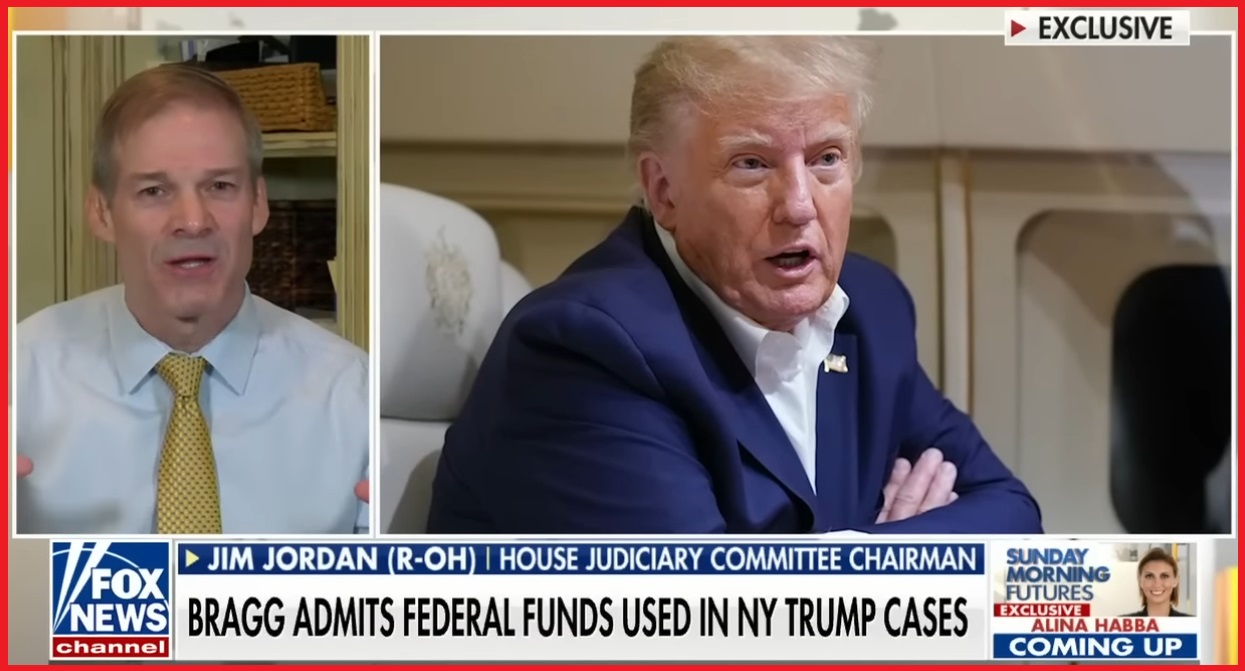
Jim Jordan appeared on Sunday Morning Futures with Maria Bartiromo to discuss his perspective on the indictment of President Donald Trump by a politically motivated Manhattan District Attorney, and the potential for the House Judiciary Committee to question DA Alvin Bragg.  WATCH:

The only way these radical leftists are going to slow down is if Republican State AG’s and local DA’s start prosecuting Democrats for similar issues.  Match them one-for-one on every attempted case.  Bring the system to its knees and show the political opposition that there’s no benefit to this political targeting.

Now is not the time for words, letters and half-measures.  We are on a war footing now.  The GOP state and local officials need to act like it!

Can We Really Last until 2032?


Armstrong Economics Blog/ECM Re- Posted Mar 31, 2023 by Martin Armstrong

QUESTION #1: Martin,

Since Trump was already not guilty of having the affair (to which Stormy Daniels admitted never took place), does that mean that the New York Court has indicted him on the charges of “being blackmailed”?

DB

QUESTION #2: Bill Clinton committed perjury. That was legal grounds to indict him and remove him from office. Nobody wanted to indict Richard Nixon either. I can now see why Socrates is forecasting the collapse of the United States. I just realized that the Declaration of Independence was approved by the Continental Congress on July 4, 1776, announcing the separation of 13 North American British colonies from Great Britain. What I did not know was it was only a vote of 12 and New York abstained. It seems like New York is at it again. Do you really think we can last until 2032?

ANSWER: What Bragg has done is so undermining to the entire country and he has accepted money from a foreign power seeking to undermine the United States – George Soros. That is treason in my book. He is doing the bidding of a declared enemy against the United States and everything our way of life has stood for.

Yes, the Declaration was designed 1776.506. The United State will exist no more after 2034.50. I am very concerned that the 2024 Presidential election is not going to be fair. By the time we get to 2025.90, this does not look good in the least. It is highly unlikely that we are looking at this lasting as we have known it until 2032. It looks like everything unravels starting in 2027.

Rand Paul Shreds Josh Hawley Over “Restrict Act” While Blocking Unanimous Consent and Reminding About Constitution and “Bills of Attainder”


Posted originally on the CTH on March 30, 2023 | Sundance 

Senator Rand Paul can be both frustrating at times and brutally purposeful at times.  While Paul is a legislative enigma and often a hot mess…. When he is incorrect, he is allowing the DeceptiCons to advance; but when he is correct on the core issue, Senator Paul can be brilliant.

Senator Josh Hawley took to the Senate floor yesterday to present a modified version of the “Restrict Act” as an alternative to the complete government takeover of all internet content – a worthy endeavor.

Hawley tried to strip out the DHS takeover component of the Restrict Act, and just present a bill that bans TikTok.   Senator Rand Paul refused to permit Unanimous Consent for the bill to proceed immediately to a vote.  Senator Paul slows down the Senate deliberations while asking some bigger questions.

The entire Hawley -vs- Paul debate is worth watching (there are two videos, one long – one short).  I sense that Hawley’s intent is good, but Rand Paul is on the right side of the argument.  The American people have never, not once, benefited from any legislative endeavor such as what is being proposed in the effort to ban TikTok.   It’s not about TikTok, it’s about freedom.

The originating debate is below the fold.  This segment is the shorter follow-up that follows Senator Paul blocking unanimous consent.   If you have time, watch both. If you do not have the time, this first one is solid enough to understand the arguments.  Notice how Senator Paul says everything inside this rush to ban is based on “speculation and conjecture.”  This is a point DC doesn’t want people to think about.  Nothing has been proven, only accused.  WATCH:

.

WASHINGTON, March 29 (Reuters) – U.S. Republican Senator Rand Paul on Wednesday blocked a bid to fast-track a ban of popular Chinese-owned social media app TikTok, which more than 150 million Americans use, citing concerns about free speech and uneven treatment of social media companies.

“I think we should beware of those who use fear to coax Americans to relinquish our liberties,” Paul said on the Senate floor. “Every accusation of data gathering that has been attributed to TikTok could also be attributed to domestic big tech companies.”

Republican Senator Josh Hawley had sought unanimous consent for a TikTok ban bill. “It protects the American people and it sends a message to Communist China that you cannot buy us,” Hawley said, adding the app is spying on Americans.

“If Republicans want to continuously lose elections for a generation they should pass this bill to ban TikTok — a social media app used by 150 million people, primarily young Americans,” Paul said on the Senate floor. “Do we really want to emulate Chinese speech bans?… We’re going to be just like China and ban speech we’re afraid of?”

House Speaker Kevin McCarthy said last week he expects the house will take up a bill to address TikTok but the timing is unclear. It is also not clear what a final bill to address TikTok might look like.

A small but growing number of Democrats and Republicans have raised concerns, citing free speech and other issues and have objected to legislation targeting TikTok as overly broad. (read more)

Longer debate…

Why Bank Bailout of Depositos is Critical


Armstrong Economics Blog/Banking Crisis Re-Posted Mar 26, 2023 by Martin Armstrong

QUESTION: Hi. I do not understand why you keep advocating over and over how the depositors should be bailed out over 250k. It makes no sense from a moral hazard perspective. It is fact that should they do that, in spite of depositors signing agreements acknowledging that deposits over 250k would not be guaranteed, the Fed will also need to cancel all outstanding debt instruments, whose borrowers also signed an agreement that if they don’t pay they lose the asset. The moral hazard is so severe as to bloody the eyes. Why do you keep endorsing the bailout which will have to be at least initially funded by taxpayers even if they get the money back? The money to shore up bank reserves in exchange for collateral has to come from somewhere. What is the real fear, that people will move deposits direct to T-bills and in so doing, set up funding for a US CBDC? Please address the moral hazard aspect of your position. So far, I’ve heard nothing to defend the immorality of it.

FO
ANSWER: Do not confuse a bank depositor with (1) an investor in a fund, or (2) bank shareholders & Management. A bank depositor is NOT an investor. The $250k is by NO MEANS sufficient for small businesses. They need to keep large amounts on hand for payroll etc. You do business and accept credit cards and they deposit that into your bank account.

Bank depositors are unsophisticated average people. The sophisticated investor moves their, money to a hedge fund or money market fund and fully understands that there is a risk associated with that investment. The bank depositor accepts no risk on any investment the bank makes. It does not give them, a piece of their profits. That goes to shareholders. It is a bailout of the entity and thus the shareholders which presents the moral hazard perspective.

If deposits in excess of $250 are NOT covered, you wipe out small businesses, they cannot pay employees and the ripple effect will be the total destruction of the entire economy. Your house will become worthless for its value will drop to only what someone can pay in cash.

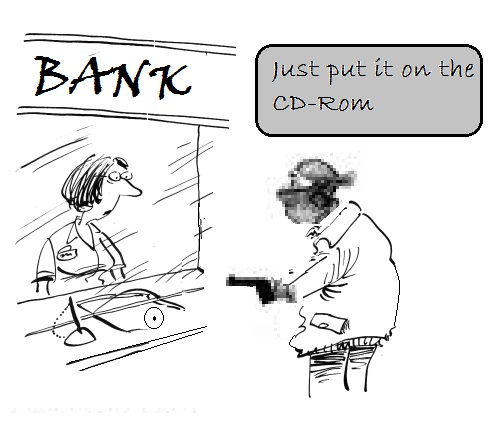
There is a HUGE difference between investing and losing and simply depositing your money in a bank because we are moving to an electronic monetary system that there will be no way for a depositor to even demand money from a bank. Some are restricting wires to $3,000 and limiting the amount of cash one can withdraw. There is also not enough paper currency to facilitate bank withdrawal on a grand scale. Bank robbery will come to an end without cash.

None of that will unfold if a hedge fund fails. We must look deeper into this entire question.

You are Damn Right This is an ‘Us -vs- Them’ Conflict – And There are More of Us Than Them


Posted originally on the CTH on March 25, 2023 | Sundance 

A familiar tactic from within the toxic corporate media system is to push a narrative that anyone who opposes their worldview is just being divisive.  This is said in order to make the victims acquiesce to the demands of the abuser.  In many ways, We The People are in an abusive relationship with government.

If you do not agree with the agenda as it is controlled by a small a powerful self-described elitist class, then we become the problem.

The division is not determined by our definitions, the conniving and corrupt administrators of the system are the ones creating the division we are accused of perpetrating.   However, there is no division in a social context as clear as the division between the working class and the investment class rulers who consider themselves above such arbitrary labels.

When you peel the issues down to their essential core, what you will always find, always find, is the money of the thing.

The created system of control is maintained through economics, and any America-First policy that threatens to close the divide between the ‘haves and have-nots’ is viewed against their interests.  This is the essential core of the opposition we face.

A thriving middle class is a powerful political balance. But a working class struggling for scraps doesn’t have the time to deliver accountability.  This division of wealth is what the Washington DC UniParty exploits.  Despite their pontificating lies to the contrary, all of the DC systems are created to take advantage of the wealth gap.

The social structures which create and maintain society are easier to control with a divided nation.

President Trump and the coalition of MAGA represents a true existential threat to this perpetuated system of division.  The America-First economic agenda created exclusively by Donald Trump is the main problem at the heart of all MAGA opposition.

Quite simply the America First agenda puts *their* money at stake, and collectively that amounts to trillions of dollars in multinational globalist financial control.  The scale of the money behind the MAGA opposition is really the biggest challenge; it is almost unfathomable, and that scale is represented within the size of the war chest they assembled for Ron DeSantis.

The top of this financial pyramid holds a grip on political power that is threatened by the worldview, outlook and economic nationalist policy of Donald Trump.  The top this system will not ‘lose’ with America-First Trump; however, they will gain at a slower rate.  This group will not leave their throne, they only see a slower assembling within their vaults.

The Blackrock, Vanguard, State Street and World Economic Forum crews will follow the America-First policy and invest in America, they will just hate doing it.  They will hate the best-play of slower gains because the returns are not as lucrative, expedient or fraught with the simple indulgences of their custom.

However, underneath that top-tier, there are many layers of vested financial interests at lesser but more generational risk. The Cornwallis crowd will see a much more difficult time advancing their influence and affluence with America-First in place.  For this tier of powdered wigs, a loss for them could really change things.  This reality is why you see demographic polling showing the more affluent the respondent, the less supportive of MAGA their responses.

It’s not a class war, per se’, it is something far deeper within the psyche and outlook of people. The need for control is a reaction to fear.  Losing influence and affluence is the fear behind the division.  If we make the totalitarians a better sandwich, if we reach across the aisle and afford benefit of high-minded doubt, maybe our professional abusers will permit us to keep a little more…  Ultimately, the chase for scraps.

This sensibility, this triggering of selfish fear, is a powerful tool.  This is exactly what is being intentionally and purposefully triggered by those who are professionally political, and they are doing it for their own benefit.  It is not necessarily about creating a class war; it is more akin to controlling the wealth of a nation and then forcing groups to position themselves for what remains.

The ‘us -vs- them‘ scenario is not Republicans -vs- Democrats, it’s We The People, represented by MAGA, -vs- the totalitarian rulers in both parties.

We the people are the heart of America

.

Interview: The Financial Collapse is GUARANTEED – What Now?


Armstrong Economics Blog/Armstrong in the Media Re-Posted Mar 25, 2023 by Martin Armstrong

Watch the video above or click here to watch my latest interview with Maria Zeee: “The Financial Collapse is GUARANTEED – What Now?”

Credit Suisse Banking Crisis


Armstrong Economics Blog/Banking Crisis Re-Posted Mar 24, 2023 by Martin Armstrong

It is refreshing when you actually find a journalist who is honest and is not being included by the Neocons to put out their propaganda. Her review of Credit Suisse is a worthwhile read. Especially when this is not over yet and the winds of finance are now turning toward questioning Deutsche Bank.

Izabella Kaminska is senior finance editor at POLITICO Europe.

Over the span of 10 days, the global financial system was once again shaken.

The time frame between the collapse of Californian lender Silicon Valley Bank, America’s 16th largest bank, and that of the 167-year-old lender Credit Suisse was approximately just that — 10 days.

And as we witness the fallout, so far it appears contained. Stock markets are up, bank stocks seem stabilized and government bonds are in high demand. Officials reassure ad nauseam that the financial system remains strong and stable.

But the truth is, even if so, what happened in this period of time has changed the financial system forever — and worryingly, most people haven’t even noticed.

Governments and central banks would have you believe that in both cases, private sector solutions were found to resolve the failures. No taxpayer funds were used.

But that is likely not true.

In the United States, growing calls from the country’s top billionaires and hedge fund bosses to guarantee the full extent of customer deposits would, if acted on, deliver a backstop that must be underwritten by public funds. That’s the case even if costs are distributed among whatever healthy banks remain later. The sums involved are eye-watering — by some measures up to $17 trillion of unfunded liabilities.

If the rule is passed — and all indications are that it will be — this would finally make the implicit explicit: that the financial system was never really rescued following the 2008 financial crisis but merely put on life-support. And that has now failed, which means socialization of the losses beckons.

Over in Europe, things are potentially worse. This time, it wasn’t the storming of the Winter Palace Hotel in Gstadt that seized the means of financing but something far more mundane: an untidy bank resolution for Credit Suisse, which relies far too heavily for comfort on Swiss National Bank (SNB) guarantees.

As one former top British central banker told POLITICO, “They could have used bail-in; it would have worked; and banking would become part of a capitalist market economy” — a reference to the loss-absorbing processes regulators came up with after 2008 to ensure bank failures didn’t have to draw on public resources ever again. “The only stable equilibrium is one where bank resolution works, or socialism,” he added.

But the resolution didn’t work. And investors are belatedly realizing this.

Key to this reality is that Credit Suisse was a bank considered to be in good condition and solvent by all regulatory measures. As one bank analyst told POLITICO, going by the assets, you would never have seen the problem coming. Even the SNB and financial markets regulator FINMA said so as recently as last week.

The SVB Private logo is displayed on an ATM outside of a Silicon Valley Bank branch in Santa Monica, California | Patrick Fallon/AFP via Getty images

So were the regulators lying? Or is the accounting somehow fundamentally broken?

What we know for sure is that markets questioned the numbers, and this was evidenced by a run on the bank’s deposits, equity and bonds. And the discrepancy poses a big problem going forward, as it knocks trust in the accounting of all similarly assessed banks, which, thanks to international accounting standards, means pretty much all of them.

Credit Suisse’s sale to domestic rival UBS at cents on the dollar of what regulators claim the underlying assets are worth presents another problem too. If similar assets are lurking in UBS’ own balance sheet — and chances are that is the case, as the assets in question are probably government bonds — they might have to be written down to a similar degree. This is probably why UBS needed the guarantee from the SNB to be doubled to 100 billion Swiss francs to do the deal.

In light of this, Switzerland now faces an even larger issue: If UBS were to become stressed — and it very well could due to this discrepancy — there’s no private sector pathway for resolution left. The country now only has one major bank and, thus, only two possible pathways to deal with a failure — nationalization or acquisition by a foreign buyer with enough cash to keep the valuation of all the consolidated assets at a price that brings everything back to par. And there are few of those in the Western hemisphere.

With a full foreign acquisition off the table due to global discord, this leaves only an unthinkable solution for the home of Swiss private banking — the dawn of a type of finance more commonly seen in communist countries, where banks are directed by the state to allocate funds to activities they prioritize. Combined with a central bank digital currency, this would reduce banks to mere proxies of the state, with uncertain consequences for efficient capital allocation and inflation.

How things would unfold from then on is unclear. The only thing we can be sure of is that nothing in banking, or capitalism, may ever be the same again.