Trump Keeps His Pledge on Tax Reform


trump-cohen

TAX-REF (3)A lot of emails are coming in asking if I have been advising Trump on the taxes since this is similar to the plan I proposed when I testified before Congress. The answer is no. If they took the tax proposals we had worked on with members of Congress back in the Nineties, who knows. They are on file and have been endorsed by many different tax reform advocates.

I have not spoken with anyone in the White House regarding taxes. I testified why the corporate tax rate must be cut to 15% before the House Ways & Means Committee. The answer is very simple. Corporations will be taxed in their home country unless they pay some tax where they are domiciled overseas. Our headquarters back then was in Hong Kong. Everyone was there because of a 15% corporate tax rate. I testified if the USA lowered the corporate tax rate to 15%, then the USA would become the tax-haven and corporations would move to the States. This is a no brainer and was based on the fact that we did in fact advise multinational corporations – not just theory. I knew what they would do and would have advised them to move accordingly.

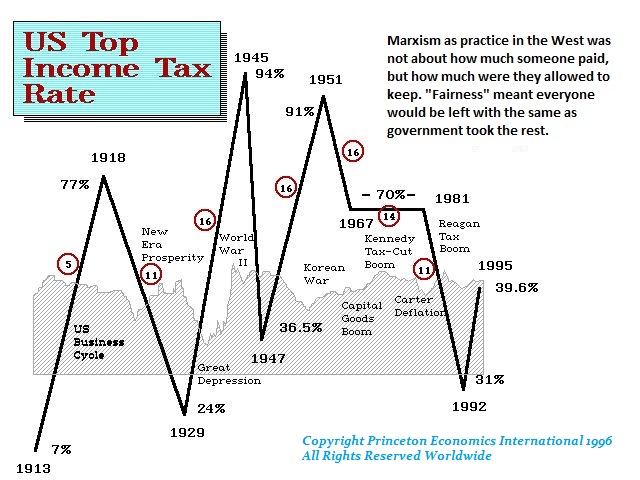
tax-cycThe biggest problem we face is this has to be made into a Constitutional Amendment. This is my ADVICE to Trump right now! Why, as soon as the cycle changes and the Democrats gain control, the taxes will rise again. This is why corporations level. We LACK TAX STABILITY. Taxes become a yo-yo  and business cannot plan long-term when the political atmosphere keeps changing between Marxism and a Free Market. This eternal battle destroys economic growth and has ruined jobs only to reduce the standard of living for the long run. A chart of the top tax brackets look like the brainwave of a schizophrenic.

Trump’s tax plan reduces seven tax brackets down to three. So it’s not the Flat Tax that Democrats will slam because the rich will keep more than they average person based solely on Marxism that discriminates freely against someone based upon their income. The first tax cut was JFK, the second was Reagan. This will be the biggest tax reform in US history. It does not go far enough, but it is the best we can do until there is a collapse in the monetary system that ends Marxism once and for all.

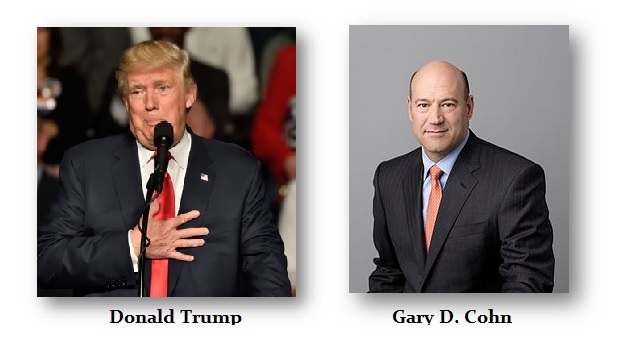
White House chief economic advisor Gary Cohn and Treasury Secretary Steven Mnuchin effectively summarized the plan to reporters. It reflects the proposal Trump outlined as a candidate keeping his word to his supporters. That in itself is really unusual for any candidate to do what they said during the election.

The tax rate on repatriation of trillions of dollars offshore is still being argued with Democrats, who never saw a $1 they did not want at least 50% of. The Death Tax has been devastating to small business and farmers. The next generation have been compelled to sell land, the farm or close the business to pay the estate taxes. This has wiped out small farms and resulted in big corporate America producing food as small farmers were forced to sell because of taxes. Likewise, if a small business sees its owner die, the family has been forced to shut it down. This was one primary reason I have been saying we will go public or else if I died, the taxes owed for my death would result in job losses for staff. Going public was the only way to get around this to ensure the company continues. So these changes will be beneficial for the economy and this may be one of the reasons why the stock market still looks like it will double in value into the years ahead after we get past 2017 this year from Political Hell.

  • Trump’s plan will cut the number of income tax brackets from seven to three, with a top rate of 35 percent and lower rates of 25 percent and 10 percent. It is not clear what income ranges will fall under those brackets. It would also double the standard deduction.
  • The proposal will chop the corporate tax rate to 15 percent from 35 percent.
  • It would eliminate tax deductions with only a few exceptions, including the mortgage interest and charitable contribution deductions.
  • The White House said there will be a “one-time tax” on the trillions of dollars held by corporations overseas. However, Mnuchin said the rate for that tax has yet to be determined. Mnuchin said the White House is “working with the House and Senate” on a repatriation rate, saying it would be “very competitive.”
  • The plan would get rid of the estate tax, otherwise known as the “death tax.” Cohn said that the move will help privately-held businesses and American farmers. Analysis of the estate tax reveals that it affects only a very small portion of Americans.
  • Mnuchin also said the U.S. would go to a “territorial” tax system. Though further details were not forthcoming, such systems typically exclude most or all of the income that businesses earn overseas.
  • Trump’s plan would also repeal the alternative minimum tax and 3.8 percent Obamacare taxes.

London Property Sales Crashed 40% Thanks to Tax Increase


62 Cornall Gardens

Where I use to live back in 1985

George Osborne budgetThe London housing market sales has crashed to its lowest level now since 2013. We reported in November 2015 with the turn in the ECM on 2015.75 that the London property market peaked. Valued crashed by 11.5% in the first month after the turn of the ECM. Landlords are joining together to challenge the Conservative’s (i.e. Tory’s) tax hike by filing a suit in the high court against their tax increase on “buy-to-let” investment properties.  In July 2015, we warned that the Conservatives were going after the non-domiciled residents in London and that would stop the real estate boom.

The figures are now out and they show that the number of homes bought over the last year crashed by 40% between March 2017 and March 2016, from 173,860 to 102,810. “That was thanks to new stamp duty rules introduced at the beginning of last April, which hiked stamp duty on second homes and led to a buying frenzy just before the rules were introduced,” reported Emma Haslett.

Keep in mind that we are only human. Consequently, if you see municipal taxes rising in the USA, expect property values to also decline. It is the same worldwide.

President Donald Trump – Captain of Global Trade and Finance…


Sometimes geo-politics can be funny and deserve a little snark in discussion. The International Monetary Fund (IMF), and World Bank, are holding a conference in DC. this weekend.  Deplorable Secretary Mnuchin represents U.S. and Trump interests.

Amid the earlier G20 Summit the Trump effect ended up with changed language from the finance leadership.  Titan Trump’s election changed the way the IMF and World Bank globalists talk about international trade.   Bi-lateral and nationalism are no longer dirty words.

WASHINGTON (Reuters) – International Monetary Fund members on Saturday dropped a pledge to fight protectionism amid a split over trade policy and turned their attention to another looming threat to global economic integration: the first round of France’s presidential election. (more)

However, funnier still is the resurfacing of a familiar face.  You might well remember former Mexican Finance Minister Augustin Carstens resigned as Mexico’s central bank chief just after the election of Donald Trump.   Well, apparently, the job of saving face for the changed approach of the IMF/World Bank is now squarely on Carsten’s shoulders.

A communique from the IMF’s steering committee on Saturday dropped an anti-protectionism pledge, adopting language from the Group of 20 nations that the Trump administration sought last month in Germany as it develops a strategy to slash U.S. trade deficits.

Earlier in the week, the IMF had warned that protectionist policies that restrict trade could choke off improving global growth.

Instead, the International Monetary and Financial Committee (IMFC) statement pledged that members would “work together” to reduce global trade and current account imbalances “through appropriate policies.”

Mexican central bank chief Agustin Carstens, the IMFC chairman, said most countries have some trade restrictions and that protectionism was an “ambiguous” term.

“Instead of dwelling on what that concept means, we managed to put it in a more positive, more constructive framework,” Carstens told a news conference.

Some officials chose to focus on the brightening global economy instead of the risks posed by the French election, new U.S. trade barriers and Britain’s decision to leave the European Union, said James Boughton, a former IMF official.

“There’s an awful lot of forced optimism about what these people are saying,” said Boughton, who is now with the Centre for International Governance Innovation, a Canadian think-tank. “Until the train goes off the tracks, everything looks fine.”

U.S. Treasury Secretary Steven Mnuchin called for the IMF to step up its surveillance of members’ foreign exchange rates.

President Donald Trump “believes in reciprocal trade deals and reciprocal free trade,” Mnuchin told Lagarde in an on-stage interview. “What that means is that if our markets are open there should be a reciprocal nature to other markets which should be open as well.”  (read more)

mexican-money-1gru-lives

Raising Highway Speeding Tickets to 175% of Your Weekly Income


British Speed Trap

A word to the wise. Any American traveling to Europe, you are better off hiring a limo driver or call Uber than drive yourself. In Europe, they have speed cameras everywhere. If you are 1 KM over the speed limit in Switzerland, the camera goes off and you have a fine. It’s not like America where even on an interstate highway with a 65 mph limit, traffic typically moves at 80 mph and police will start to look at you over 80. Local municipalities are different. Some of them are so broke they make up stuff.

In Europe, they fine you using cameras, which are also illegal in the USA. You have a right to confrontation and a camera cannot testify against you in court. Those state who adopted the red light cameras used them for revenue, but you would not get any points on your license because they too were unconstitutional.

The Europeans are simply totally insane. They fine you in proportion to what you can pay. In Britain, they are setting this at 175% of the weekly wage. So if you were a CEO earning $25 million a year, your fine will be $841,346.

In 2010, motorcycle was clocked at 164 mph. They let him keep his license if he paid $12k to Canadian authorities for speeding ticket. Then there is Finland which also adjusts speeding ticket fees based on the driver’s annual income. One driver caught doing a measly 15 over in a 50 mph zone and since he made about $7mil a year, his speeding ticket was almost $60K.

There was the Nokia phone director Anssi Vanjoki who was rising his Harley-Davidson in Helsinki, Finland and got tagged going 47 mph in a 31 mph zone. They fined him €116k. Straight out of the Communist Manifesto, in 2004, a 27-year-old heir to his family’s sausage business was hit with a with a $217k ticket for going 50 mph in a 25 mph.

Then there was the Swiss millionaire speeding at 85 mph in a 50 mph zone. The court said his net worth was $22.7m and since he had a previous speeding ticket, the court fined him $290,000. Yet even this is not the record for speeding tickets. The Swiss are simply really out worshiping Marx. A Swedish driver in a Mercedes-Benz SLR in Switzerland got caught going 186 mph. He was fined €650,000, which back in 2010, was $1 million.

Making fined based upon income is definitely the ultimate Marxist agenda. Worse yet, you are being caught by a camera and need not even be chased like in some Hollywood Movie like the Fast And Furious.

If You Can’t Reform – Just Blow The Budget Completely Apart


Students-1

You really have to wonder how politicians ever come to these ideas that they have a right to discriminate and suppress anyone based solely upon what material things they possess. In France, the left is running to take 90% from the rich and hand it to everyone else. Why should they continue to invest, take risks, or even work for that matter. I would close up shop and just leave.

In February, the city of San Francisco came up with a new “free college” plan for city residents that included an added stipend for books and travel expenses. Of course, it was by no means “free” because they were raising taxes in the city to pay for it.

In Europe where education is free, kids keep going to school collecting degrees because (1) its free, (2) they cannot find a job, and (3) who wants to work and pay taxes? The education is really indoctrination and nobody ever learned how to actually do something from a school. Even doctors have to do an internship actually doing the job to get into the door.

Well now the state of New York has joined the socialist agenda of Marx and on April 9th, the N.Y. legislature passed “The Excelsior Scholarship” bill to grant free public college to state residents. On April 13th, N.Y. Governor Andrew Cuomo signed it into law.

The N.Y. college tuition of any state resident whose family earns up to $100,000 a year prior to the fall semester this year, $110,000 in the fall of 2018, and $125,000 in 2019 will be eligible. They have adopted the communist system where once you earned your free degree, you had to work for the state. Here, New York required that the student must stay in New York for four years after they graduate. If you cannot find a job in New York and there is one in California, sorry – you can’t take it.

Interesting regulations.

Latest Interview with Martin Armstrong


French Elections on Sunday


Le Pen Marine

The first round of the 2017 French presidential election is set to be held this coming Sunday on the 23rd of April 2017. Should no candidate win a majority, which is usually the case in France, a run-off election between the top two candidates will be held on May 7th, 2017.

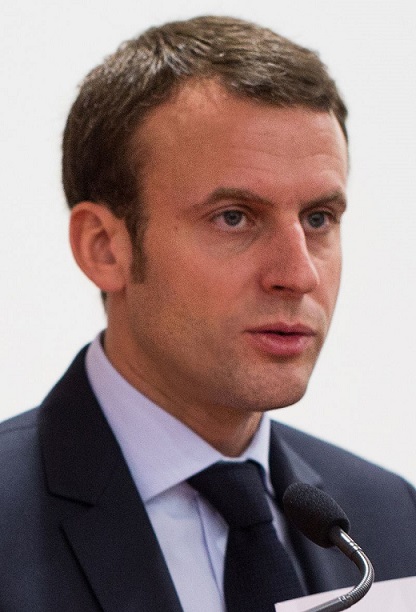
Macron and Le Pen are tied at 22% each – a far cry from a majority. Yet, what people fail to comprehend is regardless of who wins, a sizable portion of the population throughout all of Europe is anti-EU. Economically, if Le Pen does not win, it will be a very hard landing for the EU going forward for the politicians will refuse to reform and assume they have beaten the “populist” movement.

NuclearLike many Euro countries, France’s economy has reached a dead-end, or in French an economic cul-de-sac. This creates the social unrest, which is the seed of Revolution. France, as strange as it may sound, is actually closer to Britain than Germany or Italy. However, the French labor market is even more socialistic than that in Britain and it is in a major crisis. France has a major energy problem that is very specific to France. France uses primarily nuclear power. However, it does import energy from Britain.

With the elections coming up this Sunday, the EU suffered a major shock with the BREXIT vote in 2016. Then the election of Donald Trump smacked them square in the face, yet a deep-haze manifested in their eyes as the politicians refused to recognize that they were the targets.

Macron EmmanuelPanic has given way to confidence in the last few months and politicians are preparing to blame Russia for their own failures. Before the first round of the elections in France, the EU is on guard desperately trying to defeat Le Pen at all costs. They cling to the large portion of undecided and they are calling in all the markers desperately trying to get the press to manipulate this election to save Brussels.

The polls reflect considerable uncertainty. Many voters, perhaps 30 to 40% of the total, have not yet decided. This reflects the 22% poll for both Le Pen and Macron.

What is clear is that a Le Pen victory will provide a soft-landing for the Euro. If she loses, then this is going to be a very hard landing indeed in 2018. There will be no hope of reform and Brussels will push it into collapse cheering how they have defeated the “populist” movement

The End of Quantitative Easing – Perhaps Now It Will Be Inflationary?


yellen-draghi

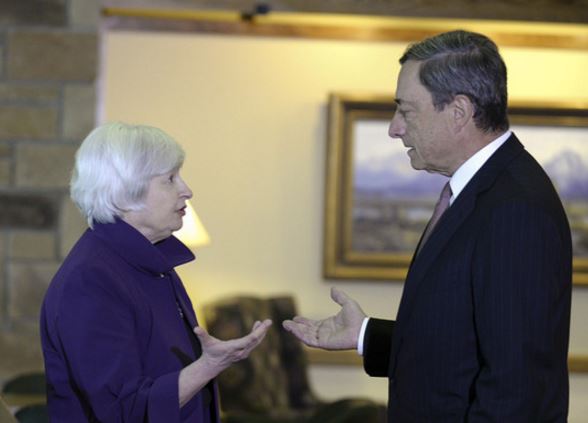
One of the greatest monetary experiment in financial history has been the global central bank buying of government debt. This has been touted as a form of “money printing” that was supposed to produce hyperinflation. That never materialized as predicted by the perpetual pessimists. Nevertheless, the total amount of Quantitative Easing (QE) adding up the balance sheets of the Fed, the ECB and BOJ is now around $13.5 trillion dollars, which by itself is a sum greater than that of China’s economy or the entire Eurozone.

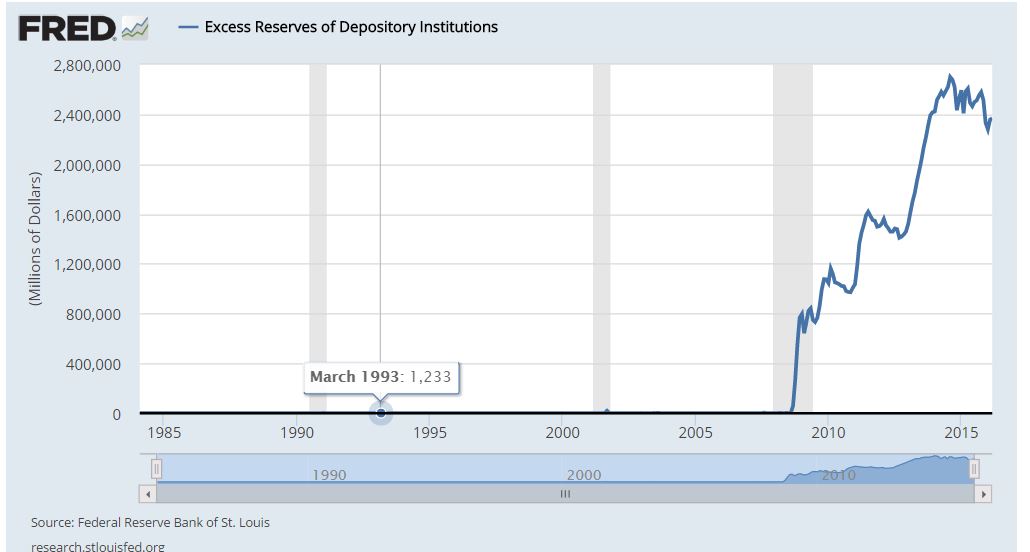
Fed Excess Reserves

QE-rIf QE failed to produce inflation, then ending QE may actually produce the inflation people previously expected. Where’s the strange logic in that one? Well you see, it really does not matter how much money you print, if it never makes it into the economy, it will not be inflationary.

The craziest think the Fed did was create excess reserves. The bankers complained that the Fed was buying the government debt so they would have no place to park their money. The Fed then accommodated them creating the excess reserves and paid them interest for absolutely no reason whatsoever.  Almost $3 trill was parked at the Fed collecting interest so that $4.5 trillion of “printing” money never made it out the door. Hence, there was no inflation to speak of (outside of healthcare which always rises no matter what).

So how does stopping QE actually create inflation? The withdrawal of the Federal Reserve (Fed), the European Central Bank (ECB) and the Japanese central bank from the QE programs will lead to an increase in yields on the bond markets sending the financing costs for the states higher. This is predicated upon the notion that people will continue to buy government debt. Governments have increased their spending sharply because interest rates were effectively zero and the central banks were buyers. Now comes the moment of truth. Has QE undermined the bond market to such an extent that only a blind fool will buy government debt in an atmosphere of rising rates?

Moreover, other sectors of the global financial system have been seriously disrupted. For one, European banks were shipping cash to their US branches and also parking it at the Fed whereas the ECB was charging negative rates. Furthermore, of the $13.5 trillion on the balance sheets in central banks, they are now trapped and cannot sell that debt. This means they are themselves screwed and they have to wait for that debt to mature in order to reduce their balance sheets. They have no way out.

The Fed had a balance sheet of about $900 billion in 2008, whereas it currently stands at about $ 4.5 trillion. The Bank of Japan recorded an increase of 107 trillion yen in the same period of time to about 490 trillion yen or also about $4.5 trillion. Then we have the ECB which has more than doubled its balance sheet from EUR 2 trillion to EUR 4.1 trillion or also about $4.5 trillion.

The central banks bought the government bonds from the commercial banks and paid them money created out of nothing which is how the pessimist put it. In theory, that is elastic and if the government debt matures, it then evaporates from the balance sheet. Here comes the problem. The governments continue to borrow. With the central banks no longer buyers, then interest rates can rise faster than anyone expects because they will have to entice fresh buyers. If that fails to materialize, then we come to the Sovereign Debt Default crisis.

The Federal Reserve had recently announced that it would no longer reinvest its gains on government bonds that had matured into new US securities, resulting in a shortening of the balance sheet. Bills of $426 billion will be due at the Fed in 2018, and again about $357 billion a year later. So if the Fed will not repurchase that debt, then the amount of new debt coming to the market will DOUBLE.

The Treasury will be forced to find ways to absorb the additional supply if the Fed wants it’s cash back so the Treasury must find a lot more private buyers. The shrinking of the balance sheets represents the continued deflationary trend from a real economic expansion trend. The government will be competing for cash in an ever growing tighter economy.

The balance sheet of the Japanese central bank is likely to be expanded for a while as long as the targeted inflation target of 2 percent is not reached. The ECB’s balance sheet will continue to grow at least until the end of the year, as the borrowing program has been running until then. However, the negative effects of the balance sheet shortening of several central banks will mutually reinforce each other in 2018 and help to bring the financial crisis to a head for 2018-2020.

The withdrawal of the ECB’s purchases of securities that also included European corporate paper will lead to secondary effects even outside Europe and help to further maintain the deflationary aspects with respect to economic growth. This will serve to demonstrate the unintentional impact of this entire unorthodox monetary policy experiment.

Therefore, at this year’s WEC, we will be looking at this complex crisis. The inflation will be asset inflation – not demand inflation. So hold on – this is going to be the craziest ride in monetary history of human kind.

British PM Calls for Early Election


Theresa May

Prime Minister Theresa May on Tuesday called for an early general election to be held June 8, 2017. She is seeking a strong mandate as she negotiates Britain’s exit from the European Union. She said that while the people voted to leave the EU, the politicians had not and they think because she has a thin majority, they can prevent BREXIT.

May’s governing Conservatives have a very small majority, with 330 seats in the 650-seat House of Commons. This has given a lift the the British pound as brain-dead and blind people still think being in the EU is somehow better. May actually triggered a two-year countdown to Britain’s exit from the EU in March. She said that if there is no election soon, then “the negotiations with the European Union will reach their most difficult stage in the run-up to the next scheduled election.”

Britain has a Fixed-Term Parliaments Act, whereby elections are held every five years. However, but the prime minister can call for a snap election if two-thirds of lawmakers vote for it.

Naturally, the primary opposition Labour Party, Jeremy Corbyn, who wants to turn Britain into total socialist state, said he welcomed May’s decision “to give the British people the chance to vote for a government that will put the interests of the majority first.”

May said she was looking forward to showing how Labour will stand up for the people of Britain against the bureaucrats in Brussels.

IBBPUS-M 4-18-2017

While the pound has rallied into the April target, it has reach into only the 12700 zone. We can see that technical support lies at the 12131 level with technical resistance at about 13400. We still need a weekly closing ABOVE 13000 just to imply the pound will hold for a while. We need a monthly closing above the 13500 area to raise hopes of extending the consolidation into the end of the year. A closing for April below 12865 will warn that the pound is losing support.

IBBPUS-M FOR 4-18-2017

Real Estate Speculation – Boom – Bust – Just Insanity


Barlow Mansion Maple Shade

QUESTION: Hi Marty, Thank you for this blog post. I understand your position but what if you find yourself as I do with real estate being the MAJORITY of your portfolio? What then? I follow your blog and I learned that mortgages in Canada are only 10 year mortgages and the exchange rate is favorable right now, so am considering 1031X purchasing investment property there, however – then I read your blog post also that their government system is not the same model as ours and defaults are not localized to municipalities but provinces must address them. So that seems a bit risky. Then I was thinking Tahoe/Donner which has a lot of cash buyers doing 1031X …however – then I read your blog post on vacation property being the worst investment in a downturn as people do not spend discretionary income… I’d guess discretionary income disappears with job loss etc. So now that is out. Then I’m thinking go small, student housing, or starter houses in the Midwest where I grew up… – however – I read your blog post that this type of housing is dependent on mortgages which could go away and so the price could crash whereas higher end properties are cash purchases… so my guess is their price might hold up better? (but the blog post does not state that I’m only guessing) At the end of the day I see risk EVERYWHERE … maybe I should just go live in a tent with my gold coins?

Question: Should we just cash out and not own investment real estate? Should we just own our home and no other investment property (e.g. that must generate rents)? It seems like that is what you have been saying by eliminating most of the options … and mentioning that people “park” money in properties they intentionally do not rent out. It will be interesting to see what happens.. because into the market I go very soon to sell here in San Francisco. Prices are going up monthly here… you can see it happening now… like some sort of quickening… most don’t notice the difference yet, but I do as I am active about to transact in this market… here it comes. Time to decide. Its a nail biter.

A

ANSWER: Real estate depends on how far down the rabbit hole we go. If government does not blink and it just keeps raising taxes trying to support a system that is unsustainable, then we end up in the full crash and burn and you are compelled to walk away from real estate. Hopefully, with education understanding the past, we can for once avoid the same outcome and advance in this learning curve of civilization.

Vacation properties are the worst to survive. I bought such a place to live in at about 50% of its 2007 high. So while high-end properties in cities were rising, vacation spots on the beach declined. I wanted beach front. So understanding the cycle helps tremendously for entry and exit points.

The risk of mortgages declining is real. As governments get in trouble, long-term confidence starts to decline. Banks will not longer be able to package mortgages. As that unfolds, the lack of the availability of mortgages means the only cash rules.

Barlow AdThe town I grew up in, Maple Shade, New Jersey, was once the sprawling real estate speculator’s paradise. Thomas Barlow, Sr. and his son, Thomas, Jr. formed the Maple Heights Land Co. together with several other businessmen in 1908. The company purchased from John R. and Margaret W. Mason their farm which was part of the original Roberts plantation surveyed in 1682. In 1910, they formed Barlow Company and began selling 1 acre lots. The buyers were the city folks in Philadelphia for the train came right into Maple Shade and that made the area worth speculating in.

Barlow Thomas

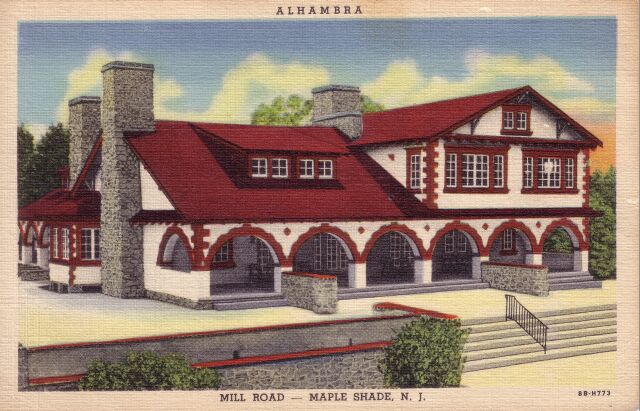
The Barlows then developed small bungalows meant to be vacation homes for people in the big city, which were called Barlow Built Bungalows (BBB). Thomas J.S. Barlow Jr., made a lot of money during the land boom into 1927. He made a lot of money also in the stock market. He built the Barlow Mansion in Maple Shade in 1916 as a wedding present to his wife. The property was then expanded containing the second 3 porch archs which were added in 1926 just before the 1927 real estate bubble burst in Florida and became a contagion in real estate around the country.

Thomas Barlow lost the house in the early 1930s after the Stock Market Crash of 1929. In March 1933, Chester Township (Maple Shade) was declared bankrupt. The Maple Shade National Bank closed was one of the banks that never opened after FDR’s bank holiday. In 1936, Maple Shade had the Highest tax rate in Burlington County because it had gone bankrupt and could not pay its bills lacking any credit facilities. It was during the 1930s that the Barlows opened up their basement for the children in town. It was one of those gatherings that my parents met.

Maple-Shade

Maple Shade OLPH ShrineAfter the bank went bust and the Barlow Mansion was lost, one of my father’s friends family had bought up most of main street for cash at 10 cents on the dollar. As state revenues declined during the Great Depression, New Jersey introduced its State Sales Tax fixed at 2% in 1935, except milk and purchases under 13 cents. The Catholic Church in Maple Shade built a shrine in 1937 to thank for a recovery. OLPH Shrine details was the showplace of the locality and stood some 40 feet in width, 36 feet high and 18 feet in depth. It was formally dedicated on Sunday August 15th, 1937.

This story can be repeated countless times for small towns that were being developed during the 1920s land boom how vacation speculation bankrupted many. Even Sarasota, Florida was developed by John Ringling in the mid-1920s. John was once one of the world’s wealthiest men in the United States, yet he died with only $311 in the bank.

Housing-MarketI warned that the Consumer Financial Protection Bureau puts regulations on people buying real estate with a mortgage that has been highly burdensome to normal people. When friend bought a house with his girlfriend, they had to explain absolutely every check where she had written to him each month paying her half of the rent. They made them account not just once, but for every check going back 5 years.

As late as the 1920’s, someone taking out a mortgage to buy a house in the U.S. would most likely get a short-term balloon mortgage with terms of 50%, and five years to pay off the other 50%. At the end of the five years, it was common to re-finance into another five-year loan. However, when the Great Depression, the value of cash rose and banks didn’t want to refinance these balloon mortgages. Banks began to foreclose. Between 1931 and 1935, a quarter million people lost their homes each year.

1933_Virginia-land-auctionBankruptcy auctions were common and prices fell to 10% for only people with cash could buy. Farm land fell to below what it sold for in the 1850s. Here is a photo of a 1933 Virginia Land Foreclosure Auction.

The whole reason Franklin D. Roosevelt created the 30 year mortgage was to try to get people to buy on credit. Property was being auctioned off in the 1930s and it was for cash only. Prices for farmland fell to pennies on the dollar for only cash buyers could bid. Roosevelt stepped in, explaining why the government shouldn’t just sit by: “Even before I was inaugurated, I came to the conclusion that such a policy was too much to ask the American people to bear. It involved not only a further loss of homes, farms, savings and wages, but also a loss of spiritual values — the loss of that sense of security for the present and the future so necessary to the peace and contentment of the individual and of his family.”

Roosevelt created federal agencies that form the basis of the housing market the United States to this day. They provided mortgage insurance, established a secondary market for mortgage loans, and converted 1 million loans into long-term mortgages. There were truly transformational in nature. It did make housing affordable and it made housing, homeownership, sustainable. However, it effectively leveraged the entire real estate market. It was truly that then more people could afford to buy, but as demand rose, so did property values.

The crisis we face is what happens this time when the banks cannot lend money, interest rates rise, and mortgages for 30 year periods vanish? Like any market, prices will crash. The maximum length of a mortgage was extended to 30 years in the 1940’s, making home ownership even more affordable and leveraged the entire housing market. Today, Roosevelt’s economic fix became the norm. The 30-year fixed-rate mortgage accounted for nearly 90% of all new mortgages.

If the government can no longer subsidize the real estate market, the 30-year fixed-rate mortgage will become too expensive, become far too risky for a lender even if the person does not default by the rise in the cost of money, and it will simply disappear. The long-term mortgage is a bet a lot of lenders don’t want to take on their own.

This is the risk to the housing market. If you have the bulk of your assets in real estate, then one way to keep them is to run out and get a 30-year FIXED mortgage now while you can. You have sold the risk to a third party and it is now their problem. You the cash wisely for investment into other movable areas.