After the FOMC decision, Jerome Powell stated during his Q&A that the Federal Reserve does not have a plan to consolidate banks. “I personally felt that having small, medium, and large were a great part of our banking system,” Powell stated, noting that they all serve different customers. Powell said it could have been a good outcome had one of the regional banks bought failed First Republic instead of JPMorgan Chase. However, the chairman noted that the FDIC mandates that banks be acquired using the least costly resolution option.
The FDIC says it does not give preference to bidders. How can a bank qualify? According to the FDIC website: “Bid lists are created for each acquisition opportunity based on potential acquirer’s qualifications and interests and characteristics of the failing bank such as capital ratios, regulatory ratings, assets and core deposits as reported on the most recent Call Report and geographic location of the bank. Each bid list is developed using several criteria sets to identify approved potential bidders for an acquisition opportunity, while considering factors that match likely approved bidders to an acquisition opportunity.”
Due to the recent banking failures, the FDIC has also created guidelines specifically for failed bank acquisitions:
“The FDIC markets troubled institutions to healthy insured depository institutions. The FDIC is statutorily required to resolve failed institutions using the least costly resolution option minimizing losses to the Deposit Insurance Fund. The FDIC's primary objective is to maintain financial system stability and public confidence. Returning assets to the private sector in an orderly manner at the best price is another key objective. The FDIC also tries to reduce the impact on the community.

Recapitalization before failure is the preferred method to resolve open troubled financial institutions. FDIC markets institutions in case a failing institution is not able to resolve its issues on its own. If an insured depository institution is unable to resolve its issues, the FDIC will implement its resolution process by which qualified bidders may seek to acquire the assets and assume the liabilities of the failing institution.”
Obviously, smaller banks will not have the ability to compete. All banks are struggling with liquidity issues, and mid-sized institutions will likely be unable to offer the “least costly resolution option.” Ideally, they want failing banks to be attained prior to failure, and only large institutions can provide that cushion. Nothing in the FDIC guidelines at the time of this writing currently limits what a large institution could acquire. The computer states that we will see more banking failures across the globe. Based on these guidelines in the US, it is reasonable to assume that large banks like JPMorgan Chase will benefit from future acquisitions and continue to grow. It is unclear whether banking monopolies are permitted under the 1890 Sherman Antitrust Act, but it remains to be seen what alternatives the system will have as more banks go under.
Posted originally on the CTH on May 4, 2023 | Sundance
According to those who relish the Cloward-Piven strategy, things are proceeding swimmingly.
…”As long as the decisionmakers continue doing the things that are creating the crisis, the crisis will continue.”
Federal Reserve Chairman Jerome Powell said yesterday the “U.S banking system is sound and resilient,” insert uncomfortable snicker here. However, uncertainty is continuing to pummel the banking industry, despite assurances from the Fed, Treasury, FDIC financial regulators and bankers such as Jamie Dimon who are all saying there is no crisis in the banking industry.
If you want to know the big picture source of the uncertainty, it’s the great pretending. The average person can sense something is wrong, and the person who pays attention has the experience of institutional lying over the past several years. The last ten years of lying and pretending has created the biggest collapse in institutional trust in U.S. history.
Russians interfered with the election – trust us. Stick this needle in your arm, it’s safe – trust us. The FBI are the good guys – trust us. Biden won more votes – trust us. This inflation is merely transitory – trust us.
See the problem?
So, when the same voices shout, “the banking industry is sound, trust us,” well,… yeah, that suspicious cat sense that’s on high alert isn’t buying the chorus.
Reasonably intelligent people who accept things as they are, not as they would have us pretend them to be, can see the core connection to the World Economic Forum, Central Banks, and western globalist policy to change the entire dynamic of economics and finance around the “Climate Change” agenda, or Build Back Better, or Green New Deal.
Overlay that commonsense and pragmatic outlook with the logical consequences of the activity, and this banking collapse issue is a self-fulfilling prophecy. As long as the decision makers continue doing the things that are creating the crisis, the crisis will continue.
(Via Wall Street Journal) – Regional-bank stocks tumbled Thursday despite assurances from the Federal Reserve that the banking system is on solid footing.
PacWest Bancorp PACW -47.04%decrease; red down pointing triangle, which has been hit hard since the collapses of several banks, dropped by about 40%. The stock started falling in after-hours trading Wednesday evening, after a report that it was considering selling itself.
PacWest said in a statement after midnight Eastern Time Thursday that its core customer deposits were up since the end of the first quarter, and that it hadn’t experienced any unusual deposit flows since the collapse of First Republic.
[…] Investors have been wondering how much further the problems in regional-banking could spread, and whether they will spill over to the broader economy. Some analysts said the decline in PacWest and others reflected the market’s tendency to view news as categorically good or bad, rather than worries about PacWest specifically. Western Alliance, another bank whose stock has been hit hard, fell by about 35%.
[…] Regional banks, as major lenders to businesses and families across the U.S., also tend to fall when investors are expecting a recession. The 10-year Treasury yield slipped this week, and Brent crude hit a 52-week low on Wednesday.
[…] On Wednesday afternoon, the Fed said the U.S. banking system “is sound and resilient,” echoing language from its March statement. Fed Chair Jerome Powell added then that deposit flows at banks had eased and that this week’s seizure and sale of First Republic should further stabilize the industry.
[…] PacWest shares were recently trading around $3.70, putting them on track for their lowest close on record. The stock has now lost some 85% of its value since March 8, the day that SVB spooked bank investors by announcing a loss and a planned capital raise.
Many of PacWest’s customers are tied to technology startups—a tightknit clientele that pulled from high-balance accounts en masse at Silicon Valley Bank before it failed. (more)
Posted originally on the CTH on May 1, 2023 | Sundance
Everything about the process of cutting down energy exploitation, then driving supply side inflation, then raising interest rates to shrink demand (stem inflation) created by a desire to lower economic activity to the scale of diminished energy production, is a game of pretending.
The collateral damage from the rate hikes has been the banking destabilization, which shows the priority of the government officials and central banks to support the climate change agenda. Into the game of pretending comes the second unavoidable consequence with inflation continuing as a result of the energy policy.
They simply cannot cut energy demand enough to meet the diminished scale of production. There is no alternative ‘green’ energy system in place to make up the difference. That is the reality. Now, the fed is scheduled to raise rates again, then begin to debate the collateral damage as they continue the pretending game.
(Via Wall Street Journal) – […] Another quarter-percentage point increase would lift the benchmark federal-funds rate to a 16-year high. The Fed began raising rates from near zero in March 2022.
Fed officials increased rates by a quarter point on March 22 to a range between 4.75% and 5%. That increase occurred with officials just beginning to grapple with the potential fallout of two midsize bank failures in March.
The sale of First Republic Bank to JPMorgan Chase & Co. by the Federal Deposit Insurance Corp. announced early Monday is the latest reminder of how banking stress is clouding the economic outlook.
Fed officials are likely to keep an eye on how investors react to that deal ahead of Wednesday’s decision, just as they did before their rate increase six weeks ago when Swiss authorities merged investment banks UBS Group AG and Credit Suisse Group AG. (read more)
There is no other way to look at the combined policy without seeing a Central Bank Digital Currency (CBDC) in the future. All of these combined policies are creating a self-fulfilling prophecy.
Posted originally on the CTH on April 30, 2023 | Sundance
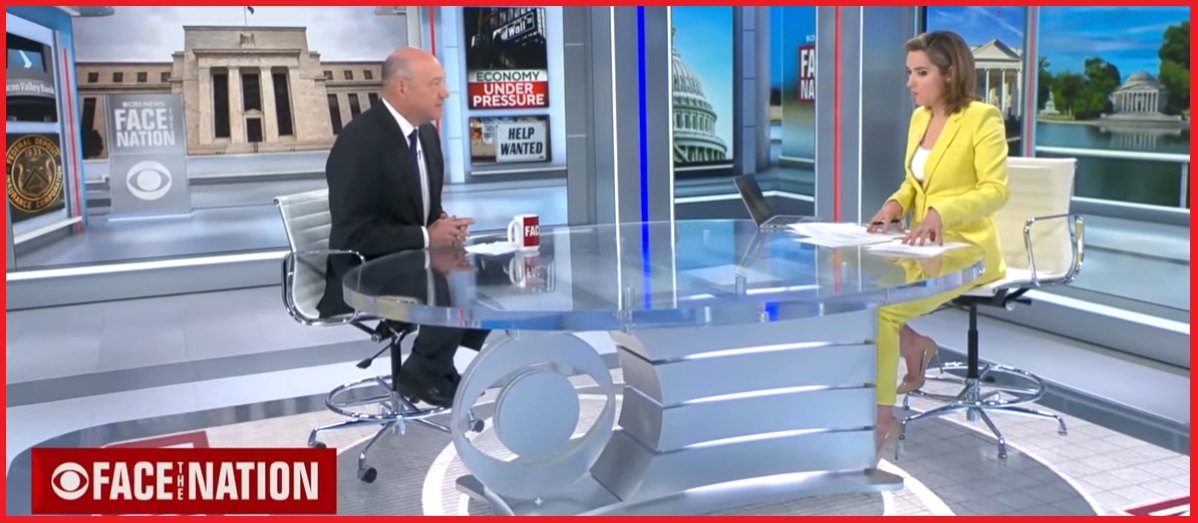
Gary Cohn is connected to the banking and finance industry, well connected. In this interview with Face The Nation earlier today, Cohn is discussing the current status of First Republic Bank, another big player in the California banking system that is about to collapse. Cohn notes something at the 1:15 mark that just seems obvious yet is undiscussed in most outlines of the FRB discussion.
Six weeks ago, in an effort organized by the FDIC, $30 billion was pushed into FRB by eleven larger banks to stabilize it. However, the only thing that infusion of capital did was allow institutional depositors time and ability to withdraw their funds. A complete racket. Once the at-risk group exits, suddenly the collapse is back on the tee. WATCH:
[Transcript] – MARGARET BRENNAN: We want to turn now to Gary Cohn, who is the vice chairman of IBM, former Goldman Sachs president and a former Trump administration top economic adviser. Good morning to you. Lots of titles, Gary, Lots of experience. That’s why we like having you here. I want to ask you about what’s happening with First Republic. It’s been under pressure. We know they’ve been looking for a buyer, the FDIC, the government is looking to arrange, moving it into government control and then maybe selling it. What are you hearing about how this would roll out?
GARY COHN: Margaret, thanks for having me. I think you’re portraying the situation as we find ourselves again on a weekend. As we closed business of Friday, the FDIC was in a process of looking for acquirers or bidders for the assets over the course of the weekend. I think the FDIC has asked potentially three banks for their final bids for the entire bank. The FDIC would prefer to sell the bank in its entirety than the pieces. What will most likely happen is the FDIC will seize control and then simultaneously resell the asset to the successful bidder. I think that will happen sometime later this afternoon before the markets open in Asia this evening.
MARGARET BRENNAN: And this will be a faster process than what happened with SVB?
COHN: It will be- it will be a much faster process. Now, we’ve been going down this process for the last two weeks or so as first republics continues to be under pressure and continues to lose deposits. Unfortunately, First Republic reported this week that they had a massive outflow of deposits over the last quarter.
MARGARET BRENNAN: So if First Republic is sold, then the acquirer would take on the deposits. So what do you think about the conversation we had earlier with Congressman Khanna about whether Congress needs to do something here? Because it seems like we’re just going into emergency mode now for three banks.
COHN: Yeah.
MARGARET BRENNAN: Does there need to be a broader change to the regulatory system and to the laws?
COHN: Well, it’s an interesting question. So, look, I don’t agree with Congressman Khanna that we want unlimited FDIC insurance. I think that to me is a bit of a race to the bottom.
MARGARET BRENNAN: You had picked like two, 2 million. 5 million, 10 million.
COHN: Yeah. I mean, there’s got to be some limit. It’s- at some point you have to limit because you don’t want to race to the bottom where you know, the weakest bank with the weakest balance sheet in the world can offer you the highest rate of return on your deposits. And therefore, you take your deposits there because guess what? They’re insured by the federal government. That’s not what we want to see. We want to see some type of discipline in the system. When you talk about more and more regulation, I smiled because if you look at the report that came out that you referenced with Ro Khanna as well, you know, one of the findings in the report is that the regulators did not do a very good job enforcing the existing rules. So if you can’t enforce the rules you already have on the books and by- it’s hard to enforce the rules because there are so many rules, do you want to create more and more rules when you can’t enforce the one you already have? Part of me feels like we need to get a simpler, more coherent set of rules so the bank regulators can actually enforce them and they know what the important rules are.
MARGARET BRENNAN: But the bank regulators here are at the Fed. That’s what we’re talking about here.
COHN: They’re at the Fed and at the States. Remember–
MARGARET BRENNAN: That’s true.
COHN: –we have state regulated banks and federally regulated banks.
MARGARET BRENNAN: Well, that’s a big conversation for California since they just had two banks–
COHN: It is.
MARGARET BRENNAN: –have some big problems. But Fed Chairman Powell is going to face questions from the press midweek.
COHN: Yes.
MARGARET BRENNAN: They- he gives a press conference around the decision on interest rates that he is expected to be making. Do you think these banking problems are going to interfere with his plan?
COHN: I don’t think these problems are going to interfere with his plans. I actually think they’re helpful to his plans.
MARGARET BRENNAN: Because they’re slowing the economy?
COHN: Exactly. What the- what the chair has been trying to do is slow the economy down. He’s been trying to tamp down inflation. Inflation is too many goods chasing too few products. And part of the chasing has been the easy availability of credit. Now that we’ve seen deposits lose- the- leave the system and we’ve seen banks in tighter financial position, they are not offering loans as easily as they were before and the loans have become more expensive. So people are borrowing less money, they have less access to credit, so their ability to purchase is going down. Purchasing power is waning in the United States, which is exactly what the chairman’s been trying to do by raising interest rates. So he’s in essence, getting enormous amount of help out of this banking crisis, not what he wanted to see happen in any way, shape or form, but the unintended consequence is very helpful to slowing down the economy and tamping down inflation.
MARGARET BRENNAN: So does it up the odds of a recession being more than mild?
COHN: It probably ups the odds. Yes. I mean, it definitely ups the odds. It takes control out of the Fed. The Fed is no longer in total control of slowing down the economy. They’ve now got the banking industry playing along with them. But as we’ve seen in the economic data recently, the consumer in the United States still is in relatively good shape. They are starting to run out of savings. The money that they got during COVID, we put an enormous amount of stimulus into consumers bank accounts and that administrations, both administrations, every every administration put enormous amount of stimulus in the bank accounts. We see from the savings data that’s starting to to wear down. It’s starting to run off. So is that runs off further and further. The economy would become more credit dependent to keep thriving. So I think we will see a slowdown. And I still think we’re in a relatively decent shape. We may have a recession, but I still. I think we could muddle through the bottom here without a real deep recession.
MARGARET BRENNAN: The chair of the House Financial Services Committee, Congressman McHenry, called the Fed’s report a self-serving justification of Democrats long held priorities. He may be venting. It doesn’t look like Congress is doing anything to change regulation or laws related to banking. There was an FDIC report on the collapse of Signature Bank, which blamed bad management, but it also said regulators just didn’t have enough staff. In New York. I mean, there’s some pretty damaging bits of information in here. If you put aside the politics, the regulators don’t have enough staff. They didn’t act. So who are they being held accountable by unless it’s Chair Powell?
COHN: Well, it is Chair Powell. And I think- I think when the chairman goes to Congress and remember, he testifies in front of both the House and the Senate a couple of times a year. Historically, all of the questions have been on monetary policy. I think we’re going to start seeing a lot more questions on the regulatory and the regulatory policy. How is regulation working? Are they keeping up to what they need to do? Do they have proper staff or there are issues that are going by that are not being covered? This is a huge finding. I mean, this is a bit of a seismic moment because we believe in the United States and I think the US population believes that the banks where they deposit their hard earned money are well regulated. And we have found out this week in the Fed’s own report that these banks are not well regulated, and they admitted it themselves. I ran a regulated bank. I know that if we would have ever told our regulator that we did not have a enough people to regulate ourselves, they would have shut us down. So we cannot be in a position where the regulators themselves say we do not have enough staff to regulate you properly.
MARGARET BRENNAN: You ran one of the biggest banks. Gary, we’ve got to leave it there. We’ll be back in a moment.
I have created this site to help people have fun in the kitchen. I write about enjoying life both in and out of my kitchen. Life is short! Make the most of it and enjoy!
This is a library of News Events not reported by the Main Stream Media documenting & connecting the dots on How the Obama Marxist Liberal agenda is destroying America




 Centinel2012