The Confidence Game – The Next Crisis


Confidence-wide

QUESTION: Martin, I started following your models shortly after college in 2000 when I entered the financial advisor world. I soon realized how clueless this industry was and formed a hedge fund in Tampa in March 2007 to short retail and housing, largely based on your models & my understanding of cycles. I reached the top 1% in Morningstar through Sept of 2008 right up until the government banned shorting. I could not receive quotes from my Goldman Sachs trading platform and I lost a lot of money in a few short hours. I eventually had to shut down the fund and my investors took losses. It was this period where I learned the error in my thought process, I underestimated the length to which the Government & politicians would go to kick the can further down the road and underestimated the big banks inside influence on the “free markets”.

Your recent post regarding inflation and the end of Quantitative Easing had me thinking, wouldn’t the moment the politicians realize there is a recession on the horizon and inflation begins to cripple the housing followed by retail, etc, wouldn’t they re-institute QE and expand the balance sheet further regardless of the future implications? It seems politicians will do whatever it takes to avoid the worst and continue to kick the can down the road to save their own careers.

Thank you for your provoking thought and mindful awareness while everyone else buries their heads in the sand.

R

credit-anstalt

ANSWER: The outcome always depends upon confidence. It is what you believe that counts rather than the facts. When Credit Anstalt went belly-up in 1931, why did an obscure bank in Austria set in motion the 1931 Panic and Sovereign Debt Defaults that made a recession into a Great Depression? The answer was found in the name. One of the owners was the Rothschilds. When people heard the Rothschilds went bust, they began selling all the banks because if they went down, everyone else surely would. They were the Goldman Sachs of the day.

Hoover - Loose Cannon

I suggest reading Herbet Hoover’s Memiors from 1931. This is a confidence game. Just because QE appeared to work before does not mean it will work a second time. The middle-class lost money and their living standards were sharply reduced. Retail investment in equities has not yet returned to even 50% of 2007 levels. Most people who lost their homes were those who could never have bought one before. Yes, the middle-class who borrowed more against their house were put under stress. Home equity loans dried up so industries like selling pianos dropped by more than 50% since people borrowed using home equity to fund expensive things like a piano.

Fed v Congress

Energizer-BunnyThe difference this time is the fiscal budget. Back in 2007, the Fed only had to worry about its policy and the contracting economy. The problem they created is that government just keeps going like the Energizer Pink Bunny – it never stops spending regardless of the level of interest rates.

The Fed cannot neutralize the Fiscal spending of government. This is deeply entrenched. Just look at the table below on the annual deficits since 2007. This has increased about 364% since the 2007 crisis began.

Government has become addicted to cheap interest rates. If rates go back just to 5%, we are looking at a fiscal deficit explosion the Fed cannot overcome.

US Deficits 2007-2016

The crisis has to hit before a politician would ever act. Once the crisis begins, you cannot restore confidence. The whole thing will have to play out. Moreover, the crisis in Europe helped to send capital to the USA easing the economic pressure here. This is why the USA is holding up the entire world economy right now and a stiff wind will blow over the European banking system. I seriously doubt that anyone can stop the next crisis and whatever they do will then be seen as a failure.

glassDuring the late 1970s, the IMF held gold auctions trying to stop its advance. The first auctions in 1975-1976 caused gold to drop by 50%. However, then continued auctions had no effect and they were seen as a validation of the bull market they could not prevent. We are looking at the same type of collapse in confidence this time around. The same fundamental act can have different interpretations. It is the glass half full or half empty.

The Euro for Month-End April 2017


IBEUUS-M 4-24-2017

The Euro turning point on our Weekly Models still points to the week of May 8th. As we can see technically, the Euro is well below the Monthly Downtrend Line which stands significantly above the market at 12622. There is no real chance of a reversal in the protracted long-term decline. We really need a Monthly Close above 11060 to signal a sustainable rally ahead and a closing for month-end beneath 10822 will warn that the Euro is still bearish in the broader term. Any rally into the week of May 8th should be sold whereas a decline into the week of May 8th will be followed by a minor relief bounce.

IBEUUS-W 4-26-2017

Turning to the weekly level, we can see the the Energy within this market has peak once again and is in danger of moving back into negative territory in the weeks ahead. We need a weekly closing on Friday above 10855 to raise hop of a rally into the week of May 8th. Therefore, this is becoming very narrowly focuses 10855 and 10822.

The Weekly Bearish lies at the 10715 level. Clearly, we do see a choppy trading people starting the week of May 8th. The computer has selected this weekly target months ago which is interesting how this falls into place with the May 7th French election.

Italy to Raise Taxes to Satisfy Brussels – Why the Euro Will Fail


Gentiloni Paolo


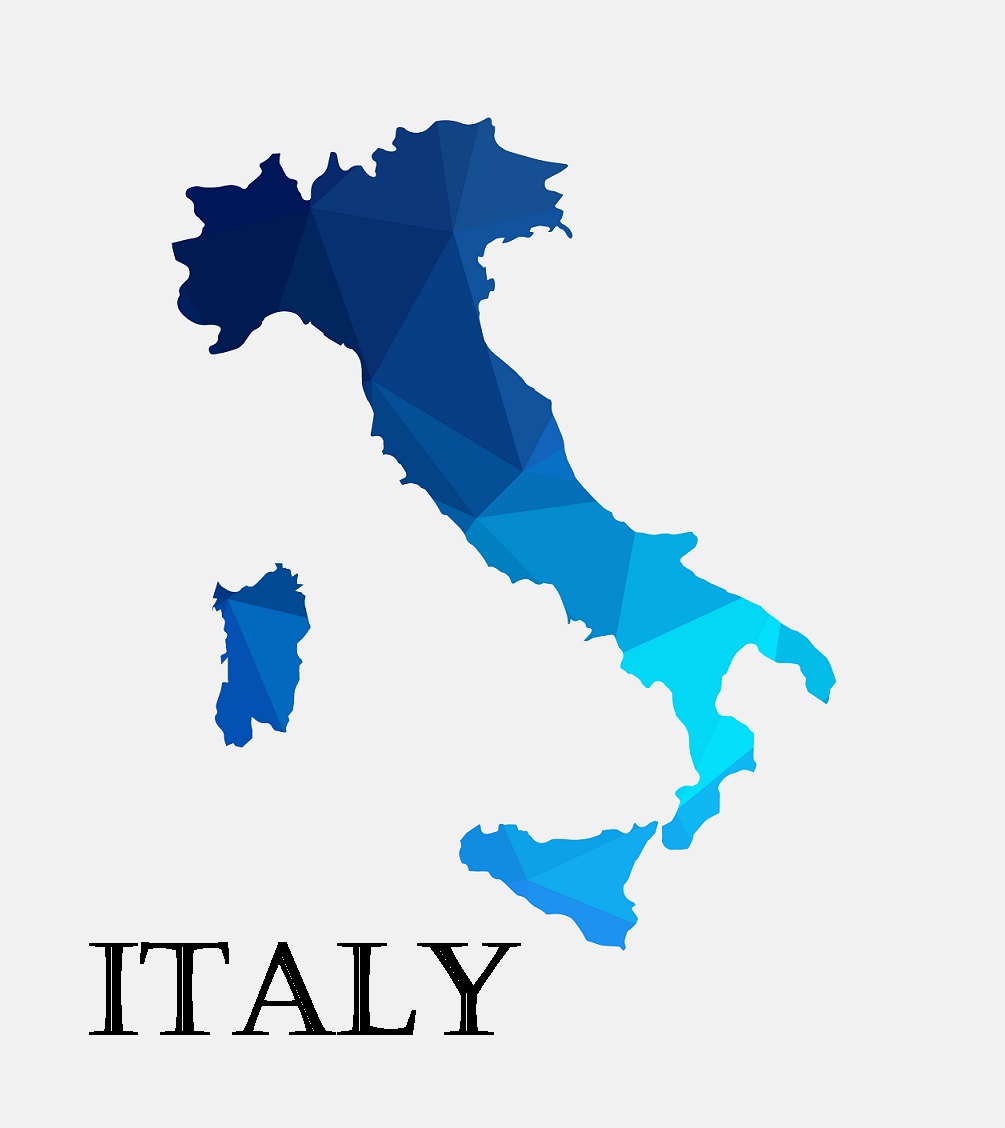
ItalyThe European Union (EU) has been pushing Italy for a very long time to reduce its deficit. Of course, governments are never capable of reducing their own expenditure. This results going in only one direction – raising taxes. Prime Minister Paolo Gentiloni had to agree on the concrete measures. The bill is now being discussed in Parliament, which has 60 days to pass. Italy has the second highest debt in the Eurozone after Greece.

This is why the EU is doomed. There will never be any reform that addresses the people. It is always about raising taxes to maintain government power and to hell with the people. The upcoming Germany vote still appears to be fragmented and as a result, Merkel may remain as Chancellor at the end of the day. We will have to run our models soon on the German election.

This is why I have warned that the Euro will fail. Had Brussels consolidated all the debts from the outset, then the Euro would have competed against the dollar. Leaving everyone to hold their own debts only created a single currency and then the fear that if one member expended their debt, it would impact everyone else.

This system is tearing Europe apart and unemployment in each country will turn to civil unrest and point the finger at Brussels. The debts should have been consolidated and the central bank would have then had a single bond issue for reserves. Now, the entire banking system has to be politically correct, owning a piece of everyone. Even the ECB has 40% of all government debt throughout the Eurozone.

It is beyond brain-dead to maintain this system demanding individual countries sacrifice their own domestic policy objectives for Brussels’ demands. In the USA, each state has its own agenda, but their debt is not acceptable as reserves for the banks. The Euro system is simply like being somehow half-pregnant.

The Gold Reports & the Building of Volatility the Precursor to Chaos


Volatility Historical

Our first report will be released on Gold, Guns & War which illustrates how gold has historically reacted to different types of war events, both internationally as well as domestically, as in civil unrest and revolution.  Illustrated here, we can see the historical volatility in gold over decades of interacting with the global economy and war. This chart shows how volatile the instrument is now in relation to a historical all time correlation.

We are witnessing the gradual rise in volatility since the 1999 lows. We are still nowhere near the sharp rise in volatility sparked by the collapse of Bretton Woods. Nevertheless, the timing is setting up on our volatility models for the future. Everything is lining up and we will be reviewing this at the Hong Kong WEC at the end of the month.

Trump Keeps His Pledge on Tax Reform


trump-cohen

TAX-REF (3)A lot of emails are coming in asking if I have been advising Trump on the taxes since this is similar to the plan I proposed when I testified before Congress. The answer is no. If they took the tax proposals we had worked on with members of Congress back in the Nineties, who knows. They are on file and have been endorsed by many different tax reform advocates.

I have not spoken with anyone in the White House regarding taxes. I testified why the corporate tax rate must be cut to 15% before the House Ways & Means Committee. The answer is very simple. Corporations will be taxed in their home country unless they pay some tax where they are domiciled overseas. Our headquarters back then was in Hong Kong. Everyone was there because of a 15% corporate tax rate. I testified if the USA lowered the corporate tax rate to 15%, then the USA would become the tax-haven and corporations would move to the States. This is a no brainer and was based on the fact that we did in fact advise multinational corporations – not just theory. I knew what they would do and would have advised them to move accordingly.

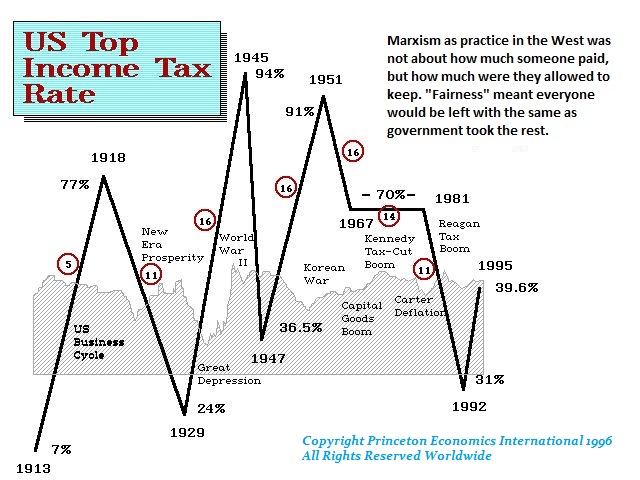
tax-cycThe biggest problem we face is this has to be made into a Constitutional Amendment. This is my ADVICE to Trump right now! Why, as soon as the cycle changes and the Democrats gain control, the taxes will rise again. This is why corporations level. We LACK TAX STABILITY. Taxes become a yo-yo  and business cannot plan long-term when the political atmosphere keeps changing between Marxism and a Free Market. This eternal battle destroys economic growth and has ruined jobs only to reduce the standard of living for the long run. A chart of the top tax brackets look like the brainwave of a schizophrenic.

Trump’s tax plan reduces seven tax brackets down to three. So it’s not the Flat Tax that Democrats will slam because the rich will keep more than they average person based solely on Marxism that discriminates freely against someone based upon their income. The first tax cut was JFK, the second was Reagan. This will be the biggest tax reform in US history. It does not go far enough, but it is the best we can do until there is a collapse in the monetary system that ends Marxism once and for all.

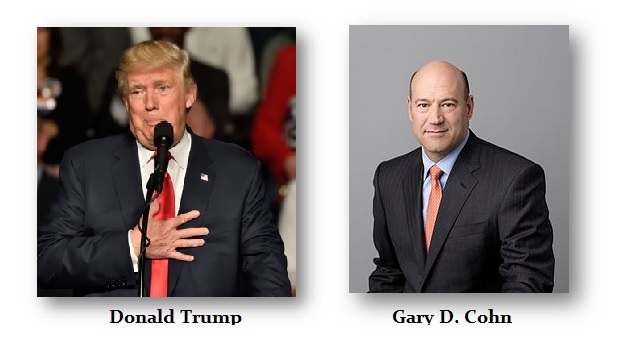
White House chief economic advisor Gary Cohn and Treasury Secretary Steven Mnuchin effectively summarized the plan to reporters. It reflects the proposal Trump outlined as a candidate keeping his word to his supporters. That in itself is really unusual for any candidate to do what they said during the election.

The tax rate on repatriation of trillions of dollars offshore is still being argued with Democrats, who never saw a $1 they did not want at least 50% of. The Death Tax has been devastating to small business and farmers. The next generation have been compelled to sell land, the farm or close the business to pay the estate taxes. This has wiped out small farms and resulted in big corporate America producing food as small farmers were forced to sell because of taxes. Likewise, if a small business sees its owner die, the family has been forced to shut it down. This was one primary reason I have been saying we will go public or else if I died, the taxes owed for my death would result in job losses for staff. Going public was the only way to get around this to ensure the company continues. So these changes will be beneficial for the economy and this may be one of the reasons why the stock market still looks like it will double in value into the years ahead after we get past 2017 this year from Political Hell.

  • Trump’s plan will cut the number of income tax brackets from seven to three, with a top rate of 35 percent and lower rates of 25 percent and 10 percent. It is not clear what income ranges will fall under those brackets. It would also double the standard deduction.
  • The proposal will chop the corporate tax rate to 15 percent from 35 percent.
  • It would eliminate tax deductions with only a few exceptions, including the mortgage interest and charitable contribution deductions.
  • The White House said there will be a “one-time tax” on the trillions of dollars held by corporations overseas. However, Mnuchin said the rate for that tax has yet to be determined. Mnuchin said the White House is “working with the House and Senate” on a repatriation rate, saying it would be “very competitive.”
  • The plan would get rid of the estate tax, otherwise known as the “death tax.” Cohn said that the move will help privately-held businesses and American farmers. Analysis of the estate tax reveals that it affects only a very small portion of Americans.
  • Mnuchin also said the U.S. would go to a “territorial” tax system. Though further details were not forthcoming, such systems typically exclude most or all of the income that businesses earn overseas.
  • Trump’s plan would also repeal the alternative minimum tax and 3.8 percent Obamacare taxes.

Does Schäuble want Draghi to Exit the Stage Once & For All?


Draghi Schauble

Federal Minister of Finance Wolfgang Schäuble of Germany is starting to show signs of rebellion against the elite in Brussels. With the event of BREXIT, the EU is more concerned about trying to punish Britain than they are in reflecting upon what is going so terribly wrong. They will throw their support behind Macron in France fearing that a Le Pen win may be the end of Brussels. Consequently, the EU Commission is trying to punish Britain, and is actually dividing Europe once again. There will be the EU membership, and then there will be the Eurozone within, limited to those countries who surrender their sovereignty to Brussels relinquishing their currency, but not their debt.

Schäuble is clearly attempting to save the Eurozone and make it operational at the same time to protect German exports within Europe. The driving force behind the Euro was to eliminate foreign exchange risk so German manufacturers could sell to all of Europe on a regular basis without currency fluctuation disturbing their sales.

Yet Schäuble is actually looking at reducing the power of the EU for reading between the lines, he has no confidence in the abilities of the EU Commission to manage Europe. Obviously, BREXIT is restructuring the EU only insofar as they seek to punish Britain rather than reform the problems that caused it. That means the Euro zone will be restructured as a block within the EU leaving the institutions, such as the ECB, applicable to the EU. The rules within the Eurozone are by no means clearly defined. This is how Markel opened the gates to refugees without ever going to a vote first in the EU. Thus, the unilateral decisions of Germany have then been applied to all of Europe without any democratic process whatsoever.

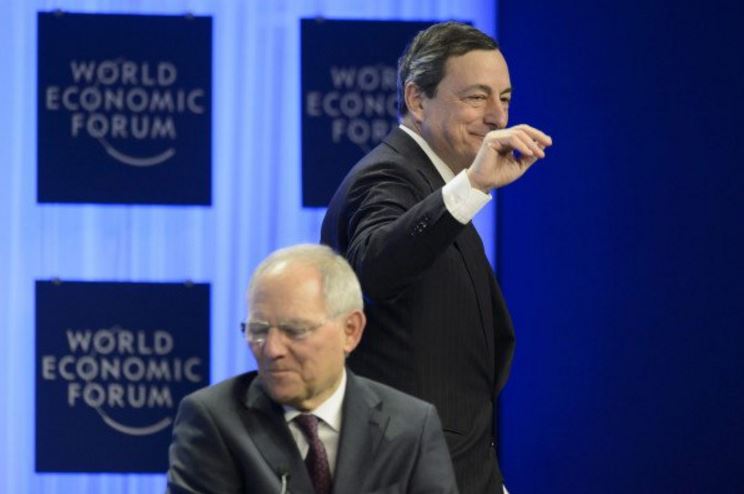
Schäuble is looking at the distinction between the EU and the Eurozone and thus reducing the power of the EU Commission to save the Eurozone – a second Europe within Europe, of which Britain was never a member. Schäuble attacked the ECB and Mario Draghi saying: “The ultralock money policy that exists in many regions is not helpful.”  Schäuble said this opening on his trip to Washington. The ECB, Schäuble argues, is creating risks such as asset price bubbles with its negative interest rate policy. This is the clash of philosophies with Schäuble’s view on AUSTERITY.

Schäuble demanded a change of direction from Mario Draghi. He warned that Draghi was increasing the risk of creating a whole new crisis rather than lessening it. The Federal Reserve reverse course right after 2015.75 on the ECM that targeted October 1st, 2015 with the first rate hike in December 2015. Schäuble remarked that it “would not be a bad idea if the European Central Bank and other central banks followed” the course of the Fed. Schäuble has clashed with Draghi who still considers his stimulus quantitative easing policy of the ECB still necessary. Draghi said on this trip to Washington that a “very significant amount of monetary easing is still needed.”

Schäuble has also proposed that the basic structure of the Eurozone in the form of budgetary policy must be changed. Schäuble remains rightly concerned what happens when Draghi changes course and raises rates. Schäuble is deeply concerned that national debts will then explode with higher interest rates. For this reason, Schäuble wants the euro rescue umbrella ESM in the near future converted to a European Monetary Fund. Schäuble sees this as a European version of the International Monetary Fund (IMF). If a new aid program for a crisis country were to run without the IMF because the IMF has disagreed with the draconian measures imposed upon Greece. Schäuble wants to replace the IMF to impose austerity. Apparently, Schäuble has also convinced Chancellor Angela Merkel of this proposal since the IMF disagrees with the austerity ideas of Schäuble.

Troika-Unelected

This new European Monetary Fund to replace the IMF, which is a member of the Troika, will then be given the task of budgetary monitoring of Eurozone countries. Therefore, we will have the EU, but a separate system within the EU for the Eurozone all based upon extending austerity. This is obviously a disempowerment of the EU Commission.

Greece is still an unsolved problem – and Schäuble also sees that Greece should exit the Eurozone. Schäuble also sees a better partnership with Russia and an emancipation from the USA. This was really based upon German manufacture having a new market to sell into given the rise of Donald Trump. Then Schäuble wanted a nuclear Europe to stand against America and Russia. Schäuble’s view is that the core of Europe is Germany, France, Belgium, Luxembourg and the Netherlands. It never included Britain. The Franco-German axis was to become the economic engine of the future. To Schäuble, the core is simply the Euro for that evens the playing field for Germany to sell products into Europe. He has embraced the Euro, but never accepting a federal debt for Europe. This is why he has never seen Italy, Spain or Greece as the core of the EU – just vassal states to sell products to.

London Property Sales Crashed 40% Thanks to Tax Increase


62 Cornall Gardens

Where I use to live back in 1985

George Osborne budgetThe London housing market sales has crashed to its lowest level now since 2013. We reported in November 2015 with the turn in the ECM on 2015.75 that the London property market peaked. Valued crashed by 11.5% in the first month after the turn of the ECM. Landlords are joining together to challenge the Conservative’s (i.e. Tory’s) tax hike by filing a suit in the high court against their tax increase on “buy-to-let” investment properties.  In July 2015, we warned that the Conservatives were going after the non-domiciled residents in London and that would stop the real estate boom.

The figures are now out and they show that the number of homes bought over the last year crashed by 40% between March 2017 and March 2016, from 173,860 to 102,810. “That was thanks to new stamp duty rules introduced at the beginning of last April, which hiked stamp duty on second homes and led to a buying frenzy just before the rules were introduced,” reported Emma Haslett.

Keep in mind that we are only human. Consequently, if you see municipal taxes rising in the USA, expect property values to also decline. It is the same worldwide.

Le Pen Seeks to Broaden Her Support


2017 Election

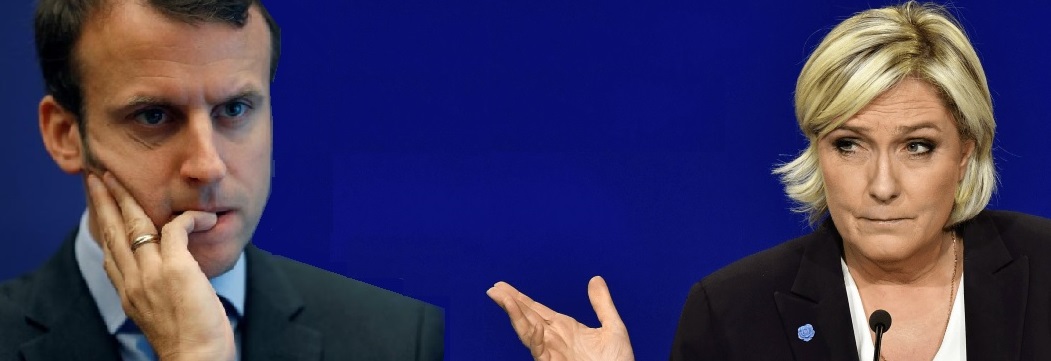
French Presidential candidate Marine Le Pen says she is temporarily stepping down as head of her National Front party. She is still in the race, just attempting to distance herself a bit more from her party to broaden her appeal. The May 7 run-off between herself and Emmanuel Macron, will be interesting for it is a test of how strong the populist movement has become.

People who think “populist” is a particular philosophy are seriously wrong. It was a “populist” movement that put FDR in the White House in 1933. It also put into power Lenin, Hitler and Mao. “Populist” is effective the label applied to any movement Indeed, FDR actually did embrace many elements of fascism, which differs from communism insofar as it supported worker unions and the ownership of business run by the workers. The Populist movement was in fact Marxism during the late 19th century, which manifested into Communism, fascism, and socialism. All three were constructed upon a strong central power of government to different degrees.

“Populist Movements are not particularly a single right or left philosophy. The term is applied to effectively an anti-establishment movement against the status quo.

Le Pen said “Tonight, I am no longer the president of the National Front. I am the presidential candidate,” on French public television news. She hopes that by distancing herself from the party founded by her father in 1972, more people will reach out to her for real change in France. Le Pen hopes to tap into the Eurosceptic and protectionist voters in other parties. The underling trend is certainly anti-EU throughout all of Europe to varying degrees.

Macron is the favorite of Brussels and all the politicians nobody wants to vote for, so what does that really tell you? All the politicians are cheering only because they do not want any real change. They like everything as is – thank you very much they say off camera. But Macron is really out there in la la land. Those who think Trump says some crazy stuff, should turn and look at Macron. How about these!

“I’ve always accepted the vertical dimension, of transcendence, but, at the same time, it has to be utterly anchored in the immanent, in the material.”

Ok, not sure what that means at all. How about this one!

“We all have our roots. And because we all do, there are trees next to us, there are rivers, there are fish. There are brothers and sisters …”

Ok roots and trees go together. What about the rivers and fish? Brothers and sisters is family. Does everyone come from fish out of the river?

If he will be the new face of France, I would probably want to double short the Euro when the cycle changes.

The IMF Is Not Done Destroying Greece Yet


Tyler Durden's picture

Authored by Raul Ilargi Meijer via The Automatic Earth blog,

Austerity is over, proclaimed the IMF this week. And no doubt attributed that to the ‘successful’ period of ‘five years of belt tightening’ a.k.a. ‘gradual fiscal consolidation’ it has, along with its econo-religious ilk, imposed on many of the world’s people. Only, it’s not true of course. Austerity is not over. You can ask many of those same people about that. It’s certainly not true in Greece.

IMF Says Austerity Is Over

Austerity is over as governments across the rich world increased spending last year and plan to keep their wallets open for the foreseeable future. After five years of belt tightening, the IMF says the era of spending cuts that followed the financial crisis is now at an end. “Advanced economies eased their fiscal stance by one-fifth of 1pc of GDP in 2016, breaking a five-year trend of gradual fiscal consolidation,” said the IMF in its fiscal monitor.

In Greece, the government did not increase spending in 2016. Nor is the country’s era of spending cuts at an end. So did the IMF ‘forget’ about Greece? Or does it not count it as part of the rich world? Greece is a member of the EU, and the EU is absolutely part of the rich world, so that can’t be it. Something Freudian, wishful thinking perhaps?

However this may be, it’s obvious the IMF are not done with Greece yet. And neither are the rest of the Troika. They are still demanding measures that are dead certain to plunge the Greeks much further into their abyss in the future. As my friend Steve Keen put it to me recently: “Dreadful. It will become Europe’s Somalia.”

An excellent example of this is the Greek primary budget surplus. The Troika has been demanding that it reach 3.5% of GDP for the next number of years (the number changes all the time, 3, 5, 10?). Which is the worst thing it could do, at least for the Greek people and the Greek economy. Not for those who seek to buy Greek assets on the cheap.

But sure enough, the Hellenic Statistical Authority (ELSTAT) jubilantly announced on Friday that the 2016 primary surplus was 4.19% (8 times more than the 0.5% expected). This is bad news for Greeks, though they don’t know it. It is also a condition for receiving the next phase of the current bailout. Here’s what that comes down to: in order to save itself from default/bankruptcy, the country is required to destroy its economy.

And that’s not all: the surplus is a requirement to get a next bailout tranche, and debt relief, but as a reward for achieving that surplus, Greece can now expect to get less … debt relief. Because obviously they’re doing great, right?! They managed to squeeze another €7.3 billion out of their poor. So they should always be able to do that in every subsequent year.

The government in Athens sees the surplus as a ‘weapon’ that can be used in the never-ending bailout negotiations, but the Troika will simply move the goalposts again; that’s its MO.

A country in a shape as bad as Greece’s needs stimulus, not a budget surplus; a deficit would be much more helpful. You could perhaps demand that the country goes for a 0% deficit, though even that is far from ideal. But never a surplus. Every penny of the surplus should have been spent to make sure the economy doesn’t get even worse.

Greek news outlet Kathimerini gets it sort of right, though its headline should have read “Greek Primary Surplus Chokes Economy“.

Greek Primary Surplus Chokes Market

The state’s fiscal performance last year has exceeded even the most ambitious targets, as the primary budget surplus as defined by the Greek bailout program, came to 4.19% of GDP, government spokesman Dimitris Tzanakopoulos announced on Friday. It came to €7.369 billion against a target for €879 million, or just 0.5% of GDP. A little earlier, the president of the Hellenic Statistical Authority (ELSTAT), Thanos Thanopoulos, announced the primary surplus according to Eurostat rules, saying that it came to 3.9% of GDP or €6.937 billion.

The two calculations differ in methodology, but it is the surplus attained according to the bailout rules that matters for assessing the course of the program. This was also the first time since 1995 that Greece achieved a general government surplus – equal to 0.7% of GDP – which includes the cost of paying interest to the country’s creditors. There is a downside to the news, however, as the figures point to overtaxation imposed last year combined with excessive containment of expenditure.

The amount of €6-6.5 billion collected in excess of the budgeted surplus has put a chokehold on the economy, contributing to a great extent to the stagnation recorded on the GDP level in 2016. On the one hand, the impressive result could be a valuable weapon for the government in its negotiations with creditors to argue that it is on the right track to fiscal streamlining and can achieve or even exceed the agreed targets. On the other hand, however, the overperformance of the budget may weaken the argument in favor of lightening the country’s debt load.

Eurogroup head Dijsselbloem sees no shame in admitting this last point :

Dijsselbloem Sees ‘Tough’ Greek Debt Relief Talks With IMF

“That will be a tough discussion with the IMF,” said Dijsselbloem, who is also the Dutch Finance Minister in a caretaker cabinet, “There are some political constraints where we can go and where we can’t go.” The level of Greece’s primary budget surplus is key in determining the kind of debt relief it will need. The more such surplus it has, the less debt relief will be needed.

That’s just plain insane, malicious even. Greek PM Tsipras should never have accepted any such thing, neither the surplus demands nor the fact that they affect debt relief, since both assure a further demise of the economy.

Because: where does the surplus come from? Easy: from Troika-mandated pension cuts and rising tax levels. That means the Greek government is taking money OUT of the economy. And not a little bit, but a full 4% of GDP, over €7 billion. An economy from which so much has already vanished.

The €7.369 billion primary surplus, in a country of somewhere between 10 and 11 million people, means some €700 per capita has been taken out of the economy in 2016. Money that could have been used to spend inside that economy, saving jobs, and keeping people fed and sheltered. For a family of 3.5 people that means €200 per month less to spend on necessities (the only thing most Greeks can spend any money on).

I’ve listed some of the things a number of times before that have happened to Greece since the EU and IMF declared de facto financial war on the country. Here are a few (there are many more where these came from):

25-30% of working age Greeks are unemployed (and that’s just official numbers), well over 1 million people; over 50% of young people are unemployed. Only one in ten unemployed Greeks receive an unemployment benefit (€360 per month), and only for one year. 9 out of 10 get nothing.

Which means 52% of Greek households are forced to live off the pension of an elderly family member. 60% of Greek pensioners receive pensions below €700. 45% of pensioners live below the poverty line with pensions below €665. Pensions have been cut some 12 times already. More cuts are in the pipeline.

40% of -small- businesses have said they expect to close in 2017. Even if it’s just half that, imagine the number of additional jobs that will disappear.

But the Troika demands don’t stop there; they are manifold. On top of the pension cuts and the primary surplus requirement, there are the tax hikes. So the vast majority of Greeks have ever less money to spend, the government takes money out of the economy to achieve a surplus, and on top of that everything gets more expensive because of rising taxes. Did I ever mention businesses must pay their taxes up front for a full year?

The Troika is not “rebalancing Greece’s public finances in a growth-friendly manner”, as Dijsselbloem put it, it is strangling the economy. And then strangling it some more.

There may have been all sorts of things wrong in Greece, including financially. But that is true to some degree for every country. And there’s no doubt there was, and still is, a lot of corruption. But that would seem to mean the EU must help fight that corruption, not suffocate the poor.


Yes, that’s about a 30% decline in GDP since 2007


The ECB effectively closed down the Greek banking system in 2015, in a move that’s likely illegal. It asked for a legal opinion on the move but refuses to publish that opinion. As if Europeans have no right to know what the legal status is of what their central bank does.

The ECB also keeps on refusing to include Greece in its QE program. It buys bonds and securities from Germany, which doesn’t need the stimulus, and not those of Greece, which does have that need. Maybe someone should ask for a legal opinion on that too.

The surplus requirements will be the nail in the coffin that do Greece in. Our economies depend for their GDP numbers on consumer spending, to the tune of 60-70%. Since Greek ‘consumers’ can only spend on basic necessities, that number may be even higher there. And that is the number the country is required to cut even more. Where do you think GDP is headed in that scenario? And unemployment, and the economy at large?

The question must be: don’t the Troika people understand what they’re doing? It’s real basic economics. Or do they have an alternative agenda, one that is diametrically opposed to the “rebalancing Greece’s public finances in a growth-friendly manner” line? It has to be one of the two; those are all the flavors we have.

You can perhaps have an idea that a country can spend money on wrong, wasteful things. But that risk is close to zilch in Greece, where many if not most people already can’t afford the necessities. Necessities and waste are mutually exclusive. A lot more money is wasted in Dijsselbloem’s Holland than in Greece.

In a situation like the one Greece is in, deflation is a certainty, and it’s a deadly kind of deflation. What makes it worse is that this remains hidden because barely a soul knows what deflation is.

Greece’s deflation hides behind rising taxes. Which is why taxes should never be counted towards inflation; it would mean all a government has to do to raise inflation is to raise taxes; a truly dumb idea. Which is nevertheless used everywhere on a daily basis.

In reality, inflation/deflation is money/credit supply multiplied by the velocity of money. And in Greece both are falling rapidly. The primary surplus requirements make it that much worse. It really is the worst thing one could invent for the country.

For the Greek economy, for its businesses, for its people, to survive and at some point perhaps even claw back some of the 30% of GDP it lost since 2007, what is needed is a way to make sure money can flow. Not in wasteful ways, but in ways that allow for people to buy food and clothing and pay for rent and power.

If you want to do that, taking 4% of GDP out of an economy, and 3.5% annually for years to come, is the very worst thing. That can only make things worse. And if the Greek economy deteriorates further, how can the country ever repay the debts it supposedly has? Isn’t that a lesson learned from the 1919 Versailles treaty?

The economists at the IMF and the EU/ECB, and the politicians they serve, either don’t understand basic economics, or they have their eyes on some other prize.

The French Elections & Socrates


QUESTION: Mr. Armstrong, I saved you article from November 25th last year where your computer forecast the collapse of mainstream politics. Macron was not even in the picture back then. Have you recalculated now that all the parties collapsed and it is Macron v Le Pen?

Image12

ANSWER: I am very familiar with France. I was supposed to debate Michel Sapin, the Finance Minister of France on national TV. He backed out.

As you can see in that article, the only way to approach this is to look at the philosophy rather than the party since we were showing that the parties would collapse as they have done. I concluded that article writing:

“Clearly, the socialists are finished. However, we are within this 10 year window between 2013 and 2023. This clearly shifts the favor toward a new power. Le Pen can win within this window. However, expect this to be also very divisive as in the United States.”

We could extrapolate and say all other party members will vote for Macron. However, that would just be a guess. The wildcard now is we know that Le Pen will get probably 30% for that is her hardcore base. The question becomes, what portion of the other parties will now vote for Le Pen. Keep in mind that the Euro will rally as fools think this will save the day if she loses. Such an event will only postpone the inevitable for the same thinking process will remain in place.

Einstein solving