I have been warning that raising taxes is DEFLATIONARY because you are reducing the net disposable income. Governments simply cannot get that through their head. In Romania where protests over political corruption have been unfolding, the government revealed its plan to try to comply with EU austerity raising they hope 10 billion lei ($2.5 billion US) in extra revenue. The market response has been a dramatic crash in Romanian stocks as they plunged and bond yields spiked the greatest in the past several years.
This is where the austerity is destroying the European economy. Romania is attempting to reduce its budget deficit that is pushing the country beyond critical EU thresholds. This new tax will include a tax on the banking industry. This is having an immediate knee-jerk reaction where foreign investors are bailing out. Using global warming as an excuse as in France, new taxes on energy and telecommunications companies are included. The government is also reducing social benefits in the retirement system also due to the pension crisis which is worldwide.
This is all part of a Global Contagion is the COLLAPSE in Confidence we see into January/February 2019.
The European refugee issue just will not go away no matter how hard the politicians try to cover-up their mistakes. Now Charles Michel, the Belgian Prime Minister, resigned on Tuesday after his government collapsed in the face of opposition to his signing of a UN migration pact. Michel found himself abandoned after he lost the support of the Flemish nationalist party in his coalition. The opposition fears that this UN migration agreement would open the door to even greater migration. There will have to be a snap election in January. Otherwise, the next Belgium election is due in May.
QUESTION: Mr. Armstrong: I have watched in amazement how you connect all these elements. Everyone I spoke to agreed this was your best WEC ever. You have said the Fed needed to raise rates because of the pension crisis and it would have nothing to do with inflation but it has to normalize rates to help pensions. Then we have the ECB refusing to raise rates. Would you please comment on the Fed’s actions yesterday? Is this a central bank war?
OM
ANSWER: I understand this can get confusing because there are so many people who talk without any real-world experience. The Fed MUST raise rates to help the crisis in Pension funds. It raised the Fed Funds Rate (what banks charge each other) 25 basis points to 2.25-2.5%. While the Fed indicated there would be two more rate hikes in 2019, what has gone over everyone’s head is exactly what I have been warning about. We are witnessing indeed not a Currency War that people claim over trade since I do not see any actual counter-trend manipulation attempts as was the case with the G5 back in 1987.
This is a brand new Central Bank War that nobody seems to get I suppose since I may be the only person who actually speaks to central banks outside the USA. All the various central banks and the IMF have been lobbying the Federal Reserve since 2014 pleading with it NOT to raise rates. I have stated many times that the rate hikes by the Fed have NOTHING to do with economic growth, inflation, or trying to stop a speculative bubble in stocks.
The lobbying behind the curtain against the Fed raising rates has been very intense. What is most interesting is that BECAUSE of what the New York boys did to me, outside the country it has been a badge of honor and a CONFIRMATION that I am NOT one of them and am independent. Hence, I meet with central banks outside the USA because I am someone who knows the real game behind the curtain, have 30+ years of real-world experience, and work internationally. That has made me fill a rather unique role with a front row seat to the world. I have written before: “The talk behind the curtain remains that the Fed is still under pressure to PLEASE don’t raise rates. The lobbying continues from the IMF, ECB, and Emerging Markets.” (see Aug 2, 2018, Post).
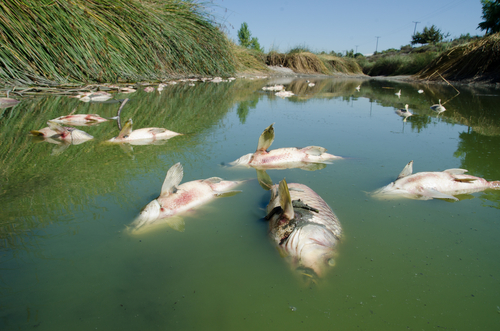
I cannot say this any stronger! The Fed is dealing with reality. It MUST raise rates, not for the economy but in order to NORMALIZE interest rates because lowering rates makes it cheaper ONLYfor borrowers while it destroys the philosophy of saving for your retirement when you cannot earn enough interest to buy a nice dinner. Then pension funds are going belly-up like the fish in a polluted pond. State pension funds then turn to their respective governments who then raise taxes lowering the standard of living (i.e. California & Illinois). The ECB is trapped and I have warned that it is the ONLY central bank that can actually go bankrupt because all central banks do not have the same structure. I have made it clear that by their very own standards, the ECB itself is insolvent.
At the end of 2017 in the USA, total household debt exceeded $13 trillion. Total non-financial business debt stood at $6.1 trillion at the end of 2017. The Fed’s balance sheet was $4.4 trillion of which $2.4 is US Treasuries – the bulk of the rest is simply excess reserves. The national debt stood at $20.5 trillion at the end of 2017. That meant the actual Quantitative Easing was not $4.4 trillion, but $2.4 or about 10% of annual GDP compared to Europe at 20% and Japan over 100%. If we look at this perspective, this means the money supply is $41.6 trillion just using the debt. If we then add M2 (all accounts & money market accounts) which stood at $13.8 trillion at the end of 2017, this brings us to a liquid money supply of $55.4 trillion. The Fed’s balance sheet does not even reach 10% of that figure and the QE portion is less than 5%. Now, do you understand why the goldbugs were dead wrong on hyperinflation?
Now let us add the stock market, which is liquid. That reached $30 trillion by the end of 2017. Therefore, the liquid assets/cash position stood at $85.4 trillion at the end of 2017. Now let us add total personal real estate (homes) in the United States which stood at $31.8 trillion. If we include illiquid real estate, now we are up to $117.2 trillion. We are NOWHERE near possible hyperinflation!
I will state this ONCE AGAIN!!!!!!!!
Poster in London
Raising rates is NECESSARY for the Fed also realizes that come the next economic recession, the only tool they have is to lower rates. They do NOT share this theory running around that full employment will only take place with NEGATIVE rates at -4% to -5%. The ECB is looking at that BECAUSE they cannot raise rates. Why do you think the IMF is now telling everyone to adopt cryptocurrency? That way they end hoarding and can ENFORCE negative rates. Where politicians in Australia have called for the removal of the $100 bill claims cash is for criminals, the Reserve Bank of Australia (central bank) has defended the embattled $100 note arguing that criminals prefer $50.
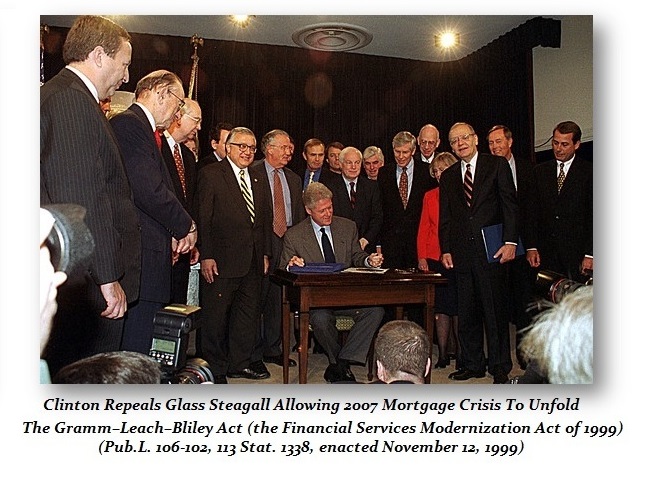
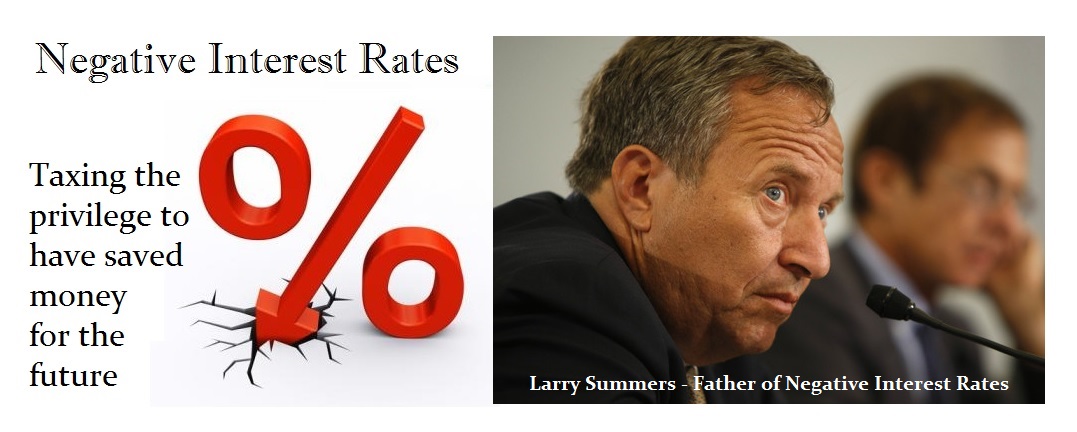
Trump wanted the wall with Mexico to stop the drug trade. The Democrats call him a racist for that, but they advocate eliminating the $100 bill as well. Lawrence Summers, a former economic adviser to President Obama and ex-Treasury secretary, say get rid of the $50 bill as well. They argue cash is for criminal in the drug trade, but then call Trump a racist for wanting a wall. Summers is spouting out pure propaganda since he admits that getting rid of the $100 bill, or even the $50, won’t eliminate crime and corruption, but would make it harder for criminals to launder money. I am no fan of Larry Summers. I believe he is a very serious danger to the world economy. He was a primary architect of the modern U.S. financial system that collapsed in 2008 and was among the first to advocate negative interest rates. Summers second in line in the U.S. Treasury in the 1990s under President Clinton and Treasury Secretary Robert Rubin. He advocated the repeal of Glass-Steagall and appears in the photo when Clinton signed that act (on the left).
He was also there arguing the creation of “too big to fail” theory to support wholesale bailouts without any criminal prosecution for frauds. He fought against the regulation of derivatives which later played a key role in the financial crisis orchestrated by Goldman Sachs. He became Secretary of the Treasury under Clinton 1999-2001 when Rubin left after fulfilling his reason to leave Goldman Sachs – the repeal of Glass Steagal. Summers then held the position as President of Harvard 2001-2006 during the administration of George W. Bush seriously calling into question the worth of a degree in economics from Harvard. Allegedly, Summers left Harvard after a no-confidence vote by the staff following the loss of some $1.8 billion in Harvard endowment funds to a derivatives deal gone bad reported by Reuters. After that fiasco, Summers became the Director of President Obama’s Nation Economic Council. So after that loss at Harvard, he is qualified for the White House to advise on economic policy from 2008-2010 and played a key role in bailing out the U.S. banking system.
Larry Summers is the guy who publicly admitted he cannot forecast the economy because it is too complicated for academics. Summers is also the architect of negative interest rates. He has stated that the natural interest rate remains BELOW zero even with the QE measures sterilizing any action of the Fed. Reducing short-term interest rates is the Fed’s greatest power according to Summers under Monetarism to bring about full employment during recessions. However, the Fed has been hamstrung by this zero-lower boundary resulting in a weaker recovery thus far. Consequently, Summer sees the larger problem is that this is not a short-term issue but systemic. He argues that should another recession hit right now, the Fed will be impudent. This is what Summers warned of in his speech at the IMF.
“Imagine a situation where natural and equilibrium interest rates have fallen significantly below zero,” Summers said. “Then conventional macroeconomic thinking leaves us in a very serious problem because we all seem to agree that whereas you can keep the federal funds rate at a low level forever, it’s much harder to do extraordinary measures beyond that forever, but the underlying problem may be there forever.”
Summer is the man behind the curtain wanting to eliminate cash and making money national cryptocurrencies to ENFORCE negative rates. If you eliminate paper money, you eliminate bank runs. You eliminate hoarding of money (cash) and that would allow Summers to enforce a -5% interest rate stealing your money which would enrich the banks on top of the taxes you pay to the government. I am not alone in my criticisms of Summers (see Atlantic) where may see him as unyielding, unrepentant, and arrogant. He was the there at the Treasury when Clinton eliminated the right to file bankruptcy on student loans.
It was the Clinton Administration that aided the bankers for on October 7, 1998, when President Clinton signed theHigher Education Amendmentsof 1998 (the 1998 HEA), which provided federal funding for education loans at a reduced rate of interest. However, Clinton sneaked in the 1998 HEA two specific changes regarding the collection of student loans that is a brewing part of the Sovereign Debt Crisis today for students cannot discharge student loans in bankruptcy and 65% cannot find a job in what they paid for. This has funded WORTHLESS education at outrageous prices creating a welfare system for academics to propagate stuff like global warming to screw us with even more taxes, and then bankers can lend money to students and turn them into economic slaves for life. Then in 2014, Summers admitted that student debt was slowing the housing recovery and the broader economic recovery. Student loans are preventing graduates from buying a home because of their debt position which will take decades to pay off at 7%+ interest rates. This man is EXTREMELYdangerous to all our liberties.
People ask me why I do not go into politics or take a political position to make a difference. First of all, I can make a living myself and do not need to rip off the country. Then there is the problem that I have real-world experience and do not come from the academic side with only theory. I actually advised under contract on portfolios that amounted to 50% of the US national debt (see testimony before Congress). I have experience which is not really a requirement these days in Washington. Plus I would lose my independence which is something I really cherish. One person cannot change the system. Look at Trump. The entire establishment is out to get him. Vogue Magazine even hates his wife – which is really a first. Every major media is marching in tune to drive Trump from office. There were 67 countries represented at the WEC event this year in Orlando. The press would spin that as I am advising people against the United States. They would turn my international experience into treason today.
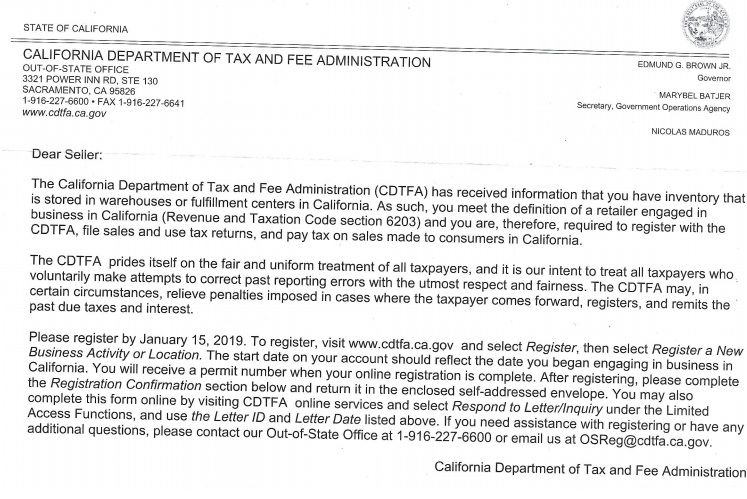
It really is very astonishing how brain-dead politicians are. The latest stats are showing that residents are increasingly fleeing New York, Los Angeles, and Chicago. The perpetually rising taxes are just getting insane. We just received this notice ourselves about taxes due in California. Apparently, they must have subpoenaed Amazon to see who has merchandise they are storing in California. First of all, we have no idea where Amazon stores what it sells of our products or to whom. You pay Amazon – not us. To claim that since Amazon is storing something of ours in California means we are now doing business in California is completely nuts. They collect the taxes and ship whatever someone purchases – not us!
If every state acts in this manner, quite honestly it is time to just close the doors. What is next? They will want income taxes on anything we sell in California on a per item basis? The accounting will cost more than the tax we collect or have to pay.
This is a sure fire way to destroy the economy all because those in governments are incapable of managing even a bubblegum machine. The hunt for taxes will destroy everything.
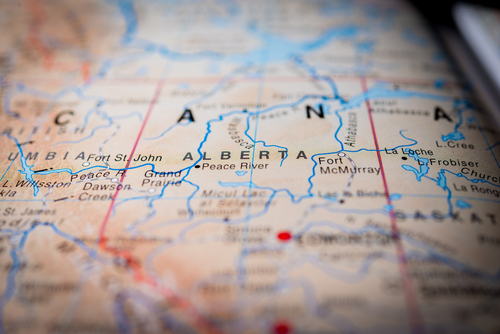
Quick question for you, as someone who grew up in Quebec in the 90’s, when Quebec was voting to separate. And now living in Alberta, and seeing the sheer anger here towards Canada, is there a legitimate chance Alberta moves towards the path of separation and actually brings it to a vote?
Thanks again
Mike
(as a kid growing up in Montreal, I wanted nothing to do with separation. If the vote was held today in Alberta, I would highly consider voting to leave Canada)
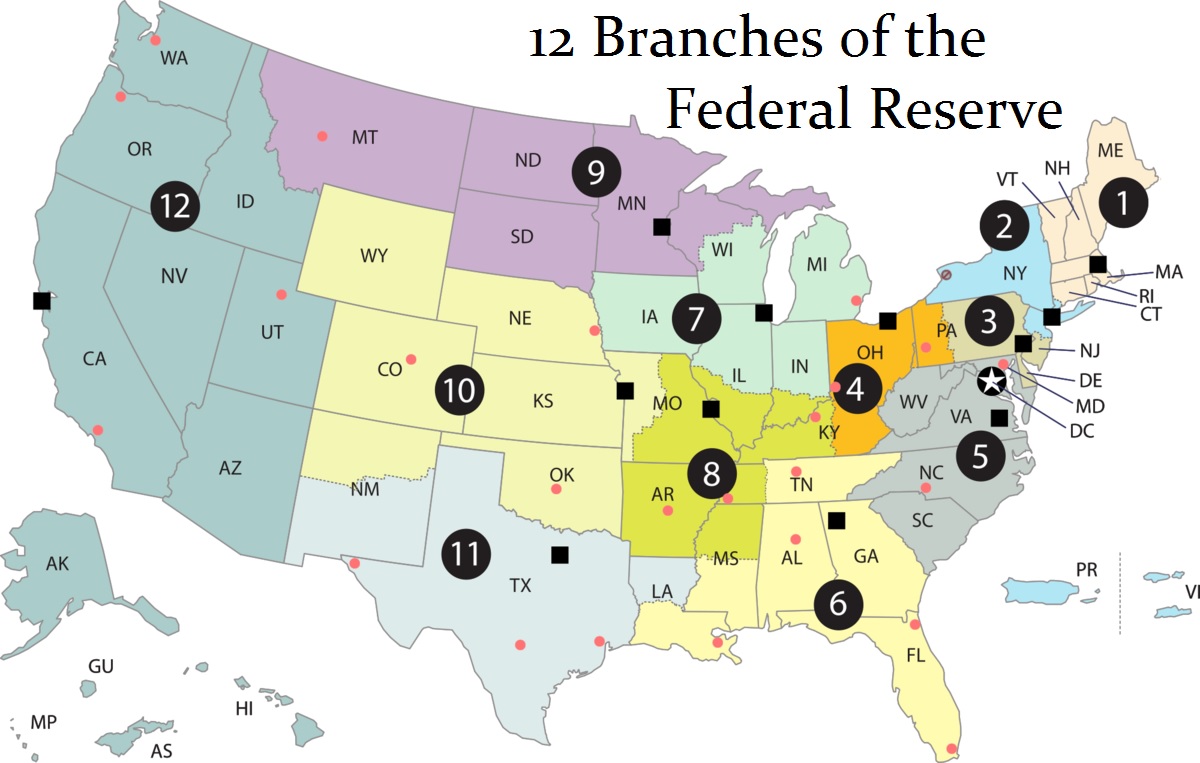
ANSWER: Alberta joined Canada in 1905. This separatist movement began precisely on the half-cycle of 112 years – 2017. What we are dealing with here is that when the Federal Reserve was formed in 1913, it was established with 12 branches. When the Fed was created, it was the solution to the Panic of 1907, which was set in motion by the disruption of the internal domestic capital flows caused by the San Francisco earthquake of 1906. The insurance companies were in New York. Consequently, the cash flowed to the West and a shortage developed in the East.
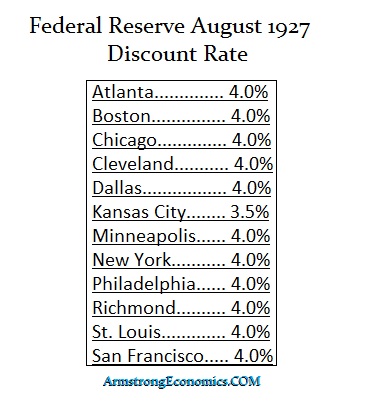
The original structural design of the Fed was to establish 12 branches to manage the capital flows domestically. Interest rates would decline where there was an excess of cash and rise where there was a shortage. This, they believed, would cause capital to move between the branches to balance the national capital flows and economy. Each branch acted independently to manage the capital flows. When crops would come to market, then Kansas would have an excess of cash and rates would decline as we can see from the table showing the rates set by each branch in August 1927.
When Roosevelt comes to power in 1933, he wanted to control the economy for his socialist agenda. He usurped the power of interest rates from the various branches of the Fed and consolidated then into Washington DC making it one-size-fits-all. He, therefore, abandoned the structural design of the Fed and ever since the capital flow focus has been international, not domestic.
This is the problem in Alberta. Governments have all followed Roosevelt post-World War II. In doing so, they have completely abandoned the proper management of their domestic economies and everyone is always focused on international capital flows and currency values with respect to trade. They have COMPLETELY ignored the fact that their domestic economies are not the same from one state or province to the next.
The commodity-producing states are booming when the financial states and at their lows. Our own model is warning that we have a commodity boom coming for the NEXT 8.6-year wave on the Economic Confidence Model. Right now, the stock market rallies and commodities linger. Central Banks will raise rates in the stock market booms to prevent inflation and that is when they put farmers and miners into bankruptcy.
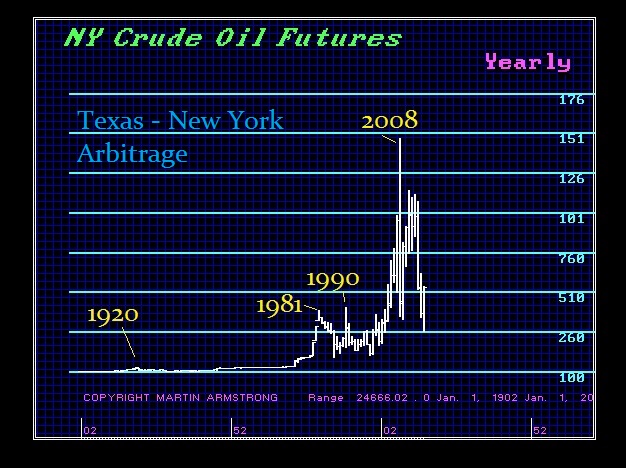
I have called this the Texas-New York arbitrage. Here is a chart showing when oil peaks in price, it is typically counter-trend to the financial markets. Oil peaked in 2008 when the stock market was crashing. Once again, oil prices are down and Alberta suffers while the financial markets are booming in Toronto.
What is resurfacing is the regional differences within Canada as well as the United States. The one-size-fits-all policy of central banks with regard to interest rates pits East v West in both Canada and the United States. Farmers, oil producers, and miners are forced to pay higher interest rates when their economies are declining because of speculative booms in Toronto or New York.
This is the root cause of the regional separatist movements we are witnessing in Canada. The structure of the central banks was originally intended to manage the domestic capital flows. That has been part of the whole socialist agenda to abandon that policy and create the one-size-fits-allpolicy of Marxism. This is why Alberta SHOULD move to separate. The very economic survival is critical unless the central banks open their eyes and STOP this Keynesian manipulation of interest rates attempting to manage DEMAND which they fail to even understand. It is this Socialist philosophy which is destroying governments and reducing our standard of living to support a theory of Marx which resulted in the collapse of China and Russia. You cannot be just a little-bit pregnant.
QUESTION: Marty, your account of Carausius and Postumus being the ancient Brexit is really interesting. Am I correct that whilst this separatist movement failed, it was this Brexit that forced Rome to reintroduce silver?
HM
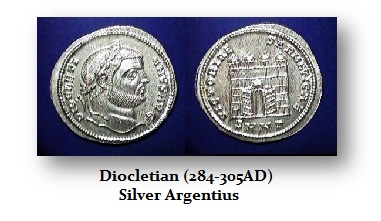
ANSWER: Correct. Diocletian introduced the silver Argenteus in 294AD after the defeat of Carausius’ separatist movement. It is highly likely that old silver denarii were still being used at a huge premium. We do find many denarii worn rather extensively indicating that they did see a lot of circulation.
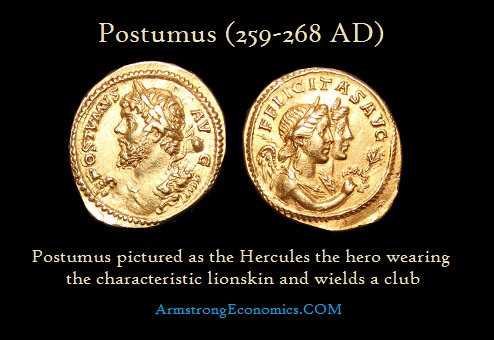
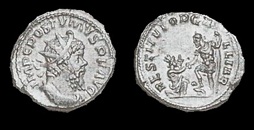
Here is a coin of Postumus (260-268AD) and the reverse is a political statement. The reverse side states “RESTITVTOR GALLIAR” with Postumus standing left with foot on the captive barbarian, resting on his spear and raising a kneeling figure of Gallia holding a cornucopia. This is portraying him as the great restorer of order and savior of Gaul. This goes directly to the political instability emerging. His rebellion was by no means an attempt to seize the empire but to split from Rome and establish the Gallic Empire.
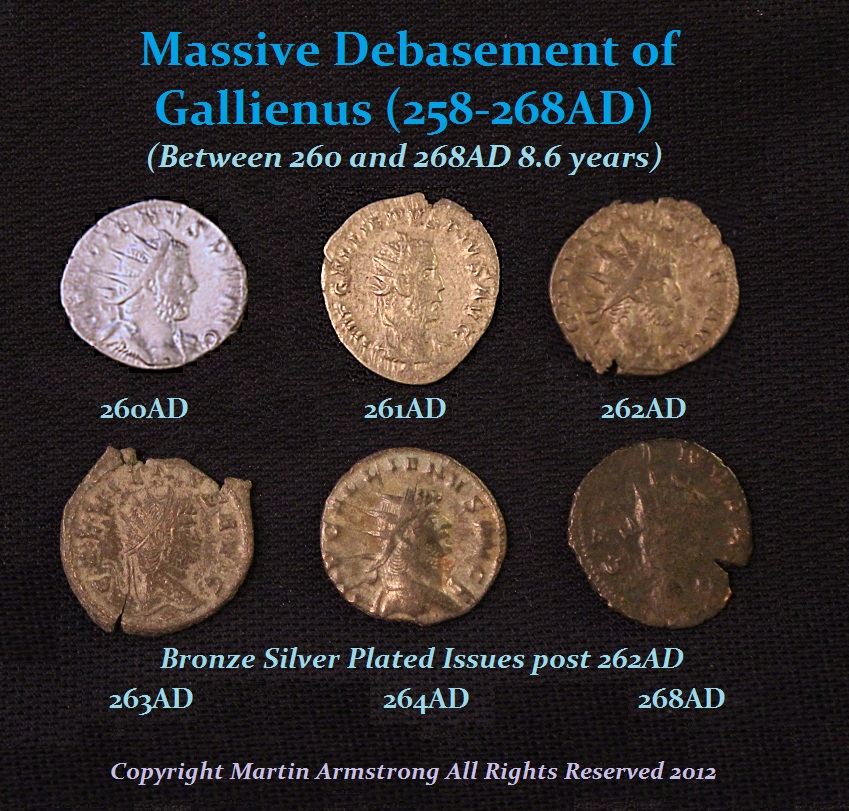
This is where the coinage PROVES a very important point. The debasement we see in the coinage of Rome clearly created a CONTAGION. Even though Postumus split creating a separatist movement with the Gallic Empire, he could not maintain a silver standard for the coinage he would strike simply vanished from circulation as was the case in Rome proper.
Consequently, we find that the coinage of Postumus shows that he too had to debase the coinage keeping in line with the debasement in Rome under Gallienus. The silver was being hoarded even within this new separatist movement. However, when we look at the second Ancient BREXIT movement 14 years later, things did calm down and confidence was beginning to return for Carausius issues a silver denarius and then Diocletian is compelled to follow in 294AD with the re-introduction of silver coinage known as the Argentius.
The most interesting aspect of this is that here the Second Ancient BREXIT influenced monetary reform in the Roman Empire working in reverse. The first reign under Postumus separated when the coinage was still silver. So the debasement in Rome compelled the same response in the Gallic Empire. The Second Ancient BREXIT takes place post-debasement and it issues a silver denarius to prove it is prosperous there in Britain. Thus, the influence moves back the other way. Thus, the sequence matters.
What this demonstrates is that if Europe cancels the currency and moves to its own cryptocurrency as the IMF is suggesting, people will then immediately begin to hoard the paper currency of the USA, Scandinavia, Switzerland, and perhaps even China. This could result in forcing other countries to move to cryptocurrencies to control capital flows. This is what I hope for. If we can get just one country to adopt our solution, this will put pressure on everyone else to follow. The danger cryptocurrency introduces is OFF THE CHARTS!. The sales pitch has been that they will bypass central banks. In reality, when government outlaws private cryptocurrencies and compels people to use the official cryptocurrency, then the global capital flows will be threatened profoundly.
All I can do is understand the economics of the situation and hope for the best.
COMMENT: Dear Martin,
I would like to share any information on the subject “The Hunt for Taxes and the Abolition of Cash” that you comment on so often:
Citi closes accounts of customers who withdraw cash instead of using credit cards The Peruvian author and journalist Jaime Bayly, who lives in Florida, comments political and arts issues in his daily TV show. Recently, he mentioned that the Miami subsidiary of Citi bank closed all his accounts because he withdraws too much cash from his account instead of using his credit card to pay his expenditures. His objection that he prefers to use cash for personal reasons was countered by the bank that he is suspicious of money laundering!
Thank you so much for your work and for maintaining a blog that I review daily with great interest,
kind regards,
U. G.
REPLY: What people do not realize is that the regulations being imposed upon banks all to hunt for taxes are rarely every discussed in mainstream media. Effectively, the government has put all banks in a position where THEY must be the judge, jury, and prosecutor whereas the government could NEVER impose such restriction upon individuals without a Constitutional violation of Due Process of law. They force banks to be the police because you are NOT entitled to Constitutional Due Process of law when it is not a LEGAL proceeding that could result in the confiscation of your property or imprisonment. Like FATCA, they imposed regulations upon foreign banks that they MUST report WHATEVER an American does overseas and if they own more than 5% of any company.
The Federal Deposit Insurance Corporation (FDIC) lists 30 some business categories that have been linked to “high-risk activity,” including marijuana dealers, gun sellers, home-based charities, payday loans, dating services, escort services, fireworks suppliers, cable box de-scramblers, coin dealers, credit card repair services, gaming and gambling websites, and telemarketing companies. The coin dealers they deal are selling people things off-the-grid and gun dealers because they may be helping to arm you against the government.
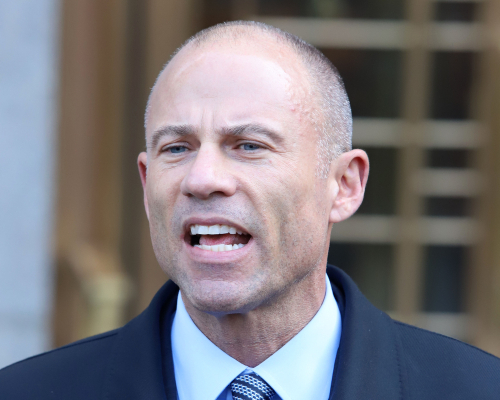
Then there was the pornography industry that Michael Avenatti is allegedly just usurped Stormy Daniels to become famous in suing Trump in hopes of running for president himself. It was reported that Chase closed hundreds of porn stars accounts with no explanation whatsoever. Chase bank merely sent out letters to porn industry workers revealing the accounts would be closed the following month. The letters offered no reason for the closure and just made a non-sincere apology for the inconvenience.
Banks now do background checks and continue to monitor all transactions that are made once the account is open. The FDIC also recommends that banks look at the volume and nature of consumer complaints filed on websites like the Better Business Bureau. A company that has a large number of returns or charge-backs due to customer dissatisfaction can find themselves out of business unable to even have a bank account. Another red flag is certainly cash deposits or withdraws can easily find themselves booted out of the bank.
For personal accounts, there’s a whole other set of warning signs that banks are required to look for. Chief of the list is no record of current or past employment but make frequent, large transactions, you don’t live or work anywhere near the city or state where you’ve opened an account. You do not have a valid phone number. Then there is the usual issue of a chronic overdrafters who banks will get rid of quickly.
They will also monitor your account for any sudden surge in account activity. They will also flag multiple round-number transactions like $50,000 or deposits just under $10,000. Even constant visits to safe deposit boxes send a RED FLAG THAT YOU ARE USING IT TO HIDE CASH. They will also monitor big purchases of precious metals or fine art. They view that as taking money off the grid.
Effectively, your bank reserves the right to shut your account at any time, for any reason. They are doing so because they are fined if you do something. Hence, Congress has turned banks against their own clients compelling them to be judge, jury, and prosecutor. They will close your account and report you to the government on the drop of a dime or even a penny.
Yellow vest protests in France may have a connection with the recent U.S. Tea Party movement. Stephen Green leads Scott Ott and Bill Whittle to consider the parallels and differences. Right Angle is one of the shows produced by members at http://BillWhittle.com/subscribe
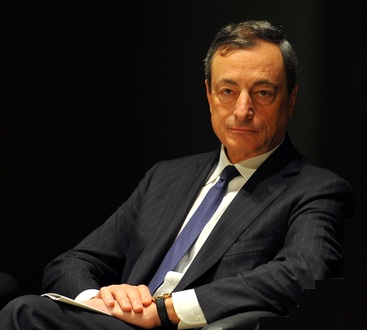
The real Game of Thrones is already underway. The contest to succeed Mario Draghi is now officially open. The head of the European Central Bank (ECB) will leave office on October 21st, 2019. The question is who has the guts to step up to the plate to clean up the mess he is leaving behind? The appointment of his successor is already underway.
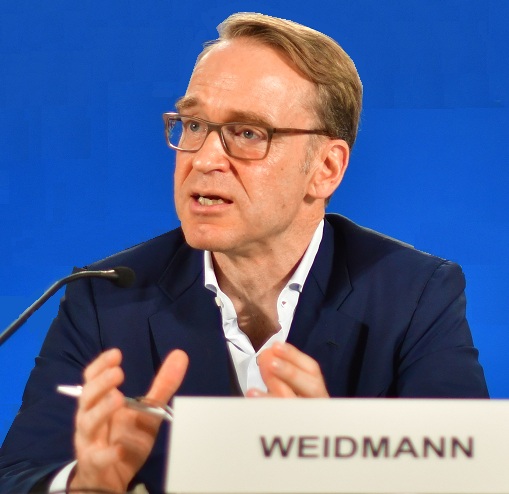
All the various governments are planning to submit their entries for what people are calling the ECB derby of 2019. Nobody really knows what will happen between now and the summer of 2019 is already a political lifetime. The favorite behind the curtain seems to be Jens Weidmann, who is the current head of Germany’s Bundesbank. If he would take that position is debatable. There are huge economic problems Draghi is leaving behind with the Quantitative Easing and then stir in conflicting political interests, and it becomes highly questionable whether this is going to be an easy compromise of the clash of titans.
The backroom shenanigans are not going to be so easy since Draghi has kept member states on life support. The monetary policy crisis in Europe may now come to a head and expect this to also become a major influence behind the Euro in 2019 as speculation grows. However, there is a prelude to the Draghi successor. Come May 2019, the term of Vítor Manuel Ribeiro Constâncio, who has served as Vice President of the ECB from June 2010 until May 2018 must be decided. Constâncio served as Governor of the Bank of Portugal from 2000 to 2010. With his term expiring in May, the new Eurogroup president, Mário Centeno, formally asked his finance minister colleagues to submit their nominations for the job by February 8th, so that the heads of government have time to agree before the spring. The choice of vice president will certainly influence political balance which could alter also the type of policy to expect from 2020 onward.
One thing is very clear, the Vice President and President will not be from the same countries regardless of their qualifications. The tradition has been that the four largest eurozone economies — Germany, France, Italy, and Spain — must have one representative on the board, with the other two seats being left to remaining 15 powers. There is little question that Jens Weidmann would reverse the policies of Draghi and shrink the ECB balance sheet as quickly as possible. The French will object to Weidmann being the man to sit in that chair when many states are starting to complain about the austerity philosophy of Germany
Once upon a time, they use to write songs about California Dreaming. It is now turned 180 degrees to the main dreaming in California is how to get out of the same. You just cannot keep raising taxes endlessly reducing the standard of living of the people and survive indefinitely. It is official. The net migration leaving California is showing up not just in the statistics, rental cars leaving the state, but now at least 1800 businesses have packed their bags and left headed to Texas or Florida.
You still see a lot of new construction in Dallas for office space going up around town. It gives the impression that there is no recession in the United States as we see in Europe and Asia. To a large extent, much of the boom in Texas and Florida is being driven by the net migration leaving California, Illinois, New York, and New Jersey – just to mention a few. The people are leaving the high tax regions and move to the states with no state income tax.
Philadelphia has also a city income tax. Worse yet, they want an income tax from people just visiting. They are taxing sports players per game in Philadelphia and that is also one of the reasons why we will never again hold a conference in Philadelphia. They demanded an income tax from us just to hold a conference in their city. They cannot understand that this type of taxation imposed upon people bringing business to the city for an event will only cause them to hold their events elsewhere.
Of course, those in government lack common sense. There lies the real problem. People ask me gee are you still forecasting doom and gloom? They prefer someone who predicts wonderful times ahead even if it is no true. Will we survive? Of course! These are the times that force change on government. Unfortunately, they will never reform until they are absolutely forced to do so
I have created this site to help people have fun in the kitchen. I write about enjoying life both in and out of my kitchen. Life is short! Make the most of it and enjoy!
This is a library of News Events not reported by the Main Stream Media documenting & connecting the dots on How the Obama Marxist Liberal agenda is destroying America








 Centinel2012