The corporate-owned, Wall Street-controlled, U.S. media are twisting, contorting, and in many cases hiding the consequential details of the U.S-Mexico trade agreement.
The reason for MSM disinformation campaign is quite simple: the deal helps the U.S. middle-class; helps both U.S. and Mexican workers; begins deconstructing the tentacles of Wall Street economic policy; and highlights a major success story for President Trump and the country in general. The UniParty, Wall Street and the agenda of their purchased political class are being dismantled…. All of those interests are furious.
While it is still available, watch the 10 minutes of this report (and interview with U.S.T.R. Lighthizer) from 07:00 to 17:00 to get a generally good idea of how significant a day this is. (prompted, just hit play)
White House trade adviser Peter Navarro also appears on Fox Business with Lou Dobbs to discuss the deal.
Earlier today President Donald Trump and First Lady Melania Trump welcomed Kenyan President Kenyatta and his wife to the White House. Two videos and transcripts.
♦Oval Office Meeting:
.
[Transcript] Oval Office – 1:53 P.M. EDT – PRESIDENT TRUMP: Thank you very much. It’s great to have President Kenyatta of Kenya, and First Lady Kenyatta. Thank you very much for being here. It’s a great honor.
We have a tremendous relationship with Kenya. We have terrorism, a lot of trade, getting bigger and bigger all the time.
PRESIDENT KENYATTA: Absolutely.
PRESIDENT TRUMP: We’re working on a major infrastructure project, a massive roadway that will be record setting, in many ways. And we are going to conclude a lot of good things.
We have the President’s representatives in the next room. And we’re going to be going in there, and we’re going to be making some great deals for both countries.
So thank you very much, both, for being here. This is a tremendous honor. Thank you very much.
PRESIDENT KENYATTA: Great pleasure. Wonderful to have us. Thank you. We appreciate it.
PRESIDENT TRUMP: Thank you very much.
PRESIDENT KENYATTA: Yep.
PRESIDENT TRUMP: Would you like to say something?
PRESIDENT KENYATTA: Yes. I want to just take this opportunity to thank Mr. President and the First Lady for welcoming us here to the White House.
As President Trump has said, Kenya and United States have had strong, solid relationships ever since our independence. We are here to renew that partnership. We are here to strengthen it. We have had very good and excellent cooperation, especially in our fight against terrorism because of the neighborhood that we’re in — al-Shabaab fights, which the United States have been a very good, strong, and solid partner.
But more importantly, we’re here to pursue and to strengthen our trade and investment ties, which are already very strong. We have a good number of American companies in Kenya. And we want to see how we can strengthen that going forward for the mutual benefit of our two countries.
And I believe that we will have very fruitful discussions this afternoon. And we’ll have a lot to report at the end of it.
Well, thank you once again, Mr. President —
PRESIDENT TRUMP: Thank you.
PRESIDENT KENYATTA: — for welcoming us to the White House.
PRESIDENT TRUMP: Great honor.
PRESIDENT KENYATTA: Happy to be with you.
PRESIDENT TRUMP: Thank you.
PRESIDENT KENYATTA: Thanks, Melania.
PRESIDENT TRUMP: Thank you very much everybody. Thank you. Thank you.
[Transcript] – Cabinet Room – 2:13 P.M. EDT – PRESIDENT TRUMP: Well, thank you very much. We are with President Kenyatta of a wonderful country that we do a lot of business with, Kenya. One of the most beautiful countries, from what I understand, Mr. President.
We have lots of pictures and lots of people that tell me how beautiful your country is. And we do a lot of tourism. We do a lot of trade. And we do a lot of defense and security. And we’re working very much on security right now. And I appreciate you very much being with us and your staff. This is really great. Your representatives have been dealing with our representatives and making a lot of progress. We’re talking about a very major highway/roadway. And that seems to be going along well. That’s a very important project, I think, for your country.
And so we appreciate, very much, you being at the White House and being with us. And we look forward to the discussion.
Thank you very much.
PRESIDENT KENYATTA: Thank you very much. And thank you for your warm welcome. As you said, we’ve had strong relations that stretch back — all the way back to our own independence. And we are here to cement that partnership. We are here to strengthen the support we have received as a country, especially with regards to our security and defense cooperation has been immense.
I had a good opportunity to speak with Mike, both in his former capacity and his current capacity. (Laughter.) And we work very well together, and I want to take this opportunity to appreciate that.
But more importantly, even as we work on these aspects, what’s most important and what makes our country survive is the trade and investment partnership. I mean, this is really what we should work to deepen much more as we go forward.
So I’m really looking forward to this discussion, and I’m looking forward to seeing how we take our relationship now to the next level —
PRESIDENT TRUMP: Good.
PRESIDENT KENYATTA: — for the mutual benefit of our two peoples.
PRESIDENT TRUMP: Well, you are here on a very special day because the stock market is up almost 300 points today. We just signed a trade agreement with Mexico, and it’s a terrific agreement for everybody. It’s been in the works for a long time. It’s an agreement that a lot of people said couldn’t be done, and we did something, and it was very special. Great for our farmers, our workers.
And our stock market just broke 26,000 for the first time ever in the history. So today we have the highest stock price we’ve ever had. And we’re very happy about that. I said that was going to happen and it’s happened. Everything I said is going to happen, it ends up happening.
So you picked a good day to come. (Laughter.) We’re in a very good mood.
PRESIDENT KENYATTA: Well, let’s hope you’re going to transfer some of that into Kenya. (Laughter.)
PRESIDENT TRUMP: We’ll bring that over to Kenya. (Laughter.) Thank you very much, everybody. I appreciate it. Thank you. Thank you.
So much good news:WASHINGTON (Reuters) – The trade deal between the United States and Mexico will stand even if Canada does not come to an agreement with the Trump administration in the renegotiation of the North American Free Trade Agreement (NAFTA), Mexico’s foreign minister said on Monday.
“If for any reason the government of Canada and the United States do not reach an agreement, we already know that there will still be a deal between Mexico and the United States.”
Remember those “private meetings” between Jesus Seade and Robert Lighthizer?
It is said: a picture is worth a thousand words. Cue the audio visual:
The incoming Mexican President, Andrés Manuel López Obrador,(AMLO)’s representative is Jesus Seade. The outgoing Mexican President Pena Nieto’s representative is Mexican Secretary of Economy Idelfonso Guajardo.
Why the joy in Seade and the defeated Guajardo? The answer is inthe details:
One of President Trump’s principal objectives in the renegotiation is to ensure the agreement benefits American workers. The United States and Mexico have agreed to a Labor chapter that brings labor obligations into the core of the agreement, makes them fully enforceable, and represents the strongest provisions of any trade agreement.
Key Achievement: Worker Representation in Collective Bargaining
The Labor chapter includes an Annex on Worker Representation in Collective Bargaining in Mexico, under which Mexico commits to specific legislative actions to provide for the effective recognition of the right to collective bargaining.
BOOM !!
Key Achievement: Labor Rights Recognized by the International Labor Organization
The Labor chapter requires the Parties to adopt and maintain in law and practice labor rights as recognized by the International Labor Organization, to effectively enforce their labor laws, and not to waive or derogate from their labor laws.
Additionally, the chapter includes new provisions to take measures to prohibit the importation of goods produced by forced labor, to address violence against workers exercising their labor rights, and to ensure that migrant workers are protected under labor laws.
Key Achievement: New Labor Value Content Rule
To support North American jobs, the deal requires new trade rules of origin to drive higher wages by requiring that 40-45 percent of auto content be made by workers earning at least $16 USD per hour.
Why is this important?
Massive consequences.
♦First, this is the part where AMLO gets a key win for his new Mexican economic agenda; the right of workers to form collective bargaining agreements, ie. unions. Mexico’s President-elect Andrés Manuel López Obrado is not only coming into office with a mandate, he is also bringing with him a majority parliament on his agenda.
By putting the rights of Mexican workers in the forefront two win/win objectives are accomplished for both AMLO and Trump. (1) The reason U.S. corporations moved to Mexico was party to exploit cheaper labor. Now that those corporations have invested themselves in Mexico they will have to agree to collective bargaining; thereby raising the standard of living for Mexican workers (an AMLO goal). (2) For future investment considerations the low-wage incentive of U.S. manufacturing is now eliminated (a Trump goal).
Multinational vulture corporations can no longer bribe local Mexican officials for low-wage regional labor. The Mexican worker, with AMLO legislation, will have the ability to fight off exploitation.
Manufacturing corporations will need to raise wages (AMLO win), and corporations will be less likely to move out of the U.S. based on the wage analysis portion of the total cost equation (Trump win). I have no doubt this was part of the ‘closed-door’ private discussions between Seade and Lighthizer. No doubt.
♦Secondly, how is the left-wing political opposition in Canada and the U.S. going to fight against this deal which includes protections for collective bargains and union representation? Trump fractures the Democrats/Liberals by supporting a policy that they claim is at the heart of their support base. Do you really think Senator Patrick Leahy, or Senator Bernie Sanders are going to go on record against organized labor?
How can Justin or Chrystia from Canada going to argue against higher Mexican wages?
The U.S./Mexico 75% auto rule of origin for manufacturing parts works in synergy with the demand that 45% of those manufacturing components must come from assembly and manufacturing wages of $16/hr or higher. In essence AMLO and Trump are controlling the calculations within the Total Cost of Manufacturing.
Watch the Canadian Leftists try to reconcile today’s events while not yet absorbing how the projected Mexican wage increases are factored into the total agreement. (first six minutes):
.
Here’s the Mexican trade team press conference. Use the ‘closed caption’ for the English sub-titles:
.
Within this agreement President-elect Lopez-Obrador and President Trump have fractured Wall Street’s exploitative multinational Big Club. No doubt, despite his hundreds of millions spent, U.S. Chamber of Commerce Tom Donohue is finally seeing significant defeat on the horizon.
The first White House visit by AMLO is going to be epic!
In direct relationship to the checkbook policy that impacts middle-class Americans the U.S./Mexico trade deal is the biggest win so far in Trump’s presidency. There are such massive ramifications it could take days for anyone to comprehend how the granular details have such massive downstream consequences. The deal is incredibly complex.
At the 30,000 ft level, the deal positions Mexico to retain their current multinational investments, and through a series of sector-by-sector standards on origination the deal simultaneously closes the fatal NAFTA loophole. The agreement makes an economic manufacturing partnership between the U.S. and Mexico; and for assembly products third parties will have to produce parts and origination material within the U.S. and Mexico.
U.S.T.R. Lighthizer has put some details forward:
♦The NAFTA Loophole closure is explained in Summary Form HERE; with emphasis on the Auto-Sector. The key is a 75% part origination level for auto-assembly; and a 40-45% level for parts with a minimum $16/hr wage rate. The source-origination rate (75%) is even higher than all previously forecast negotiation results.
Example of downstream consequences/benefits: German auto-maker BMW recently built a $2 billion assembly plant in Mexico (almost complete). Most of their core parts were coming from the EU (steel/aluminum casting components) and/or Asia (electronics). Now the assembly plant will have to source 75% of the auto-parts from the U.S. and Mexico, with 45% of those parts from facilities paying $16/hr. Result: BMW will need to modify their supply chain and build auto parts in the U.S. and Mexico.
♦Agriculture is another important sector, explained in Summary Form HERE. CTH needs to dig into the details on this sector. Overall it appears Mexico has agreed to a common set of food manufacturing safety standards. Additionally the removal of any/all subsidies in agricultural trade between the U.S. and Mexico. There’s more, a lot more, but it will require some analysis akin to separating grains of sand with a toothpick.
♦U.S.T.R. Lighthizer also provides a Summary Fact Sheet HERE with a broad high-level review of the agreement principles.
New “rules of origin” requirements to incentivize billions a year in vehicle and automobile parts production in the United States, supporting high-wage jobs.
The strongest, fully enforceable labor standards of any trade agreement.
New commitments to reduce trade-distorting policies for agricultural goods.
Improvements enabling food and agriculture to trade more fairly.
Strong and effective intellectual property protections.
The strongest disciplines on digital trade of any international agreement.
The most robust transparency obligations of any United States trade agreement.
NOTE: #7 is a critical point, with a great deal of emphasis, given the complexity of the rules of origin now constructed to close the NAFTA loophole.
CTH will have a lot more on the specific details, but we wanted to get the links to the fact sheets out quickly. Because of the fundamentally flawed prior agreement, this new trade agreement has massive consequences far beyond what would normally be considered.
Not only is Asia, specifically China, impacted; but so too are the EU and other international trade partnerships. The critical point is that the U.S. and Mexico have agreed to partner in our approach toward the rest of the world. Outgoing globalist Mexican President Pena Nieto is not happy; incoming nationalist Mexican President Andres Manuel Lopez-Obrador is ultimately the winner.
Through the efforts of Robert Lighthizer (U.S.) and Jesus Seade (AMLO) the Trump administration has now closed one of the access routes into coveted U.S. market, exploited by multinational corporations and countries (using NAFTA). The Mexico route is secure, agreements are made, and now attention turns toward Canada.
Think about the BMW example above, the downstream ramifications within this agreement are massive. It is not coincidental that Canada’s Foreign Minister Chrystia Freeland is in Germany coordinating the response. Now that a deal with Mexico has been reached, Canada has lost all prior leverage.
Remember, the U.S. and Mexico have agreed to “no protectionist tariffs/subsidies” in the agricultural sector. Canada protects its dairy sector with massive protectionist tariffs and subsidies. It is doubtful Trudeau and Chrystia can retreat from their construct.
Therefore:
“I think with Canada, frankly, the easiest we can do is to tariff their cars coming in. It’s a tremendous amount of money and it’s a very simple negotiation. It could end in one day and we take in a lot of money the following day,” Trump said.
Canada responded:
Canada responded with a statement Friday night, saying: “Our focus is unchanged. We’ll keep standing up for Canadian interests as we work toward a modernized trilateral NAFTA agreement.” (link)
This will likely be the outcome. Like it or not, Canada gets to continue protecting dairy sector and gives up its auto-manufacturing sector as a consequence.
Freeland is expected to arrive in the U.S. tomorrow….
Promises made, promises kept. The CTH community is in a unique position to understand exactly what has taken place today as President Donald Trump announces the termination of NAFTA and simultaneously announces a bilateral trade agreement has been made between the U.S. and Mexico. This is exactly what CTH predicted. Most, not all, but most of the media are absolutely clueless.
In an Oval Office announcement today President Trump put outgoing Mexican President Enrique Peña Nieto on his speaker phone as the press watched in the Oval Office. U.S. Trade Representative Robert Lighthizer, Mexican Secretary of Economy Idelfonso Guajardo, and the key figure for incoming Mexican President, Andrés Manuel López Obrador (AMLO), Jesus Seade was present for the announcement.
CTH will have much more on the details of the trade agreement. This is the most comprehensive and complex trade agreement in U.S. history. However, in the interim here’s the full video of the announcement (including nuance). ENJOY:
.
[Transcript] Oval Office – 11:09 A.M. EDT – PRESIDENT TRUMP: Hello everybody. It’s a big day for trade, a big day for our country. A lot of people thought we’d never get here because we all negotiate tough. We do, and so does Mexico. And this is a tremendous thing.
This has to do — they used to call it NAFTA. We’re going to call it the United States-Mexico Trade Agreement, and we’ll get rid of the name NAFTA. It has a bad connotation because the United States was hurt very badly by NAFTA for many years. And now it’s a really good deal for both countries, and we look very much forward to it.
And I believe the President is on the phone. Enrique? You can hook him up. Tell me when.
How are you? It’s a big thing. A lot of people waiting. Hello? Do you want to put that on this phone, please? Hello? Be helpful.
♦PRESIDENT PEÑA NIETO: (As interpreted.) President Trump, how are you? Good morning.
♦PRESIDENT TRUMP: Thank you, Enrique. And congratulations. That’s really a fantastic thing. We’ve all worked very hard, and your brilliant representatives are sitting right in front of me. And I thought we would congratulate each other before it got out. And I know we’ll have a formal news conference in the not-too-distant future.
♦PRESIDENT PEÑA NIETO: (As interpreted.) Thank you very much, President Trump. I think this is something very positive for the United States and Mexico. And the first reason for this call, Mr. President, is, first of all, to celebrate the understanding we have had between both negotiating peace on NAFTA, in the interest we have had for quite a few months now to renew it, to modernize it, to update it, and to generate a framework that will boost and potentiate productivity in North America.
It is our wish, Mr. President, that now Canada will also be able to be incorporated in all this. And I assume that they going to carry out negotiations of the sensitive bilateral issues between Mexico — rather, between Canada and the United States.
And I’m really grateful, Mr. President. I want to say that you — I greatly recognize and acknowledge your political will and your participation in this. And on this paved path, I want to bear my testimony, Mr. President, and my acknowledgement to both negotiating teams, especially the team that is headed and led by Mr. Robert Lighthizer, and also the accompaniment and the support we have had from the White House through Jared Kushner.
And I also extend this recognition to the Mexican team. They are listening to you. They are close to you right now — Foreign Minister Luis Videgaray and the Secretary of the Economy, Mr. Guajardo.
Yes, in terms of (inaudible) the negotiations that have taken months, it’s been difficult, complex, and a very hard negotiation altogether with difficult moments, of course. But I truly acknowledge now the fact that we’ve been able to reach an agreement that we are about to make public. And this is the result of good understanding and good work. And I — of course, I am quite hopeful that now Canada would start discussing with the United States the sensitive bilateral issue.
Congratulations, President Trump. I am very grateful and I am attentive to your comments.
♦PRESIDENT TRUMP: Well, Mr. President, thank you very much. It’s an honor. You’ve been my friend. It’s been a long time since I traveled to Mexico, where we got to know each other quite well and we actually had a good meeting. Some people weren’t sure if it was a good meeting, but I was.
I have a lot of good meetings that a lot of people aren’t sure if they were good or not.
But it’s been a long time, and this is something that’s very special for our manufacturers and for our farmers from both countries, for all of the people that work for jobs. It’s also great trade and it makes it a much more fair bill. And we are very, very excited about it.
We have worked long and hard. Your representatives have been terrific. My representatives have been fantastic too. They’ve gotten along very well, and they’ve worked late into the night for months. It’s an extremely complex bill and it’s something that I think will be talked about for many years to come. It’s just good for both countries.
As far Canada is concerned, we haven’t started with Canada yet. We wanted to do Mexico and see if that was possible to do. And it wasn’t — I think, it wasn’t from any standpoint something that most people thought was even doable when we started.
If you look at it, you remember, at the beginning, many people thought that this was something that just couldn’t happen because of all of the different factions, all of the different sides, and the complexity. And we made it much simpler, much better. Much better for both countries.
Canada will start negotiations shortly. I’ll be calling the Prime Minister very soon. And we’ll start negotiation, and if they’d like to negotiate fairly, we’ll do that. You know, they have tariffs of almost 300 percent on some of our dairy products, and we can’t have that. We’re not going to stand for that.
I think with Canada, frankly, the easiest thing we can do is to tariff their cars coming in. It’s a tremendous amount of money and it’s a very simple negotiation. It could end in one day and we take in a lot of money the following day.
But I think we’ll give them a chance to probably have a separate deal. We can have a separate deal or we can put it into this deal. I like to call this deal the United States-Mexico Trade Agreement. I think it’s an elegant name. I think NAFTA has a lot of bad connotations for the United States because it was a rip-off. It was a deal that was a horrible deal for our country, and I think it’s got a lot of bad connotations to a lot of people. And so we will probably — you and I will agree to the name.
We will see whether or not we decide to put up Canada or just do a separate deal with Canada, if they want to make the deal. The simplest deal is more or less already made. It would be very easy to do and execute.
But I will — I will tell you that working with you has been a pleasure. Speaking with and working President-elect López Obrador has been absolutely a very, very special time.
You both came together for your country. You worked together. I think that’s important for the media to know. We have a little — a small amount of media in our presence, like everybody. And the media should know that the President and the President-elect worked very closely together because the President felt it was important that the President-elect liked what he was seeing.
And our teams worked together. Our teams were really well unified, and your team was very well unified. I was very impressed with the fact that the two Presidents came together and worked out something mutually agreeable.
So it’s an incredible deal. It’s an incredible deal for both parties. Most importantly, it’s an incredible deal for the workers and for the citizens of both countries. Our farmers are going to be so happy. You know, my farmers — the farmers have stuck with me; I said we were going to do this. And Mexico has promised to immediately start purchasing as much farm product as they can. They’re going to work on that very hard.
And as you know, we’re working — unrelated to this, we’re working very much with other countries. China is one; they want to talk. And it’s just not right time to talk right now, to be honest, with China. It’s been — it’s too one-sided for too many years, for too many decades. And so it’s not the right time to talk. But eventually, I’m sure, that we’ll be able to work out a deal with China. In the meantime, we’re doing very well with China.
Our economy is up. It’s never been this good before, and I think it’s only going to get better.
But, Mr. President, you’ve been my friend and you have been somebody that’s been very special in a lot of ways. We talk a lot. We talked a lot about this deal. And I’d like to congratulate you and the Mexican people.
♦PRESIDENT PEÑA NIETO: (As interpreted.) Thank you very much, Mr. President.
I finally recognize this, especially because of the point of understanding we are now reaching on this deal. And I really hope and I desire — I wish — that the part with Canada will be materializing in a very concrete fashion; that we can have an agreement the way we proposed it from the initiation of this renegotiating process, a tripartite.
But today I celebrate the (inaudible) between the United States and Mexico because we’re reaching a final point of understanding. And I hope that in the following days we can materialize (inaudible) in the formalization of the agreement.
Something additional, Mr. President — and you have already mentioned it — it has to do with an involved and committed participation of the administration and the President-elect of Mexico. As you know, we are now going through a period of transition, and it has been possible to create a highly unified front between the negotiating team of this administration and the people appointed by the President-elect of Mexico to be observers and participate in this agreement, in this understanding, to reach the point we are now reaching.
The President-elect has been aware of everything that has been happening, and I have also had the opportunity of talking to him directly and personally on the progress being made.
You have also had direct conversations with President-elect. Things that we have to do and I hope we have the space to do it would be to find — to toast a good toast with tequila, of course — (laughter) — to celebrate this understanding.
♦PRESIDENT TRUMP: Enrique, I think that’s exactly right. And you know the good relationship that I’ve already established with the President-elect. I was very impressed with him, I must tell you. He was terrific in every way. And he wants — you know, he loves your country like you love your country. You want to do the right thing. And we’re really doing the right thing for all of us. So I really enjoy that. Please send him my regards, and I will speak to him very shortly.
But this was great that you were able to do it together. I think doing it mutually as opposed to just you doing it — or even just him doing it — I think a mutual agreement between your two administrations was a fantastic thing. I suggested that early on, and I think it was immediately embraced and I think it was a really fantastic thing that you were able to do it — and with great spirit. I mean, it was great coordination and spirit. So I think that is really just great.
And, you know, one of the things that I’m excited about is you’re going to be helping us at the border. You’re going to be working together with us on agriculture. You’re going to be working in many different ways, and we’re going to be working with you in many different ways. This is a very comprehensive agreement.
So, Enrique, I will see you soon. I think we’re going to have a very formal ceremony. This is one of the largest trade deals ever made. Maybe the largest trade deal ever made. And it’s really something very special that two countries were able to come together and get it done.
And I just want to thank all of my people — Bob and Jared. And, gentlemen, you have been really great, the way you’ve worked so long. And I know you’ve been going up until three o’clock, four o’clock in the morning, and then getting in at eight.
So I just want to — on behalf of the United States, I want to thank you very much. And I can say that Mexico is very proud of you. They’re very proud of you. Thank you all very much.
Enrique, I’ll see you soon. I’ll talk to you soon. And congratulations, and job well done.
♦PRESIDENT PEÑA NIETO: (As interpreted). Thank you, Mr. President, and congratulations as well to you, to the negotiating team, to the (inaudible) of both countries. We’ll be waiting for Canada to be integrated into this process.
I send you an affectionate hug. And all my greetings to you and my regards.
♦PRESIDENT TRUMP: A hug from you would be very nice. (Laughter). Thank you. So long. Thanks. Goodbye, Enrique.
Okay, so we’ve made the deal with Canada. It’s a very —
Q With Canada?
♦PRESIDENT TRUMP: They’re starting. We made the deal with Mexico. And I think it’s a very — deal. We’re starting negotiations with Canada, pretty much immediately. I can’t tell you where those negotiations are gone. It’s going to be a — it’s a smaller segment, as you know. Mexico is a very large trading partner. But we’ve now concluded our deal and it’s being finalized.
And, Bob, when would you say it will be signed — actually, formally, signed?
♦AMBASSADOR LIGHTHIZER: Well, it will likely be signed at the end of November because there’s a 90-day layover period because of our statute. But we expect to submit our letter to Congress, beginning that process on Friday.
♦PRESIDENT TRUMP: Okay, so that starts the process.
♦AMBASSADOR LIGHTHIZER: And then 90 days later, it will be signed.
♦PRESIDENT TRUMP: We have an agreement where — both with Canada and with Mexico — I will terminate the existing deal. When that happens, I can’t quite tell you; it depends on what the timetable is with Congress. But I’ll be terminating the existing deal and going into this deal. We’ll start negotiating with Canada relatively soon. They want to start — they want to negotiate very badly.
But one way or the other, we have a deal with Canada. It will either be a tariff on cars, or it will be a negotiated deal. And, frankly, a tariff on cars is a much easier way to go. But perhaps the other would be much better for Canada.
And we’re looking to help — you know, we’re looking to help our neighbors, too. If we can help our neighbors, that’s a good thing, not a bad thing. So we’re going to start that negotiation imminently. I’ll be speaking with Prime Minister Trudeau in a little while.
So I want to thank everybody. I want to thank you. What a great job you’ve all done. And it’s been — it’s been a long one, but a lot of people thought this was not a doable transaction. It’s going to be great for our people. And again, I want to thank you folks. And we’ll see you at the signing, and we’ll see you many times before that, I’m sure.
So, congratulations to the people of Mexico. Great job.
In June, 2017, while trying to keep President Trump committed to the Paris Climate Treaty, Germany’s Angela Merkel and France’s Emmanuel Macron delivered a joint statement proclaiming: “the Paris Climate Treaty is irreversible and cannot be renegotiated.”
U.S. President Trump knew the economic ramifications would handcuff the U.S. and that was the primary motive behind their demands. Rightly POTUS Trump brushed off the demands and withdrew the U.S. from the treaty, in July 2017:
Then came a predictable series of events…
A month after U.S. President Trump called out the ridiculous globalist economic agenda and withdrew the U.S. from participating, German Chancellor Angela Merkel responded on August 20th, 2017, by removing her own country from the primary treaty demands. Five months later, January 2018, the anointed leader of far-left international political policy then withdrew entirely from the 2020 carbon emission reduction goal.
All of these moves only further evidenced that ‘climate change’, vis-a-vis the Paris Treaty, was/is an insufferable economic control policy; a ruse; a scheme manufactured by global financial elites who seek power and leverage upon the sheeple proles. Merkel well understands that global emission control mechanisms, specifically carbon reduction schemes, are nothing more than policy tools to exfiltrate national wealth.
Today, much to the chagrin of the barking moonbats and pontificating international elites, Chancellor Merkel refuses to change her position:
(Via Reuters) […] Merkel said such calls, most recently from the European Commission’s climate chief Miguel Arias Canete, for swifter cuts to harmful carbon dioxide emissions would be counterproductive, adding that setting new goals made little sense when European countries were already struggling to meet their cuts targets.
“I’m not particularly happy about these new proposals,” she said of Canete’s call to increase from 40 to 45 percent the scale of cuts to target by 2030.
“I think we should first stick to the goals we have already set ourselves. I don’t think permanently setting ourselves new goals makes any sense.”
Merkel’s government has already faced criticism for abandoning emissions targets it had set itself for 2020 after concluding they were unachievable, while sticking to a target it had set itself for a decade later. (read more)
In related news…. Approximately two weeks ago the mainstream media was apoplectic when Interior Secretary Ryan Zinke explained the root cause of the California wildfires.
When Secretary Zinke said the primary problem was a failure of State and Federal officials to control the fuel load and manage the forest(s), the climate nuts went bananas. WATCH:
.
Well….
….Fast forward two weeks later, and here’s the latest plan from California Governor Moonbeam:
The Hill
✔@thehill
California Gov. Jerry Brown considers easing logging rules to help fight fires http://hill.cm/ZcWi9K9
Remember the ju-ju bones?… Well…. The U.S. Main Street economic engine is almost firing on all cylinders as brick-and-mortar retailers drop their historic complaints of e-commerce impacting their sales and foot-traffic, and instead begin seeing the real life consequences from a resurgent American middle-class.
Target CEO Brian Cornell: “There’s no doubt that, like others, we’re currently benefiting from a very strong consumer environment — perhaps the strongest I’ve seen in my career.” “We’re seeing a great consumer response … unprecedented traffic. As we go back and look, we’ve never seen traffic growth like this.” (link)
The growth in retail foot-traffic is a critical KPI for the economy. Despite economic and business school theory (pushed over the past 20 years), everything of consequence is dependent on a thriving American middle-class; blue and white collar.
Target CEO Brian Cornell is not alone in his optimism:
Walmart VP of Investor Relations Dan Binder: “Job growth is great. Wages are up. Credit is expanding … So the consumer is in great shape. In the surveys that we look at, they tell us that they are feeling good about their financial condition.”
Home Depot CFO Carol B. Tomé: “As we look to the back half of the year, we continue to expect strong economic growth, with the backdrop of a healthy home improvement environment. Homeowners continue to enjoy home price appreciation, and rising wages and low unemployment have driven consumer confidence to record high levels.”
Macy’s CEO Jeffrey Gennette: “Based on the first-half performance, our strong execution and the anticipation of continued healthy consumer spending, we’re raising both sales and earnings guidance for the year.”
Lowe’s CFO Marshall A. Croom: “We expect to see solid sector growth driven by gains in employment which should boost disposable income and consumer spending.”
The middle-class economic engine can/is self-sustaining around the basic principles of MAGAnomics. Additionally, finalizing America-first trade deals could explode U.S. GDP growth as investment pours into the U.S.A. We will soon need to build a bigger-engine to handle all the high-octane investment fuel.
The economic models of the entire last generation+ are based on the assumptions of continuing globalist economics which advances, and has advanced, the interest of Wall Street over Main Street. They were driving a “service-driven economy” message.
The investing class economy, ie. another name for a ‘service-driven economy’, has been the only source of historic reference for approximately three decades. These talking heads convinced themselves that a “service driven economy” was the ONLY economy ever possible for the U.S. in the future. WATCH:
.
Back in January 2017 Deutsche Bank began thinking about it, applying new models, trying to conceptualize and quantify MAGAnomics, and trying to walk out the potential ramifications. They began talking about Trump doubling the U.S. GDP growth rate when all U.S. investment groups couldn’t yet fathom the possibility.
As we have continued to share, CTH believes the paycheck-to-paycheck working middle-class are going to see a considerable rise in wages and standard of living. How high can wages rise?… that depends on the pressure; and right now the pressure is massive. I’m not going to dismiss the possibility we could see 10 to 20% increases in year-over-year wage growth in multiple Main Street economic sectors.
Winnamins. We need lots of them…
Now here’s the critical leadership part…. After two-plus decades of Wall Street emphasis on inventory and supply chain management: Who is going to be bold enough to ramp up inventories high enough to prepare for, and take advantage of, the upcoming MAGAnomic holiday season?
Italy is the third largest economy in Europe just behind France, but it is number two insofar as industrial production is concerned. The French manufacture three main brands, Peugeot, Citroen, and Renault, in the world of automobiles which are not very popular in the USA. The Italians, however, have the more recognized brands worldwide such as Ferrari, Maserati, Lamborghini, Alfa Romeo, Fiat, and Lancia. The sports car enthusiast is always torn between a Ferrari and a Lamborghini while you are beginning to see Maserati’s everywhere in the standard high-end marketplace.
From the manufacturing perspective, the Italians have been able to compete producing cars in Euro for their reputation in car production carries the day. The crisis for Italy with respect to the Euro has been the conversion of their past debt to Euro which altered the standard depreciation of debt whereby you are paying back with cheaper currency.
The idea that was floated as an alternative to leaving the Euro calling for a referendum on the country’s EU membership was the proposal which called for the introduction of so-called mini-bots – government guaranteed bills. The catch was that they were to be restricted only to Italy and can be used to pay taxes. This idea does not seem to be moving anywhere close to reality. However, it recognized that there was a problem with its debt.
Instead, the proposals have turned on reforming the ECB. There are people in the Italian government who want to alter the ECB as a direct result of Draghi’s policy of Quantitative Easing which has destroyed the European Bond Market. The Italian proposal call for the ECB’s statutes should be changed to allow the central bank to act as a lender of last resort and acquire Italian government bonds not only on the secondary market by QE, but also on the primary market buying them directly from the Italian government. In reality, this would be a direct assault on the German philosophy of austerity. There would be nothing against higher inflation if it would create more jobs. Italy is making it clear that they would prefer 7% inflation and an unemployment rate of 2% rather than 2% inflation and an unemployment rate of 7%. In reality, Italy is arguing for the same policies that were adopted by Roosevelt to end the Great Depression.
This is becoming a battle behind the curtain between austerity and reality. The question to emerge is what happens if Germany refuses to yield? Are we looking at the very issue that brings down the entire EU house of cards?
QUESTION: Mr. Armstrong; I find your anecdotes fascinating and very enlightening how you always bought German cars and made money on them. Is currency the primary reason people often think something is a good investment when in fact it is really just currency fluctuations?
PVB
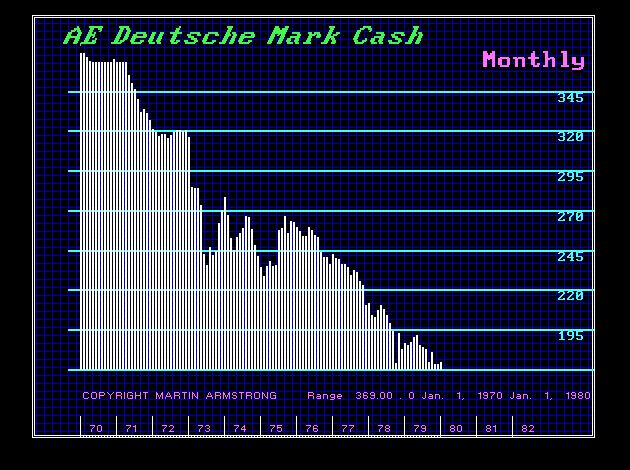
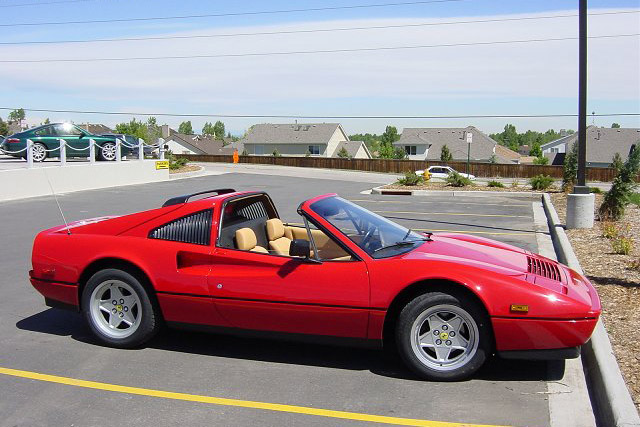
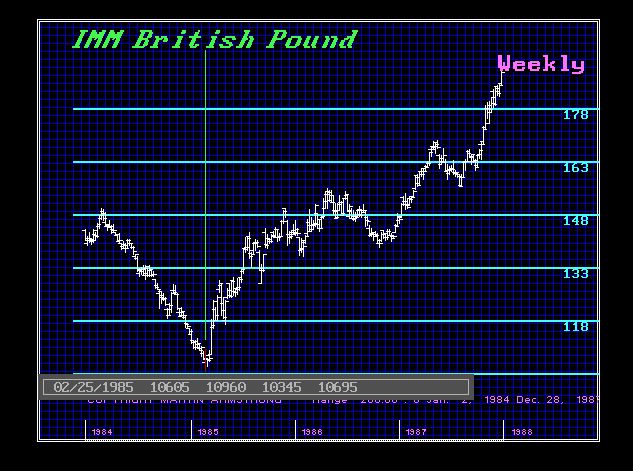
ANSWER: You are hitting the nail right on the head. The decline in the dollar throughout the 1970s made German cars appear to appreciate and this was attributed to quality. This was the entire reason why the German car industry exploded. I have often stated at WEC conferences that I made the same play with a Ferarri in London. When the British pound dropped to $1.03 in 1985, I ran out and used the currency to make some deals. I bought a 328 Ferarri for about $30,000 when in the US it was a $50,000 car. Because the pound had dropped, Ferarri could not afford to sell them in Britain at that price so they raised it £45,000.
As you can see from the chart I provided, the pound bottomed in February 1985 at $1.0345. After Ferrari raised the price and then the pound went to nearly $2, suddenly a car that cost me $30,000 had a replacement cost of almost $100,o00. This is what led to many people buying several Ferraris and garaging them thinking that the car was the investment.
Currency Inflation is probably the most misunderstood economic force in the matrix. Probably 99% of economists and investors remain ignorant of such trends because they have never dealt in the international world of finance and focused only domestically. Those of us who have been hedge fund managers and worked internationally understand the fluctuations of currency and its impact. This is a lesson still not taught in school and politicians remain oblivious to the real implications.
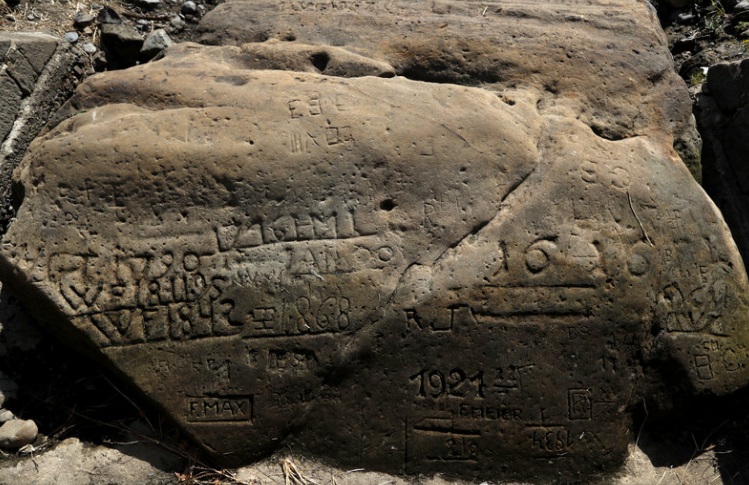
While the Global Warming fanatics are out in force saying “see” the heat in Europe is caused by humans driving their cars around, they continue to ignore history. The extreme heat in Europe this year is part of a cycle. The swings from extreme heat to extreme cold are also not unheard of. Another piece of historical evidence they ignore is known as the Hungry Stones. Pictured here is a Hungry Stone from 1616 which has been exposed by the low level of water in the Elbe River. This is at Decin, in the Czech Republic. Throughout the centuries, there have been these cycles of extreme heat followed by extreme cold. Such events have been recorded when drought has resulted in the low level of water in the Elbe river.
This year’s drought in Europe has exposed once again the Hunger Stones that have been used for centuries to commemorate historic droughts which warn of their consequences when you see these stones again. The Hunger Stones are visible in the Elbe River once again. This is a major river which begins in the Czech Republic and flows through Germany. There are more than a dozen Hunger Stones that serve as records of previous droughts establishing that the extreme heat and drought of this year is by no means unique to history.
The various Hunger Stones record droughts that resulted in famine and soaring prices for food. The droughts that have been recorded on the stones date to 1417, 1616, 1707, 1746, 1790, 1800, 1811, 1830, 1842, 1868, 1892, and 1893, which covers a period of 476 years. This produces an average of 39.6 years. Just applying that average would bring you to 2012. However, we have to look closer. Note that two years 1892 and 1893 are back-to-back. This does not reflect two separate droughts, but the peak in intensity. Instead of there being TWO separate droughts, it is the same even just extended. That means there were really 11 events within this 476-year span of history and low and behold this alters the average to 43.27 years. This actually conforms to our Economic Confidence Model frequency of 8.6 years /2 = 4.3.
In fact, additional evidence that is being ignored by the Global Warming crowd who seem intent upon leading society to its doom by ignoring the past entirely. Extensive research has also been done on tree-rings in north-central Europe. This study has discovered that there has been a pattern of “megadroughts”in the 15th through 19th centuries. They classified 1893 as the “Great Drought of 1893” where rainfall decline between 30 to 90% throughout various regions in Europe. They also found that the Irish famine of 1740–1741 was the result of a cooling period they pointed out resulted in unusually low winter and spring temperatures in 1740 that produced in crop failures and a massive subsequent famine. They point out that there were five major “megadrought” that took place in 1540, 1590, 1616, 1718, and 1719. Once again, we see back-to-back events in 1718 and 1719 which in our analysis reflect a build up in intensity rather than two separate events. Reducing this to 4 evens once again gives us an average of 44.75 years which is very close to the Pi frequency. If we plot this serious out, we arrive at 2020.
It appears that instead of a back-to-back event in 2019, this cand become the worst period of intensity and produce three years of drought into 2020. The greater the number of volcanos erupting can also produce an increase in intensity for this period. What we must be concerned about is volcanic activity appearing in the West Indies, which includes Soufriere on St. Vincent. It is the stratovolcano type event that can change the weather. These are volcanoes that are known as a composite volcano, which is a conical volcano built up by many layers (strata) of hardened lava, tephra, pumice, and ash. When they erupt, this sends a tremendous amount of material into the atmosphere which reduces sunlight and cools the temperatures.
When we ran the drought data through our models, not only did it correlate with the ECM, it also coordinated with the first historical eruption of the volcano which took place during 1718 and a subsequent eruption 1812. Now, look at the drought records of megadroughts – 1718/1719. When we ran the model, out comes the year 1816 which s known as the Year Without a Summer. The climate turned extremely cold and it was snowing in July in New York City. This resulted in major food shortages across the Northern Hemisphere. Note that the second eruption was 1812.
When we correlated this entire period, what emerged was a dramatic increase in volcanic activity which also correlated with the decline in the energy output of the sun. Our model warned that volcanic activity would rise beginning here in 2018 correlated with a decline in the energy output of the sun which should have begun in 2015. Note that the Hunger Stones also mark the year 1811. While this is one year prior to the eruption in the West Indies in 1812, there is what has been called the 1808/1809 Mystery Volcanic Eruption which seems to have set in motion a Mini Ice Age during the early 1800s. This was a monumental volcanic eruption in the VEI 6 range which appears to have taken place in late 1808. This event preceded the 1815 eruption of Mount Tambora (VEI 7) which produced the Year Without a Summer in 1816.
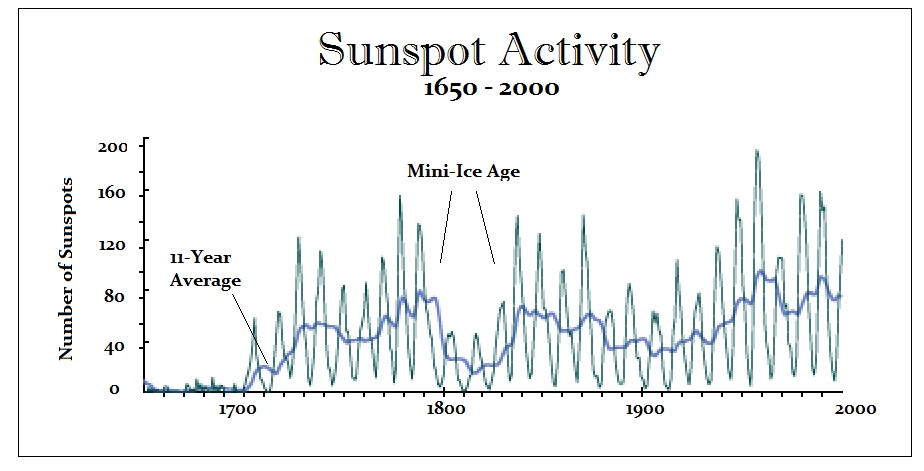
There was the period climatologists called the Little Ice Age they believed took place starting around 1650. This was the result of primarily the decline in the energy output of the sun reflected in the drastic decline in sunspot activity. What we are looking at here is a drastic correction in market-terminology which took place during the early 1800s. A study of Greenland and Antarctic ice cores in the 1990s revealed evidence that pointed to a massive volcanic eruption that had occurred in early 1809. The problem that everyone face was there were not human records of such an event. This meant that it must have been in a region where humans did not record the event. Additional research revealed from tree-ring data that there was also a major eruption in 1808. Now two independent sources were pointing to a mystery eruption – but where?
The mystery was simply that such a catastrophic eruption of that magnitude should have been noticed by someone. They began to scour the records around the world hoping that someone somewhere recorded the event. Finally, in 2014 a Ph.D. student Alvaro Guevara-Murua and Dr. Caroline Williams of the University of Bristol discovered an account of atmospheric events consistent with such an event by Colombian scientist Francisco José de Caldas who recorded a massive transparent cloud that obstructed the sunlight at Bogotá, Columbia in early 1809. The further investigation revealed that the cloud was first been observed by him on December 11th, 1808. De Caldas reported conditions consistent with a volcanic cloud that altered the weather turning it unusually cold, with even bitter frosts in Columbia.
Further investigations to the south in Peru produced another observation by a physician named Hipólito Unanue of Lima. Combining these two observations led to the conclusion that the window of the eruption was sometime within 14 days of December 4th, 1808. The only area in the tropics to the west of Colombia and Peru with possible volcanoes was also located in the South Western Pacific Ocean between Indonesia and Tonga. At the time, there was hardly any reporting coming from this region lacking European settlements. The Rabaul area has had such major VEI 6+ eruptions but records only date back to the mid-1800s.
However, this one catastrophic VEI6+ eruption is NOT the only volcano that erupted. This is why we have warned that the cyclical period for volcano eruptions turned upo with 2018. In 1808 there were major additional eruptions in Urzelina, the Azores during May (1st to 4th), as well as the Taal Volcano, in the Philippines during March that year. There was also the Chilean Putana volcano which had a major eruption during of 1808-1810 (records are not precise) This period is then followed by the truly massive 1815 eruption of Mount Tambora in the Dutch East Indies. This one is attributed with creating the Year without a Summer because it was the largest eruption in at least 1,300 years that has been recorded. This event was followed by the 1814 eruption of Mayon in the Philippines, which appears to have contributed to the weather changes of cooling creating an accumulative event.
Our models have pinpointed yet another such period that perhaps sent human civilization into the Dark Ages. There was a similar period with volcanos and extreme weather events of 535–536. Researchers from Los Alamos Laboratory published a thesis (LA-UR 004608) in this study these researchers developed a model recreating a volcanic eruption of such proportion that it staggers the human mind. This eruption is known as the Proto-Krakatau eruption. It occurred in the year 536 AD in the present day country of Indonesia. This predecessor or the 18 15 AD eruption of Krakatau of the same name and place was many times greater. The evidence these scientists present is that this resulting blast of this super volcano with its caldera (magma chamber) collapsing beneath it formed the Strait of Sunda between the islands of Sumatra and Java. Before this explosive eruption, these two islands were one land mass. The bathymetry data indicates this caldera is about 40 to 60 km in diameter. Michael the Syrian: “The Sun became dark and its darkness has lasted eighteen months. Each day it shone for about four hours, and still, this light was only a feeble shadow the fruits did not ripen, and the wine tasted like sour grapes.”
This appears to be the eruption of the volcano Krakatoa is located on Rakata, in the Pacific between Java and Sumatra, Indonesia. We know the name from the major eruption on August 26th, 1883 which was one of the most catastrophic ever witnessed in recorded in modern history. Previously, we knew of a more moderate eruption that took place back in 1680. Contemporary historians recorded events. Procopius wrote in 536AD: “during this year a most dread portent took place. For the sun gave forth its light without brightness … and it seemed exceedingly like the sun in eclipse, for the beams it shed were not clear.” John the Lydian, or John Lydus, was a 6th-century Byzantine administrator and a historian who wrote also in 536AD: “The sun became dim … for nearly the whole year … so that the fruits were killed at an unseasonable time.”
In Mesopotamia, a source quoted by Michael the Syrian (ca. 1166-1 199 AD) and Bar-Hebraeus 1246-1286 records that: “In the year 848 of the Greeks [536 A.D.]. the Sun was dark and its darkness lasted for eighteen months, each day it shone for about 4 hours, and still, this light was only a feeble shadow,. , the fruits did not ripen and wine tasted like sour grapes”
Flavius Magnus Aurelius Cassiodorus Senator (c. 485 – c. 585), was a Roman statesman and a historian. He wrote of this period: “The sun … seems to have lost its wonted light, and appears of a bluish color. We marvel to see no shadows of our bodies at noon, to feel the mighty vigor of the sun’s heat wasted into feebleness, and the phenomena which accompany an eclipse prolonged through almost a whole year. We have had … a summer without heat … the crops have been chilled by north winds … the rain is denied …”
The ice core samples clearly show actually two very large sulfate peaks that occur with volcanos. The first took place during 537AD and the second follows in 541—542AD. Therefore, once again we may be dealing with multiple volcanic eruptions. Both peaks are approximately the same size. It is the first event that has been recorded as the catastrophe. Contemporary historians mention above have provided contemporary accounts of this dramatic decrease in the Sun’s brightness during 536 and 537 AD. We have yet another contemporary account of a historian from Constantinople (Hamilton and Brooks, 1899, p. 267), believed to be Zacharius of Mytilene, who describes: ‘”In the year 14 [536 AD], the Sun began to be darkened by day and the Moon by night… from the 24th of March in this year until the 24th of June in the following year 15.” Because the dimming was less severe and shorter in duration, it is generally assumed that the atmosphere was filled with fine volcanic ash or dust from this event. (Rigby et al., 2004; Larsen et al., 2008), There is no question that SO2 emissions from volcanos produce a cooling trend in weather. However, it has also been shown that there is a time lag between 6 and 18 months that will vary depending upon how far up the ash is thrust into the atmosphere. Thus, there can be a delayed effect from when the eruption actually takes place.
Yet there is still another theory that strangely comes into play this October/November. The argument is that we pass through a particularly dense section of the Taurid Meteor path around every 2500 years and this has contributed to legends and climate change. Every year there are as South Taurid Meteor shower which will peak overnight on Oct. 9-10 for the Southern Hemisphere and then in the Northern Hemisphere, the North Taurid Meteor shower peaks Nov. 11-12. This has provided the foundation for love stories and wishing upon a shooting star. However, there have been intense Meteor storms that led to legends of dragons fighting in the sky breathing fireballs at each other. Chinese historical records from 540AD describe: “Dragons fought in the pond of the K’uho, They went westward … in the places they passed, all trees were broken.” Ice core sample also contain extraterrestrial dust from this period as well. It is argued that a larger meteor struck the Earth about this time and this is what is described as dragons fighting in the sky.
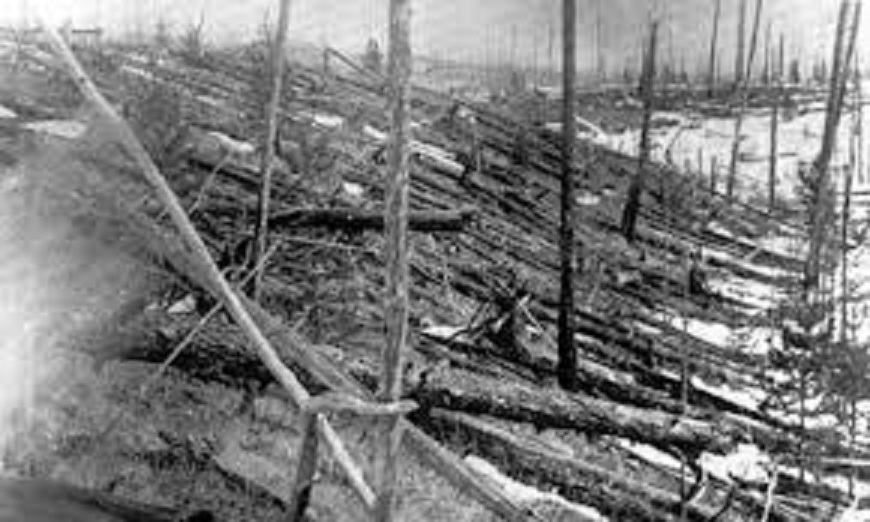
The one major know meteor even is that of Tunguska which was a large explosion that occurred in Russia, on the morning of June 30th, 1908. The explosion flattened 770 square miles (2,000 square kilometers) of the forest. The explosion is classified as an impact event, even though no impact crater has been found. The meteor is believed to have exploded above ground and thereby disintegrated at an altitude of 3 to 6 miles before it actually struck the ground. This is the largest impact event on Earth in recorded history, not geological history.
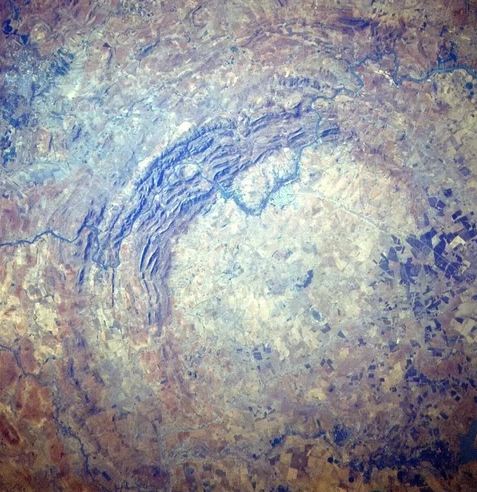
Meteorite impacts are by far perhaps among the most destructive forces in the solar system. It is believed that such events have resulted in mass extinctions. However, there are others who suggest that they may have also delivered the seeds of life soon after Earth was born. The oldest impact crater on Earth is also the largest and it is located in South Africa. It is known as the Vredefort Crater for it was originally 185 miles in diameter which struck some 2.02 billion years ago (pictured here). There is another major impact known as the Chicxulub crater located in the Yucatan peninsula of Mexico which is 93 miles in diameter that some argue may have wiped out the dinosaurs with a blast that was equal to the estimated energy of 10 billion Hiroshima A-bombs which took place about 66 million years ago.
Sodom and Gomorrah which are most likely located at the Dead Sea may have been destroyed by debris from a comet, startling new archaeological and astronomical research suggests. The Dead Sea is famous for is extreme salinity (34% salt, or almost 10 times as salty as the ocean), and for having the lowest elevation on Earth, at 1,407 feet (429 meters) below sea level. The argument remains that there was a simultaneous fall of the Old Kingdom of ancient Egypt, the Sumerian civilization in Mesopotamia and the Harrapin Civilisation of the Indus Valley. In total, some 40 cities are thought to have disappeared, in a series of catastrophes. Many astronomers believe that the Earth was bombarded by a particular dense storm of meteorites over a couple of centuries every 2,500 years. The last two occurrences were around 2200-2000BC and 400-600AD. Part of the evidence is that three Middle Eastern regions all contain a calcite material found only in meteorites. They argue that the Biblical account found in Genesis describes how “the Lord rained upon Sodom and upon Gomorrah brimstone and fire from the Lord out of Heaven” which is a description of a meteorite storm.
When all is said and done, we may be as insignificant as a pebble lying at the bottom of the ocean with no understand what lies above our heads.
I have created this site to help people have fun in the kitchen. I write about enjoying life both in and out of my kitchen. Life is short! Make the most of it and enjoy!
This is a library of News Events not reported by the Main Stream Media documenting & connecting the dots on How the Obama Marxist Liberal agenda is destroying America





 Centinel2012