Largest Iceberg & Crazy Weather


QUESTION: You said while the energy output of the sun declines, at the same time the summers can get hotter. It seems strange but my daughter lives near you in Florida and it is hotter here in New York. Is the weather just getting crazy?

ANSWER: This summer we should see sweltering heat build across parts the northern United States and over western and central Europe throughout the summer months. The temperatures will be hotter in the Northern regions which definitely seems crazy. It is more comfortable in the South than in the North. These regions will simply see high temperatures past 90 F (32 C) up to 100 F (38 C ) on numerous occasions from June through August from probably Toronto to the Carolinas in the USA and in Europe from Frankfurt down to Milan/Rome.and Berlin, Germany.

There seems to be a pattern historically of dry summers and cold winters for Europe while in the Eastern US there will generally be flooding. This can contribute to producing dangerous conditions for not just people, the young and elderly, but to further the cycle of drowning crops in the US to droughts in Europe. This historically also tends to create the cycle of famine. The entire process is plagued by higher volatility with the swings to both extremes. This builds in cyclical force much as a bull market in a volatility period.

Meanwhile, the largest iceberg to ever threaten the shoreline in Greenland has appeared. An 11-million-ton iceberg, 300 feet tall, is now hovering over the town of Innaarsuit in Greenland. The massive iceberg floats dangerously close to shore coming within just 500 to 600 feet offshore last weekend. This is all part of perhaps the shift in climate that is brewing.

Senator Rand Paul Discusses Comrade Trump Derangement Syndrome…


Senator Rand Paul talks about the ridiculous Russia, Russia, Russia nonsense that infects the current DC body politic.

Trade Gaslighting – Every Financial Pundit/Writer Misleads or Omits Key NAFTA Construct Issue…


There is a key issue in every NAFTA discussion that is omitted purposefully.  The issue always hidden is that NAFTA is not a North American “Trade Bloc”.

Most people mistakenly equate NAFTA with other multi-nation trade partnerships like the EU (European Union).  The NAFTA partnership is nothing like the EU trade bloc; it is not even close.
Within the EU example, each nation is committed to only trade with outside nations on terms of agreement within the trade bloc.  All trade parameters must meet and comply with the terms within the EU trade agreements.  The terms of trade inside the group are connected to the same terms outside the group. It is an agreement between themselves and their commerce toward all other external nations.

However, in NAFTA, the Canadian and Mexican trade ministers can negotiate freely with outside nations.  There are no restrictive parameters on their independent decisions.  NAFTA is more similar to an access agreement with *only* terms of internal trade and commerce between the U.S., Canada and Mexico subject to the agreement. NAFTA is only an agreement between the U.S., Canada and Mexico and does not extend to external nations.

If France wanted to negotiate trade with China on a specific product -or sector- they have to comply with, and go through, the EU trade group.  China would have to apply the same terms to France as all other nations within the trade bloc.   However, if Mexico wants to negotiate with China on a specific product, they do not need to check with the U.S., they can cut any deal they want.  This is the basic issue underlining the NAFTA ‘fatal flaw’.

If the U.S. wanted to apply a tariff to Chinese cars the Chinese can work around the issue.

Chinese cars could be trans-shipped into Mexico and/or Canada for delivery under NAFTA to the U.S. market.  The only way to block this issue is to apply auto tariffs to Mexico and Canada.   This is currently the reason why Canada and Mexico are facing steel and aluminum tariffs.

As a consequence of NAFTA not being a trade-bloc, it has been exploited exclusively for access to the U.S. market.  Over the past 30 years Canada and Mexico have structured their manufacturing economy based on unlimited access to the U.S. market.  Mexico and Canada assemble foreign products shipped to them as parts, then send the finished products into the U.S. market.  Hence, Canada and Mexico demand high content of cheap foreign parts in any internal NAFTA manufacturing agreement. There is zero benefit to the U.S. worker or manufacturing base under this structure.

This exploitative approach, a backdoor to the U.S. market, was the primary reason for massive foreign investment in Canada and Mexico; it was also the primary reason why candidate Donald Trump, now President Donald Trump, wanted to shut down that loophole and renegotiate NAFTA.  However, with hundreds-of-billions already invested by the multinational banks and corporations – they are fighting to retain the status quo.

This loophole was the primary reason for U.S. manufacturers to relocate operations to Mexico.  Corporations within the U.S. Auto-Sector could enhance profits by building in Mexico or Canada using cheap parts imported from Asia/China.  The labor factor was not as big a part of the overall cost consideration as cheaper parts and imported raw materials.

From the POTUS Trump position, NAFTA always came down to two options:

Option #1 – renegotiate the NAFTA trade agreement to eliminate the loopholes.  That would require Canada and Mexico to agree to very specific rules put into the agreement by the U.S. that would remove the ability of third-party nations to exploit the current trade loophole. Essentially the U.S. rules would be structured around removing any profit motive with regard to building in Canada or Mexico and shipping into the U.S.

Canada and Mexico would have to agree to those rules; the goal of the rules would be to stop third-party nations from exploiting NAFTA.  The problem in this option is the exploitation of NAFTA currently benefits Canada and Mexico.  It is against their interests to remove it.  Knowing it was against their interests President Trump never thought it was likely Canada or Mexico would ever agree.  But he was willing to explore and find out.

Option #2 – Exit NAFTA.  And subsequently deal with Canada and Mexico individually with structured trade agreements about their imports.  Canada and Mexico could do as they please, but each U.S. bi-lateral trade agreement would be written with language removing the aforementioned cost-benefit-analysis to third-party countries (same as in option #1.)

All nuanced trade-sector issues put aside, the larger issue is always how third-party nations will seek to gain access to the U.S. market through Canada and Mexico.  [It is the NAFTA exploitation loophole which has severely damaged the U.S. manufacturing base.]

Now, watch the gaslighting:

.

President Trump Establishes Council for The American Worker – 3:00pm Livestream…


Begin, with the end in mind:…  A critical component of MAGAnomic need:

A skilled American Workforce.

In anticipation of; and in preparation for; the Trumpian manufacturing, innovation, and industrial-era resurgence, today President Trump is hosting the “Pledge to America’s Workers” event.  He has to get tens of millions trained and developed for our future.

President Donald Trump will sign an executive order “outlining immediate steps to address the vocational crisis” on developing new opportunities and set up a workforce council. The president will call upon industry leaders and the private sector to sign a pledge on helping advance workforce development.  Anticipated start time 3:00pm EST

WH Livestream LinkRSBN Livestream LinkFox News Livestream Link

MAGAnomics: Jobless Claims in U.S. Lowest Level Since 1969 – As Predicted POTUS Trump Focused on Workforce Development…


Begin, with the end in mind….  More than two years ago CTH began discussing the ramifications to a new emphasis on the economy outlined as a possibility of candidate Donald Trump’s economic policy outlook. Within the overall discussion we walked through the anticipated changes possible if A.) Trump won the election, and B.) Trump began instituting Main Street economic policy ahead of Wall Street policy (the past 30+ years).  Today is the two year anniversary of that MAGAnomic prediction.

We discussed the new dimension that would occur between two economic engines (Main Street -vs- Wall Street) as three decades of policy shifted. CTH outlined statistical and measurable KPI’s that would become visible in the space between the policy shifts:

July 2016 – […] The demand for labor increases, and as a consequence so too does the U.S. wage rate which has been stagnant (or non-existent) for the past three decades.

As the wage rate increases, and as the economy expands, the governmental dependency model is reshaped and simultaneously receipts to the U.S. treasury improve. More money into the U.S Treasury and less dependence on welfare programs have a combined exponential impact. You gain a dollar, and have no need to spend a dollar. That is how the SSI and safety net programs are saved under President Trump. (link)

So let’s take a look at the measurable KPI’s via the Labor Department and the Federal Reserve (beige book) today in 2018:

“Unemployment lines across the U.S. last week were the shortest since December 1969, according to a Labor Department report Thursday that showed an unexpected drop in filings for jobless benefits. […] The Federal Reserve’s Beige Book, released Wednesday, showed momentum is building in the nation’s job market. “All districts reported that labor markets were tight and many said that the inability to find workers constrained growth,” it said.”  (read more)

(Full Labor Report PDF Here)

In the week ending July 14, the advance figure for seasonally adjusted initial claims was 207,000, a decrease of 8,000 from the previous week’s revised level. This is the lowest level for initial claims since December 6, 1969 when it was 202,000.

.

Our Journey Through Life


QUESTION:  Hello Martin. Over the years I have read so much of your adventurers (if you could call them that =) and some of the great masters you
quote from time to time.

I know you have done a massive amount of research on your own. I was wondering about some of the unknown people in your early days. Like when you first started programming on wall street. People who shared things with you that gave incite… or steered you in the right directions knowledge wise. People who keyed you in on trading, markets and so forth.

It would be interesting to hear if you could share.

Alright, Nice evening to you sir.

N

ANSWER:  Life is a math equation. Life = Sum(x + y + z). Everything we do accumulates and the sum forges our character-defining who we are. Experience = knowledge. Nobody is ever born knowing everything. We learn ONLY from our mistakes so cherish them well for they are what make us who we are. When there is nothing left to learn about this world, then it is time to leave. Never be afraid to question for unless we have questions, we will never arrive at answers.

People often ask me why I am not bitter for the injustices I have fought against in New York. They have been absorbed and contribute to my understanding of life. In our natural habitat, we tend to judge others by ourselves. We need to be confronted by the opposite to understand its very nature. I have seen the corruption of the Judicial system from the inside out and am so glad I did not become a lawyer as my father wanted. You learn that there are truly evil people who know what they do is wrong, so they try to oppress and even kill those who would expose them. They deny all wrong-doing and pretend to be so upright, but someone who really is upright never pretends to be because they do not have to. The fact that they must act in this manner demonstrates that they themselves know they are evil or they would stand in the light of day. Just mind-blowing how people can act so corruptly and then sleep at night. There was one kid they were charging with conspiracy for murder because someone asked him where a person was he pointed to him and they killed him. The wanted the death penalty. The prosecutor refused because the kid had no priors and was 23. He quit and the next prosecutor had no problem trying to kill this kid for a conspiracy all because they wanted to win the first death penalty case in New York City regardless of who it was they would kill. Some of the evilest people in the world go to the Justice Department.

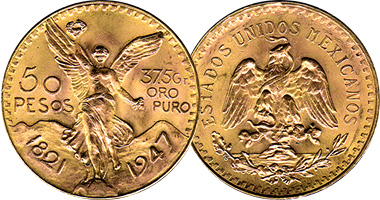
My father pushed me into computers because I was probably a natural trader which he disapproved of and I decided I did not want to become a lawyer. I was also not motivated by the education system. I suppose I began to see that those teaching did not have actual experience in what they taught. The ancient Romans had the best school system. You have the basic reading, writing, math, as well as history. However, you would decide what you wanted to do in life and left what would be called grade school to seek an apprenticeship. My father was going to take us to Europe for the summer, I believe, in 1964. I wanted to earn some money for myself and got a job in a coin/bullion store. Yes, you could buy gold before 1975 in coin form. There were countries who produced restrikes to be able to sell gold. Hungary issued coins data 1908 and Mexico kept the date 1947 on 50 pesos. Gold coins were legal for “collectors” as long as they were dated 1947 or earlier.

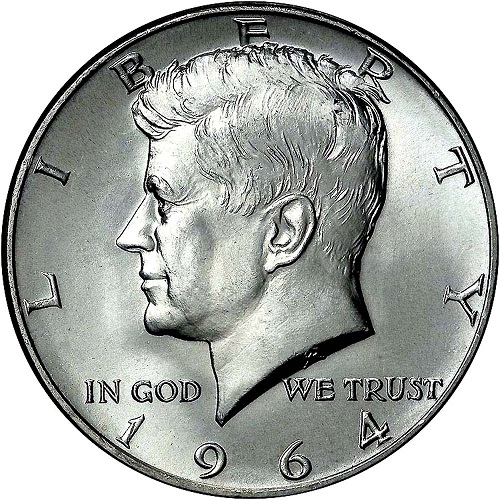
That was my apprenticeship for I began to see markets and observed the daily fluctuations. Silver was rising in price and President Kenney signed in 1963 the Executive Order 11110 on June 4th, 1963 to remove silver from the coins starting in 1965 before he was assassinated. Just about every country soon followed by 1965-1966. They two years later is when Bretton Woods began to crack in 1968 and a two-tier market in gold began – private and official. Gold begab to trade in London. It didn’t trade in the USA until 1975.

Going to Europe, we traveled the entire summer driving from Sweden down to Naples to visit Pompeii. I became the navigator but it also was a quick introduction to foreign exchange. We would have to exchange money at each border. I have a few 1964 Kennedy half-dollars. Whenever I would pull one out, whatever the bill was if $10 to $25, they just wanted that coin instead. It taught me early lessons about arbitrage. I remember telling my father we should have come to Europe with a bag of them and we would have paid for everything.

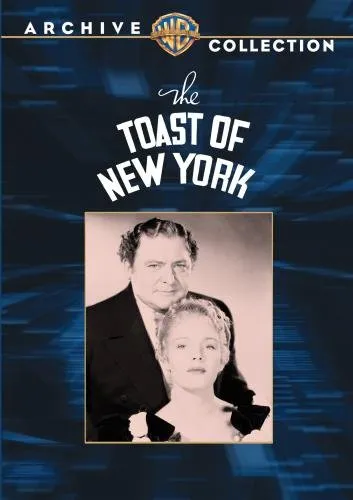
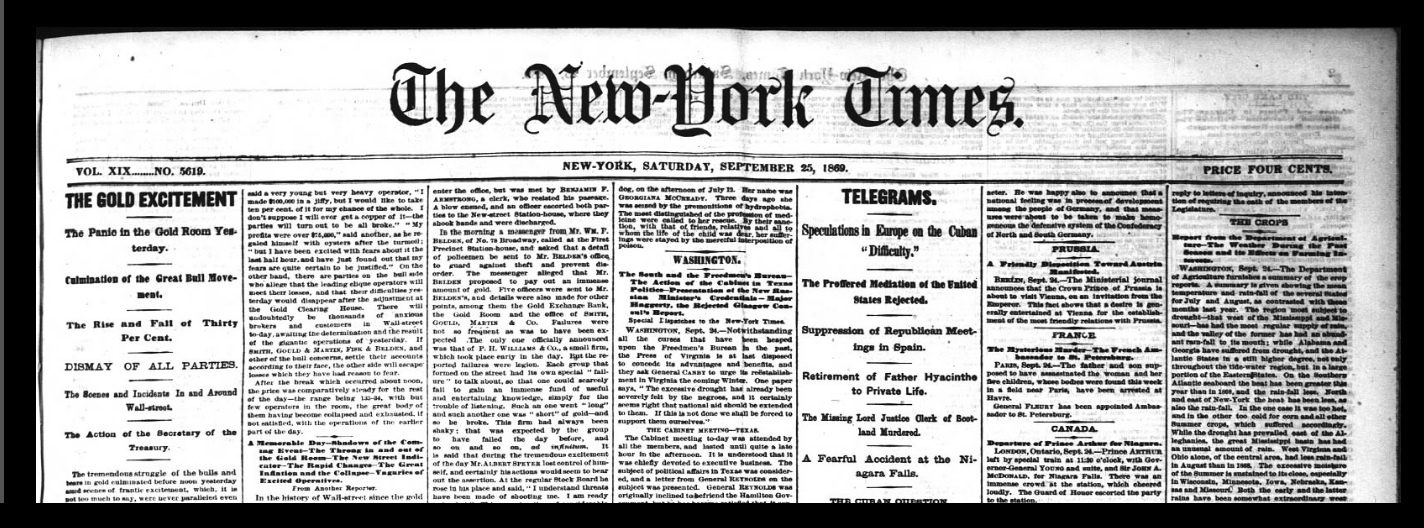
Every door we open in life leads to another. I have never been one to be afraid of trying something new. Failure is how we learn and success is our reward. Had I not gotten a job in that coin store where I bought my first Roman coin for $10, I would not be here today writing this. That is what I mean that we are the sum of our experiences. I was in history class and the high school professor brought in an old film The Toast of New York. It was a film about the Panic of 1869 and the attempt of Jim Fisk to corner the gold market. In this clip, you will see what sparked my imagination and sense of curiosity given my exposure to reality by working. Jim Fisk is at the ticker-tape, and he then turns to his girlfriend and quotes gold at $162. Now I knew from working that gold was $35. Suddenly, I was confronted with an anomaly. I was being taught that everything was linear. So how was it possible that gold could be $162 in 1869 and $35 today in the 1960s?

At first, I assumed it was just a movie. But it bothered me. There was a QUESTION in the back of my mind that would not be answered. I went to the library and looked up the price of gold in the microfilm copies of The New York Times. There it was, the quote, $162. It was real. It profoundly shook my belief system to the very foundation.

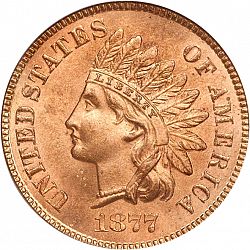
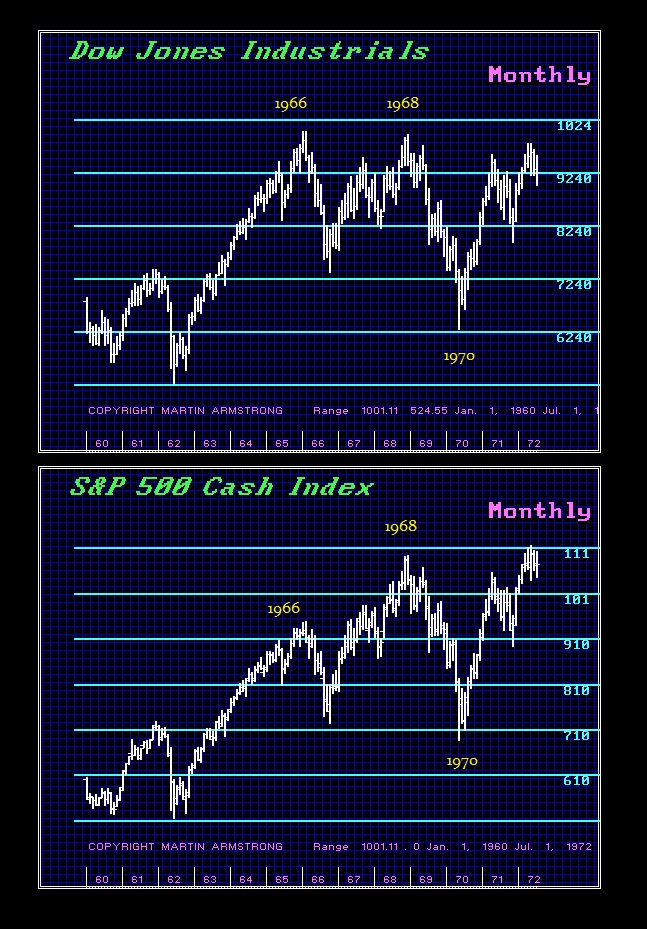
Countless questions were running around my mind like a pack of wild animals being chased. I began to ask questions in economics class. The answer was even more disturbing. Well, there was this thing that they once called the business cycle, but the government has eradicated that I was told.  It was a real bull market in everything going into 1966. Rare coins peaked. I remember an 1877 Indian Head Penny was sold for $700. It crashed by 50% in months and never saw that price again for at least a decade. Pennies were the hot thing back then. I was buying and selling and it taught me how to trade. I made so much money my father convinced me to invest in mutual funds. I did, and then the stock market collapsed and the mutual fund dropped from $54 to about $5. I asked my father if this was the way conservative people made money? My speculating in commodities was much more profitable than stocks I knew nothing about at that time.

I began to notice that there were certain things that were hot and others that were cold. The pennies were soaring but not ancient coins or many other denominations of American coins. Collectibles market crashed with the 1966 stock market crash as did mutual funds. The Crash of 1966 was followed by another in 1968 when the two-tier market in gold began with the crack in Britton Woods. The real estate crashed in 1970 as well. But even more confounding, gold actually fell BELOW $35 in 1970 – the old Bretton Woods fixed rate that everyone assume would hold.

There was no mentor back then. You had to learn from observation. Bretton Woods was collapsing and nobody knew what would even happen no less forecast what would come by 1971. I was finished with high school, but the nagging questions only multiplied. Clearly, there was some sort of a cycle. It did not matter if it was stocks, bonds, coins, collectibles, foreign exchange, or real estate. It was obvious that everything went through the same boom and bust cycle.

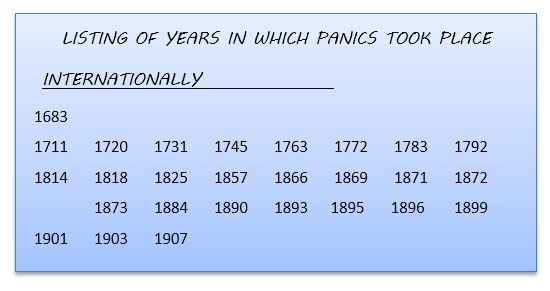
I was doing my own research now in the Firestone Library at Princeton University. I was searching old newspapers, looking for previous prices of booms and busts that I had been confronted with in gold. That’s when I stumbled upon an article that listed previous panics between 1683 and 1907. This was an old article published even before the 1929 Great Depression. That is why the list stopped with 1907. It was even pre-World War I.


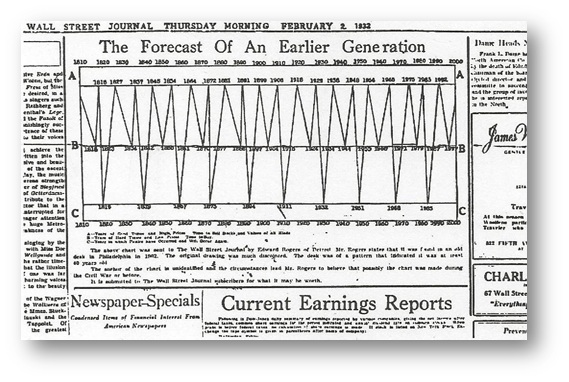
That’s when I also stumbled upon this illustration of a business cycle published on February 2nd, 1932 in The Wall Street Journal. I took the list I found that covered a span of 224 years and I divided it by the 26 events which yielded the 8.6-year average. I began to test through history which I knew well. The rest is history itself as they say (see wave structure). So no, there was nobody to talk to back then. You had to learn everything on your own. It was not until the Crash of 1974 that Paul Volcker was inspired to call it “The Rediscovery of the Business Cycle” because they did not even teach the existence of such a cycle. It was supposed to have been conquered by the government with Keynesianism. It was an age of rediscovery indeed. There was no place to go. Gold futures began in 1975, bonds 1977 and S&P 500 futures in 1985. There were no trading clubs. I was on my own.

China Venture Capital Raising now Exceed the USA


Believe it or not, Chinese start-ups have for the first time collected more venture capital than newly established US companies in the past quarter. This is reported by the South China Morning Post . Almost half (47%) of the venture capital used worldwide was spent on start-ups from the Middle Kingdom. The American start-ups were only just over a third (35%). This is part of the entire real reason why China will be surpassing the United States and take the title Financial Capital of the World. 

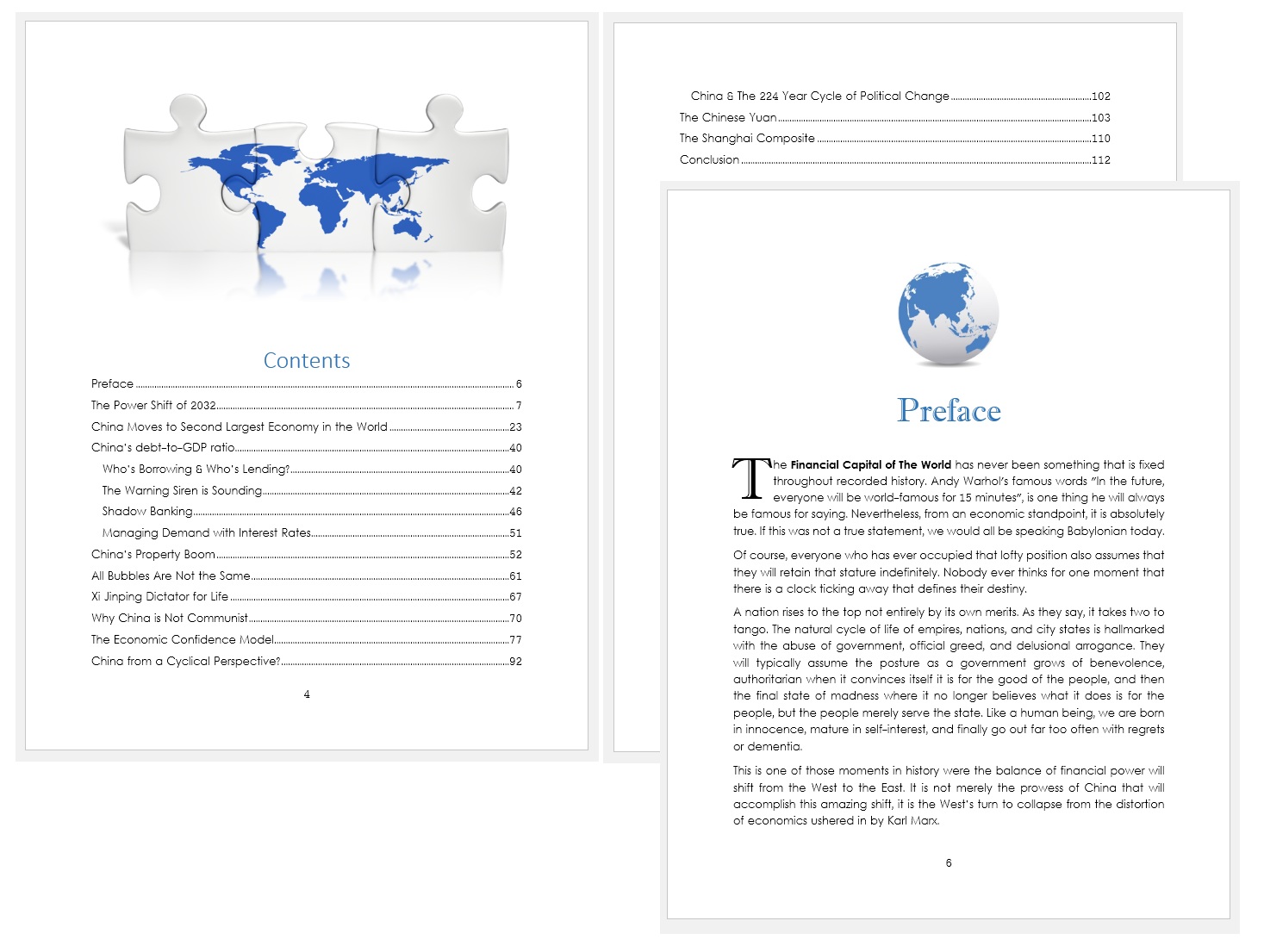
We will be releasing a printed report on this subject covering all the topics from politics to economic

Why CONFIDENCE is the Backbone of the New Monetary System


QUESTION: Mr. Armstrong; I found your recent article on inflation and contagions fascinating. Am I correct in summing it up that today because currencies are not commodity based, they rise and fall on anticipation of political events whereas under precious metals contagions took place by one country debasing compared to another?

Thank you for your reply;

EG

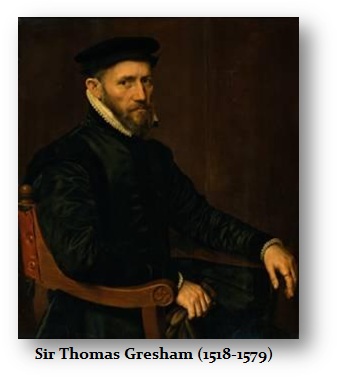
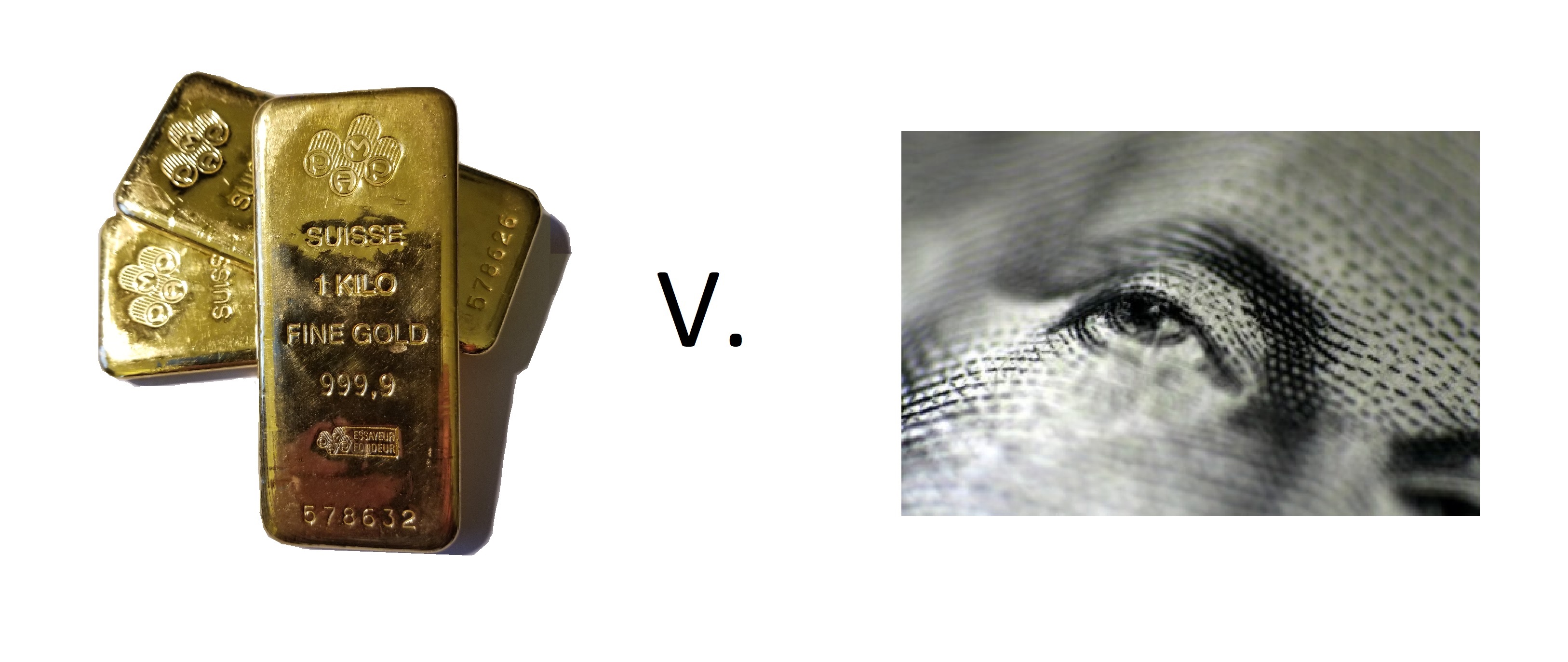
ANSWER: Correct. The monetary system has been altered far more than people understand. The question of money supply and inflation was philosophically established with Gresham’s Law. Gresham worked in Amsterdam and witnessed the response to the debasement of Henry VIII in England. His proposition that bad money drove out good money from circulation was one important observation. As countries would debase, people would hoard the old coinage, and actually, the money supply would shrink. It then requires a greater production of debased coinage to maintain an adequate money supply. This results in more debasement and unfolds in what people call hyperinflation. Yet, it is much more than simply just producing debased coinage or in modern time printing more money.

In addition to this observation, what is overlooked is frankly the driving forces behind the foreign exchange markets during the precious metal based monetary system and the modern paper monetary system (soon to be electronic based monetary system). Under a precious metal system, the coinage of one nation is compared and exchanged with others based entirely on its monetary value based on metal content. If England was at war with France, this had zero impact upon the value of their coinage as long as there was no debasement. Once debasement began, then the exchange rate between one currency and another changed.

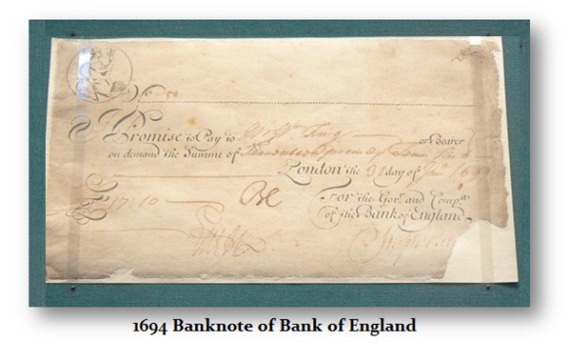
Consequently, this influence of anticipating future value based upon possible political decisions was not readily dominant and the coins of one nation were compared entirely on their metal content rather than political events. When money began to appear as paper currency, this altered the monetary system for then the value of that currency was dependent upon the “confidence” of the people in that currency. Bank runs would emerge when people lost confidence in that establishment surviving.

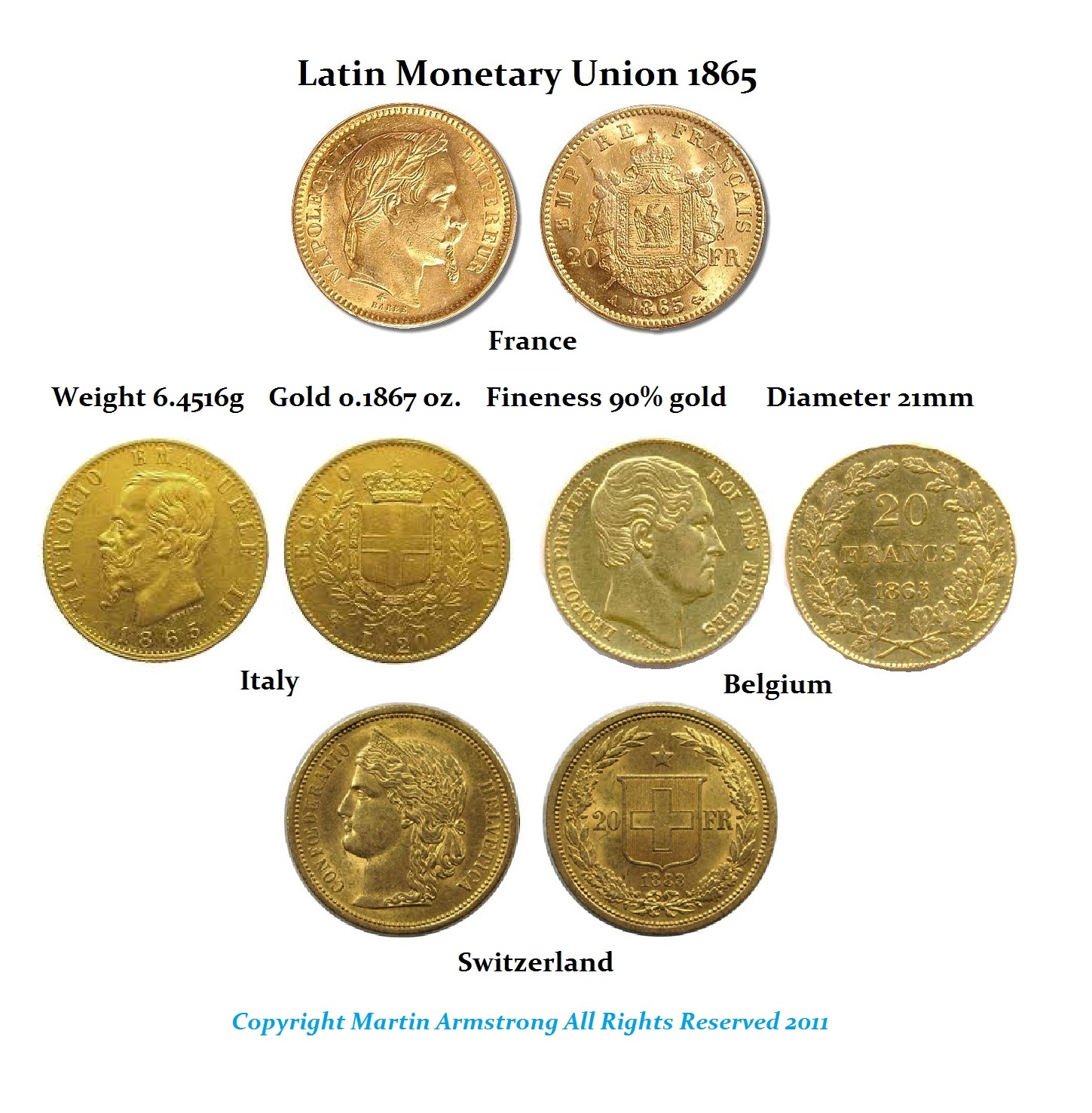
The Latin Monetary Union was an attempt to create a gold standard whereby member nations issued a standard coin of equal weight and metal content as to allow them to be interchangeable. Therefore, 20 French francs was equal to 20 Italian lire, 20 Belgian francs or 20 Swiss francs. The problem with commodity based monetary systems has always been that domestic economic trends in one country are exported as contagion to others. For example, the Spanish discovery of South American led to a massive influx of gold and silver coins which then created a contagion of inflation (lowering the purchasing value of coinage) throughout Europe.

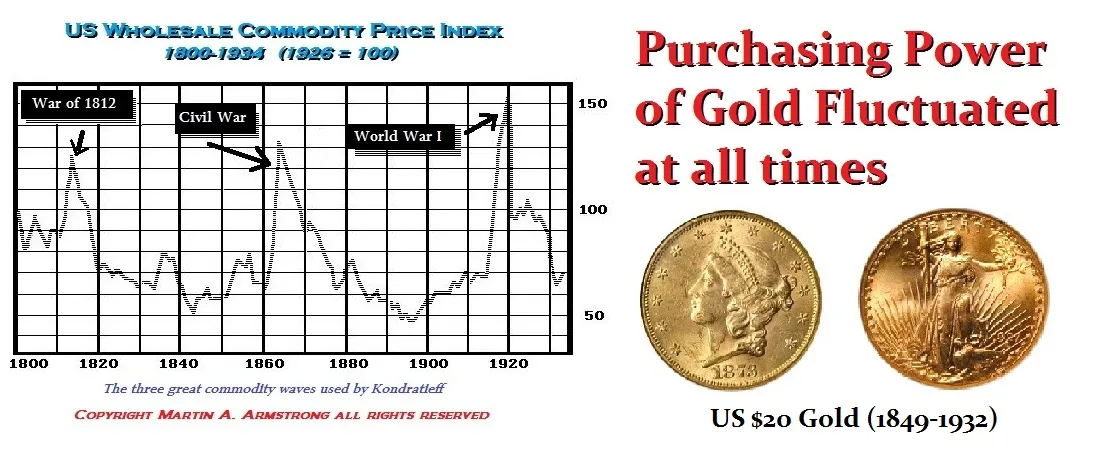
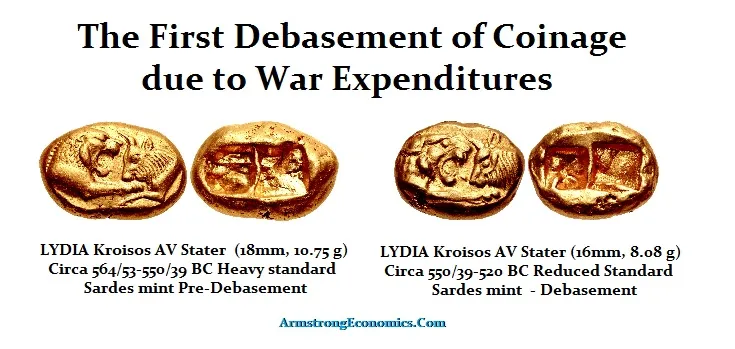
The waves of gold discoveries during the 19th century also created huge instabilities in the business cycle resulting also in waves of inflation. This is what Kondratieff studied to come up with his long wave theory. War has always resulted in waves of inflation as governments have had to increase the money supply to pay for these expenses. The US national debt exploded by $1 trillion for the Iraq war. We find from the very beginning of coinage in Lydia, its war against Cyrus the Great of Persia also resulted in a debasement of the very first coinage.

There are clearly established driving forces behind the monetary systems rise and fall. What we must come to understand is that a commodity based monetary system NEVER produced a perfect world where money was tangible and worth something. There were always waves of inflation based upon the discovery of new metal deposits. If we had a money supply that could NEVER change, then you would create deflation as the population grew. If there were only 10 gold coins and a population of 5 people, then everyone could have two coins, but one will inevitably have 4 because they invented something others wanted. Increase the population to 10, then the value of the 10 coins will rise in value meaning asset values will decline creating deflation.


Therefore, a tangible monetary system has never eliminated the business cycle and it will never bring “stability” as people preach. What has taken place is that by moving to a paper monetary system and a unit of account, which is increasingly more electronic (since paper money is less than 5% of commerce), the “confidence” factor that was once predicated upon the metal content has migrated to political events and thus we anticipate the future possibilities in the current value of any currency.


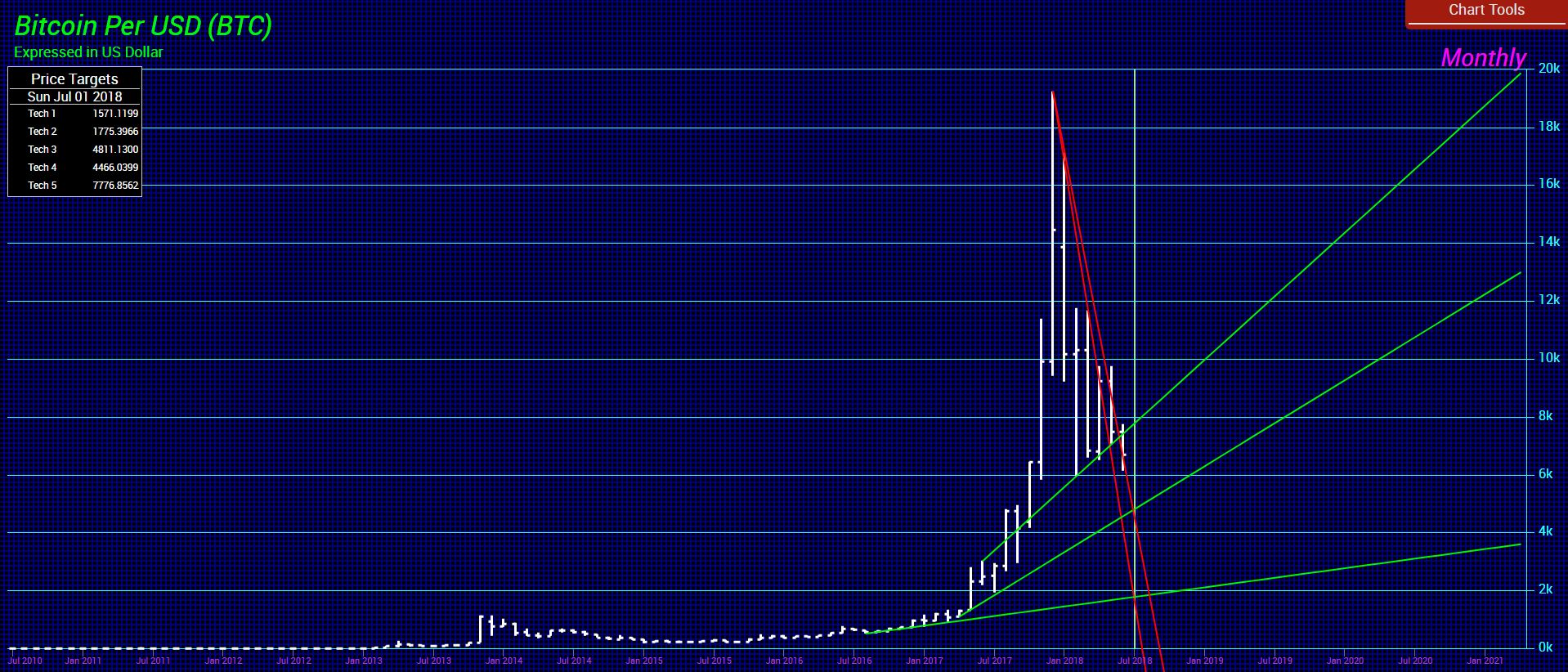
Here is a chart of Bitcoin. Once again, we do not see an instrument which is immune to the business cycle. It does not matter if we are dealing with coins, paper money, or electronic entries. Everything will still be subject to the business cycle. There will NEVER be any such exception. Moving forward, the only way to isolate contagions to some degree will be to create a basket of currencies as the international unit of account. It will still rise and fall in value. It cannot be permanently fixed.


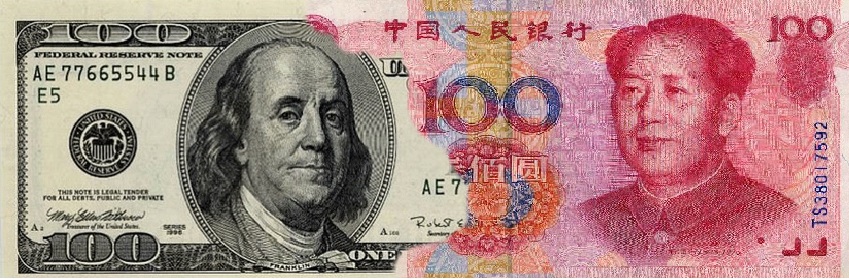
Therefore, while our computer forecasts that China will emerge as the Financial Capital of the World after 2032, those who hate the dollar and keep calling for its demise fail to understand that the more critical element that will make the China yuan a major global currency is when the “confidence” level rises among big capital and they feel “comfortable” parking their money in Chinese bonds, assets, etc. China is moving in that direction slowly. They will eventually allow their currency to be freely traded and currency controls will vanish. As that dawns, then we will see the yuan rise in global respect. They are moving to achieve that position. It just takes time.

We MUST comprehend that contagions have existed in ancient times to modern times regardless of the monetary system be it precious metals, paper, or electronic. We are all connected and the sooner we come to grips with that understanding, the sooner we can move forward in our evolution of money. Even the creation of money by banks through lending is driven by the business cycle