Hope you are doing great. Recently you may have heard Cristiano Ronaldo, the best football (what you guys wrongfully call soccer 😉 ) player in the world has left Spain’s Real Madrid and signed for Italian Juventus. There are many reasons behind this which involve broken promises of a better salary and especially lack of support on his situation with the Spanish tax department which has been very aggressive on him and other football players lately; now it has surfaced he is even planning to cancel a construction of a hotel of his own in Madrid, sources point to the tax witch hunt as the main reason for this decision as well. This way Spanish La Liga has lost one of the two best players in the world who happened to each play for one of the two biggest clubs in Spain, now the most important football match in the world has lost a lot of appealing as well.
It’s incredible how governments destroy all good things in their despair to find money, not realizing they only dig themselves deeper into trouble. Btw, Cristiano sold about 520,000 Juventus jerseys with his name only on his first day at his new club making around 52 million Euro which is half what Juventus paid for his transfer and way more than the extra 18,8 million the Spanish government is demanding from his pockets, if you add what the guy generated in publicity and TV audience one doesn’t need to be a rocket scientist to see that running him out of Spain was not a wise business decision.
JC
REPLY: Those in government NEVER make wise business decisions. All they ever do is envy people in the private sector. You generally have two types of people who work in the bureaucracy (excluding Department of Justice). They tend to be there because they are afraid of risk and seek government jobs because there is ZERO chance of getting fired. The other person is there to punish the world for their own lack of talent. Far too often they will hunt down people with money to abuse them as much as possible as a pay-back to society for their own failures. The Department of Justice is either a parking place for people who CANNOT find a real job in the REAL WORLD, or they are there to win prosecutions and then pretend to be selling their experience to get those big paying jobs. They are either looking for such a job or they enter that field and then become a politician. As Nigel Farage said: Politicians are dominated by lawyers, but they are the failed lawyers
One of the more interesting downsides of the collapse in socialism is the impact upon the elderly. The data now shows that since the 2007-2009 recession, about twice as many elderly are still working. When interest rates decline, income from savings collapsed. So while the theory was to lower interest rates to “stimulate” the economy, the central banks have discovered a dark hidden secret — demand-side economics has utterly failed. Saving for retirement has failed. Your house has failed to provide a savings account and states are broke so they keep raising property taxes. Government pensions keep demanding higher taxes to exploit the public so government unions survive. In many states, the promises handed to union workers are bankrupting everything as one of the main benefits was free healthcare for life for the members and their spouses.
Today, a record number of folks aged 85 and older are still working. Most are just trying to supplement losses from tax increases and decreased interest income. States make no accommodation for people when they retire. The property taxes keep rising and that is forcing many to sell their homes even in down markets to try to make ends meet. The youth are finding that their degrees are worthless. More than 60% cannot find employment in what they have worked to get a degree in these days. Even those with a law degree are often waiting on tables. When I was looking for office space in Florida, nearly 100% of the vacant spaces were former law firms. So 85 may be the new 65, but it appears that might be 95. Justice Kennedy is 81 so even he did not retire at 65. As the Washington Post reported, some 255,000 Americans who are 85 years old or older were working over the past 12 months.
Everything is about the economics. All politics is about the economics. The current battles waged are multinationals (economic globalists) fighting to retain their position against an uprising of previously diminished economic nationalists. Peel all the layered skin from the onion and the core issue is about money; wealth. Always the money.
As you read this, remember – the Mexican Electoral Tribunal (a political construct similar to the electoral college) has *not* formally declared AMLO President-Elect.
MEXICO CITY (Reuters) – Mexico’s incoming president Andres Manuel Lopez Obrador on Friday slammed a decision by the electoral authority to fine his party $10 million over a campaign financing breach, calling it an “act of vengeance” against his landslide victory.
[…] “This is an act of vengeance,” Lopez Obrador said outside his team’s offices in Mexico City, accusing the INE of behaving “tendentiously” and of overreaching.
“They’re acting this way because they don’t accept the new reality,” the 64-year-old said, resorting to the sort of combative tone he used in the campaign to attack the government.
[…] As a result, Lopez Obrador said he would not attend a summit meeting of leaders from the Pacific Alliance trading bloc in the western city of Puerto Vallarta next week.
He will, however, meet with Canadian Foreign Minister Chrystia Freeland when she and other ministers from the Canadian Cabinet visit Mexico City on Wednesday, he said. (read more)
Interesting dynamic. AMLO is rebuking the globalist multinationals who have constructed the Trans-Pacific Partnership (TPP), ie. Wall Street…. and holding economic court with the Canadian Socialists to discuss NAFTA.
“That’s right, crew…. Let’s go get us some pesos.”
We have been schooled over the past 40 years that Carbon Dioxide (CO2) is rising to levels never seen before on this planet and as a result the world’s average temperature is rising to levels that will, if nothing else, destroy large areas of the planet. The latest UN predictions indicate a major Catastrophe will happen by 2040 unless we do something drastic right now. This destruction will be from two factors; one, ocean levels raising and flooding all worlds coastal areas forcing the world population to higher ground; and two, even if those moves are accomplished the increased temperatures will bring massive storms that will ravage the areas not flooded. The only solution to prevent this from happening is, stop using carbon based fuels; petroleum, natural gas, and coal which, all, generate large amount of water and carbon dioxide and replacing them with wind or solar energy.
These dire projections are based on the belief that CO2 is the “primary” driver of global temperature changes; i.e. more CO2 in the atmosphere is very bad. This view is severally distorted and more likely entirely false. One can argue the reasons for these lies but it really doesn’t matter whether they are innocent or malicious in their construct; either way promoting something that is tearing up the worlds civilizations by miss allocation of resources is very misguided.
Basic facts:
The planets global temperature is directly related to the energy arriving here from our sun
That energy manifests itself in a form which we call temperature
Temperature is a measure of the amount of heat (energy) that an object holds
The planets temperature is directly related to the amount of water in the atmosphere
Without water in the atmosphere the earth would be 330 Celsius colder and frozen solid
Carbon Dioxide (CO2) is a requirement for life to exist on this planet
More Carbon Dioxide (CO2) is better as planets grow faster, less Carbon Dioxide (CO2) is bad
Carbon Dioxide (CO2) only indirectly affects temperature probably less than 5% that of water
Climate is a measure of the average of all the factors that produce a stable environment
Weather is a measure of local factors that may make large changes in daily or seasonal conditions
The planets temperature in geological times ranged from170 Celsius +/- 60 Celsius
12,000 or so years ago the last ice age ended for no reason we can determine
The first thing that needs to be done when developing a theory is to identify and define the issue or problem. The issue was that after WW II there was a large buildup of industry required to rebuild the devastated planet and that rapid uncontrolled growth created real environmental problems. Much good resulted from the original environmental emphasis such as the creation of the Environmental Protection Agency, EPA, however, others in the 90’s saw a way to gain power and wealth by exaggerating aspects of the movement. During the 80’s and the 90’s global temperatures were going up so these people saw a way to increase the size and scope of government to their advantage with a carbon tax. They picked increased levels of CO2 in the atmosphere as the strawman argument and funneled large amounts of research money into universities to study how bad the increases were.
Unfortunately, federal grant money is “directed” money so it was given to find out how bad the issue was, not to find out if it was even bad or even real. Therein was the problem as this is a very complex math and physics study in a subject that had not been previously studied in detail such that 30 years later the key variables and relationship are still not known with specify. The mistake that was made in the attempt to quantify the apparent increase in global temperatures was that increased CO2 in the planet’s atmosphere was that CO2 was the ONLY REASON the global temperatures were increasing. Unfortunately this assumption was not true as there had been several warm and cold periods in history going back thousands of years. The previous little ice age in the seventeenth century was one of these and the warming we now have, about 10 Celsius, is partly from the northern hemisphere still coming out from that cold period.
Next we’ll review some important information on temperatures and how it’s measured. We need to understand the details before we can draw conclusions. The problem, intentional or not, goes back to physics and how we show information. It’s critical that when we talk to nonscientists that information is properly displayed. And nowhere is this more important than when we are discussing global temperature in relationship to anthropogenic climate change.
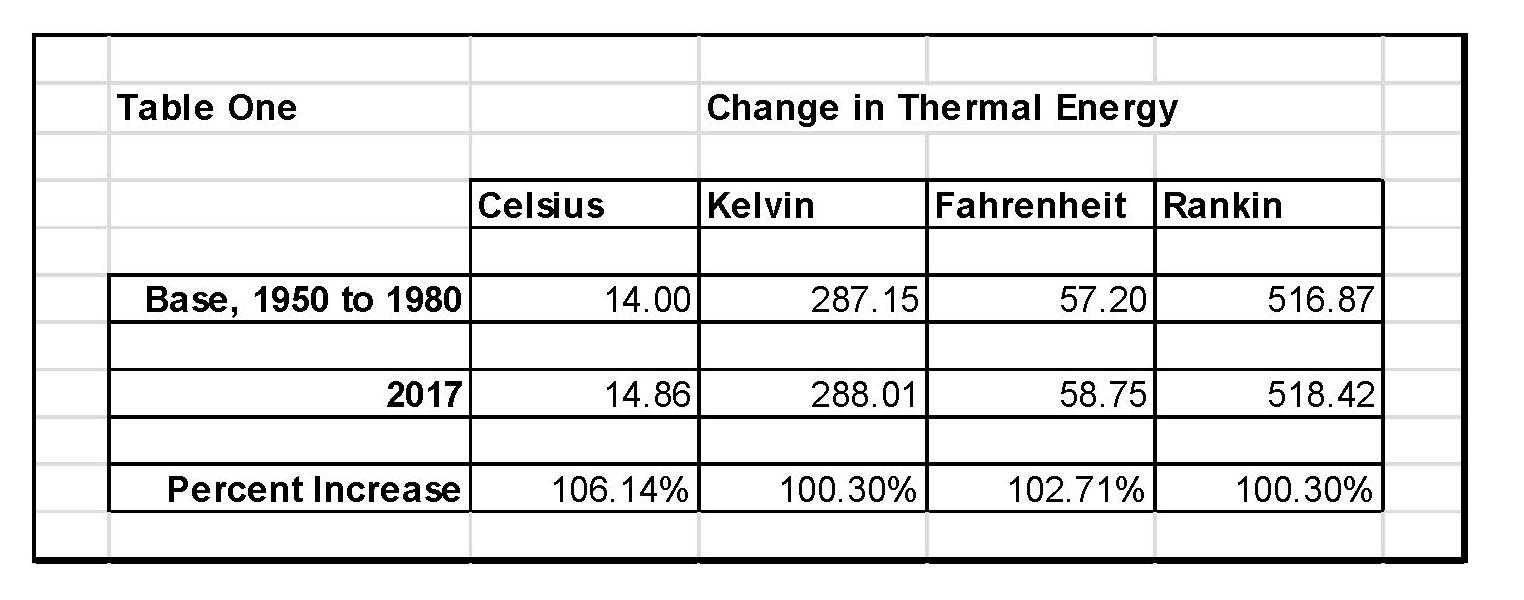
When we talk about climate (long term changes; centuries) or weather (short term changes; decades) local temperatures are going be in Celsius (C) in the EU and science, or degrees Fahrenheit (F) in America. The base temperature for the earth that NASA established is 14.00 C or 57.20 F; but these are both relative measures and do not tell us how much heat (thermal energy) is there. To know that we must use Kelvin (K) or Rankin (R) and that would be 287.150 K and 516.870 R all four of those numbers 14.00 C, 287.150 K 57.20 F, and 516.870 R are exactly the same temperature, just using a different base. But if the current temperature went from 14.00 C, to 14.860 C that is a 6.14% increase in C, an increase of 2.71% in F and an increase of .30% in K and R; so which one is real? The answer is .30% because Kelvin and Rankin are the only ones that measure the total increase in energy! Table One shows these relationships that we just discussed.
The next step is to plot Carbon Diode (CO2) from NOAA-ESRL and the estimated global temperature as published by NASS-GISS each month. As can be seen in Table One It doesn’t really matter whether we would use Kelvin and Rankin since the increase in thermal energy is exactly the same either way; but we’ll use Kelvin as that is the accepted norm in the scientific community for determining the amount thermal energy in any object especially when looking at changes in temperature or measuring the thermal energy in any object. There are other less known temperature scales that have specific purposes but they don’t really apply here in this subject.
The important thing is how much has the temperature actually gone up since we started to measure CO2 in the atmosphere? To show this graphically Chart 8 was constructed by plotting CO2 as a percent increase from when it was first measured in 1958, the Black plot, the scale is on the left and it shows CO2 going up about 30.0% from 1958 to May of 2018. That is a very large change as anyone would have to agree. Now how about temperature, well when we look at the percentage change in temperature from 1958, using Kelvin, we find that the changes in global temperature are almost un-measurable. The scale on the right side had to be expanded 5 times (the range is 20 % on the left and 4% on the right) to be able to see the plot in the same chart in any detail. The red plot, starting in 1958, shows that the thermal energy in the earth’s atmosphere increased by .30%; while CO2 has increased by 30.0% which is 100 times that of the increase in temperature. So is there really a meaningful link between them that would give as a major problem?
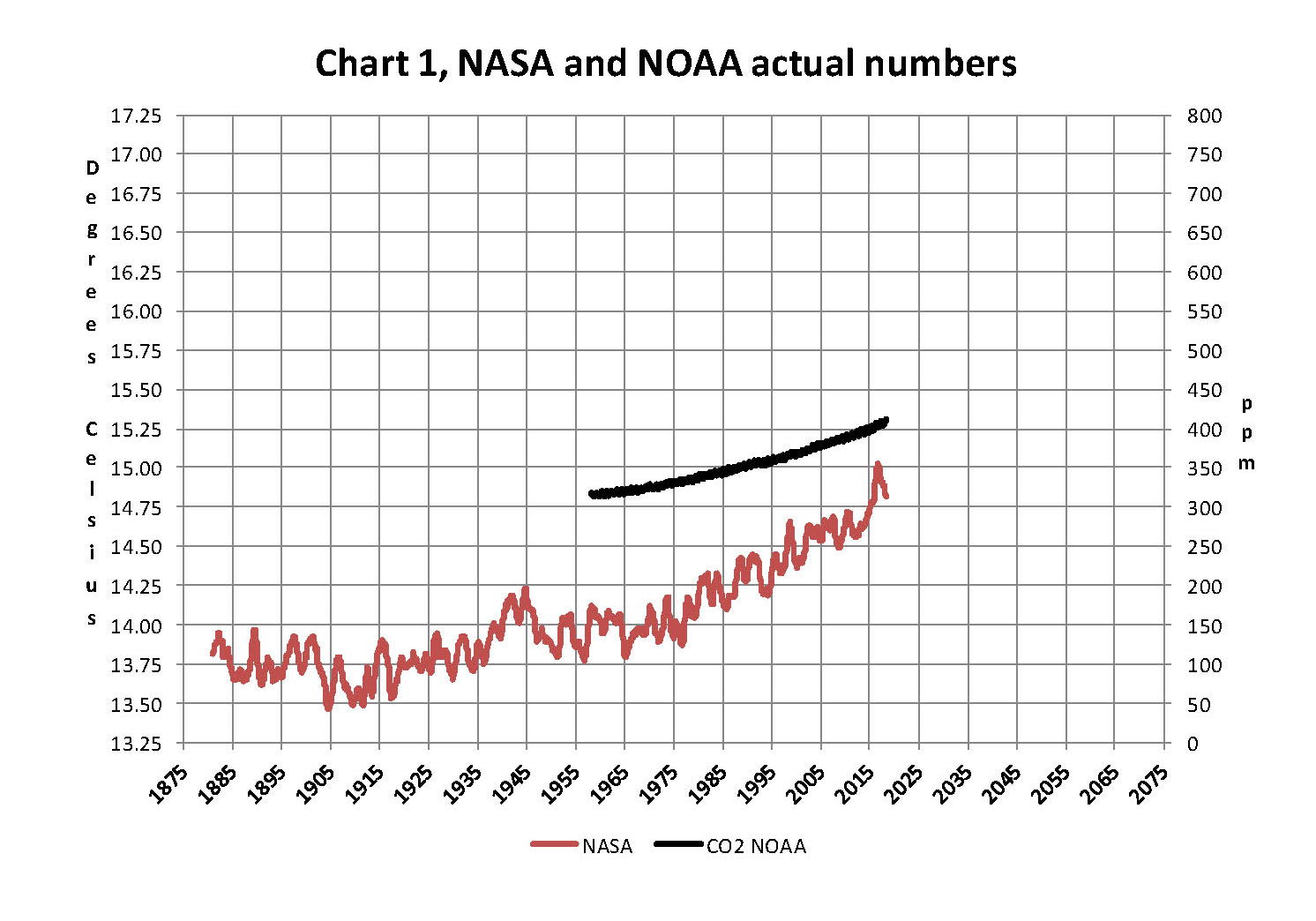
Chart 8 and all the rest of what is shown here in this paper are based on the following two data series. First NASA-GISS estimates of a global temperature shown as an anomaly (converted to degrees Celsius) as shown in their table Land Ocean Temperature Index (LOTI) and shown in Chart 1 as the red plot labeled NASA the scale for the temperatures is on the left. The NASA LOTI temperatures are shown as a 12 month moving average because of the very large monthly variations. Second NOAA-ESRL CO2 values in Parts per Million (PPM) which are shown in Chart 1 as a black plot labeled NOAA the scale for CO2 is shown on the right no change is required to the NOAA data set it is ready to use as is.
NASA published data is shown as an anomaly, but what is a temperature anomaly? An anomaly is a deviation from some base value normally an average that is fixed. There were two problems with the system that NASA picked which were number one there is no “actual” global temperature and two since climate is a variable and always has been so there cannot be a real base to measure from. NASA known for its science and engineering expertise back in the day thought it could get around these issues and created a system to do so. First they developed a computer model which took the readings from all over the planet and made adjustments to them in software which they called homogenization and came up with the estimated global temperature. Second they picked the period 1950 to 1980 (30 years) and averaged the values found in that period and came up with 14.00 degrees Celsius and make that their base. Lastly they took the calculated monthly temperature and subtracted the base from it which gave them the anomaly and multiplied the result by 100.
The problem is that both are arbitrary. Why pick 1950 to 1980 as the base period? Is there something special about that time frame? And as to a global temperature there is no such thing for many reasons like the earth faces the sun so one side is cool and onside it warm. Higher latitudes are cooler than the equator and higher elevations are cooler than lower. And finally there are many areas where there are no measurements taken. Therefore there is no one temperature only an artificial artifact solely dependent on the soundness of the software used to create that one temperature!
Chart 1 below is 100% accurate and based only on NASA and NOAA data as published.
Now that we have a base to work with we are going to add to Chart 1 three things. The first is a trend line of the growth in CO2 since that is according to the government through NASA and NOAA the entire basis for climate change. That plot is superimposed over the black plot of the actual NOAA CO2 values as the cyan line labeled as the CO2 model and one can see there is a very good fit to the actual NOAA values so there should be no dispute about its validity, and it’s historically accurate. This plot allows us to make projections to future global temperatures according to the projected level of CO2The second added item is James E. Hansen’s 1988 Scenario B data, which is the very core of the IPCC Global Climate models (GCM’s) and which was based on a CO2 sensitivity value of 3.0O Celsius per doubling of CO2. This plot is shown here in lavender and is from a presentation that Hansen showed congress in 1988 to help support the UN in setting up the International Panel on Climate Change (IPCC). This plot is labeled as Hansen Scenario B which Hansen stated was the most likely to happen based on his 1979 climate theories’. The third item is the current plot of the most likely temperature of the planet based on the growth of CO2 published by the IPCC. This plot is shown in Red and is labeled as IPCC AR5 A2 as that is the table where the data was found. This plot is a GCM computer projection of the planets temperature based on the complex relationships developed by the IPCC primarily though NASA and NOAA.
It can be seen in Chart 2 that the lavender plot and the Hansen plot are very close from 1965 to around 2000. However there isn’t a good correlation between the growth in CO2 and the increase in the planets temperature, as shown in Chart 8. The CO2 is going up in a log function and the temperature was going up until 2000 then it plateaued from 2000 until 2014 where there was a mysterious spike up of .5 degrees Celsius just in time for COP21 in Paris. Then after CP21 was over the unexplained change in temperature started to come back down. The climate doesn’t make changes like what the NSA/NOAA data shows that would be weather if it even was real.
Chart 7 looks at the period from 2010 to 2020 so we can see where a change in CO2 of only a few ppm has caused a major change in the global temperature way beyond anything previously shown in any published NASA data. There are three ovals on Chart 7 one at the top of Chart 7 which is a black oval around the CO2 levels from 2010 to 2018 and it’s very obvious that there has been very little change, maybe 3 ppm a year Then at the bottom of Chart 7 is dark red oval around the NASA global temperature levels from 2013 to 2018 and its very obvious that there has been a sudden large change, almost .50 degrees Celsius in 3 years. There has never been such a large increase in temperature from such a small increase in CO2. By contrast the previous comparable period of the last part of 2010 through 2013 Blue oval shows about the same increase per year for CO2 but global temperature decreased.
An explanation is needed here as the NASA temperature plot in Chart 7 seems to show the jump in temperature in 2016 not 2015; this is a result of the very large jump in temperature shown by NASA. Since we are using a 12 month moving average and the increase occurred in only a few months it actually shifted the curve into 2016. The raw data for December 2012 was at a low of 14.44 degrees Celsius but by February 2016 the temperature was at a record high of 15.35 degrees Celsius a .91 degree Celsius increase, Red arrow. With the global temperature over 15.0 Celsius at COP21 in December 2015 at the Paris COP21 conference the climate accord was approved and the manipulation was a success. After COP21 the Fake Warming was no longer needed so we are now seeing a downward trend developing. The current temperature for June 2018 is 14.88 degrees Celsius.
In summary, the IPCC models were designed before a true picture of the world’s climate was understood. During the 1980’s and 1990’s CO2 levels were going up and the world temperature was also going up so there appeared to be correlation and causation. The mistake that was made was looking at only a ~20 year period when the real variations in climate move in much longer cycles of centuries which can be observed in the NASA data but they were ignored for some reason. By ignoring those actual geological trends and focusing only on CO2 the Global Climate Models will be unable to correctly plot global temperatures until they are fixed. Also the temperature data from 1850 to 1880 was dropped for some reason as it showed a lower temperature than would be expected. The lower temperatures’ in that period would have shown a shorter cycle they didn’t want shown.
A decade ago when I started looking at “climate” change the first thing I did was look at geological temperature changes since it is well known that the climate is not a constant; I learned that 53 years ago in my undergrad geology and climatology courses in 1964. The next paragraph explains currently observed patterns in climate related to this subject and is historical accurate.
Ignoring the last Ice Age which ended some 11,000 years ago when a good portion of the Northern hemisphere was under miles of ice the following observations give a starting point to any serious study on the subject of climate. First, there is a clear movement up and down in global temperatures with a 1,000 some year cycle going back at least 3,000 to 4,000 years; probably because of the apsidal precession of the earth’s orbit of about 20,000 years for a complete cycle. About every 10,000 years the seasons are reversed making the winter colder and the summer warmer in the northern hemisphere. 10,000 years from now the seasons will be reversed again. Secondly, there are also 60 to 70 year cycles in the Pacific and the Atlantic oceans that are well documented. These are known as the Atlantic Multi Decadal Oscillations (AMO) in the Atlantic and as La Nina and El Nino in the Pacific. Thirdly, we also know that there are greenhouse gases such as carbon dioxide that can affect global temperatures. Lastly the National Academy of Sciences (NAS) estimated that carbon dioxide had a doubling rate of 3.0O Celsius plus or minus 1.5O Celsius in 1979 when there were only two studies available and one for sure and maybe both were not peer reviewed.
The result of looking objectively at the three possible sources of global temperature changes was a series of equations based on these observations that when added together produced a sinusoidal curve that seemed to follow NASA published temperatures very closely when first developed in 2007, and modified a few years later when it was found the short and long cycles were related to multiples of Pi. Since this curve was based on observed temperature patterns it was called a Pattern Climate Model (PCM) which has been described in previous papers and posts on my blog and since it is generated by “equations” many assume it is some form of least squares curve fitting, which it is not. It does seem to be related to ocean currents where the bulk of the planet’s surface heat is stored and cloud formation.
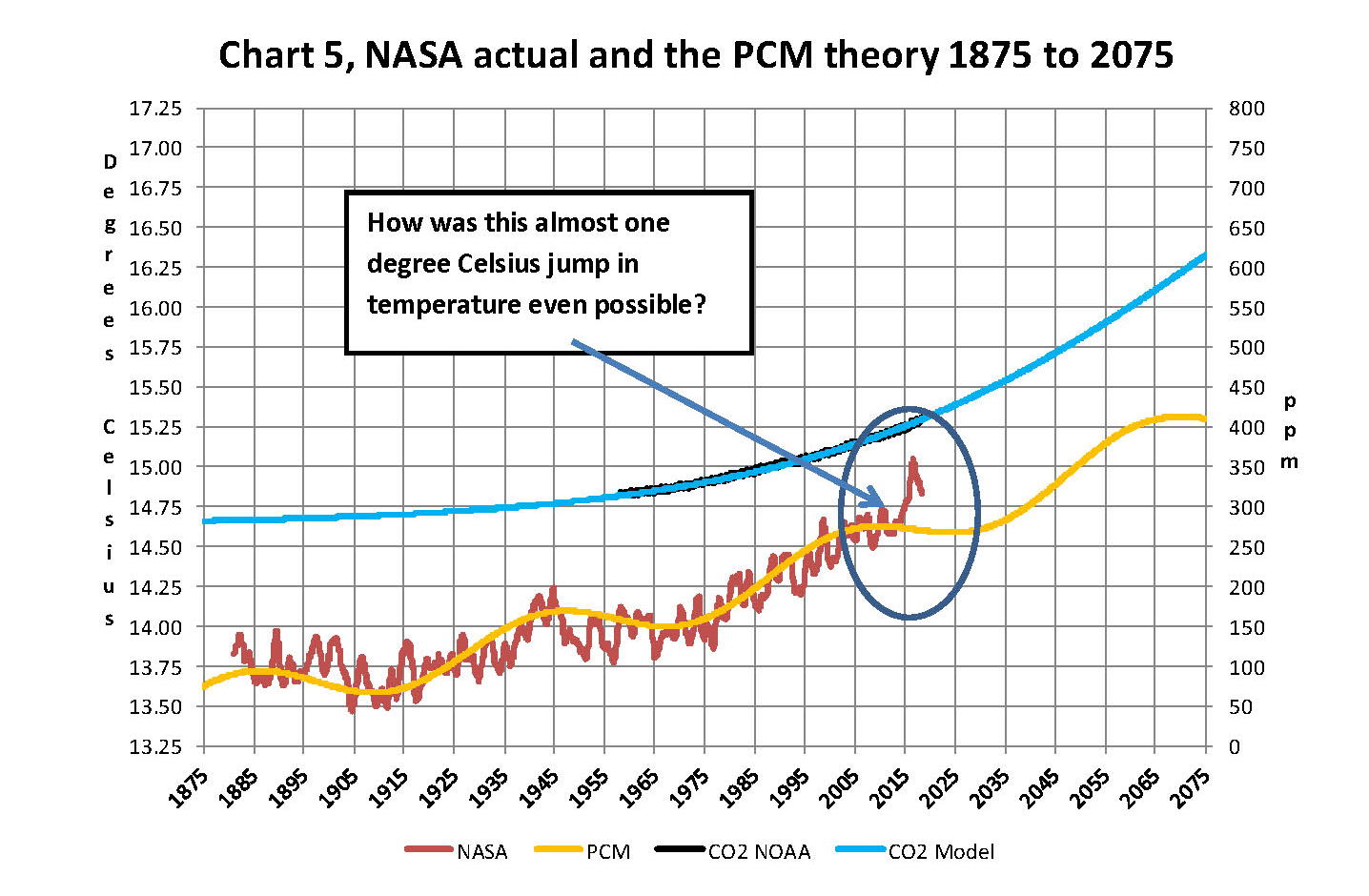
Chart 5 shows the PCM a composite of two cycles and CO2. There is a long trend, 1036.7 years with an up and down of 1.65O Celsius (.00396O C per year) we in the up portion of that trend. Then there is a 69.1 year cycle that moves the trend line up and then down a total of 0.29O Celsius and we are now in the downward portion of that trend (-.01491O C per year), which will continue until around ~2035. Lastly, there is CO2 currently adding about .0079O Celsius per year so together they all basically wash out at -.0039O C per year, which matches the current holding pattern we were experiencing until 2014. After about 2035 the short cycle will have bottomed and turn up and all three will be on the upswing again duplicating what was observed in the 1980’s. Note: the values shown here are only representative from what is in the model.
When using a 12 month running average for global temperatures up until 2014 the PCM model was within +/- .01 degrees of what NASA was publishing in their LOTI table since the early 1960’s as shown in Chart 5. Further the back projection of the PCM plot matched historical records and global temperatures going back past the time of Christ. It should also be considered that geologically CO2 levels have reached levels many times that of the current 400 ppm without destroying the planet so the current hysteria over the current very small numbers can only be explained by political science not real science.
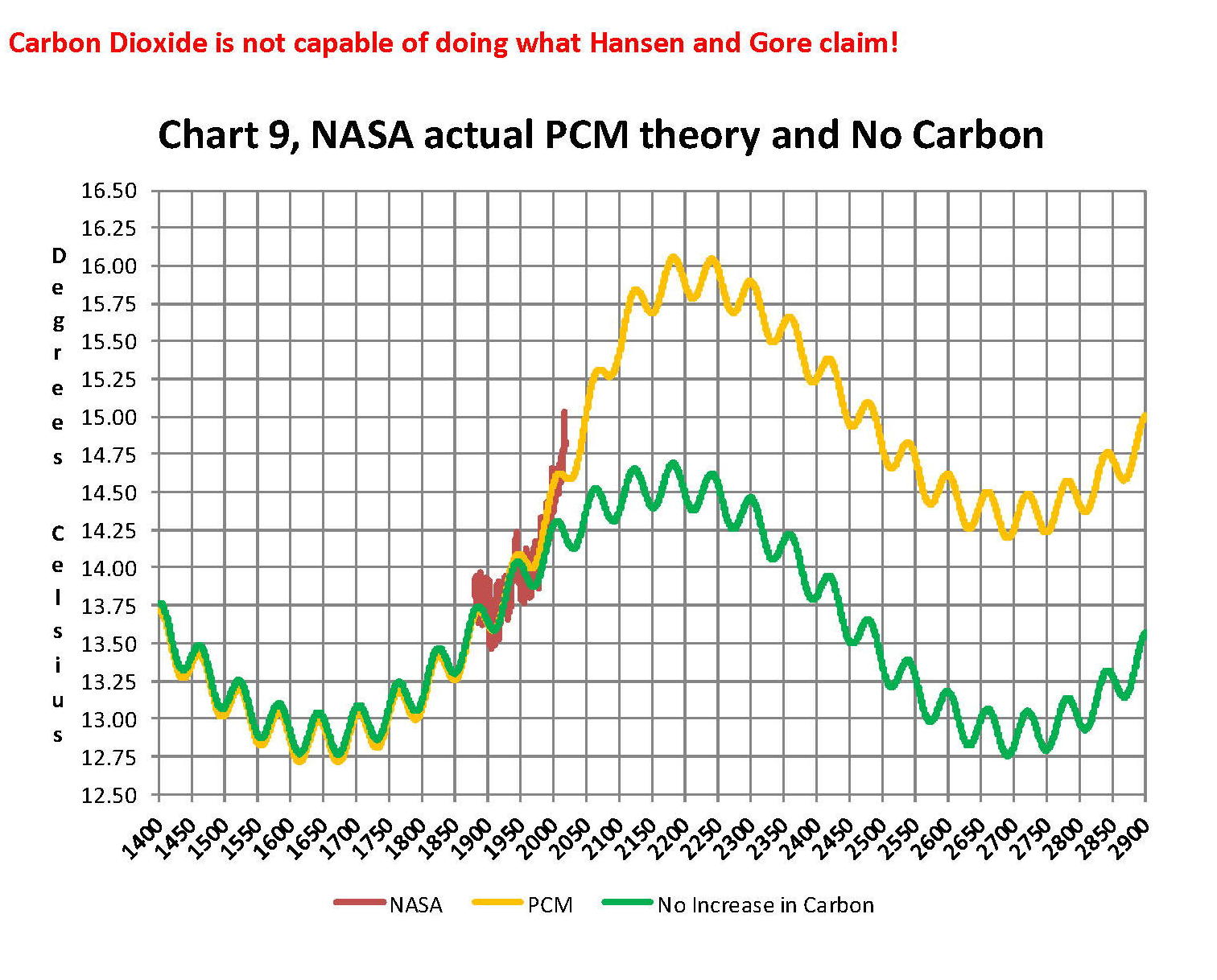
Lastly, Chart 9 shows what a plot of the PCM model, in yellow, would look like from the year 1400 to the year 2900. This plot matches reasonably well with recorded history and fits the current NASA-GISS table LOTI data, in red, very closely, despite homogenization. I do understand that this PCM model is not based on physics but it is also not some statistical curve fitting. It’s based on two observed reoccurring patterns in the climate and a factor for CO2. These patterns can be modeled and when they are, you get a plot that works better than any of the IPCC’s GCM’s. If the real conditions that create these patterns do not change and CO2 continues to increase to 800 ppm or even 1000 ppm then this model will work well into the foreseeable future. 150 years from now global temperatures will peak at around 15.750 to 16.000 C and then they will be on the downside of the long cycle for the next ~500 years.
The overall effect of CO2 reaching levels of 1000 ppm or even higher will be about 1.50 C which is about the same as that of the long cycle. The Green plot on Chart 9 shows the observed pattern with no change in CO2 from the pre-industrial era of ~280 ppm. CO2 cannot affect global temperatures more than 1.500 C +/- no matter what the ppm level of CO2 is. The reason being that the CO2 sensitivity value is not 3.00 per doubling of CO2but less than 1.00 C per doubling of CO2as shown in more current scientific work and it’s a logistics curve not a log curve.
The purpose of this post is to make people aware of the errors inherent in the IPCC models so that they can be corrected.
The Obama administration’s “need” for a binding UN climate treaty with mandated CO2 reductions in Europe and America was achieved as predicted at the COP12 conference in Paris in December 2015. To support this endeavor NASA was forced to show ever increasing global temperatures that will make less and less sense based on observations and satellite data which will all be dismissed or ignored. Within a few years the manipulation will be obvious even to those without knowledge in the subject, but by then it will be to late the damage to the reputation of science will have been done. Fortunately President Trump pulled us out of the bad agreement.
In closing keep this in mind. The current panic generated by the government using political science is that the current global temperature of around 15.0O Celsius is an increase of 7.14% from the 1960’s when the global temperature was 14.0O Celsius; and that does seem like a lot. However those views would be in error as the actual increase in thermal energy, as measured by temperature, would be only .35% because we must use Kelvin not Celsius when working with heat energy. When we use kelvin the temperature goes from 287.15O K to 288.15O K which is only .35% not 7.14% about 1/20 of what is implied by the IPCC. What the IPCC shows is not technically wrong as much as it is extremely misleading to anyone without a science background.
Sir Karl Raimund Popper (28 July 1902 – 17 September 1994) was an Austrian and British philosopher and a professor at the London School of Economics. He is considered one of the most influential philosophers for science of the 20th century, and he also wrote extensively on social and political philosophy. The following quotes of his apply to this subject.
If we are uncritical we shall always find what we want: we shall look for, and find, confirmations, and we shall look away from, and not see, whatever might be dangerous to our pet theories.
Whenever a theory appears to you as the only possible one, take this as a sign that you have neither understood the theory nor the problem which it was intended to solve.
… (S)cience is one of the very few human activities — perhaps the only one — in which errors are systematically criticized and fairly often, in time, corrected.
President Trump gave CNBC anchor Joe Kernen an extensive interview on Thursday just outside the Oval Office at the White House. You probably have not seen this interview, because it does not support the media narrative du jour; this interview destroys the narrative(s).
When you watch the interview you’ll see why the media made the decision not to sound-bite-it throughout broadcast, headlines and column inches. In fact, you’ll probably understand why CNBC didn’t upload the interview content until today.
The conversation with President Trump touched on the state of the U.S. economy; America’s trade reset; the timing of the trade reset juxtaposed against the current value of the U.S. stock market; the president’s news-making remarks about the Federal Reserve’s ongoing interest-rate hikes; and pragmatic insight behind the meeting with Vladimir Putin. Watch it, you’ll see:
A lot of people have emailed in about the outrageous taxes being imposed on those who own boats. A number of people are complaining about California that they sail there and dock in San Diego briefly and go visit Mexico and then get a property tax for having a boat even when they are not citizens of California. This is really getting insane. A number of cities are doing this and they shift the burden to you to object. I have mentioned before where I was given a parking ticket in a private lot in front of Starbucks in New Jersey. Of course, it was illegal. They also know you will not take off a day from work to go to court to object and a $50 fine is not worth hiring a lawyer. So what happens? You pay the fine. They are doing this to boaters and they order the marinas to report the boats docketed there and they treat them as if you are a citizen and just send you a bill for $900 or more
Yesterday U.S. Commerce Secretary Wilbur Ross sat down for a discussion about the White House workforce development program that aims to bridge the skills gap for American workers. Secretary Ross discusses the initiative and also shares insight to President Trump’s trade agenda.
The important and interesting trade discussion begins at 04:15 and Secretary Ross outlines his initial sense of contact with Mexican President-elect AMLO on NAFTA:
.
On the “trade-war” meme, I have to laugh at the anonymous interest [07:25] who worries the Wall Street equity markets could lose value at a rate of 23%. Why laugh? Here’s my reference point – Yes “equity markets”, ie. “investment markets” will drop while the U.S. economy expands…. Yes. It will happen. Here’s why: Main Street -vs- Wall Street.
Amid ongoing maneuvers by China and Russia to influence the activity of North Korea; and amid both Chinese and Russian interests in violating ongoing trade and economic sanctions against North Korea; Secretary of State Mike Pompeo and U.N. Ambassador Nikki Haley meet with the U.N. Security Council.
.
[Transcript] SECRETARY POMPEO: Good afternoon, everyone. First I want to commend my good friend Ambassador Haley and her excellent team here at the United Nations. Her leadership in advancing American interest on North Korea and many other issues has been evident here this morning, and she’s got a great team behind her helping. So thank you, Nikki.
The main reason I came here today was to meet with members of the UN Security Council – South Korea and Japan as well – to convey details of my work on the trip to North Korea earlier this month and the progress that was made there. I also had the opportunity to meet with UN Secretary-General Guterres to discuss the topic and other topics as well.
The countries of the Security Council are united on the need for final, fully verified denuclearization of North Korea, as agreed to by Chairman Kim. Strict enforcement of sanctions is critical to our achieving this goal.
Members of the UN Security Council, and by extension all UN member-states, have unanimously agreed to fully enforce sanctions on North Korea, and we expect them to continue to honor those commitments. When sanctions are not enforced, the prospects for the successful denuclearization are diminished. Right now, North Korea is illegally smuggling petroleum products into the country at a level that far exceeds the quotas established by the United Nations. These illegal ship-to-ship transfers are the most prominent means by which this is happening.
These transfers happened at least 89 times in the first five months of this year and they continue to occur. The United States reminds every UN member-state of its responsibility to stop illegal ship-to-ship transfers, and we urge them to step up their enforcement efforts as well.
We must also crack down on other forms of sanctions evasion, including the smuggling of coal by sea, smuggling by overland borders, and the presence of North Korean guest workers in certain countries. North Korean cyber thefts and other criminal activities are also generating significant revenues for the regime, and they must be stopped.
President Trump remains upbeat about the prospects of denuclearization of North Korea. So do I, as progress is happening. It is the Trump administration’s hope that one day the DPRK could be in our midst here at the United Nations – not as a pariah, but as a friend. Imagine UN Security Council meetings in which the DPRK nuclear and missile programs were not the agenda time and time again. We’ll be able to focus our energy on so many urgent problems that face our world.
I believe this reality is possible, and so does President Trump. But it will take full enforcement of sanctions for us to get there. It will also take Chairman Kim following through on his personal commitments that he made to President Trump in Singapore. The path ahead is not easy; it will take time. But our hopes for a safer world for all of us and a brighter future for North Korea remains our objective, and that hope endures.
Thank you. Ambassador Haley.
AMBASSADOR HALEY: Thank you so much. And I’m very grateful to my friend, Secretary Pompeo, for coming out and meeting with the Security Council today.
This is what we know. Eighteen months ago when I came in, our biggest concern was North Korea. Everyone was wondering when that new test was going to happen, everyone was wondering when the new threat would occur, and the entire international community knew something had to happen. It was a herculean task by the Security Council to pass three massive sanctions packages, getting rid of all exports, 90 percent of their trade, 30 percent of their oil, expelling all labor workers and scheduling that down, making sure all joint ventures stopped. All of that combined with the international community coming together and expelling diplomats and stopping communication, and with the President’s tough stance, all of that was really the combination that brought North Korea to the table.
Now, North Korea and the U.S. have started to have talks. And as those things are happening, we and the Security Council and the international community have to support those talks. And the best way we can support those talks is to not loosen the sanctions. And what we have been seeing is certain countries wanting to do waivers, certain countries saying, “Let’s lift sanctions,” certain countries wanting to do more. And what – I appreciate Secretary Pompeo coming up and what we continue to reiterate is we can’t do one thing until we see North Korea respond to their promise to denuclearize. We have to see some sort of action. And so until that action happens, the Security Council’s going to hold tight, the international community – we ask you to hold tight as we go forward.
The problem that we are encountering is that some of our friends have decided that they want to go around the rules. You saw that there was violations of the oil ban. We have, as Secretary Pompeo said, seen 89 times where that has happened. We have photographs of proof of ship-to-ship transfers. And our friends, what we decided was let’s come together and let’s make sure that this stops. So the U.S. put yesterday a halt to all additional refined petroleum shipments to North Korea. China and Russia blocked it.
Now for China and Russia to block it, what are they telling us? Are they telling us that they want to continue supplying this oil? They claim they need more information. We don’t need any more information. The sanctions committee has what it needs. We all know it’s going forward. We put pressure today on China and Russia to abide and be good helpers through this situation and to help us continue with denuclearization.
And so I think this was a day of very frank talk between the Secretary, the foreign minister of South Korea, our Japanese friends as well, as well as the Security Council to say: If we want to see success, we have to see a response from Chairman Kim, and we have to continue to hold the line until that happens. And so very successful day, again, promising that the Security Council has remained united and continuing to put pressure on our members to not fall through on that process. Thank you.
QUESTION: Mr. Secretary —
MS NAUERT: Three quick – three quick questions. Rich Edson, Fox News.
QUESTION: Thank you. Mr. Secretary, UN Ambassador Haley mentioned that Russia isn’t being all that helpful to sanctions enforcement. The President mentioned after his meeting with President Putin that President Putin was going to help on North Korea. Is Russia reneging on an agreement that it made with the President? And is – what else did the two presidents agree to when they met?
SECRETARY POMPEO: So enforcement of sanctions is a continuing process. There are many places where the Russians have been helpful. Certainly since the very beginning of the time of the UN Security resolutions the Russians have done many things to enforce these sanctions, and we’re deeply appreciative of that. What we need now, though, is we need to continue that. We need to make sure that the world doesn’t begin to see this – this is not an American demand for the North Koreans to denuclearize; it is the world’s demand and we need the world to continue to participate.
And so where we find issues where any country, whether it’s Russia or another one, not doing their part to enforce it, we’re going to make sure that we provide the information to them so they can all see it and the world can see it, and we’re going to demand that every country in the world do their part.
MS NAUERT: Kylie from CBS News.
QUESTION: Just following up, Mr. Secretary, on a question about Russia, because that’s kind of what everyone in Washington is talking about today. Why is it a good idea for the President to invite Vladimir Putin to the White House? What does the U.S. have to gain from that visit?
SECRETARY POMPEO: Yeah, I’m happy that the two leaders of two very important countries are continuing to meet. If that meeting takes place in Washington, I think it’s all to the good. Those conversations are incredibly important. We have our senior leaders meeting all across the world with people where we have deep disagreements with. It is incredibly valuable to the people of the United States of America that President Putin and President Trump continue to engage in dialogue to resolve the difficult issues that our countries face between each other. I think this makes enormous sense, and I’m very hopeful that that meeting will take place this fall.
MS NAUERT: And final question, Michelle from Reuters.
QUESTION: Thank you. Mr. Secretary, what concrete steps do you need to see North Korea take now to show that they are committed to denuclearization? And on Russia, the Russian defense ministry said this morning that they’ve sent proposals to Washington about the return of millions of Syrian refugees. They said it’s based on an agreement that was reached by President Putin and President Trump. Have you seen those proposals, and what is this agreement that they’ve reached?
SECRETARY POMPEO: So I’ll take the second one first. So lots of discussion taking place. There was a discussion between President Trump and President Putin about the resolution in Syria and how we might get the refugees back. The President shared with me the conversations that they’d had. It is important to the world that at the right time, through a voluntary mechanism, these refugees are able to return to their home country. It’s what we’ve all been working on. It’s what the UN has been working on with Staffan de Mistura working on that very same problem set. And President Putin and President Trump did discuss that. There’s lots of work to do to figure out how to implement that, but the United States certainly wants to be part of help achieving that resolution in Syria, make no mistake about it.
Your first question was about what we need to see. It’s really pretty straightforward, right? And it’s not my – it’s not my description of what needs to take place. Chairman Kim made a promise. Chairman Kim told not only President Trump, but President Moon that he was prepared to denuclearize. The scope and scale of that is agreed to. The North Koreans understand what that means. There’s no mistake about what the scope of denuclearization looks like.
So what do we need to see? We need to see Chairman Kim do what he promised the world he would do. It’s not very fancy, but it’s the truth.
[White House] The economy has come roaring back to life under President Trump. In May, unemployment fell to 3.8 percent—its lowest level in nearly 50 years. Optimism among employers, particularly manufacturers and small businesses, has reached historic highs in the 6 months since tax reform became law.
Many economists expect the winning streak to continue, predicting second quarter GDP growth to exceed 4 percent. This high-energy growth environment presents both a challenge and an opportunity. The challenge is that companies must find more workers with specific skill sets to fill an increasing number of open jobs. The opportunity is that with more affordable, relevant training, many American workers will now have the chance to move into better jobs that deliver bigger paychecks:
President Trump promised to make Government work for ordinary Americans, and support for workforce training is key to that vision. “For decades the government has had more than 40 workforce-training programs in more than a dozen agencies, and too many have produced meager results,” Advisor to the President Ivanka Trump wrote this week.
It’s time to fix that. In its first 500 days, the Trump Administration has already taken action to expand apprenticeships; increase access to high-quality Science, Technology, Engineering, and Math (STEM) education for K–12 students; and encourage companies to invest more of what they earn in American workers and American production.
Now, President Trump has signed an Executive Order to establish the National Council for the American Worker. Comprised of senior Administration officials, the Council is charged with developing a National strategy for training and retraining the workers needed across high-demand industries. The group will convene voices from the public, private, education, labor, and not-for-profit sectors to enhance employment opportunities for Americans of all ages.
Most important, they will focus on getting results. That task begins by asking companies and trade groups to sign a new Pledge to America’s Workers.
Today, more than 20 companies and associations were the first to sign that pledge at the White House. They committed to creating new opportunities over the next five years for American students and workers, including through apprenticeships and work-based learning, continuing education, on-the-job training, and reskilling.
“By signing the Pledge to America’s Workers, these great companies . . . are affirming their commitment to train American workers for American jobs,” President Trump said. “Because America’s strength, America’s heart, and America’s soul is found in our people.”
One of the initial areas of focus for the Council will be finding ways to increase access to available job data, including data on which regions offer the most opportunities. Unlike piling burdensome regulations on employers, this focus on transparency helps the economy, allowing students and workers alike to make informed decisions about education, job selection, and career paths.
Growing America’s workforce is an important goal. To help achieve it, the Council will develop a national campaign to raise awareness of workforce issues, such as the urgency of the skills crisis and the importance of STEM education. It will also create a plan for recognizing companies that demonstrate excellence in workplace education, retraining, and workforce investment. (link)
Action oriented. Yesterday President Trump introduced the workforce initiative to develop American workers to support the dynamic economic resurgence. A group of private employers signed a pledge to help train and develop over 3.8 million workers for the 21st century American economy.
However, no plan, no pledge and no promise, can succeed without: 1) establishing clear goals; 2) evaluating progress; and 3) measuring the effectiveness in the results. President Trump introduces the results-oriented business action plan to the public sector.
.
[Executive Order] By the authority vested in me as President by the Constitution and the laws of the United States of America, and in order to provide a coordinated process for developing a national strategy to ensure that America’s students and workers have access to affordable, relevant, and innovative education and job training that will equip them to compete and win in the global economy, and for monitoring the implementation of that strategy, it is hereby ordered as follows:
♦Section 1. Purpose. Our Nation is facing a skills crisis. There are currently more than 6.7 million unfilled jobs in the United States, and American workers, who are our country’s most valuable resource, need the skills training to fill them. At the same time, the economy is changing at a rapid pace because of the technology, automation, and artificial intelligence that is shaping many industries, from manufacturing to healthcare to retail.
For too long, our country’s education and job training programs have prepared Americans for the economy of the past. The rapidly changing digital economy requires the United States to view education and training as encompassing more than a single period of time in a traditional classroom. We need to prepare Americans for the 21st century economy and the emerging industries of the future.
We must foster an environment of lifelong learning and skills-based training, and cultivate a demand-driven approach to workforce development. My Administration will champion effective, results-driven education and training so that American students and workers can obtain the skills they need to succeed in the jobs of today and of the future.
♦Sec. 2. Policy. It shall be the policy of the executive branch to work with private employers, educational institutions, labor unions, other non-profit organizations, and State, territorial, tribal, and local governments to update and reshape our education and job training landscape so that it better meets the needs of American students, workers, and businesses.
♦Sec. 3. Establishment and Composition of the President’s National Council for the American Worker. (a) There is hereby established the President’s National Council for the American Worker (Council), co-chaired by the Secretary of Commerce, the Secretary of Labor, the Assistant to the President for Domestic Policy, and the Advisor to the President overseeing the Office of Economic Initiatives (Co-Chairs).
(b) In addition to the Co-Chairs, the Council shall include the following officials, or their designees:
(i) the Secretary of the Treasury;
(ii) the Secretary of Education;
(iii) the Secretary of Veterans Affairs;
(iv) the Director of the Office of Management and Budget;
(v) the Administrator of the Small Business Administration;
(vi) the Assistant to the President and Deputy Chief of Staff for Policy Coordination;
(vii) the Director of the National Economic Council;
(viii) the Chairman of the Council of Economic Advisers;
(ix) the Director of the National Science Foundation; and
(x) the Director of the Office of Science and Technology Policy.
♦Sec. 4. Additional Invitees. As appropriate and consistent with applicable law, the Co-Chairs may, from time to time, invite the heads of other executive departments and agencies (agencies), or other senior officials in the White House Office, to attend meetings of the Council.
♦Sec. 5. Council Meetings. The Co-Chairs shall convene meetings of the Council at least once per quarter.
♦Sec. 6. Functions of the Council.
(a) The Council shall develop recommendations for the President on policy and strategy related to the American workforce, and perform such other duties as the President may from time to time prescribe.
(b) The Council shall develop recommendations for:
(i) a national strategy for empowering American workers, which shall include recommendations on how the Federal Government can work with private employers, educational institutions, labor unions, other non-profit organizations, and State, territorial, tribal, and local governments to create and promote workforce development strategies that provide evidence-based, affordable education and skills-based training for youth and adults to prepare them for the jobs of today and of the future;
(ii) fostering close coordination, cooperation, and information exchange among the Federal Government, private employers, educational institutions, labor unions, other non-profit organizations, and State, territorial, tribal, and local governments as related to issues concerning the education and training of Americans; and
(iii) working with agencies to foster consistency in implementing policies and actions developed under this order.
♦Sec. 7. Initial Tasks of Council. Within 180 days of the date of this order, the Council shall:
(a) develop a national campaign to raise awareness of matters considered by the Council, such as the urgency of the skills crisis; the importance of science, technology, engineering, and mathematics education; the creation of new industries and job opportunities spurred by emerging technologies, such as artificial intelligence; the nature of many careers in the trades and manufacturing; and the need for companies to invest in the training and re-training of their workers and more clearly define the skills and competencies that jobs require;
(b) develop a plan for recognizing companies that demonstrate excellence in workplace education, training, and re‑training policies and investments, in order to galvanize industries to identify and adopt best practices, innovate their workplace policies, and invest in their workforces;
(c) examine how the Congress and the executive branch can work with private employers, educational institutions, labor unions, other non-profit organizations, and State, territorial, tribal, and local governments to support the implementation of recommendations from the Task Force on Apprenticeship Expansion established in Executive Order 13801 of June 15, 2017 (Expanding Apprenticeships in America), including recommendations related to:
(i) developing and increasing the use of industry‑recognized, portable credentials by experienced workers seeking further education, displaced workers seeking skills to secure new jobs, students enrolled in postsecondary education, and younger Americans who are exploring career and education options before entering the workforce;
(ii) increasing apprenticeship, earn-and-learn, and work-based learning opportunities;
(iii) expanding the use of online learning resources; and
(iv) increasing the number of partnerships around the country between companies, local educational institutions, and other entities, including local governments, labor unions, workforce development boards, and other non-profit organizations, in an effort to understand the types of skills that are required by employers so that educational institutions can recalibrate their efforts toward the development and delivery of more effective training programs.
(d) consider the recommendations of the American Workforce Policy Advisory Board (Board) established in section 8 of this order and, as appropriate, adopt recommendations that would significantly advance the objectives of the Council. The Council shall continue to consider and, as appropriate, adopt the Board’s recommendations beyond the initial 180‑day period provided by this section;
(e) recommend a specific course of action for increasing transparency related to education and job-training program options, including those offered at 4‑year institutions and community colleges. The Council shall also propose ways to increase access to available job data, including data on industries and geographic locations with the greatest numbers of open jobs and projected future opportunities, as well as the underlying skills required to fill open jobs, so that American students and workers can make the most informed decisions possible regarding their education, job selection, and career paths. The Council shall also propose strategies for how best to use existing data tools to support informed decision making for American students and workers;
(f) develop recommendations on how the public sector should engage with the private sector in worker re-training, including through the use of online learning resources. In developing these recommendations, the Council shall examine existing private sector efforts to re‑train workers or develop them professionally, and consider how investments in worker training and re-training programs compare to investments in other human-resource related areas, such as recruitment, health benefits, and retirement benefits; and
(g) examine public and private-sector expenditures, including tax expenditures, related to providing Americans with knowledge and skills that will enable them to succeed in the workplace at various stages of life (such as during primary and secondary education, postsecondary education, continuing professional development, and re-training), consider the effectiveness of those expenditures, and make suggestions for reforms in order to serve American workers and students better.
♦Sec. 8. Establishment of the American Workforce Policy Advisory Board.
(a) There is hereby established the American Workforce Policy Advisory Board.
(b) The Board shall be composed and function as follows:
(i) The Board shall be composed of the Secretary of Commerce and the Advisor to the President overseeing the Office of Economic Initiatives, and up to 25 members appointed by the President from among citizens outside the Federal Government, and shall include individuals chosen to serve as representatives of the various sectors of the economy, including the private sector, employers, educational institutions, and States, to offer diverse perspectives on how the Federal Government can improve education, training, and re-training for American workers;
(ii) The Board shall be co-chaired by the Secretary of Commerce and the Advisor to the President overseeing the Office of Economic Initiatives;
(iii) Members appointed to the Board shall serve for a term of 2 years. If the term of the Board established in subsection (a) of this section is extended, members shall be eligible for reappointment, and may continue to serve after the expiration of their terms until the appointment of a successor;
(iv) The Board shall advise the Council on the workforce policy of the United States. Specific activities of the Board shall include, to the extent permitted by law, recommending steps to encourage the private sector and educational institutions to combat the skills crisis by investing in and increasing demand-driven education, training, and re-training, including through apprenticeships and work-based learning opportunities;
(v) Members of the Board shall serve without any compensation for their work on the Board. Members of the Board, while engaged in the work of the Board, may be allowed travel expenses, including per diem in lieu of subsistence, to the extent permitted by law for persons serving intermittently in Government service (5 U.S.C. 5701-5707), consistent with the availability of funds;
(vi) The Board shall terminate 2 years after the date of this order, unless extended by the President; and
(vii) Insofar as the Federal Advisory Committee Act, as amended (5 U.S.C. App.), may apply to the Board, any functions of the President under that Act, except for those in section 6 and section 14 of that Act, shall be performed by the Secretary of Commerce, in accordance with the guidelines issued by the Administrator of General Services.
♦Sec. 9. Administrative Provisions.
(a) The Department of Commerce shall provide the Council and the Board with funding and administrative support as may be necessary for the performance of their functions.
(b) The Secretary of Commerce, in consultation with the Co-Chairs of the Council, shall designate an official to serve as Executive Director, to coordinate the day-to-day functions of the Council.
(c) To the extent permitted by law, including the Economy Act (31 U.S.C. 1535), and subject to the availability of appropriations, other agencies may detail staff to the Council, or otherwise provide administrative support, in order to advance the Council’s functions.
(d) Agencies shall cooperate with the Council and provide such information regarding its current and planned activities related to policies that affect the American workforce as the Co-Chairs shall reasonably request, to the extent permitted by law.
♦Sec. 10. Termination of Council. The Council shall terminate 2 years after the date of this order, unless extended by the President.
♦Sec. 11. General Provisions.
(a) Nothing in this order shall be construed to impair or otherwise affect:
(i) the authority granted by law to an executive department or agency, or the head thereof; or
(ii) the functions of the Director of the Office of Management and Budget relating to budgetary, administrative, or legislative proposals.
(b) This order shall be implemented consistent with applicable law and subject to the availability of appropriations.
(c) This order is not intended to, and does not, create any right or benefit, substantive or procedural, enforceable at law or in equity by any party against the United States, its departments, agencies, or entities, its officers, employees, or agents, or any other person.
I have created this site to help people have fun in the kitchen. I write about enjoying life both in and out of my kitchen. Life is short! Make the most of it and enjoy!
This is a library of News Events not reported by the Main Stream Media documenting & connecting the dots on How the Obama Marxist Liberal agenda is destroying America











 Centinel2012