We as farmers are paying a price as our pm is bad-mouthing the Chinese. We, Australian farmers, have had a rough deal over the last 30 years because we lost $12 /ton on the Iraq debt, the UN destroyed our AUST WHEAT BOARD SHARE PRICE OVER WHAT SALES TO SADDAM HUSSEIN so the SHARE went FROM $6.5 TO $1 PER SHARE and then it was taken over by a Canadian company for $1.5/share.
Cheers P
REPLY: This coronavirus has been a political coup, and we are heading into a confusing time for markets as well as politics. We have the CEO of Facebook, Mark Zuckerberg, who is now calling for the breakup of the US government and boldly saying that no one government can stand up against Facebook. This political turmoil has reached an absolute toxic level, and the impact of that is the destabilization of confidence in the future. That undermines the markets going forward.
As it now stands, we should see a retest of support in wheat produce going into the fourth quarter of 2020. We still see 2020 as a Directional Change, but the market will routinely create the false move to get everyone on the wrong side in order to create the necessary powerful slingshot. So just understand that it will get worse BEFORE it turns around. This virus has undercut the supply chain, and the rising tensions with China will only add to the confusion. We seem to have the worst possible politicians in key places at the exact wrong time.
As we head into the fall of 2020, the damage from this coronavirus lockdown will begin to make its full impact felt. While about 25 million unemployed receive $600 a week, there remain arguments to reduce that to $200. Meanwhile, the real impact will be witnessed as the eviction moratorium, which lasted for nearly four months, ends as it will raise the risk of many being put out on the street. Over 12 million renters are already behind on rent payments thanks to these lockdowns. The small businesses that are in trouble cast a very dark cloud over commercial real estate. Virtually every small shopping strip even in Florida has signs out for rent.
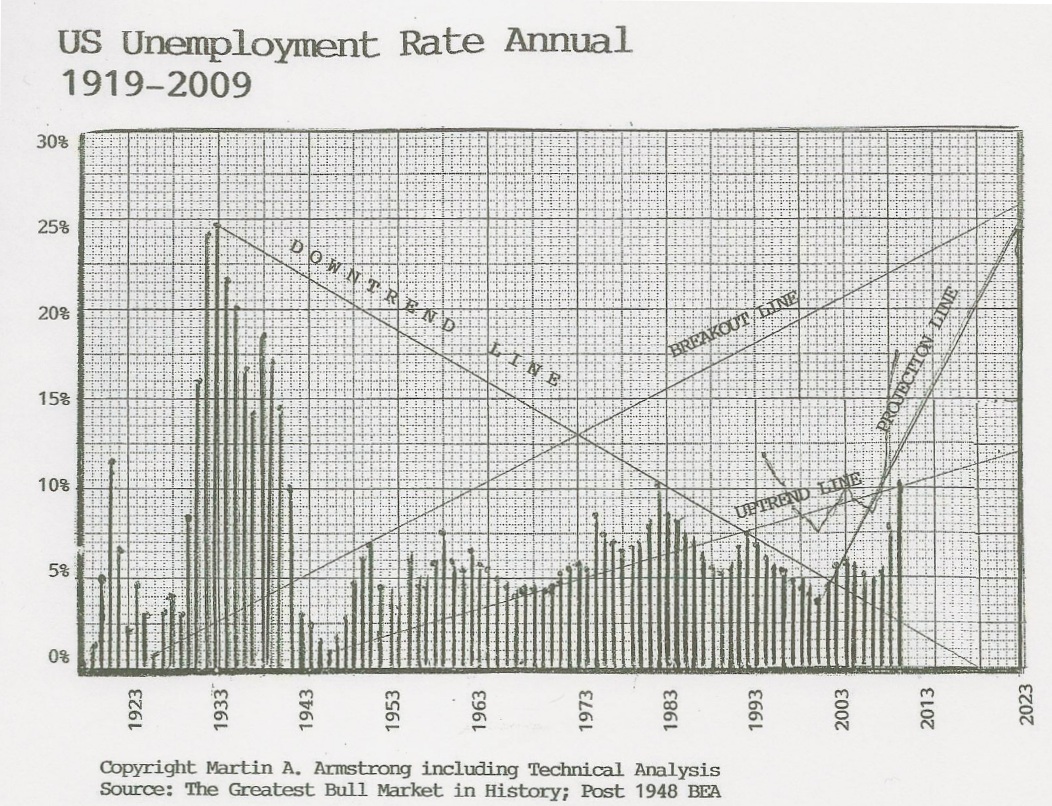
The total official unemployment figure for the US stands at more than 31 million who have collected unemployment benefits of some form. However, our model shows the real number is closer to 40 million given all the part-time people who were not entitled to unemployment. At the start of the year, the total civil workforce was about 164,606,000. The official unemployment rate is about 19%, but counting the full scope we have reached the same levels of the Great Depression. Small business always suffers the most during such declines disproportionately. This will impact future economic growth.
Chopper pressers are the best pressers. On his way to Texas, President Trump stopped for a brief press conference with the media prior to departure. [Video and Transcript]
[Transcript] THE PRESIDENT: Good morning. We have a lot of things going on. As you know, we’re heading out to Texas right now.
But Portland — I’ll give you a little report on Portland: We have the courthouse very well secured. Our people have done a fantastic job. You hear all sorts of reports about us leaving. We’re not leaving until they’ve secured their city. We told the governor, we told the mayor: “Secure your city.” If they don’t secure their city soon, we have no choice — we’re going to have to go in and clean it out. We’ll do it very easily. We’re all prepared to do it.
So, in Portland, they either clean out their city and do the job and get rid of the anarchists and agitators, which is what they are. They’re not protesters; they’re anarchists and agitators. We have many in jail. Many of them have been put in jail. It’s going to be a long sentence. They either clean out their city and do it right, or we’re going to have to do it for them.
On CARES, I think — maybe, Steve, would you like to say something on that?
SECRETARY MNUCHIN: Well, as of now, we’re very far apart. And because of that, the President and we have discussed a short-term extension to UI and the evictions so that we have some period to negotiate before this runs out. And the President is very (inaudible).
THE PRESIDENT: We want to work on the evictions so that people don’t get evicted. We’ll work on the payments for the people. And the rest of it, we’re so far apart, we don’t care. We really don’t care. We want to take care of the people. The Democrats aren’t taking care of the people. The payments aren’t enough. The payments aren’t enough. You understand that. They’re not making the payments; they’re not making them high enough. The Democrats are not taking care of the people. Nancy Pelosi takes care of herself, but she doesn’t take care of anyone else.
If you look at what’s going on with Schumer: So when Schumer and Pelosi can get together and take care of the people, we’ll do something. In the meantime, we ought to stop evictions because that expires very soon. So we want to stop the evictions.
Q How do you rate Kamala Harris as a VP? There’s a rumor it’s going to be her.
THE PRESIDENT: I think she’d be a fine choice, Kamala Harris. She’d be a fine choice.
Q Sir, you said you want to pass a short-term bill? A short-term bill. Are you saying you want to pass a short-term bill?
THE PRESIDENT: I don’t hear a word you’re saying.
Q Mr. President, are you saying you want to pass a short-term bill?
SECRETARY MNUCHIN: Well, we’re looking at a deadline, obviously, of this Friday. The President is very focused on evictions and unemployment. And if we can’t reach an agreement by then, the President wants to look at giving us more time to negotiate this.
THE PRESIDENT: We’re focused on those two things. We want to take care of them now. The rest, we can discuss later. They want big bailout money for Democrats that ran cities terribly. Their cities are going down the tubes. If you look at Portland, if you look at what’s going in Seattle — Democrat-run cities, whether you like it or not, they’re terribly run, and they’re always over-taxed. So they’ve taxed them too much and they run them poorly. And we don’t like that.
And what the Democrats want are bailout funds, and what we want is we want to take care of people. And we should reward most of this country that’s well run. You know, most of the country is very well run. You’re watching a Portland and you’re watching Seattle. You’re watching New York, where they had a 400 percent increase in crime. Four hundred percent. My city that I love, that I left to do this job, and they had a 400 percent increase, and it’s unacceptable.
But most of the country is very well run, and Republican cities are very well run. And it’s a shame to reward badly run, radical-left Democrats, with all of this money that they’re looking for, for cities — to throw it away on cities that are poorly run.
Q Are you confident that Russia did not place bounties on U.S. troops?
THE PRESIDENT: I don’t — I told you, I certainly read about it, and since then, I’ve talked about it. Colin Powell says it’s not true. Colin Powell is not exactly somebody that I’m a big fan of. Colin Powell says it’s not true. Other people say it’s not true.
If it were true, I’d be very angry about it. But if you look at Russia, Russia became Russia from the Soviet Union because of Afghanistan. They lost a fortune and a lot of people — a lot of people.
So I don’t know why they’d be doing it. But if you tell me they’re doing it, I will certainly take that under consideration.
Q How would you respond if Russia did turn out to have done that? How would you respond? Would you do sanctions?
THE PRESIDENT: I would respond appropriately. Nobody has been tougher on Russia. Nobody has been tougher on China. Nobody has been tougher on Iran than me, and it’s not even close. And everybody knows this. Nobody has been tougher on Russia, China, or anybody else than me, including our allies — NATO, who I got to pay $140 billion more money — $140 billion. You know what that is?
Q A lot of money.
THE PRESIDENT: And you know why? That’s to hold Russia in check, all right? I did Russia no favor. Nobody has been tougher on Russia than I am.
Q Mr. President, on NATO, you just gave the order to remove U.S. troops from Germany. How does that keep Russia in check?
THE PRESIDENT: Well, Germany is delinquent. They haven’t paid their fees. They haven’t paid their NATO fees. And they’re way off, and they’ve been off for years, and they have no intention of paying it. And the United States has been taken advantage of on trade and on military and on everything else for many years, and I’m here and I’ve been straightening it out.
But Germany owes billions and billions of dollars to NATO. And why would we keep all of those troops there? And now Germany is saying it’s bad for their economy. Well, it’s good for our economy. Germany is delinquent. They’re at 1 percent. They should be at 2 percent. And actually, everybody should be at 4 percent, not 2 percent, because 2 percent is too low. But they’re at 1 percent, and they’ve take advantage of us for many years.
And you think that’s bad? They take worse advantage on trade. And I was all set to fix that, and then we got hit with the China plague. But we’ll be fixing it.
And a guy like Biden — this country wouldn’t have a chance. With Biden, our country wouldn’t have a chance.
Go ahead.
Q In terms of China, they closed our consulate in Chengdu. Are you planning a response for that move by China?
THE PRESIDENT: No, we’ll see what happens. That’s all right. We’ll see what happens.
Q Are you dropping the demand for FBI money — the FBI building?
THE PRESIDENT: So the FBI building — they’ve been trying to build a new building for many years — many, many years. They were thinking about going very far away, but you have to be near the Justice Department. You don’t want to be too far away, where they have to drive for an hour, hour and a half — because they had a site way out in Virginia, way out in Maryland. And I said, “The best place is right where it is. It’s the best piece of property in Washington.” I’m very good at real estate.
So I said, “We’ll build a new FBI building.” Let’s build a new FBI building — either a renovation of the existing, or even better would be a new building. So we have that in the bill. It should stay. People have wanted a new FBI building now for 15 or 20 years.
Q But Republicans don’t want it in the bill.
THE PRESIDENT: Then Republicans should go back to school and learn. They need a new building. It’s a bad building. It’s a dangerous building. You have slabs falling off. It’s not a good building from the inside, and it’s a very expensive building. They need a new building, and we can do it very easily. To me, it would be very — super (inaudible). I would make sure you build a great building at a fraction of the cost, and they can have it done quickly. So the FBI building is not new; this is something they’ve been talking about for many, many years, for decades.
Q Mr. President, on TikTok, how close are you to making a decision about banning TikTok?
THE PRESIDENT: We’re looking at TikTok. We’re thinking about making a decision. We’re going to be watching the hearings today very closely, because there is no question that what the big tech companies are doing is very bad.
SECRETARY MNUCHIN: Let me just also add on that: CFIUS — TikTok is under CFIUS review, and we’ll be making a recommendation to the President on it this week. So we have lots of alternatives.
Q Do you regret tweeting about that doctor, Mr. President? Do you regret tweeting about that doctor yesterday?
THE PRESIDENT: Regret what?
Q Stella Immanuel, the doctor — do you wish you had not retweeted that?
THE PRESIDENT: I was very impressed with her and other doctors that stood with her. I think she made sense, but I know nothing about her. I just saw her on — you know, making a statement with very respected doctors. She was not alone. She was making a statement about hydroxychloroquine with other doctors that swear by it. They think it’s great. So she was not alone.
Fake news CNN made it like, “Oh, I said this, I said that.” She was with a whole group of people. And you ought to tell your network the reason their ratings are so bad is because the coverage is so false. If CNN would be honest — and that goes for MSDNC also. But your network is so dishonest in its coverage on just about everything, and there’s an example.
I was very impressed by her. Know nothing about her; I had never seen her before. But certainly you can put her up and let her have a voice. So what they did is they took down their voice. Now, they seem to never take down the other side. They only take down conservative voices. It’s a shame.
And with hydroxy, all I want to do is save lives. I don’t care if it’s hydroxy or anything else. All I want to do is save lives. If we can save lives, that’s great.
Now, one thing: We’re doing very well on vaccines and very well on therapeutics. So that’s very important. But I happen to be a believer in hydroxy. I used it. I had no problem. I happen to be a believer. Many, many people agree with me. A great test just came out from the Ford clinic in Michigan — very respected. We’ll see how it is.
Q Mr. President, have you decided how you’re going to give your convention acceptance speech yet?
THE PRESIDENT: Well, I’m thinking about it, but we’re picking a location. Fairly soon we’ll let you know.
Q It won’t be here at the White House? It’ll be somewhere in —
THE PRESIDENT: Might be. It’s something we’re thinking about.
Q Back to Germany: Are those troops — what signal does it send to Russia? Those troops were always there to defend Europe against Russia.
THE PRESIDENT: You’re right. They’re there to protect Europe; they’re there to protect Germany. Right? And Germany is supposed to pay for it. Germany is not paying for it. So why should we leave them if they were not — we don’t want to be the suckers anymore.
The United States has been taken advantage of for 25 years, both on trade and on the military. We are protecting Germany. So we’re reducing the force because they’re not paying their bill. It’s very simple: They’re delinquent. Very simple. And there are other NATO countries also.
Right now, you have 8 out of the 28 countries that have paid up. I got them to pay $130 billion a year more, going up to $400 [billion]. Most of them will be up to date. It wasn’t easy. But most of them will be up to date. The one that won’t be up to date is Germany. And we spend a lot of money on Germany. They take advantage of us on trade, and they take advantage on the military, so we’re reducing the force. Now, if they start paying their bills, I could rethink about — I would think about it.
Yeah.
Q Did you talk to Russia about a coronavirus vaccine?
THE PRESIDENT: We talked to Putin about a lot of different things, mostly —
Q About a vaccine?
THE PRESIDENT: — arms control. We’re working on a vaccine. I think we’ll have one. Oxford is doing very well. Pfizer is doing very well. We have a lot of good options.
Q They said Russia was trying to steal information about a vaccine from researchers. Did you talk to them about that?
THE PRESIDENT: You’re going to have to talk up. I can hear everybody but you.
Q Can you come right here?
THE PRESIDENT: I can hear everybody but you.
Q Can you come right here?
Q On arms control, did you make progress? Are there going to be formal negotiations?
THE PRESIDENT: Yeah. There already are. We’re — we’re in formal negotiations with Russia on arms control — meaning, on nuclear arms control.
Q What about bringing China in?
THE PRESIDENT: We’ll talk about that later. We’re going to work this first and we’ll see. China right now is a much lesser nuclear power — you understand that — than Russia. Right now, we are the great nuclear power. We’ve upgraded our nuclear tremendously since. We have the most power. Russia is second and China is third. China is surging; they’ll be there at some point. And, yeah, we would want to talk to China eventually. Yes. Okay?
Q Why not as part of a trilateral negotiation? Does China not want to be involved?
THE PRESIDENT: We thought that we would do it first. I don’t know if it’s going to work out. But we would do it first and then we go to China together. Okay? Which, I think, works out probably better.
Q Did you talk to O’Brien? Did you talk to Robert O’Brien?
THE PRESIDENT: I did. I wished him well. I haven’t seen him in a while —
Q Why not?
THE PRESIDENT: — but he went on vacation. He came back, he wasn’t well. He tested positive. He’s doing very, very well.
Q Why haven’t you seen him lately?
THE PRESIDENT: He said he’s doing very well. I spoke to him yesterday.
Q Mr. President, are you concerned about reports that a lot of Americans wouldn’t accept a vaccine? And what could the administration do —
THE PRESIDENT: No, I’m not — I’m not concerned. Well, I’m a therapeutic person, too, you know, to be honest. I love the idea of therapeutics, where you go in, you give somebody a transfusion or a shot, and they get better. I am a big therapeutic person. But we’re doing very well on vaccines and therapeutics. Okay?
And as far as Portland is concerned, we’ve taken a very strong stand. They are anarchists. They’re radical, crazy people. And they’re either going to straighten it out for themselves — Portland, the police — and maybe if the state gets involved; that means the governor and the mayor. But they’re very weak people. They’re very weak people. These radicals, these anarchists are controlling the governor and this mayor.
The mayor went into a rally — it wasn’t accurately reported by CNN, by NBC. The mayor went into a rally. He thought he’d be their buddy. They excoriated him. They excor- — what they did to him was incredible. Lucky he had five bodyguards. But they excoriated him.
NBC — I didn’t see CNN because I don’t watch CNN. NBC absolutely covered it like he was their big buddy. No, he was in great danger of dying. He would have been dead if he didn’t have his bodyguards.
These are bad people. These are anarchists. They’re agitators. And either they do something or we’re going to do it.
In the meantime, our purpose there is only to protect our federal buildings, which we’re doing with no problem. I mean, they’re nasty and they’re vicious people, but our people are very powerful people. Very powerful.
And either they’re going to clean up Portland soon or the federal government is going up and we’re going to do it for them. So either they clean out Portland — the governor and the mayor, who are weak — either they clean out Portland or we’re going in to do it for them.
The latest claim running around is that the dollar is overvalued relevant to its trading partners, and it will decline as the economy recovers due to imports. You really have to wonder if these analysts are just working from home and have lost all sense of the world because they are locked down. In that forecast, they are ASSUMING that the world economy will recover as if nothing has taken place.
This is the typical analysis that simply focuses on domestic numbers and assumes that if you import more goods, then the dollar must decline. This theory is up there with thinking raising interest rates will be bearish for the economy and the stock market. Interestingly, both the economy and the stock market rallied as long as interest rates were RISING!
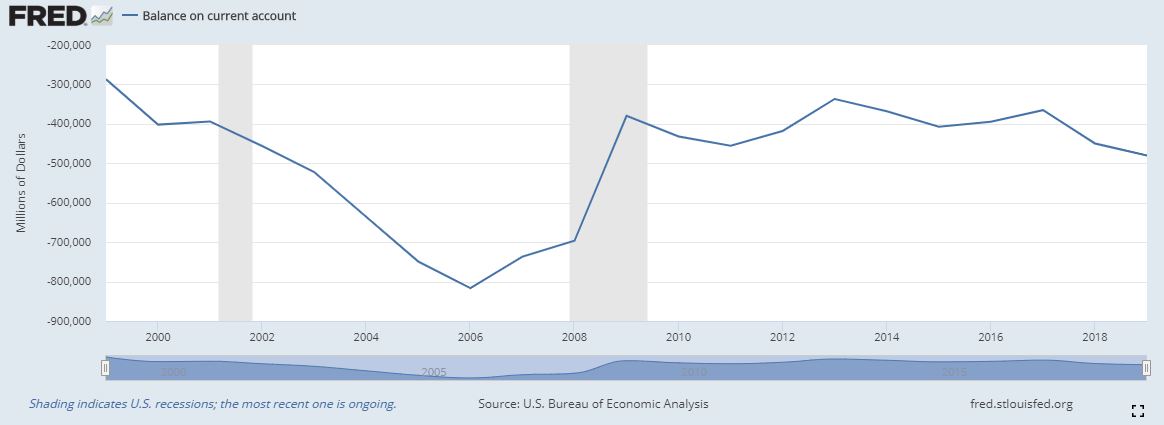
This is not a world that you can judge simply by looking at trade statistics. It is pure sophistry. In 2018, exports of goods and services from the United States made up about 12.22% of its gross domestic product (GDP), while US imports amounted to 15.33%. We have allocated trade according to the flag the company flies, and then you will see that the US has a trade surplus. Moreover, I assisted the Japanese on how to reduce their trade surplus buying gold in New York, taking delivery, and exporting it to London and selling it there. It does not matter what is exported; the statistics only look at dollars — not goods. This theory about trade to claim the dollar will decline is laughable.
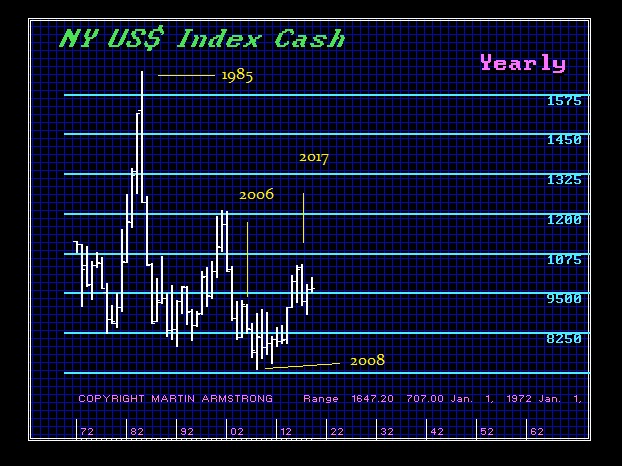
All you have to do is real correlation analysis. Here is the US dollar Index, which was wrongly constructed based upon trade rather than capital flows, and the low in the trade deficit took place in 2006. It began to IMPROVE as the world economy turned down, and in 2008, we see an outside reversal with the dollar rising. The dollar peaked in 2001 on this index and that was the crash in the market from the 2000 peak in the Dot.com Bubble.
The true trends that reveal the future are based upon capital flows. The dollar rallied and peaked in 1985 during that recession, but on the US stock market, the Dow performed a rare outside reversal to the upside in 1982, which began the explosion from 1,000 to 6,000. That also attracted capital flows for investment. The dollar peaked in 2001 during that recession as capital contracted.
Re-posted from Uncommon Knowledge by Russell Roberts Thursday, July 23, 2020
A lot of people reject capitalism because they see the market process at the heart of capitalism—the decentralized, bottom-up interactions between buyers and sellers that determine prices and quantities—as fundamentally immoral. After all, say the critics, capitalism unleashes the worst of our possible motivations, and it gets things done by appealing to greed and self-interest rather than to something nobler: caring for others, say. Or love. Adam Smith said it well:
It is not from the benevolence of the butcher, the brewer, or the baker that we expect our dinner, but from their regard to their own self-interest.
Capitalism, say its critics, encourages grasping, exploitation, and materialism. As Wordsworth put it: “Getting and spending, we lay waste our powers.” In this view, capitalism degrades our best selves by encouraging us to compete, to get ahead, to win in business, to have a nicer car and house than our neighbors, and to always look for higher profits and advantages. In the great rat race of the workplace, we all turn into rats. Is it any wonder so many want to kill off capitalism and replace it with something more just, more fair, more humane?
This urge to try something else seems to be on the rise. In a 2019 Gallup poll, 43 percent of respondents said socialism would be good for the country. A self-avowed socialist, Bernie Sanders, came closing to winning the Democratic nomination for president in 2020, finishing a close second as he had four years earlier.
One answer to this increased taste for socialism is that socialism has to be specified in order to compare it to capitalism. I think a lot of people are attracted to socialism because they believe it means capitalism without the parts they don’t like. How to get there from here is left unspecified. A second answer is that the American economic system is, in fact, a hybrid of capitalism and socialism. Some parts of the American economy are pretty free market, or what we might call capitalist: those parts where profit and loss determine success or failure, where prices and wages are mostly free to adjust to what the market will bear, and where subsidies are small or nonexistent. But other parts of the American economy, such as education, health care, and housing, are highly distorted—they are heavily subsidized or regulated in ways that make innovation and competition very difficult. They’re not fully socialist, but you can’t really call them free market, either.
Capitalism, somehow, gets blamed for anything that goes wrong. Consider health care—it is highly subsidized; its prices are distorted by those subsidies along with incredibly complex regulations; the supply and allocation of doctors are highly constrained by regulations; hospital competition is curtailed by certificate of need requirements; and finally, on top of that, a highly regulated private insurance business is tangled up with everything. And when outcomes go sideways, people claim it proves that markets don’t work for health care. One of the essential pillars of capitalism is people spending their own money on themselves. The essence of the health-care market is people spending other people’s money, often on other people.
People decry the high price of housing in New York and San Francisco, and some blame it on the greed of landlords. But greed is as old as humankind. What has changed in recent decades and driven prices upward is ever more restrictive zoning that has made it harder to build new rental units in cities where the demand is highest.
But let’s put aside the question of whether capitalism can fairly be blamed for the ills of health care in America or the high price of housing in certain American cities. Let’s look at the more basic charge of immorality.
Is capitalism good for us? Does it degrade us or does it lift us up? The critics are right that competition is an important component of the capitalist system, but the dog-eat-dog nature of that competition is greatly exaggerated. We call it competition, but it can also be thought of as the availability of alternatives. As Walter Williams likes to point out, I don’t tell the grocery store when I’m coming. I don’t tell them what or how much I want to buy. But if they don’t have what I want when I get there, I “fire” them. The existence of alternatives, choices of where to shop, and competition incentivizes the grocer to stock the shelves with what I want.
My cleaning crew speaks almost no English and has little or no formal education. Yet I pay them about double the legal hourly minimum. It isn’t because I’m a nice person. If I paid them only the minimum, they wouldn’t show up, because many other people are willing to pay much more to have their houses cleaned. Competition, not the minimum wage, is what protects my cleaning crew from the worst side of me and anyone else they work for.
Competition in sports is typically zero sum. The team with the higher score wins and the other team must lose. But economic competition is positive sum. Market share has to sum to 100 percent. When highly reliable Hondas and Toyotas showed up in the United States at very reasonable prices in the 1970s and 1980s, for example, they took market share from American companies. But the total number of cars sold wasn’t fixed. By making better and cheaper cars, the number of cars sold increased. And the quality wasn’t static, either. Spurred by Japanese competition, American car companies improved their products’ quality. And the American consumer was better off.
The essence of commercial life is positive sum. You hire me at a wage that makes it worthwhile for you to do so. I work for you because the wage is high enough to make me better off as well. Without both of us gaining, there’s no deal to be made.
Of course, some people have fewer or less attractive alternatives than other people. Why does Walmart pay what its critics claim are inadequate wages? It’s not because Walmart is especially cruel or greedy. (After all, I could make more on Wall Street than I do in academic life. That’s not because Goldman Sachs is kinder than Stanford University.) Walmart pays what it does because it can. And it can pay what it does because the people who choose to work there have unattractive alternatives. Otherwise, they’d take a job somewhere else.
Similarly, workers in overseas factories make very little relative to their American counterparts because their alternatives are much worse than those available to American factory workers. It’s not the cruelty of greedy international corporations that keeps the wages low. It’s the poor alternatives those workers have available to them. In fact, poor workers in poor countries typically line up for the opportunity to work for an international corporation. Wages there, while low by American standards, are much higher than in other parts of the economy.
Over time, the poorest workers in countries such as China have seen their wages rise dramatically. Again, this is not because of the compassion of corporate employers but because of the competition they face in attracting good workers. There are two positive ways to help both foreign workers and low-wage American workers at places such as Walmart: increase the demand for their services and find ways to help them increase their skills. That makes them more attractive to employers, who can pay them more because the workers are more productive.
Competition in a free-market system is about who does the best job serving the customer. Unlike traditional competition, there isn’t a single winner—multiple firms can survive and thrive as long as they match the performance of their competitors. They can also survive and thrive by providing a product that caters to customers looking for something a little different.
Finally, there is a great deal of cooperation in capitalism. One kind is obvious: investors cooperate with managers, who cooperate with employees to produce a great product or service. Many people find the opportunity to work with others in this way—to produce something of value for the consumer—deeply rewarding in ways that go beyond money. Part of the reason people start businesses is money, of course. But there is a large nonmonetary component: the experience of joining with others to create a great product or service that people value.
In the second Keynes-Hayek rap video I created with filmmaker John Papola, we tried to capture the best of this entrepreneurial side of capitalism:
Give us a chance so we can discover
The most valuable way to serve one another.
When Apple introduced the iPod in 2001, the 10GB model held two thousand songs, the battery lasted ten hours, and its price was $499. By 2007, the best iPod held twenty times that number of songs, the battery lasted three to four times longer, and its price was $299. Apple didn’t improve the quality and lower the price because Steve Jobs was a nice or kind person. Apple improved the iPod because its competitors were, as always, constantly trying to improve their own products. But I don’t think money was the only thing motivating improvement at Apple. Steve Jobs was happy to get rich. But he was also eager to keep his firm afloat in order to employ thousands of people at good wages and to work alongside those workers to create insanely great, ever better products. The money was nice. But it was not all (and maybe hardly at all) about the money.
Steve Jobs wanted to put what he called a dent in the universe. He wanted to make a difference. To do that, he needed to convince people of his vision, and then that vision had to be made real in a way that could profitably sustain an enterprise. Free markets gave Jobs the landscape where he could make his vision a reality.
You do have to pay the bills. The money that comes from consumers who value your product has to be sufficient to cover your costs. That’s the profit-and-loss criterion that underlies capitalism—you have to do as good or better than your competitors at serving your customers. But that’s not enough. You also have to do it at a price and pay a wage to your employees that result in a profit.
The other moral imperative of capitalism comes from repeated interactions between buyers and sellers. When there are repeated interactions, sellers have an incentive to treat their workers and their customers well—otherwise, they would put future interactions at risk. The safety of air travel, for example, is highly regulated. But cutting corners to save money and thereby putting passengers at risk are bad ideas for an airline that wants to exist past tomorrow. Crashes caused by negligence destroy an airline’s reputation. In markets, reputation helps insure honesty and quality. Being decent becomes profitable. Exploitation is punished by future losses.
None of the above rules out a role for government. You can defend free markets and capitalism without being an anarchist. Government plays a central role as the most effective enforcer of property rights and contracts. It administers the legal system. And it can and should restrict opportunities for people to impose costs on others. There’s nothing un-capitalist about making it illegal to dump your garbage into the air or water.
But what about the poor? How can we applaud the morality of capitalism if its gains go only to the richest Americans? Who wants to champion a system that gives the 1 percent the richest of chocolate cake and leaves everyone else with crumbs?
While there is evidence that supports this claim of the poor as bystanders who are left unchanged by decades of economic growth, this evidence typically looks at snapshots of workers at two different points in time, comparing changes in income or wealth of the top 1% to the to the standing of the top 1% decades later. The implicit assumption is that the people who were at the top in the past got much richer over time. This approach ignores economic mobility and falsely assumes that the top 1 percent are a fixed group. The people composing that 1 percent change; the same people do not simply get richer while everyone else treads water. The 1 percent includes people who once were much poorer but, now that they have reached the top, are richer than the people who previously were at the top. Similarly, the bottom twenty percent today are not the same people who were at the bottom in the past. When you follow the same people over time, rather than comparing group snapshots at two different points in time, all groups—poor, middle class, rich become more prosperous over time. A rising tide lifts all boats and not just the yachts. (I’ve explored these issues in videos and essays published elsewhere.)1
I would also point out that the guards in Cuba face south; they prevent Cubans from escaping the egalitarian paradise of Cuba for the unequal American economy. Poor people from all over the world risk their lives to come to the United States. Certainly they come here for opportunity for themselves and for their children. They expect—correctly, in my view—to share in the future growth of the American economy.
But I think poor people come here for more than just the financial opportunities of the American economy. They come for a chance for their children, and for themselves, to flourish, to use their gifts and skills in ways that bring meaning well beyond financial rewards. Money is pleasant, and not starving beats starving. But the real morality of capitalism and of the American system, with all its flaws, is that it gives people the chance to flourish through their work.
Not everyone has this chance in America today. But I believe that many of the challenges that the poorest among us face are not the fault of capitalism but the result of the breakdown of other institutions, which makes it hard for people, especially young people, to acquire the skills that would allow them to thrive. The US school system needs an overhaul. In particular, it could use more competition. The charter school movement is one part of a potential policy improvement. Even more competition—including private school options funded by scholarships—would go a long way toward allowing the poorest among us a chance to share in the American economic system, imperfectly capitalist that it is.
In the two months since George Floyd was killed by a white Minneapolis police officer, the world has changed significantly. For example, major businesses in America are fully onboard with the Black Lives Matter (BLM) movement as almost 300 top corporations have pledged support for the cause. These corporate leaders have been joined by all the professional sports franchises and political leaders of both parties have expressed solidarity with BLM.
Any expression of “All Lives Matter” has been deemed to be racist. For example, a Sacramento Kings broadcaster lost his job for tweeting “All Lives Matter.” In New Orleans, a Mardi Gras krewe captain faced intense criticism and the defection of members and bands from her parade for issuing a similar message online. A New Orleans area teacher was fired because her husband admitted to painting “We All Matter” and other non-racist slogans on his fence. It seems clear that in the politically correct climate today, everyone must express support for BLM or face a withering backlash.
The problem is that the BLM organization was founded by individuals who admitted to being “trained Marxists”
The problem is that the BLM organization was founded by individuals who admitted to being “trained Marxists.” Of course, all Americans should oppose individuals advocating an ideology that threatens our constitutional republic and our capitalist economic system.
Karl Marx is the founder of communism, a system of government that survives by fully destroying the freedom of its citizens. People living in communist countries have no human rights and exist only to serve the all-powerful state. Today, communist governments endure in North Korea, Vietnam, Laos, Cuba, and China.
All these countries repress their people and deprive them of basic freedoms such as the right to speak, assemble, petition, and practice their religious faith. These barbaric practices have existed in all communist nations since the overthrow of the Czar in Russia in 1917 and the eventual formation of the Soviet Union. Since that time, communist dictators have killed at least 100 million innocent people throughout the world.
Unfortunately, the media does not allow any mention of the Marxist origins of BLM or any criticism of the organization. Any courageous critics will be labeled a racist. Understandably, most people fear being given such a label, so they will refuse to give their honest opinion and just appease the mob to protect their job and their family.
The stampede to support BLM has been seen in every sports league over the last few months. Americans used to be able to enjoy sporting events without being lectured about their political beliefs. It used to be a nice diversion from the pressures of everyday life. Unfortunately, those days are long gone. Today, sports are just one more area of life that has been overtaken by social justice warriors.
The NBA has painted Black Lives Matter next to their court in the “bubble” in Orlando. The NFL has expressed support and will play the “Black National Anthem” prior to the National Anthem during the first week of games this season. In Major League Soccer, players raised their fist and knelt in support of BLM at the opening of their season.
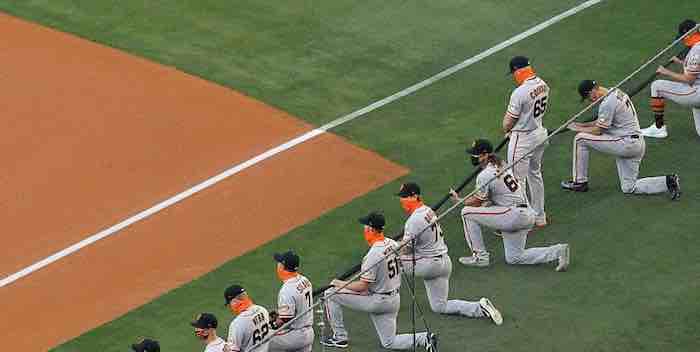
The acceptance of this Marxist group has been especially apparent in Major League Baseball. Members of the Cincinnati Reds and San Francisco Giants knelt during exhibition games. In Boston, the Red Sox just unveiled a massive Black Lives Matter billboard right outside of Fenway Park.
On Thursday night, before the opening game of the season, all the players with the New York Yankees and Washington Nationals knelt before and during the National Anthem. However, in the San Francisco Giants game against the Los Angeles Dodgers, all the players knelt prior to the National Anthem, except one lonely “Christian.”
The player who refused to kneel was Giants relief pitcher Sam Coonrod, a true hero. In an interview after the game, Coonrod explained his refusal to join his teammates by claiming that he “can’t kneel before anything besides God.”
Such a courageous stand needs to be applauded. Usually, a player, such as Saints Quarterback Drew Brees, who expresses support for standing for the National Anthem, will cave after strong criticism. Eventually, Brees and his wife apologized multiple times.
Coonrod took the road less traveled. He explained his opposition to BLM by noting “I’m a Christian, like I said, and I just can’t get on board with a couple of things that I have read about Black Lives Matter. How they lean towards Marxism and they have said some negative things about the nuclear family. I just can’t get on board with that.”
Fortunately, Gabe Kapler, the manager of the Giants, supported Coonrod’s decision. He said that players were going to be able to “express themselves.” He also noted “We were going to give them the choice on whether they were going to stand, kneel, or do something else. That was a personal decision for Sam.”
This “personal decision” is quite exceptional in the environment we live in today. Congratulations to a rare breed indeed, a player who truly stands alone.
Money greases the wheels of exchange, and thus makes the whole economy more productive. The idea that everything should be cashless is problematic for so many reasons. Bartering is a good under certain circumstances and societies, but it relies on what Keynesian economists call a “double coincidence of wants,” making it less desirable than cash.
Cash is easier because it is a convenient medium of exchange, sometimes free from government prying eyes, a unit of account for quoting prices, and a store of value as long as the trust in government is not eroded and inflation is low.
From the people’s perspective, cash is freedom
Cash is lightweight, can have large denominational value, does not spoil, and is thus better than commodity money, i.e., cigarettes, bullets, chocolate, jewelry, gold coins, pelts, furs, soap, etc.
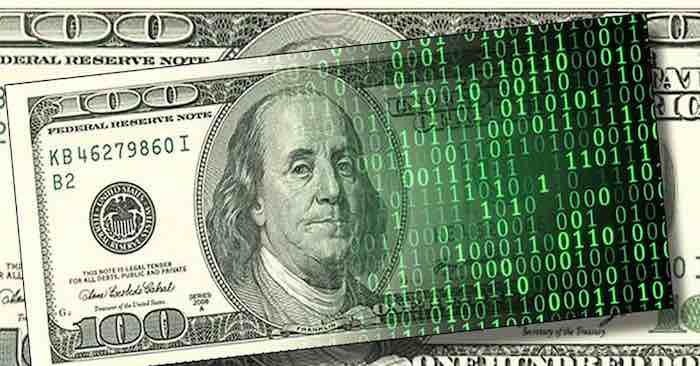
From the government’s perspective, it is easy to see why they would want a cashless society. Banning cash under the guise of it being infected by disease, of controlling money laundering of criminals and drug lords, and routing all of our income, every last penny through the banking system helps them better control everything we do, freezing accounts at will, while taxation becomes so much easier, including payments to Obamacare insurance and any financial penalties an individual is required to pay. It enables governments to track with 100 percent accuracy everything we buy and sell, everything we own, and everything we do.
From the people’s perspective, cash is freedom, but the leftist mainstream media is attacking it with pathetic excuses such as cash is physically dirty, expensive, potentially criminal, and obsolete 19th century technology, happily promoting the “war on cash.”
The media’s opposition sees the “war on cash” as another form of population control when people’s accounts can be raided and their owners classified as potential domestic terrorists, or denied healthcare, travel, education, and other services if they are marked with a “digital star.”
The issues with a cashless society are too many to mention them all:
Cashless Global Currency
Total control by the state or its proxy
Savings could result from not using special paper, printing, ink, labor, and metal alloys but then those in the trade would become unemployed
If an attack occurs on the Smart Grid and there is no power, there are no financial transactions possible without some cash, a substitute, or barter
In the event of a national disaster, i.e., earthquake, tsunami, hurricane, tornado, power outages, transactions can be made by cash, commodity money, or barter
An EMP attack or intense solar flares would make cash or one world currency worthless and people will resort to theft
A cashless or global currency would give banks extraordinary power with no cap on interest rates or their control
Cashless transaction will always be traceable and thus the person’s location
One world currency in a cashless market would eliminate exchange rates, currency trading futures, eliminate a substantial sector of the job market and thus revenues
Black markets and illegal activities would be eliminated, and everyone will be forced to pay taxes on every penny
Children under 18 would be excluded from holding credit cards and thus excluded from financial transactions without cash; no more grandma cash gifts, lawn mowing money, or rainy-day cash savings in a jar
Prostitution will have to be legalized and client’s names become public record
Billions of Muslims would lose hawala transactions which are based on cash
Conducting monetary policy about money stock will be altered as cash disappears and one world government such as the U.N. would have to do it
Labor will be purchased and sold with electronic credits and debits
How would the value of one world currency be decided? Will it be tied to gold, silver, platinum, or some other precious metal or decided arbitrarily by the United Nations?
The destabilization of economies via counterfeit currency between countries would be eliminated as a tactic of war if only one currency exists
What would cyber attacks do to a single grid of digital money?
What would happen to third world nations that are not so electronically wired and depend heavily on cash and barter? How could they possibly make transactions in digital money?
Imust ask, what does the destruction of statues of abolitionists have to do with George Floyd?
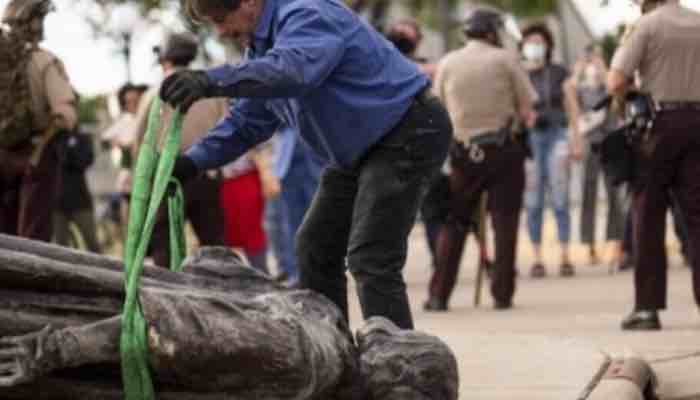
OK, yes, that is the pure definition of a rhetorical question; it has nothing to do with it. And therein lies the crux of what is happening in America. The misguided children, and that reference is not based upon age, but rather level of rational competence, have taken a totally unrelated event and leveraged it for an ideological agenda that embraces violence. The nation was appalled at the George Floyd murder. However, the rational inquiry that should be made is, what does tearing down the statue of Frederick Douglass or Abraham Lincoln have to do with George Floyd?
Clear and present delusion of America’s misguided children
Matter of fact, what do Christopher Columbus, Teddy Roosevelt, or the Washington Redskins have to do with George Floyd? None of those whom I reference wore a Minneapolis police officer uniform and certainly have not been charged and sit in jail awaiting a court date.
Only the irrational, misguided children of the progressive, socialist left would deduce that the way to respond to that tragedy is with violence. And so, business owners who had nothing to do with George Floyd are having their livelihoods assailed, looted.
Then, America’s misguided children respond by saying, “what’s the big deal, they have insurance?” This is the infantile, delusional mind of leftists that justify their brand of violence and mobocracy by saying “you can pay for the damage we inflicted yourself.” I guess they do not understand the effect of their lunacy on insurance premiums increasing.
Just this past week, Minneapolis and Burlington, Vt. declared that racism is a public health emergency.
Oh boy, another “pandemic,” what shall we do now, be forced to wear BLM face coverings? Is there going to be a rush for a vaccine to end the public health emergency called racism? Can I go to my local pharmacy and get an over-the-counter drug to curtail the symptoms of racism? Ahh, maybe a band-aid will do.
Yes, I jest, but one can only laugh and use a little humor to offset the clear and present delusion of America’s misguided children.
Misguided temper tantrums
In cities like Chicago and New York City, crimes, shootings, and murders are on the rise, but two of the left’s most prominent misguided children, Mayors Lightfoot and de Blasio, blame COVID-19. I have yet to hear either of these two take a stand against the leftist violence plaguing our streets. Matter of fact, de Blasio went so far as to assist in painting a BLM mural on Fifth Avenue in NYC…after all, Marxist misguided children tend to flock together. And in Chicago, the black-on-black crime is genocidal, far more than the 2019 statistic of only 15 unarmed black men being shot by police officers. But BLM nor Mayor Lightfoot are taking any actions in Chicago.
See, the misguided children get angry, abjectly enraged, when you refuse to follow along with their misguided temper tantrums. You become the problem…did I mention George Floyd?
Speaking of childish temper tantrums, in Portland Ore., the violence is running rampant in the streets. And what is the response of the mayor of Portland? Try to get things under control? Ask for assistance? Nah, this misguided child lashes out at the federal government which was attempting to restore law and order and serve and protect the citizens of Portland from the mob.
More misguided children.
We watched what happened in CHOP/CHAZ, whatever you call it, in Seattle. The mayor there, a misguided child herself, allowed this little “Lord of the Flies” endeavor to happen. She referred to the place as festive, until what we knew would happen, happened. And it happened that young black men lost their lives, shot, murdered, again…but no BLM protest. So, the Seattle mayor moves in the police to restore law and order. Now, the misguided children have turned on her and demand her being recalled.
Lesson learned: you cannot appease, compromise, negotiate, or acquiesce to the misguided children
Lesson learned: you cannot appease, compromise, negotiate, or acquiesce to the misguided children, so stop giving them the Froot Loops and believing they will be placated, satisfied.
But probably the biggest indicator of America’s misguided children comes from a city not far from where I went to college: Asheville, North Carolina. In Asheville, they have decided to issue reparations to descendants of slaves…after all, it was a Republican president, Abraham Lincoln, who freed the slaves. Did I mention that the misguided children want to destroy and take down Lincoln’s statue? He apparently didn’t do enough for blacks.
So, who writes the check to who in Asheville, NC? I can almost guarantee you that there is no one alive in Asheville that has ever owned slaves. Heck, I do not think you can find anyone in Asheville, NC that was a slave. The only slaves in America today are those economically enslaved to the Democrat Party because of their welfare nanny-state policies and programs. Yet the misguided children align themselves with the party of the “soft bigotry of low expectations” that still views blacks as nothing more than descendants of slaves.
How utterly disgusting.
We should not be allowing the misguided children to run the amusement park. Where are the adults, the grown-ups, who instill guidance, rational thought, discipline, wisdom, and discernment? Who will step in and be the statesman, stateswoman?
The sad reality is that very few are finding the resolve, intestinal fortitude, and character to confront America’s misguided children. And if that continues to happen, they become useful idiots…and we lose a country.
I have created this site to help people have fun in the kitchen. I write about enjoying life both in and out of my kitchen. Life is short! Make the most of it and enjoy!
This is a library of News Events not reported by the Main Stream Media documenting & connecting the dots on How the Obama Marxist Liberal agenda is destroying America