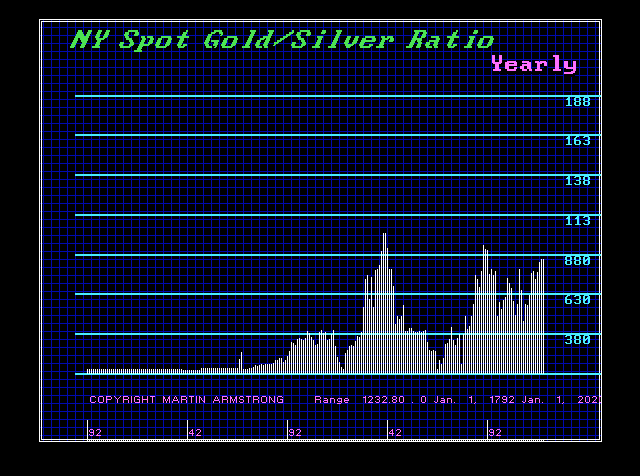
Hoards Are Vital to our Understanding of History


Armstrong Economics Blog/Ancient Economies Re-Posted Jan 26, 2023 by Martin Armstrong
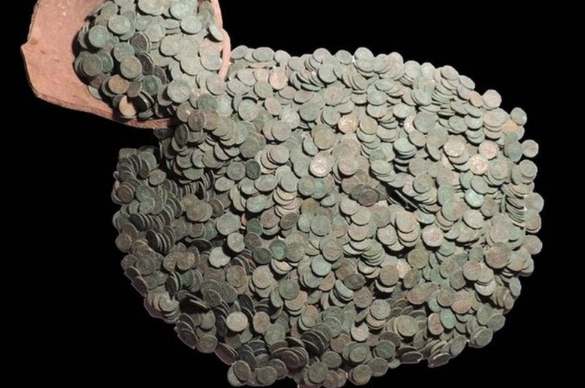
QUESTION: Why do you buy hoards? It is interesting. Just curious.

JY
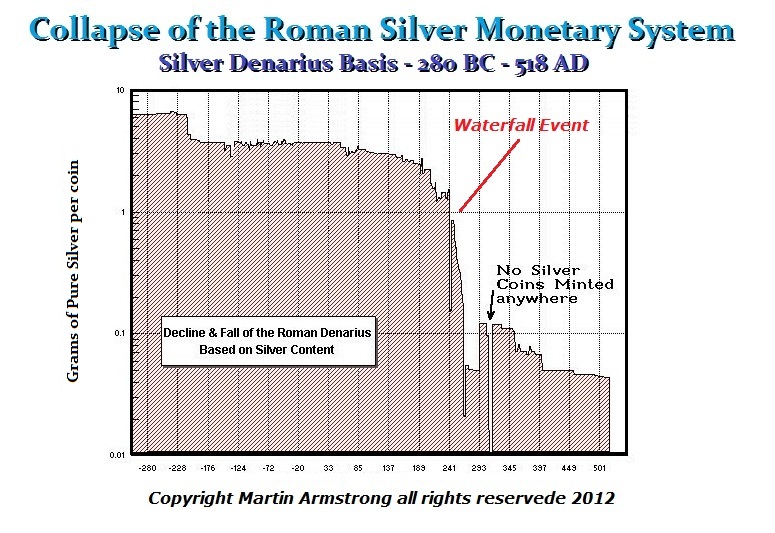
ANSWER: The coinage is the ONLY way to truly confirm the history. Much of the most important periods like the 3rd century AD, the fall of the Republic, or the Revolution during the Debt Crisis of the 1st century BC known as the Social War, can only be properly understood through the coinage lacking really detailed accounts of financially what was taking place. By recreating the monetary system using coinage, I was able to answer the question – How did Rome Fall? Gradually? Or Catastrophically? By assembling all the coinage, and testing it out, I could establish what nobody else could due using documents or archaeological digs. Rome collapsed in just 8.6 years.
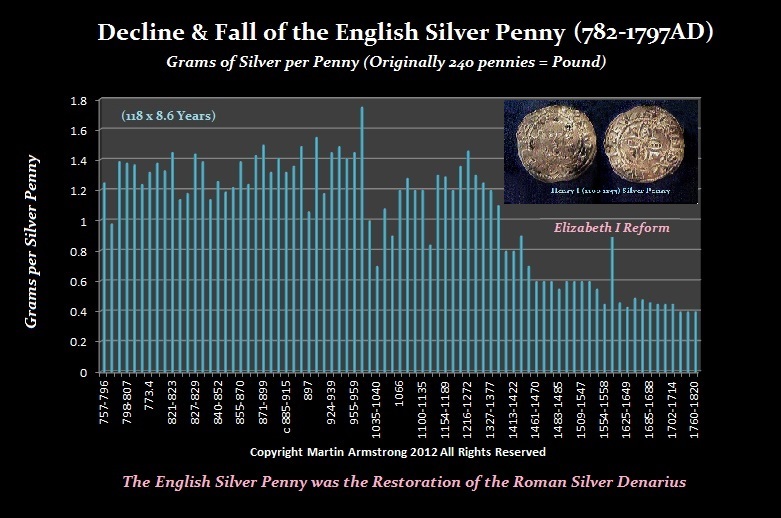
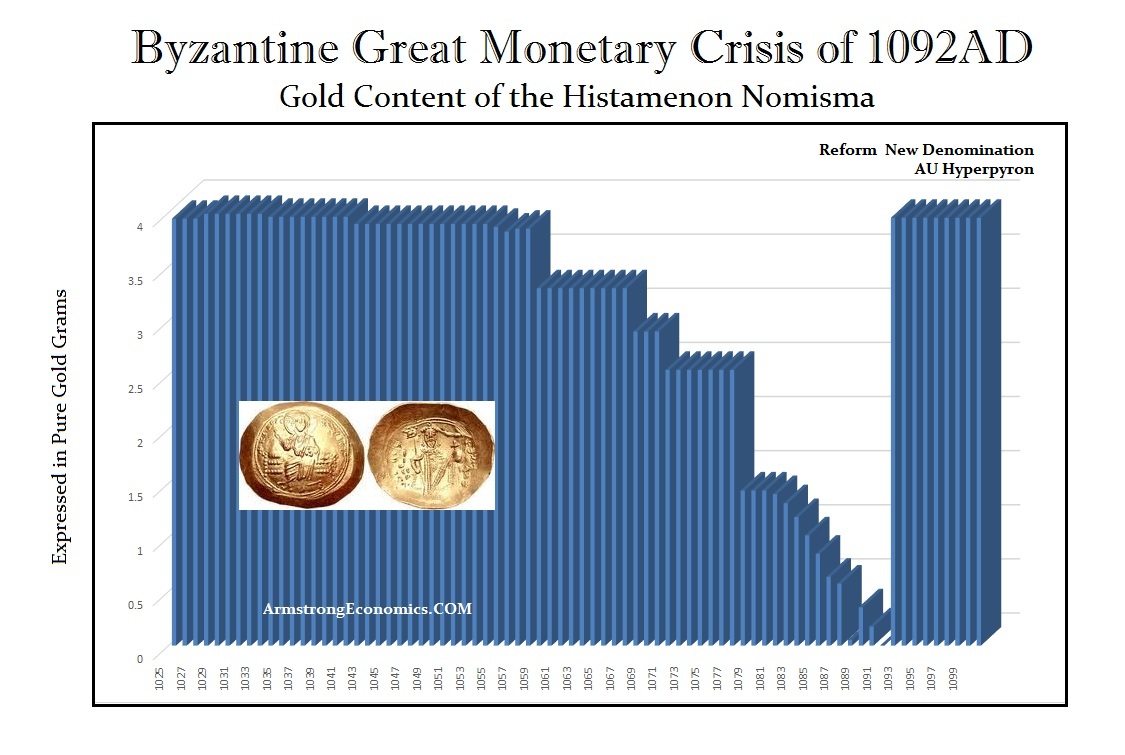
That was then observed in testing and using the same methods around the world. The collapse of the English coinage that inspired Gresham’s Law, bad money drives out good, also took just 8 years.

The Great Monetary Crisis of 1092 saw the gold content collapse also in just 8 years. The same pattern has unfolded time and time again. History repeats NOT because of wars or abstract theories. It repeats simply because human nature never changes – on technology.

The computer was about to forecast the fall of Communism in 1989.95 and it spread and took down the Berlin wall a few months after Tiananmen Square. People attributed that to modern communication. That was nonsense, The Roman Republic fell in 509 BC, and in the same few months in Athens, they too overthrew their tyrants, and Democracy was born.

The question is NOT how fast the information spreads. It could have traveled from Rome to Athens in a few days. The real question is how long does it take to filter through society to create political change?
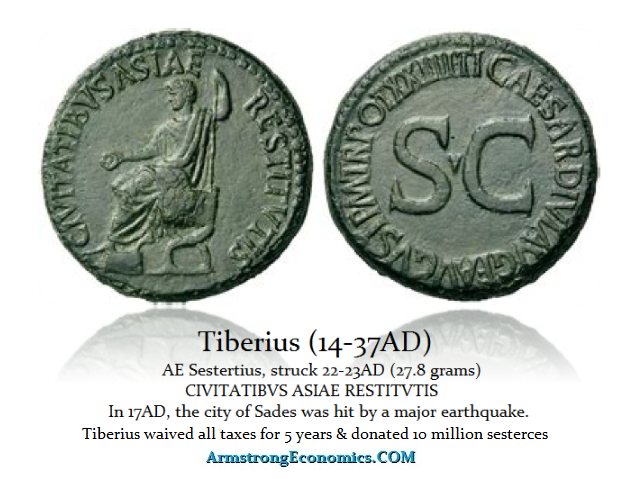
Therefore, assembling the number of coins by examining hoards and the number of different dies multiplied by 15,000 will give us a good idea of the money supply at that time as illustrated above. Granted, this research project cost tens of millions of dollars to produce. Nonetheless, it has yielded a wealth of information that enabled us to see specifically what took place economically. Human nature has not changed. When Rome burned, Nero did visit the victims. Tiberius issued coins for the aid of Asia when a major earthquake devasted the region we call Turkey today.

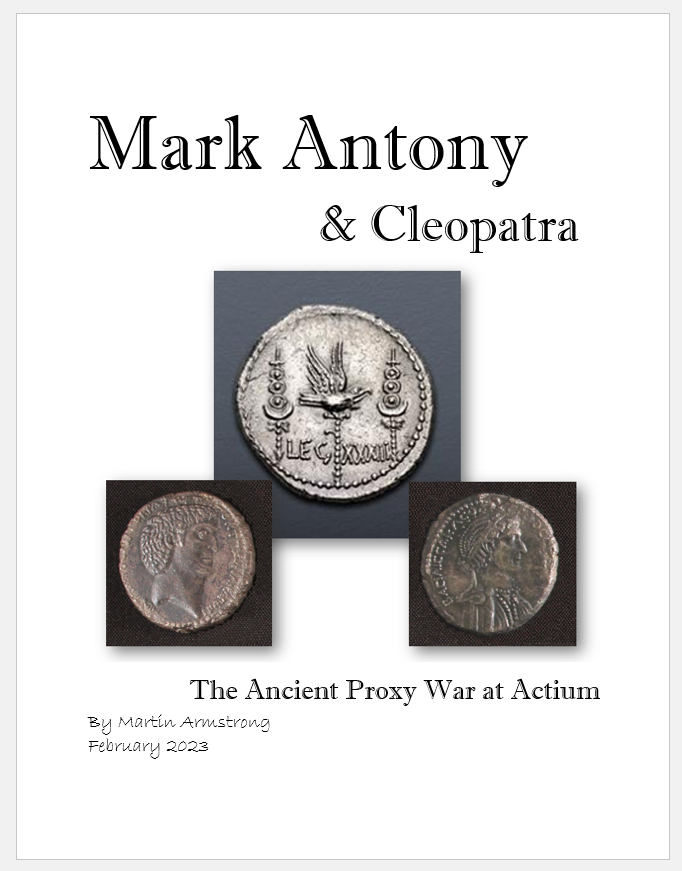
I am finishing a book on the famous Battle of Actium where Mark Antony lost to Octavian giving birth to Imperial Rome. The number of dies and the amount of coins issued by Antony demonstrates that the entire wealth of Egypt was at his disposal and it was really an Egyptian proxy war against Rome. The number of silver denarii struck had to be at least 25 million. The sheer massive amount of the increase in the money supply thanks to Egypt was huge. Antony’s coins remained in circulation for decades, although very work. They were the most common coin found in hoards at Pompeii in 79AD about 100 years later. Hoards enable us to see the cost of that war and how it changed Egypt and Rome.
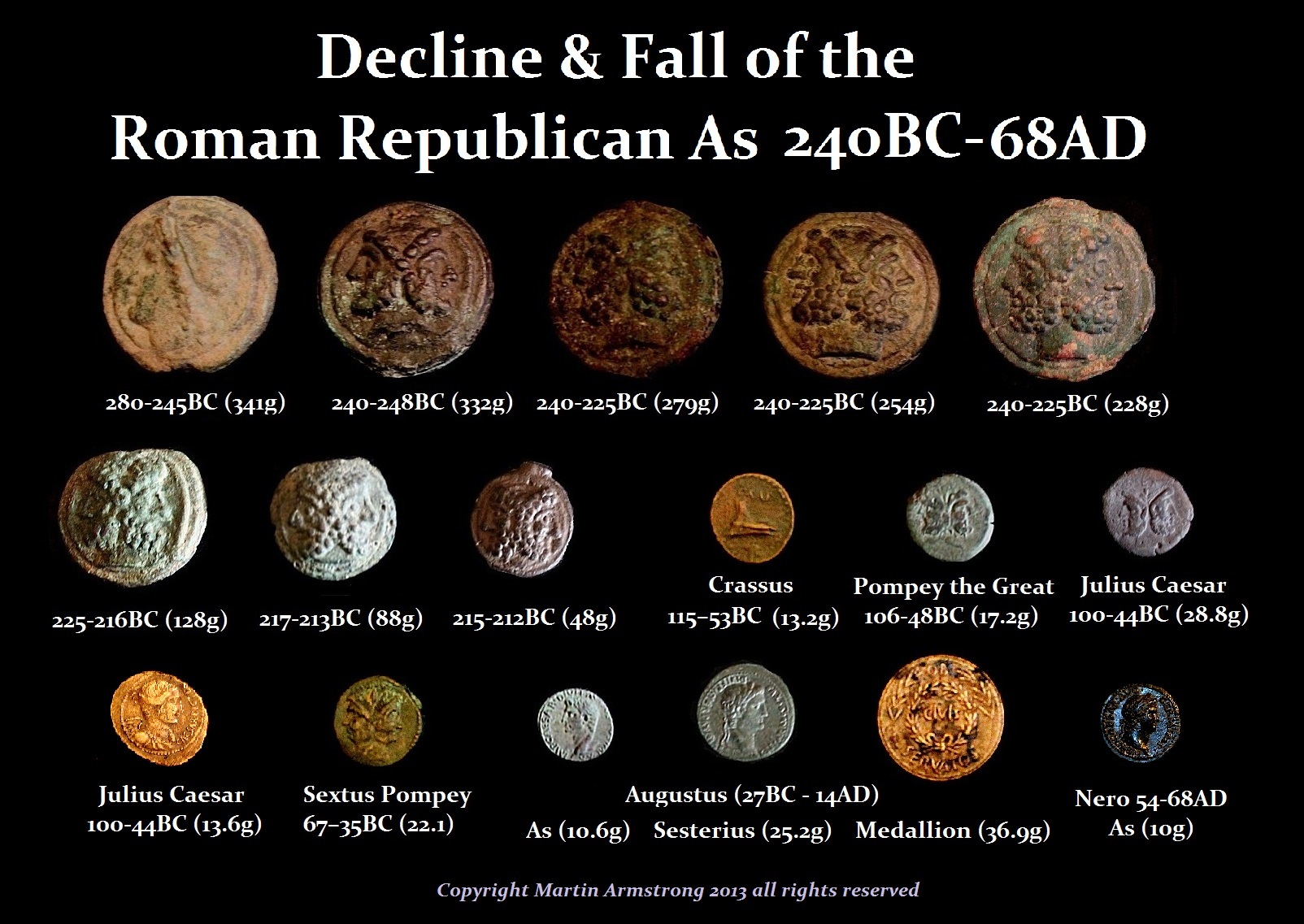
Where Rome began with bronze as its monetary unit and one pound was known as a Roman As, we can see that the price of the Punic Wars as what was one pound of bronze consistently declined. Here we found it was six waves of 51.6 years which are in themselves six waves of 8.6 years,  that produced the major wave of 309.6 years. So if we look from the beginning of the Roman As being 341 grams in 280 BC, by the time we get to Nero in 54AD, the Roman As was about only 10 grams.
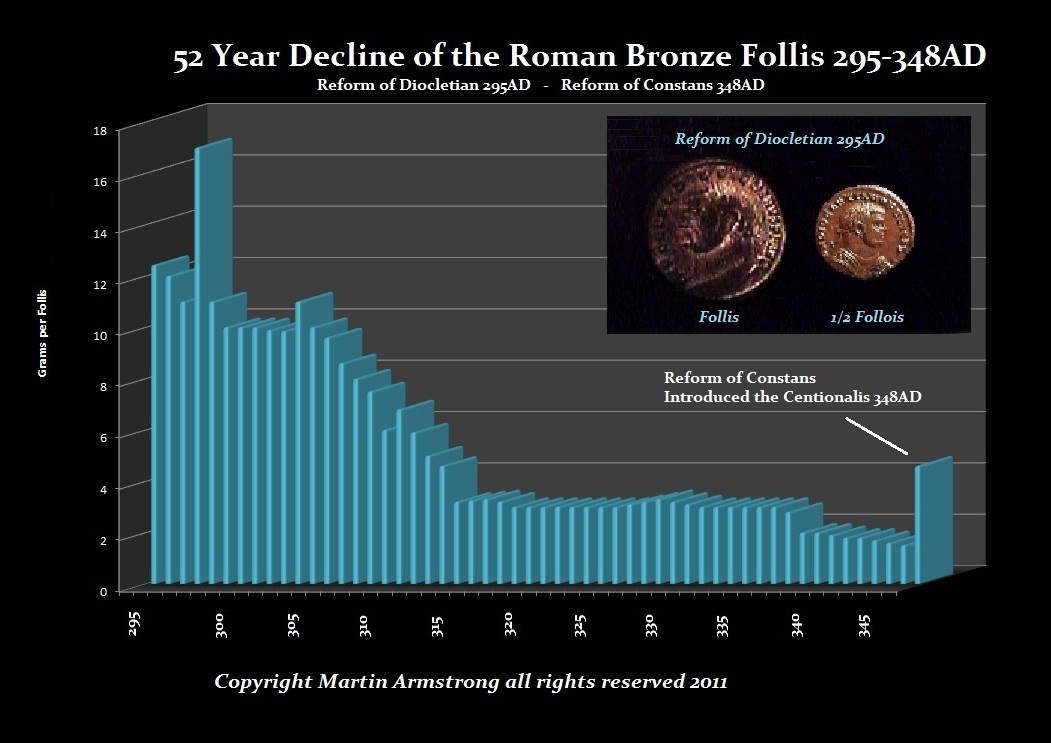
Even looking at the reforms of Diocletian in 295AD, his introduction of the follis declines remarkably also following the six waves of 8.6 years. I have looked at the monetary systems of Asia, the Middle East, Europe, and the Americas. they have conformed to the Economic Confidence Model confirming that this is a cycle that clearly incorporates everything from war to climate change.
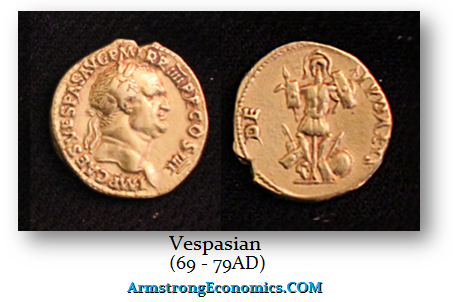
Even though Emperor Titus’ (79-81AD) reign was marked by a relative absence of military and political conflicts after his father, Vespasian (69-79AD) had defeated Judaea was defeated, there were several disasters during his brief leadership. On October 24 in 79 AD, Mount Vesuvius erupted and almost destroyed the cities and resort communities around Naples. The cities of Pompeii and Herculaneum were buried under stones and lava in 79AD shortly after Titus (79-81AD) came to power. Titus made all efforts to help the victims of the volcano and donated large amounts of money from the imperial treasury. The emperor visited Pompeii right after the tragedy happened.
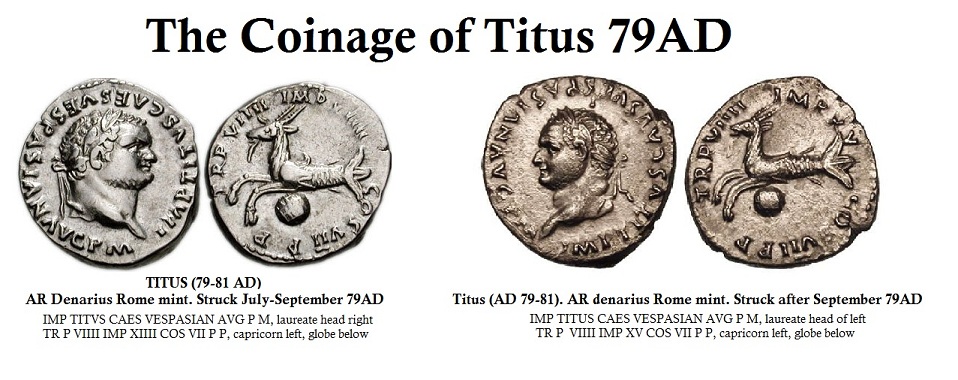
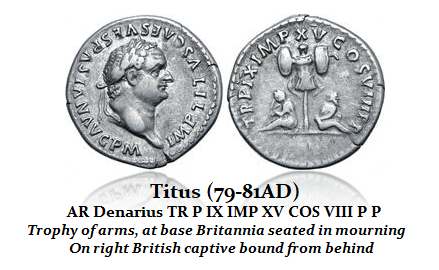
A single silver denarius was discovered in 1974 among the 180 silver coins buried in Pompeii. When it was cataloged, it overturned history. Titus’ father died on June 24th, 79 AD. Therefore, any coin of Titus as emperor would have to have the very first recording of his power “IMP VIIII” or 8th Imperator, which was a title that meant ‘leader of the army’ to the Romans. The coin discovered in Pompeii had the legend “IMP XV,” which was granted to Titus for the war in Britannia. Titus sent Gnaeus Julius Agricola who pushed further into Caledonia and managed to establish several forts there as recorded by Tacitus (Agricola 22). Therefore, Titus received the title of Imperator for the fifteenth time for this event, according to Cassius Dio (Roman History LXVI.20). This took place we know in September 79 AD about 3 months after becoming emperor following his father’s death. Obviously, if any coin was discovered in the ruins of Pompeii with “IMP XV” in its legend, then this provides absolute proof that the date for Vesuvius of August 24th, 79 AD cannot be correct.

Archeologists in Pompeii have discovered a remarkable inscription written in charcoal which has survived the catastrophe confirming that the eruption of Mt Vesuvius indeed took place in October 79AD as confirmed by the coin discovered and ignored by historians.  The charcoal writing, discovered on the wall of a villa during a new phase of excavations, adds weight to a theory that the volcano destroyed the town in October 79AD rather than August of that year in line with Cassio Dio and the denarius of Titus. The date of August 24th, 79 AD, came from a letter addressed by Pliny the Younger to the Roman historian Tacitus, originally written some 25 years after the event.
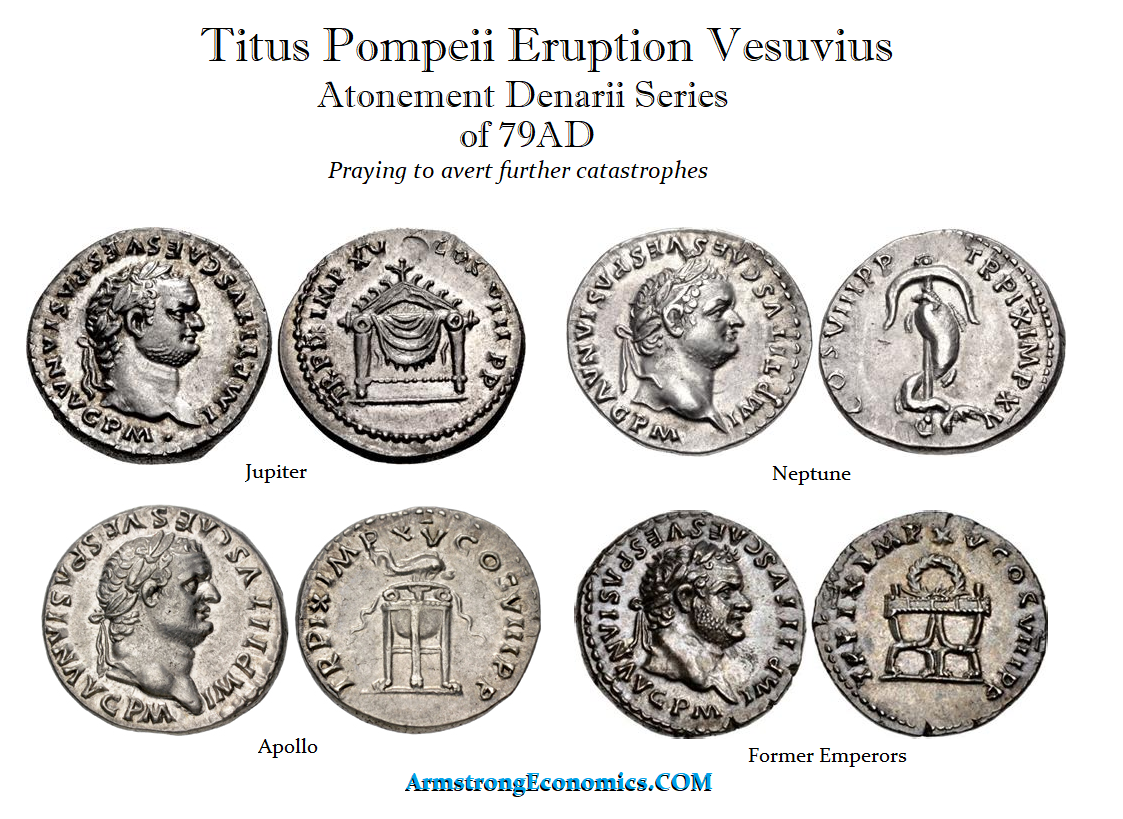
Titus devoted much of his silver coinage of Atonement to the gods for the disaster of Pompeii. There were four main Atonement issues commemorating the services of prayer and propitiation through which the emperor attempted to address the public alarm over the disaster. People often attributed such events to the gods being angry. The coinage showed emblems seeking the approval of Jupiter, Neptune, Apollo, and the deceased former Emperors to watch over the Roman people.

News actually spread rapidly around the Roman Empire. There were formal boards where notices would be posted in which important news and major events would be informed to the people much like such a board in a big company with notices to the employees. These boards were called the Acta Diurna and they were designed to inform the Roman people thereby avoiding fake news. We could call them ancient billboards in modern terms and even government officials would walk up and pin a written notice and the crowds would rush to see what is news. Thus, everyone knew of Pompeii in a matter of days. It did not take long for information to circulate.
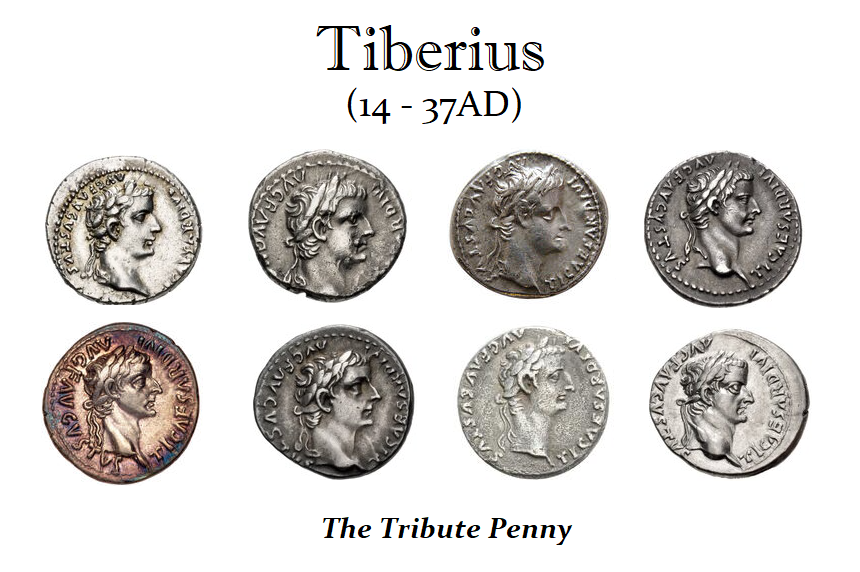
Because the coin dies back then were hand carved, we are able to identify the number of dies in use during a given year because each is unique. Just look at these portraits on the famous Tribute Penny of Tiberius (14-37AD). It all depended upon the artistic ability of the engraver.

The coin itself has taken its name because Jesus, referring to a denarius, which the English translated to “penny” because that was their silver coin, asked: “Whose is this image and superscription?” When answered that the likeness was Caesar, He replied; ”Render therefore unto Caesar the things which are Caesar’s and unto God the things that are God’s” (Matthew 22:20-21). Thus, the coin has been called the tribute penny meaning that was how you paid your taxes.

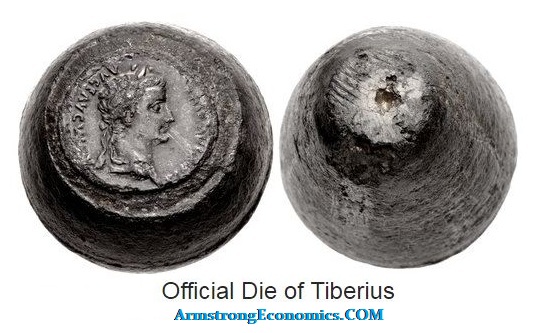
Hoards have enabled me to (1) see what was in circulation at that point in time for the hoard can be dated to around the most recent coin in the hoard. (2) I also have a number of ancient Roman dies like this one of Tiberius. Studies creating modern dies to test how many coins could be struck from such a die before it cracked provides a picture of about 15,000 coins.
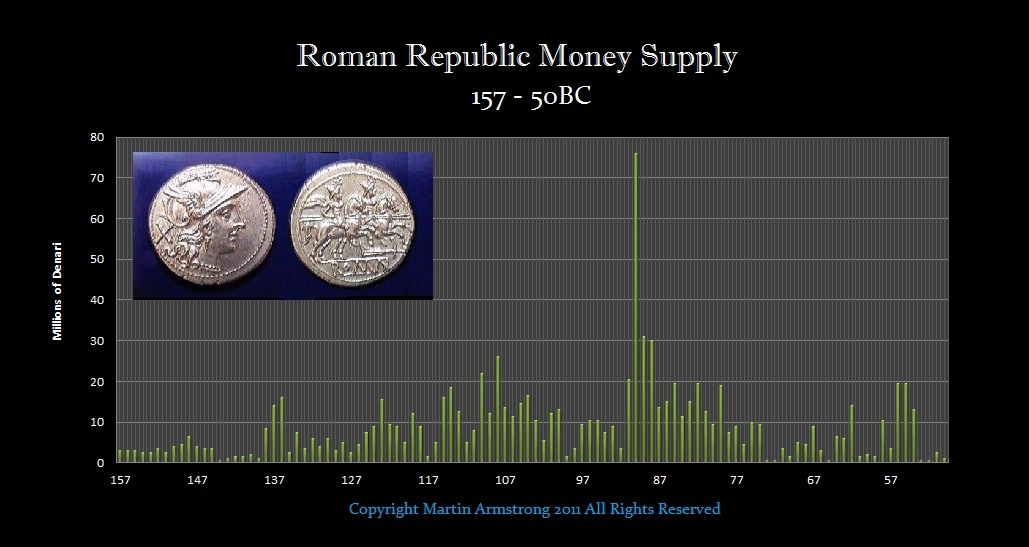
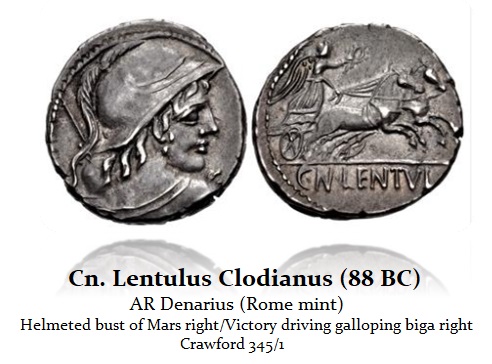
By completing die studies quantifying how many were in use, it then becomes possible to estimate the money supply. Here we can see that during the Social War of 90-87BC, there is a drastic increase in the quantity of coinage issued obviously to pay for soldiers. However, conducting metal testing on the coinage of this period, we find that Rome also debased the coinage slightly adding up to 10% copper to the silver. Therefore, studying hoards allows one to actually ascertain the extreme of monetary affairs.
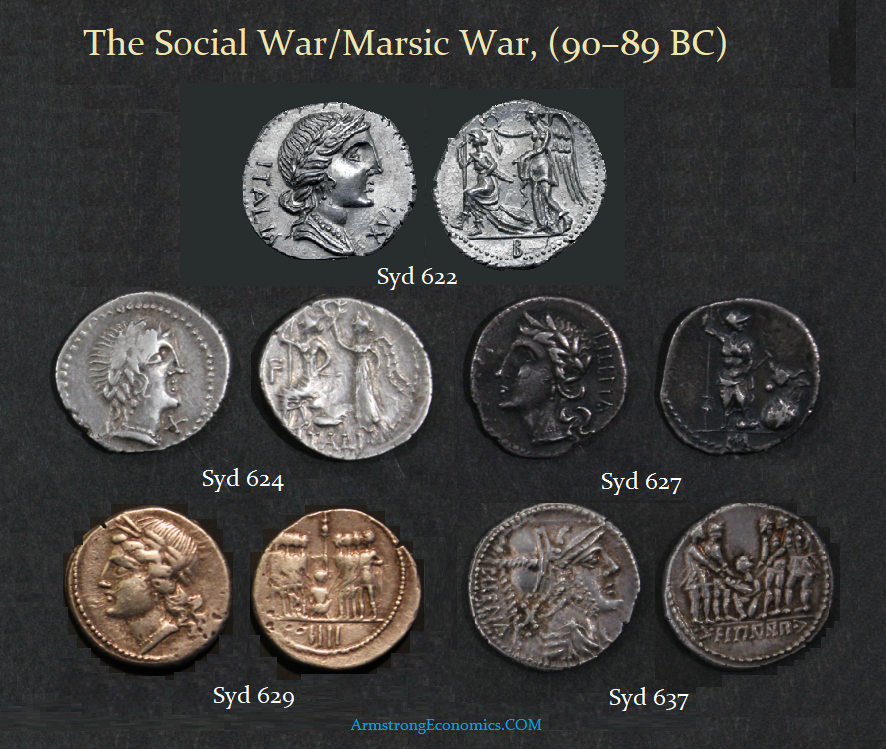
The Social War of the First Century BC was a failed Revolution against the corrupt Republic. The rebellion was waged by ancient Rome’s Italian allies (socii) who were denied equal rights with the Romans, despite the fact that they also fought alongside Romans in battle. They were seeking to separate and thus they fought for independence. Here are the coins of the rebels. They are very rare. You can see the theme celebrating the female head of Italia.
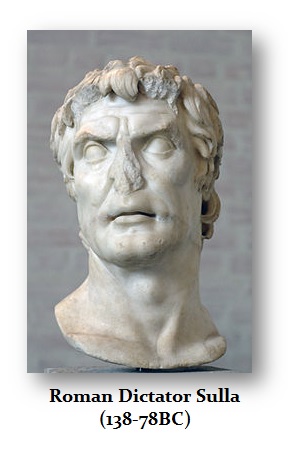
The allies in central and southern Italy had fought side by side with Rome in several wars and had grown restive under Roman autocratic rule, wanting instead Roman citizenship and the privileges it conferred. In 91 BC, the Roman tribune Marcus Livius Drusus proposed granting them Roman citizenship. The arrogance of the Senators erupted into a heated opposition. They went as far as to even Drusus for daring to propose such a decree. That resulted in the revolution.

When I dug deeper, the coinage with the debasement also reveals that there was a financial crisis. In all honesty, it was the Debt Crisis that ended the Roman Republic. There was a Sovereign Debt Crisis during the Roman Republic period that resulted in a dictatorship and a debt default. The Roman Debt Crisis of the 1st century BC has left behind a vivid account of what took place. The volume of gold and silver in Italy had increased dramatically during the late 2nd century BC following the Punic Wars. We have the first real gold coins issued by the Roman Republic at that time.
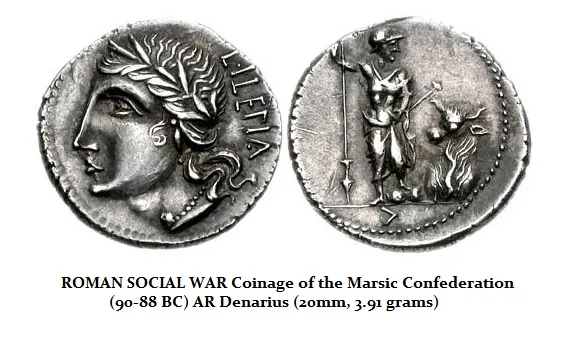
However, this concentration of wealth, which was akin to the United States after World War I and II, was absorbed by commercial expansion and investment in Gaul and Asia. A period of excessive concentration of money and large profits came to an end with the rise of the Social War of 91-88BC which was a war waged between the Roman Republic and several of the other cities in Italy (no taxation without representation), which prior to the war had been Roman allies for centuries. The war was begun by the Picentes because the Romans did not want to afford them Roman citizenship, thus leaving the Italian groups with fewer rights. The war resulted in a Roman victory and genocide against the Samnites. However, Rome granted Roman citizenship to almost all of its Italian allies, including the Samnites, to avoid another war. Therefore, we find that the debt crisis was correlated with a separatist movement – which we are beginning to see worldwide starting in Europe, but will eventually become a contagion in the United States as the conflict between left and right erupts after the November elections.
The Social War led to the complete state bankruptcy of the Roman State. We can see the dramatic rise in the money supply created during this time of war. This turmoil was then followed by the dictatorship of Sulla who then imposed an attempt to control the debt crisis capping interest rates at 12%. The previous legal rate was capped at 8.5%, but obviously, the market had exceeded that limit and Sulla had to confront that reality in 88BC. The debt crisis continued and then in 86 BC, the government was compelled into default. This is when the Valerian Law came into play. The State debts were defaulted on and thus reduced to 25%.
December Retail Sales Drop -1.1%, November Sales Data Revised Lower to -1.0%


Posted originally on the CTH on January 18, 2023 | Sundance 

There is something predictable about Main Street economics, eventually what you see around you overwhelms the great pretending.  CTH has been outlining the state of the consumer economy in great detail for quite a while, and though it is difficult to note when the outcomes will surface, eventually they do surface. [Reminder Here]

CONTEXT. CTH outlined the moment when the purchasing power of the U.S. middle class actually began contracting.  It was March and April of 2021 when that Rubicon was crossed.  We saw it in the second and third quarter data from 2021, but few were willing to admit.

What changed in those two months back in ’21 was a dramatic drop in the “unit sales” of stuff within the consumer economy.  The drop in unit sales was hidden because it happened simultaneously with the first wave of massive spike in prices.  Prices rose so fast the sales data was giving an artificial impression of sales growth, but in the background the actual unit sales dropped.   Those analysts correcting and adjusting historic data to ‘inflation adjusted terms’ are now noticing.

Additionally, and not coincidentally – because the metrics are connected, you will note this line from the Wall Street Journal review of the producer price index. “The producer-price index, which generally reflects supply conditions in the economy, rose 6.2% in December from a year earlier, the Labor Department said Wednesday, the slowest annual pace since March 2021.”  In essence, the current rate of wholesale price increase on materials is now returning to the rate of price increase that happened in the period when prices spiked.  Again, this is predictable.

Inflation is the measure of the ‘rate’ of price increase over time.  March and April of 2021 were the beginning of the first inflationary spike.

Driven almost entirely by the supply side shock from Biden energy policy, in the subsequent 20 months the rate of price increase skyrocketed, peaked August 2022, and now the rate of increase starts returning.  This does not mean price declines; this means the rate of growth in the price increase is lessening.

This is a cyclical outcome.

After 20 months of dropping unit sales, a result of massive price increases; and as the rate of inflation now starts to moderate created by the cyclical nature of it; what we now see is the inability of the price increases to continue hiding the drop in unit sales.   [Background pdf Data] Total retail sales data is now exposed and that’s why we will see this increasing story about negative sales data as the inflation cycle plateaus.

(Via Wall Street Journal) – Retail spending fell in December at the sharpest pace of 2022, marking a dismal end to the holiday shopping season as rising interest rates, still-high inflation and concerns about a slowing economy pinched American consumers.

Purchases at stores, restaurants and online, declined a seasonally adjusted 1.1% in December from the prior month, the Commerce Department said Wednesday. Sales were also revised lower in November and have fallen three of the past four months.

The decline in retail spending late last year adds to signs that the U.S. economy is slowing. Hiring and wage growth eased in December, U.S. commerce with the rest of the world declined significantly in November, and existing-home sales have fallen for 10 straight months. The Federal Reserve said Wednesday that industrial production slumped in December, led by weakness in the manufacturing industry.

S&P Global downgraded its estimate for fourth-quarter economic growth by a half percentage point to a 2.3% annual rate after Wednesday’s data releases. Economists surveyed by The Wall Street Journal this month expect higher interest rates to tip the U.S. economy into a recession in the coming year.

“The lag impact of elevated inflation weighs heavily on U.S. households, it’s very clear that the median American consumer is still reeling from the loss of wages in inflation-adjusted terms,” said Joseph Brusuelas, chief economist at RSM US LLP. “We’re moving towards what I would expect to be a mild recession in 2023,” he added. (read more)

When the Baghdad Bob economic pretenders say, “mild recession,” anticipate something more akin to a mild nuclear meltdown, something with breadlines and soup kitchens.

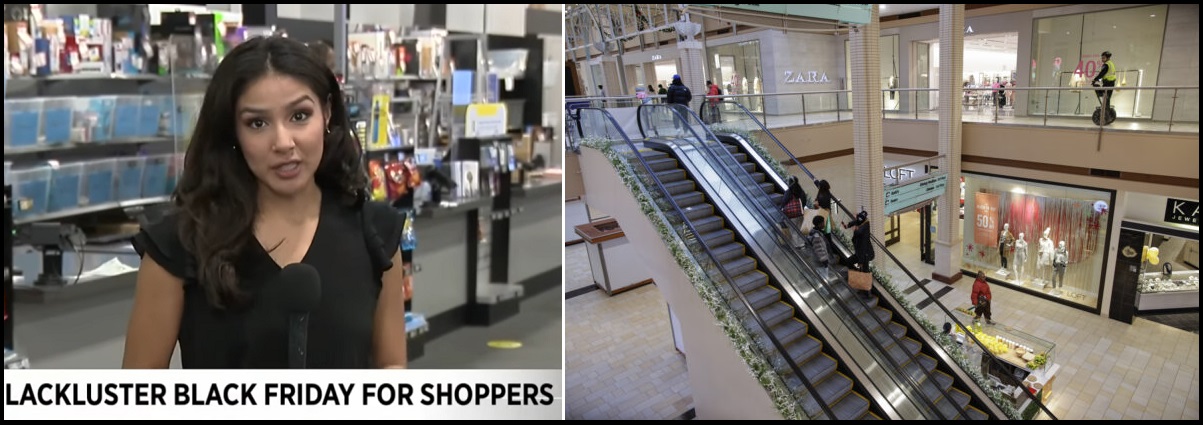
Now, you must keep in mind that almost every financial media outlet used the same Retail Federation talking point about anticipating an 8% increase in holiday sales last year.  [Reminder] Apparently, collective pretenses must be maintained.  Meanwhile, news crews and camera crews were having a desperate time finding any holiday shopping to use as background footage for the claims that sales were strong.  Here we are in January and the pretending has hit reality.

Negative retail sales in November and December when prices are roughly +10% over the prior year, means the unit sales collapse was far more dramatic…. Far more.

Trying to survive policy driven price increases in housing costs, energy costs, electricity costs, home heating, food and fuel costs has forced consumers to reevaluate purchasing decisions.  Consumer demand for non-essential items has collapsed, and Americans are dig deep into their savings just to sustain unavoidable expenses.  Eventually, pretending this is not happening is going to run into the wall of reality.

On one hand the leaders of large multinationals must pretend everything is splendid; after all, the only acceptable position they can articulate is to support interest rates being raised because demand is just too darned high….  pretending.  But on the other hand – those same suppliers and multinationals are furiously trying to calculate how to avoid being stuck with billions worth of unsold inventory and idle industrial equipment.

18th Century Copper Riots & Private Money


Armstrong Economics Blog/Civil Unrest Re-Posted Jan 6, 2023 by Martin Armstrong

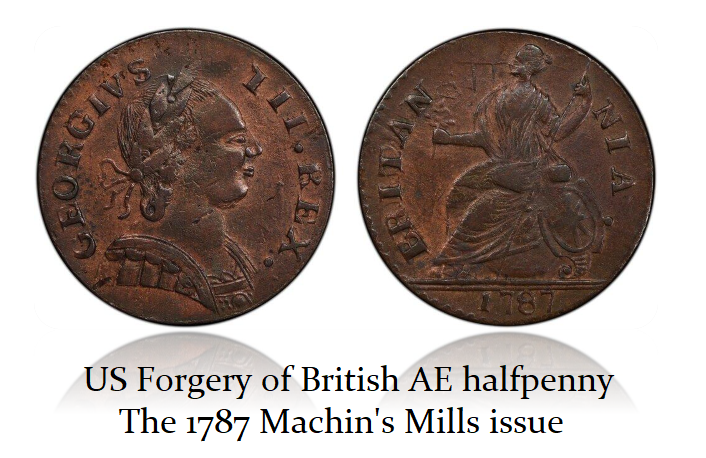
During the reign of King George III (1760–1820) the first issue of halfpennies actually was not issued until 10 years after his accession to the throne in 1770. Consequently, the vast number of halfpennies in circulation were actually all counterfeits. Indeed, counterfeiting became rampant at first because there was a coin shortage. In 1771, it was declared that counterfeiting copper coins were to be a serious crime. Nevertheless, this really made no difference. Over the course of the next twenty years, the majority of copper coins in circulation were forgeries. Even in the American Colonies, a favorite pastime was to counterfeit British halfpennies.

Coppers of this type are thought to have been minted from mid-1787 through 1788 and probably into 1789. Interestingly, it appears Thomas Machin first produced halfpence dated to the contemporary year as well as examples backdated to 1778. As the mints in Connecticut, New Jersey, and Vermont failed, their equipment ended up at Machin’s Mills. Along with imitation British halfpence, Machin’s Mills also produced illegal Connecticut coppers and some legal Vermont Coppers, with most of their Vermont coins being struck over counterfeit Irish halfpence. The illegal coining operation continued at Machin’s Mills until around early 1790, which was longer than any of the legal mints in New England.

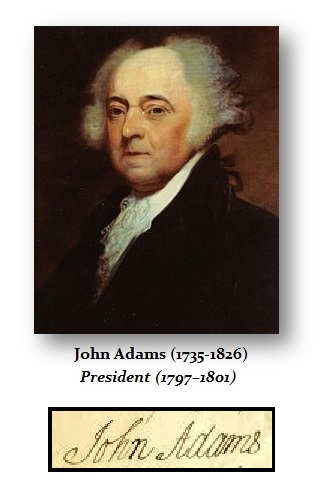
John Adams wrote to John Jay on April 10. 1787

“There is a vast sum in Circulation here of base Copper: to the amount of Several hundreds of thousands of Pounds. very lately these half Pence are refused every where: I suppose in Consequence of some Concerted Scheme. and it is supposed that they will be all purchased for a trifle and Sent to the United States where they will pass for good metal, and consequently our Simple Country men be cheated of an immense sum.2 The Board of Treasury, may be ordered with out the avowed Interposition of Congress, to give the alarm to our Citizens. and the seperate States would do well to prohibit this false Money from being paid or received.3

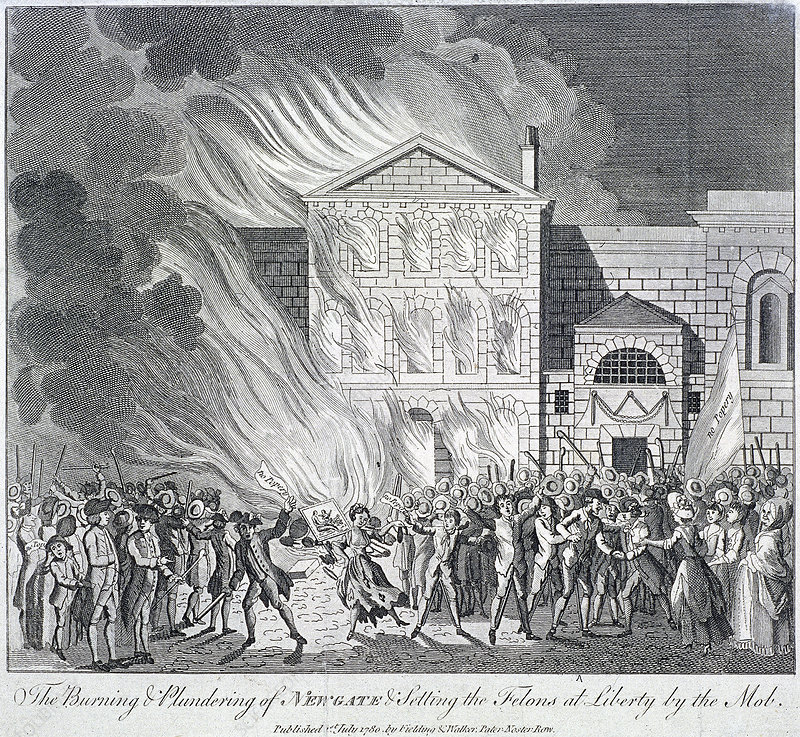
There was religious tension in Britain that still lingers to this day against Catholics. The Gordon Riots of 1780 took place over several days instigated by the anti-Catholic sentiment that again erupted with the passage of the Papists Act of 1778. That was an attempt to reduce official discrimination against British Catholics with the first legislation of the Popery Act of 1698. At the time, Lord George Gordon was the head of the Protestant Association. He argued that the law would enable Catholics to join the British Army and once in they would then use the army to plot treason. The protest became the excuse to burn people’s possessions, engaged in widespread rioting and looting, and they even used the opportunity to attack both Newgate Prison and the Bank of England. This was by far the most destructive riot in the history of London.

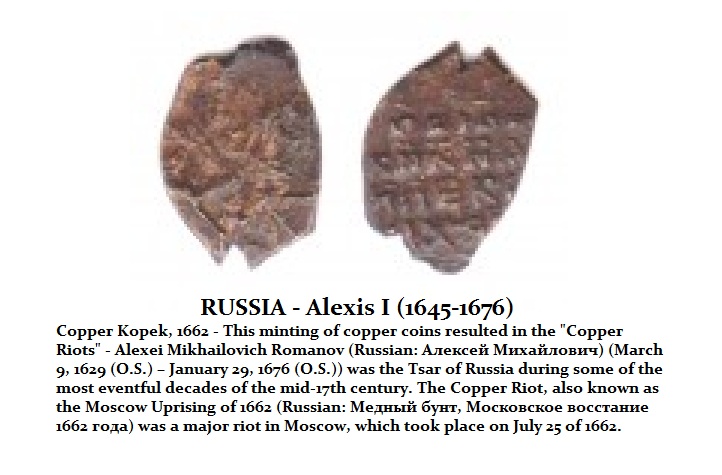
alexis-i-copper-riot-1662

From the mid-1600s, the world money supply was increased largely with copper coins. Russia, in particular, began to overvalue the copper coins. Money is always fiat for its value is typically dictated by the government. Overvaluing copper as in the 17th and 18th centuries, led to the same trend of overvaluing silver during the 19th century. The result of this monetary manipulation by the Russian government led to what became known as the Copper Riots of 1662.

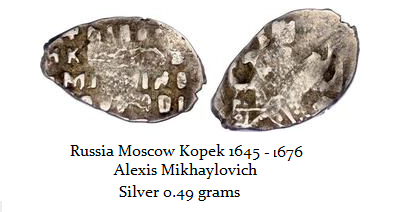
The Russian government began producing copper coins and monetizing them to be of equal value to silver Kopek currency with an average weight of about half of a gram to meet expenses during the mini-Ice Age. The effort failed and silver vanished from circulation as people began hoarding them causing the entire economy to collapse. The copper money was naturally devalued in purchasing power and then there were widespread counterfeiting operations since the official value of the copper coinage became far in excess of the cost of production. The economy collapsed into a deflationary black hole as businesses shut down and unemployment rose dramatically. This erupted into what has become known as the Copper Riots of 1662.

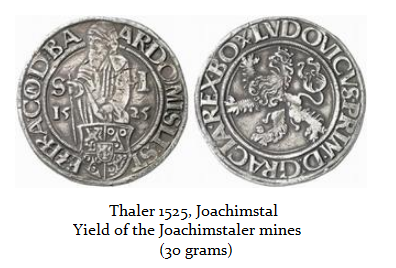
The German bankers, the Fuggers, emerged as the leading Augsburg merchant-banker, who then provided loans to local rulers secured with the silver produce of their mines. The discovery of vast silver mines eventually led to the development in 1525 of the one-ounce silver coin that was the thaler from which we derive the name “dollar” as the alternative to the British pound after the American Revolution. The Joachimsthaler of the Kingdom of Bohemia was therefore the first thaler ideally with a weight of 31 grams or one troy ounce.

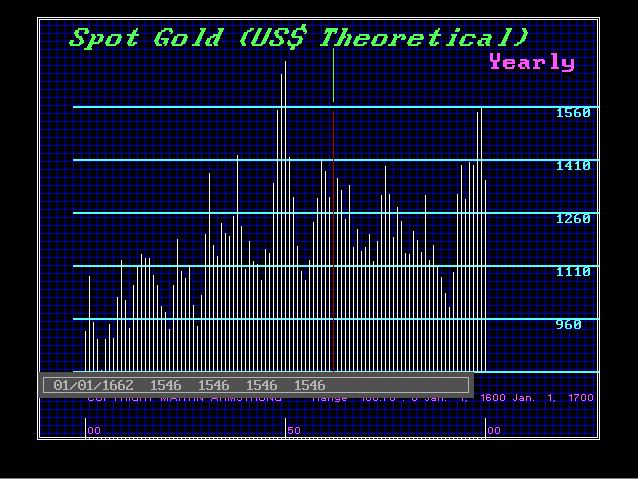
copper-panic-1662

As the silver mines were declining, the decline in the supply of silver led to the rise of copper coinage during the next century. This was not an isolated incident confined to Russia. There was a shortage of precious metals going into 1662. It was most profound in Russia. Nevertheless, the price of gold rose sharply from the low of 1655 in a 7-year bull market. This also reflected the deflationary atmosphere that was emerging thanks also to the mini-Ice Age which was peaking during the 17th century yet would last well into the mid-19th century.

It was Spain’s silver mine known as the great red Cerro Rico or ‘Rich Hill’ that towered over the city of Potosí in Bolivia. It had been mined since 1545 by drafted armies of natives. The great silver boom of c1575-1635 was when Potosí alone produced nearly half the world’s silver. But the mine’s yield was starting to decline. By 1678, native workers became scarce and the output of the mines began to dwindle. This was the royal mint that produced vast amounts of ‘pieces of eight’, which became the precursor of the American dollar. The shortage of labor ended up being augmented by purchasing African slaves from the Dutch who were buying them under the pretense that they were the spoils of war, which had been the justification for slaves from ancient times.

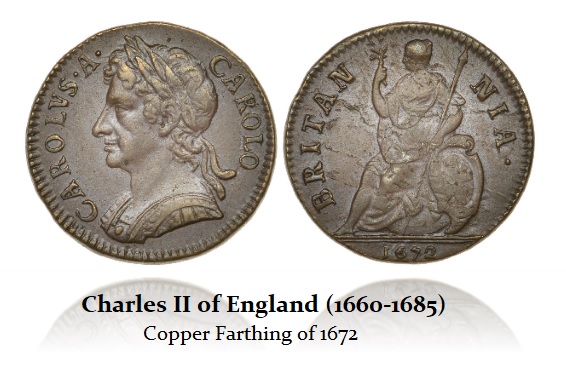
As the quantity of new silver in the world monetary system was declining, we begin to see the rise of copper coinage make its first appearance under James I of England (1603-1625). Due to a shortage of small coins, James I authorized John Harrington to issue tin-coated bronze farthings in 1613, and three main types were minted – the last being a slightly larger copper farthing without the tin coating. The first halfpenny was introduced in 1672 by Charles II (1660-1685). Charles II issued some copper halfpennies and farthings in 1672 for a single year but issued farthings again in 1873. The next issue of a farthing was struck in a tin but during 1684 and 1685.

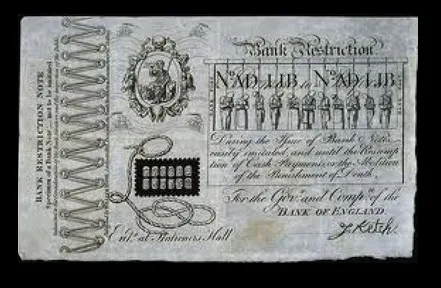
However, in 1694 the Bank of England was established to raise money for King William III’s war against France. The Bank started to issue notes in return for deposits. Therefore, the money supply for the first time began to include paper currency. By 1695 the first fraud took place. The authorities prosecuted Daniel Perrismore for forging sixty £100 notes. This incident caused the Bank of England to introduce a watermark in the paper to prevent such fraud. This was further enhanced by making counterfeiting subjected to the death penalty as a felony resulting in the confiscation of all your wealth and throwing your family out of the street as well. Pictured here, is a protest imitation note. The law was being prosecuted on the mere possession of a forged note. The complaint here was that these one-pound notes were easily forged and innocent people were duped, thereby committing a felony by mere possession. They were being hanged with no proof that they created the forgery – merely that they possessed one. This was creating an incentive not to even accept the notes in transactions.

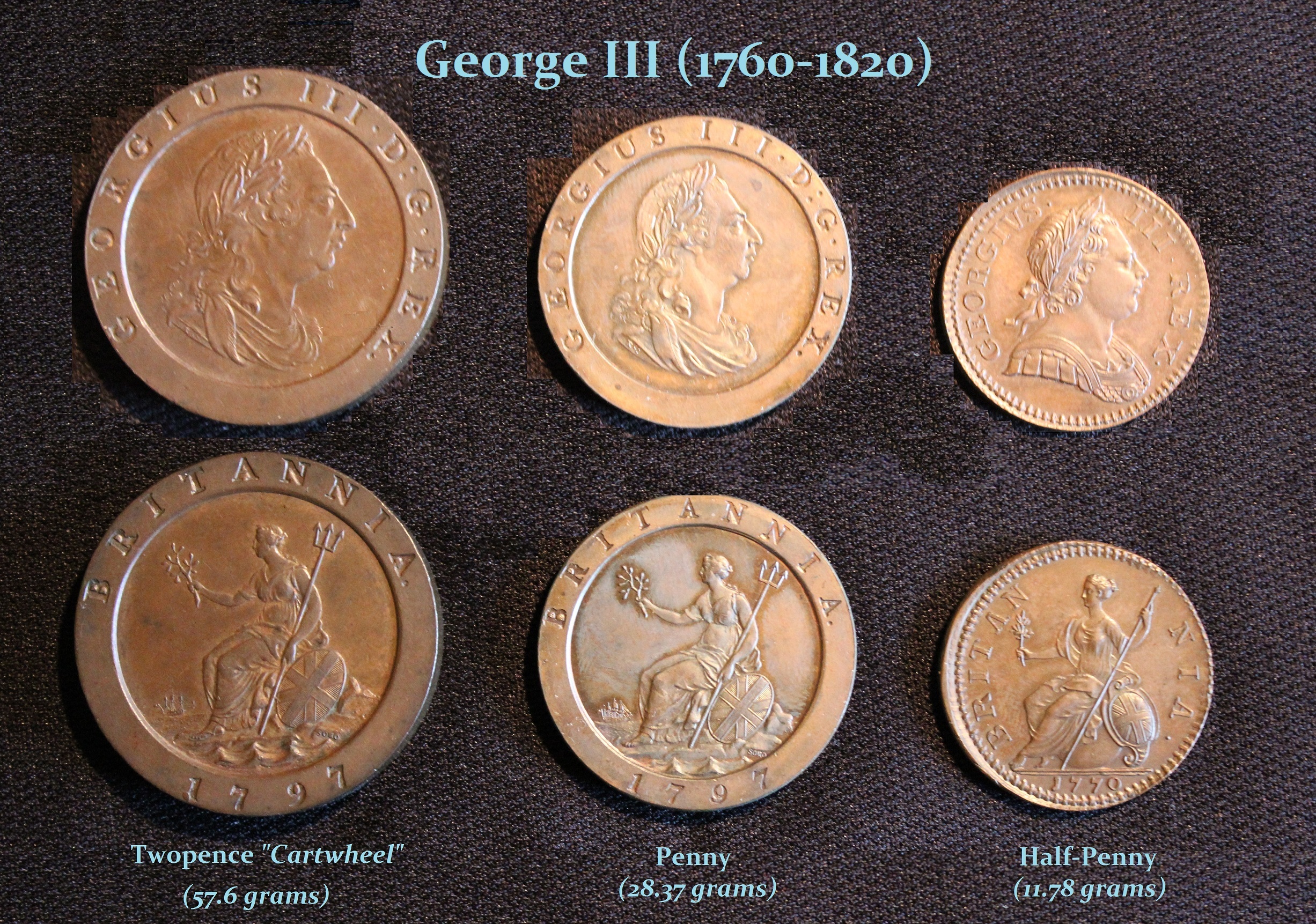
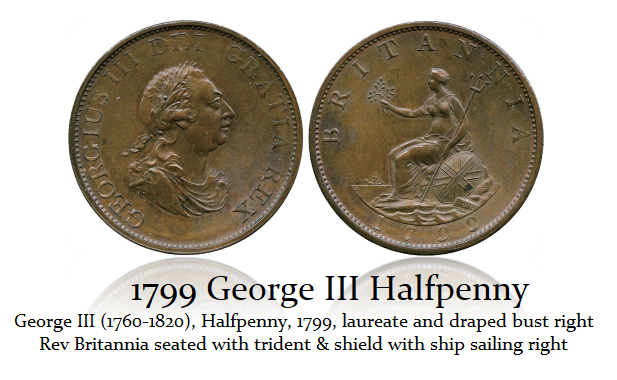
George I, II, and III all issued copper halfpennies. George III’s halfpennies were dated 1770 to 1772. The economic hard times no doubt contributed to the riots of 1780. After those events, at Newgate Prison in March 1782 a female alleged counterfeiter of halfpennies was hanged. She was then fixed to a stake and burned before the debtor’s door at Newgate prison in London as a further example of not to counterfeit.

In a letter to Lord Hawkesbury on April 14th, 1789, Matthew Boulton, who is considered the Grandfather of modern coinage,  commented

“In the course of my journeys, I observe that I receive upon average two-thirds counterfeit halfpence for change at toll-gates, etc., and I believe the evil is daily increasing, as the spurious money is carried into circulation by the lowest class of manufacturers, who pay with it the principal part of the wages of the poor people they employ”.

Boulton’s contract in 1797 to produce the Cartwheel pennies and twopences, thwarting the counterfeiters, did not extend to producing the halfpenny, though Boulton had expected that it would, and had prepared patterns of the appropriate size and weight in accordance with his ideas on the intrinsic value of copper coins. The reason the government gave for the omission of the denomination from the contract was that a large number of de facto halfpennies (including tokens and fakes) would be driven out of circulation and Boulton would be unable to produce enough coins to meet the demand that would ensue.

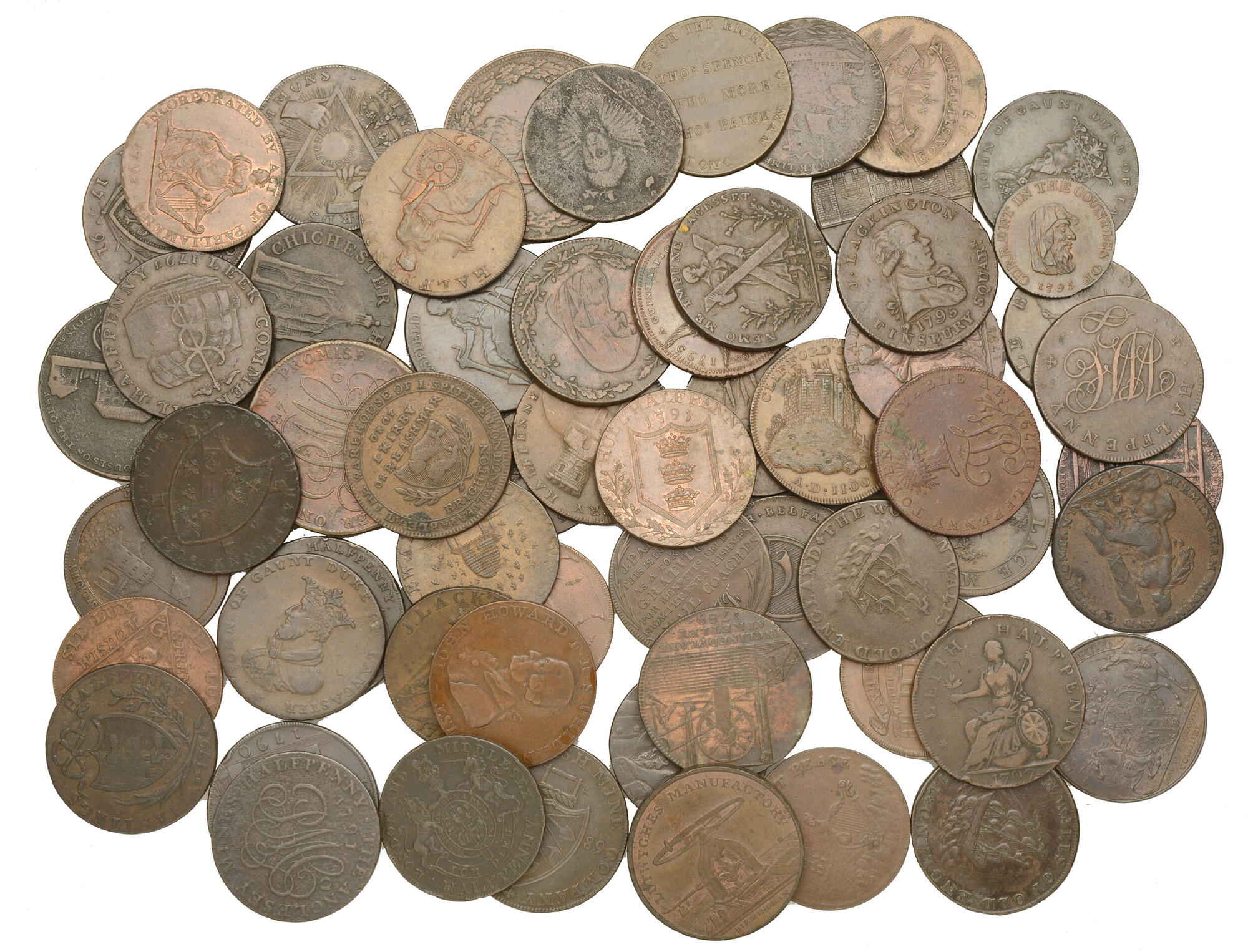
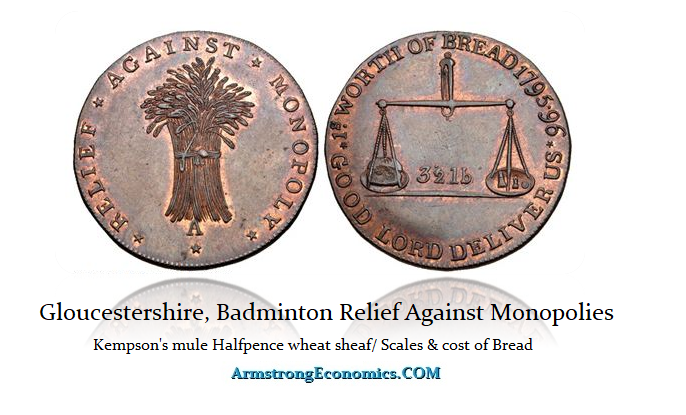
To avoid being hung for counterfeiting and burned at the stake, there was a multitude of halfpenny tokens. Many were of a political nature as this one complaining about the cost of bread. The government yielded to the private halfpenny tokens which became the majority of the small change. The overall public demand for legal halfpennies soon forced the government to change its mind, and in 1798 a contract was issued to Boulton for him to produce halfpennies and farthings dated 1799.

Interestingly, it was also at this time when inflation sent the price of copper rising, and consequently, the weight of the coins was reduced slightly, which resulted in them not being as popular as expected. In 1806 a further 427.5 tons of copper was struck into halfpennies by Boulton, but the price of copper had risen again and the weight was even less than the 1799 issue. This time, however, there was no unfavorable reaction from the public, so perhaps the national obsession with “intrinsic value” had run its course.

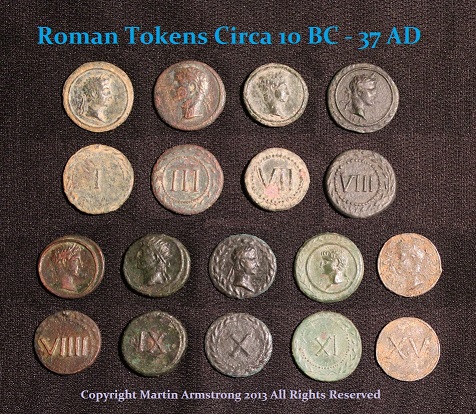
This was a very curious period where private money dominated the money supply for halfpennies. There are other periods where this has emerged in history primarily due to the shortage of real official money. One of the earliest such periods was during the reign of the Roman Emperor Tiberius (14-37AD).

Tiberius was legendary to be a frugal emperor. His deliberate contraction in creating new money led to the Financial Panic of 33AD. As far as Quantitative Easing, that too was nothing new. Tiberius offered loans INTEREST-FREE, but they had a limitation of three years. This was to prevent people from being forced to sell their estates further depressing land values.

There was a major earthquake in Asia, modern Turkey, and this was so devastating, he issued coins stating they were for the relief of Asia. He also waived all taxes in the region for 5 years – something our modern-day politicians would never dream of.

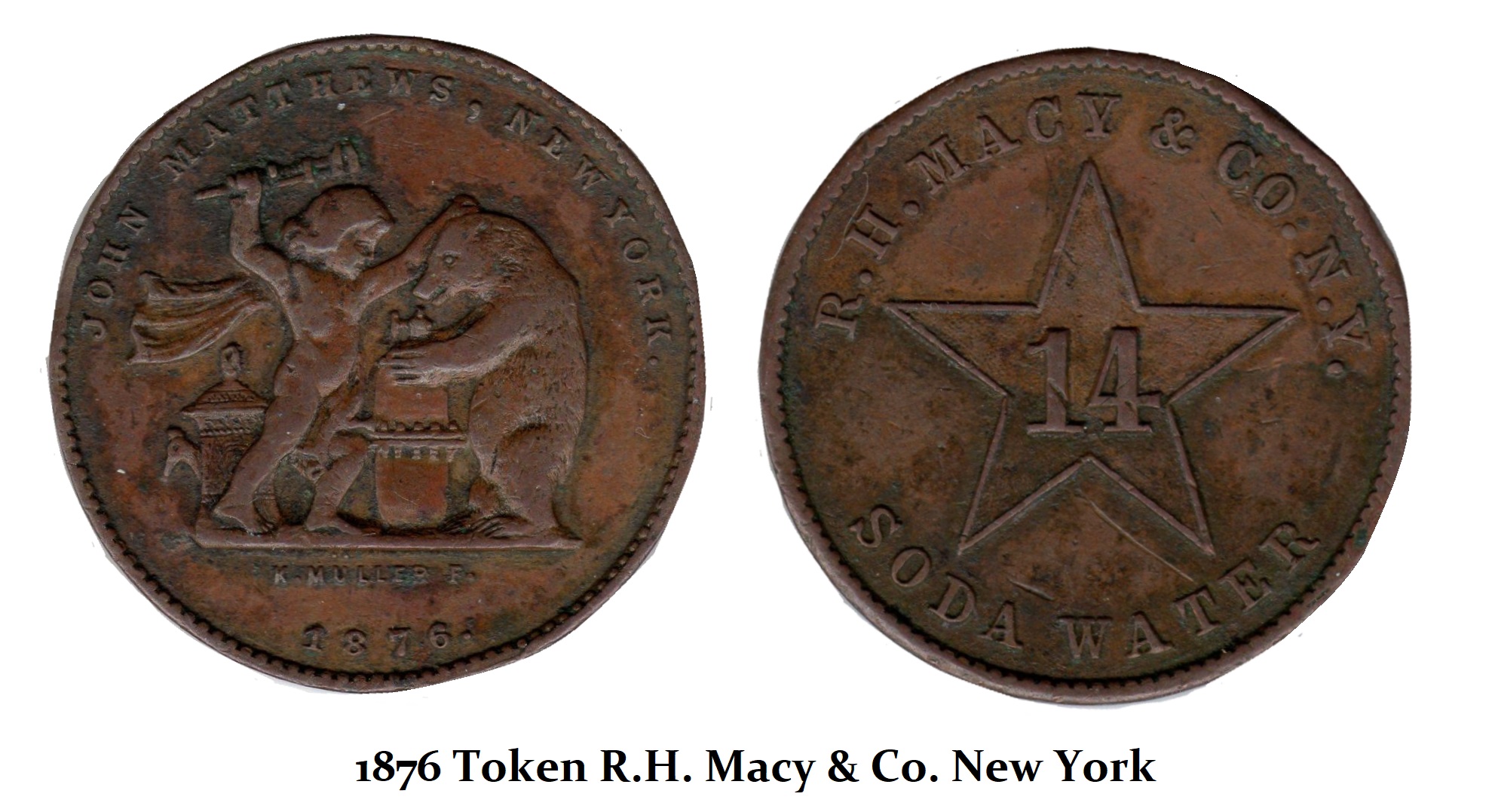
The lesson from history reveals that at times there emerges the acceptance of private money. During the 1870s, we also see private tokens circulating as money in the United States. Collectors call them the Hard Times Tokens. The very same thing took place during the American Civil War.

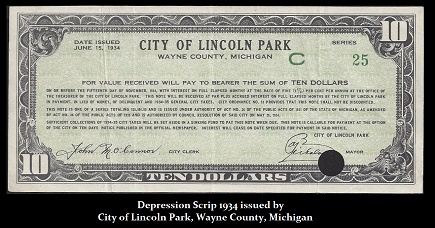
During the Great Depression, the shortage of money led to more than 200 cities issuing their own paper currency. As long as everyone in town accepted it, these Depressions Scrips enable people to work and to be paid locally when there was simply not enough federal money to go around.

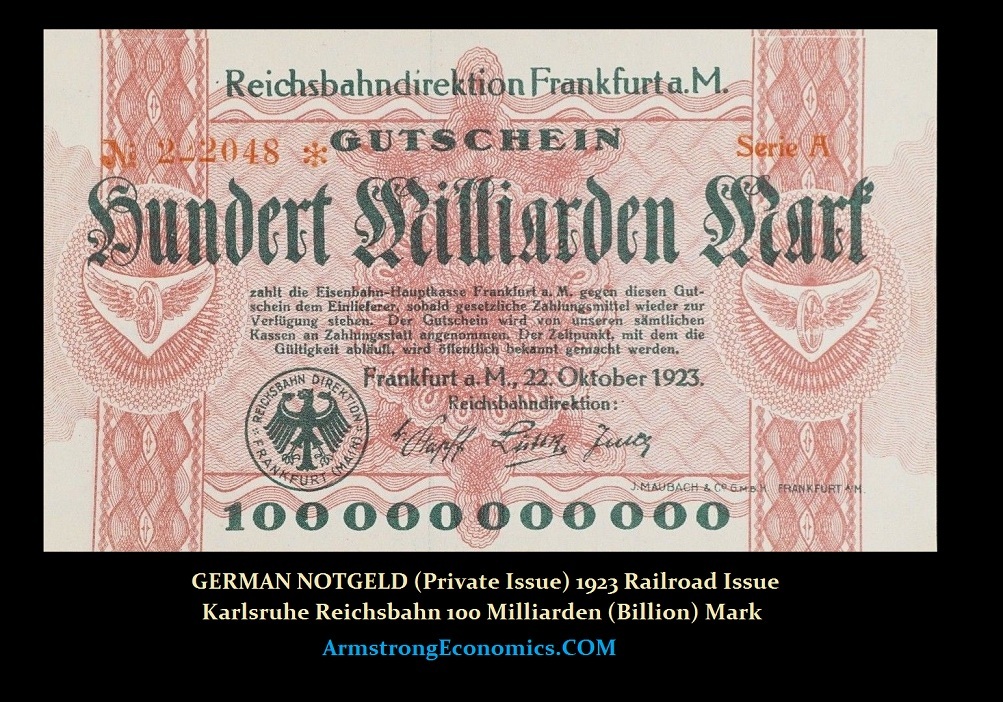
During the Hyperinflation in Germany of the 1920s, there again we see private currency being printed known as NOTGELD. Therefore, in the end, when the confidence in government declines, society is compelled to return to a barter-based society and that is when we begin to see private forms of money take hold.

The Real Cost of War


Armstrong Economics Blog/War Re-Posted Jan 6, 2023 by Martin Armstrong

COMMENT: Good Morning Mr. Armstrong, a long-time reader and client of Socrates and your conferences. I just read your entry for Belarus drafting 18 to 60-year-olds. I had a feeling that eventually, that would take place here in the states. I can tell you without a doubt, I will never comply. My family has served in WWII and Vietnam. We have given enough. I absolutely despise our government. I am wondering if this is part of the continued collapse of the government. With such low recruitment levels and the political fallout from the past few years, they must realize people will not be forced to serve. Especially those with the means to defend themselves. Is this a main component of civil unrest here with separatist movements? Just curious if you can elaborate on what you think will happen when they institute a draft here.
All the Best.

J

REPLY: My family has fought in every war since the American Revolution. My cousin still has the musket on his wall from the American Revolution. I lost half of my high school friends to Vietnam and my father and his three brothers were all in World War II and my grandfathers on both sides of the family were in World War I. There is no question that in a time of war, the first shot fired is both silent and never against an enemy. It is always against any truthful reporting of events.

The Defense Casualty Analysis System (DCAS) Extract Files contain records of 58,220 U.S. military fatal casualties of the Vietnam War. The government propaganda site, Wikipedia also directed by the Deep State, has low-balled the casualties claiming in total, all US and allied military deaths reached 282,000. We claim that is a victory for the VC lost 444,000 to possibly 666,000. The civilians who died have been low-balled with estimates of 405,000 up to 627,000. Just turn to Britannica and you get:

“In 1995 Vietnam released its official estimate of the number of people killed during the Vietnam War: as many as 2,000,000 civilians on both sides and some 1,100,000 North Vietnamese and Viet Cong fighters.”

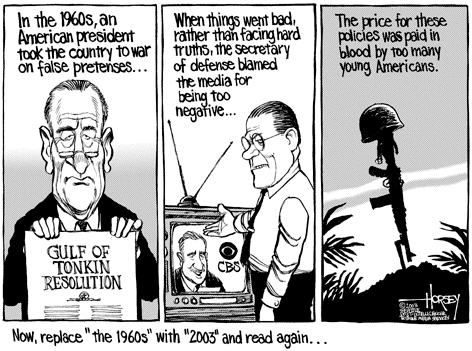
President Lydon Johnson knew there was no reason to enter Vietnam. He knew we could not get out easily. Still, he committed the country to war because the Neocons wanted it.

Audio Player

00:00

00:00

Use Up/Down Arrow keys to increase or decrease volume.

This is a famous photograph from Vietnam that is probably the most memorable of all time. You see South Vietnamese forces following terrified children. At the center is 9-year-old Phan Thi Kim Phùc, as she and other children are running from an aerial napalm attack on suspected Viet Cong hiding places on June 8, 1972. The plane accidentally dropped napalm on South Vietnamese troops and civilians. As always, just the collateral damage of war. The terrified girl had ripped off her burning clothes while fleeing. This photo was taken by Nick Ut of The Associated Press that captured the horror of Vietnam worldwide. It was 1972 when President Nixon said enough and promised to bring the troops home.

This 9-year-old make girl running from napalm, Phan Thi Kim Phúc, had profoundly changed her forever. Such people are tormented for a lifetime. They wake up at night dreaming over and over about the horror of those events for the rest of their lives. Kim Phúc was bitter and full of hatred she said. Later, she picked up the Bible and converted to Christianity. Today, she lives in Toronto with her family and helps other children victims of war around the world. It is those who survive who are profoundly tortured for the remainder of their lives. That is the real cost of war that nobody cares about.

The official estimate of civilian deaths in World War II stands at a total of 70–85 million. The actual military deaths were 21,000,000 to 25,500,000. There is ALWAYS an equal amount of civilian deaths in times of war. Those in power never want to talk about that.

War Against Conservatives


Blog/Press

Posted Jan 10, 2021 by Martin Armstrong

Spread the love

People are leaving Facebook, Instagram, Twitter, and were moving to Parlar. Google and Apple removed the Parlar APP and then Amazon kicked then off of AWS. This is a complete purge going on of all conservatives. We are in the midst of nothing short of a real live Russian version of a revolution. Cheer up – you get to see what it was like to live history in a major confrontation between left and right. But make no mistake about it, the super-rich remains in power just behind the curtain. They own the press and social media while they use the virus to prevent people from gathering or organizing. It is their way or no way. Their motto: Resistance is Futile!

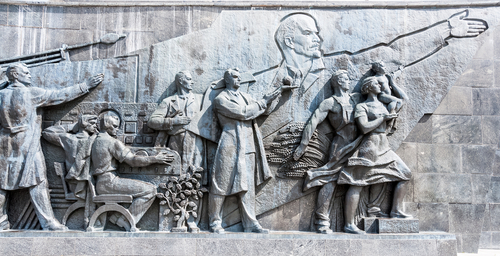
The SciFi Verison of Communism

Are the Immigrants Part of the Decline & Fall?


Armstrong Economics Blog/Migraction Re-Posted Jan 3, 2023 by Martin Armstrong

The invasion of migrants, both in Europe and the United States, is evolving into a major crime wave not seen in decades. In Germany, Berlin looked like a war zone. There were 3,943 incidents, but when recuse workers arrived, they were deliberately attacked. Some 15 firefighters and 18 police officers were injured. The Bild newspaper has reported that these incidents were “particularly bad attacks in the hotspot neighborhoods of Kreuzberg and Neukölln with a high proportion of migrants.” They were setting up barricades, setting them on fire, and when the firefighters arrived, they were attacked by some 200 men. There were even attacking an ambulance, hurling objects inside the vehicle’s open rear doors.

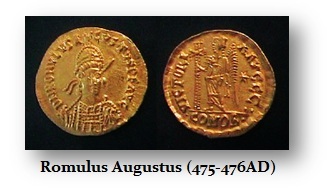
I have been getting emails from people shocked here in the United States from towns that never had any homeless are suddenly inundated. This mass migration into Europe and the United States is reminiscent of the barbarian invasions into Rome. Rome officially fell in 476AD with the last emperor named Romulus Augustus (475-476AD).

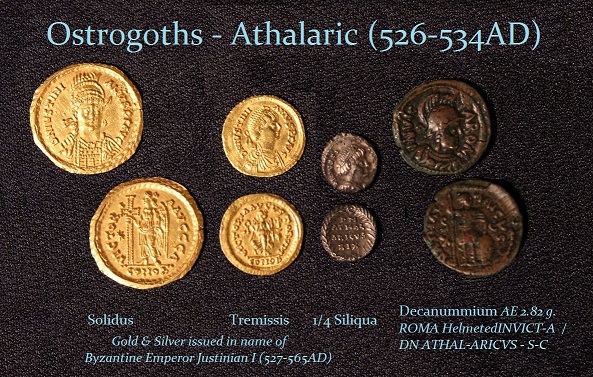
The barbarians effectively took over and even issued coins pretending to be Roman. They imitated the Roman Coinage. There had even been laws passed insisting you only marry a Latin. Even to this very day, in Italy, they do not consider those in Sicily Italians in some parts. I had gone into a bakery in Rome and asked for a cannoli. The owner wanted to pull a knife on me yelling that’s not “Italian, it’s Sigii” meaning from Sicily.

These migrations are all part of the decline and fall. Just like in Rome, once that process began, there was no turning back. They bring a different culture that undermined the traditions that held society together creating a civilization that will no longer be. The migration of the 19th century from Europe to America did not take place because of welfare programs. People came to America for the land of opportunity to work and to buy property. They did not come looking for free money and then wage war and violence to out of frustration demanding every more free money.

The Most Traumatizing Events From 2022!


Awaken With JP Published originally on Rumble on December 31, 2022 

JP’s summary of 2022

The Political Storm on the Horizon


Armstrong Economics Blog/Politics Re-Posted Dec 30, 2022 by Martin Armstrong

COMMENT: Could an individual state finish the wall started by the previous administration?
It’s painfully obvious Washington has its own agenda. And at this time, I see no point in even lobbying our federal government to do anything in our border towns/states. Is it legal to have our individual states finish what was started? I know I’m not alone in my concerns and would gladly contribute to a “wall fund”, or something of the sort. Maybe things are so corrupted it would be pointless?

REPLY: Yes, it is the state’s border. Knowing the atmosphere on Capitol Hill, it has simply become war and it has nothing to do with the benefit of the nation. I was impressed by the words of Arizona Sen. Kyrsten Sinema who courageously announced that she was leaving the Democratic Party to register as an independent. It was her words that rang true. She stated that she was abandoning the Democratic Party and turning her back on the “broken partisan system in Washington” that prioritizes denying the opposition party a win rather than “delivering for all Americans.

This is the very reason why the United States will collapse. There is no longer any sense of guiding the nation for the benefit of all the people. This has turned into a hate game. Neither side will dare to agree that ANYTHING the other side did was just, fair, or in the best interest of the whole. It is just partisan war and in the process, they are destroying the core of the United States and our once culture of freedom that was admired and inspired by the world.

I can confirm that when the US invaded Iraq on the nonsense of weapons of mass destruction, the pro-Americans in Russia lost ground. They were indeed pushing to join NATO and enter the world economy for the benefit of all the Russian people. But that invasion armed the Neocons and they pointed to that invasion that America was imperialistic and was seeking to control the entire world. It also lowered the esteem of America in the eyes of many in China. Ukraine has merely reconfirmed that view.

Politics has degenerated into a very dark era. If history repeats itself, there will be no other choice but to move toward separatism. We will no longer be able to live in peace together because that is not acceptable anymore. All this nonsense of what is your pronoun and men can have babies with a sex change is dividing the country into groups. Once you do that, you do not benefit the right of those people, you cast them as the new enemy of the state just as Hitler did with the Jews. The end is near for the United States. A house as divided as we have become CANNOT stand. That was the view of Lincoln to justify the Civil War.