QUESTION: Governments create their own sovereign fiat currency, to facilitate trade, among other reasons. So counterfeit is punishable, in some countries, by death, & at minimum, incarceration. Currency is supposed to be sacrosanct, created under the most exacting conditions. So what to do when your own gov’t engages in what is essentially officially endorsed counterfeit? I mean, the “money” has become almost meaningless, unless you’re on the receiving end. For non-insiders like me…buy PM.
HS
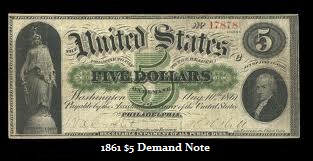
ANSWER: I have trouble with this misinformation always about the only money is gold and paper dollars are worthless fiats, which have rebuilt the world many times over since 1861 and the introduction of the paper dollar.
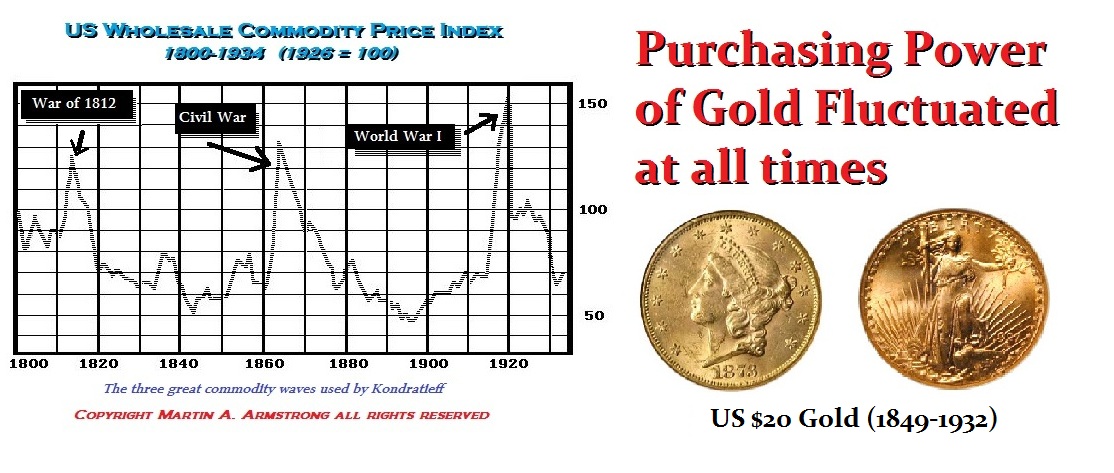
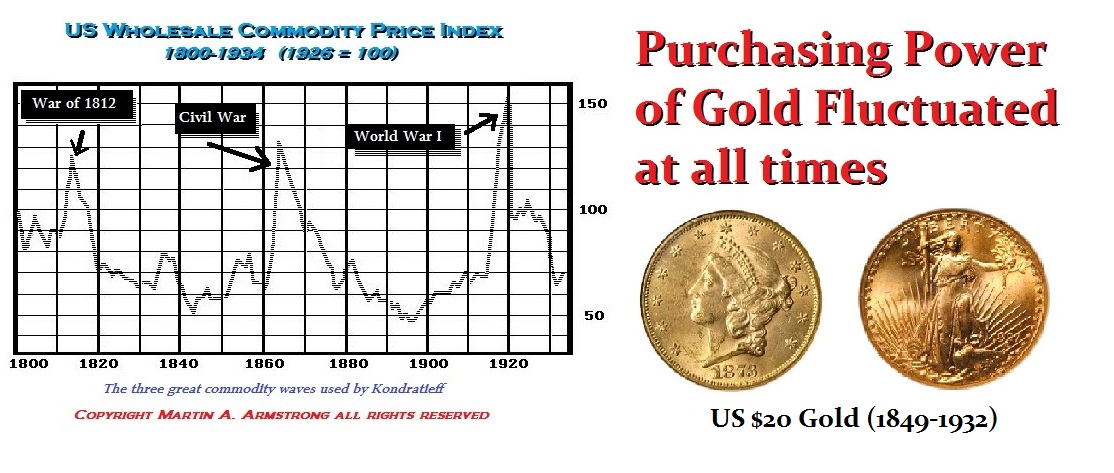
The propaganda of the goldbugs which has led so many to lose so much has been this nonsense that gold is the hedge against inflation. When the gold coin was money during the 19th century, it rose and fell in purchasing power no different than any paper currency. These people sell fiction like a used car salesman just to sell their product. It honestly does not matter what money is. It always is just a derivative of barter. I give you this for that. You will accept paper money because you know that others will accept it from you. A woman tried to spend a $20 gold coin at Walmart and they refused to accept it because they did not know what it was. She then took them to the back and exchanged them for $20 bills.
Try going to Starbucks and spending a $20 gold coin and asking for change. Unless the salesperson knows what it is, they will refuse.MONEY has always been nothing more than a belief system. That’s all!
FIAT simply means by arbitrary decree. Just because a currency is gold or even silver, does NOT make its value intrinsic. Governments have debased their coinage and reduced the weight declaring its value shall be whatever they say. I have written about how Japan did that and eventually, the people refused to accept Japanese coins and they stopped minting them for 600 years.
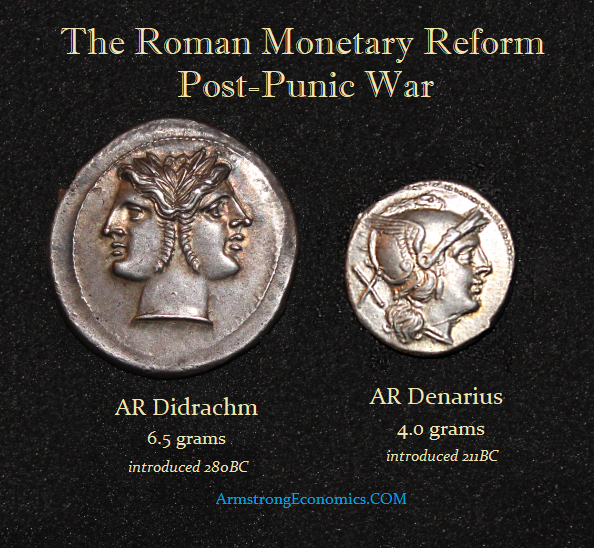
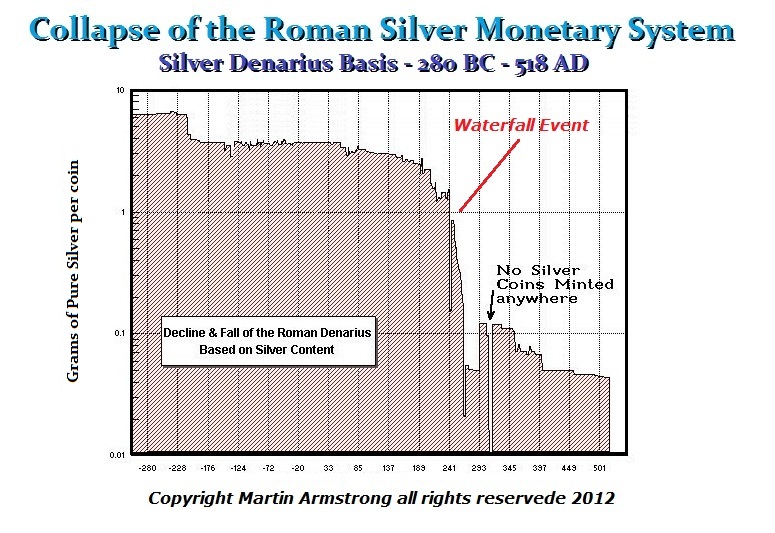
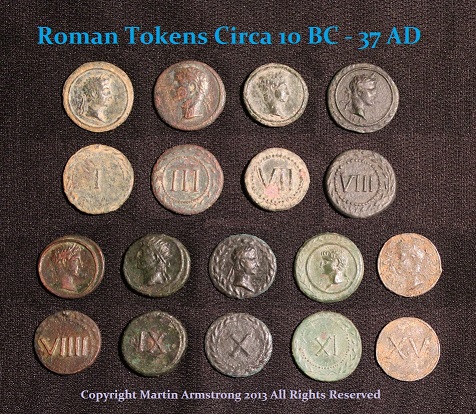
The Romans reduced the weight of their silver coinage from 6.5 grams to 4 grams and only because they defeated the Greeks, the Roman monetary system became standard.
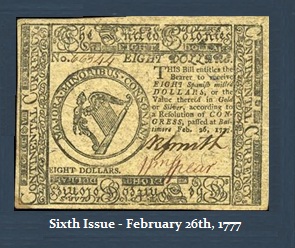
During the American Revolution, people accepted the Continental Currency. Money has always simply been predicated upon what people will accept.
Gold has no value whatsoever unless the other person also believes it has value. Gold or silver has no value intrinsically any more than a paper dollar or a bag of rice unless there is an unspoken agreement among people that it is a valuable medium of exchange.
This is the truth. All else is propaganda. Money has been many things throughout thousands of years from seashells to cattle and even slave girls.
Saint Patrick in the 5th Century AD upon his arrival in Ireland, found that MONEY was expressed in human slave girls. He wrote in his Confession,“I think that I have given away to them no less than the price of fifteen humans.” This passage shows something very important. First, MONEY is not defined as the Medium of Exchange exclusively. It also serves the purpose of a Unit of Account. This becomes the true function of MONEY even more so than what it is. MONEY is a language of value.
FIAT is when the government dictates what something is and that will be Digital Central Bank Currency. But if everyone accepts it, then it becomes the medium of exchange.
QUESTION: Mr. Armstrong; Who is being irrational? The markets or the analysts?
KE
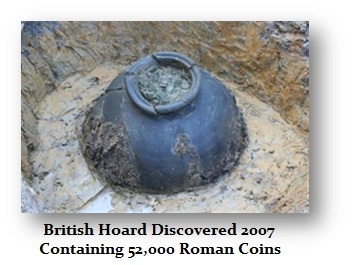
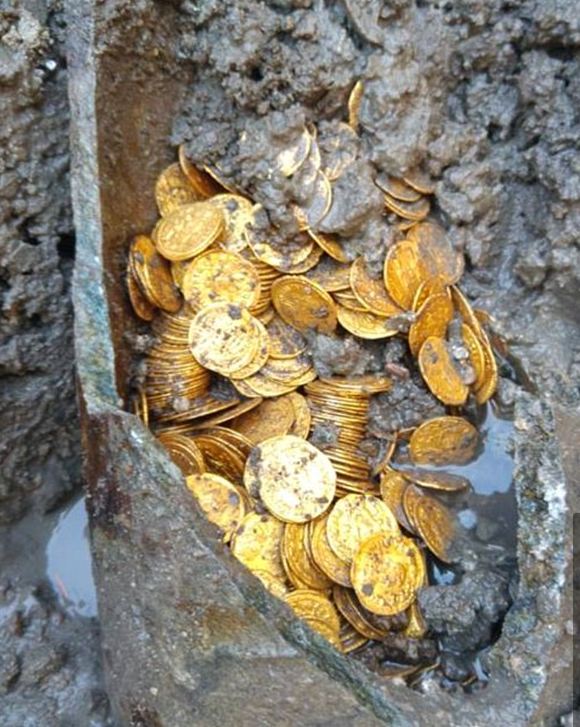
ANSWER: That’s simple. It is the analysts. The markets are ALWAYS correct. When you have bank failures unfolding, people will withdraw money out of caution. It is the very same reason there are ancient hoards of coins. You find coins in times of economic stress and uncertainty. This is a purely RATIONAL human response to uncertainty. It consistent for thousands of years. For any analyst to claim the markets are acting “irrationally” only proves they should look for another profession.
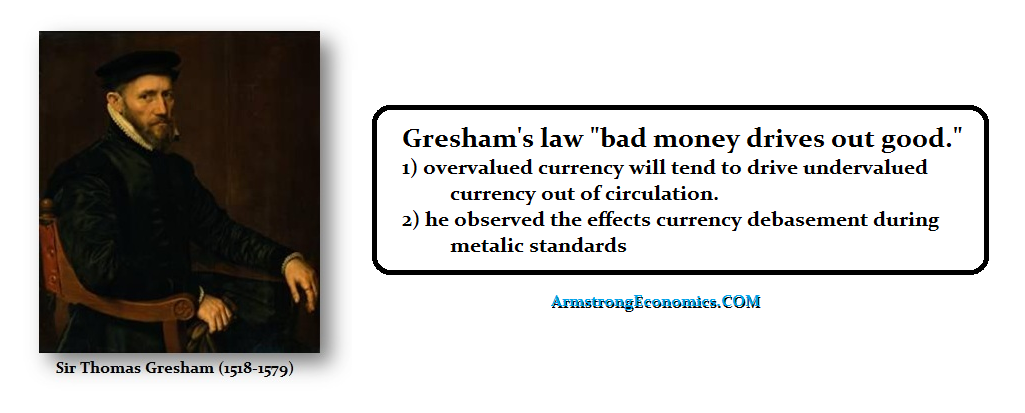
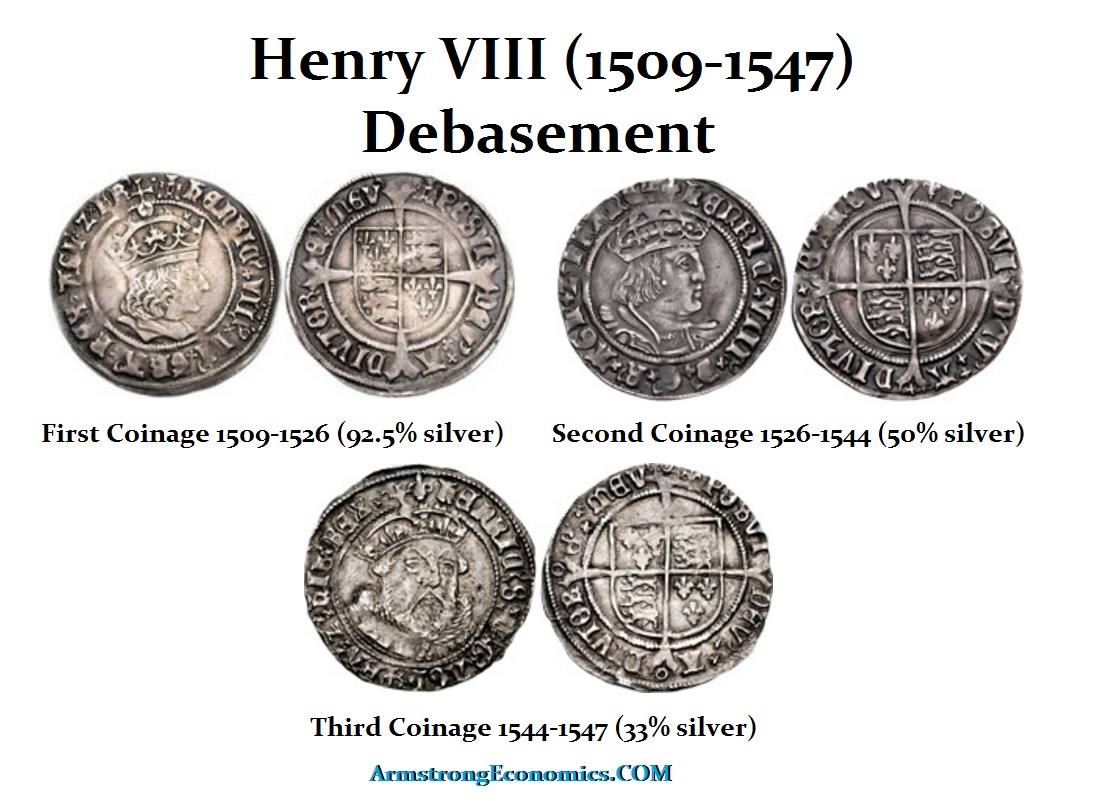
Sir Thomas Gresham began his career in 1543 working at Mercers’ Company at the age of 24 years old. He left England for Antwerp/Amsterdam which was the financial center of the day much like Wall Street. That was where he became a merchant businessman which was where banking existed in those days. He became an agent for King Henry VIII in the Antwerp/Amsterdam market. He became a trader and in so doing, he began to observe how capital moved.
The interesting aspect was that he was called in as a sort of crisis manager as I have been during financial upheavals. In 1551, Sir William Dansell, who was King’s Merchant there in the markets, ended up putting the English Government into a financial crisis thanks to his mismanagement. The English turned to Gresham for advice since he became quite astute at trading. They adopted his proposals. It was then that Gresham proposed a very ingenious tact. He advocated a FOREX intervention to push the pound higher on the Antwerp change. His intervention proved so successful that in just a few years King Edward VI had discharged almost all of his debts. By pushing the pound higher, he was able to repay the previous debts by devaluing them.
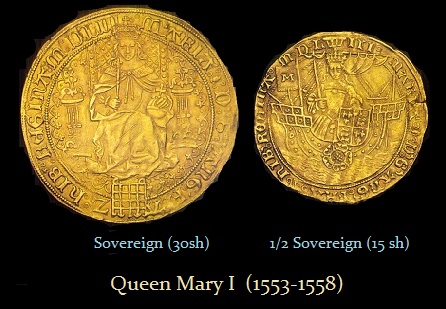
Therefore, the English Crown sought Gresham’s advice in all their finances until Mary came to the throne in 1553. Gresham was instantly pushed aside for Alderman William Dauntsey, who lacked trading experience and quickly sent the Crown into financial stress. Gresham was called back to deal with the mess once again.
Under Queen Elizabeth’s reign (1558–1603), he continued as a financial agent of the Crown and also became the Ambassador Plenipotentiary to the Governor of the Netherlands. This was the period of civil unrest in Antwerp which compelled him to return to England in 1567. This is also when the English had the founding of the Royal Exchange to compete with the Netherlands. It was Gresham who made the proposal to build, at his own expense, a bourse or exchange. This demonstrated that Gresham was a trader and understood how capital flowed. Apart from some small sums to various charities, Gresham bequeathed the bulk of his property (consisting of estates in London and around England giving an income of more than 2,300 pounds a year) to his widow and her heirs, with the stipulation that after her death his own house in Bishopsgate Street and the rents from the Royal Exchange should be vested in the Corporation of London and the Mercers Company, for the purpose of instituting a college in which seven professors should read lectures, one each day of the week, in astronomy, geometry, physic, law, divinity, rhetoric and music.[1] Thus, Gresham College, the first institution of higher learning in London, came to be established in 1597.
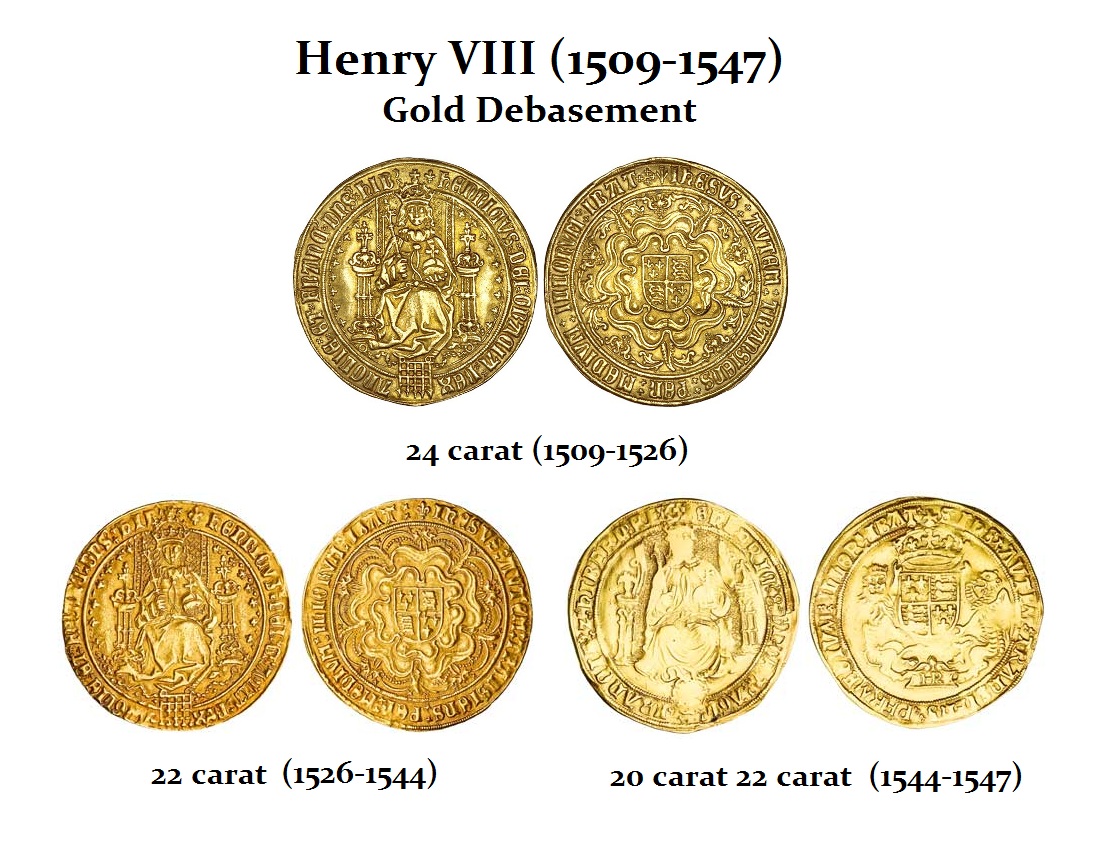
Gresham’s Law (stated simply as: “Bad money drives out good“). He concluded this from his observations that foreign exchange back then was based on the metal content and weight of the coinage. Therefore, as debasement took place, people would hoard the old coinage of higher quality and spend the debased. Thus, the bad money drove out the good and actually shrunk the money supply in circulation.
He urged Queen Elizabeth to restore the debased currency of England. In so doing, you got to repay old debts with debased currency. Governments to this day practice that same trick. Repaying a 30-year bond today the bondholder cannot buy what the money was once worth 30 years ago. The interest does not really compensate for the loss of purchasing power over long periods of time.
The Chinese yuan has out-traded the US dollar by volume for one of the first times in recent Russian history. The dollar was king in 1991 when the Soviet Union collapsed, but that is no longer the case after Moscow branded the dollar a “toxic currency” along with the euro. Toxic currencies accounted for 87% of exports from Russia at the beginning of 2022, but this figure fell to 48% by the start of the new year. The Bank of Russia has reported that the proportion of USD/ruble pair in exchange fell to only 36% in February. The central bank is calling this a “broad structural transformation of the Russian economy.”
As “unfriendly countries” and their “toxic currencies” band together, those on the outskirts are winning. China has become the new go-to country for new trade partnerships as it bypasses Western-imposed sanctions. Toxic currencies represented 46% of imports in December 2022 but were at 65% in January 2022 before the war. In contrast, the yuan’s share rose from 4% to 23% during that time.
Those who were previously shunned from the big table are now pulling up a chair to discuss economic prospects with China. This will make it much easier to phase out toxic currencies because more people are willing to accept the yuan. The confidence in the yuan is growing. Everything occurring may seem odd, but it is precisely on target. As I mentioned in my report“China on the Rise,” China will dethrone the United States to become the world’s leading economic powerhouse by 2032. It’s just time.
QUESTION: If the metals are not trading at a fair value relative to everything else, then does that not prove they are manipulated?
SN
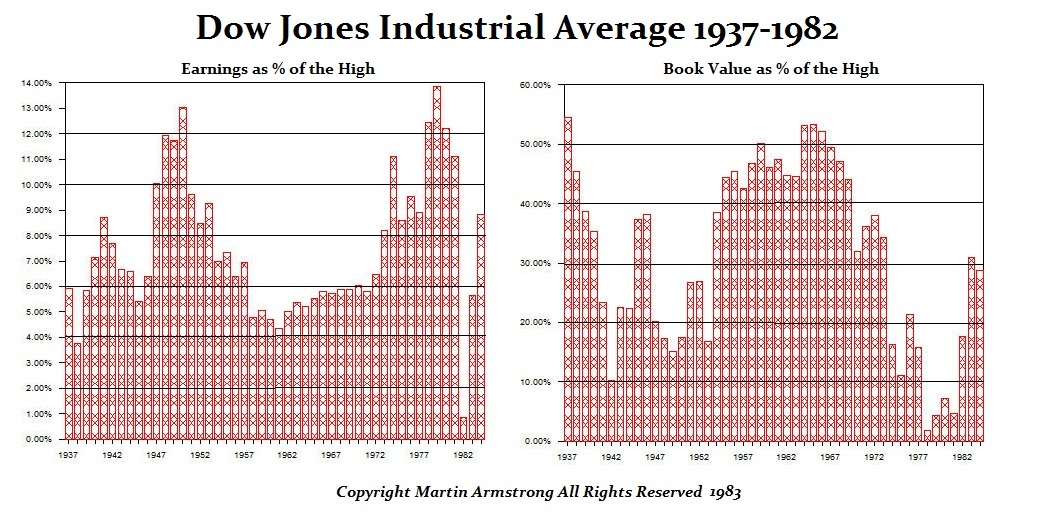
ANSWER: Your problem is the assumption that everything must be trading at some fair value. That is up there with the theory of random walks. ALL markets trade for periods where they remain well below fair value. That was the entire takeover boom of the 1980s which they also blamed on me because I was advising many of the takeover players. I simply showed these charts back then which show in terms of book value, the Dow Jones bottomed in 1977. The market was grossly undervalued because you could buy a company, sell all its tangible assets, and double or triple your money. Michael Douglas’ famous speech in that movie about “greed” would not even be possible if everything always trade like some mythical robot at fair value. Everything overshoots and undershoots.
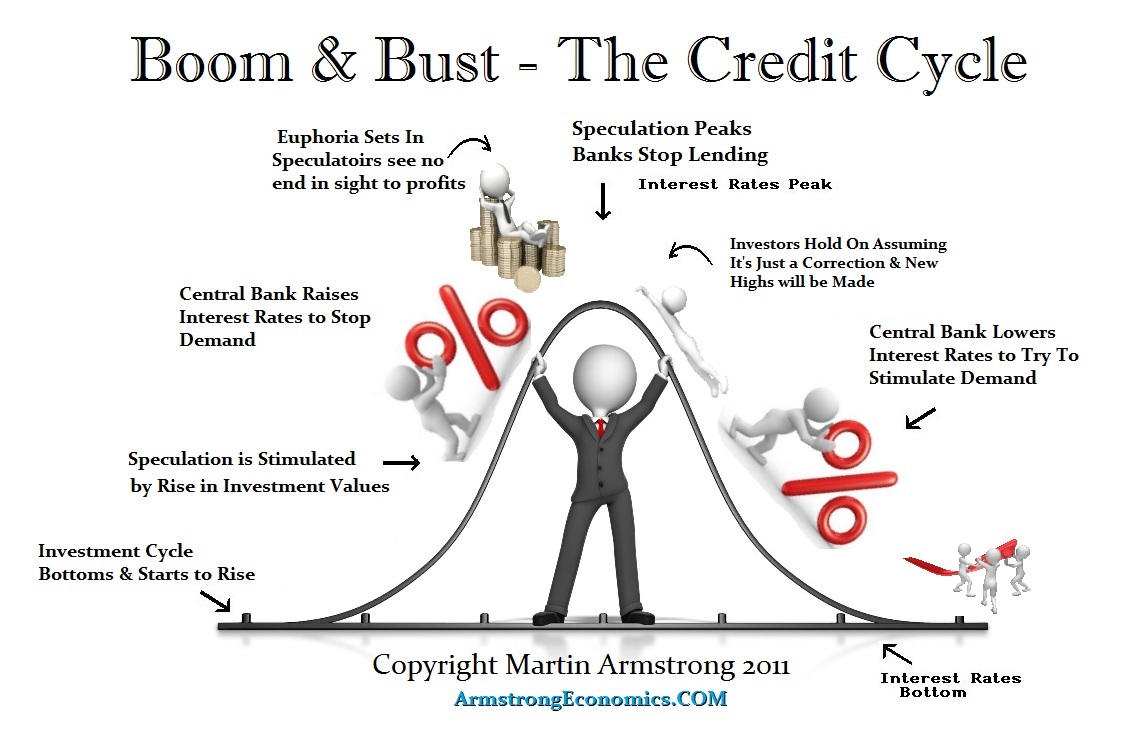
The metals are NO DIFFERENT. Every market swings between grossly UNDERVALUED and then grossly OVERVALUED. This is part of the business cycle. If there were no periods of gross undervaluations, there would not be a sudden boom either.
This is what you have to come to grips with. There is such a thing and the business cycle. Our cyclical analysis would not be possible if everything was trading at a flat line of fair value. This nonsense in metals is made up of people who have been wrong, and need to blame someone else. It is like blaming climate cycles on CO2. This notion of fair value is rooted, I hate to tell you, in Marxism, because he too did not understand the business cycle.
QUESTION: Do you think that this entire scam with cryptocurrencies that the government will be able to track, do they realize that in war you take down the power grid and all digital currency fails? If the backup system is destroyed, all your digital currency will vanish. Are they this stupid? Is this why they have shills saying you are wrong?
HK
ANSWER: Yes. I have spoken to people involved in creating this insanity. First, they do not think there will ever be a nuclear war. Second, they really do think that they will create regime change in Russia at the expense of probably every Ukrainian alive today who are fools being led to the slaughter. When I have brought up the subject – WHAT IF YOU ARE WRONG! They dismiss it and do not even entertain plan B. The whole digital currency is all about tracking every dime. I have said many times, this is all about the new world order which is Schwab’s Great Rest and he knows that is our 2032 forecast. They all believe that forecast and are preparing to redesign the world this time to achieve their totalitarian dreams.
When I asked – Did you authorize Bitcoin? They just do not reply. Silence is golden. The launch of Bitcoin was just too damn convenient. That was standard operational political tactics – you float a balloon and see how the people accept it.
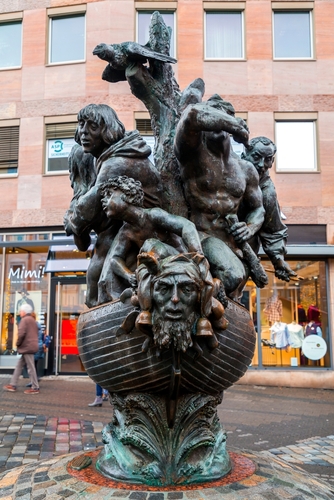
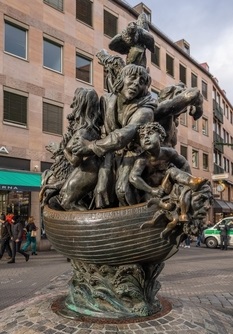
If you have ever been to Nuremberg, Germany, they have a bronze statue there – the Ship of Fools. The sculpture named Ship of Fools by Jurgen Weber is based on the satirical allegory by Sebastian Brant. This is now a reality.
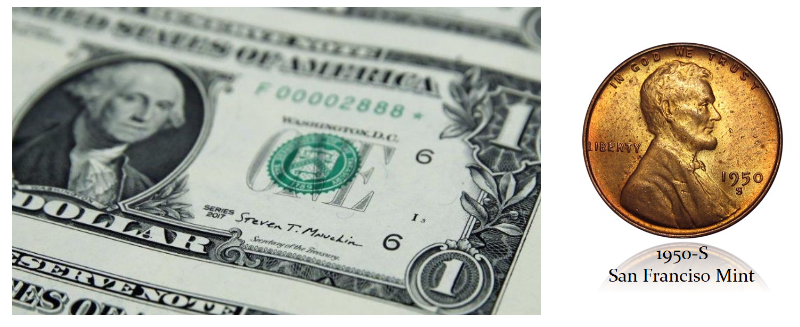
History repeats because human nature never changes. During the Roman Republic, the name of the moneyer would appear on the coinage just as today the Secretary of the Treasury’s signature appears on our paper currency – i.e. Steven T. Munchin. To this day, our coins are denoted by which mint produced them – Philadelphia, Denver, or San Francisco.
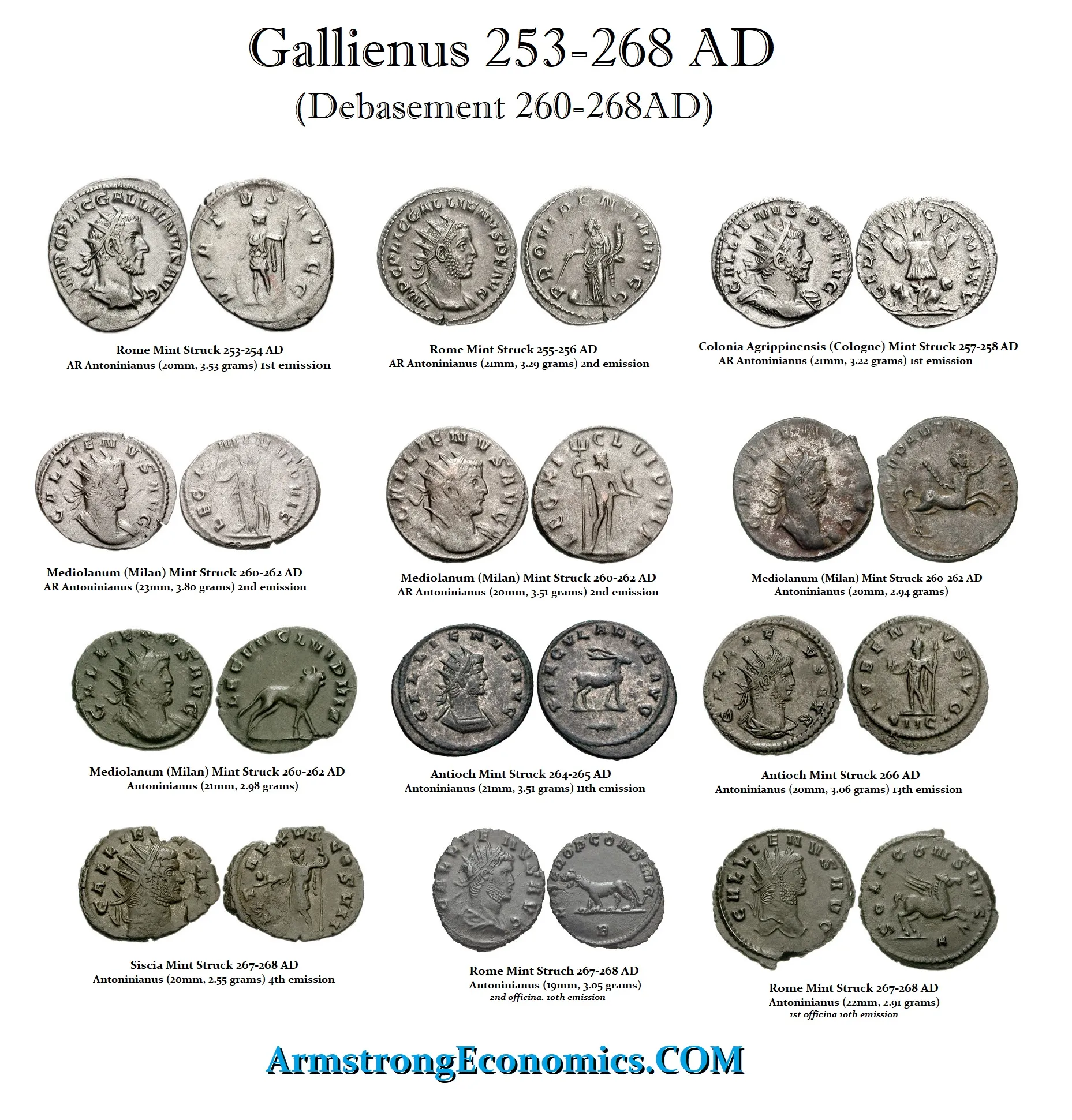
The collapse of the monetary system following the capture of Emperor Valerian I in 260AD by the Persians, set off a collapse in public confidence whereby the people suddenly saw Rome as vulnerable. What is fascinating is that the “hyperinflation” of Rome which took place in just 8.6 years, was aided by the corruption within the Deep State of the Roman Empire. This raises the question: We will see the same thing take place during our final 8.6 years into 2032 which begins by May 2024. The debasement of the coinage was NOT on the decree of the Emperor. This was the greed of those in the Deep State.
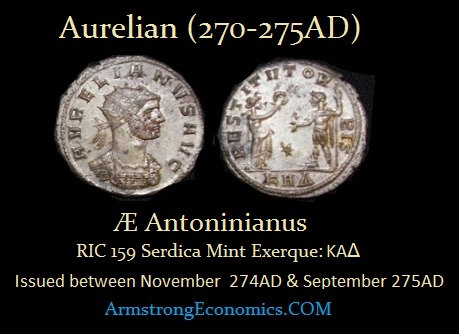
Following the assassination of Emperor Gallienus, that is when Claudius II came to power and the debasement reached it lowest point during his reign. The Goths invaded Rome and brought the plague with them from the East. Emperor Claudius II died of the plague. Claudius’s brother, Quintillus tried to succeed him, but Aurelian and his troops marched against him. His troops deserted him and he committed suicide.
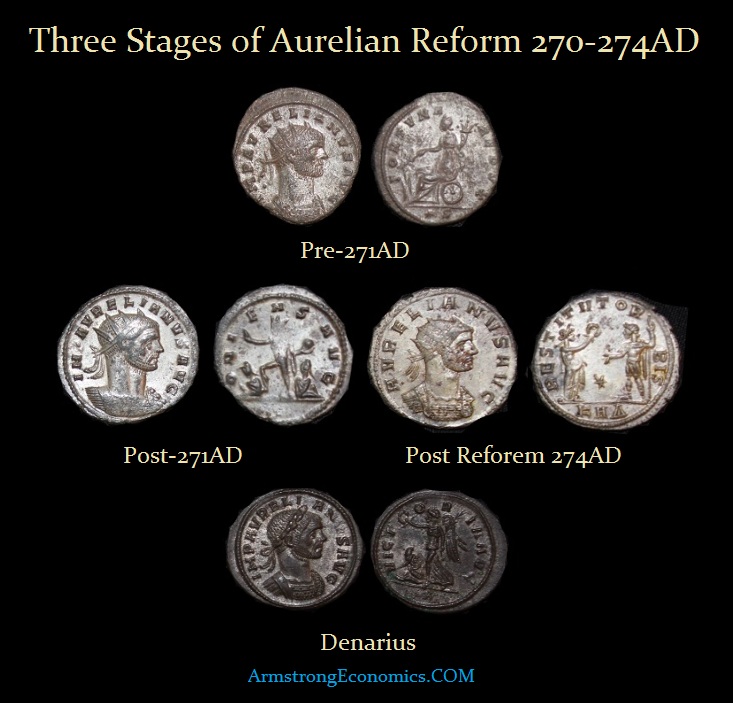
Therefore, Aurelian became emperor in 270 AD and he returned to Rome in 271 AD, where he had to pacify a terrified city. He immediately halted the rioting and restored order to the capital. The controller of the mint in Rome began a rebellion over the monetary reforms laid out by Aurelian. He ordered that all the debased currency be purchased back and replaced with a new currency of higher content in silver. The rebellion was led by Felicissimus. It appears that those who had been running the mint were embezzling the intended silver and issuing the debased coinage at least in part on their own authority.
Obviously, any reform to the monetary system that called for an increase in silver content would have been unprofitable for those running the mint for personal gain. In the rebellion, as many as 7,000 soldiers died when Aurelian was forced to trap and execute them and their allies, some of the senatorial ranks, in a terrible battle on the Caelian Hills. Thereafter, Aurelian then introduced mintmarks to identify if any mint was cheating the silver content.
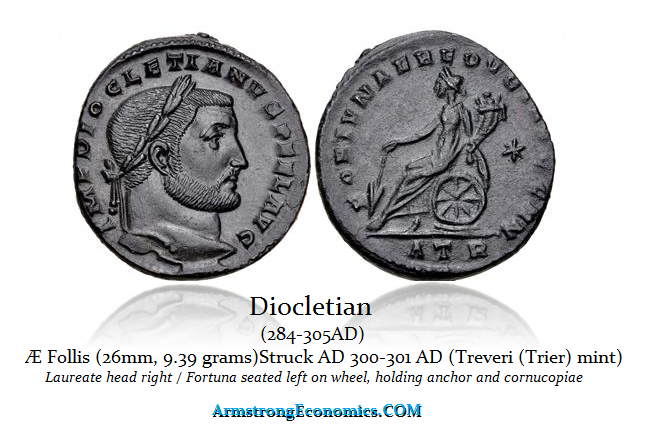
When Diocletian (284-305AD) reorganized the coinage when he came to power as well as the political structure of the Roman Empire. With respect to politics, he divided the empire in two creating two emperors with their eventual successors given the rank of Caesar. This became the Tetrarchy.
The monetary reform introduced the new bronze coinage silver plated known as the follis terminating the radiate antoninianus which had begun as a double denarius during the reign of Caracalla (198-217AD). Diocletian required each mint to engrave their coins with an identifiable mint mark, and also letters or marks to indicate the individual workshops (officina) within the mints. Thereby, any collusion to debase the coinage would be identifiable to a specific group within each mint.
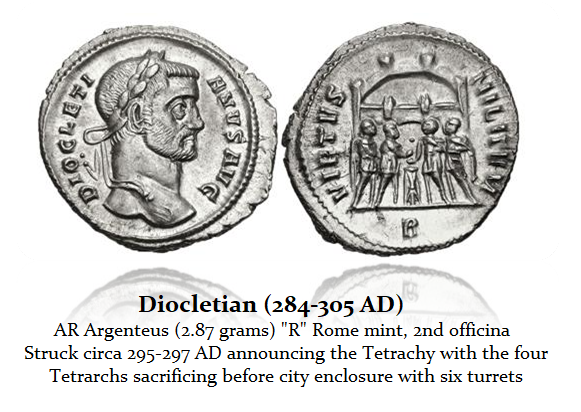
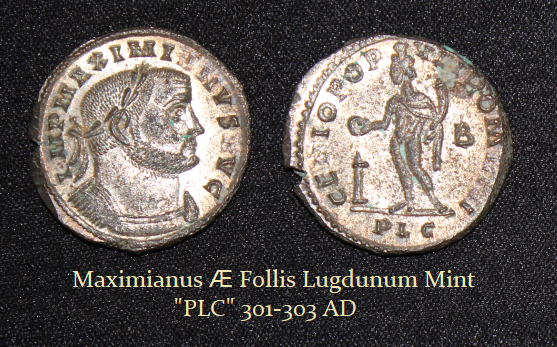
Each mint mark from Diocletian onwards consists of a group of letters identifying the mint (normally in the exergue) and usually (but not always) letter(s) and/or mark(s), sometimes in the exergue, sometimes in the field, These identified the individual workshop within the mint. In the West, workshops were numbered either in Latin numerals I, II, III or in the initial letters of Latin ordinals such as P(rimus), S(ecundus), T(ertius). The problem with Latin surfaced when trying to distinguish between S(ecunda) and S(exta) or between Q(uarta) and Q(uinta). They had to develop in the West a mixed system of Greek and Latin to give P(rima), B, T(ertia), Q(uarta), E, and S(exta) valid meanings. Western mints sometimes used the Greek system at varying times.
Here we can see a silver Argentius (2.87 grams) with the “R” Roman mint mark. Lugdunum used “PL” for their mint mark as illustrated by this follis of Maximianus – Diocletiuan’s co-emperor.
COMMENT: Mr. Armstrong, Now with Switzerland outlawing a cashless society, I understand your point that cryptocurrency is really a dead end. Without power, it cannot exist and as you said in times of war, you take down the power grid and they can do that with an EPM pulse. These Bitcoin zealots are clueless about history and humanity. It’s just another way to separate a fool from his money.
Thank you for the education
BH
REPLY: The whole blockchain was the perfect creation of a totalitarian state. They can trace everything. How would you bribe politicians? It would all have to revert to barter. Do this and I will give you that – off the grid. This is why people are still buying real estate, precious metals, ancient coins, art, collectibles, and various things that are tangible and are thus off the grid.
Having funds in any cryptocurrency is still on the grid. When I was one of the three top market-makers in gold back in the ’70s, the IRS walked in and said they declared me to be a bank. Thus, I was supposed to report every transaction of $10,000 or more. They acknowledged I did not realize I was a bank, so they waived the fines. They seized all my records and went off to audit over 3,000 clients. They claimed that gold was not DEMONETIZED as money, just suspended for a while. I retired because I was supposed to report customers but not everyone else in the field. My lawyers said I could fight it. It would take years. My model warned that gold would decline for 19 years anyway so I choose to retire. The clients still wanted the research and thus Princeton Economics was spun off separately.
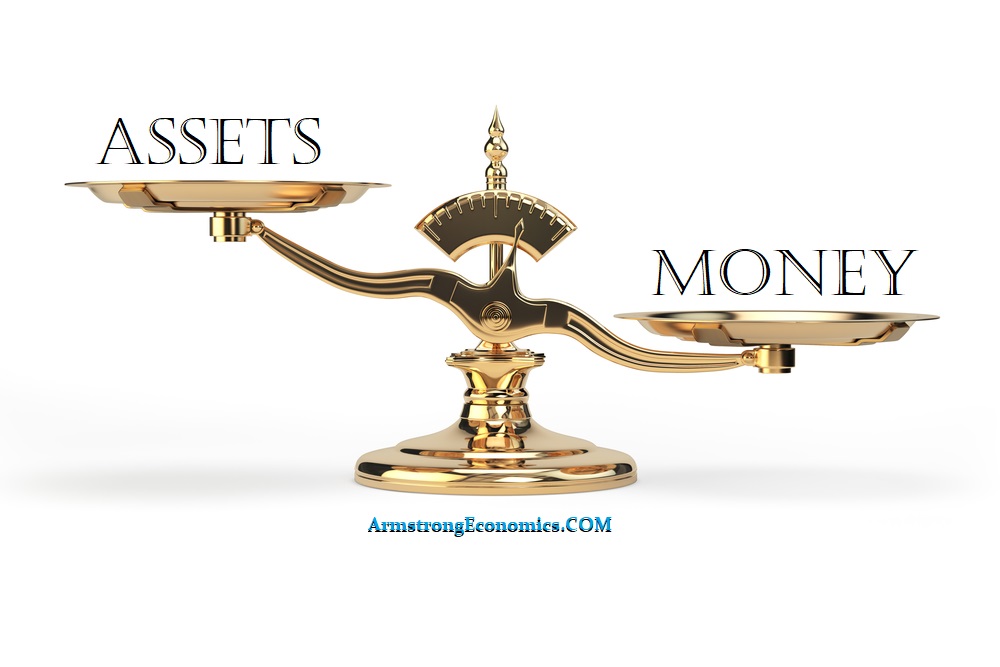
They can declare every person running an exchange in crypto is now a bank and must report every transaction. They can be put them out of business in the blink of an eye. These people have no idea who they are messing with. You will not win. All this is because of their twisted view of fiat money. They no more understand money and assets any more than Karl Marx.
During inflation, assets rise in value, and money declines. That took place during the 19th century when a gold coin was money. MONEY has NEVER been of a constant value – NEVER! These people yelling fiat simply do not comprehend that for thousands of years, there has always been a business cycle and that means money rises and calls in purchasing power REGARDLESS of whatever it has been. The fiscal irresponsibility of governments is well documented throughout history long before paper money.
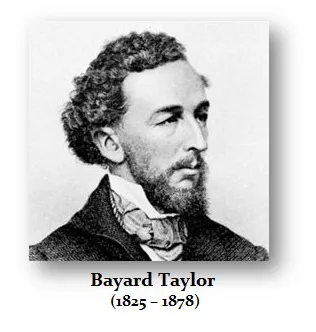
Even under a gold standard, there were periods of inflation and deflation. Read the history of the California Gold Rush. During the 1849 Gold Rush in California, the journalist for the New York Tribune, Bayard Taylor (1825-1878), arrived in San Francisco by ship during the summer of 1849. He was shocked at what he encountered and did not think that anyone would even believe what he was going to write. His dispatches about the gold rush economy in California stunned many and helped to create the 1849 Gold Rush.
The average wage for a laborer in New York was about one or two dollars a day. In California, individual hotel rooms were rented to professional gamblers for upwards of $10,000 a month, which is the equivalent of about $300,000 today. The degree of inflation in terms of gold was astounding and lacks comparison in modern times. There was so much gold, that the value of goods rose even though they did not in New York. The inflation phenomenon was local.
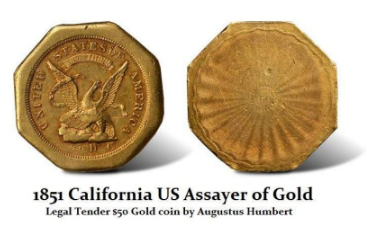
Gold became so common; they were even striking $50 gold coins in California when $20 was the highest denomination elsewhere and $1-dollar coins down to 25 cents all in gold. Eventually, there were $1 gold coins minted in the United States for general circulation throughout the USA. Indeed, Taylor wrote:
“[One] citizen of San Francisco died insolvent to the amount of forty-one thousand dollars the previous autumn. His administrators were delayed in settling his affairs and his real estate advanced so rapidly in value meantime that after his debts were paid, his heirs had a yearly income of $40,000 [$1.2 million today].
“These facts were indubitably attested; everyone believed them, yet hearing them talked of daily, as matters of course, one at first could not help feeling as if he had been eating ‘of the insane root.’”
It does NOT matter what is money. It will always rise and fall as measured against tangible assets as it has done since Babylonian times. In fact, the very first attempt to control inflation, as the central banks are doing right now, were the wage and price controls put in place by the legal codes of the Assyrians and Babylonians.
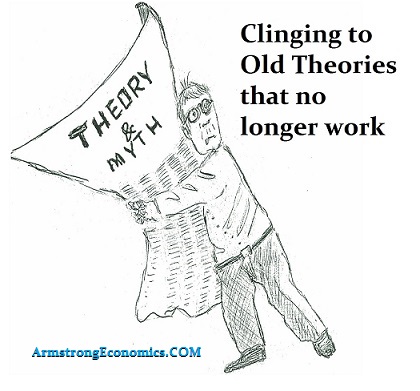
So – stop the BS. Understand that there are times when CASH will be king regardless of what money is at that moment in time, and then it will fall in value when everyone wants tangible assets. There is a business cycle – learn to live with it and we will be better off. The hard-nosed cryptocurrency zealots will never admit they are wrong. They are like politicians and will cling to their theories no matter what evidence you show them.
I asked one once, to name a single period in history where money was constant and never declined in value. He could not!
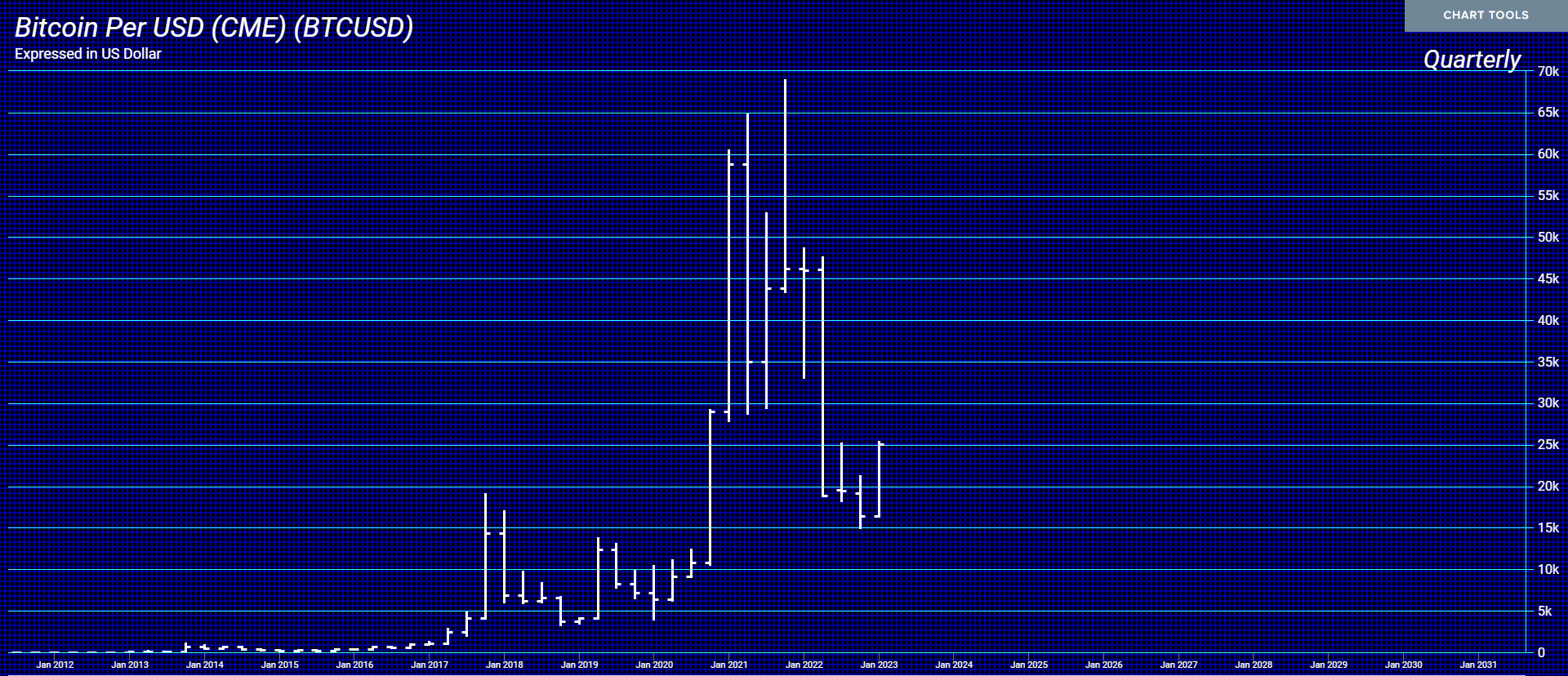
Bitcoin is an instrument for trading. This very chart CONFIRMS it is by no means a store of wealth. It rises and falls like ant commodity of stock. It is still influenced as part of the business cycle. Sorry – there is NOTHING that is a perfect store of wealth. Everything fluctuates. Trade Bitcoin, that is fine. But do not make a religion out of it for you will lose not just your shirt, but your pants as well.
COMMENT: Martin, After several years of reading your blog, I have concluded that Socrates’ prognostications appear to be spot on. I also share your assertion that a study of history supplies an insight into future events due to the constancy of “human nature.” Where we appear to part ways is in the definition of “money.”
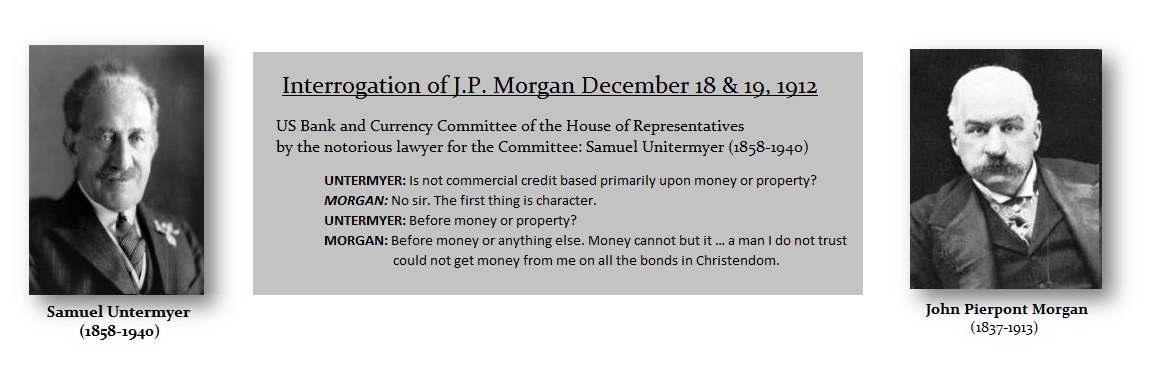
In the early 20th century J. P. Morgan said: “Gold is money; everything else [used as currency] is credit.” Hence, paper money, (and digital entries in an electronic ledger) when issued by a monopolist i.e. government, inevitably descends to its intrinsic value: zero.
AN
ANSWER: Human society has recorded our monetary history and you should not confuse irresponsible government with what is really money. I have a great deal of Respect for J.P. Morgan. If you asked the question of what is money in a Babylonian, it would be a silver shekel. Even the Bible spoke of weighing the silver and how Judas sold out Christ for a handful of silver coins. To a Greek from Anatolya (Turkey), he would have said it is a stater. To an Athenian, he would say a drachma. A Roman would have replied a denarius. But when Rome was first forming, money had been cattle which became thereafter bronze. Indeed, if you had asked before all of them, a Minoan, would have it was bronze. Money has been many things including sea shells, and cattle.
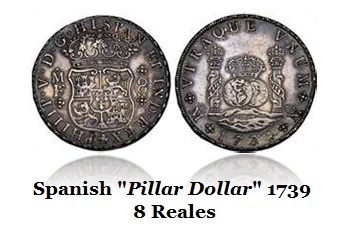
A Spanish during the 15th century would have said it was a one-ounce silver reale. The German would have said no – it’s the silver thaler. The British would disagree and said it was the pound sterling (.925 silver). The Americans, not wanting to be subservient to England, adopted the dollar, which was a version of the German thaler. In Asia, it was the cash, then the yen.
Saint Patrick in the 5th Century AD upon his arrival in Ireland, found that MONEY was expressed in human slave girls. He wrote in his Confession,“I think that I have given away to them no less than the price of fifteen humans.” This passage shows something very important. First, MONEY is not defined as the Medium of Exchange exclusively. It also serves the purpose of a Unit of Account. In fact, this becomes the true function of MONEY even more so than what it is. MONEY is a language of value.
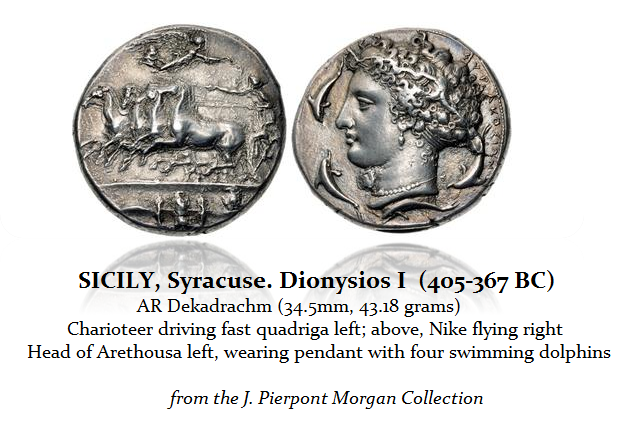
Many of the major bankers, kings, and heads of companies were ancient coin collectors including President Teddy Roosevelt. JP Morgan understood banking and credit – but not money. This was a Syracuse Dekadrachm of Dionysios I (405-367BC) was one of the coins from his collection that was eventually sold by the coin firm Stacks of New York in September 1983. You can download that catalog. People like Josiah K. Lilly Jr. and Paul A. Straub donated their collections to the Smithsonian.
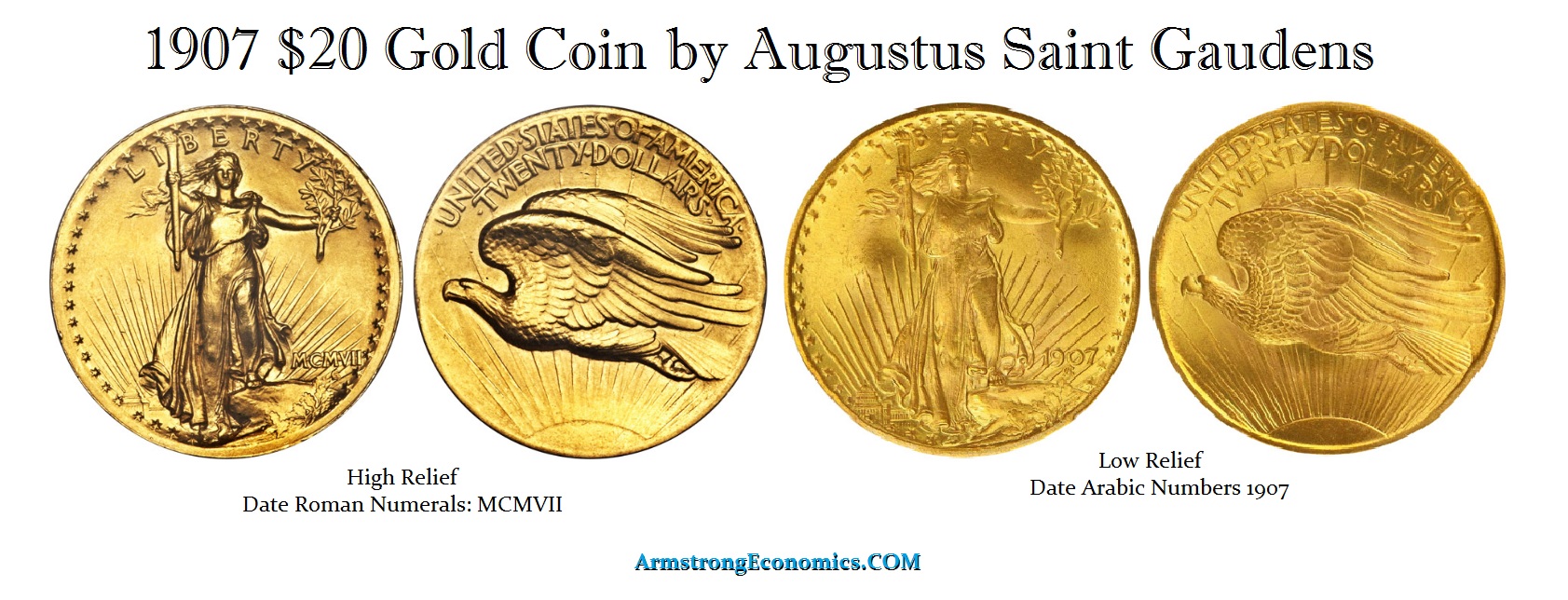
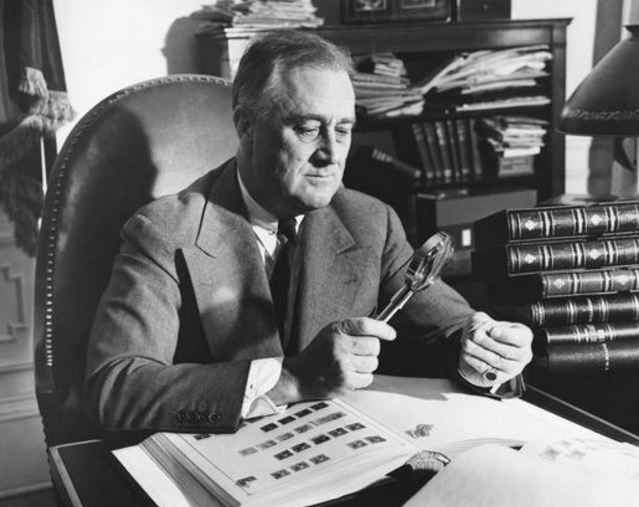
Teddy Roosevelt (1858-1919) loved the high relief of ancient Greek coins. When Teddy Roosevelt became president on September 14, 1901 – March 4, 1909, he commissioned the artist Augustus Saint-Gaudens (1848 –1907) to redesign the $20 gold coin and made it high relief as the ancient coins had been struck. The machines could not handle the high relief for the dies would break and they lacked the power of an individual stamping out coins. Thus, the new $20 gold coins had to be reduced in their relief. Nevertheless, we have ancient coins to thank for the limitation on the confiscation of gold in 1934. It was that very reason that his cousin FDR exempted ancient gold coins from confiscation when FDR was himself a stamp collector instead.
I would say the problem here is the definition of money and what predates coinage was the development of a weight standard to enable trade. That invention of weighing technology appears to emerge around 3100 to 3000 BC. This was the most significant turning point in monetary history for it marked the beginning of economic history itself.
It was private merchants during the Bronze Age that created the weight systems. Trade took place through informal networks, but it was clearly Mesopotamian merchants who established a standardized system of weights that later spread across the Western region and into Europe. This innovation enabled international trade across the continent. By the second millennium BC, merchants could potentially trade anywhere in Western Eurasia simply by knowing the conversion factors of a multitude of local weight units. What was emerging was the formation of weight systems that was the foundation for the booming commercial interaction of the Bronze Age world.
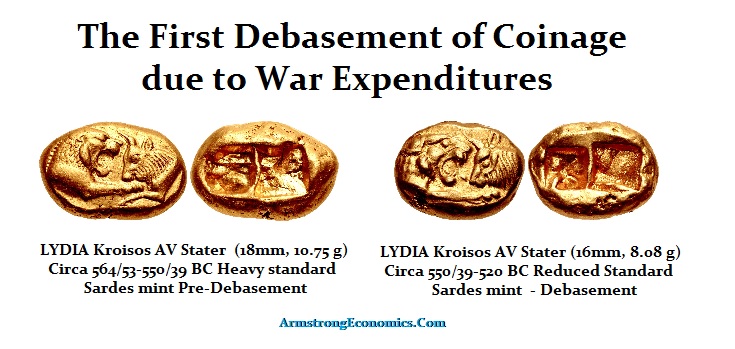
From the very beginning, MONEY has been a commodity – nothing more. It simply began a barter. I will give you these carrots for potatoes. When the Lydian King Kroisos (561-546BC) created the first bimetal monetary system, a gold stater was about 10.71 grams and the silver-gold ratio was 13.33:1 because gold was common in the Turkey. The inflation caused by war led to a gold weight reduction to 8.71 grams. Fiscal mismanagement existed from the very beginning. This would have been no different than FDR revaluing gold in 1934 from $20.67 to $35 per ounce.
There were competing standards from the very beginning. The Lydian/ Milesian standard began with an electrum stater at 14.2 grams. The stater as minted under the Euboic Standard was 17.2 grams of electrum. There was the Phokaic Standard placing the electrum stater at 16.1 grams. Obviously, foreign exchange dealers became necessary for international trade among the city states.
I can find no evidence of a single standard that dominates the nations at this time. By 530BC, the invention of coins spreads to Greece and now the first city state begins to strike a silver stater at 12.6 grams – the Isle of Aigina. In Greece, silver was common and gold was rare.
In Athens they established the Attic Standard based on a silver didrachm (2 drachms) of 8.6 grams, but as inflation emerged, the standard coin became the tetradrachms (4 drachms) at 17.2 grams. So you can see there may have been gold and silver used as MONEY, but by no means was there a unified standard agreement as to weight. In Corinth, they set their stater at 8.5 grams and divided it into three drachms. Standardization comes only with conquest as was the case with Napoleon. Athens dominated many city states and in 449BC issued its famous enigmatic “Coinage Decree” promulgated by Perikles that restricted other city states from striking coins making their coins a single currency. Perhaps it was just a power play. On the other hand, it was most likely just the profit earned over the raw metal cost known as seigniorage. In other words, the coins once minted purchased more in goods than the raw metal.
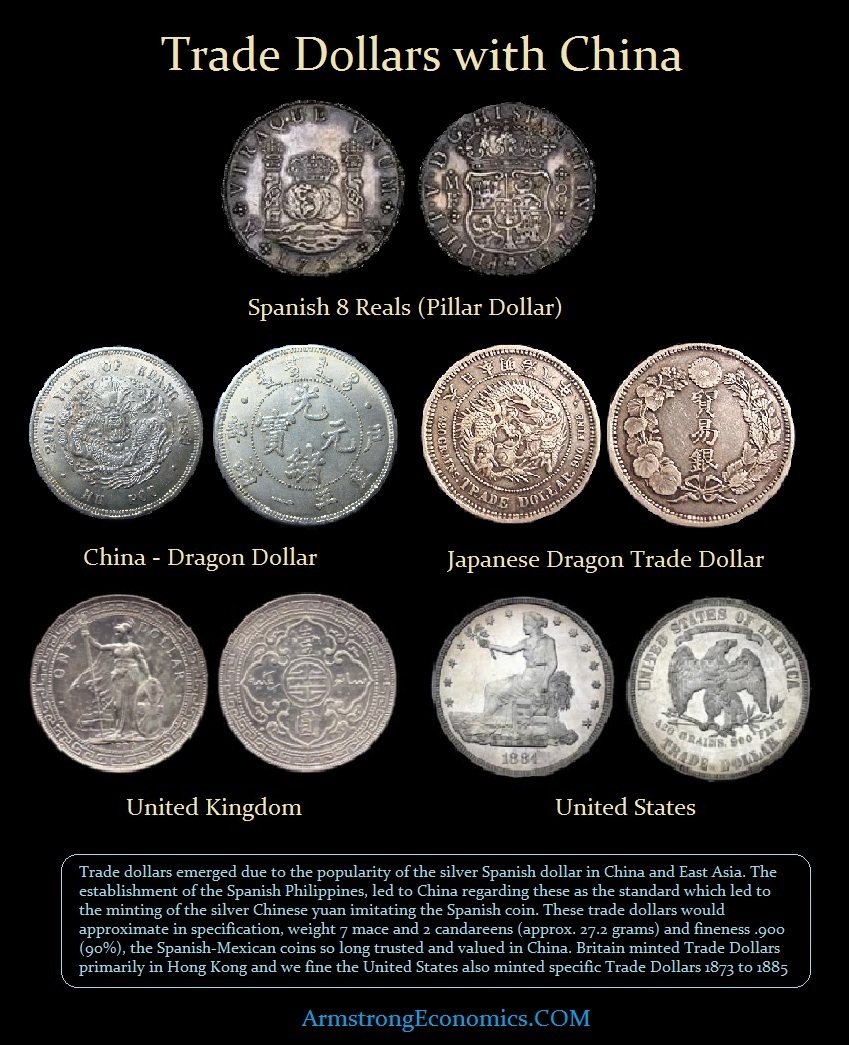
China did not use gold. They had a silver standard. The West had to create silver trade dollars set to their weight standard, which was heavier than the standard United States silver dollar. There have been different monetary systems throughout world history. They have not all been based on precious metals. What it always boils down to is the capacity of the people to produce. There are plenty of places with natural resources and the countries are barely even 3rd world. China, German, and Japan rose from the ashes without gold. Their people produced and they rose to the top of the list of economies despite others having gold.
The bottom line has always been that the wealth of a nation is nothing more than they total productivity of its people.
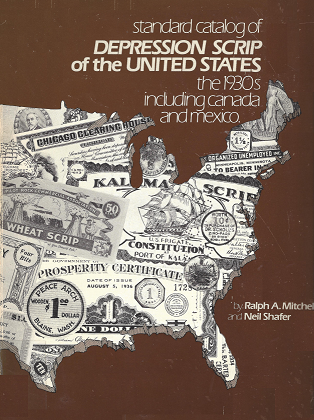
QUESTION: At the WEC, you said as the nation breaks apart, the most likely course of action will be the creation of local currencies. You also said you would post a catalog of Depression Scrip. I have not seen that. Can you post that, please?
Thank you for a great WEC. Always learning something new.
GJ
ANSWER: Sorry. I may have forgotten to publish that because I searched Amazon and could not find it. It was published back in 1984. Because Depression Scrip is not a huge field of collectors largely because most have never heard of the existence of private currency during the Great Depression, this book is quite rare. You may find some used copies that go for $125 or more.
I have studied the subject from the standpoint of economics. During the reign of Tiberius (14-37AD), he was very frugal and as such there was a shortage of money which led to a Financial Panic in 33AD. During such periods, private money surfaces as a necessity. This is why history repeats because human nature never changes. It will always respond the same way.
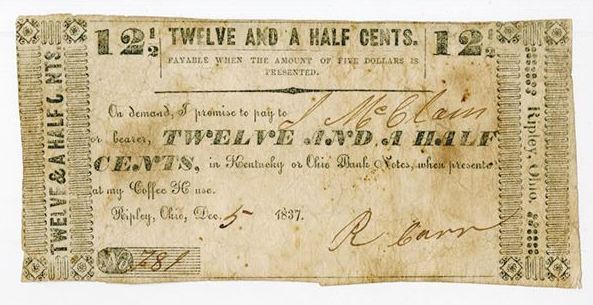
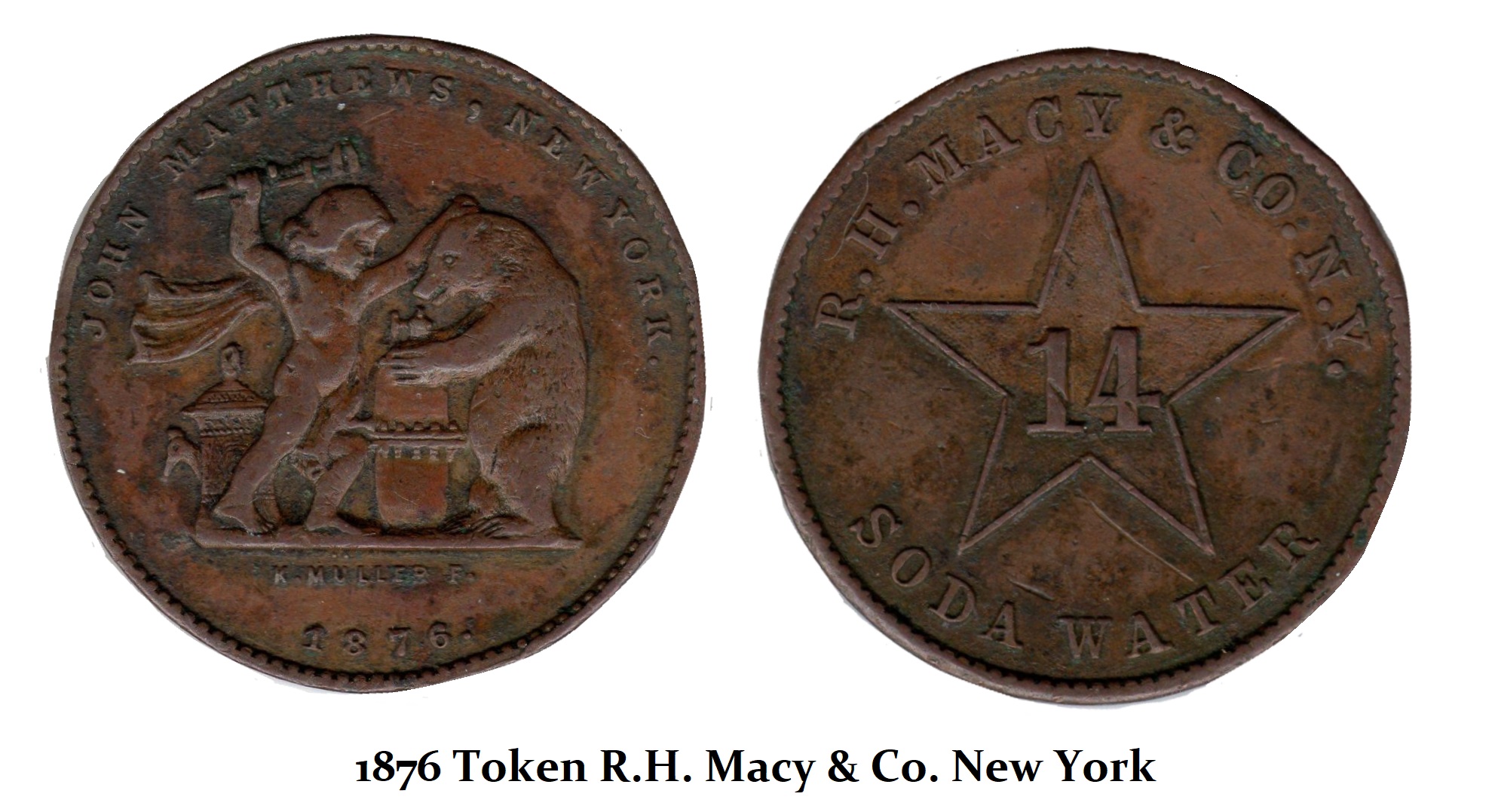
Here is private money from the Panic of 1837. The denomination reads 12 1/2 cents. This was issued by a Coffee House. Here is a half-penny issued by the New York store of Macy’s in 1876 following the Panic of 1873.
Throughout history, we see the very same reaction each and every time. I have collected a large number of private currencies covering the various financial waves of panic since Roman times. It has been a critical part of being able to forecast what takes place during these events. The common denominator is always humanity since we never change for thousands of years. We only progress in terms of technology – not our human emotions.
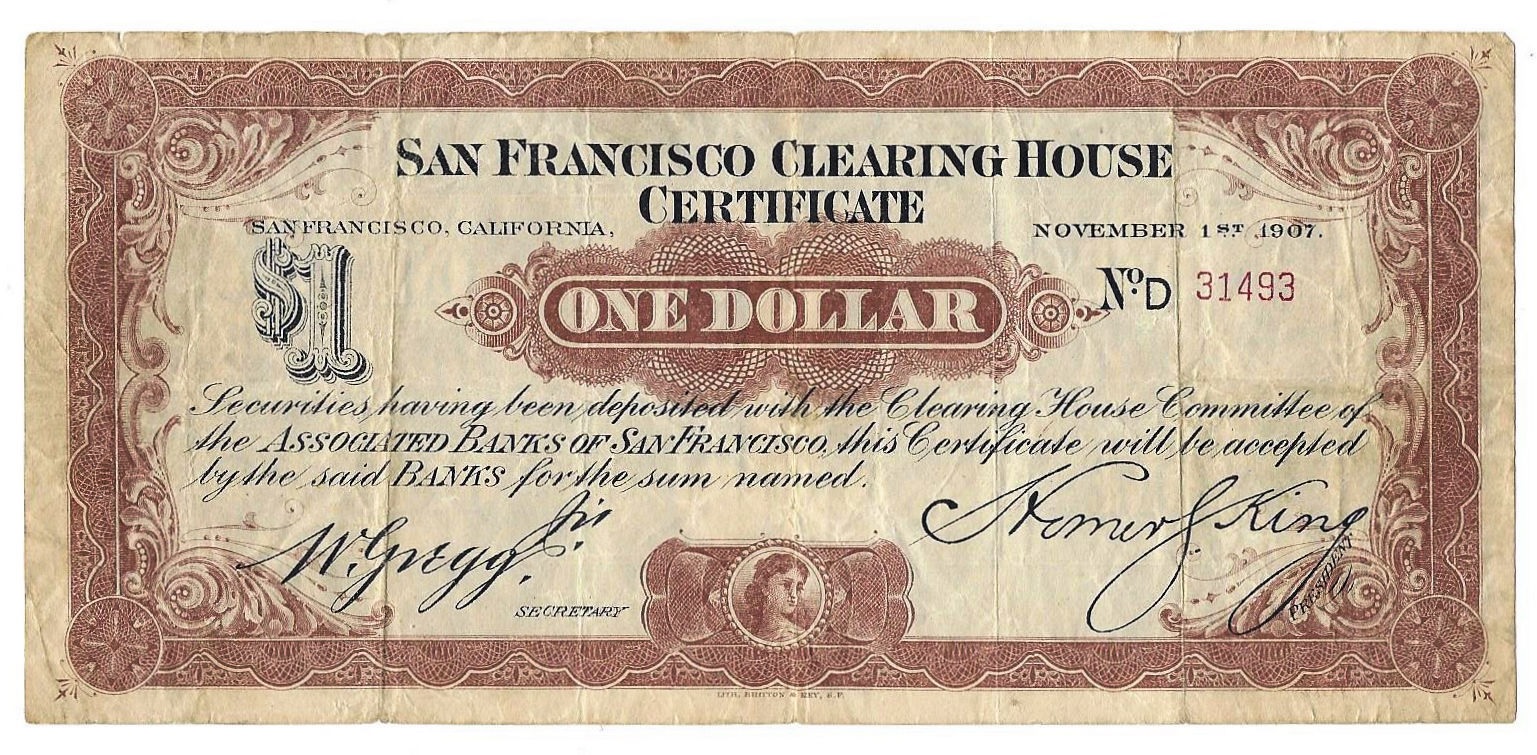
Here is private scrip issued by the San Francisco Clearing House where transactions were settled in the bond and stock markets. The backing was the private shares in companies. This was the Panic of 1907.
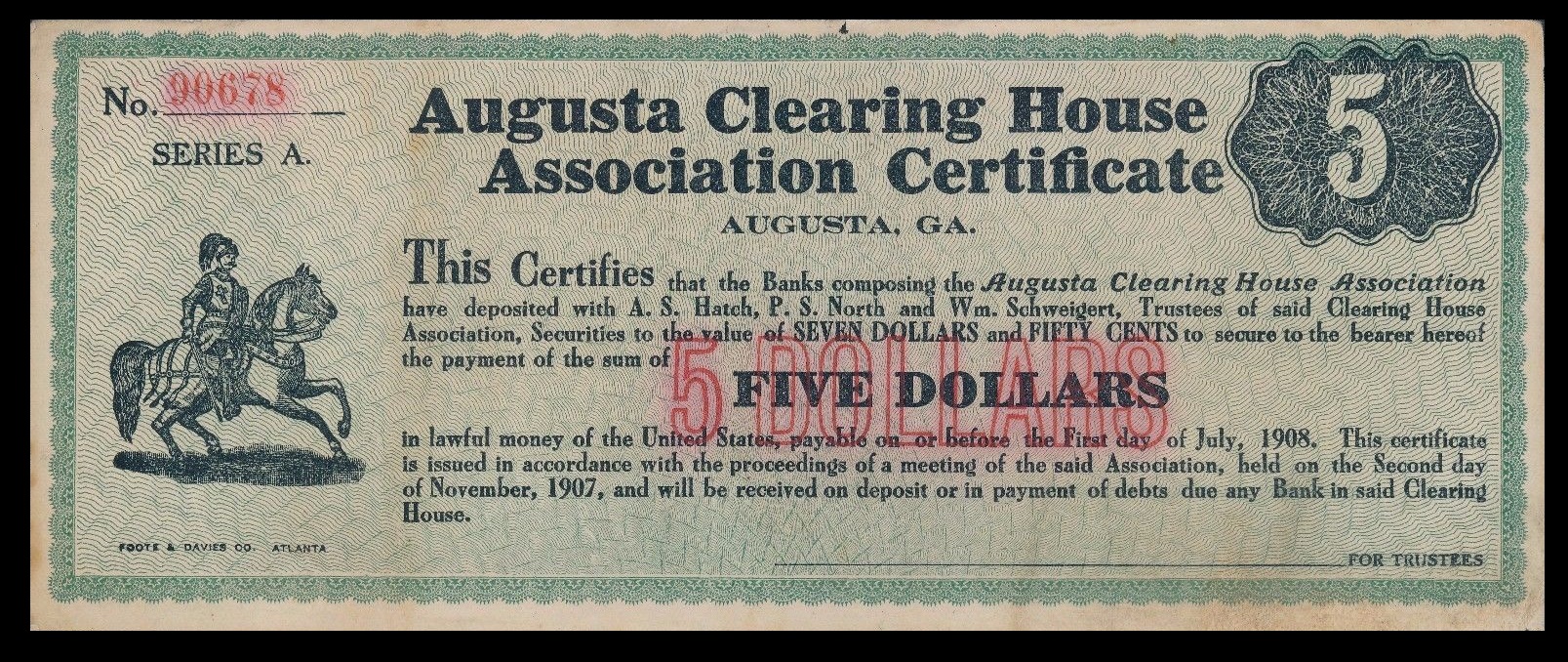
Here is another issued in 1908 in Augusta, Georgia. It was the Panic of 1907 that really we began to see widespread stock exchanges issuing money that began because if there was a shortage of cash, you could not conduct any business whatsoever since it was impossible to pay.
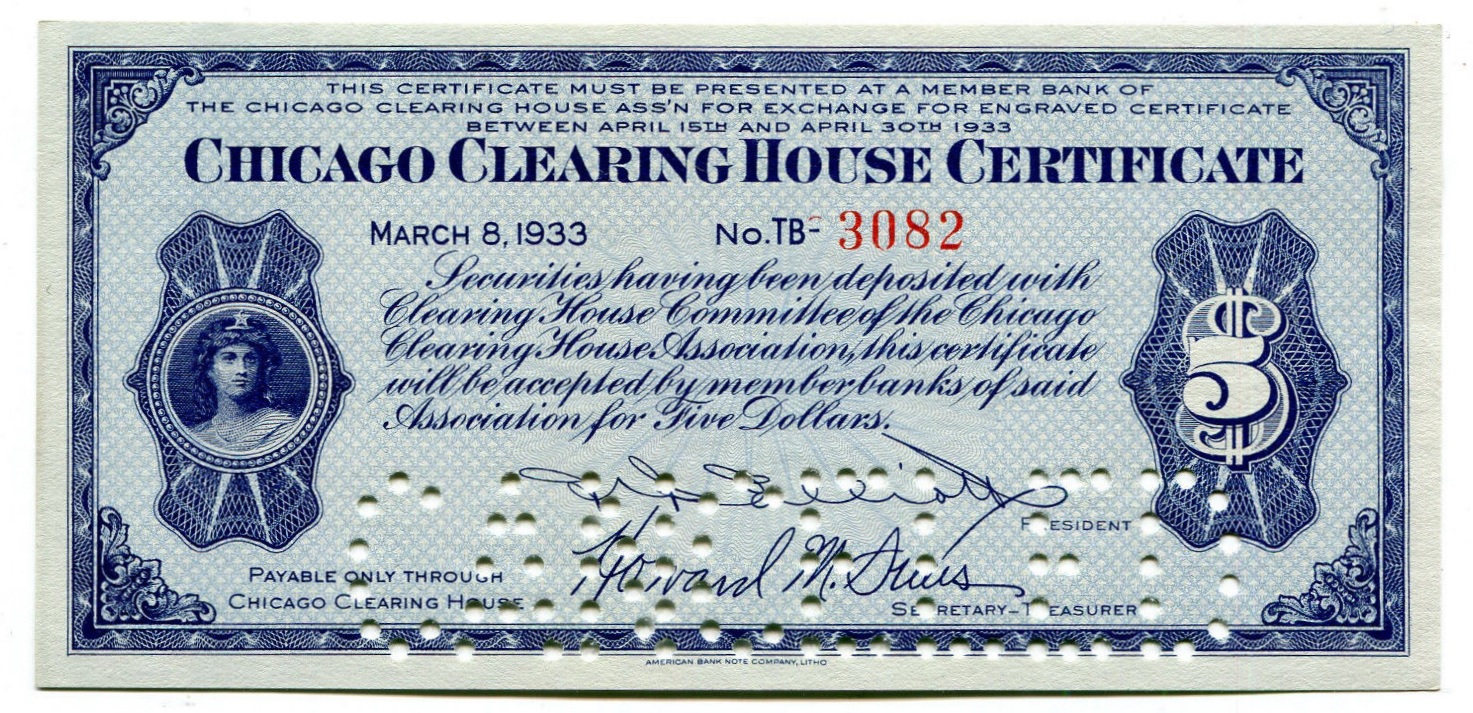
Here is the Chicago Clearing House which issued private money during the Great Depression in 1933. We find various stock exchanges issuing private currency in times when there was a shortage of money because people were hoarding their cash in times of uncertainty.
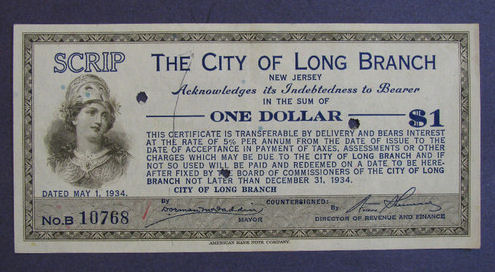
This was the very first Depression Scrip I ever saw and immediately purchased it. This opened the door in economics for me to understand how things function during a great crash. What took place during the Great Depression was that there was such a shortage of cash, over 200 cities began to issue their own currencies just to enable transactions to take place. Businesses could not hire people because there was no available cash to pay them
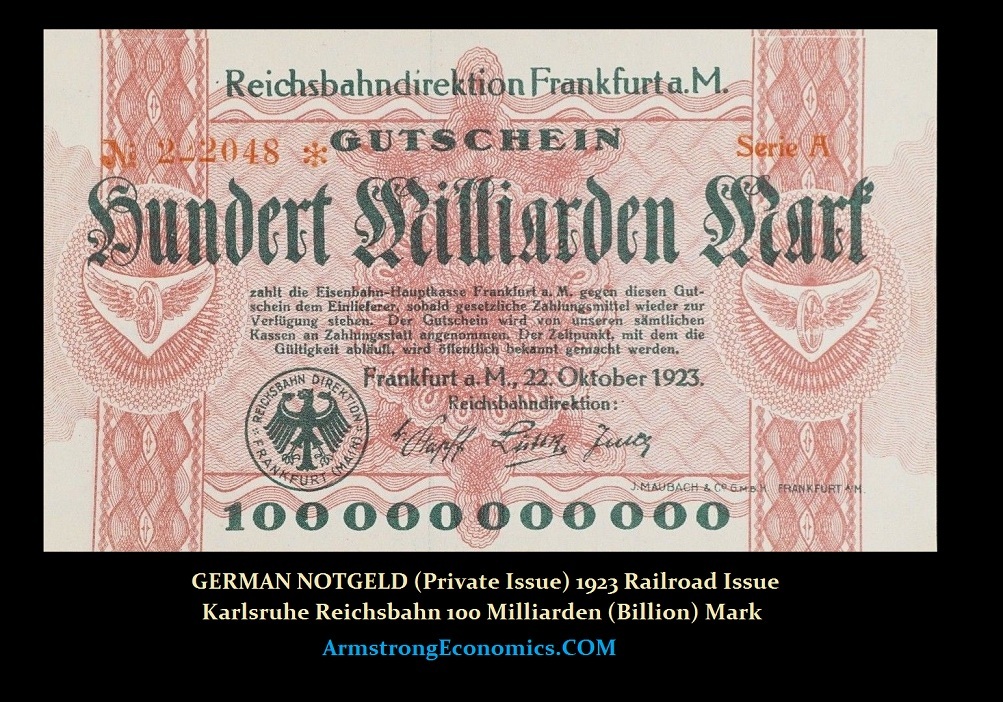
There are catalogs available in German concerning the NotGeld, private issues of currency, during the Hyperinflation of the 1920s. Once again, it does not matter what nation or culture. The same human response will unfold every time.
As the United States breaks up, as is the case in Europe, we will see currencies appears on a regional basis. This is how it will always work. I spent more than two decades investigating these trends and collecting scrip from all financial crises going back to ancient times. Without access to these examples, there is just no economic historical account that has ever tied all of this together. I had to explore this all on my own.
QUESTION: Marty, Ever since the debacle in London with the long-term debt, there have been whispers in NYC about how the demand for long-term is drying up. When this becomes critical, is that when the whole thing comes crashing down?
KW
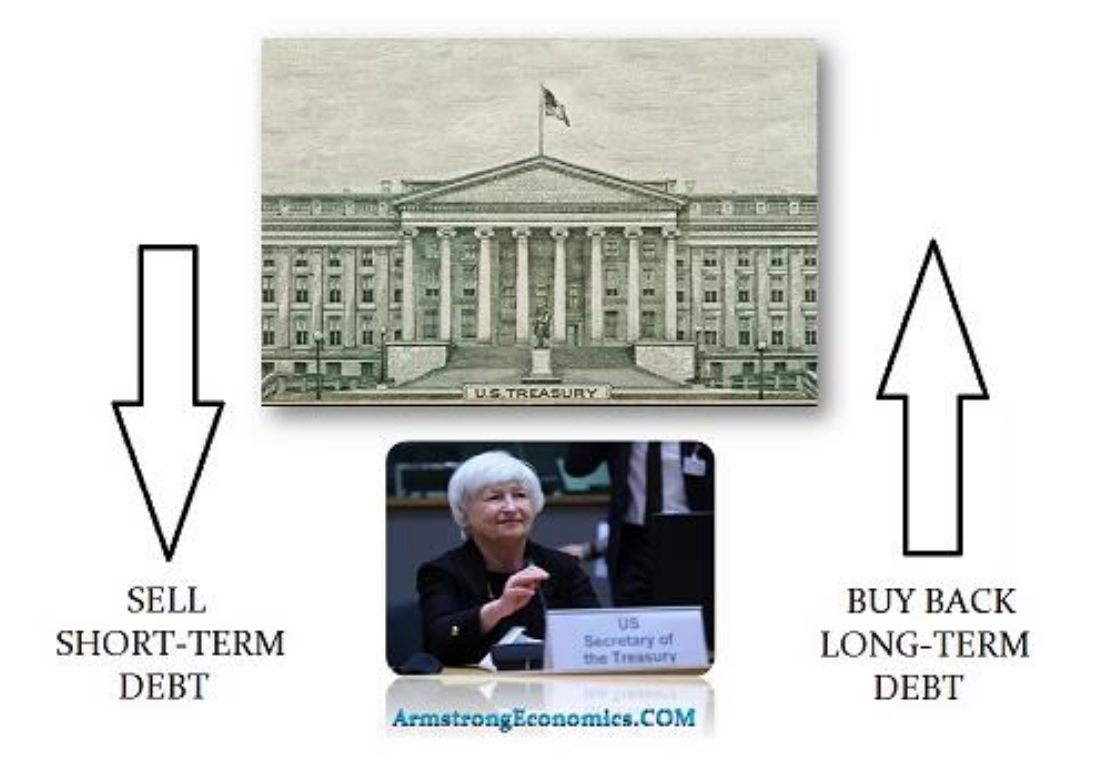
ANSWER: That was the real gist of Yellen’s speech back in October of 2022. Of course, the US press will never elaborate on this problem until it smacks them in the face. Yellen publicly admitted that the Treasury asked the primary dealers of US government debt for their views on the merits and limitations of a buyback program. The Treasury Borrowing Advisory Committee, made up of market participants, highly recommended considering the move because the demand for long-term was declining.
Yellen herself publicly acknowledged the decline in trading volume in 20-year bonds, which they reintroduced in 2020 thanks to COVID. Quoting from her direct comments:
“The 20-year Treasury is an area, an issue where there’s been less liquidity — but we haven”t made any decisions about it.”
Even the Securities Industry and Financial Markets Association came out and publicly also stated last October that there had been episodes of illiquidity. This was the same problem that created the Crisis in the Long-term British gilt market.
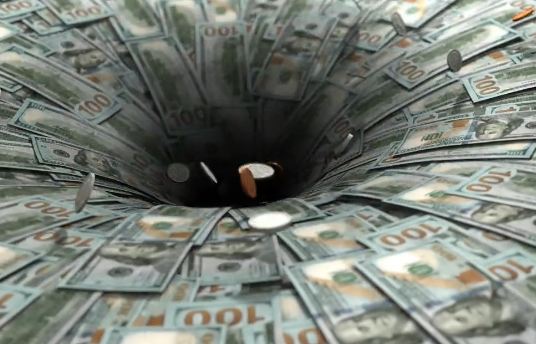
Institutions do not want to buy the long-term in the face of (1) rising interest rates to fight inflation, and (2) unlimited handing of money to Ukraine that will NEVER come back for Ukraine is a black hole and reliable sources are deeply concerned that Ukraine will lose and exist no more.
The escalation in debt on the horizon with World War III is beyond the capacity of the Primary Dealers to buy. They are strained now with the debt expansion for socialism, then Ukraine, and add War, this system is cracking NOW! The Primary Dealers cannot buy more debt than their balance sheets allow. The “whispers” running around have been on the street. The press has not articulated this for (1) it’s above their pay grade to comprehend, and (2) they cannot dare report the truth.
I have created this site to help people have fun in the kitchen. I write about enjoying life both in and out of my kitchen. Life is short! Make the most of it and enjoy!
This is a library of News Events not reported by the Main Stream Media documenting & connecting the dots on How the Obama Marxist Liberal agenda is destroying America



 Centinel2012