
You know something’s wrong when people are publicly villified for offering prayers. Do we really want a godless America?
Tag Archives: centinel2012
Crossing the Rural/Urban Divide
State-Run Funds v Private – Why Politicians Cannot be Trusted with Investments/Pensions
Armstrong Economics Blog/Pension Crisis
Re-Posted Mar 10, 2018 by Martin Armstrong

QUESTION: Dear Mr. Armstrong: Many times you were warning about CalPERS. What is your scope on 401k via employers, RothIRA, Simple IRA, and SEP that investing in at Vanguard or Fidelity? Should we continue to contribute? Will these types of retirement plans be in peril as CalPERS ? Can our government get involved in these plans? Thank you very much for your expertise and service.
Best Regards
TN
ANSWER: Actually, the way a liquidator would view the task would be – if the funds were deployed into an asset (Vanguard or similar fund) then it is the “clients/accounts money” and not the institution! Therefore, the investment would hold better regulatory standing than if the funds were deployed rather than simply sitting in cash held by CALPER’s!
Additionally, a major fund such as Vanguard or Fidelity would defend their business in court if a state dared to try to seize it. The likelihood of that type of action being successful is somewhere BELOW -1%. The only was a Vanguard or Fidelity would be at risk is should the FEDERAL government go after it – not a state. Again, the likelihood of that is not very high and I would put that at a 15% chance. That would be the type of action taken by a Democrat under the pretense that they are going after the evil rich. But keep in mind, Democrats boast but behind the curtain, they are loading the trunks of their cars with as much loot as they too can carry off. That type of action would be in a major economic crisis that would threaten their political standing.
The bottom-line is that a private fund is FAR SAFER than a state-run fund. CalPERS is partly in trouble because the politician told it to invest in ENVIRONMENTALLY friendly ventures. So the “political” agenda overruled the economic purpose of actually making money.
Politicians should NEVER control investment decisions – N E V E R ! ! ! ! ! ! ! ! ! ! !
The Economic Confidence Model & Why there are 6 waves
Armstrong Economics Blog/ECM
Re-Posted Mar 10, 2018 by Martin Armstrong

QUESTION: Dear Mr. Armstrong,
Firstly – sorry to hear about the passing of your mother.
Secondly – thank you very much for reading and answering questions.
My question – what is the significance of the six repetitions in the ECM? Six 8.6 years make a cycle and six of these make a larger cycle and then six of these make a super-cycle. Why six? Why not five or seven? Can you explain the significance?
Thank you
g
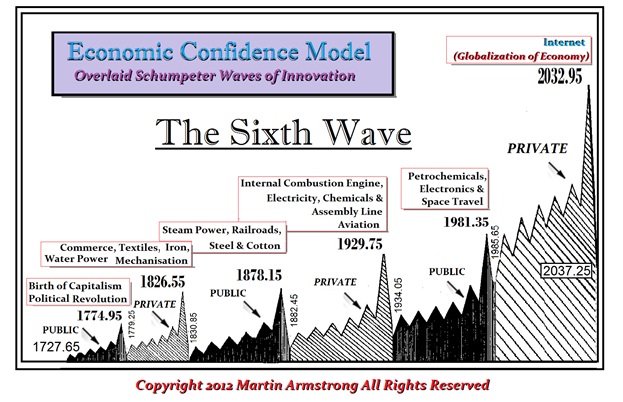
ANSWER: The Economic Confidence Model is actually a three-dimensional wave structure. The volatility is a different frequency and that is what determines the number of 8.6-year waves for this is building in intensity. What you get at the end of these 51.6-year waves is very profound. After the 1774.95 peak, we end up with a revolution against the monarchy. The next wave peak in 1826.55 Russo-Persian War, 1826-1828, Greek War of Independence, Battle of Monte Santiago between Brazil and Argentina, Mexican Constitution is formed, the Maryland Democratic Party begins creating the confrontation between the Democrats and Republicans (South v North), and even Thomas Jefferson and John Adams both died on the 4th of July 1826 (1826.50) whereas the peak of the wave was July 19th. The next wave 1878 saw the Long Depression which was called the “Great Depression” until 1929-1932. Then the next wave was 1981.35 which marked the peak in interest rates even to the day. The next one will be 2032 and this will be followed by the shift from the West to the East in economic power.
The Creature from Jekyll Island – Unprofessional Propaganda Book
Armstrong Economics Blog/Central Banks
Re-Posted Mar 9, 2018 by Martin Armstrong

QUESTION: Martin. Have you read the book Creature of Jekyll Island by Edward Griffin it is about the Feds and how they control? Many years ago I thought it was fiction but after reading it again it is true. My Question what can we do money will be what they want it to be the control?
ST
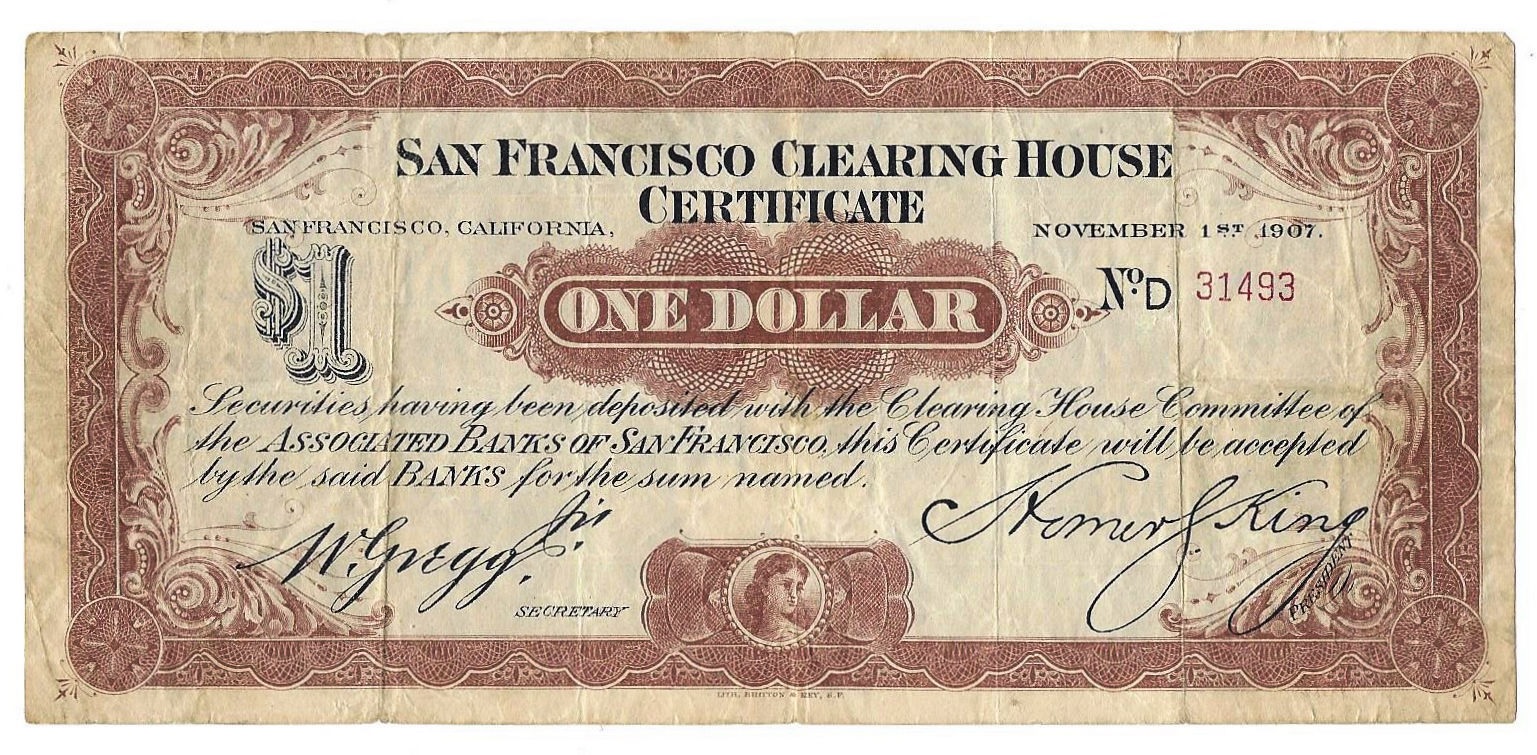
ANSWER: The book you refer to is propaganda. There are quotes in there that he simply made up about the Rothschilds. Go ahead and try and find the source. I have written about this before. That book is highly dangerous for it completely misrepresents and fails to understand that elastic money began in the 1850s and was created privately by clearing houses. It worked perfectly fine and it was not economically disastrous but BENEFICIAL!
The ability to create money by the Federal Reserve is essential. However, that design was directly beneficial for it would buy ONLY short-term corporate paper in a crisis when banks could not lend. Buying in corporate paper saved jobs. The key was a simple fact it was corporate and NOT the government. Corporates have to pay back – the government does not.
It was not that the Fed was evil, it was that the Fed was usurped by Congress during World War I and directed to buy only the paper of the government. It was that aspect that has altered the role of the central bank and is demonstrated who the ECB in Europe now own 40% of all government debt and they cannot stop without creating a crisis.
The Creature of Jekyll Island advocates what Jackson did, and that will lead to a massive Sovereign Debt Crisis among the States and undermined the entire economy both domestically as well as internationally. That is by no means the answer. The answer lies in the curtailment of politicians. The banks owned the Fed BECAUSE it was a bailout system that they paid into. It was never intended that taxpayer money would be used to bail out banks. Once the banks became the seller of government debt, they then had a grip on government and with the Fed only buying government debt, the entire system is nothing like the intended design.
Interbank Market Collapsing
Armstrong Economics Blog/Banking Crisis
Re-Posted Mar 9, 2018 by Martin Armstrong
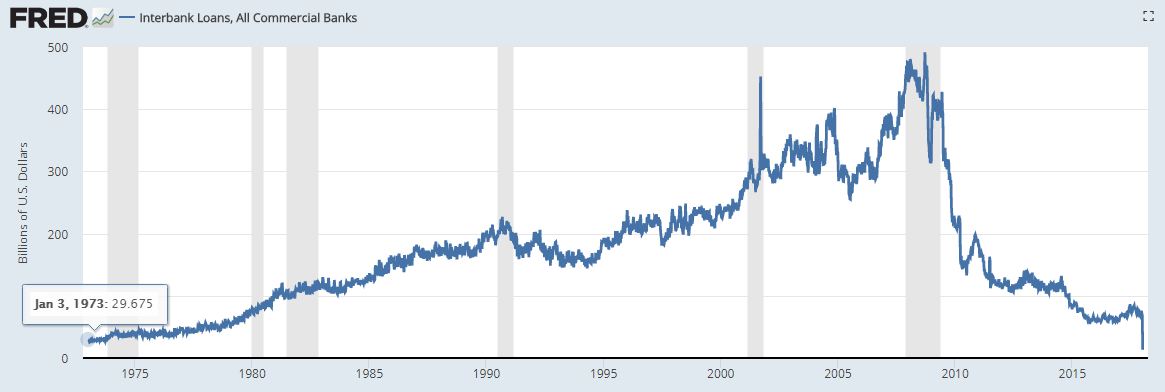
QUESTION: Mr. Armstrong; Has interbank lending collapse due to a lack of confidence concerning counter-party risk?
Thank you for being a rare source with experience
ER
ANSWER: Yes that is a correct statement. The failure of Lehman and Bear Sterns was the result of interbank lending when they could not make good on the collateral they posted the day before in the REPO market. Then we had the collapse of MF Global, which was also a loss linked to the overnight markets. Now mix in the LIBOR scandal and banks were scrutinized for manipulating LIBOR rates in the interbank market.
The interbank lending market is a market in which banks extend loans to one another for a specified term, typically 24 hrs. Most interbank loans are for maturities of one week or less, the majority being overnight. Such loans are made at the interbank rate (also called the overnight rate if the term of the loan is overnight).
The collapse of this market is a clear warning that liquidity is extremely vulnerable. When crisis strikes, liquidity will simply vanish entirely. This warns that volatility will rise sharply and it appears to be predominantly focused in on the debt market.
The Analysts Are Turning Back to Bearish Again
Armstrong Economics Blog/Dow Jones
Re-Posted Mar 9, 2018 by Martin Armstrong
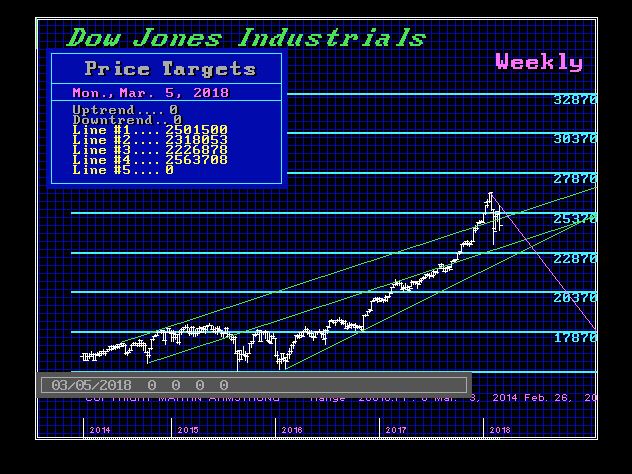
CNN Money is reporting the headline “A top JPMorgan Chase executive is warning that stocks could fall as much as 40% in the next few years.” CNN reports that Daniel Pinto, JPMorgan’s co-president, said on Bloomberg Television he believed that market gains should continue for the next year or two. However, he added that investors were nervous could result in a “deep correction” of between 20% and 40%, “depending upon the market values at the time the downturn starts.”
Indeed, this was the pause we were looking for from January. We did not see a collapse as in terms of 1987. Instead, this is simply the transition period where the marketplace must come to grips with a Sovereign Debt Crisis and that means rising interest rates will devastate the bond bubble. So exactly how does that equate to a 40% decline in equities?
What is clear is that the initial stages of this consolidation period involved the marketplace coming to grips with the shift from PUBLIC to the PRIVATE rationale. In other words, inflation, rising interest rates, the rapid rise in interest rates, explosion in public debt, and the inability of governments to fund their never-ending deficit spending at the federal, state, and local levels. Then as the economy begins to worsen, this will also historically lead to trade wars.
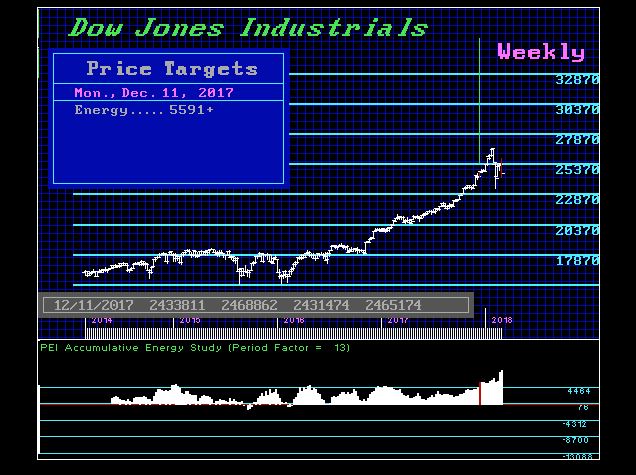
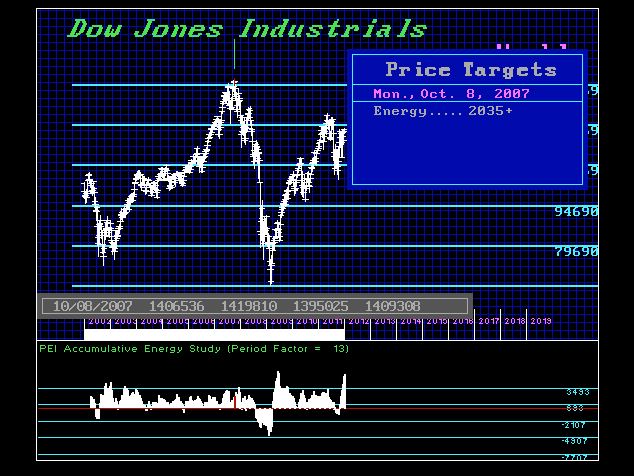
This is good news. We need the majority of analysts to turn bearish in order to restore the upward bias we have enjoyed for the past 8 years. We can see that our Energy Models are not in a position for a major high. They have been rising, not declining as new highs were made. This strongly suggests we will still see higher highs in the years ahead. The more analysts we get back to bearish, the strong the breakout to the upside later on.
Lativa Banking Crisis Unfolding on Schedule – Will May Be a European Contagion?
Armstrong Economics Blog/Banking Crisis
Re-Posted Mar 8, 2018 by Martin Armstrong

The Latvian Financial Supervisory Authority is concerned announcing a resolution plan for the crisis bank ABLV that is threatening a contagion risk of further closures of financial institutions in the country with a predominantly foreign customer base. There is a serious risk of a contagion unfolding that will also force consolidation and mergers in the industry as a whole. The financial system of the Baltic country has seen a run with customers withdrawing about 500 million euros in deposits in recent weeks. There are about ten banks in Latvia who have been serving primarily foreign customers. Concerns and a decline in confidence unfolding in Europe as a whole over the banking system as a whole may force a change in the business model of Latvian banks where they must return to a reliance upon domestic deposits rather than foreign.
Latvia’s third largest financial institution, ABLV, is about to collapse after being accused by the US of being involved in money laundering by customers from neighboring Russia and Ukraine. The bank denied the allegations but simply making those allegations by New York prosecutors can have a devastating impact upon foreign banks. A run on the bank began after the allegations were made public. The European Central Bank (ECB) came to the conclusion that the bank was facing collapse. The European Agency for the Settlement of Marged Banks (SRB) classified the bank as non-systemically important and left it to its fate. In Latvia, loans are provided mainly by Scandinavian banks located in Sweden. Many Latvian banks have specialized in financing themselves mainly through deposits of foreigners rather than domestic Latvian citizens. The crisis brewing stems from the fact that about 40% of Latvian bank deposits come from abroad. Allegations of money laundering by the US authorities have been sending foreign depositors into a state of panic.
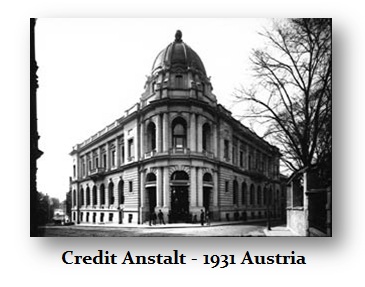
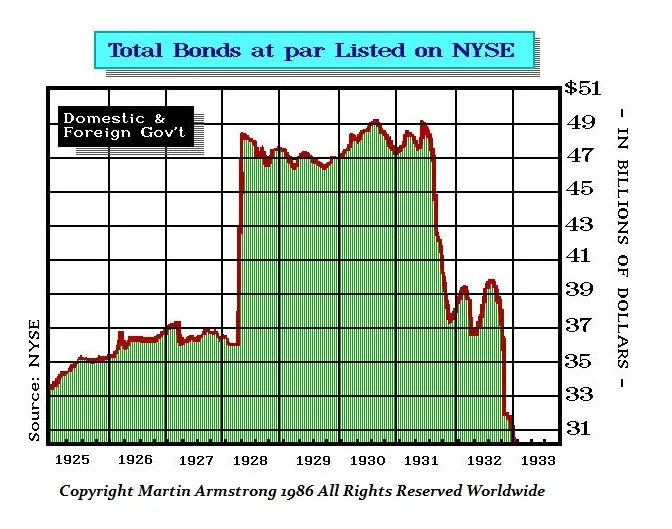 The risk that this presents is self-evident from the Banking Crisis of 1931. The failure of Credit Anstalt, which was partly owned by the Rothschilds, sent a wave of panic throughout the entire banking system. Once the rumor was that the Rothschilds had failed, all banks began to get hit. This resulted in the Sovereign Default of 1931.
We can see here looking at the foreign bonds that were listed on the New York Stock Exchange and how they just defaulted going to zero. Therefore, the question is not whether the Latvian banks are essential to the country, a collapse can still have a profound contagion impact simply because people are losing confidence in the banking system as a whole.
There is no such thing as letting these banks go because they are “not essential” with respect to Latvia.
We are dealing with a matter of PUBLIC CONFIDENCE that is just not something that is very solid right now.
How the Euro Will Be Killed by Politicians
Armstrong Economics Blog/Euro €
Re-Posted Mar 8, 2018 by Martin Armstrong
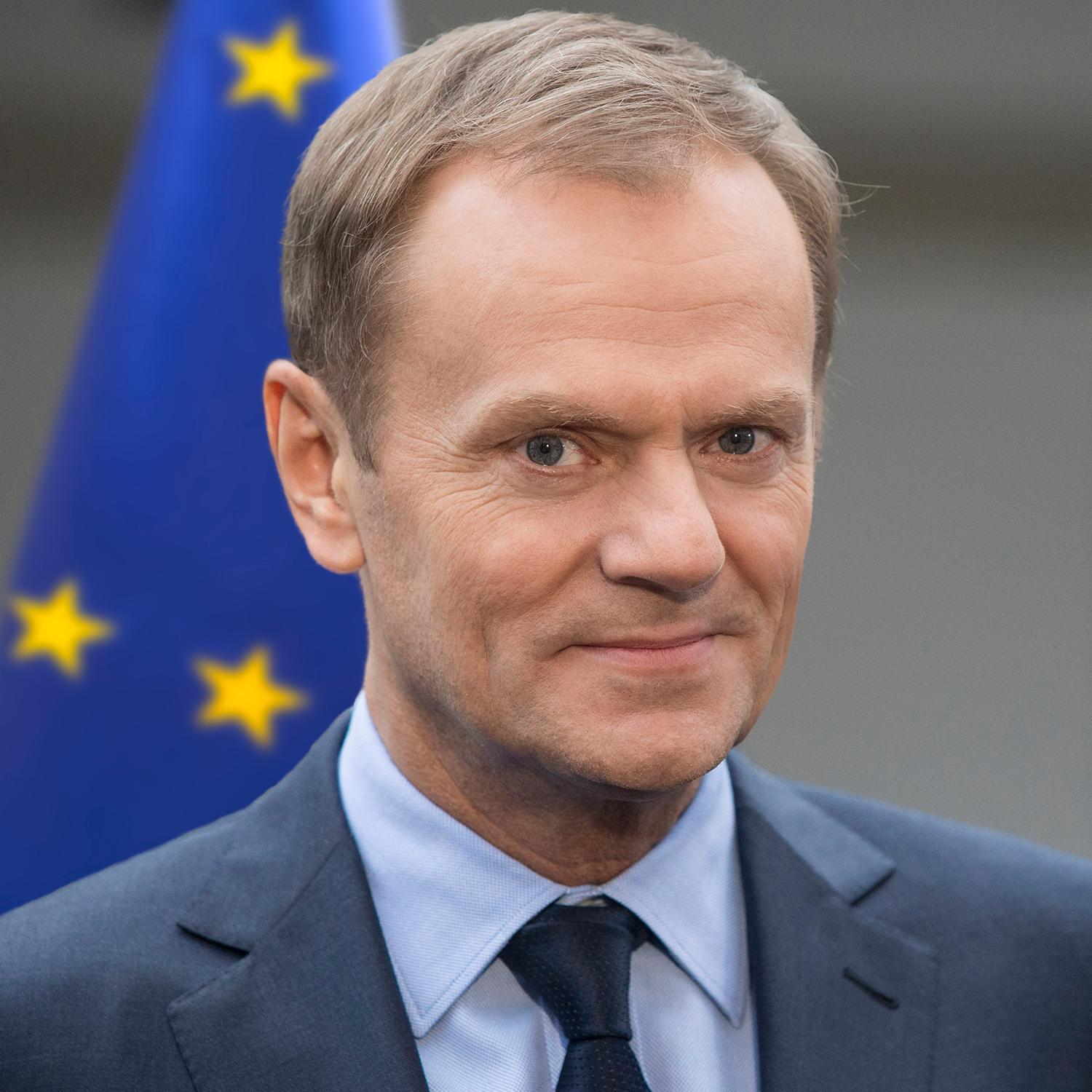 The man who is killing the Euro as a viable currency is none other than Donald Franciszek Tusk who is a Polish politician who has been the President of the European Council since 2014. He is the living example why politicians MUST be prohibited from making any decisions whatsoever regarding economics and finance. These people have ZERO qualifications in the field yet rise to the top of politics and then assume positions based entirely upon politics – not economics.
The crisis that is pending for the Euro is all about political control. The desire of British banks to achieve free access to the European Single Market even after Brexit and this was rejected by the EU. Council President Tusk spoke out against maintaining the British-European financial center in London after Brexit. He fails to comprehend that NEITHER the French nor the Germans possess the infrastructure no less the expertise to maintain global markets in the Euro.
Tusk claims that Britain is trying to be like Norway which has free access but pays dues as a member of the EU for free access. On the other hand, Tusk characterizes British desires and trying to blend the Canadian position, which only has a free trade agreement, with full access like Norway but pays no dues like Canada. Meanwhile, France is taking the position that they want to fill the shoes of the London financial markets who have never been able to create deep markets.
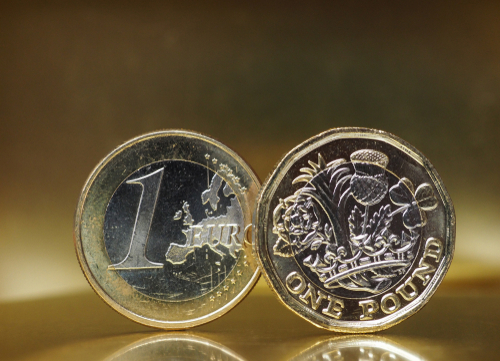 This hardline position against the financial markets of Britain remaining as the core trading center for the Euro is extremely dangerous. The Euro holds a minimal position among the reserves of central banks. The exact composition of the foreign-exchange reserves of China is a state secret. Nevertheless, based upon reliable sources, about two-thirds of Chinese foreign-exchange reserves are held in U.S. Dollars. The rest is composed of Japanese Yen, British pounds with less than 15% residing in Euros.
Brussels is far more interested in punishing Britain than in securing a strong and viable market for the Euro. With respect to a banking center, the primary competitors running second and third are Switzerland and Luxembourg. Never the less, France and Luxembourg are seeking to gain from blocking Britain as they seek to strengthen their positions against Britain. Luxembourg has the EU President Jean-Claude Juncker in their corner, who traditionally has a good relationship with the banks in his home country of Luxembourg. Ironically, while Germany is the largest economy within the Eurozone, by contrast, it relies heavily on trade in goods and financing rather than banking. We have a conflict of interests here where Germany actually need the free market in London for trade deals whereas France and Luxembourg are more interested in capturing business from Britain.
Meanwhile, Brussels needs control so they can maintain the outlawing of shorting government bonds and make no mistake about it, they will prohibit shorting the Euro when it goes against them as well. The danger of politics making the decision over such an issue is that any free market in the Euro will suffer. This is becoming a high stakes financial poker game. Even the President of the Swiss bank UBS, Axel Weber, has come out warning against a withdrawal of the euro clearing from London. “We have to be very careful that we do not shoot any own goals on the subject of Brexit.”
If the EU blocks Britain from euro clearing, this will be the end of the Euro. Politics will present far too great a risk for the Euro to survive going forward.
Canada Covering Up Global Warming Nuts Destroying the Water Supply
Armstrong Economic Blog/Climate
Re-Posted Mar 7, 2018 by Martin Armstrong

COMMENT: When Government turns on its own citizens.
Good day, Martin;
This climate change movement here in Ontario, Canada has gone too far. Construction of windmills in a small farming area has contaminated 16 residential water wells with that destroyed the pumps and piping that feed water to farms rendering property values to almost nothing.
Driving piles into the shale bedrock beneath the sandy soil for the foundation of windmills has disturbed the water sources. The Ministry of the environment has denied the water has been contaminated therefore avoiding an easy fix to install new systems that can easily purify the water. Instead, they will spend upwards of $50 to $100 million in legal battles to sway scientific study and avoid admittance of stupidity.
It’s like a farmer’s Flint Michigan for Canada. The ministry of environment has come out and claimed there is nothing wrong with the water. The citizens formed a group called “Water Wells First” and have been sidelined and lied to. Anyone with any sense could have figured out that if wind and solar electricity production costs are 30 to 80 cents per kilowatt-hour and sold to the public for 12 cents, the difference will be paid by the tax-payer anyway to the tune of hundreds of $millions over 20 years.
Government is contaminated when they protect their own failures and fail to protect the basic property rights of the people.
Thank you;
RH
REPLY: Governments are the worst evil in human society. Whenever they make a mistake, they will NEVER admit it. This is standard procedure in absolutely every department and it is universal infecting all governments worldwide. This is the political nature behind the curtain. Take the Refugee Crisis in Europe. Instead of admitting a mistake, they threaten all governments to take in a portion to lessen their own exposure. As they say, doctors bury their mistakes, but government imprisons theirs and then buries them after years of torture.

